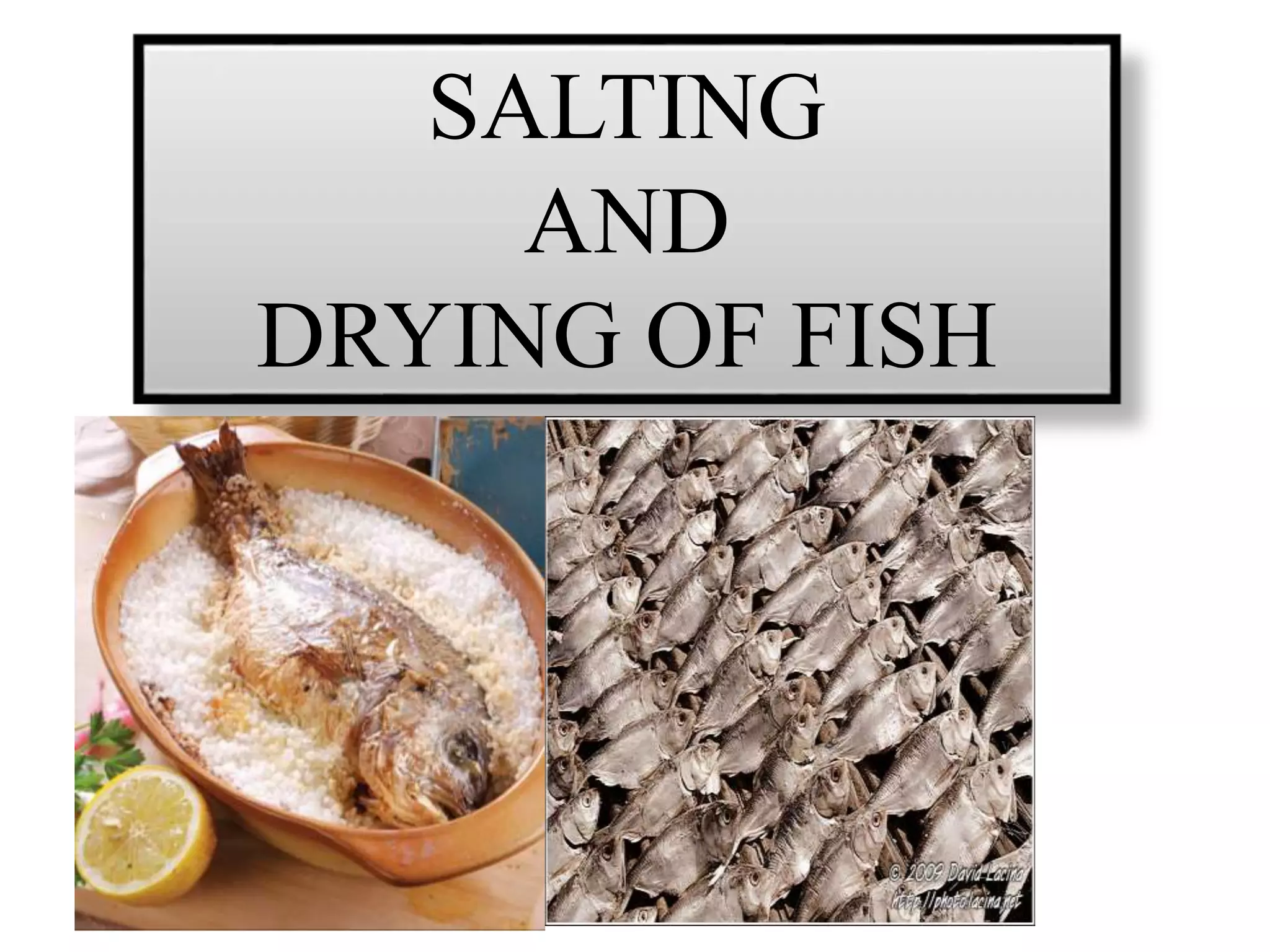
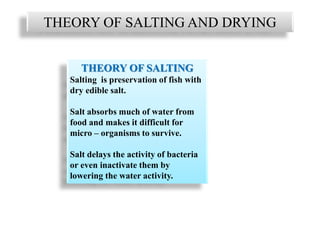
SALTING
AND
DRYING OF FISH
THEORY OF SALTING AND DRYING
THEORY OF SALTING
Salting is preservation of fish with
dry edible salt.
Salt absorbs much of water from
food and makes it difficult for
micro – organisms to survive.
Salt delays the activity of bacteria
or even inactivate them by
lowering the water activity.
THEORY OF DRYING AND
DEHYDRATION
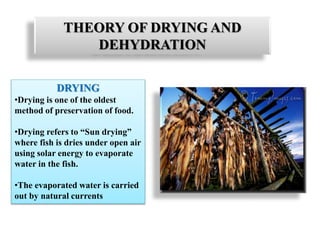
DRYING
•Drying is one of the oldest
method of preservation of food.
•Drying refers to “Sun drying”
where fish is dries under open air
using solar energy to evaporate
water in the fish.
•The evaporated water is carried
out by natural currents
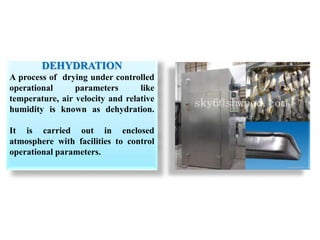
DEHYDRATION
A process of drying under controlled
operational parameters like
temperature, air velocity and relative
humidity is known as dehydration.
It is carried out in enclosed
atmosphere with facilities to control
operational parameters.
METHODS OF SALTING
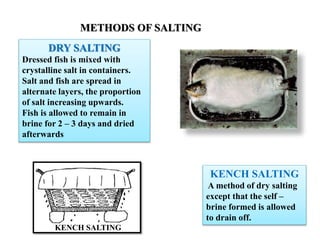
DRY SALTING
Dressed fish is mixed with
crystalline salt in containers.
Salt and fish are spread in
alternate layers, the proportion
of salt increasing upwards.
Fish is allowed to remain in
brine for 2 – 3 days and dried
afterwards
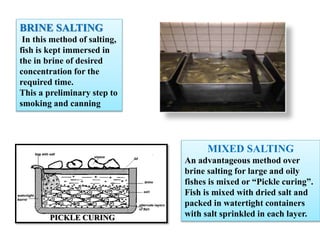
KENCH SALTING
A method of dry salting
except that the self –
brine formed is allowed
to drain off.
KENCH SALTING
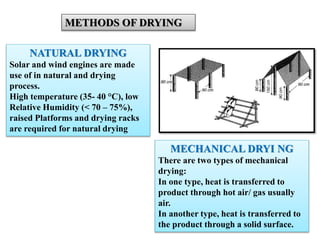
BRINE SALTING
In this method of salting,
fish is kept immersed in
the in brine of desired
concentration for the
required time.
This a preliminary step to
smoking and canning
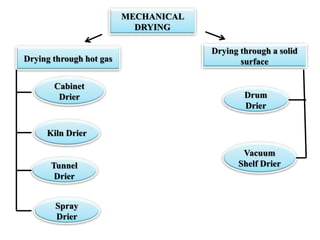
MIXED SALTING
An advantageous method over
brine salting for large and oily
fishes is mixed or “Pickle curing”.
Fish is mixed with dried salt and
packed in watertight containers
with salt sprinkled in each layer.
PICKLE CURING
METHODS OF DRYING
NATURAL DRYING
Solar and wind engines are made
use of in natural and drying
process.
High temperature (35- 40 °C), low
Relative Humidity (< 70 – 75%),
raised Platforms and drying racks
are required for natural drying
MECHANICAL DRYI NG
There are two types of mechanical
drying:
In one type, heat is transferred to
product through hot air/ gas usually
air.
In another type, heat is transferred to
the product through a solid surface.
MECHANICAL
DRYING
Cabinet
Drier
Kiln Drier
Tunnel
Drier
Drum
Drier
Vacuum
Shelf Drier
Spray
Drier
Drying through hot gas
Drying through a solid
surface
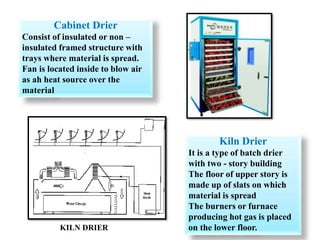
Cabinet Drier
Consist of insulated or non –
insulated framed structure with
trays where material is spread.
Fan is located inside to blow air
as ah heat source over the
material
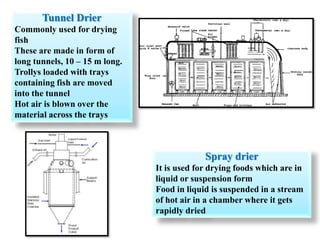
Kiln Drier
It is a type of batch drier
with two - story building
The floor of upper story is
made up of slats on which
material is spread
The burners or furnace
producing hot gas is placed
on the lower floor.
KILN DRIER
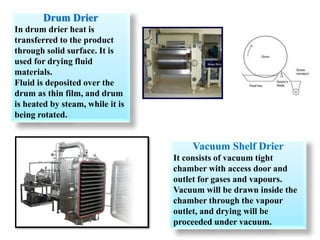
Tunnel Drier
Commonly used for drying
fish
These are made in form of
long tunnels, 10 – 15 m long.
Trollys loaded with trays
containing fish are moved
into the tunnel
Hot air is blown over the
material across the trays
Spray drier
It is used for drying foods which are in
liquid or suspension form
Food in liquid is suspended in a stream
of hot air in a chamber where it gets
rapidly dried
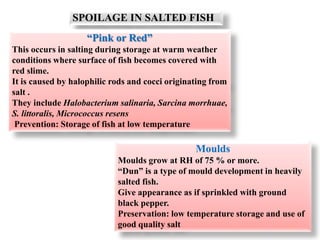
Drum Drier
In drum drier heat is
transferred to the product
through solid surface. It is
used for drying fluid
materials.
Fluid is deposited over the
drum as thin film, and drum
is heated by steam, while it is
being rotated.
Vacuum Shelf Drier
It consists of vacuum tight
chamber with access door and
outlet for gases and vapours.
Vacuum will be drawn inside the
chamber through the vapour
outlet, and drying will be
proceeded under vacuum.
SPOILAGE IN SALTED FISH
“Pink or Red”
This occurs in salting during storage at warm weather
conditions where surface of fish becomes covered with
red slime.
It is caused by halophilic rods and cocci originating from
salt .
They include Halobacterium salinaria, Sarcina morrhuae,
S. littoralis, Micrococcus resens
Prevention: Storage of fish at low temperature
Moulds
Moulds grow at RH of 75 % or more.
“Dun” is a type of mould development in heavily
salted fish.
Give appearance as if sprinkled with ground
black pepper.
Preservation: low temperature storage and use of
good quality salt
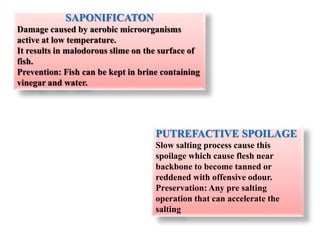
SAPONIFICATON
Damage caused by aerobic microorganisms
active at low temperature.
It results in malodorous slime on the surface of
fish.
Prevention: Fish can be kept in brine containing
vinegar and water.
PUTREFACTIVE SPOILAGE
Slow salting process cause this
spoilage which cause flesh near
backbone to become tanned or
reddened with offensive odour.
Preservation: Any pre salting
operation that can accelerate the
salting
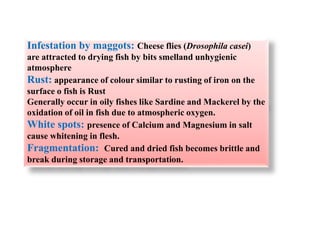
Infestation by maggots: Cheese flies (Drosophila casei)
are attracted to drying fish by bits smelland unhygienic
atmosphere
Rust: appearance of colour similar to rusting of iron on the
surface o fish is Rust
Generally occur in oily fishes like Sardine and Mackerel by the
oxidation of oil in fish due to atmospheric oxygen.
White spots: presence of Calcium and Magnesium in salt
cause whitening in flesh.
Fragmentation: Cured and dried fish becomes brittle and
break during storage and transportation.
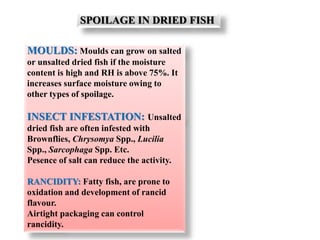
SPOILAGE IN DRIED FISH
MOULDS: Moulds can grow on salted
or unsalted dried fish if the moisture
content is high and RH is above 75%. It
increases surface moisture owing to
other types of spoilage.
INSECT INFESTATION: Unsalted
dried fish are often infested with
Brownflies, Chrysomya Spp., Lucilia
Spp., Sarcophaga Spp. Etc.
Pesence of salt can reduce the activity.
RANCIDITY: Fatty fish, are prone to
oxidation and development of rancid
flavour.
Airtight packaging can control
rancidity.
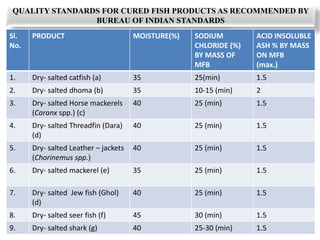
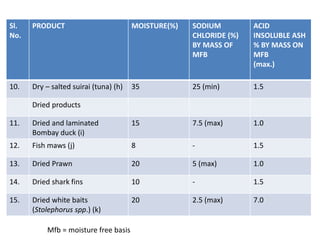
QUALITY STANDARDS FOR CURED FISH PRODUCTS AS RECOMMENDED BY
BUREAU OF INDIAN STANDARDS
Sl.
No.
PRODUCT MOISTURE(%) SODIUM
CHLORIDE (%)
BY MASS OF
MFB
ACID INSOLUBLE
ASH % BY MASS
ON MFB
(max.)
1. Dry- salted catfish (a) 35 25(min) 1.5
2. Dry- salted dhoma (b) 35 10-15 (min) 2
3. Dry- salted Horse mackerels
(Caranx spp.) (c)
40 25 (min) 1.5
4. Dry- salted Threadfin (Dara)
(d)
40 25 (min) 1.5
5. Dry- salted Leather – jackets
(Chorinemus spp.)
40 25 (min) 1.5
6. Dry- salted mackerel (e) 35 25 (min) 1.5
7. Dry- salted Jew fish (Ghol)
(d)
40 25 (min) 1.5
8. Dry- salted seer fish (f) 45 30 (min) 1.5
9. Dry- salted shark (g) 40 25-30 (min) 1.5
Sl.
No.
PRODUCT MOISTURE(%) SODIUM
CHLORIDE (%)
BY MASS OF
MFB
ACID
INSOLUBLE ASH
% BY MASS ON
MFB
(max.)
10. Dry – salted suirai (tuna) (h) 35 25 (min) 1.5
Dried products
11. Dried and laminated
Bombay duck (i)
15 7.5 (max) 1.0
12. Fish maws (j) 8 - 1.5
13. Dried Prawn 20 5 (max) 1.0
14. Dried shark fins 10 - 1.5
15. Dried white baits
(Stolephorus spp.) (k)
20 2.5 (max) 7.0
Mfb = moisture free basis
Thank You

10560723.ppt

  • 1.
  • 2.
    THEORY OF SALTINGAND DRYING THEORY OF SALTING Salting is preservation of fish with dry edible salt. Salt absorbs much of water from food and makes it difficult for micro – organisms to survive. Salt delays the activity of bacteria or even inactivate them by lowering the water activity.
  • 3.
    THEORY OF DRYINGAND DEHYDRATION DRYING •Drying is one of the oldest method of preservation of food. •Drying refers to “Sun drying” where fish is dries under open air using solar energy to evaporate water in the fish. •The evaporated water is carried out by natural currents
  • 4.
    DEHYDRATION A process ofdrying under controlled operational parameters like temperature, air velocity and relative humidity is known as dehydration. It is carried out in enclosed atmosphere with facilities to control operational parameters.
  • 5.
    METHODS OF SALTING DRYSALTING Dressed fish is mixed with crystalline salt in containers. Salt and fish are spread in alternate layers, the proportion of salt increasing upwards. Fish is allowed to remain in brine for 2 – 3 days and dried afterwards KENCH SALTING A method of dry salting except that the self – brine formed is allowed to drain off. KENCH SALTING
  • 6.
    BRINE SALTING In thismethod of salting, fish is kept immersed in the in brine of desired concentration for the required time. This a preliminary step to smoking and canning MIXED SALTING An advantageous method over brine salting for large and oily fishes is mixed or “Pickle curing”. Fish is mixed with dried salt and packed in watertight containers with salt sprinkled in each layer. PICKLE CURING
  • 7.
    METHODS OF DRYING NATURALDRYING Solar and wind engines are made use of in natural and drying process. High temperature (35- 40 °C), low Relative Humidity (< 70 – 75%), raised Platforms and drying racks are required for natural drying MECHANICAL DRYI NG There are two types of mechanical drying: In one type, heat is transferred to product through hot air/ gas usually air. In another type, heat is transferred to the product through a solid surface.
  • 8.
  • 9.
    Cabinet Drier Consist ofinsulated or non – insulated framed structure with trays where material is spread. Fan is located inside to blow air as ah heat source over the material Kiln Drier It is a type of batch drier with two - story building The floor of upper story is made up of slats on which material is spread The burners or furnace producing hot gas is placed on the lower floor. KILN DRIER
  • 10.
    Tunnel Drier Commonly usedfor drying fish These are made in form of long tunnels, 10 – 15 m long. Trollys loaded with trays containing fish are moved into the tunnel Hot air is blown over the material across the trays Spray drier It is used for drying foods which are in liquid or suspension form Food in liquid is suspended in a stream of hot air in a chamber where it gets rapidly dried
  • 11.
    Drum Drier In drumdrier heat is transferred to the product through solid surface. It is used for drying fluid materials. Fluid is deposited over the drum as thin film, and drum is heated by steam, while it is being rotated. Vacuum Shelf Drier It consists of vacuum tight chamber with access door and outlet for gases and vapours. Vacuum will be drawn inside the chamber through the vapour outlet, and drying will be proceeded under vacuum.
  • 12.
    SPOILAGE IN SALTEDFISH “Pink or Red” This occurs in salting during storage at warm weather conditions where surface of fish becomes covered with red slime. It is caused by halophilic rods and cocci originating from salt . They include Halobacterium salinaria, Sarcina morrhuae, S. littoralis, Micrococcus resens Prevention: Storage of fish at low temperature Moulds Moulds grow at RH of 75 % or more. “Dun” is a type of mould development in heavily salted fish. Give appearance as if sprinkled with ground black pepper. Preservation: low temperature storage and use of good quality salt
  • 13.
    SAPONIFICATON Damage caused byaerobic microorganisms active at low temperature. It results in malodorous slime on the surface of fish. Prevention: Fish can be kept in brine containing vinegar and water. PUTREFACTIVE SPOILAGE Slow salting process cause this spoilage which cause flesh near backbone to become tanned or reddened with offensive odour. Preservation: Any pre salting operation that can accelerate the salting
  • 14.
    Infestation by maggots:Cheese flies (Drosophila casei) are attracted to drying fish by bits smelland unhygienic atmosphere Rust: appearance of colour similar to rusting of iron on the surface o fish is Rust Generally occur in oily fishes like Sardine and Mackerel by the oxidation of oil in fish due to atmospheric oxygen. White spots: presence of Calcium and Magnesium in salt cause whitening in flesh. Fragmentation: Cured and dried fish becomes brittle and break during storage and transportation.
  • 15.
    SPOILAGE IN DRIEDFISH MOULDS: Moulds can grow on salted or unsalted dried fish if the moisture content is high and RH is above 75%. It increases surface moisture owing to other types of spoilage. INSECT INFESTATION: Unsalted dried fish are often infested with Brownflies, Chrysomya Spp., Lucilia Spp., Sarcophaga Spp. Etc. Pesence of salt can reduce the activity. RANCIDITY: Fatty fish, are prone to oxidation and development of rancid flavour. Airtight packaging can control rancidity.
  • 16.
    QUALITY STANDARDS FORCURED FISH PRODUCTS AS RECOMMENDED BY BUREAU OF INDIAN STANDARDS Sl. No. PRODUCT MOISTURE(%) SODIUM CHLORIDE (%) BY MASS OF MFB ACID INSOLUBLE ASH % BY MASS ON MFB (max.) 1. Dry- salted catfish (a) 35 25(min) 1.5 2. Dry- salted dhoma (b) 35 10-15 (min) 2 3. Dry- salted Horse mackerels (Caranx spp.) (c) 40 25 (min) 1.5 4. Dry- salted Threadfin (Dara) (d) 40 25 (min) 1.5 5. Dry- salted Leather – jackets (Chorinemus spp.) 40 25 (min) 1.5 6. Dry- salted mackerel (e) 35 25 (min) 1.5 7. Dry- salted Jew fish (Ghol) (d) 40 25 (min) 1.5 8. Dry- salted seer fish (f) 45 30 (min) 1.5 9. Dry- salted shark (g) 40 25-30 (min) 1.5
  • 17.
    Sl. No. PRODUCT MOISTURE(%) SODIUM CHLORIDE(%) BY MASS OF MFB ACID INSOLUBLE ASH % BY MASS ON MFB (max.) 10. Dry – salted suirai (tuna) (h) 35 25 (min) 1.5 Dried products 11. Dried and laminated Bombay duck (i) 15 7.5 (max) 1.0 12. Fish maws (j) 8 - 1.5 13. Dried Prawn 20 5 (max) 1.0 14. Dried shark fins 10 - 1.5 15. Dried white baits (Stolephorus spp.) (k) 20 2.5 (max) 7.0 Mfb = moisture free basis
  • 18.