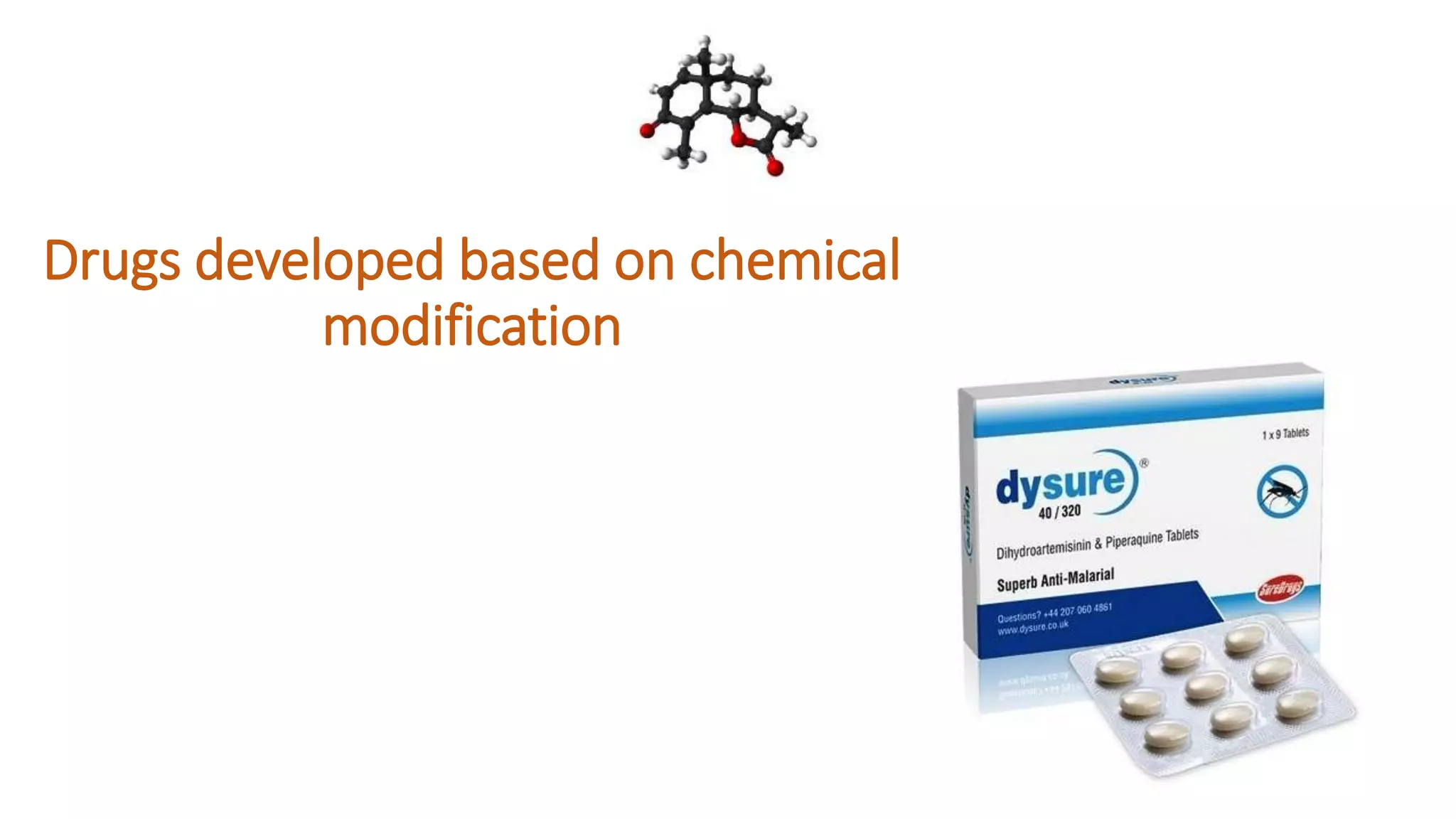
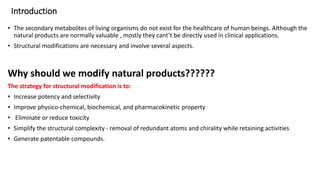
Drugs developed based on chemical
modification
Introduction
• The secondary metabolites of living organisms do not exist for the healthcare of human beings. Although the
natural products are normally valuable , mostly they cant’t be directly used in clinical applications.
• Structural modifications are necessary and involve several aspects.
Why should we modify natural products??????
The strategy for structural modification is to:
• Increase potency and selectivity
• Improve physico-chemical, biochemical, and pharmacokinetic property
• Eliminate or reduce toxicity
• Simplify the structural complexity - removal of redundant atoms and chirality while retaining activities
• Generate patentable compounds.
General features of Natural compounds
Structural diversity and complexity
More sp3-hybridized (Single bonded) C atom,and less N atoms
Existence of Chiral centers & Stereochemistry
Many structures of natural compounds are not involved in binding to the target.
Unnecessary moieties need to be removed from lead compounds
Most natural compounds have more C,H, and O atoms, and less N atoms (Except Leguminosae).
N atoms-highly nucleophilc and versatile atom in many aspects
Introduction or modification of various nitrogen atoms is an important molecular operation in lead compound optimization.
Most natural compounds – contain chiral centers-leading to stereo cis/trans
Chiral centres not participating in binding-trimmed out
Key points in structural modification
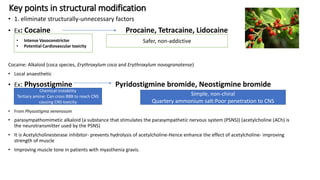
• 1. eliminate structurally-unnecessary factors
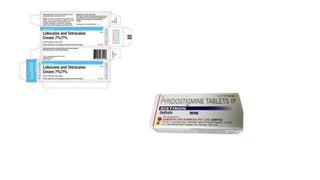
• Ex: Cocaine Procaine, Tetracaine, Lidocaine
Cocaine: Alkaloid (coca species, Erythroxylum coca and Erythroxylum novogranatense)
• Local anaesthetic
• Ex: Physostigmine Pyridostigmine bromide, Neostigmine bromide
• From Physostigma venenosum
• parasympathomimetic alkaloid (a substance that stimulates the parasympathetic nervous system (PSNS)) (acetylcholine (ACh) is
the neurotransmitter used by the PSNS)
• It is Acetylcholinesterase inhibitor- prevents hydrolysis of acetylcholine-Hence enhance the effect of acetylcholine- improving
strength of muscle
• Improving muscle tone in patients with myasthenia gravis.
• Intense Vasoconstrictor
• Potential Cardiovascular toxicity
Safer, non-addictive
Chemical instability
Tertiary amine: Can cross BBB to reach CNS
causing CNS toxicity
Simple, non-chiral
Quartery ammonium salt:Poor penetration to CNS
Compounds with small size have structural space to add atoms,
groups, or moieties
Ex: introducing a hydrogen donor or acceptor may increase the affinity
to receptors
or adding solubilizing groups raises the solubility or modulates the
partition property to benefit or avoid crossing the blood brain barrier
Simplifying structures
Large size and complex structure : unfavorable for solubility, absorption and metabolism.
• Objective: To decrease the molecular size and to eliminate the unnecessary functional groups
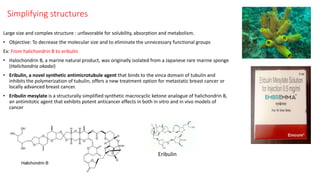
Ex: From halichondrin B to eribulin
• Halochondrin B, a marine natural product, was originally isolated from a Japanese rare marine sponge
(Halichondria okadai)
• Eribulin, a novel synthetic antimicrotubule agent that binds to the vinca domain of tubulin and
inhibits the polymerization of tubulin, offers a new treatment option for metastatic breast cancer or
locally advanced breast cancer.
• Eribulin mesylate is a structurally simplified synthetic macrocyclic ketone analogue of halichondrin B,
an antimitotic agent that exhibits potent anticancer effects in both in vitro and in vivo models of
cancer
Eribulin
Diminishing chiral centers
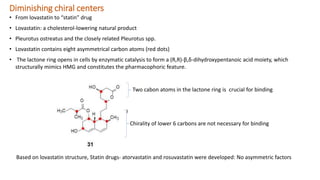
• From lovastatin to “statin” drug
• Lovastatin: a cholesterol-lowering natural product
• Pleurotus ostreatus and the closely related Pleurotus spp.
• Lovastatin contains eight asymmetrical carbon atoms (red dots)
• The lactone ring opens in cells by enzymatic catalysis to form a (R,R)-β,δ-dihydroxypentanoic acid moiety, which
structurally mimics HMG and constitutes the pharmacophoric feature.
Two cabon atoms in the lactone ring is crucial for binding
Chirality of lower 6 carbons are not necessary for binding
Based on lovastatin structure, Statin drugs- atorvastatin and rosuvastatin were developed: No asymmetric factors
Increasing activity or selectivity
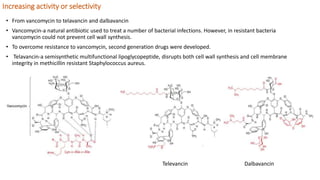
• From vancomycin to telavancin and dalbavancin
• Vancomycin-a natural antibiotic used to treat a number of bacterial infections. However, in resistant bacteria
vancomycin could not prevent cell wall synthesis.
• To overcome resistance to vancomycin, second generation drugs were developed.
• Telavancin-a semisynthetic multifunctional lipoglycopeptide, disrupts both cell wall synthesis and cell membrane
integrity in methicillin resistant Staphylococcus aureus.
Televancin Dalbavancin
Increasing metabolic stability
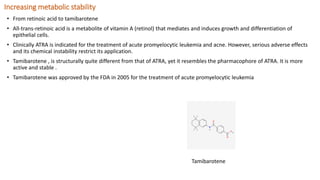
• From retinoic acid to tamibarotene
• All-trans-retinoic acid is a metabolite of vitamin A (retinol) that mediates and induces growth and differentiation of
epithelial cells.
• Clinically ATRA is indicated for the treatment of acute promyelocytic leukemia and acne. However, serious adverse effects
and its chemical instability restrict its application.
• Tamibarotene , is structurally quite different from that of ATRA, yet it resembles the pharmacophore of ATRA. It is more
active and stable .
• Tamibarotene was approved by the FDA in 2005 for the treatment of acute promyelocytic leukemia
Tamibarotene
Improving physico-chemical properties
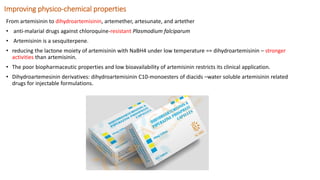
From artemisinin to dihydroartemisinin, artemether, artesunate, and artether
• anti-malarial drugs against chloroquine-resistant Plasmodium falciparum
• Artemisinin is a sesquiterpene.
• reducing the lactone moiety of artemisinin with NaBH4 under low temperature == dihydroartemisinin – stronger
activities than artemisinin.
• The poor biopharmaceutic properties and low bioavailability of artemisinin restricts its clinical application.
• Dihydroartemesinin derivatives: dihydroartemisinin C10-monoesters of diacids –water soluble artemisinin related
drugs for injectable formulations.

drugs developed based on chemical modification.pptx

  • 1.
    Drugs developed basedon chemical modification
  • 2.
    Introduction • The secondarymetabolites of living organisms do not exist for the healthcare of human beings. Although the natural products are normally valuable , mostly they cant’t be directly used in clinical applications. • Structural modifications are necessary and involve several aspects. Why should we modify natural products?????? The strategy for structural modification is to: • Increase potency and selectivity • Improve physico-chemical, biochemical, and pharmacokinetic property • Eliminate or reduce toxicity • Simplify the structural complexity - removal of redundant atoms and chirality while retaining activities • Generate patentable compounds.
  • 3.
    General features ofNatural compounds Structural diversity and complexity More sp3-hybridized (Single bonded) C atom,and less N atoms Existence of Chiral centers & Stereochemistry Many structures of natural compounds are not involved in binding to the target. Unnecessary moieties need to be removed from lead compounds Most natural compounds have more C,H, and O atoms, and less N atoms (Except Leguminosae). N atoms-highly nucleophilc and versatile atom in many aspects Introduction or modification of various nitrogen atoms is an important molecular operation in lead compound optimization. Most natural compounds – contain chiral centers-leading to stereo cis/trans Chiral centres not participating in binding-trimmed out
  • 4.
    Key points instructural modification • 1. eliminate structurally-unnecessary factors • Ex: Cocaine Procaine, Tetracaine, Lidocaine Cocaine: Alkaloid (coca species, Erythroxylum coca and Erythroxylum novogranatense) • Local anaesthetic • Ex: Physostigmine Pyridostigmine bromide, Neostigmine bromide • From Physostigma venenosum • parasympathomimetic alkaloid (a substance that stimulates the parasympathetic nervous system (PSNS)) (acetylcholine (ACh) is the neurotransmitter used by the PSNS) • It is Acetylcholinesterase inhibitor- prevents hydrolysis of acetylcholine-Hence enhance the effect of acetylcholine- improving strength of muscle • Improving muscle tone in patients with myasthenia gravis. • Intense Vasoconstrictor • Potential Cardiovascular toxicity Safer, non-addictive Chemical instability Tertiary amine: Can cross BBB to reach CNS causing CNS toxicity Simple, non-chiral Quartery ammonium salt:Poor penetration to CNS
  • 6.
    Compounds with smallsize have structural space to add atoms, groups, or moieties Ex: introducing a hydrogen donor or acceptor may increase the affinity to receptors or adding solubilizing groups raises the solubility or modulates the partition property to benefit or avoid crossing the blood brain barrier
  • 8.
    Simplifying structures Large sizeand complex structure : unfavorable for solubility, absorption and metabolism. • Objective: To decrease the molecular size and to eliminate the unnecessary functional groups Ex: From halichondrin B to eribulin • Halochondrin B, a marine natural product, was originally isolated from a Japanese rare marine sponge (Halichondria okadai) • Eribulin, a novel synthetic antimicrotubule agent that binds to the vinca domain of tubulin and inhibits the polymerization of tubulin, offers a new treatment option for metastatic breast cancer or locally advanced breast cancer. • Eribulin mesylate is a structurally simplified synthetic macrocyclic ketone analogue of halichondrin B, an antimitotic agent that exhibits potent anticancer effects in both in vitro and in vivo models of cancer Eribulin
  • 9.
    Diminishing chiral centers •From lovastatin to “statin” drug • Lovastatin: a cholesterol-lowering natural product • Pleurotus ostreatus and the closely related Pleurotus spp. • Lovastatin contains eight asymmetrical carbon atoms (red dots) • The lactone ring opens in cells by enzymatic catalysis to form a (R,R)-β,δ-dihydroxypentanoic acid moiety, which structurally mimics HMG and constitutes the pharmacophoric feature. Two cabon atoms in the lactone ring is crucial for binding Chirality of lower 6 carbons are not necessary for binding Based on lovastatin structure, Statin drugs- atorvastatin and rosuvastatin were developed: No asymmetric factors
  • 10.
    Increasing activity orselectivity • From vancomycin to telavancin and dalbavancin • Vancomycin-a natural antibiotic used to treat a number of bacterial infections. However, in resistant bacteria vancomycin could not prevent cell wall synthesis. • To overcome resistance to vancomycin, second generation drugs were developed. • Telavancin-a semisynthetic multifunctional lipoglycopeptide, disrupts both cell wall synthesis and cell membrane integrity in methicillin resistant Staphylococcus aureus. Televancin Dalbavancin
  • 11.
    Increasing metabolic stability •From retinoic acid to tamibarotene • All-trans-retinoic acid is a metabolite of vitamin A (retinol) that mediates and induces growth and differentiation of epithelial cells. • Clinically ATRA is indicated for the treatment of acute promyelocytic leukemia and acne. However, serious adverse effects and its chemical instability restrict its application. • Tamibarotene , is structurally quite different from that of ATRA, yet it resembles the pharmacophore of ATRA. It is more active and stable . • Tamibarotene was approved by the FDA in 2005 for the treatment of acute promyelocytic leukemia Tamibarotene
  • 12.
    Improving physico-chemical properties Fromartemisinin to dihydroartemisinin, artemether, artesunate, and artether • anti-malarial drugs against chloroquine-resistant Plasmodium falciparum • Artemisinin is a sesquiterpene. • reducing the lactone moiety of artemisinin with NaBH4 under low temperature == dihydroartemisinin – stronger activities than artemisinin. • The poor biopharmaceutic properties and low bioavailability of artemisinin restricts its clinical application. • Dihydroartemesinin derivatives: dihydroartemisinin C10-monoesters of diacids –water soluble artemisinin related drugs for injectable formulations.