ALKALOIDS
Presented by,
Mohit Umare
M. Pharm First Year (2019-20)
Department of Pharmceutical Sciences
RTM Nagpur University, Nagpur.440033
1
CONTENTS
 Introduction
 Classification
 Isolation
 Purification
 Structural elucidation of some alkaloids
like- Reserpine, Emetine.
 Reference
2
INTRODUCTION
 Alkaloids are a group of naturally occurring
chemical compounds that mostly contain basic
nitrogen atoms.
 The term alkaloid was coined by Meissner, a German
pharmacist, in 1819.
 Alkaloids are cyclic organic compounds containing
nitrogen in a negative state of oxidation with limited
distribution among living organisms.
3
PROPERTIES
 Most alkaloids contain oxygen in their molecular structure;
those compounds are usually colorless crystals at ambient
conditions.
 Some alkaloids are colored, like berberine (yellow) and
sanguinarine (orange).
 Most alkaloids are weak bases, but some, such as theobromine
and theophylline, are amphoteric.
 Many alkaloids dissolve poorly in water but readily dissolve in
organic solvents.
 Most alkaloids have a bitter taste or are poisonous when
ingested.
4
CLASSIFICATION
The alkaloids, as an important and enormously large conglomerate of
naturally occurring nitrogen containing plant substances having very
specific as well as most diversified pharmacological properties may be
classified as :
i. Biosynthetic Classification
ii. Chemical Classification
iii. Pharmacological Classification
5
CLASSIFICATION
Bio Synthetic based: According to this alkaloids are
classified on the basis of the type precursors or
building block compounds used by plants to synthesise
the complex structure. e.g.. Morphine, papaverine,
narcotine, tubocurarine & calchicine in phenylalanine
tyrosin derived base.
6
CLASSIFICATION
Pharmacological based: Their pharmacological
activity or response. For example:
 Analgesic alkaloids eg Morphine
 Antimalarial eg Quinine
7
CLASSIFICATION
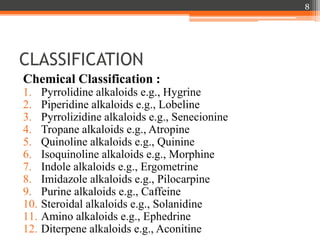
Chemical Classification :
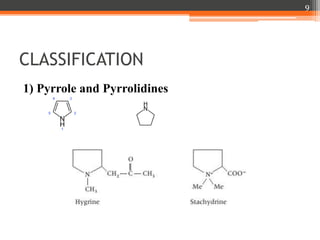
1. Pyrrolidine alkaloids e.g., Hygrine
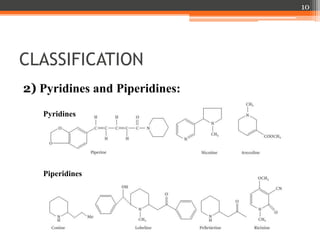
2. Piperidine alkaloids e.g., Lobeline
3. Pyrrolizidine alkaloids e.g., Senecionine
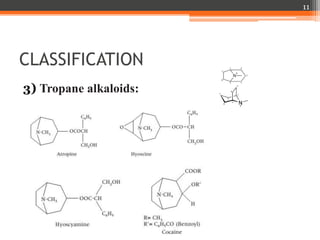
4. Tropane alkaloids e.g., Atropine
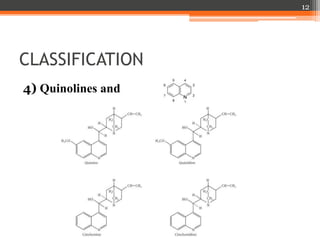
5. Quinoline alkaloids e.g., Quinine
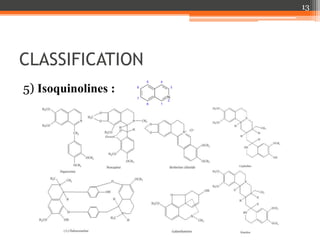
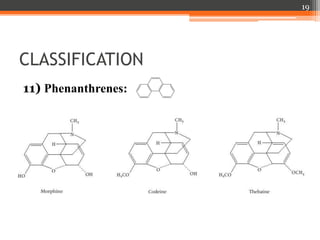
6. Isoquinoline alkaloids e.g., Morphine
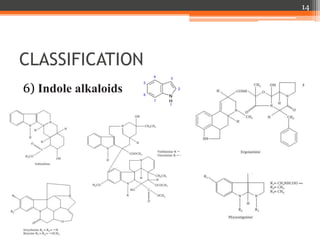
7. Indole alkaloids e.g., Ergometrine
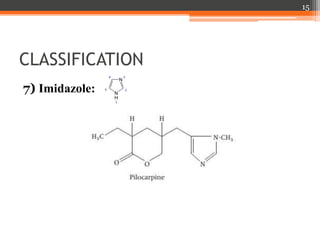
8. Imidazole alkaloids e.g., Pilocarpine
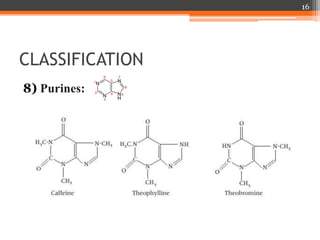
9. Purine alkaloids e.g., Caffeine
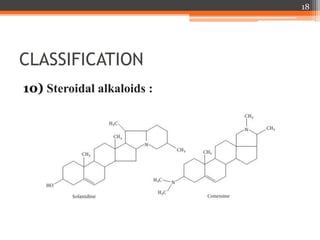
10. Steroidal alkaloids e.g., Solanidine
11. Amino alkaloids e.g., Ephedrine
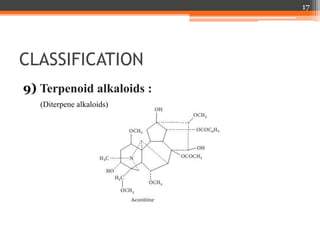
12. Diterpene alkaloids e.g., Aconitine
8
CLASSIFICATION
1) Pyrrole and Pyrrolidines
9
CLASSIFICATION
2) Pyridines and Piperidines:
Pyridines
Piperidines
10
CLASSIFICATION
3) Tropane alkaloids:
11
CLASSIFICATION
4) Quinolines and
12
CLASSIFICATION
5) Isoquinolines :
13
CLASSIFICATION
6) Indole alkaloids
14
CLASSIFICATION
7) Imidazole:
15
CLASSIFICATION
8) Purines:
16
CLASSIFICATION
9) Terpenoid alkaloids :
(Diterpene alkaloids)
17
CLASSIFICATION
10) Steroidal alkaloids :
18
CLASSIFICATION
11) Phenanthrenes:
19
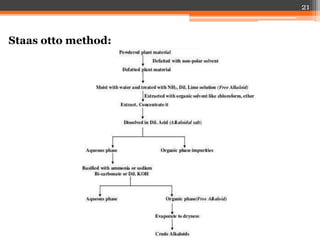
ISOLATION
Alkaloid bearing plant usually contains a complex mixture of
alkaloids The steps involved in the isolation of an alkaloid may
be summarized as follows:
1. The presence of an alkaloid in a plant is ascertained by using
the various alkaloidal reagents.
2. The next step is the separation of relatively small amount of
alkaloids from large amount of extraneous plant materials.
3. The final step is the separation and purification of individual
alkaloids from the crude mixture.
20
Staas otto method:
21
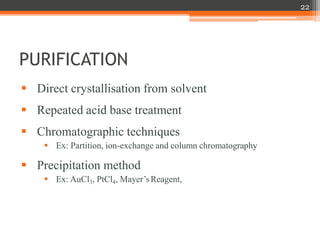
PURIFICATION
 Direct crystallisation from solvent
 Repeated acid base treatment
 Chromatographic techniques
 Ex: Partition, ion-exchange and column chromatography
 Precipitation method
 Ex: AuCl3, PtCl4, Mayer’sReagent,
22
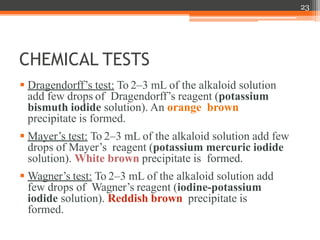
CHEMICAL TESTS
 Dragendorff’s test: To 2–3 mL of the alkaloid solution
add few drops of Dragendorff’s reagent (potassium
bismuth iodide solution). An orange brown
precipitate is formed.
 Mayer’s test: To 2–3 mL of the alkaloid solution add few
drops of Mayer’s reagent (potassium mercuric iodide
solution). White brown precipitate is formed.
 Wagner’s test: To 2–3 mL of the alkaloid solution add
few drops of Wagner’s reagent (iodine-potassium
iodide solution). Reddish brown precipitate is
formed.
23
STRUCTURAL ELUCIDATION
 Reserpine
 Emetine
24
RESERPINE
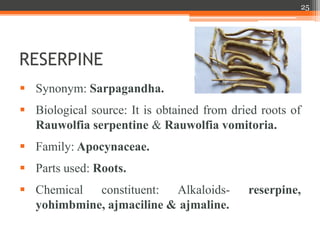
 Synonym: Sarpagandha.
 Biological source: It is obtained from dried roots of
Rauwolfia serpentine & Rauwolfia vomitoria.
 Family: Apocynaceae.
 Parts used: Roots.
 Chemical constituent: Alkaloids- reserpine,
yohimbmine, ajmaciline & ajmaline.
25
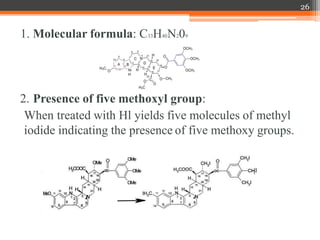
1. Molecular formula: C33H40N209
2. Presence of five methoxyl group:
When treated with Hl yields five molecules of methyl
iodide indicating the presence of five methoxy groups.
I
26
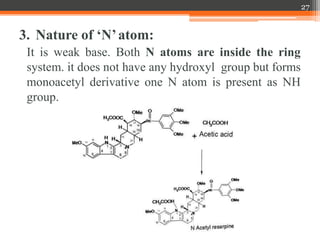
3. Nature of ‘N’atom:
It is weak base. Both N atoms are inside the ring
system. it does not have any hydroxyl group but forms
monoacetyl derivative one N atom is present as NH
group.
27
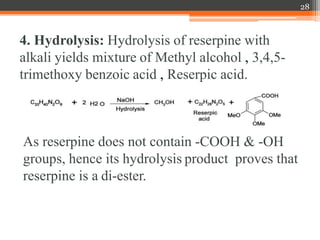
4. Hydrolysis: Hydrolysis of reserpine with
alkali yields mixture of Methyl alcohol , 3,4,5-
trimethoxy benzoic acid , Reserpic acid.
As reserpine does not contain -COOH & -OH
groups, hence its hydrolysis product proves that
reserpine is a di-ester.
28
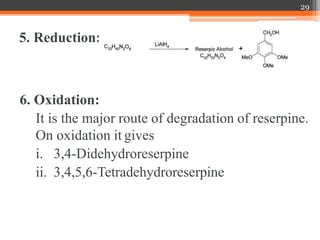
5. Reduction:
6. Oxidation:
It is the major route of degradation of reserpine.
On oxidation it gives
i. 3,4-Didehydroreserpine
ii. 3,4,5,6-Tetradehydroreserpine
29
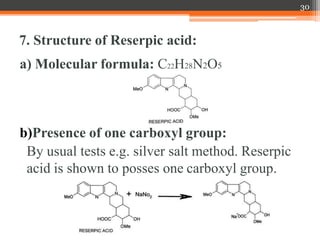
7. Structure of Reserpic acid:
a) Molecular formula: C22H28N2O5
b)Presence of one carboxyl group:
By usual tests e.g. silver salt method. Reserpic
acid is shown to posses one carboxyl group.
30
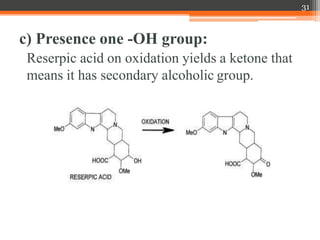
c) Presence one -OH group:
Reserpic acid on oxidation yields a ketone that
means it has secondary alcoholic group.
31
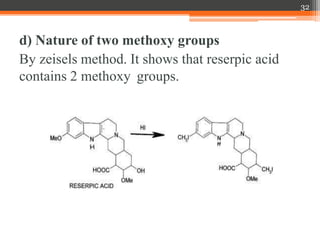
d) Nature of two methoxy groups
By zeisels method. It shows that reserpic acid
contains 2 methoxy groups.
32
e) Nature of two ‘N' atom :
lt shown that it contains two ‘N’ atoms in
heterocyclic ring in the form of Secondary ‘N’
,Tertiary amino group
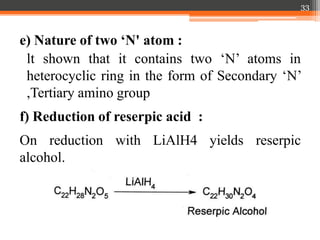
f) Reduction of reserpic acid :
On reduction with LiAlH4 yields reserpic
alcohol.
33
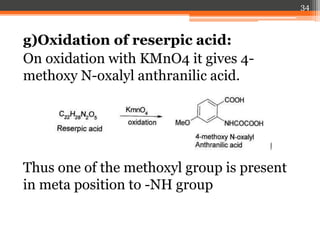
g)Oxidation of reserpic acid:
On oxidation with KMnO4 it gives 4-
methoxy N-oxalyl anthranilic acid.
Thus one of the methoxyl group is present
in meta position to -NH group
34
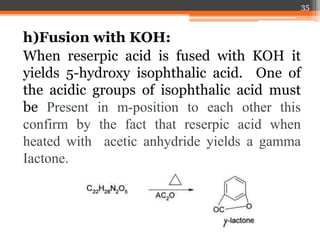
h)Fusion with KOH:
When reserpic acid is fused with KOH it
yields 5-hydroxy isophthalic acid. One of
the acidic groups of isophthalic acid must
be Present in m-position to each other this
confirm by the fact that reserpic acid when
heated with acetic anhydride yields a gamma
Iactone.
35
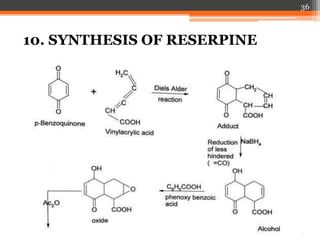
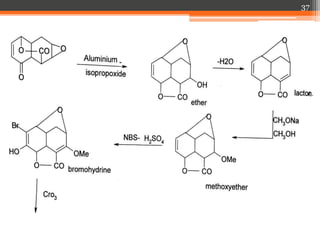
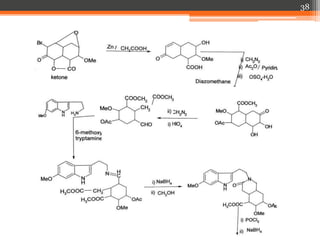
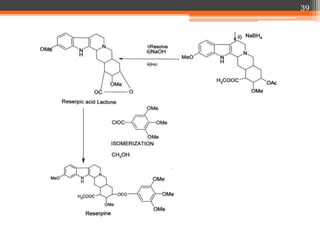
10. SYNTHESIS OF RESERPINE
36
37
38
39
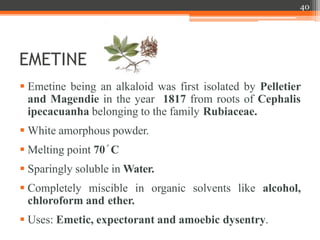
EMETINE
 Emetine being an alkaloid was first isolated by Pelletier
and Magendie in the year 1817 from roots of Cephalis
ipecacuanha belonging to the family Rubiaceae.
 White amorphous powder.
 Melting point 70 ֠ C
 Sparingly soluble in Water.
 Completely miscible in organic solvents like alcohol,
chloroform and ether.
 Uses: Emetic, expectorant and amoebic dysentry.
40
 Molecular formula- By analytical data it is found
to be C29H40N2O4
 Emetine does not contain N -methyl groups but
has a secondary and a tertiary nitrogen atoms.
 Presence of 4 methoxyl group- it is given by
Zeisel Method where in on treating with
hydroiodic acid this yields 4 molecules of
methyl iodide showing presence of methoxyl
groups.
41
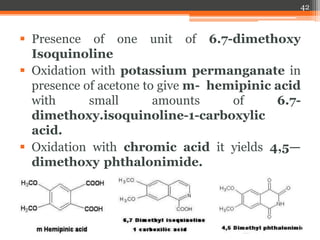
 Presence of one unit of 6.7-dimethoxy
Isoquinoline
 Oxidation with potassium permanganate in
presence of acetone to give m- hemipinic acid
with small amounts of 6.7-
dimethoxy.isoquinoline-1-carboxylic
acid.
 Oxidation with chromic acid it yields 4,5—
dimethoxy phthalonimide.
42
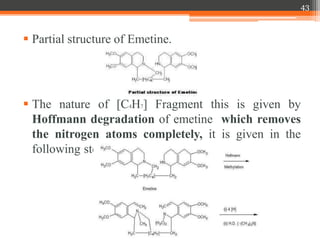
 Partial structure of Emetine.
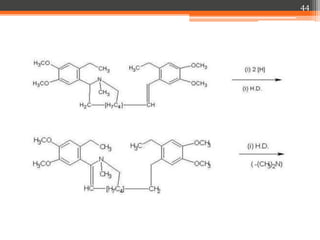
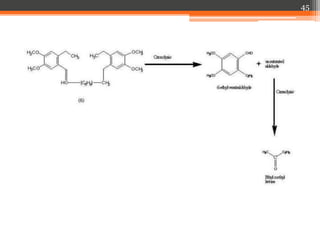
 The nature of [C4H7] Fragment this is given by
Hoffmann degradation of emetine which removes
the nitrogen atoms completely, it is given in the
following steps.
43
44
45
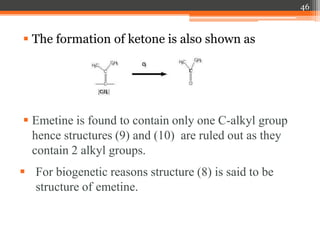
 The formation of ketone is also shown as
 Emetine is found to contain only one C-alkyl group
hence structures (9) and (10) are ruled out as they
contain 2 alkyl groups.
 For biogenetic reasons structure (8) is said to be
structure of emetine.
46
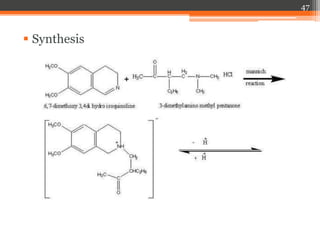
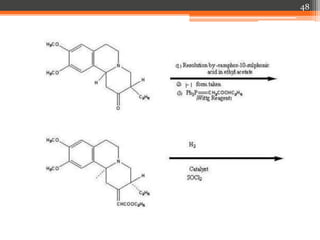
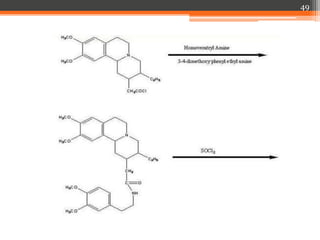
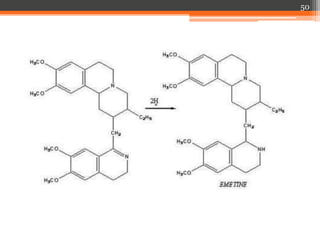
 Synthesis
47
48
49
50
REFERENCE
 Chemistry of natural products, Vol. 1, O. P.
Agarwal, Goel publishing house. Meerut., Page
No. 193-311.
 Organic chemistry of natural products, Vol. 1, Gurdeep
R. Chatwal, Edited by M. Arora, Page No. 3.1 – 3.154
51
52