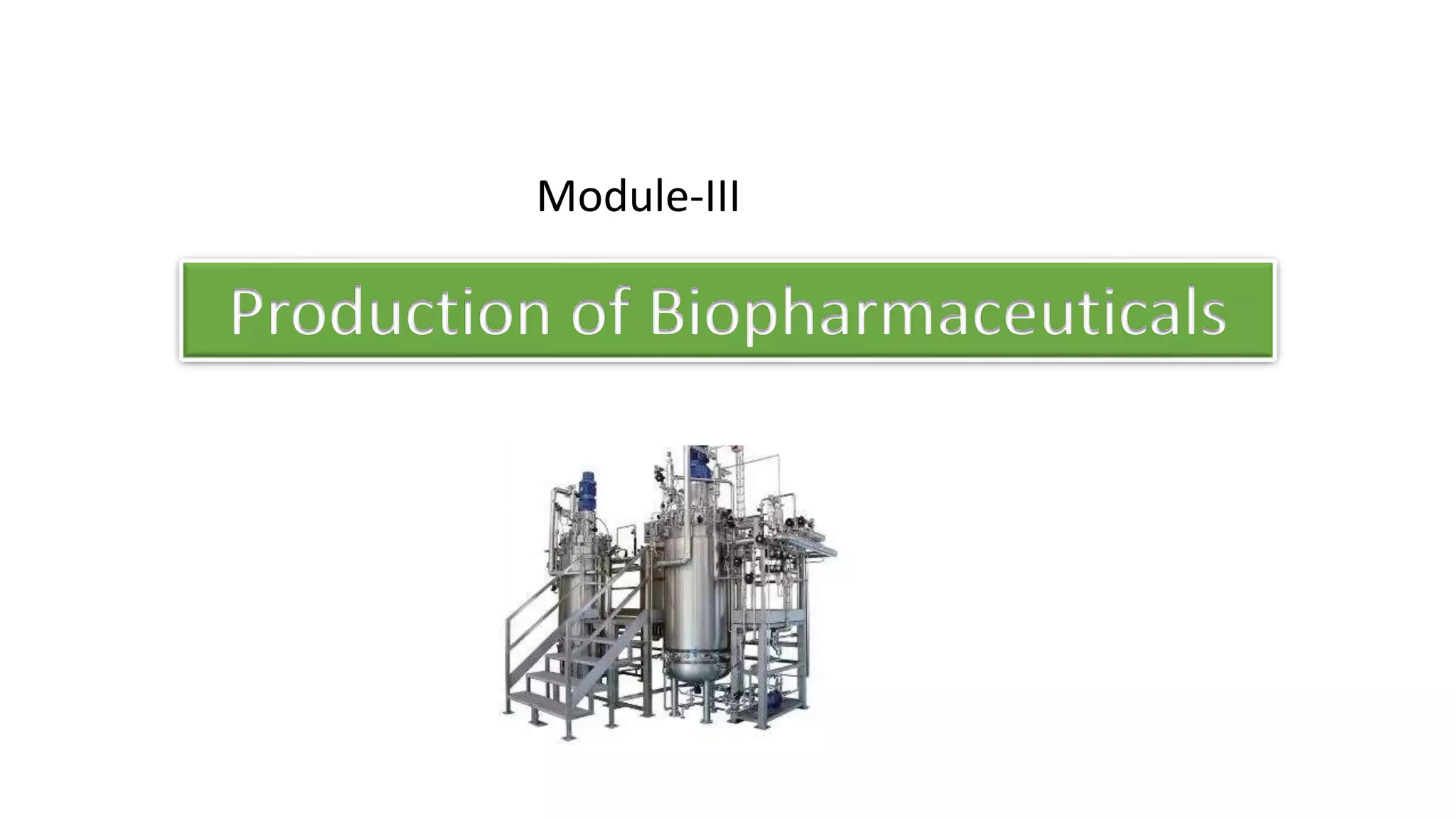
Production of Biopharmaceuticals
Module-III
Bioreactor
• Many important bio-products are produced by means of fermentation where microbial, plant or
animal cells are employed to produce them as their metabolites.
• Bioreactors are vessels that have been designed and produced to provide an effective environment for
enzymes or whole cells to transform biochemicals into products. Used in industrial processes to
produce pharmaceuticals, vaccines, or antibodies.
• The production of biopharmaceuticals, known as bioprocess, involves a wide range of techniques.
• The variety of bioprocesses is tremendous and many different designs of bioreactors have been
developed to meet the different needs.
• To design an appropriate bioreactor for a particular bioprocess, intensive studies on the biological
system, such as cell growth, metabolism, genetic manipulation, and protein or other product
expression, are needed to understand the cells’ requirement on their physical and chemical
environment.
Characteristic features of cell culture bioreactors
• Aeration and low shear mixing
• Adequate dispersion of gas
• Homogenous mixing
• Easy handling
• Long-term stability and sterility
• Ease of scale-up
• Ability to control temperature, pH, and nutrient concentration inside the reactor
• Avoid all possible contamination of the culture
Design and types of bioreactor
(1) Continuous Stirred Tank Bioreactors
(2) Bubble Column Bioreactors
(3) Airlift Bioreactors
(4) Fluidized Bed Bioreactors
(5) Packed Bed Bioreactor….. Etc etc etc
Continuous Stirred Tank Bioreactors
• Stirred tank bioreactors (STBRs) are the reactors most widely employed for culturing of biological
agents such as cells, enzymes, or antibodies.
• Stirred tank bioreactors consist of a cylindrical vessel with a motor driven central shaft that supports
one or more agitators.
Bubble column bioreactor
• Bubble columns (BCs) belong to a family of pneumatic bioreactors.
• These bioreactors do not have any mechanical or otherwise moving parts. The upper section of the BC
is often widened to encourage gas separation.
• BCs require very little maintenance or floor space and have low operating costs compared to other
reactor types.
Airlift Bioreactors
• Although STRs are considered to be the industrial standard for animal cell biotechnology, airlift
bioreactors have been used in a number of large-scale processes.
• Airlift bioreactors are quite similar to the stirred tank reactors, except for the impeller.
• Mixing of the culture broth is done by the inserted gas via an airlift pump.
Fluidized Bed Bioreactors & Packed bed bioreactors
• Fluidization: Small solid particles are suspended in a stream of upward flowing liquid.
• Solid particles swirl around the bed creating excellent mixing.
• The material fluidized is almost always solid, and the fluidizing medium is always a liquid or a gas.
• Packed-bed bioreactors are tubular types of reactors which are packed with immobilized enzyme or microbial cells as biocatalysts.
Different techniques such as encapsulation, cross-linking, covalent bonding, and adsorption are generally used for immobilization
purposes.
Batch, Fed-batch and continuous processes
Batch processes:
• All nutrients are provided at the beginning of the cultivation, without adding any more in the subsequent bioprocess.
• During the entire bioprocess, no additional nutrients are added – just control elements such as gases, acids and bases;
it is a closed system.
• The bioprocess then lasts until the nutrients are consumed.
Fed-batch processes:
• One way of keeping nutrients from becoming a limiting factor is to constantly supply them during cultivation. This is
called a fed-batch process, which is a partly open system.
• Generally, the substrate is pumped from the supply bottle into the culture vessel through a silicone tube.
• During the course of incubation a particular nutrient is added at intervals without removing the used up media.so the
volume of culture increases continuously.
Continuous culture:
• Continuous culture technique is also called as open system of cultivation.
• In this technique fresh sterile medium is added continuously in the vessel and used up media with bacterial culture is
removed continuously at the same rate. So the volume and bacterial density remain same in the cultivation vessel.
Upstream processing on biopharmaceuticals production
• The manufacturing technology for biopharmaceuticals can be divided into up- and downstream processes.
• Upstream process: Involves a series of events including the selection of cell line, culture media, growth parameters, and
process optimization to achieve optimal conditions for cell growth and biopharmaceutical production.
• The main goal of the upstream process is the transformation of substrates into the desired metabolic products.
• This requires well-controlled conditions and involves the use of large-scale bioreactors.
• Several factors should be considered such as the type of process (batch, fed-batch, continuous, etc.) temperature, pH, and
oxygen supply control, sterilization of materials and equipment employed, and maintenance of the environment to ensure it
is free of contaminating microorganisms.
Downstream processes
• Downstream process: Isolation and purification of Biophamaceuticals.
• Downstream processing includes all steps required to purify a biological product from cell culture broth to final
purified product.
• It involves multiple steps to capture the target biomolecule and to remove host cell related impurities (e.g.,host cell
proteins, DNA, etc.), process related impurities (e.g., buffers, leached ligands, antifoam, etc.) and product related
impurities (e.g., aggregates, fragments, clipped species, etc.).
• Each purification step is capable of removing one or more classes of impurities.
• Downstream processing usually encompasses three main stages, namely (i) initial recovery (extraction or isolation),
(ii) purification (removal of most contaminants), and (iii) polishing (removal of specified contaminants and
unwanted forms of the target biomolecule that may have formed during isolation and purification).
• Initial recovery involves the separation between cell and supernatant (broth clarification).
• For this purpose, the main operations employed are centrifugation, filtration, sedimentation, and flotation.
• If the target biomolecule is produced extracellularly, the clarified broth is submitted to concentration (e.g.,
ultrafiltration) followed by purification.
• Efficient recovery and purification of biopharmaceuticals have been referred as a critical part of the production
process.
• Chromatography allows for high resolution and has traditionally been the workhorse for protein purification and
polishing.
• Samples can then be concentrated and the target protein purified from the supernatant by processes such as
ultrafiltration, precipitation, and/or chromatography.
• For intracellular biomolecules, the cells harvested must be submitted to lysis (e.g., high-pressure homogenizer,
sonication, passing through mills, etc.) followed by clarification to remove cell debris.
• The target biomolecule is purified from the clarified cell homogenate (usually by precipitation and/or
chromatography).
• In cases where proteins are expressed as inclusion bodies (as some recombinants produced by E. coli), an extra
step of protein refolding (buffer exchange) is required.
Chromatography
• Chromatography is a very effective purification technique with a wide range of industrial applications.
• The separation principle in chromatography is based on the differences in the affinity of the species carried by a fluid
mobile phase toward a solid stationary phase.
• When a sample is introduced and transported by the eluent along the column, some of its components will have more
powerful interactions with the stationary phase than others, generating concentration profiles that will percolate the
chromatographic column at different speeds.
• The less retained species will elute earlier from the column than the most retained ones, eventually allowing the
collection of the products of interest with a high purity degree.
• Based on the interaction between the solid stationary phase and biomolecules, chromatographic techniques can be
summarized into five classes: (i) affinity, (ii) ion-exchange, (iii) hydrophobic interactions, (iv) size exclusion, and (v)
mixed-mode chromatography
BIOTECHNOLOGY PROCESSES
Current biotechnological processes essentially involve five different groups of organisms:
• Bacteria (e.g. Escherichia coli, Pseudomonas spp. Serratia mascescens, Erwenia herbícola, Lactococcus
lactis and Bacillus subtilis),
• Fungi (e.g. Saccharomyces cerevisiae, Pichia and Hansenula, Trichoderma and Aspergilli),
• Plants (e.g. tobacco plant, rape and transgenic potatoes, insects (e.g. Spodoptra frugiperda)
• Mammalians (e.g. Chinese hamster ovary cells (CHO), baby hamster kidney cells (BHK) and transgenic
animals).
Production of Antibiotics
• Antibiotics are the largest group in terms of economic importance among the products obtained by
fermentation.
• Some examples of antibiotics whose synthesis involved microorganisms include
• Penicillin produced from Penicillium notatum
• Cephalosporins (usually semi-synthetic process) from the genus Streptomyces
• Chloramphenicol from Streptomyces venezuelae; streptomycin from Streptomyces griseus
• Cycloserine from Streptomyces orchidaceus
• Clindamycin from Streptomyces lincolnensis
• Vancomycin isolated from cultures of Streptomyces orien-talis (Nocardia orientalis)
• Teicoplanin from Actinmoplanes teichomyceticus and mupirocin from Pseudomonas fluoresces.
The Manufacturing Process
• Although most antibiotics occur in nature, they are not normally available in the quantities necessary for large-scale
production.
• For this reason, a fermentation process was developed.
• It involves isolating a desired microorganism, fueling growth of the culture and refining and isolating the final antibiotic
product.
• It is important that sterile conditions be maintained throughout the manufacturing process, because contamination by
foreign microbes will ruin the fermentation.
1. Starting the culture : The desired antibiotic-producing organism must be
isolated
• A sample of the organism is transferred to an agar-containing plate.
• The initial culture is then put into shake flasks along with food and other nutrients necessary for
growth.
• This creates a suspension, which can be transferred to seed tanks for further growth.
• The seed tanks are steel tanks designed to provide an ideal environment for growing microorganisms. The seed-stage medium is devised for rapid
growth, and to prevent antibiotic production and sporulation.
• Seed tanks are designed to keep well defined strains of cells, bacteria or yeast viable at a high density for further upstream processing in the
bioreactor.
• They are filled with all the things the specific microorganism would need to survive and thrive, including warm water and carbohydrate foods like
lactose or glucose sugars. Additionally, they contain other necessary carbon sources, such as acetic acid, alcohols, or hydrocarbons, and nitrogen
sources like ammonia salts. Growth factors like vitamins, amino acids, and minor nutrients round out the composition of the seed tank contents.
• The seed tanks are equipped with mixers, which keep the growth medium moving, and a pump to deliver sterilized, filtered air. After about 24-28
hours, the material in the seed tanks is transferred to the primary fermentation tanks.
• The contents of the seed tank are harvested and used as inoculum for the production batch.
Fermentation
• The fermentation tank is essentially a larger version of the steel, seed tank, which is able to hold about 30,000 gallons. It is filled with the same
growth media found in the seed tank and also provides an environment inducive to growth.
• Here the microorganisms are allowed to grow and multiply. During this process, they excrete large quantities of the desired antibiotic.
• The tanks are cooled to keep the temperature between 73-81° F (23-27.2 ° C).
• It is constantly agitated, and a continuous stream of sterilized air is pumped into it.
• For this reason, anti-foaming agents are periodically added. Since pH control is vital for optimal growth, acids or bases are added to the tank as
necessary.
Isolation and purification
• After three to five days, the maximum amount of antibiotic will have been produced and the isolation process can begin.
• Depending on the specific antibiotic produced, the fermentation broth is processed by various purification methods.
Antibiotic isolation and purification employs solvent extraction, ion exchange, ultrafiltration, reverse osmosis, precipitation
and crystallization.
Examples:
• To isolate antibiotic compounds that are water soluble, an ion-exchange method may be used for purification. In this
method, the compound is first separated from the waste organic materials in the broth and then sent through equipment,
which separates the other water-soluble compounds from the desired one.
• To isolate an oil-soluble antibiotic such as penicillin, a solvent extraction method is used. In this method, the broth is treated
with organic solvents such as butyl acetate or methyl isobutyl ketone, which can specifically dissolve the antibiotic.
• The dissolved antibiotic is then recovered using various organic chemical means.
• At the end of this step, the manufacturer is typically left with a purified powdered form of the antibiotic, which can be
further refined into different product types.
Refining
• Antibiotic products can take on many different forms.
• They can be sold in solutions for intravenous bags or syringes, in pill or gel capsule form, or they may be sold as
powders, which are incorporated into topical ointments.
• Depending on the final form of the antibiotic, various refining steps may be taken after the initial isolation.
• Vinca rosea alkaloid production in bioreactors.
• Vinca rosea alkaloid production by plant tissue culture methods.
• Plant cell and tissue culture technique is widely used method to enhance the accumulation of such therapeutic
secondary metabolites in a wide range of plants.
• The cultured plant tissues have demonstrated much higher concentrations of alkaloids than the intact plants.
Alkaloid production in bioreactors
Step-1
• Selection of Plants and Explants
Step-2
• Explants Preparation and Culture Establishment
Step-3
• Culture Medium and Culture Conditions
Step-5
• Induction and Multiplication of Callus and Biomass
Step-6
• Extraction of total alkaloids: Dried callus Ground in methanol Rotary shaker
Centrifugation Collection of supernatant Drying the supernatant
Step-7
• The alkaloid content, productivity and the yield were enhanced almost 2-3 timeS in suspension
conditions as compared to agar solidified medium in their respective formulations and
strength.
• Plant cell culture bioreactors are different from microbial fermenters
because of the differences in cellular properties of plants and
microbes. However, did you know that not all of the cell culture
bioreactors are the same?
A schematic diagram of Rotary Bioreactor.

Production of biopharmaceuticals.pptx

  • 1.
  • 2.
    Bioreactor • Many importantbio-products are produced by means of fermentation where microbial, plant or animal cells are employed to produce them as their metabolites. • Bioreactors are vessels that have been designed and produced to provide an effective environment for enzymes or whole cells to transform biochemicals into products. Used in industrial processes to produce pharmaceuticals, vaccines, or antibodies. • The production of biopharmaceuticals, known as bioprocess, involves a wide range of techniques. • The variety of bioprocesses is tremendous and many different designs of bioreactors have been developed to meet the different needs. • To design an appropriate bioreactor for a particular bioprocess, intensive studies on the biological system, such as cell growth, metabolism, genetic manipulation, and protein or other product expression, are needed to understand the cells’ requirement on their physical and chemical environment.
  • 3.
    Characteristic features ofcell culture bioreactors • Aeration and low shear mixing • Adequate dispersion of gas • Homogenous mixing • Easy handling • Long-term stability and sterility • Ease of scale-up • Ability to control temperature, pH, and nutrient concentration inside the reactor • Avoid all possible contamination of the culture
  • 4.
    Design and typesof bioreactor (1) Continuous Stirred Tank Bioreactors (2) Bubble Column Bioreactors (3) Airlift Bioreactors (4) Fluidized Bed Bioreactors (5) Packed Bed Bioreactor….. Etc etc etc
  • 5.
    Continuous Stirred TankBioreactors • Stirred tank bioreactors (STBRs) are the reactors most widely employed for culturing of biological agents such as cells, enzymes, or antibodies. • Stirred tank bioreactors consist of a cylindrical vessel with a motor driven central shaft that supports one or more agitators.
  • 6.
    Bubble column bioreactor •Bubble columns (BCs) belong to a family of pneumatic bioreactors. • These bioreactors do not have any mechanical or otherwise moving parts. The upper section of the BC is often widened to encourage gas separation. • BCs require very little maintenance or floor space and have low operating costs compared to other reactor types.
  • 7.
    Airlift Bioreactors • AlthoughSTRs are considered to be the industrial standard for animal cell biotechnology, airlift bioreactors have been used in a number of large-scale processes. • Airlift bioreactors are quite similar to the stirred tank reactors, except for the impeller. • Mixing of the culture broth is done by the inserted gas via an airlift pump.
  • 8.
    Fluidized Bed Bioreactors& Packed bed bioreactors • Fluidization: Small solid particles are suspended in a stream of upward flowing liquid. • Solid particles swirl around the bed creating excellent mixing. • The material fluidized is almost always solid, and the fluidizing medium is always a liquid or a gas. • Packed-bed bioreactors are tubular types of reactors which are packed with immobilized enzyme or microbial cells as biocatalysts. Different techniques such as encapsulation, cross-linking, covalent bonding, and adsorption are generally used for immobilization purposes.
  • 9.
    Batch, Fed-batch andcontinuous processes Batch processes: • All nutrients are provided at the beginning of the cultivation, without adding any more in the subsequent bioprocess. • During the entire bioprocess, no additional nutrients are added – just control elements such as gases, acids and bases; it is a closed system. • The bioprocess then lasts until the nutrients are consumed. Fed-batch processes: • One way of keeping nutrients from becoming a limiting factor is to constantly supply them during cultivation. This is called a fed-batch process, which is a partly open system. • Generally, the substrate is pumped from the supply bottle into the culture vessel through a silicone tube. • During the course of incubation a particular nutrient is added at intervals without removing the used up media.so the volume of culture increases continuously. Continuous culture: • Continuous culture technique is also called as open system of cultivation. • In this technique fresh sterile medium is added continuously in the vessel and used up media with bacterial culture is removed continuously at the same rate. So the volume and bacterial density remain same in the cultivation vessel.
  • 10.
    Upstream processing onbiopharmaceuticals production • The manufacturing technology for biopharmaceuticals can be divided into up- and downstream processes. • Upstream process: Involves a series of events including the selection of cell line, culture media, growth parameters, and process optimization to achieve optimal conditions for cell growth and biopharmaceutical production. • The main goal of the upstream process is the transformation of substrates into the desired metabolic products. • This requires well-controlled conditions and involves the use of large-scale bioreactors. • Several factors should be considered such as the type of process (batch, fed-batch, continuous, etc.) temperature, pH, and oxygen supply control, sterilization of materials and equipment employed, and maintenance of the environment to ensure it is free of contaminating microorganisms.
  • 11.
    Downstream processes • Downstreamprocess: Isolation and purification of Biophamaceuticals. • Downstream processing includes all steps required to purify a biological product from cell culture broth to final purified product. • It involves multiple steps to capture the target biomolecule and to remove host cell related impurities (e.g.,host cell proteins, DNA, etc.), process related impurities (e.g., buffers, leached ligands, antifoam, etc.) and product related impurities (e.g., aggregates, fragments, clipped species, etc.). • Each purification step is capable of removing one or more classes of impurities. • Downstream processing usually encompasses three main stages, namely (i) initial recovery (extraction or isolation), (ii) purification (removal of most contaminants), and (iii) polishing (removal of specified contaminants and unwanted forms of the target biomolecule that may have formed during isolation and purification).
  • 12.
    • Initial recoveryinvolves the separation between cell and supernatant (broth clarification). • For this purpose, the main operations employed are centrifugation, filtration, sedimentation, and flotation. • If the target biomolecule is produced extracellularly, the clarified broth is submitted to concentration (e.g., ultrafiltration) followed by purification. • Efficient recovery and purification of biopharmaceuticals have been referred as a critical part of the production process. • Chromatography allows for high resolution and has traditionally been the workhorse for protein purification and polishing.
  • 13.
    • Samples canthen be concentrated and the target protein purified from the supernatant by processes such as ultrafiltration, precipitation, and/or chromatography. • For intracellular biomolecules, the cells harvested must be submitted to lysis (e.g., high-pressure homogenizer, sonication, passing through mills, etc.) followed by clarification to remove cell debris. • The target biomolecule is purified from the clarified cell homogenate (usually by precipitation and/or chromatography). • In cases where proteins are expressed as inclusion bodies (as some recombinants produced by E. coli), an extra step of protein refolding (buffer exchange) is required.
  • 14.
    Chromatography • Chromatography isa very effective purification technique with a wide range of industrial applications. • The separation principle in chromatography is based on the differences in the affinity of the species carried by a fluid mobile phase toward a solid stationary phase. • When a sample is introduced and transported by the eluent along the column, some of its components will have more powerful interactions with the stationary phase than others, generating concentration profiles that will percolate the chromatographic column at different speeds. • The less retained species will elute earlier from the column than the most retained ones, eventually allowing the collection of the products of interest with a high purity degree. • Based on the interaction between the solid stationary phase and biomolecules, chromatographic techniques can be summarized into five classes: (i) affinity, (ii) ion-exchange, (iii) hydrophobic interactions, (iv) size exclusion, and (v) mixed-mode chromatography
  • 15.
    BIOTECHNOLOGY PROCESSES Current biotechnologicalprocesses essentially involve five different groups of organisms: • Bacteria (e.g. Escherichia coli, Pseudomonas spp. Serratia mascescens, Erwenia herbícola, Lactococcus lactis and Bacillus subtilis), • Fungi (e.g. Saccharomyces cerevisiae, Pichia and Hansenula, Trichoderma and Aspergilli), • Plants (e.g. tobacco plant, rape and transgenic potatoes, insects (e.g. Spodoptra frugiperda) • Mammalians (e.g. Chinese hamster ovary cells (CHO), baby hamster kidney cells (BHK) and transgenic animals).
  • 16.
    Production of Antibiotics •Antibiotics are the largest group in terms of economic importance among the products obtained by fermentation. • Some examples of antibiotics whose synthesis involved microorganisms include • Penicillin produced from Penicillium notatum • Cephalosporins (usually semi-synthetic process) from the genus Streptomyces • Chloramphenicol from Streptomyces venezuelae; streptomycin from Streptomyces griseus • Cycloserine from Streptomyces orchidaceus • Clindamycin from Streptomyces lincolnensis • Vancomycin isolated from cultures of Streptomyces orien-talis (Nocardia orientalis) • Teicoplanin from Actinmoplanes teichomyceticus and mupirocin from Pseudomonas fluoresces.
  • 17.
    The Manufacturing Process •Although most antibiotics occur in nature, they are not normally available in the quantities necessary for large-scale production. • For this reason, a fermentation process was developed. • It involves isolating a desired microorganism, fueling growth of the culture and refining and isolating the final antibiotic product. • It is important that sterile conditions be maintained throughout the manufacturing process, because contamination by foreign microbes will ruin the fermentation.
  • 18.
    1. Starting theculture : The desired antibiotic-producing organism must be isolated • A sample of the organism is transferred to an agar-containing plate. • The initial culture is then put into shake flasks along with food and other nutrients necessary for growth. • This creates a suspension, which can be transferred to seed tanks for further growth.
  • 19.
    • The seedtanks are steel tanks designed to provide an ideal environment for growing microorganisms. The seed-stage medium is devised for rapid growth, and to prevent antibiotic production and sporulation. • Seed tanks are designed to keep well defined strains of cells, bacteria or yeast viable at a high density for further upstream processing in the bioreactor. • They are filled with all the things the specific microorganism would need to survive and thrive, including warm water and carbohydrate foods like lactose or glucose sugars. Additionally, they contain other necessary carbon sources, such as acetic acid, alcohols, or hydrocarbons, and nitrogen sources like ammonia salts. Growth factors like vitamins, amino acids, and minor nutrients round out the composition of the seed tank contents. • The seed tanks are equipped with mixers, which keep the growth medium moving, and a pump to deliver sterilized, filtered air. After about 24-28 hours, the material in the seed tanks is transferred to the primary fermentation tanks. • The contents of the seed tank are harvested and used as inoculum for the production batch.
  • 20.
    Fermentation • The fermentationtank is essentially a larger version of the steel, seed tank, which is able to hold about 30,000 gallons. It is filled with the same growth media found in the seed tank and also provides an environment inducive to growth. • Here the microorganisms are allowed to grow and multiply. During this process, they excrete large quantities of the desired antibiotic. • The tanks are cooled to keep the temperature between 73-81° F (23-27.2 ° C). • It is constantly agitated, and a continuous stream of sterilized air is pumped into it. • For this reason, anti-foaming agents are periodically added. Since pH control is vital for optimal growth, acids or bases are added to the tank as necessary.
  • 21.
    Isolation and purification •After three to five days, the maximum amount of antibiotic will have been produced and the isolation process can begin. • Depending on the specific antibiotic produced, the fermentation broth is processed by various purification methods. Antibiotic isolation and purification employs solvent extraction, ion exchange, ultrafiltration, reverse osmosis, precipitation and crystallization. Examples: • To isolate antibiotic compounds that are water soluble, an ion-exchange method may be used for purification. In this method, the compound is first separated from the waste organic materials in the broth and then sent through equipment, which separates the other water-soluble compounds from the desired one. • To isolate an oil-soluble antibiotic such as penicillin, a solvent extraction method is used. In this method, the broth is treated with organic solvents such as butyl acetate or methyl isobutyl ketone, which can specifically dissolve the antibiotic. • The dissolved antibiotic is then recovered using various organic chemical means. • At the end of this step, the manufacturer is typically left with a purified powdered form of the antibiotic, which can be further refined into different product types.
  • 22.
    Refining • Antibiotic productscan take on many different forms. • They can be sold in solutions for intravenous bags or syringes, in pill or gel capsule form, or they may be sold as powders, which are incorporated into topical ointments. • Depending on the final form of the antibiotic, various refining steps may be taken after the initial isolation.
  • 25.
    • Vinca roseaalkaloid production in bioreactors. • Vinca rosea alkaloid production by plant tissue culture methods. • Plant cell and tissue culture technique is widely used method to enhance the accumulation of such therapeutic secondary metabolites in a wide range of plants. • The cultured plant tissues have demonstrated much higher concentrations of alkaloids than the intact plants. Alkaloid production in bioreactors
  • 26.
    Step-1 • Selection ofPlants and Explants Step-2 • Explants Preparation and Culture Establishment Step-3 • Culture Medium and Culture Conditions Step-5 • Induction and Multiplication of Callus and Biomass Step-6 • Extraction of total alkaloids: Dried callus Ground in methanol Rotary shaker Centrifugation Collection of supernatant Drying the supernatant Step-7 • The alkaloid content, productivity and the yield were enhanced almost 2-3 timeS in suspension conditions as compared to agar solidified medium in their respective formulations and strength.
  • 28.
    • Plant cellculture bioreactors are different from microbial fermenters because of the differences in cellular properties of plants and microbes. However, did you know that not all of the cell culture bioreactors are the same?
  • 30.
    A schematic diagramof Rotary Bioreactor.