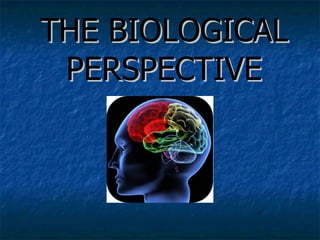
THE BIOLOGICAL PERSPECTIVE
Biological Perspective Linking the  introspective study of consciousness  (what you are thinking and feeling based on mental self-report) With what is happening at the biological level?  ( brain activity  at different sites and changes in chemical messengers)
Methodologies Correlational Studies  Experiments Observations Case Studies
Brain/Behavior Link Our ancestors understood that the brain and behavior are linked . For example a  strong blow to the head  can result in: A change of consciousness A change in perception Memory loss Loss of movement
Trepanation 40,000 –year-old skulls show evidence that parts of the skull were deliberately removed . May have been a medical treatment or to release evil spirits. Sometimes practices by tribal groups in  “religious” ceremonies. The presence of trepanated skulls does suggest an awareness of the link between brain and behavior .
Correlational Studies Psychologists  investigate the relationship between the brain and behavior  by examining what happens after the  brain is damaged – either accidentally or deliberately as part of an experiment Examples include:  stroke, epileptic seizure or head injury Studies are  correlational   because  changes in behavior are assumed to be related to brain damage
Observations An alternative way of studying brain function is to  stimulate the brain itself  and  then observe what happens Methods include: Chemical stimulation Electrical stimulation Magnetic stimulation
Methods of Investigating Brain Function: Accidental Damage Deliberate Damage Stimulation of the Brain
ACCIDENTAL DAMAGE Researchers use these natural experiments to compare the alteration in psychological functioning with the location of damage by scan, surgery, or autopsy. Damage may be caused by: 1.  strokes 2.  head trauma 3.  virus
Advantages/Disadvantages Advantages:   the altering damage occurs naturally so there are less ethical problems compared to other methods. Disadvantages:   1.  Lack of precision 2.  Comparison problems 3.  other non-physical effects may be  responsible for behavioral differences.
Case Studies Are useful when there are  few examples of a particular type of damage Case studies can illustrate how we can determine brain function by looking at what happens to behavior when specific parts of the brain are damaged Excellent example of a case study is Phineas Gage.
Phineas Gage Phineas P. Gage  was a railroad construction foreman now remembered for his incredible survival of an accident in which a large iron rod was driven completely through his head, destroying one or both of his brain's frontal lobes, and for that injury's reported effects on his personality and behavior—effects said to be so profound that friends saw him as "no longer Gage."
Phineas Gage The damage to Gage’s frontal cortex resulted in a loss of social inhibitions, which led to inappropriate behavior.
Significant injury to the brain is often fatal , but as noted earlier the iron's 1/4-inch leading point may have reduced its destructiveness, and apparently all important blood vessels were spared.  Nonetheless, the  brain tissue destroyed must have been substantial  (considering not only the initial trauma but the subsequent infection as well)  though debate as to whether this was in both frontal lobes, or primarily the left,  began with the earliest papers by physicians who had examined Gage
Gage is a fixture in the curricula of neurology, psychology and related disciplines, and is frequently mentioned in books and academic papers; he also has a minor place in popular culture. Relative to this celebrity, the body of known fact about the case is remarkably small, so that historically it has been cited in support of mutually incompatible theories of the brain
 
CLIVE WEARING
On March 27, 1985, Wearing, then an acknowledged expert in early music at the height of his career with BBC Radio 3, contracted a virus which normally causes only cold sores. In Wearing's case  the virus attacked the brain (Herpes simplex encephalitis). Since this point, he has been unable to store new memories. He has also been unable to control emotions and associate memories well.
Clive Wearing Wearing developed a profound case of total amnesia as a result of his illness. Because  an area of the brain required to transfer memories from working memory to long-term memory is damaged, he is completely unable to form lasting new memories .  He spends every day 'waking up' every few seconds, 'restarting' his consciousness once the time span of his short term memory elapses (about 30 seconds).  He remembers little of his life before 1985; he knows, for example, that he has children from an earlier marriage, but cannot remember their names.
Clive Wearing In a diary provided by his caretakers, Clive was encouraged to record his thoughts. Page after page is filled with entries similar to the following: 8:31 AM: Now I am really, completely awake. 9:06 AM: Now I am perfectly, overwhelmingly awake. 9:34 AM: Now I am superlatively, actually awake
Test Friday Know the difference between biological, cognitive, and learning perspectives. Ethical Considerations Reductionism Freewill/Determinism Structuralism/Functionalism Collectivism/Individualism Cultural Bias
Stimulation of the Brain Electrical Stimulation-  aims to stimulate brain areas with microelectrodes to reveal their function through behavioral change. Examples: -animal studies- Delgado -human studies-  Penfield
Electrical Stimulation Eduard Hitzig (1838-1907) Hitzig in 1860’s worked on patients who had  pieces of their skulls blown away in battle and he stimulated exposed brains with wires connected to a battery Gustav Fritish (1828-1929) Hitzig discovered  weak electric shocks applied to areas at the back of the brain,   caused the patients’ eyes to move.
Electrical Stimualtion Hitzig and Fritsch set up a makeshift lab in Fritsch’s house Stimulated the brains of live dogs Found that they could cause  crude movements of the dog’s bodies. Found specific areas of the brain controlled specific movements Question of ethics in non-human studies
Wilder Penfield Wilder Penfield  (1891-1976) Neurosurgeon specializing in the  surgical treatment of epilepsy Kept his patients awake  so they could talk to him about what they were feeling as  he stimulated areas of the brain to locate seizure activity. Developed a map of the somatosensory cortex showing how much space is taken up by the different regions of the body.
Chemical Stimulation Microdialysis – a micropipette is used to deliver a neurotransmitter into a neuronal synapse Can be used in reverse to extract neurotransmitters
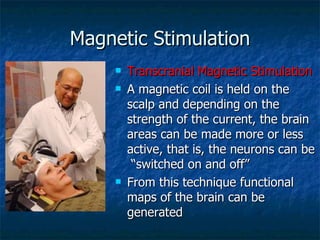
Magnetic Stimulation Transcranial Magnetic Stimulation A magnetic coil is held on the scalp and depending on the strength of the current, the brain areas can be made more or less active, that is, the neurons can be  “switched on and off” From this technique functional maps of the brain can be generated
Trans-cranial Magnetic Stimulation
Advantages/Disadvantages Advantages Less Harmful to stimulate the brain then to physically damage it. More Valid-  it is a better way to investigate living function of brain areas. Disadvantages Invasive technique Interconnectedness
Deliberate Damage Ablation/Lesion Studies-  these studies aim to investigate the function by removing areas of the brain or destroying links between areas. Some of the psychological functions investigated have included: -Motivation -Aggression -Memory -Consciousness -Psychopatholgy Roger Sperry
Experimental Exposure Effects These aim to influence brain physiology by using environmental distortion or deprivation.
Lesion A lesion is when a part of the brain is either  destroyed or its function is disrupted . Lesions can occur naturally such as following a stroke or after a seizure.
BRAIN LESIONS Some lesions are from brain injury or trauma and some experiments have been conducted to deliberately lesion a portion of the brain.
Brain Lesioning Some experiments have been conducted to deliberately lesion the brain Electrodes can be placed in the brain and a current applied Toxins can be injected into specific brain sites using a micropipette
Ablation Ablation is when a part of the brain is removed. MRI of normal brain (right) and fluid-filled or ablated brain (left).
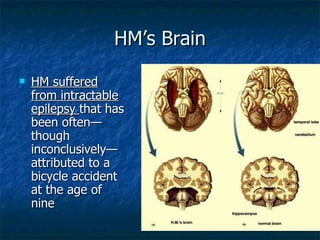
The HM Case Henry Gustav Molaison  (February 26, 1926 – December 2, 2008), better known as  HM  or  H.M. ,  was a memory-impaired patient who was widely studied from the late 1950s until his death. His case played a very important role in the development of  theories that explain the link between brain function and memory,  and in the development of cognitive neuropsychology, a branch of psychology that aims to understand how the structure and function of the brain relates to specific psychological processes.
HM’s Brain HM suffered from intractable epilepsy  that has been often—though inconclusively—attributed to a bicycle accident at the age of nine
The Surgery After the surgery—which was  successful in its primary goal of controlling his  epilepsy—he suffered from severe anterograde amnesia: although his working memory and procedural memory were intact, he could not commit new events to long-term memory
Split Brain- Roger Sperry In the 19th century, research on people with certain brain injuries,  made it possible to suspect that the "language center" in the brain was commonly situated in the left hemisphere.  One had observed that people with lesions in two specific areas on the left hemisphere lost their ability to talk, for example.
Right Brain/Left Brain In the 1960s, there was no other cure for people who suffered from a special kind of epilepsy than by cutting off the connection,  corpus callosum , between the two hemispheres.  Sperry had 10 patients who underwent the operation. The area used to transfer information from the right hemisphere to the left hemisphere was disrupted.
Right vision field is connected to the left hemisphere.  Left vision field is connected to the right hemisphere.
“ Split Brain” Studies Robert Sperry Visual field information is processed in the contralateral hemisphere
Advantages/Disadvantages Advantages: Greater control and precision in the location of the damage. Ability to compare the behavior before and after the alteration. Disadvantages: Ethical problems of intervention. Non-human findings Plasticity- the brain can compensate for damage.  Might not disturb the performance of the rest of the brain.
Wearing developed a profound case of total amnesia as a result of his illness. Because the hippocampus, an area required to transfer memories from short-term to long-term memory is damaged, he is completely unable to form lasting new memories – his memory only lasts between 7 and 30 seconds
Methods of Investigating Brain Function Measurement Direct Recording of Neuronal Activity Microelectrodes are inserted into single neural cells and record their electrochemical activity. Hubel and Wiesel measured the activity of single neuronal cells in the visual cortex of monkeys.
Advantages/Disadvantages Advantages:  Extremely precise. Disadvantages:  -very time-consuming. -too focused, neglects the interactions between nerve cells. -invasive method
External Recording of Brain Activity Aims to detect brain activity from measurements made at the surface of the skull. EEG-electroencephalograms-brain waves under the scalp. EOG- electrooculargrams- eye movement EMG- electrobyograms- muscles to measure tension
Advantages/Disadvantages Advantages Non-invasive Practical for use with sleep, brain damage, epilepsy, and Alzheimer’s disease, etc.. Disadvantages Crude measure. The EEG’s indicate the activity level but not the precise function of the neurons involved.

Drugan Notes- Biological Perspective

  • 1.
  • 2.
    Biological Perspective Linkingthe introspective study of consciousness (what you are thinking and feeling based on mental self-report) With what is happening at the biological level? ( brain activity at different sites and changes in chemical messengers)
  • 3.
    Methodologies Correlational Studies Experiments Observations Case Studies
  • 4.
    Brain/Behavior Link Ourancestors understood that the brain and behavior are linked . For example a strong blow to the head can result in: A change of consciousness A change in perception Memory loss Loss of movement
  • 5.
    Trepanation 40,000 –year-oldskulls show evidence that parts of the skull were deliberately removed . May have been a medical treatment or to release evil spirits. Sometimes practices by tribal groups in “religious” ceremonies. The presence of trepanated skulls does suggest an awareness of the link between brain and behavior .
  • 6.
    Correlational Studies Psychologists investigate the relationship between the brain and behavior by examining what happens after the brain is damaged – either accidentally or deliberately as part of an experiment Examples include: stroke, epileptic seizure or head injury Studies are correlational because changes in behavior are assumed to be related to brain damage
  • 7.
    Observations An alternativeway of studying brain function is to stimulate the brain itself and then observe what happens Methods include: Chemical stimulation Electrical stimulation Magnetic stimulation
  • 8.
    Methods of InvestigatingBrain Function: Accidental Damage Deliberate Damage Stimulation of the Brain
  • 9.
    ACCIDENTAL DAMAGE Researchersuse these natural experiments to compare the alteration in psychological functioning with the location of damage by scan, surgery, or autopsy. Damage may be caused by: 1. strokes 2. head trauma 3. virus
  • 10.
    Advantages/Disadvantages Advantages: the altering damage occurs naturally so there are less ethical problems compared to other methods. Disadvantages: 1. Lack of precision 2. Comparison problems 3. other non-physical effects may be responsible for behavioral differences.
  • 11.
    Case Studies Areuseful when there are few examples of a particular type of damage Case studies can illustrate how we can determine brain function by looking at what happens to behavior when specific parts of the brain are damaged Excellent example of a case study is Phineas Gage.
  • 12.
    Phineas Gage PhineasP. Gage was a railroad construction foreman now remembered for his incredible survival of an accident in which a large iron rod was driven completely through his head, destroying one or both of his brain's frontal lobes, and for that injury's reported effects on his personality and behavior—effects said to be so profound that friends saw him as "no longer Gage."
  • 13.
    Phineas Gage Thedamage to Gage’s frontal cortex resulted in a loss of social inhibitions, which led to inappropriate behavior.
  • 14.
    Significant injury tothe brain is often fatal , but as noted earlier the iron's 1/4-inch leading point may have reduced its destructiveness, and apparently all important blood vessels were spared. Nonetheless, the brain tissue destroyed must have been substantial (considering not only the initial trauma but the subsequent infection as well) though debate as to whether this was in both frontal lobes, or primarily the left, began with the earliest papers by physicians who had examined Gage
  • 15.
    Gage is afixture in the curricula of neurology, psychology and related disciplines, and is frequently mentioned in books and academic papers; he also has a minor place in popular culture. Relative to this celebrity, the body of known fact about the case is remarkably small, so that historically it has been cited in support of mutually incompatible theories of the brain
  • 16.
  • 17.
  • 18.
    On March 27,1985, Wearing, then an acknowledged expert in early music at the height of his career with BBC Radio 3, contracted a virus which normally causes only cold sores. In Wearing's case the virus attacked the brain (Herpes simplex encephalitis). Since this point, he has been unable to store new memories. He has also been unable to control emotions and associate memories well.
  • 19.
    Clive Wearing Wearingdeveloped a profound case of total amnesia as a result of his illness. Because an area of the brain required to transfer memories from working memory to long-term memory is damaged, he is completely unable to form lasting new memories . He spends every day 'waking up' every few seconds, 'restarting' his consciousness once the time span of his short term memory elapses (about 30 seconds). He remembers little of his life before 1985; he knows, for example, that he has children from an earlier marriage, but cannot remember their names.
  • 20.
    Clive Wearing Ina diary provided by his caretakers, Clive was encouraged to record his thoughts. Page after page is filled with entries similar to the following: 8:31 AM: Now I am really, completely awake. 9:06 AM: Now I am perfectly, overwhelmingly awake. 9:34 AM: Now I am superlatively, actually awake
  • 21.
    Test Friday Knowthe difference between biological, cognitive, and learning perspectives. Ethical Considerations Reductionism Freewill/Determinism Structuralism/Functionalism Collectivism/Individualism Cultural Bias
  • 22.
    Stimulation of theBrain Electrical Stimulation- aims to stimulate brain areas with microelectrodes to reveal their function through behavioral change. Examples: -animal studies- Delgado -human studies- Penfield
  • 23.
    Electrical Stimulation EduardHitzig (1838-1907) Hitzig in 1860’s worked on patients who had pieces of their skulls blown away in battle and he stimulated exposed brains with wires connected to a battery Gustav Fritish (1828-1929) Hitzig discovered weak electric shocks applied to areas at the back of the brain, caused the patients’ eyes to move.
  • 24.
    Electrical Stimualtion Hitzigand Fritsch set up a makeshift lab in Fritsch’s house Stimulated the brains of live dogs Found that they could cause crude movements of the dog’s bodies. Found specific areas of the brain controlled specific movements Question of ethics in non-human studies
  • 25.
    Wilder Penfield WilderPenfield (1891-1976) Neurosurgeon specializing in the surgical treatment of epilepsy Kept his patients awake so they could talk to him about what they were feeling as he stimulated areas of the brain to locate seizure activity. Developed a map of the somatosensory cortex showing how much space is taken up by the different regions of the body.
  • 26.
    Chemical Stimulation Microdialysis– a micropipette is used to deliver a neurotransmitter into a neuronal synapse Can be used in reverse to extract neurotransmitters
  • 27.
    Magnetic Stimulation TranscranialMagnetic Stimulation A magnetic coil is held on the scalp and depending on the strength of the current, the brain areas can be made more or less active, that is, the neurons can be “switched on and off” From this technique functional maps of the brain can be generated
  • 28.
  • 29.
    Advantages/Disadvantages Advantages LessHarmful to stimulate the brain then to physically damage it. More Valid- it is a better way to investigate living function of brain areas. Disadvantages Invasive technique Interconnectedness
  • 30.
    Deliberate Damage Ablation/LesionStudies- these studies aim to investigate the function by removing areas of the brain or destroying links between areas. Some of the psychological functions investigated have included: -Motivation -Aggression -Memory -Consciousness -Psychopatholgy Roger Sperry
  • 31.
    Experimental Exposure EffectsThese aim to influence brain physiology by using environmental distortion or deprivation.
  • 32.
    Lesion A lesionis when a part of the brain is either destroyed or its function is disrupted . Lesions can occur naturally such as following a stroke or after a seizure.
  • 33.
    BRAIN LESIONS Somelesions are from brain injury or trauma and some experiments have been conducted to deliberately lesion a portion of the brain.
  • 34.
    Brain Lesioning Someexperiments have been conducted to deliberately lesion the brain Electrodes can be placed in the brain and a current applied Toxins can be injected into specific brain sites using a micropipette
  • 35.
    Ablation Ablation iswhen a part of the brain is removed. MRI of normal brain (right) and fluid-filled or ablated brain (left).
  • 36.
    The HM CaseHenry Gustav Molaison (February 26, 1926 – December 2, 2008), better known as HM or H.M. , was a memory-impaired patient who was widely studied from the late 1950s until his death. His case played a very important role in the development of theories that explain the link between brain function and memory, and in the development of cognitive neuropsychology, a branch of psychology that aims to understand how the structure and function of the brain relates to specific psychological processes.
  • 37.
    HM’s Brain HMsuffered from intractable epilepsy that has been often—though inconclusively—attributed to a bicycle accident at the age of nine
  • 38.
    The Surgery Afterthe surgery—which was successful in its primary goal of controlling his epilepsy—he suffered from severe anterograde amnesia: although his working memory and procedural memory were intact, he could not commit new events to long-term memory
  • 39.
    Split Brain- RogerSperry In the 19th century, research on people with certain brain injuries, made it possible to suspect that the "language center" in the brain was commonly situated in the left hemisphere. One had observed that people with lesions in two specific areas on the left hemisphere lost their ability to talk, for example.
  • 40.
    Right Brain/Left BrainIn the 1960s, there was no other cure for people who suffered from a special kind of epilepsy than by cutting off the connection, corpus callosum , between the two hemispheres. Sperry had 10 patients who underwent the operation. The area used to transfer information from the right hemisphere to the left hemisphere was disrupted.
  • 41.
    Right vision fieldis connected to the left hemisphere. Left vision field is connected to the right hemisphere.
  • 42.
    “ Split Brain”Studies Robert Sperry Visual field information is processed in the contralateral hemisphere
  • 43.
    Advantages/Disadvantages Advantages: Greatercontrol and precision in the location of the damage. Ability to compare the behavior before and after the alteration. Disadvantages: Ethical problems of intervention. Non-human findings Plasticity- the brain can compensate for damage. Might not disturb the performance of the rest of the brain.
  • 44.
    Wearing developed aprofound case of total amnesia as a result of his illness. Because the hippocampus, an area required to transfer memories from short-term to long-term memory is damaged, he is completely unable to form lasting new memories – his memory only lasts between 7 and 30 seconds
  • 45.
    Methods of InvestigatingBrain Function Measurement Direct Recording of Neuronal Activity Microelectrodes are inserted into single neural cells and record their electrochemical activity. Hubel and Wiesel measured the activity of single neuronal cells in the visual cortex of monkeys.
  • 46.
    Advantages/Disadvantages Advantages: Extremely precise. Disadvantages: -very time-consuming. -too focused, neglects the interactions between nerve cells. -invasive method
  • 47.
    External Recording ofBrain Activity Aims to detect brain activity from measurements made at the surface of the skull. EEG-electroencephalograms-brain waves under the scalp. EOG- electrooculargrams- eye movement EMG- electrobyograms- muscles to measure tension
  • 48.
    Advantages/Disadvantages Advantages Non-invasivePractical for use with sleep, brain damage, epilepsy, and Alzheimer’s disease, etc.. Disadvantages Crude measure. The EEG’s indicate the activity level but not the precise function of the neurons involved.