NATURE VS NURTURE
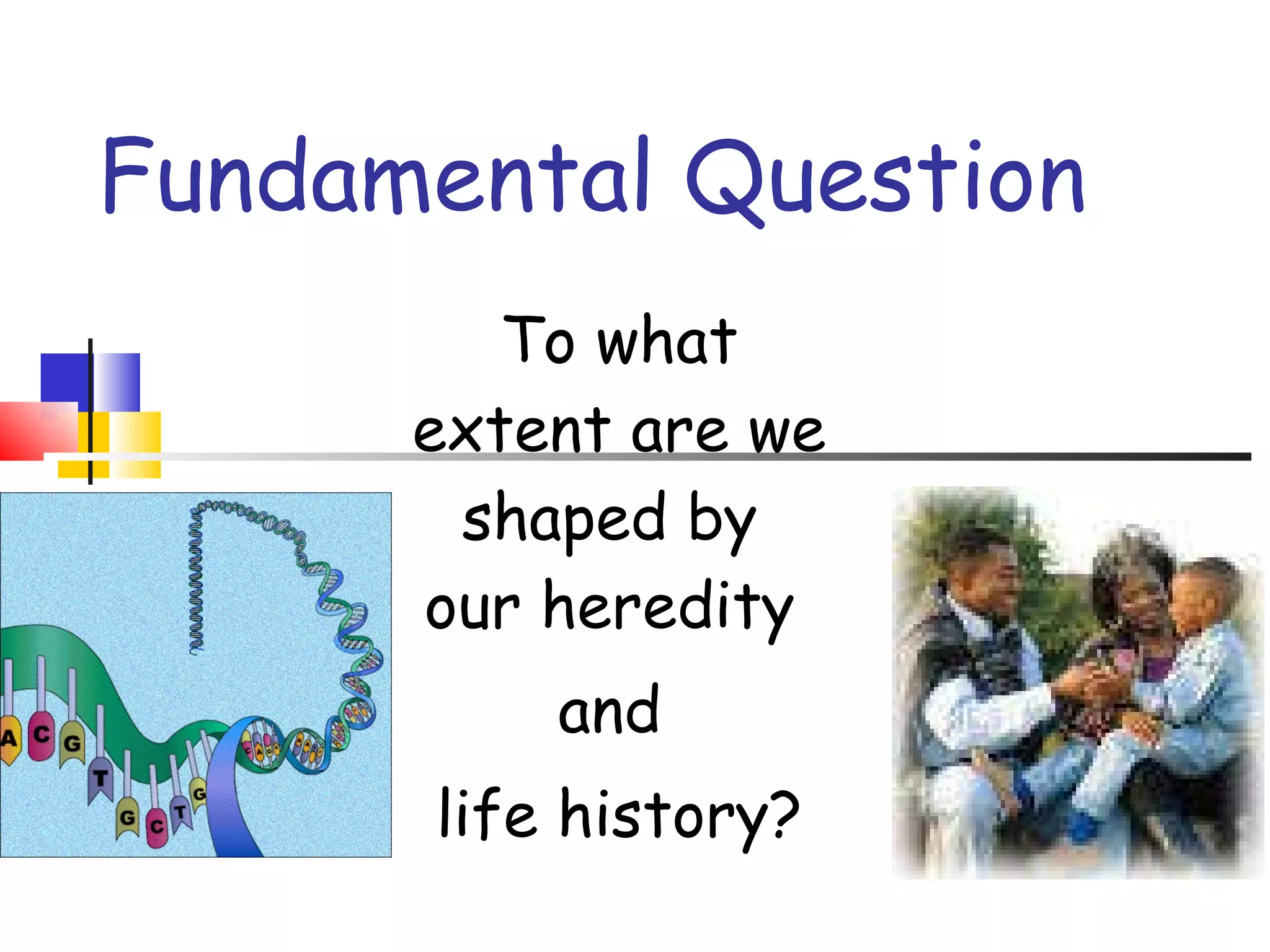
Fundamental Question To what extent are we shaped by  our heredity  and  life history?
NATURE, NURTURE, AND HUMAN DIVERSITY   Topics:   Behavior Genetics Evolutionary Psychology Parents and Peers Cultural Influences Gender Development Why are we so different yet very much the same?
Nature vs. Nurture and the Perspectives PSYCHOANALYTIC Innate biological forces (nature) are paramount but early experiences interact with these to shape personality. BEHAVIORIST Environmental experiences are paramount (nurture) although our physical make-up will impose limitations.
HUMANISTIC Shared biological type (nature) means that humans are all motivated by the same need to achieve their potential.  Life (nurture) can help hinder this. COGNITIVE Nature and nurture cannot be separated.  The organization and operation of the brain and how we process information are affected by both.
Perspectives… BIOLOGICAL Nature and nurture are inseparable.  They determine our physical make-up and interact to produce behavior.
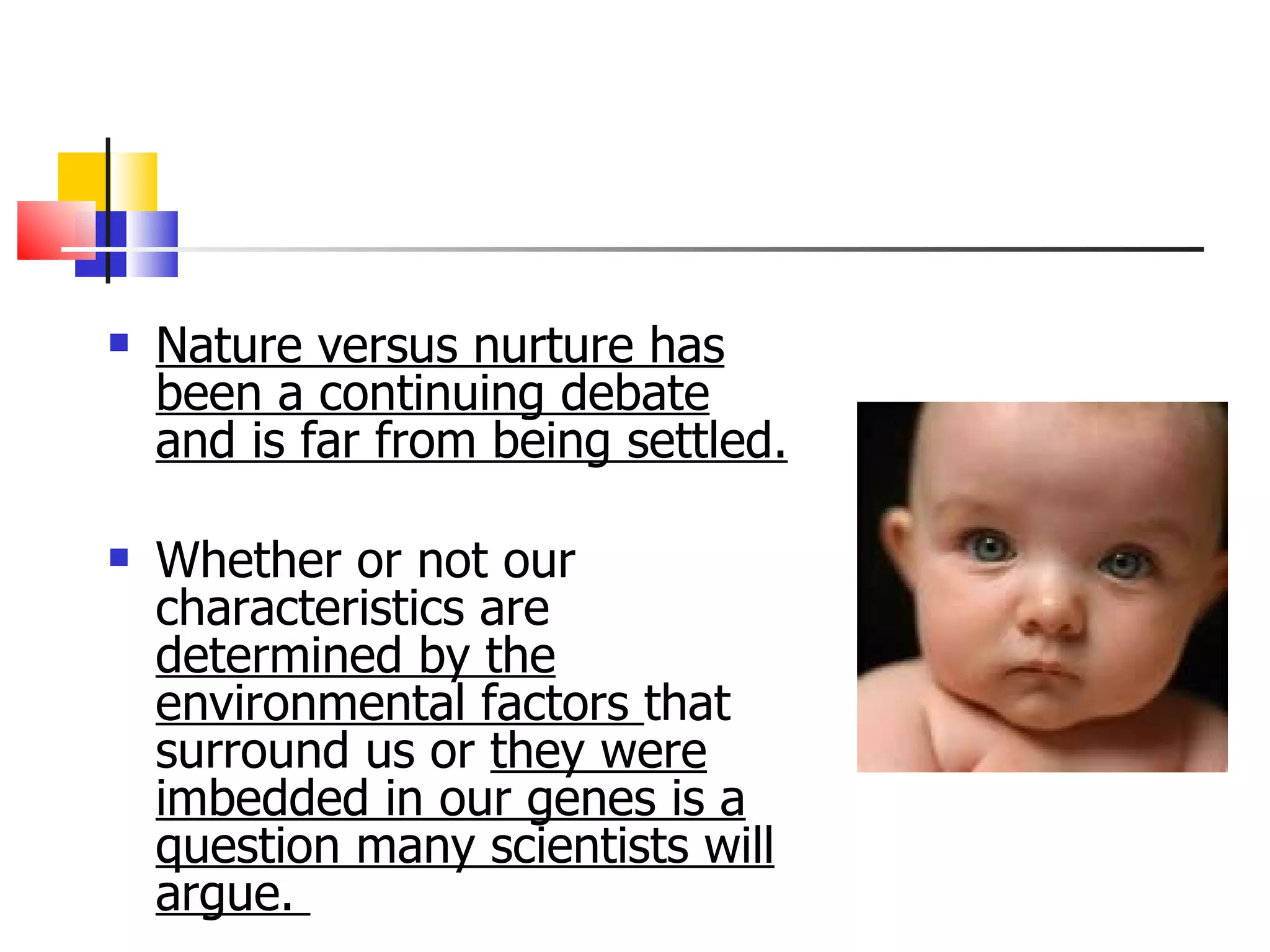
Nature versus nurture has been a continuing debate and is far from being settled.  Whether or not our characteristics are  determined by the environmental factors  that surround us or  they were imbedded in our genes is a question many scientists will argue.
HISTORY OF THE DEBATE Traditionally, human nature has been thought of as not only inherited but divinely ordained . Whole ethnic groups were considered to be, by nature, superior or inferior.  In scientific circles, this conflict led to ongoing controversy of sociobiology and evolutionary psychology.
CHARLES DARWIN He published his theory with compelling evidence for evolution in his 1859 book  On the Origin of Species .  In modified form, Darwin's scientific discovery is the unifying theory of the life sciences, explaining the diversity of life.  Darwin’s theory of evolution, with its message that traits were inherited, influenced early psychologists .
Evolutionary Psychology Evolutionary Psychology  explains psychological traits—such as memory, perception, or language—as adaptations, that is, as the functional products of natural selection or sexual selection.  Modern evolutionary psychologists argue that much of  human behavior is generated by psychological adaptations that evolved to solve recurrent problems in human ancestral environments.
Example: They hypothesize, for example, that  humans have inherited special mental capacities for acquiring language, making it nearly automatic , while inheriting no capacity specifically for reading and writing.
Evolutionary Psychology:  Phobias Phobias are generally caused by an event recorded by the amygdala and hippocampus  and labeled as deadly or dangerous; thus whenever a specific situation is approached again  the body reacts as if the event were happening repeatedly afterward.
Evolutionary Psychology How does natural selection work with regards to behavior? Survival-oriented behavior is  passed on. Examples:  Fears Why do people not have phobias of electricity?  It can cause death just like a poisonous snake.
Sociobiology Sociobiology  is a  synthesis of scientific disciplines which attempts to explain social behavior in animal species by considering the Darwinian advantages specific behaviors may have.  It is often considered a branch of biology and sociology, but also draws from ethology, anthropology, evolution, zoology, archaeology, population genetics and other disciplines.
Behavior Genetics How much are our behavior differences shaped by our genetic differences?  How much by our environment? To what extent are we molded by our upbringing, our culture? Behavior geneticists study our differences and weigh the relative effects of heredity and environment.
GENES Genes are working subunits of DNA. DNA is a vast chemical information database  that carries the complete set of instructions for making all the proteins a cell will ever need.  Genetic traits:  eye color, hair color, dimples…
Genes vs. the Environment Some people look at there being  two "buckets", genes and environment, each able to hold a certain capacity of the trait.  It would be more accurate to represent how the genes interact with the diagram on the right.  It is more of a blending of environment and heritability.
Hitchhiker’s Thumb Parents N offspring H offspring Percent N N x N 281 32 90% N x H 71 37 66% H x H 1 30 3%
Curled Tongue Parents R offspring NR offspring R x R 28 5 R x NR 33 22 NR x NR 4 9
Right Thumb, Left Thumb Left thumb on top is supposed to indicate a logical thinker.  Right thumb on top suggests a more creative mind.  What do you think about this? Parents L offspring R offspring percent L L x L 1252 880 59% L x R 2309 2573 47% R x R 1298 2815 32%
Vulcan Hand
Earlobes:  Free or Attached Some people have earlobes that curve up between the lowest point of the earlobe and the point where the ear joins the head; these are known as "free" or "unattached" earlobes, as shown in the upper left of the picture below. Other people have earlobes that blend in with the side of the head, known as "attached" or "adherent" earlobes, as shown in the lower right.
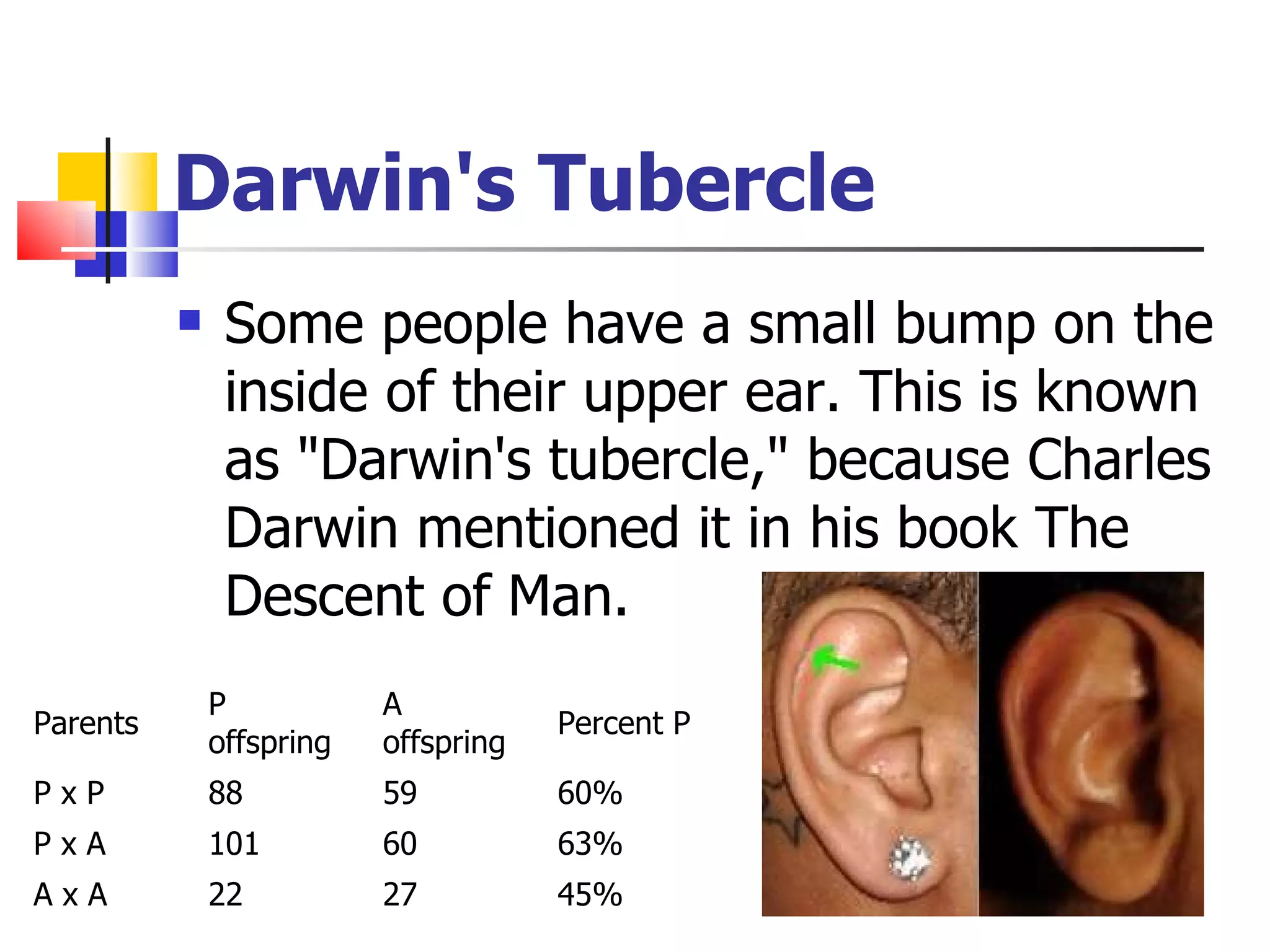
Darwin's Tubercle Some people have a small bump on the inside of their upper ear. This is known as "Darwin's tubercle," because Charles Darwin mentioned it in his book The Descent of Man. Parents P offspring A offspring Percent P P x P 88 59 60% P x A 101 60 63% A x A 22 27 45%
Traits According to search engine trackers, the phrase  “are inherited traits influenced by the environment ?” is one of the most asked science questions online, with hundreds of hits on Google per day.   On the surface though, it appears a needless question;  of course traits that have a genetic component are also influenced by the environment .
Behavior Genetics Attempts to explain individual differences by using twin studies and adoption studies.
Behavior Genetics How much are our behavior differences shaped by genetic differences? Behavior Geneticists study our differences and weigh the  relative effects of heredity and environment . Human genome researchers have discovered the common sequence within human DNA.  It is the shared genetic profile that makes us humans. Human traits are influenced by  gene complexes- many genes acting in concert .
What is Tabula Rasa? Tabula rasa   is the thesis that individuals are born without built-in mental content and that their knowledge comes from experience and perception . Generally proponents of the  tabula rasa  thesis favor the "nurture" side of the nature versus nurture debate,  when it comes to aspects of one's personality, social and emotional behavior, and intelligence.
Environmental Influence Five ways we are shaped along with genes: 1.  Prenatal environment 2.  Early experience 3.  Peer Influence 4.  Culture 5.  Gender influences
What is inherited? Handedness Personality Aggressiveness Happiness I.Q. Gender Identity
Is Handedness Inherited? There was a time, not too long ago, when left-handed children felt actively oppressed--and they were right!  Teachers whacked their hands, other children teased them, and they were made to feel that their handedness was a reflection of flawed character.
Man during the stone-age time, used to kill animals using spears. After colonies came, man started to fight against other colonies and also among themselves.  But as time passed, they noticed that when they attacked the left part of the chest (i.e. the heart) the kill was faster(i.e. the victim would die faster).  Back to the Caveman Days
The Shield Later when he started advancing in technology, he started to use a shield for defense.  But as they knew that the weak point was on the left of the chest (heart), the shield was used with the left hand and attacking was done using the right hand
HANDEDNESS Studying from pre-historic times, right-handedness prevails in all human cultures. Bias toward the right hand is unique to humans and primates. Right-handedness  is most common. Right-handed people are more dexterous with their right hands when performing a task.  Left-handedness  is less common than right-handedness. Left-handed people are more dexterous with their left hands when performing a task. About 8-15% of people are left-handed.
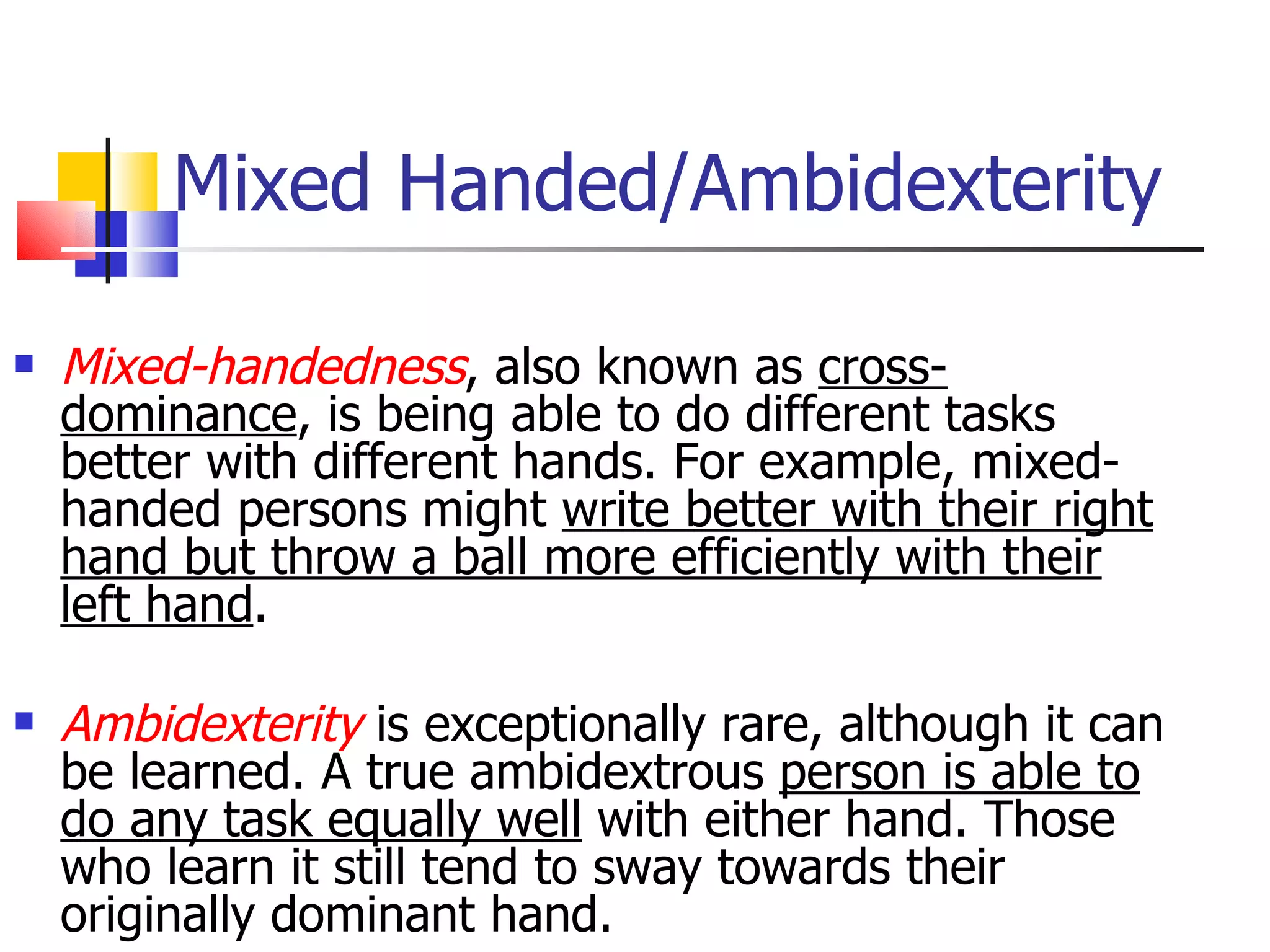
Mixed Handed/Ambidexterity Mixed-handedness , also known as  cross-dominance , is being able to do different tasks better with different hands. For example, mixed-handed persons might  write better with their right hand but throw a ball more efficiently with their left hand .  Ambidexterity  is exceptionally rare, although it can be learned. A true ambidextrous  person is able to do any task equally well  with either hand. Those who learn it still tend to sway towards their originally dominant hand.
Left Hand Discrimination This unfair treatment of lefties was--and still is--a worldwide phenomenon. In many parts of the world, the left hand is considered "unclean," and left-handedness is simply not tolerated; the word for "left" often has strongly negative connotations
Lefties Are the Only Ones in the Right Mind. 90% of the population is right-handed.  Of the 10% who are left-handed, there are more males than females. 95% of right-handers process information in their left hemisphere, which tends to be slightly larger. Left-handers tend to be more diverse. 50% process speech in their left hemisphere, as right-handers do.  25% process language in the right hemisphere, the other quarter use both hemispheres.
Lefty Brain Teasers Because their brains are organized differently, left-handers see and think differently and can get some very different results from various "brain tests", usually doing very well on tests that involve creative thinking or unraveling complex images and manipulating 3D images. Here's a famous test of creativity - have a look at the image below:
Thurston's hand test  The left-handed brain's mastery of the visual has an important benefit - it can "see" three dimensionally. In Thurston's hand test, you are asked to identify which pictures are of left hands and which are of right hands. Your right-handed brain is at a loss to handle this problem, but your left-handed brain can actually rotate these drawings in imaginary space to solve the test - have a go!
Famous Left-Handers Luke Skywalker Julius Caesar  Beethoven Sarah Jessica Parker Leonardo da Vinci Tom Cruise  Aristotle  Gandhi Matthew Broderick Alexander the Great
Imagine the centre of your back is itching. Which hand do you scratch it with?  Interlock your fingers. Which thumb is uppermost?  Imagine you are applauding. Start clapping your hands. Which hand is uppermost?  Wink at and imaginary friend straight in front of you. Which eye does the winking?  Put your hands behind your back, one holding the other. Which hand is doing the holding?  Someone in front of you is shouting but you cannot hear the words. Cup your ear to hear better. Which ear do you cup?  Count to three on your fingers, using the forefinger of the other hand. Which forefinger do you use?  Tilt your head to one shoulder. Which shoulder does it touch?  Fixate a small distant object with your eyes and point directly at it with your forefinger. Now close one eye. Now change eyes. Which eye was open when the fingertip remained in line with the small object? (when the other eye, the non-dominant one, is open and the dominant eye is closed, the finger will appear to move to one side of the object.)  Fold your arms. Which forearm is uppermost?
 
The most debated issue pertaining to the nature theory is the existence of a "gay gene," pointing to a genetic component to sexual orientation. A closer look at the issue of gender helps to explain the nurture side of the argument.
What is Gender? A  Gender  difference  is a distinction of biological and/or physiological characteristics typically associated with either males or females of a species in general.  In the study of humans , socio-political issues arise  in  classifying whether a sex difference results from the biology of gender or our experiences .  Quantitative differences  are based on a gradient and involve different averages. For example, men are taller than women on average, but an individual woman may be taller than an individual man.
What is a Schema? In psychology a schema is an  organized pattern of thought about a certain subject. It is  a mental structure  that we create. It is a  cognitive representation  of our views on a certain subject.
What Schema do you have for the following: A fireman A ballet dancer A politician A college student A male A female
What is gender identity? Gender identity is the individual’s subjective sense of belonging to the male or female category or indeed neither of the two. Gender may determine self concept and self esteem. Gender may determine the talents that are cultivated/encouraged (boys vs girls knowledge & skills). Biologically sex differences may also determine traits.
Gender Roles Gender roles are our expectations about the way men and women behave . 30 years ago: Men were expected to initiate dates, drive the car, pick  up the check. Women were expected to decorate the home, raise the children, and cook and clean. Do gender roles reflect what is biologically natural for men and women or do cultures construct them?
Pink vs. Blue Gender differences surface early in children’s play.  Boys typically play in large groups with activity focus and little intimate discussion.  Girls usually play in smaller groups with one friend . Girls are less competitive  in their play than boys and  initiate social relationships.
Child Rearing Gender Identity :  our sense of being male or female. Gender-typed:   some boys exhibit more masculine traits and some girls exhibit more feminine traits. Social Learning Theory  This theory assumes that children learn gender-linked behaviors by observing and imitating and by being rewarded or punished .  “ Big boys don’t cry.” Or “You are a good mommy to your dolls.”
Would you let your son have a dollhouse? Would you allow your daughter to join the wrestling team?
Sex identity Sex means biological maleness/femaleness Genetic sex denotes chromosomes (xy & xx)
Sex as identity  Anatomical sex denotes the physical sex features  Gender therefore becomes the psycho-social meaning attached to the biological maleness & femaleness
Theories of gender identity
Gender Schema Theory This theory combines social learning theory with cognition.  Gender becomes a lens through which you view your experiences. Age 1-  Children discriminate between male and female voices. Age 2- Children organize their language according to gender he/she Age 3/4- Children seek out their own gender for play. Age 5/6- Stereotypes about boys/girls peek.
Gender schema theory Links cognitive development with social learning theory in the sense that schemas are socialized cognitive networks of sex & gender roles People with high gender schemas are more prone to stereotypic perception & behavior. High schemas facilitate the  creation of cognitive gender stereotypes & gender values.
Social learning theory Almost from birth children are  treated in gender specific ways  (e.g birth day cards & dress) Parents & society reinforce gender specific behaviours & attitudes. Boys and girls imitate males & females respectively
Identity constructed theory This theory emphasises the individual’s sense of commitment to a gender category. The gender category may conflict with social norms  (McManus 1999) - may lead to gender dysphoria.
Gender Dysphoria Crossdressing Transsexuality Gender Identity Disorder (GID) Hormones & sex reassignment surgery Other gender variant issues
Gender dysphoria When sex identity is in conflict with gender identity (biological vs psycho-social  identity) Sex identity is given & genetic while gender identity & roles are culturally constructed.
Transition 1998 2001
Gender and Culture A number of studies have been conducted in western cultures for the most part, specifically North America and Western Europe.  Most of the research has indicated that sex differences in expressing emotion tend to be greater in North America than in other cultures, particularly Asian culture. Culture impacts gender differences in the expression of emotions.  This may be partly explained by the different social roles  (social role) men and women have in different cultures, and by the status and power men and women hold in different societies, as well as the different cultural values various societies hold
Enculturated-lens theory Development of gender identity is embedded in socio-historical context of each culture. Culture operates as lens through which gender identity & gender roles are defined & passed on as memes of behavior. Androgyny is the socialized freedom to identify with male or female roles (Bem 1993).
Physical Health From conception to death, but particularly before adulthood,  females are less vulnerable than males to developmental difficulties and chronic illnesses.  This could be due to females having two x chromosomes instead of just one, or being unexposed to testosterone.  What other reasons might contribute to this?
Neurology Female brains are more compact than male brains in that, though smaller, they are more densely packed with neurons, particularly in the region responsible for language .  Also, females have  language functions evenly  distributed in both cerebral hemispheres, while  in males they are more concentrated in the left hemisphere. This puts males more at risk for language disorders like dyslexia.
Gender and Biology Biological characteristics may partly explain gender differences  Hormonal activities tend to influence mind and body  (e.g.  aggression  & emotionality) Estrogen (associated with xx) may be a  protective hormone associated with longevity Estrogen may also be associated with the slow processing of alcohol & quicker intoxication
Biological theory of gender identity Biologists argue that males with Klinefelter’s syndrome & females with Turner’s syndrome have a very different gender identity Intersexed infants  (born with both male & female genitals) may have to decide which gender category they belong
Klinefelter’s Syndrome Klinefelter's syndrome, 47, XXY or XXY syndrome is a condition in which males have an extra X sex chromosome.  While females have an XX chromosomal makeup, and males an XY, affected individuals have at least two X chromosomes and at least one Y chromosome.   Klinefelter's syndrome is the most common sex chromosome disorder  and the second most common condition caused by the presence of extra chromosomes.
Turner Syndrome Turner syndrome or Ullrich-Turner syndrome (also known as "Gonadal dysgenesis" encompasses several conditions, of which monosomy X (absence of an entire sex chromosome) is most common .  It is a chromosomal disorder in which all or part of one of the sex chromosomes is absent  (unaffected humans have 46 chromosomes, of which 2 are sex chromosomes).  Typical females have 2 X chromosomes, but in Turner syndrome, one of those sex chromosomes is missing or has other abnormalities.
Gender and Discrimination Some feminists see gender differences as caused by patriarchy or discrimination, although different feminism argues for an acceptance of gender differences.  Conservative males  tend to see gender differences as  inherent in human nature , while liberal males see gender differences as caused by matriarchy or discrimination.
Gender Bias in psychological theories. Alpha Bias-  Theories that exaggerates differences between men and women, thus reinforcing stereotype. Beta Bias-  Minimizes the differences between men and women, thus important parts of female life experiences are ignored. These biases exist because of androcentric views are standard/norm. If women display different behaviour to the norm (men) then it is seen as inferior. . .what does not concern the androcentric world will not be investigated. A2 PSYCHOLOGY Lana Crosbie
Examples of gender bias in psychological theories. Moral development-   Kohlberg's work derived from male participants- female. He concluded the latter reached lower levels. Gilligan (1982) suggested that female morality is based on different priorities. Childcare-  Bowlby’s research on maternal care suggested women should needed to stay at home and care for the child . Socialisation-  Freud suggested women suffered from ‘Penis envy’ which will leave traces on their personality development. Erickson proposed women were destined to bear and take care of the offspring of men!! A2 PSYCHOLOGY Lana Crosbie
Reporting Bias . Through interpretation of results:  Results that report differences may well be exaggerating differences and displaying female stereotypes. Selection of material to be published:  Male biased editors of journals and books may filter out research on women and studies that report no difference. A2 PSYCHOLOGY Lana Crosbie
Studies have shown… Some studies show that  males are more inclined to risky behavior than females. In one large scale study, most  cognitive abilities and psychological  traits showed  little or no average difference between the sexes.  Where sex differences exist, there is often considerable overlap between the sexes; in addition, it is unclear how many of these differences hold true across different cultures.
Big Five Personality Traits Openness  - appreciation for art, emotion, adventure, unusual ideas, curiosity, and variety of experience. Conscientiousness  - a tendency to show self-discipline, act dutifully, and aim for achievement; planned rather than spontaneous behavior. Extraversion  - energy, positive emotions, urgency, and the tendency to seek stimulation in the company of others. Agreeableness  - a tendency to be compassionate and cooperative rather than suspicious and antagonistic towards others. Neuroticism  - a tendency to experience unpleasant emotions easily, such as anger, anxiety, depression, or vulnerability.
Gender and the Big 5 In the big five personality traits, women score higher in  Agreeableness  (tendency to be compassionate and cooperative) and  Neuroticism  (tendency to feel anxiety, anger, and depression).  Demographics of the surveys indicate that 60-75% of women prefer feeling and 55-80% of men prefer thinking.
Tannen’s Study Deborah Tannen’s studies found these gender differences in communication styles. The studies also reported that in general both sexes  communicated in similar ways.  Critics, including Suzette Haden Elgin, have suggested that Tannen's findings may apply more to women of certain specific cultural and economic groups than to women in general.  Although it is  widely believed that women speak far more words than men, this is actually not the case .
Tannen’s Results Men tend to talk more than women in public situations, but women tend to talk more than men at home.  Females are more inclined to face each other and make eye contact when talking, while males are more likely to look away from each other.  Boys tend to jump from topic to topic, but girls tend to talk at length about one topic.  When listening, women make more noises such as “mm-hmm” and “uh-huh”, while men are more likely to listen silently.  Women are inclined to express agreement and support, while men are more inclined to debate.
Intelligence Many recent studies have  concluded that IQ performances of men and women vary little . However, one researcher in the United Kingdom, Richard Lynn, has authored research showing advantages to men of variable statistical significance.  Other studies show a greater variance in the IQ performance of men compared to that of women, i.e. men are more represented at the extremes of performance, and less represented at the median.
Recommended reading Bee, H. (1998) Lifespan development (chapter 8) McManus, B.F. (1999) Theories about the construction of gender identity : accessed on the Internet on 29 November 2003@ http:// www..cnr.edu/home/bmcmanus/socialization.html http://www.psych.westminster.edu/womenpsych-ws/child.htm Bem, S., L. (1993) The lenses of gender. Yale University Press: New Haven
I.Q. DEBATE Evidence suggests that family environmental factors may have an effect upon childhood IQ, accounting for up to a quarter of the variance .  On the other hand, by  late adolescence this correlation disappears , such that adoptive siblings are no more similar in IQ than strangers.
 
PERSONALITY Personality is a frequently cited example of a heritable trait that has been studied in twins and adoptions.  Identical twins reared apart are far more similar in personality than randomly selected pairs of people .  Likewise, identical twins are more similar than fraternal twins.  Also,  biological siblings are more similar in personality than adoptive siblings.  Each observation suggests  that personality is inheritable to a certain extent.  However, these  same study designs allow for the examination of environment as well as genes.
 
Twin Studies It is unethical to take a child out of its natural surroundings  to test nature versus nurture, so  identical twins have become the most reliable test  cases for finding the answers of what is learned and what is inherited.
This chart illustrates three patterns one might see when studying the influence of genes and environment on traits in individuals
Even after they are born, it is sometimes difficult to know whether twins are identical or fraternal. It can be easier if they: share one placenta (identical)  are different sexes (fraternal)  have different blood types (fraternal)
It is harder to know if they are the same sex, have the same blood type, or if there are two placentas, since they could then be either fraternal or identical twins. Don't be fooled by a fused placenta (fraternal twins), which can look like it is just one placenta, or if the twins don't look alike. Sometimes, factors during the pregnancy, especially twin to twin transfusion syndrome, can lead to identical twins that have very different birth weights and are mistakenly thought to be fraternal. And sometimes, fraternal twins can look enough alike to be confused with identical twins.
Higher Order Multiples The same factors occur with higher order multiples, with either multiple eggs being fertilized or one or more fertilized eggs splitting. For example, in the case of triplets, you could have: three separate eggs being released and fertilized by three different sperms (fraternal triplets)  two separate eggs being released, with one splitting after it is fertilized (2 of the triplets will be identical and the other fraternal)  the last type is the most rare, with one egg being released and splitting three times after it is fertilized (identical triplets)
Identical vs. Fraternal Identical twins develop from a single fertilized egg that splits into two  and are genetically identical.  They are nature’s own human clones who share the same  Conception, uterus, birth date, and usually the same cultural history. Fraternal twins are genetically no different than regular brothers and sisters.  There are similarities in the genetic structure because they  related and because of shared environment.   Are identical twins, being genetic clones of on another, behaviorally more similar than fraternal twins?
ADOPTION STUDIES Adoption studies also directly measure the strength of shared family effects. Adopted siblings share only family environment. Unexpectedly, some adoption studies indicate that by adulthood the personalities of adopted siblings are no more similar than random pairs of strangers.  This would mean that shared family effects on personality are zero by adulthood. As is the case with personality, non-shared environmental effects are often found to out-weigh shared environmental effects
The most debated issue pertaining to the nature theory is the existence of a "gay gene," pointing to a genetic component to sexual orientation.
The Nature Theory - Heredity Scientists have known for years that traits such as eye color and hair color are determined by specific genes encoded in each human cell.  The Nature Theory takes things a step further to say that  more abstract traits such as intelligence, personality, aggression, and sexual orientation  are also encoded in an individual's DNA.
Parental Influence
PEER INFLUENCE Children are subject to group influences at all ages.  The  conformity behavior of children seeking to fit into certain groups is a significant influence on day-to-day behavior.  Examples: Children who refuse to eat certain foods at home will more likely eat that same food at a table of children who like it. Children pick up accents and slang from other children. Children/Teens are influenced by peers who smoke.  Parental has less of an effect than peer influence.
Howard Gardner (1998)-  Parents and Peers are Complimentary Parents are more important when it comes to: -Education -Discipline -Responsibility -Orderliness -Charitableness -Interaction with Authority Figures Peers are more important when it comes to: -Learning Cooperation -Finding Popularity -Styles of Interaction with other Peers.
CULTURAL INFLUENCES Culture   is the behaviors, ideas, attitudes, values, and traditions shared by a group of people and transmitted from one generation to another .  Some animals are social such as wolves which live and hunt in packs.  People are social and cultural.  Wolves function the same as they did 10,000 years ago.  People adapt to their environment through culture. Cultural differences vary throughout the world.  We live in an extremely multi-cultural society.
VARIATIONS ACROSS CULTURES
Gestures A  gesture  is a form of non-verbal communication in which visible bodily actions are used to communicate particular messages, either in place of speech or together and in parallel with spoken words.  Gestures include movement of the hands, face, or other parts of the body.  Gestures differ from physical non-verbal communication that does not communicate specific messages, such as purely expressive displays, proxemics, or displays of joint attention
TWIN STUDIES Fraternal vs. Identical Twins Even after they are born, it is  sometimes difficult to know whether twins are identical or fraternal . It can be easier if they: share one placenta (identical)  are different sexes (fraternal)  have different blood types (fraternal)  It is harder to know if they are the same sex, have the same blood type, or if there are two placentas, since they could then be either fraternal or identical twins.
Higher Order Multiples The same factors occur with higher order multiples, with either multiple eggs being fertilized or one or more fertilized eggs splitting. For example, in the case of triplets, you could have: three separate eggs being released and fertilized by three different sperms (fraternal triplets)  two separate eggs being released, with one splitting after it is fertilized (2 of the triplets will be identical and the other fraternal)  the last type is the most rare, with one egg being released and splitting three times after it is fertilized (identical triplets)
Identical Twins vs. Fraternal Twins Identical twins develop from a single fertilized egg that splits into two and are genetically identical.  They are  nature’s own human clones who share the same conception, uterus, birth date, and usually the same cultural history. Fraternal twins are genetically no different than regular brothers and sisters.  There are similarities in the genetic structure because they related and because of shared environment. Are identical twins, being genetic clones of on another, behaviorally more similar than fraternal twins?
Thomas Bouchard 2004 Bouchard’s study was  longitudinal.   *In 1979, Bouchard  came across an account of a pair of twins (Jim Springer and Jim Lewis) who had been separated from birth and were reunited at age 39. * "The twins," Bouchard later wrote, "were found to have married women named Linda, divorced, and married the second time to women named Betty. One named his son James Allan, the other named his son James Alan, and both named their pet dogs Toy."
Bouchard "Our findings continue to suggest a very strong  genetic  influence on almost all  medical  and  psychological   traits ."
MINNESOTA TWIN FAMILY STUDY (MTFS) MTFS was established in 1989 using same-gendered twin pairs age 11 or 17.  Twin studies   are valuable to researchers because identical twins share 100% of their genes and fraternal twins share, on average, 50% of their genes.  Both identical and fraternal twins  share certain aspects of their environment (e.g. religious practices in the home).  This allows researchers to  estimate the heritability  of certain  traits . Participants are asked about academic ability, personality, and interests; family and social relationships; mental and physical health; physiological measurements.
Twins Reared Apart In 1979,  Thomas Bouchard  began to study twins who  were separated at birth and raised in different families.  He found that an identical twin reared away from his or her  co-twin seems to have about an equal chance of being similar to the co-twin in terms of personality, interests, and attitudes as one who has been reared with his or her co-twin.  This leads to the conclusion that the similarities between twins are  due to genes, not environment , since the differences between twins reared apart must be due totally to the environment.
SIBLING INTERACTION AND BEHAVIOR STUDY The Sibling Interaction and Behavior Study (SIBS) is a  study of adoptive and biological siblings and their parents.  Because adopted siblings are not biologically related to each other or their siblings,  comparing families in which two siblings are both adopted, families in which one sibling is adopted and one is biologically related to the parents, and families in which both siblings are biologically related to the parents allows environmental  and biological influence to be teased apart.
IB Exam Question Discuss the nature-nurture debate, with reference to psychological theories  and/or  studies. ... (a) Explain what is meant by the nature-nurture debate.  (b) Discuss  two or more  examples of the nature-nurture debate in psychology


Nature vs Nurture

  • 1.
  • 2.
    Fundamental Question Towhat extent are we shaped by our heredity and life history?
  • 3.
    NATURE, NURTURE, ANDHUMAN DIVERSITY Topics: Behavior Genetics Evolutionary Psychology Parents and Peers Cultural Influences Gender Development Why are we so different yet very much the same?
  • 4.
    Nature vs. Nurtureand the Perspectives PSYCHOANALYTIC Innate biological forces (nature) are paramount but early experiences interact with these to shape personality. BEHAVIORIST Environmental experiences are paramount (nurture) although our physical make-up will impose limitations.
  • 5.
    HUMANISTIC Shared biologicaltype (nature) means that humans are all motivated by the same need to achieve their potential. Life (nurture) can help hinder this. COGNITIVE Nature and nurture cannot be separated. The organization and operation of the brain and how we process information are affected by both.
  • 6.
    Perspectives… BIOLOGICAL Natureand nurture are inseparable. They determine our physical make-up and interact to produce behavior.
  • 7.
    Nature versus nurturehas been a continuing debate and is far from being settled. Whether or not our characteristics are determined by the environmental factors that surround us or they were imbedded in our genes is a question many scientists will argue.
  • 8.
    HISTORY OF THEDEBATE Traditionally, human nature has been thought of as not only inherited but divinely ordained . Whole ethnic groups were considered to be, by nature, superior or inferior. In scientific circles, this conflict led to ongoing controversy of sociobiology and evolutionary psychology.
  • 9.
    CHARLES DARWIN Hepublished his theory with compelling evidence for evolution in his 1859 book On the Origin of Species . In modified form, Darwin's scientific discovery is the unifying theory of the life sciences, explaining the diversity of life. Darwin’s theory of evolution, with its message that traits were inherited, influenced early psychologists .
  • 10.
    Evolutionary Psychology EvolutionaryPsychology explains psychological traits—such as memory, perception, or language—as adaptations, that is, as the functional products of natural selection or sexual selection. Modern evolutionary psychologists argue that much of human behavior is generated by psychological adaptations that evolved to solve recurrent problems in human ancestral environments.
  • 11.
    Example: They hypothesize,for example, that humans have inherited special mental capacities for acquiring language, making it nearly automatic , while inheriting no capacity specifically for reading and writing.
  • 12.
    Evolutionary Psychology: Phobias Phobias are generally caused by an event recorded by the amygdala and hippocampus and labeled as deadly or dangerous; thus whenever a specific situation is approached again the body reacts as if the event were happening repeatedly afterward.
  • 13.
    Evolutionary Psychology Howdoes natural selection work with regards to behavior? Survival-oriented behavior is passed on. Examples: Fears Why do people not have phobias of electricity? It can cause death just like a poisonous snake.
  • 14.
    Sociobiology Sociobiology is a synthesis of scientific disciplines which attempts to explain social behavior in animal species by considering the Darwinian advantages specific behaviors may have. It is often considered a branch of biology and sociology, but also draws from ethology, anthropology, evolution, zoology, archaeology, population genetics and other disciplines.
  • 15.
    Behavior Genetics Howmuch are our behavior differences shaped by our genetic differences? How much by our environment? To what extent are we molded by our upbringing, our culture? Behavior geneticists study our differences and weigh the relative effects of heredity and environment.
  • 16.
    GENES Genes areworking subunits of DNA. DNA is a vast chemical information database that carries the complete set of instructions for making all the proteins a cell will ever need. Genetic traits: eye color, hair color, dimples…
  • 17.
    Genes vs. theEnvironment Some people look at there being two "buckets", genes and environment, each able to hold a certain capacity of the trait. It would be more accurate to represent how the genes interact with the diagram on the right. It is more of a blending of environment and heritability.
  • 18.
    Hitchhiker’s Thumb ParentsN offspring H offspring Percent N N x N 281 32 90% N x H 71 37 66% H x H 1 30 3%
  • 19.
    Curled Tongue ParentsR offspring NR offspring R x R 28 5 R x NR 33 22 NR x NR 4 9
  • 20.
    Right Thumb, LeftThumb Left thumb on top is supposed to indicate a logical thinker. Right thumb on top suggests a more creative mind. What do you think about this? Parents L offspring R offspring percent L L x L 1252 880 59% L x R 2309 2573 47% R x R 1298 2815 32%
  • 21.
  • 22.
    Earlobes: Freeor Attached Some people have earlobes that curve up between the lowest point of the earlobe and the point where the ear joins the head; these are known as "free" or "unattached" earlobes, as shown in the upper left of the picture below. Other people have earlobes that blend in with the side of the head, known as "attached" or "adherent" earlobes, as shown in the lower right.
  • 23.
    Darwin's Tubercle Somepeople have a small bump on the inside of their upper ear. This is known as "Darwin's tubercle," because Charles Darwin mentioned it in his book The Descent of Man. Parents P offspring A offspring Percent P P x P 88 59 60% P x A 101 60 63% A x A 22 27 45%
  • 24.
    Traits According tosearch engine trackers, the phrase “are inherited traits influenced by the environment ?” is one of the most asked science questions online, with hundreds of hits on Google per day.  On the surface though, it appears a needless question; of course traits that have a genetic component are also influenced by the environment .
  • 25.
    Behavior Genetics Attemptsto explain individual differences by using twin studies and adoption studies.
  • 26.
    Behavior Genetics Howmuch are our behavior differences shaped by genetic differences? Behavior Geneticists study our differences and weigh the relative effects of heredity and environment . Human genome researchers have discovered the common sequence within human DNA. It is the shared genetic profile that makes us humans. Human traits are influenced by gene complexes- many genes acting in concert .
  • 27.
    What is TabulaRasa? Tabula rasa is the thesis that individuals are born without built-in mental content and that their knowledge comes from experience and perception . Generally proponents of the tabula rasa thesis favor the "nurture" side of the nature versus nurture debate, when it comes to aspects of one's personality, social and emotional behavior, and intelligence.
  • 28.
    Environmental Influence Fiveways we are shaped along with genes: 1. Prenatal environment 2. Early experience 3. Peer Influence 4. Culture 5. Gender influences
  • 29.
    What is inherited?Handedness Personality Aggressiveness Happiness I.Q. Gender Identity
  • 30.
    Is Handedness Inherited?There was a time, not too long ago, when left-handed children felt actively oppressed--and they were right! Teachers whacked their hands, other children teased them, and they were made to feel that their handedness was a reflection of flawed character.
  • 31.
    Man during thestone-age time, used to kill animals using spears. After colonies came, man started to fight against other colonies and also among themselves. But as time passed, they noticed that when they attacked the left part of the chest (i.e. the heart) the kill was faster(i.e. the victim would die faster). Back to the Caveman Days
  • 32.
    The Shield Laterwhen he started advancing in technology, he started to use a shield for defense. But as they knew that the weak point was on the left of the chest (heart), the shield was used with the left hand and attacking was done using the right hand
  • 33.
    HANDEDNESS Studying frompre-historic times, right-handedness prevails in all human cultures. Bias toward the right hand is unique to humans and primates. Right-handedness is most common. Right-handed people are more dexterous with their right hands when performing a task. Left-handedness is less common than right-handedness. Left-handed people are more dexterous with their left hands when performing a task. About 8-15% of people are left-handed.
  • 34.
    Mixed Handed/Ambidexterity Mixed-handedness, also known as cross-dominance , is being able to do different tasks better with different hands. For example, mixed-handed persons might write better with their right hand but throw a ball more efficiently with their left hand . Ambidexterity is exceptionally rare, although it can be learned. A true ambidextrous person is able to do any task equally well with either hand. Those who learn it still tend to sway towards their originally dominant hand.
  • 35.
    Left Hand DiscriminationThis unfair treatment of lefties was--and still is--a worldwide phenomenon. In many parts of the world, the left hand is considered "unclean," and left-handedness is simply not tolerated; the word for "left" often has strongly negative connotations
  • 36.
    Lefties Are theOnly Ones in the Right Mind. 90% of the population is right-handed. Of the 10% who are left-handed, there are more males than females. 95% of right-handers process information in their left hemisphere, which tends to be slightly larger. Left-handers tend to be more diverse. 50% process speech in their left hemisphere, as right-handers do. 25% process language in the right hemisphere, the other quarter use both hemispheres.
  • 37.
    Lefty Brain TeasersBecause their brains are organized differently, left-handers see and think differently and can get some very different results from various "brain tests", usually doing very well on tests that involve creative thinking or unraveling complex images and manipulating 3D images. Here's a famous test of creativity - have a look at the image below:
  • 38.
    Thurston's hand test The left-handed brain's mastery of the visual has an important benefit - it can "see" three dimensionally. In Thurston's hand test, you are asked to identify which pictures are of left hands and which are of right hands. Your right-handed brain is at a loss to handle this problem, but your left-handed brain can actually rotate these drawings in imaginary space to solve the test - have a go!
  • 39.
    Famous Left-Handers LukeSkywalker Julius Caesar Beethoven Sarah Jessica Parker Leonardo da Vinci Tom Cruise Aristotle Gandhi Matthew Broderick Alexander the Great
  • 40.
    Imagine the centreof your back is itching. Which hand do you scratch it with? Interlock your fingers. Which thumb is uppermost? Imagine you are applauding. Start clapping your hands. Which hand is uppermost? Wink at and imaginary friend straight in front of you. Which eye does the winking? Put your hands behind your back, one holding the other. Which hand is doing the holding? Someone in front of you is shouting but you cannot hear the words. Cup your ear to hear better. Which ear do you cup? Count to three on your fingers, using the forefinger of the other hand. Which forefinger do you use? Tilt your head to one shoulder. Which shoulder does it touch? Fixate a small distant object with your eyes and point directly at it with your forefinger. Now close one eye. Now change eyes. Which eye was open when the fingertip remained in line with the small object? (when the other eye, the non-dominant one, is open and the dominant eye is closed, the finger will appear to move to one side of the object.) Fold your arms. Which forearm is uppermost?
  • 41.
  • 42.
    The most debatedissue pertaining to the nature theory is the existence of a "gay gene," pointing to a genetic component to sexual orientation. A closer look at the issue of gender helps to explain the nurture side of the argument.
  • 43.
    What is Gender?A Gender difference is a distinction of biological and/or physiological characteristics typically associated with either males or females of a species in general. In the study of humans , socio-political issues arise in classifying whether a sex difference results from the biology of gender or our experiences . Quantitative differences are based on a gradient and involve different averages. For example, men are taller than women on average, but an individual woman may be taller than an individual man.
  • 44.
    What is aSchema? In psychology a schema is an organized pattern of thought about a certain subject. It is a mental structure that we create. It is a cognitive representation of our views on a certain subject.
  • 45.
    What Schema doyou have for the following: A fireman A ballet dancer A politician A college student A male A female
  • 46.
    What is genderidentity? Gender identity is the individual’s subjective sense of belonging to the male or female category or indeed neither of the two. Gender may determine self concept and self esteem. Gender may determine the talents that are cultivated/encouraged (boys vs girls knowledge & skills). Biologically sex differences may also determine traits.
  • 47.
    Gender Roles Genderroles are our expectations about the way men and women behave . 30 years ago: Men were expected to initiate dates, drive the car, pick up the check. Women were expected to decorate the home, raise the children, and cook and clean. Do gender roles reflect what is biologically natural for men and women or do cultures construct them?
  • 48.
    Pink vs. BlueGender differences surface early in children’s play. Boys typically play in large groups with activity focus and little intimate discussion. Girls usually play in smaller groups with one friend . Girls are less competitive in their play than boys and initiate social relationships.
  • 49.
    Child Rearing GenderIdentity : our sense of being male or female. Gender-typed: some boys exhibit more masculine traits and some girls exhibit more feminine traits. Social Learning Theory This theory assumes that children learn gender-linked behaviors by observing and imitating and by being rewarded or punished . “ Big boys don’t cry.” Or “You are a good mommy to your dolls.”
  • 50.
    Would you letyour son have a dollhouse? Would you allow your daughter to join the wrestling team?
  • 51.
    Sex identity Sexmeans biological maleness/femaleness Genetic sex denotes chromosomes (xy & xx)
  • 52.
    Sex as identity Anatomical sex denotes the physical sex features Gender therefore becomes the psycho-social meaning attached to the biological maleness & femaleness
  • 53.
  • 54.
    Gender Schema TheoryThis theory combines social learning theory with cognition. Gender becomes a lens through which you view your experiences. Age 1- Children discriminate between male and female voices. Age 2- Children organize their language according to gender he/she Age 3/4- Children seek out their own gender for play. Age 5/6- Stereotypes about boys/girls peek.
  • 55.
    Gender schema theoryLinks cognitive development with social learning theory in the sense that schemas are socialized cognitive networks of sex & gender roles People with high gender schemas are more prone to stereotypic perception & behavior. High schemas facilitate the creation of cognitive gender stereotypes & gender values.
  • 56.
    Social learning theoryAlmost from birth children are treated in gender specific ways (e.g birth day cards & dress) Parents & society reinforce gender specific behaviours & attitudes. Boys and girls imitate males & females respectively
  • 57.
    Identity constructed theoryThis theory emphasises the individual’s sense of commitment to a gender category. The gender category may conflict with social norms (McManus 1999) - may lead to gender dysphoria.
  • 58.
    Gender Dysphoria CrossdressingTranssexuality Gender Identity Disorder (GID) Hormones & sex reassignment surgery Other gender variant issues
  • 59.
    Gender dysphoria Whensex identity is in conflict with gender identity (biological vs psycho-social identity) Sex identity is given & genetic while gender identity & roles are culturally constructed.
  • 60.
  • 61.
    Gender and CultureA number of studies have been conducted in western cultures for the most part, specifically North America and Western Europe. Most of the research has indicated that sex differences in expressing emotion tend to be greater in North America than in other cultures, particularly Asian culture. Culture impacts gender differences in the expression of emotions. This may be partly explained by the different social roles (social role) men and women have in different cultures, and by the status and power men and women hold in different societies, as well as the different cultural values various societies hold
  • 62.
    Enculturated-lens theory Developmentof gender identity is embedded in socio-historical context of each culture. Culture operates as lens through which gender identity & gender roles are defined & passed on as memes of behavior. Androgyny is the socialized freedom to identify with male or female roles (Bem 1993).
  • 63.
    Physical Health Fromconception to death, but particularly before adulthood, females are less vulnerable than males to developmental difficulties and chronic illnesses. This could be due to females having two x chromosomes instead of just one, or being unexposed to testosterone. What other reasons might contribute to this?
  • 64.
    Neurology Female brainsare more compact than male brains in that, though smaller, they are more densely packed with neurons, particularly in the region responsible for language . Also, females have language functions evenly distributed in both cerebral hemispheres, while in males they are more concentrated in the left hemisphere. This puts males more at risk for language disorders like dyslexia.
  • 65.
    Gender and BiologyBiological characteristics may partly explain gender differences Hormonal activities tend to influence mind and body (e.g. aggression & emotionality) Estrogen (associated with xx) may be a protective hormone associated with longevity Estrogen may also be associated with the slow processing of alcohol & quicker intoxication
  • 66.
    Biological theory ofgender identity Biologists argue that males with Klinefelter’s syndrome & females with Turner’s syndrome have a very different gender identity Intersexed infants (born with both male & female genitals) may have to decide which gender category they belong
  • 67.
    Klinefelter’s Syndrome Klinefelter'ssyndrome, 47, XXY or XXY syndrome is a condition in which males have an extra X sex chromosome. While females have an XX chromosomal makeup, and males an XY, affected individuals have at least two X chromosomes and at least one Y chromosome. Klinefelter's syndrome is the most common sex chromosome disorder and the second most common condition caused by the presence of extra chromosomes.
  • 68.
    Turner Syndrome Turnersyndrome or Ullrich-Turner syndrome (also known as "Gonadal dysgenesis" encompasses several conditions, of which monosomy X (absence of an entire sex chromosome) is most common . It is a chromosomal disorder in which all or part of one of the sex chromosomes is absent (unaffected humans have 46 chromosomes, of which 2 are sex chromosomes). Typical females have 2 X chromosomes, but in Turner syndrome, one of those sex chromosomes is missing or has other abnormalities.
  • 69.
    Gender and DiscriminationSome feminists see gender differences as caused by patriarchy or discrimination, although different feminism argues for an acceptance of gender differences. Conservative males tend to see gender differences as inherent in human nature , while liberal males see gender differences as caused by matriarchy or discrimination.
  • 70.
    Gender Bias inpsychological theories. Alpha Bias- Theories that exaggerates differences between men and women, thus reinforcing stereotype. Beta Bias- Minimizes the differences between men and women, thus important parts of female life experiences are ignored. These biases exist because of androcentric views are standard/norm. If women display different behaviour to the norm (men) then it is seen as inferior. . .what does not concern the androcentric world will not be investigated. A2 PSYCHOLOGY Lana Crosbie
  • 71.
    Examples of genderbias in psychological theories. Moral development- Kohlberg's work derived from male participants- female. He concluded the latter reached lower levels. Gilligan (1982) suggested that female morality is based on different priorities. Childcare- Bowlby’s research on maternal care suggested women should needed to stay at home and care for the child . Socialisation- Freud suggested women suffered from ‘Penis envy’ which will leave traces on their personality development. Erickson proposed women were destined to bear and take care of the offspring of men!! A2 PSYCHOLOGY Lana Crosbie
  • 72.
    Reporting Bias .Through interpretation of results: Results that report differences may well be exaggerating differences and displaying female stereotypes. Selection of material to be published: Male biased editors of journals and books may filter out research on women and studies that report no difference. A2 PSYCHOLOGY Lana Crosbie
  • 73.
    Studies have shown…Some studies show that males are more inclined to risky behavior than females. In one large scale study, most cognitive abilities and psychological traits showed little or no average difference between the sexes. Where sex differences exist, there is often considerable overlap between the sexes; in addition, it is unclear how many of these differences hold true across different cultures.
  • 74.
    Big Five PersonalityTraits Openness - appreciation for art, emotion, adventure, unusual ideas, curiosity, and variety of experience. Conscientiousness - a tendency to show self-discipline, act dutifully, and aim for achievement; planned rather than spontaneous behavior. Extraversion - energy, positive emotions, urgency, and the tendency to seek stimulation in the company of others. Agreeableness - a tendency to be compassionate and cooperative rather than suspicious and antagonistic towards others. Neuroticism - a tendency to experience unpleasant emotions easily, such as anger, anxiety, depression, or vulnerability.
  • 75.
    Gender and theBig 5 In the big five personality traits, women score higher in Agreeableness (tendency to be compassionate and cooperative) and Neuroticism (tendency to feel anxiety, anger, and depression). Demographics of the surveys indicate that 60-75% of women prefer feeling and 55-80% of men prefer thinking.
  • 76.
    Tannen’s Study DeborahTannen’s studies found these gender differences in communication styles. The studies also reported that in general both sexes communicated in similar ways. Critics, including Suzette Haden Elgin, have suggested that Tannen's findings may apply more to women of certain specific cultural and economic groups than to women in general. Although it is widely believed that women speak far more words than men, this is actually not the case .
  • 77.
    Tannen’s Results Mentend to talk more than women in public situations, but women tend to talk more than men at home. Females are more inclined to face each other and make eye contact when talking, while males are more likely to look away from each other. Boys tend to jump from topic to topic, but girls tend to talk at length about one topic. When listening, women make more noises such as “mm-hmm” and “uh-huh”, while men are more likely to listen silently. Women are inclined to express agreement and support, while men are more inclined to debate.
  • 78.
    Intelligence Many recentstudies have concluded that IQ performances of men and women vary little . However, one researcher in the United Kingdom, Richard Lynn, has authored research showing advantages to men of variable statistical significance. Other studies show a greater variance in the IQ performance of men compared to that of women, i.e. men are more represented at the extremes of performance, and less represented at the median.
  • 79.
    Recommended reading Bee,H. (1998) Lifespan development (chapter 8) McManus, B.F. (1999) Theories about the construction of gender identity : accessed on the Internet on 29 November 2003@ http:// www..cnr.edu/home/bmcmanus/socialization.html http://www.psych.westminster.edu/womenpsych-ws/child.htm Bem, S., L. (1993) The lenses of gender. Yale University Press: New Haven
  • 80.
    I.Q. DEBATE Evidencesuggests that family environmental factors may have an effect upon childhood IQ, accounting for up to a quarter of the variance . On the other hand, by late adolescence this correlation disappears , such that adoptive siblings are no more similar in IQ than strangers.
  • 81.
  • 82.
    PERSONALITY Personality isa frequently cited example of a heritable trait that has been studied in twins and adoptions. Identical twins reared apart are far more similar in personality than randomly selected pairs of people . Likewise, identical twins are more similar than fraternal twins. Also, biological siblings are more similar in personality than adoptive siblings. Each observation suggests that personality is inheritable to a certain extent. However, these same study designs allow for the examination of environment as well as genes.
  • 83.
  • 84.
    Twin Studies Itis unethical to take a child out of its natural surroundings to test nature versus nurture, so identical twins have become the most reliable test cases for finding the answers of what is learned and what is inherited.
  • 85.
    This chart illustratesthree patterns one might see when studying the influence of genes and environment on traits in individuals
  • 86.
    Even after theyare born, it is sometimes difficult to know whether twins are identical or fraternal. It can be easier if they: share one placenta (identical) are different sexes (fraternal) have different blood types (fraternal)
  • 87.
    It is harderto know if they are the same sex, have the same blood type, or if there are two placentas, since they could then be either fraternal or identical twins. Don't be fooled by a fused placenta (fraternal twins), which can look like it is just one placenta, or if the twins don't look alike. Sometimes, factors during the pregnancy, especially twin to twin transfusion syndrome, can lead to identical twins that have very different birth weights and are mistakenly thought to be fraternal. And sometimes, fraternal twins can look enough alike to be confused with identical twins.
  • 88.
    Higher Order MultiplesThe same factors occur with higher order multiples, with either multiple eggs being fertilized or one or more fertilized eggs splitting. For example, in the case of triplets, you could have: three separate eggs being released and fertilized by three different sperms (fraternal triplets) two separate eggs being released, with one splitting after it is fertilized (2 of the triplets will be identical and the other fraternal) the last type is the most rare, with one egg being released and splitting three times after it is fertilized (identical triplets)
  • 89.
    Identical vs. FraternalIdentical twins develop from a single fertilized egg that splits into two and are genetically identical. They are nature’s own human clones who share the same Conception, uterus, birth date, and usually the same cultural history. Fraternal twins are genetically no different than regular brothers and sisters. There are similarities in the genetic structure because they related and because of shared environment.   Are identical twins, being genetic clones of on another, behaviorally more similar than fraternal twins?
  • 90.
    ADOPTION STUDIES Adoptionstudies also directly measure the strength of shared family effects. Adopted siblings share only family environment. Unexpectedly, some adoption studies indicate that by adulthood the personalities of adopted siblings are no more similar than random pairs of strangers. This would mean that shared family effects on personality are zero by adulthood. As is the case with personality, non-shared environmental effects are often found to out-weigh shared environmental effects
  • 91.
    The most debatedissue pertaining to the nature theory is the existence of a "gay gene," pointing to a genetic component to sexual orientation.
  • 92.
    The Nature Theory- Heredity Scientists have known for years that traits such as eye color and hair color are determined by specific genes encoded in each human cell. The Nature Theory takes things a step further to say that more abstract traits such as intelligence, personality, aggression, and sexual orientation are also encoded in an individual's DNA.
  • 93.
  • 94.
    PEER INFLUENCE Childrenare subject to group influences at all ages. The conformity behavior of children seeking to fit into certain groups is a significant influence on day-to-day behavior. Examples: Children who refuse to eat certain foods at home will more likely eat that same food at a table of children who like it. Children pick up accents and slang from other children. Children/Teens are influenced by peers who smoke. Parental has less of an effect than peer influence.
  • 95.
    Howard Gardner (1998)- Parents and Peers are Complimentary Parents are more important when it comes to: -Education -Discipline -Responsibility -Orderliness -Charitableness -Interaction with Authority Figures Peers are more important when it comes to: -Learning Cooperation -Finding Popularity -Styles of Interaction with other Peers.
  • 96.
    CULTURAL INFLUENCES Culture is the behaviors, ideas, attitudes, values, and traditions shared by a group of people and transmitted from one generation to another . Some animals are social such as wolves which live and hunt in packs. People are social and cultural. Wolves function the same as they did 10,000 years ago. People adapt to their environment through culture. Cultural differences vary throughout the world. We live in an extremely multi-cultural society.
  • 97.
  • 98.
    Gestures A gesture is a form of non-verbal communication in which visible bodily actions are used to communicate particular messages, either in place of speech or together and in parallel with spoken words. Gestures include movement of the hands, face, or other parts of the body. Gestures differ from physical non-verbal communication that does not communicate specific messages, such as purely expressive displays, proxemics, or displays of joint attention
  • 99.
    TWIN STUDIES Fraternalvs. Identical Twins Even after they are born, it is sometimes difficult to know whether twins are identical or fraternal . It can be easier if they: share one placenta (identical) are different sexes (fraternal) have different blood types (fraternal) It is harder to know if they are the same sex, have the same blood type, or if there are two placentas, since they could then be either fraternal or identical twins.
  • 100.
    Higher Order MultiplesThe same factors occur with higher order multiples, with either multiple eggs being fertilized or one or more fertilized eggs splitting. For example, in the case of triplets, you could have: three separate eggs being released and fertilized by three different sperms (fraternal triplets) two separate eggs being released, with one splitting after it is fertilized (2 of the triplets will be identical and the other fraternal) the last type is the most rare, with one egg being released and splitting three times after it is fertilized (identical triplets)
  • 101.
    Identical Twins vs.Fraternal Twins Identical twins develop from a single fertilized egg that splits into two and are genetically identical. They are nature’s own human clones who share the same conception, uterus, birth date, and usually the same cultural history. Fraternal twins are genetically no different than regular brothers and sisters. There are similarities in the genetic structure because they related and because of shared environment. Are identical twins, being genetic clones of on another, behaviorally more similar than fraternal twins?
  • 102.
    Thomas Bouchard 2004Bouchard’s study was longitudinal. *In 1979, Bouchard came across an account of a pair of twins (Jim Springer and Jim Lewis) who had been separated from birth and were reunited at age 39. * "The twins," Bouchard later wrote, "were found to have married women named Linda, divorced, and married the second time to women named Betty. One named his son James Allan, the other named his son James Alan, and both named their pet dogs Toy."
  • 103.
    Bouchard "Our findingscontinue to suggest a very strong genetic influence on almost all medical and psychological traits ."
  • 104.
    MINNESOTA TWIN FAMILYSTUDY (MTFS) MTFS was established in 1989 using same-gendered twin pairs age 11 or 17. Twin studies are valuable to researchers because identical twins share 100% of their genes and fraternal twins share, on average, 50% of their genes. Both identical and fraternal twins share certain aspects of their environment (e.g. religious practices in the home). This allows researchers to estimate the heritability of certain traits . Participants are asked about academic ability, personality, and interests; family and social relationships; mental and physical health; physiological measurements.
  • 105.
    Twins Reared ApartIn 1979, Thomas Bouchard began to study twins who were separated at birth and raised in different families. He found that an identical twin reared away from his or her co-twin seems to have about an equal chance of being similar to the co-twin in terms of personality, interests, and attitudes as one who has been reared with his or her co-twin. This leads to the conclusion that the similarities between twins are due to genes, not environment , since the differences between twins reared apart must be due totally to the environment.
  • 106.
    SIBLING INTERACTION ANDBEHAVIOR STUDY The Sibling Interaction and Behavior Study (SIBS) is a study of adoptive and biological siblings and their parents. Because adopted siblings are not biologically related to each other or their siblings, comparing families in which two siblings are both adopted, families in which one sibling is adopted and one is biologically related to the parents, and families in which both siblings are biologically related to the parents allows environmental and biological influence to be teased apart.
  • 107.
    IB Exam QuestionDiscuss the nature-nurture debate, with reference to psychological theories and/or studies. ... (a) Explain what is meant by the nature-nurture debate. (b) Discuss two or more examples of the nature-nurture debate in psychology
  • 108.
  • 109.