How to do The DBQ
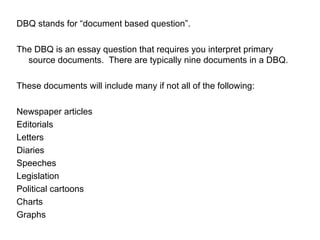
DBQ stands for “document based question”.   The DBQ is an essay question that requires you interpret primary source documents.  There are typically nine documents in a DBQ.   These documents will include many if not all of the following:   Newspaper articles Editorials Letters Diaries Speeches Legislation Political cartoons Charts  Graphs
Time Frame All of the documents will pertain to one certain subject.   The  one hour long DBQ  is administered after the multiple choice section of the AP Exam.   You will have  15 minutes to look at the documents and 45 minutes to write the essay.
Is there a right way to answer? No!  DBQ’s are worded in such a way that you can argue a number of different positions.  Typically the questions are historiographical.   Historiographical:  a topic that historians have been debating for a number of years. Students will be evaluated on their ability to interpret such factors as purpose, source, bias, date and place of origin, tone, etc.
Do not give the reader a reason to stop and question something that you have written.
Outside Information You need to be able to incorporate your own knowledge, outside of what is presented in the documents, to support your answer. Some students make the mistake of throwing everything they know into the essay whether it pertains to the topic or not.
4-6 sentences The Introductory Paragraph Establish  TIME & PLACE . Create a clear,  THESIS STATEMENT . [underline or highlight it!] Allude to the  SUB-TOPICS  or categories you will discuss to support your thesis statement Focus on the question at hand.
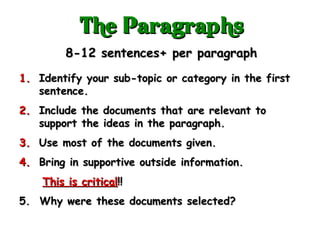
8-12 sentences+ per paragraph The Paragraphs Identify your sub-topic or category in the first sentence. Include the documents that are relevant to support the ideas in the paragraph. Use most of the documents given. Bring in supportive outside information.  This is critical !! 5.  Why were these documents selected?
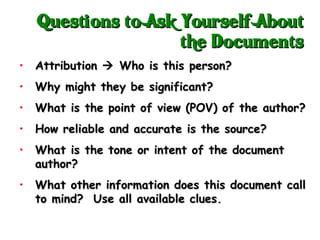
Attribution    Who is this person? Why might they be significant? What is the point of view (POV) of the author? How reliable and accurate is the source? What is the tone or intent of the document author? What other information does this document call to mind?  Use all available clues. Questions to Ask Yourself About the Documents
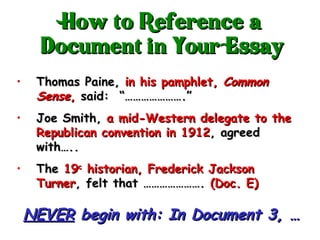
Thomas Paine,  in his pamphlet,  Common Sense ,  said:  “………………….” Joe Smith,  a mid-Western delegate to the Republican convention in 1912 , agreed with….. The  19 c  historian, Frederick Jackson Turner , felt that ………………….  (Doc. E) NEVER  begin with: In Document 3, … How to Reference a Document in Your Essay
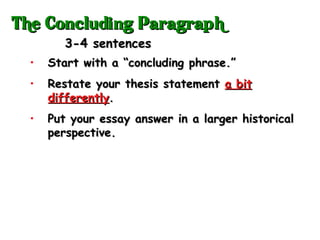
3-4 sentences The Concluding Paragraph Start with a “concluding phrase.” Restate your thesis statement  a bit differently . Put your essay answer in a larger historical perspective.
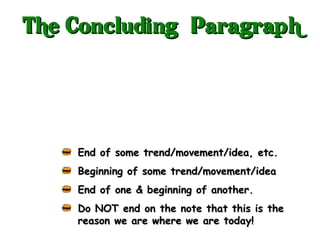
End of some trend/movement/idea, etc. Beginning of some trend/movement/idea End of one & beginning of another. Do NOT end on the note that this is the reason we are where we are today! The Concluding” Paragraph
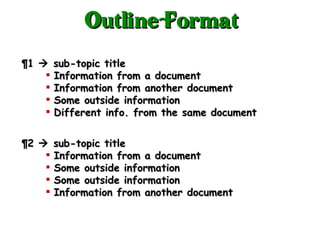
¶ 1    sub-topic title Information from a document  Information from another document  Some outside information  Different info. from the same document  ¶ 2    sub-topic title Information from a document  Some outside information  Some outside information  Information from another document  Outline Format

DBQ Tips and Hints

  • 1.
    How to doThe DBQ
  • 2.
    DBQ stands for“document based question”.   The DBQ is an essay question that requires you interpret primary source documents. There are typically nine documents in a DBQ.   These documents will include many if not all of the following:   Newspaper articles Editorials Letters Diaries Speeches Legislation Political cartoons Charts Graphs
  • 3.
    Time Frame Allof the documents will pertain to one certain subject.   The one hour long DBQ is administered after the multiple choice section of the AP Exam.   You will have 15 minutes to look at the documents and 45 minutes to write the essay.
  • 4.
    Is there aright way to answer? No! DBQ’s are worded in such a way that you can argue a number of different positions. Typically the questions are historiographical.   Historiographical: a topic that historians have been debating for a number of years. Students will be evaluated on their ability to interpret such factors as purpose, source, bias, date and place of origin, tone, etc.
  • 5.
    Do not givethe reader a reason to stop and question something that you have written.
  • 6.
    Outside Information Youneed to be able to incorporate your own knowledge, outside of what is presented in the documents, to support your answer. Some students make the mistake of throwing everything they know into the essay whether it pertains to the topic or not.
  • 7.
    4-6 sentences TheIntroductory Paragraph Establish TIME & PLACE . Create a clear, THESIS STATEMENT . [underline or highlight it!] Allude to the SUB-TOPICS or categories you will discuss to support your thesis statement Focus on the question at hand.
  • 8.
    8-12 sentences+ perparagraph The Paragraphs Identify your sub-topic or category in the first sentence. Include the documents that are relevant to support the ideas in the paragraph. Use most of the documents given. Bring in supportive outside information. This is critical !! 5. Why were these documents selected?
  • 9.
    Attribution  Who is this person? Why might they be significant? What is the point of view (POV) of the author? How reliable and accurate is the source? What is the tone or intent of the document author? What other information does this document call to mind? Use all available clues. Questions to Ask Yourself About the Documents
  • 10.
    Thomas Paine, in his pamphlet, Common Sense , said: “………………….” Joe Smith, a mid-Western delegate to the Republican convention in 1912 , agreed with….. The 19 c historian, Frederick Jackson Turner , felt that …………………. (Doc. E) NEVER begin with: In Document 3, … How to Reference a Document in Your Essay
  • 11.
    3-4 sentences TheConcluding Paragraph Start with a “concluding phrase.” Restate your thesis statement a bit differently . Put your essay answer in a larger historical perspective.
  • 12.
    End of sometrend/movement/idea, etc. Beginning of some trend/movement/idea End of one & beginning of another. Do NOT end on the note that this is the reason we are where we are today! The Concluding” Paragraph
  • 13.
    ¶ 1  sub-topic title Information from a document Information from another document Some outside information Different info. from the same document ¶ 2  sub-topic title Information from a document Some outside information Some outside information Information from another document Outline Format