Multicultural
Individuals:
What Can They Bring to
Global Organizations?
(Fitzsimmons, Miska, Stahl)

CROSS CULTURAL MANAGEMENT – 19.12.2013
Emilie BONTANT, Florence GIORNI, Margareta HEIDT, Kerstin
KNOBLOCH
Multicultural
Individuals:
What Can They Bring to
Global Organizations?

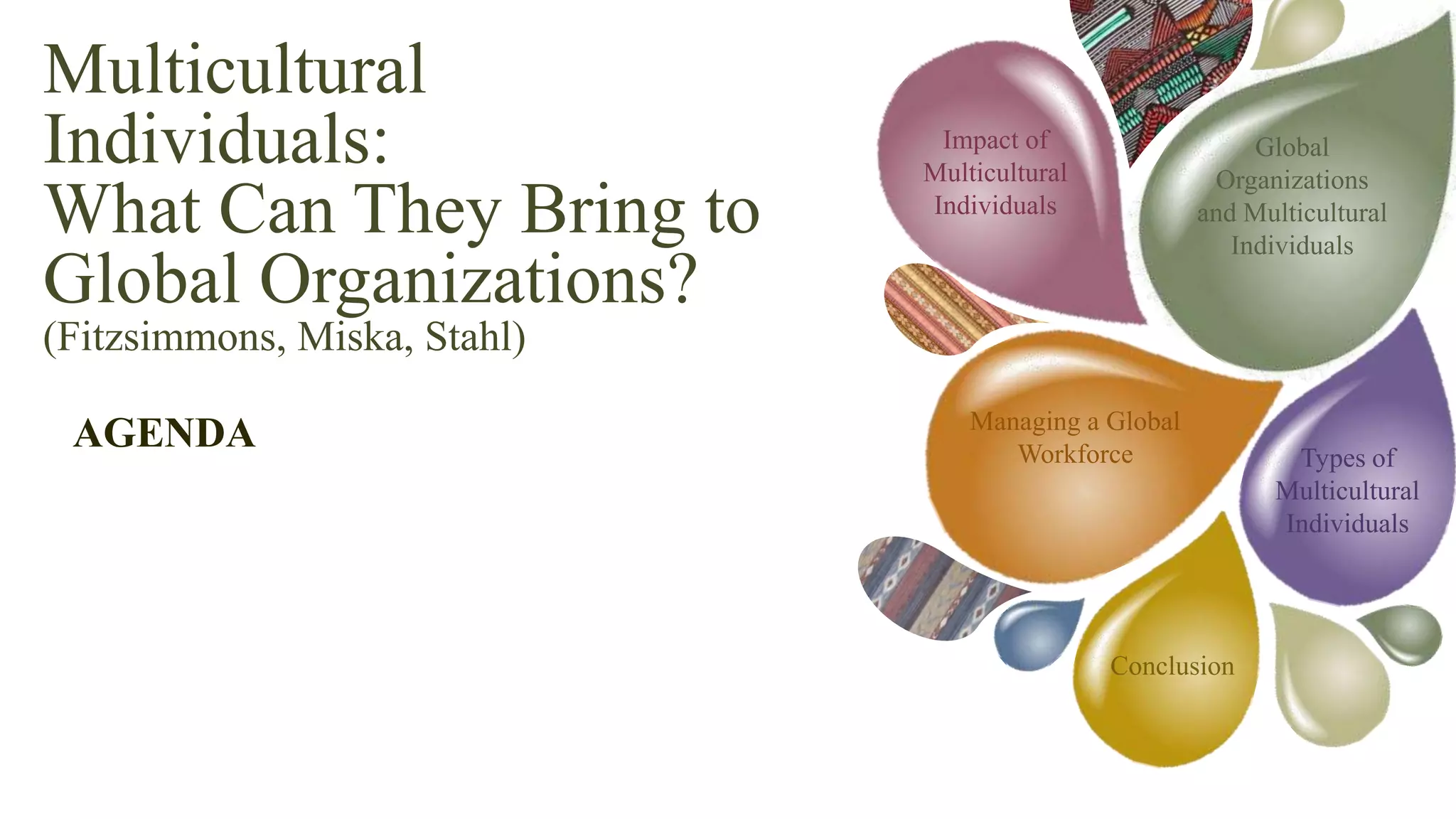
Impact of
Multicultural
Individuals

Global
Organizations
and
Multicultural
Individuals

(Fitzsimmons, Miska, Stahl)
AGENDA

Managing a
Global
Workforce

Conclusion

Types of
Multicultural
Individuals
Multicultural individuals: What can
they bring to global organizations ?
• Global organizations
•
•
•
•
•
•

an international alliance involving many different countries
technology, mobility, different cultures
multicultural individuals = multitalented
more than one culture has been internalized
cultural awarness and knowledge
for corporations, it is a ressource not optimized nowadays

19.12.2013

Emilie BONTANT, Florence GIORNI, Margareta HEIDT, Kerstin KNOBLOCH

3
Multicultural individuals: What can
they bring to global organizations ?
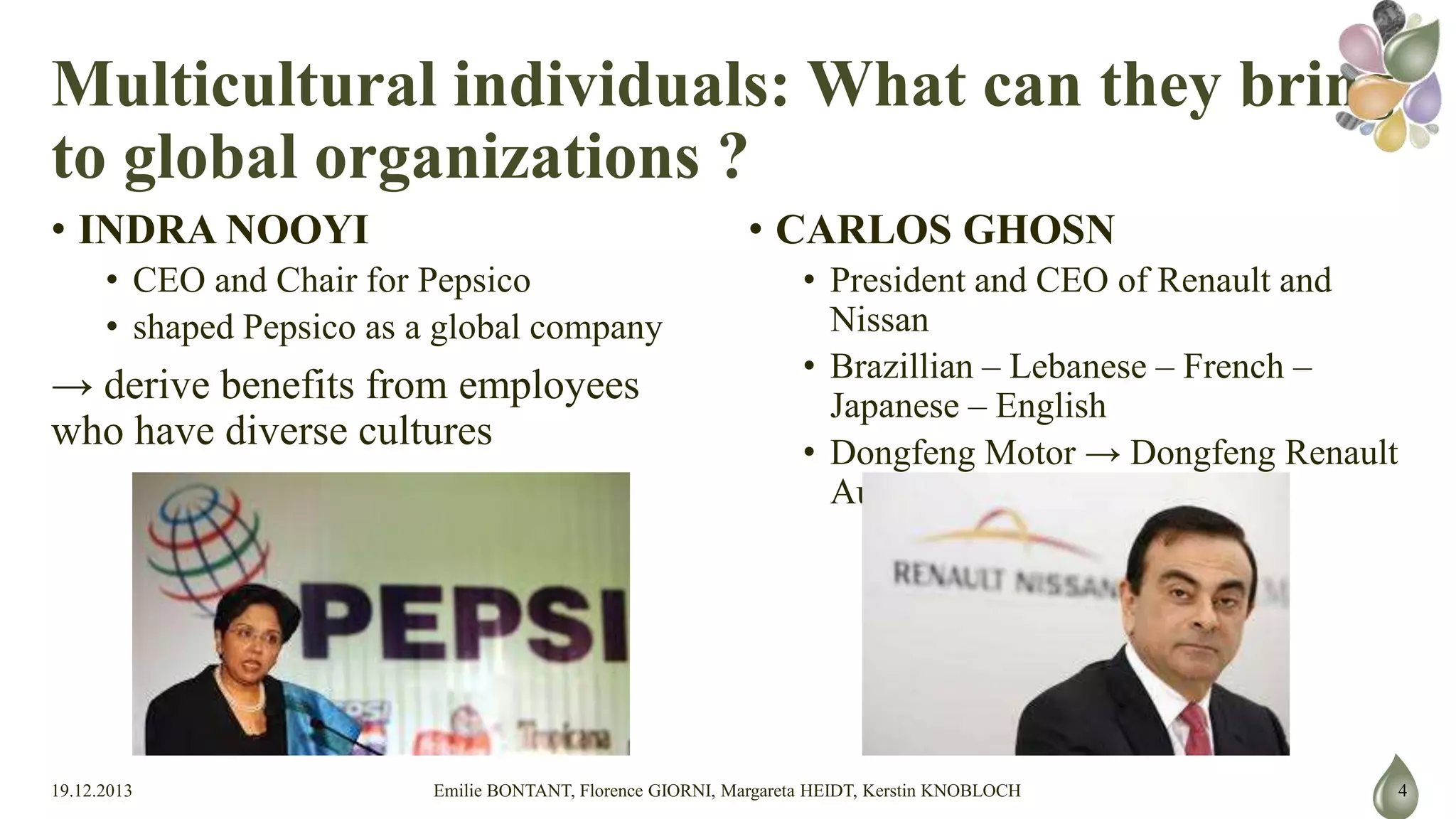
• INDRA NOOYI

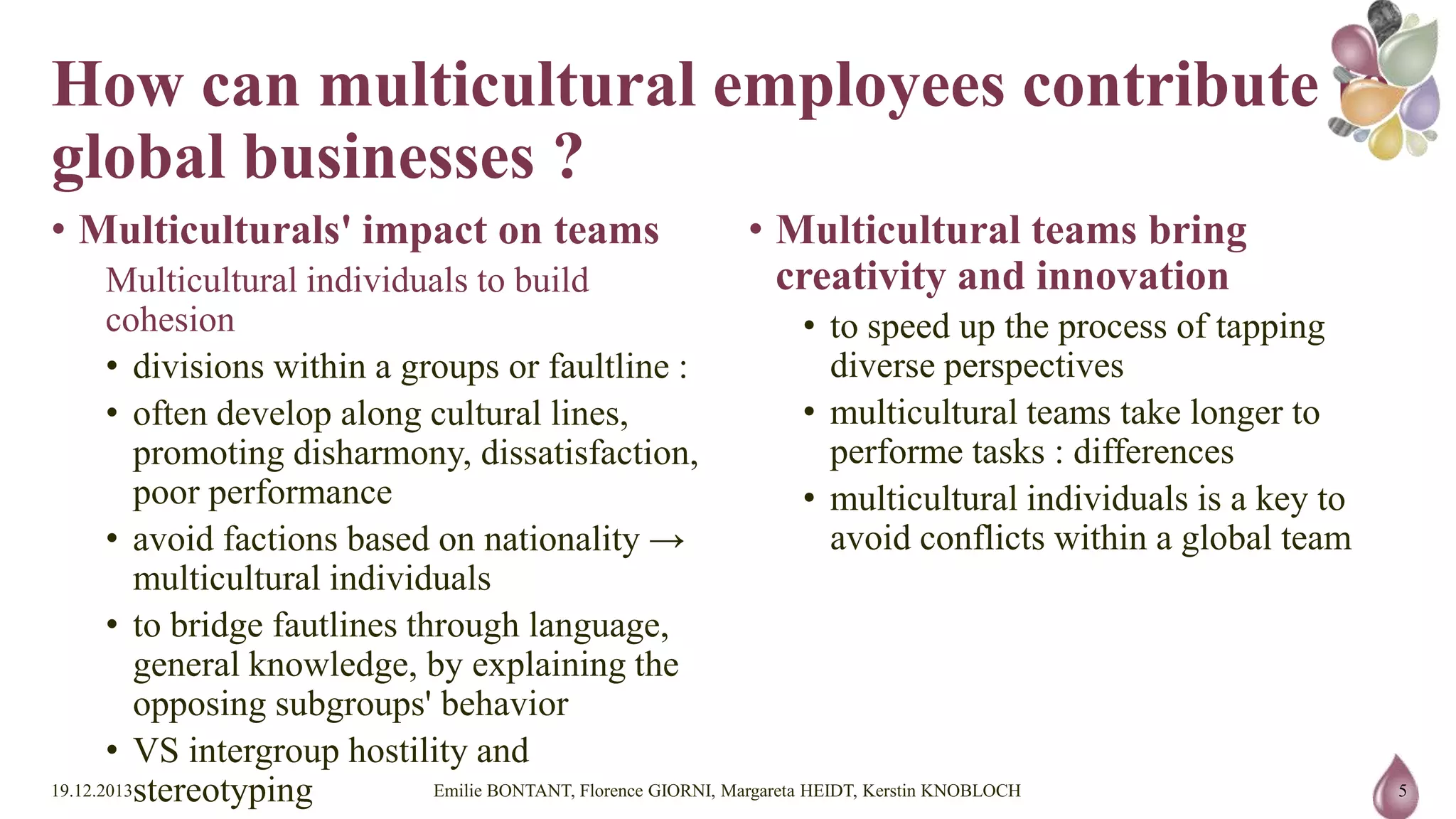
• CARLOS GHOSN

• CEO and Chair for Pepsico
• shaped Pepsico as a global company

→ derive benefits from employees who have diverse
cultures

19.12.2013

• President and CEO of Renault and Nissan
• Brazillian – Lebanese – French – Japanese – English
• Dongfeng Motor → Dongfeng Renault Automotive Co

Emilie BONTANT, Florence GIORNI, Margareta HEIDT, Kerstin KNOBLOCH

4
How can multicultural employees
contribute to global businesses ?
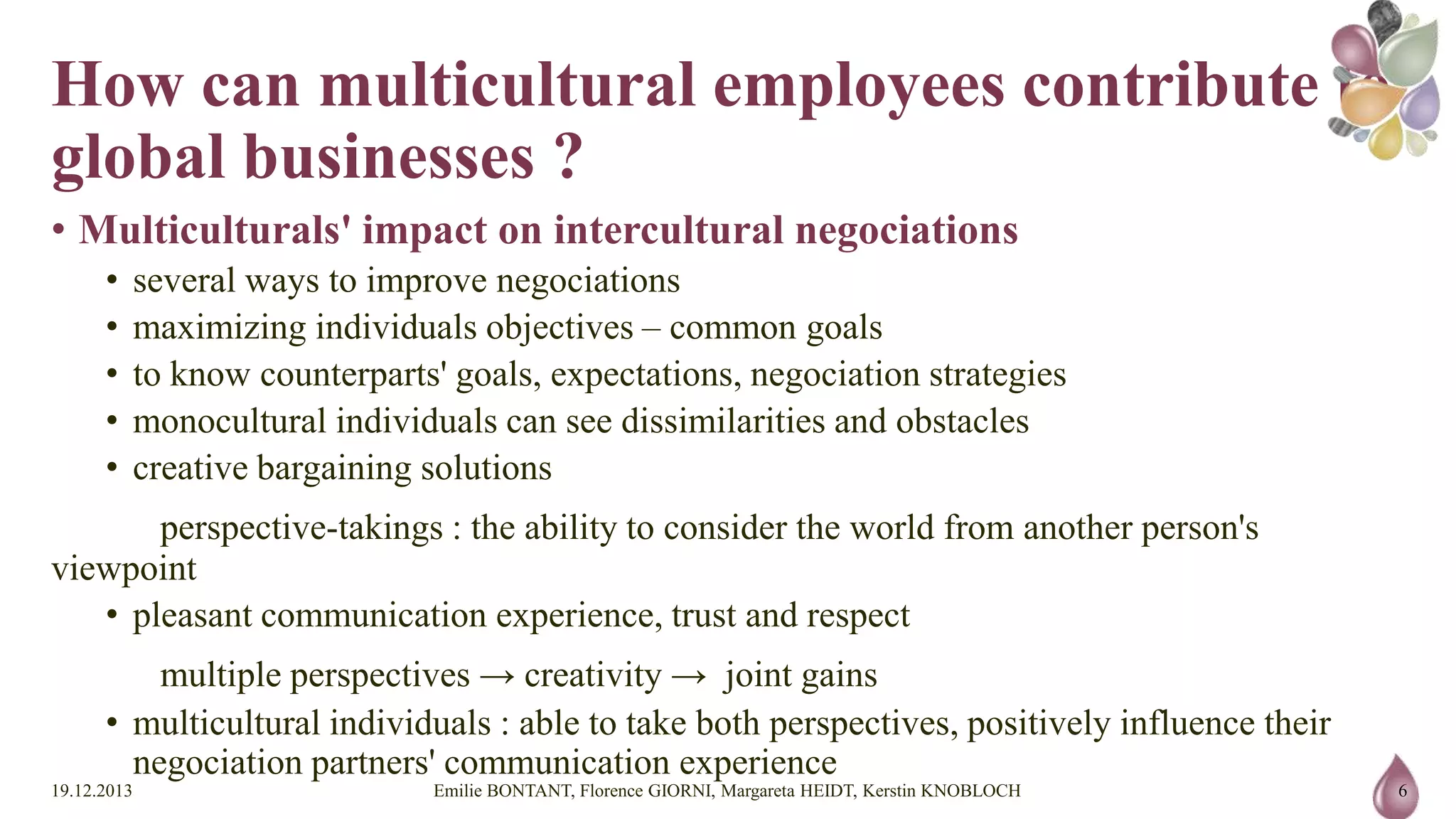
• Multiculturals' impact on teams
Multicultural individuals to build cohesion
• divisions within a groups or faultline :
• often develop along cultural lines, promoting
disharmony, dissatisfaction, poor performance
• avoid factions based on nationality → multicultural
individuals
• to bridge fautlines through language, general
knowledge, by explaining the opposing subgroups'
behavior
• VS intergroup hostility and stereotyping
19.12.2013

• Multicultural teams bring creativity and
innovation
• to speed up the process of tapping diverse perspectives
• multicultural teams take longer to performe tasks :
differences
• multicultural individuals is a key to avoid conflicts
within a global team

Emilie BONTANT, Florence GIORNI, Margareta HEIDT, Kerstin KNOBLOCH

5
How can multicultural employees
contribute to global businesses ?
• Multiculturals' impact on intercultural negociations
•
•
•
•
•

several ways to improve negociations
maximizing individuals objectives – common goals
to know counterparts' goals, expectations, negociation strategies
monocultural individuals can see dissimilarities and obstacles
creative bargaining solutions

perspective-takings : the ability to consider the world from another person's viewpoint
• pleasant communication experience, trust and respect
multiple perspectives → creativity → joint gains
• multicultural individuals : able to take both perspectives, positively influence their negociation partners' communication
experience
19.12.2013

Emilie BONTANT, Florence GIORNI, Margareta HEIDT, Kerstin KNOBLOCH

6
How can multicultural employees
contribute to global businesses ?
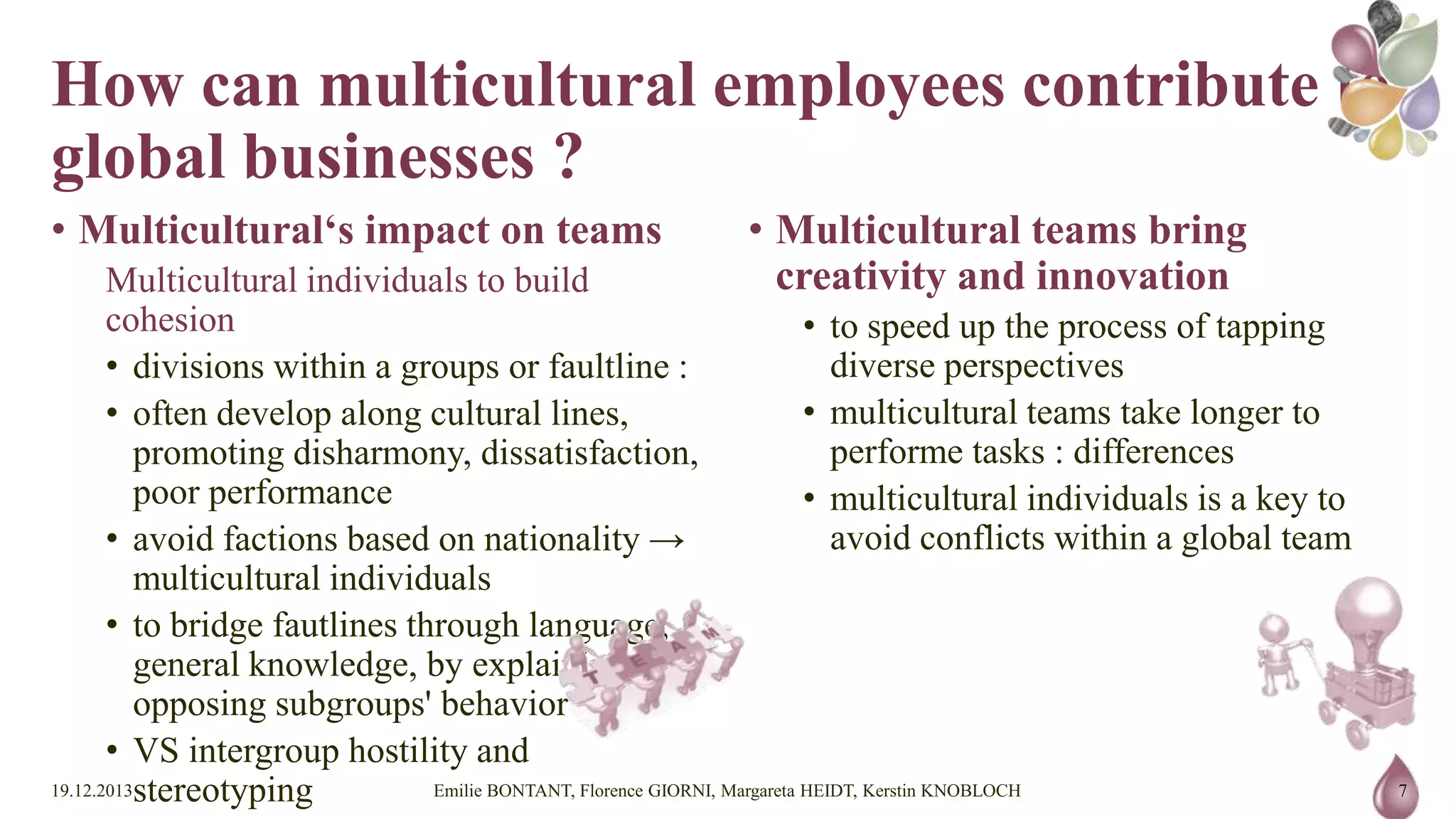
• Multicultural‘s impact on teams
Multicultural individuals to build cohesion
• divisions within a groups or faultline :
• often develop along cultural lines, promoting
disharmony, dissatisfaction, poor performance
• avoid factions based on nationality → multicultural
individuals
• to bridge fautlines through language, general
knowledge, by explaining the opposing subgroups'
behavior
• VS intergroup hostility and stereotyping
19.12.2013

• Multicultural teams bring creativity and
innovation
• to speed up the process of tapping diverse perspectives
• multicultural teams take longer to performe tasks :
differences
• multicultural individuals is a key to avoid conflicts
within a global team

Emilie BONTANT, Florence GIORNI, Margareta HEIDT, Kerstin KNOBLOCH

7
How can multicultural employees
contribute to global businesses ?
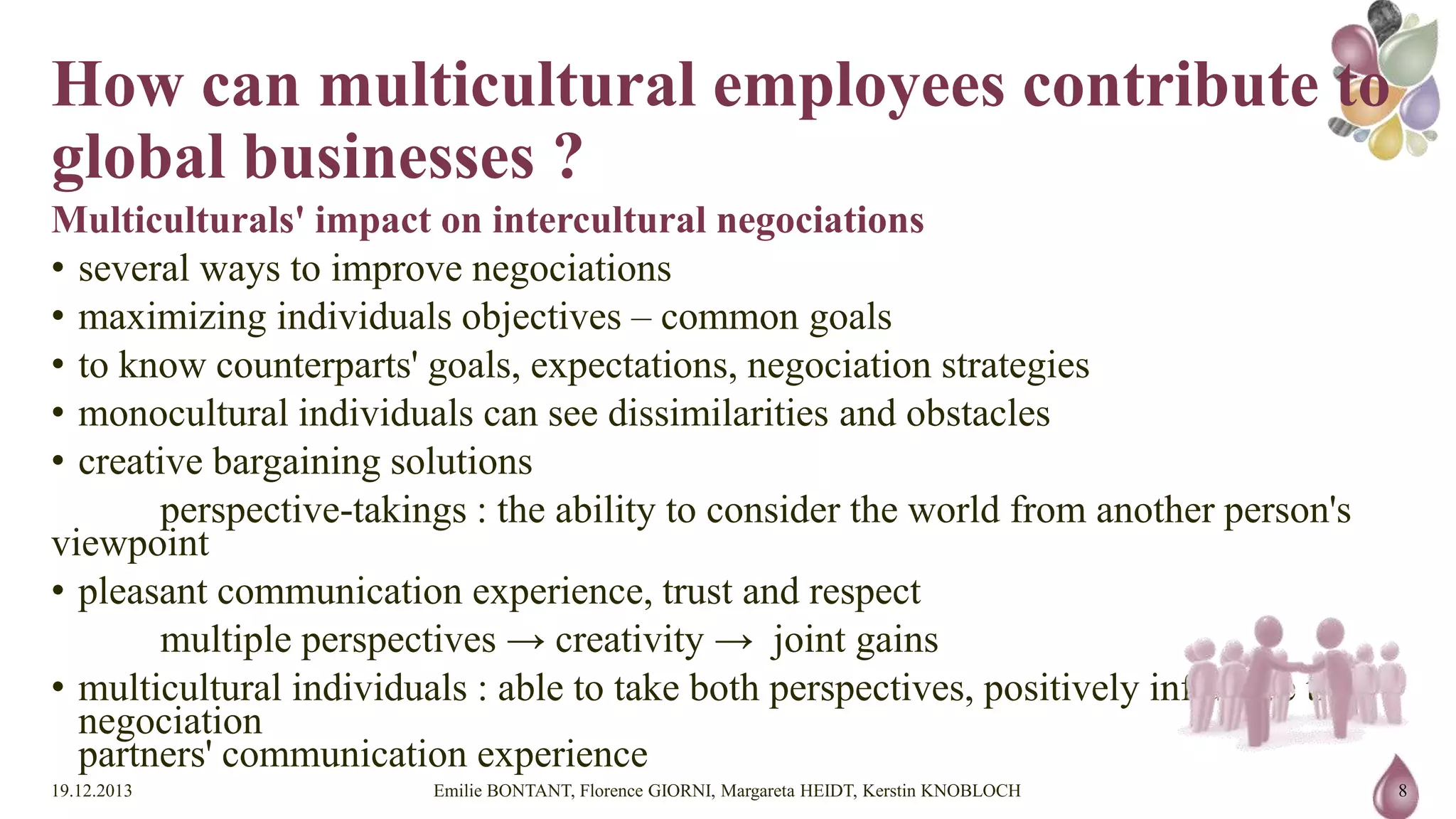
Multiculturals' impact on intercultural negociations
• several ways to improve negociations
• maximizing individuals objectives – common goals
• to know counterparts' goals, expectations, negociation strategies
• monocultural individuals can see dissimilarities and obstacles
• creative bargaining solutions
perspective-takings : the ability to consider the world from another person's viewpoint
• pleasant communication experience, trust and respect
multiple perspectives → creativity → joint gains
• multicultural individuals : able to take both perspectives, positively influence their negociation
partners' communication experience
19.12.2013

Emilie BONTANT, Florence GIORNI, Margareta HEIDT, Kerstin KNOBLOCH

8
How can multicultural employees
contribute to global businesses?
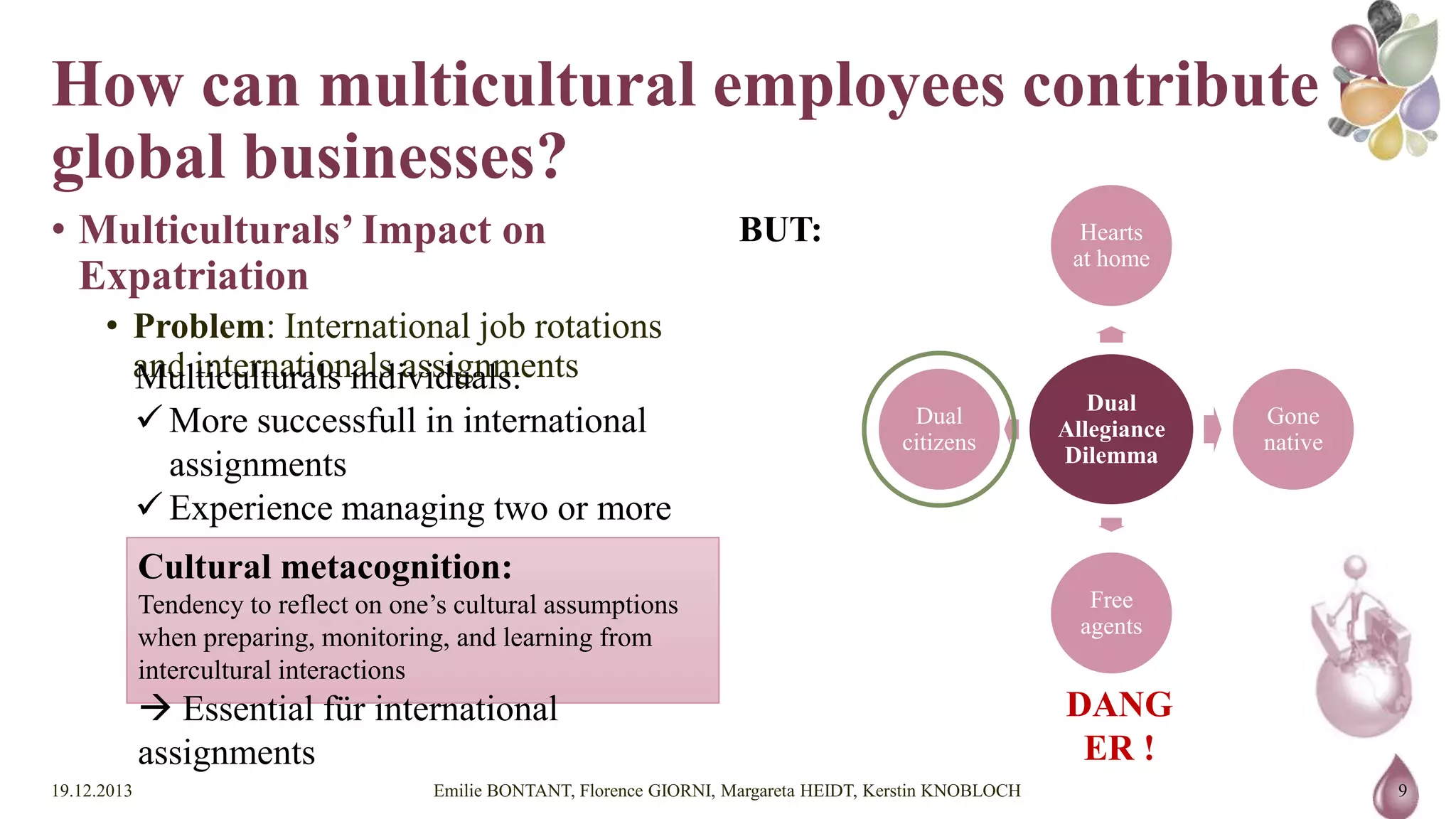
• Multiculturals’ Impact on Expatriation

BUT:

Hearts
at home

• Problem: International job rotations and
internationals assignments
Multiculturals individuals:
 More successfull in international assignments
 Experience managing two or more conflicting identies
 Higher cultural metacognition
Cultural metacognition:
Tendency to reflect on one’s cultural assumptions when preparing,
monitoring, and learning from intercultural interactions

 Essential für international assignments
19.12.2013

Dual
citizens

Dual
Allegiance
Dilemma

Gone
native

Free
agents

DANGER !

Emilie BONTANT, Florence GIORNI, Margareta HEIDT, Kerstin KNOBLOCH

9
How can multicultural employees
contribute to global businesses ?
• Multiculturals’ Impact on Ethics and Leadership
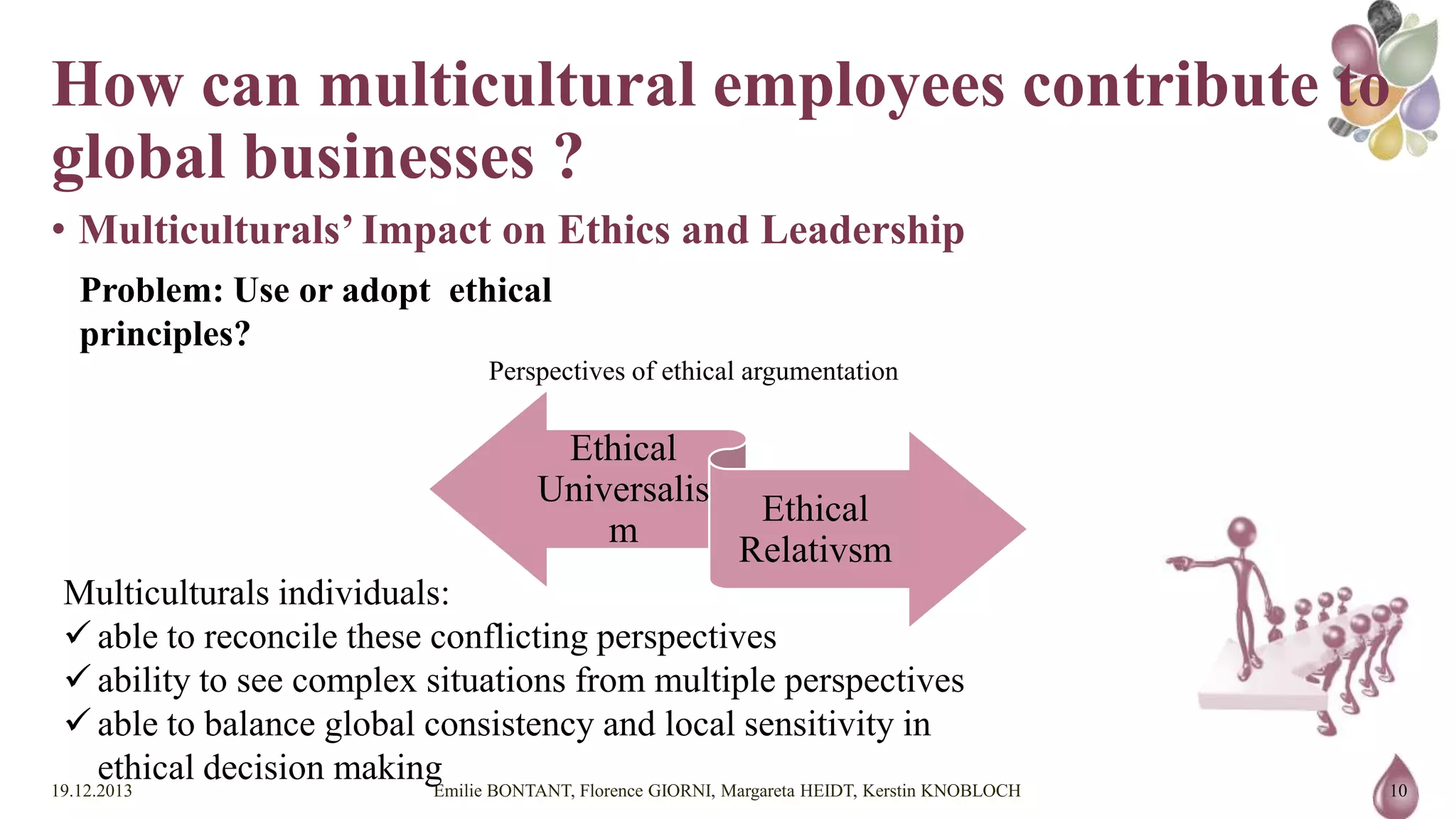
Problem: Use or adopt ethical principles?
Perspectives of ethical argumentation

Ethical
Universalism

Ethical
Relativsm

Multiculturals individuals:
 able to reconcile these conflicting perspectives
 ability to see complex situations from multiple perspectives
 able to balance global consistency and local sensitivity in ethical decision making
19.12.2013

Emilie BONTANT, Florence GIORNI, Margareta HEIDT, Kerstin KNOBLOCH

10
How can multicultural employees
contribute to global businesses?
• Multiculturals’ Impact on Cross-Border Alliances, M&A
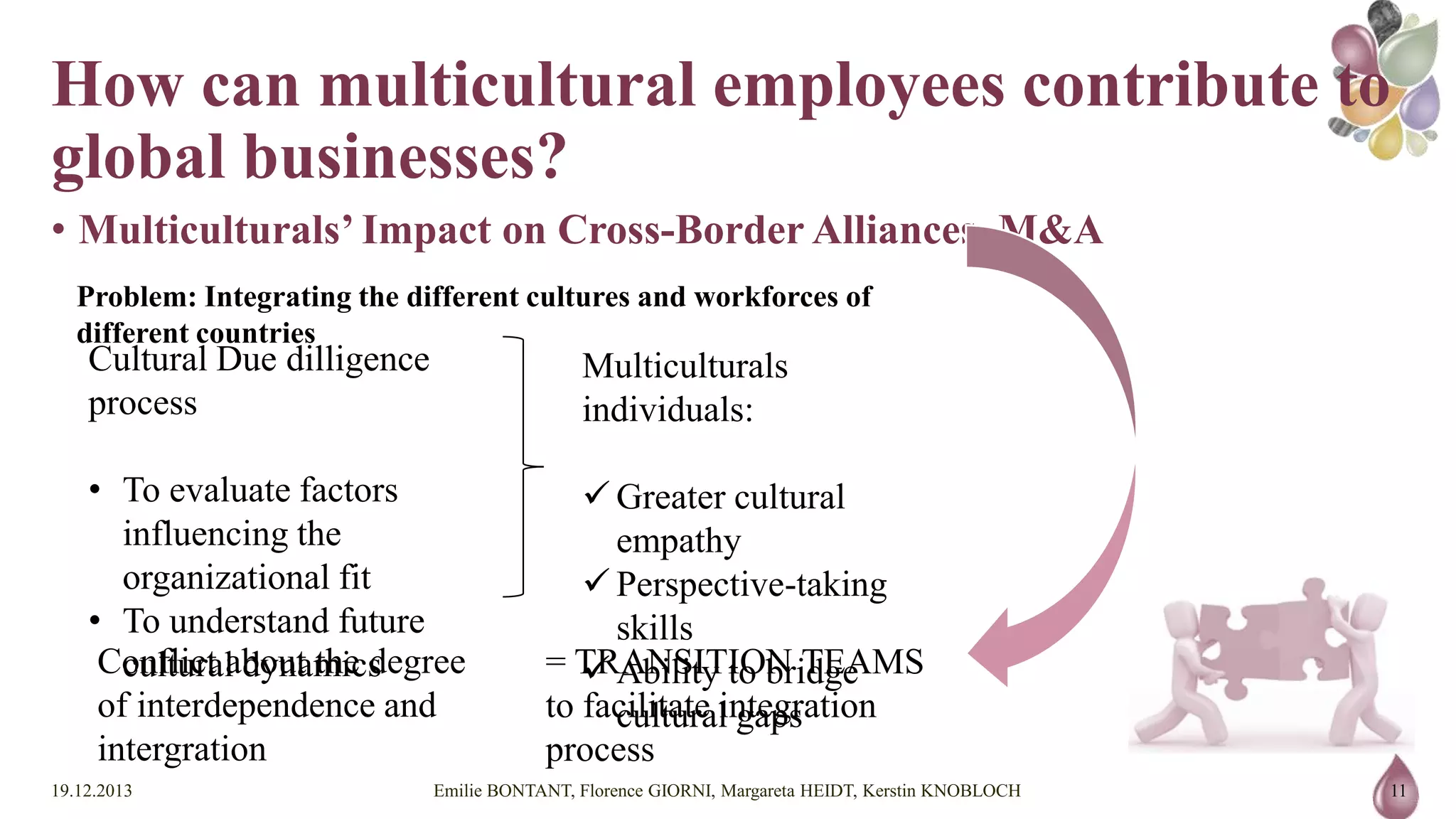
Problem: Integrating the different cultures and workforces of different countries

Cultural Due dilligence process

Multiculturals individuals:

• To evaluate factors influencing
the organizational fit
• To understand future cultural
dynamics

 Greater cultural empathy
 Perspective-taking skills
 Ability to bridge cultural gaps

Conflict about the degree of
interdependence and intergration
19.12.2013

= TRANSITION TEAMS to facilitate
integration process

Emilie BONTANT, Florence GIORNI, Margareta HEIDT, Kerstin KNOBLOCH

11
Types of Multicultural Individuals
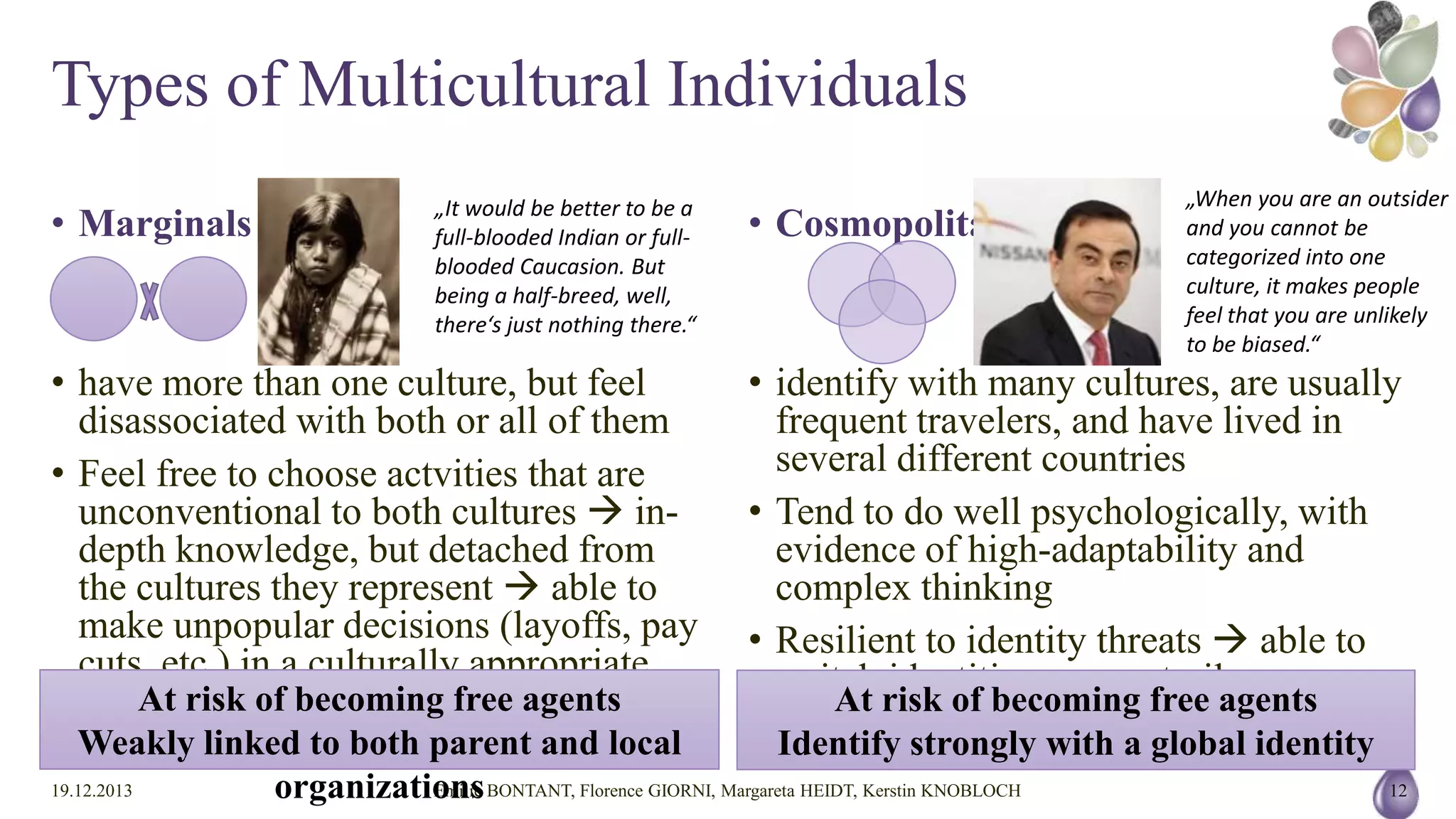
• Marginals

„It would be better to be a
full-blooded Indian or fullblooded Caucasion. But
being a half-breed, well,
there‘s just nothing there.“

• Cosmopolitans

„When you are an outsider
and you cannot be
categorized into one
culture, it makes people
feel that you are unlikely
to be biased.“

• have more than one culture, but feel disassociated with
both or all of them
• Feel free to choose actvities that are unconventional to
both cultures  in-depth knowledge, but detached
from the cultures they represent  able to make
unpopular decisions (layoffs, pay cuts, etc.) in a
culturally appropriate manner.

• identify with many cultures, are usually frequent
travelers, and have lived in several different countries
• Tend to do well psychologically, with evidence of highadaptability and complex thinking
• Resilient to identity threats  able to switch identities
momentarily

At risk of becoming free agents
Weakly linked to both parent and local organizations

At risk of becoming free agents
Identify strongly with a global identity

19.12.2013

Emilie BONTANT, Florence GIORNI, Margareta HEIDT, Kerstin KNOBLOCH

12
Types of Multicultural Individuals
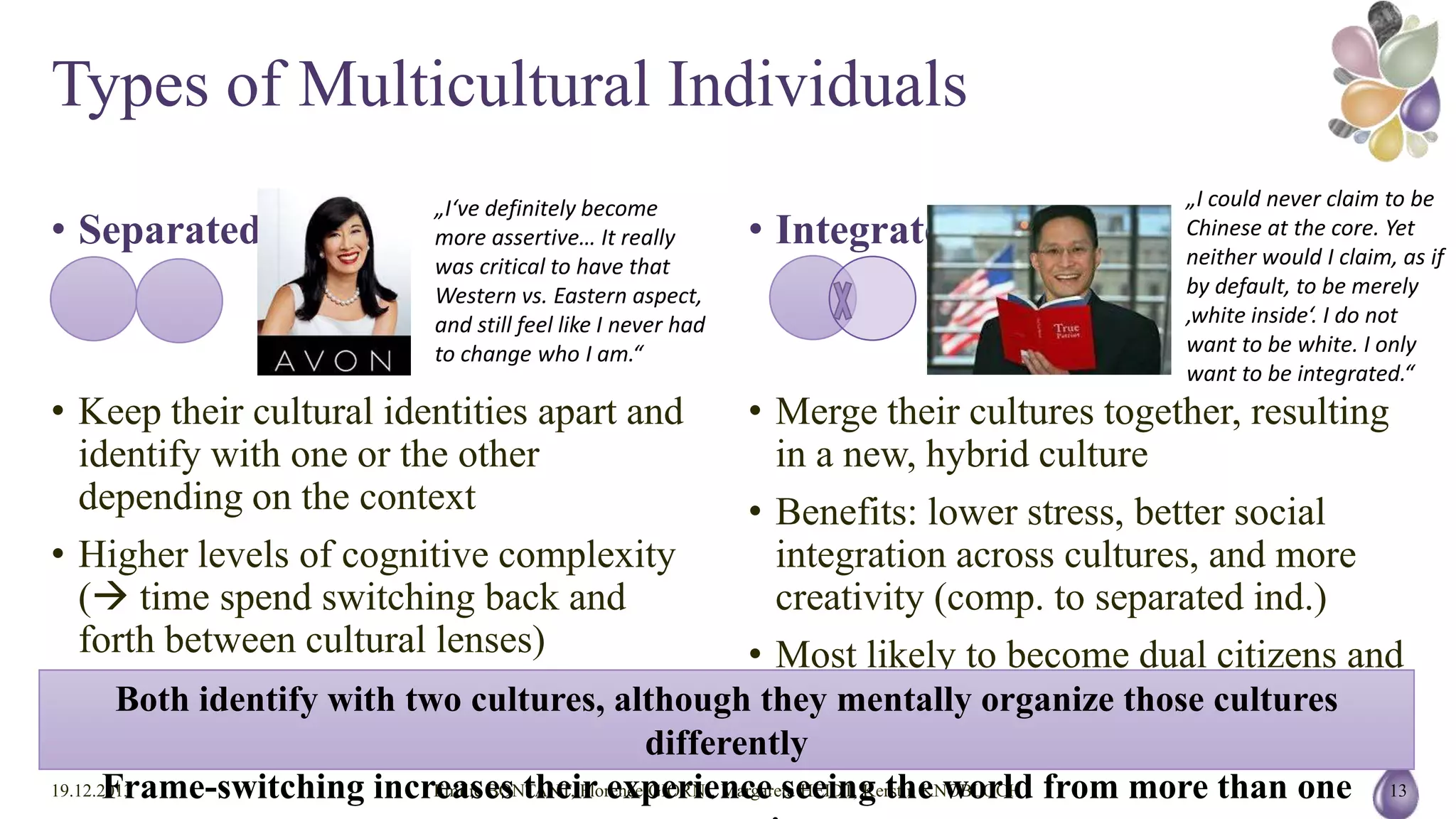
• Separated

„I‘ve definitely become
more assertive… It really
was critical to have that
Western vs. Eastern aspect,
and still feel like I never had
to change who I am.“

• Keep their cultural identities apart and identify with one
or the other depending on the context
• Higher levels of cognitive complexity ( time spend
switching back and forth between cultural lenses)
• Most likely to take on either the hearts-at-home or gonenative positions

• Integrated

„I could never claim to be
Chinese at the core. Yet
neither would I claim, as if
by default, to be merely
‚white inside‘. I do not
want to be white. I only
want to be integrated.“

• Merge their cultures together, resulting in a new, hybrid
culture
• Benefits: lower stress, better social integration across
cultures, and more creativity (comp. to separated ind.)
• Most likely to become dual citizens and have bigger
creative potential

Both identify with two cultures, although they mentally organize those cultures differently
Frame-switching increases their experience seeing the world from more than one perspective
19.12.2013

Emilie BONTANT, Florence GIORNI, Margareta HEIDT, Kerstin KNOBLOCH

13
Managing a Multicultural Workforce
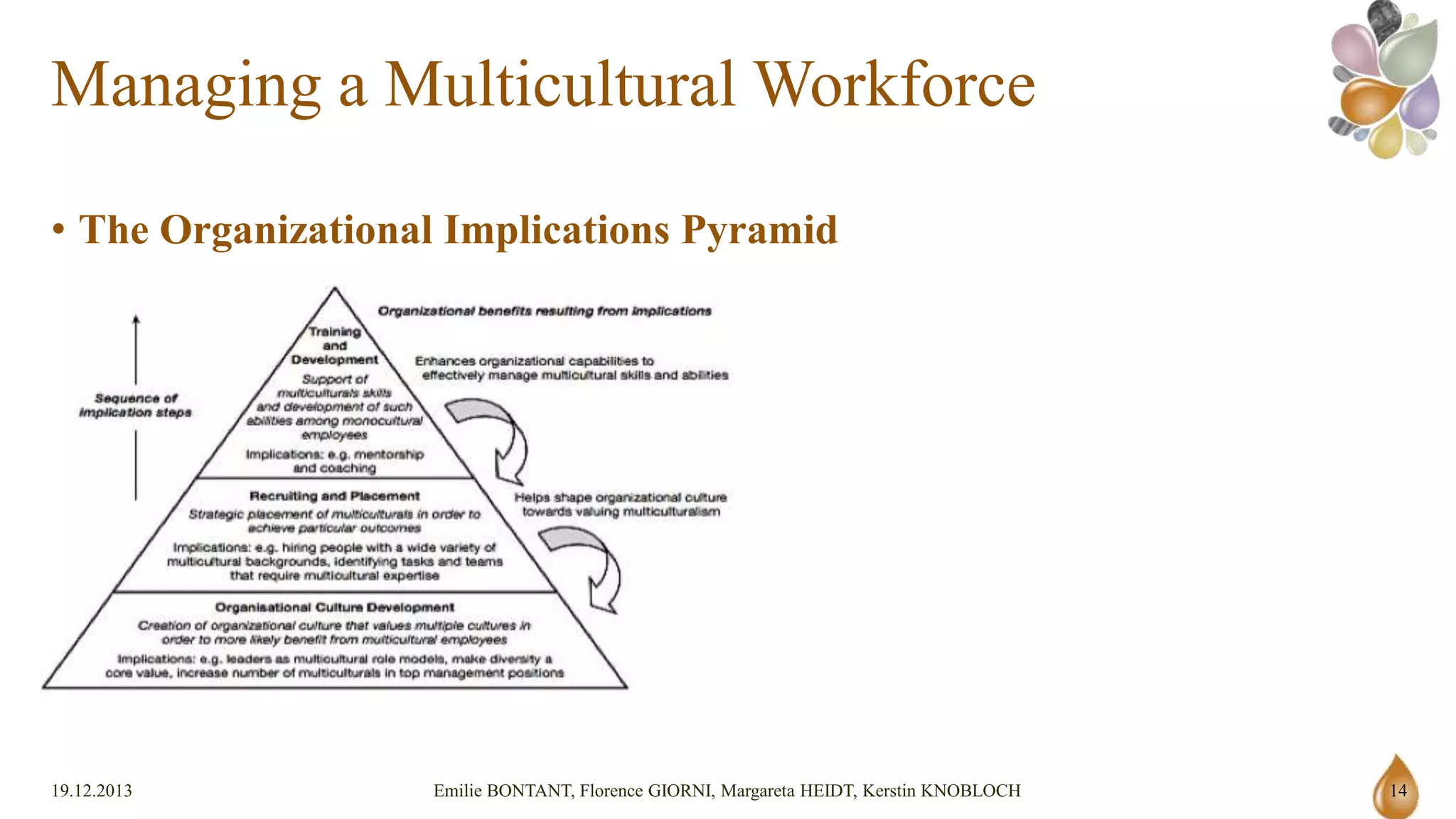
• The Organizational Implications Pyramid

19.12.2013

Emilie BONTANT, Florence GIORNI, Margareta HEIDT, Kerstin KNOBLOCH

14
Managing a Multicultural Workforce
• The Organizational Implications Pyramid

19.12.2013

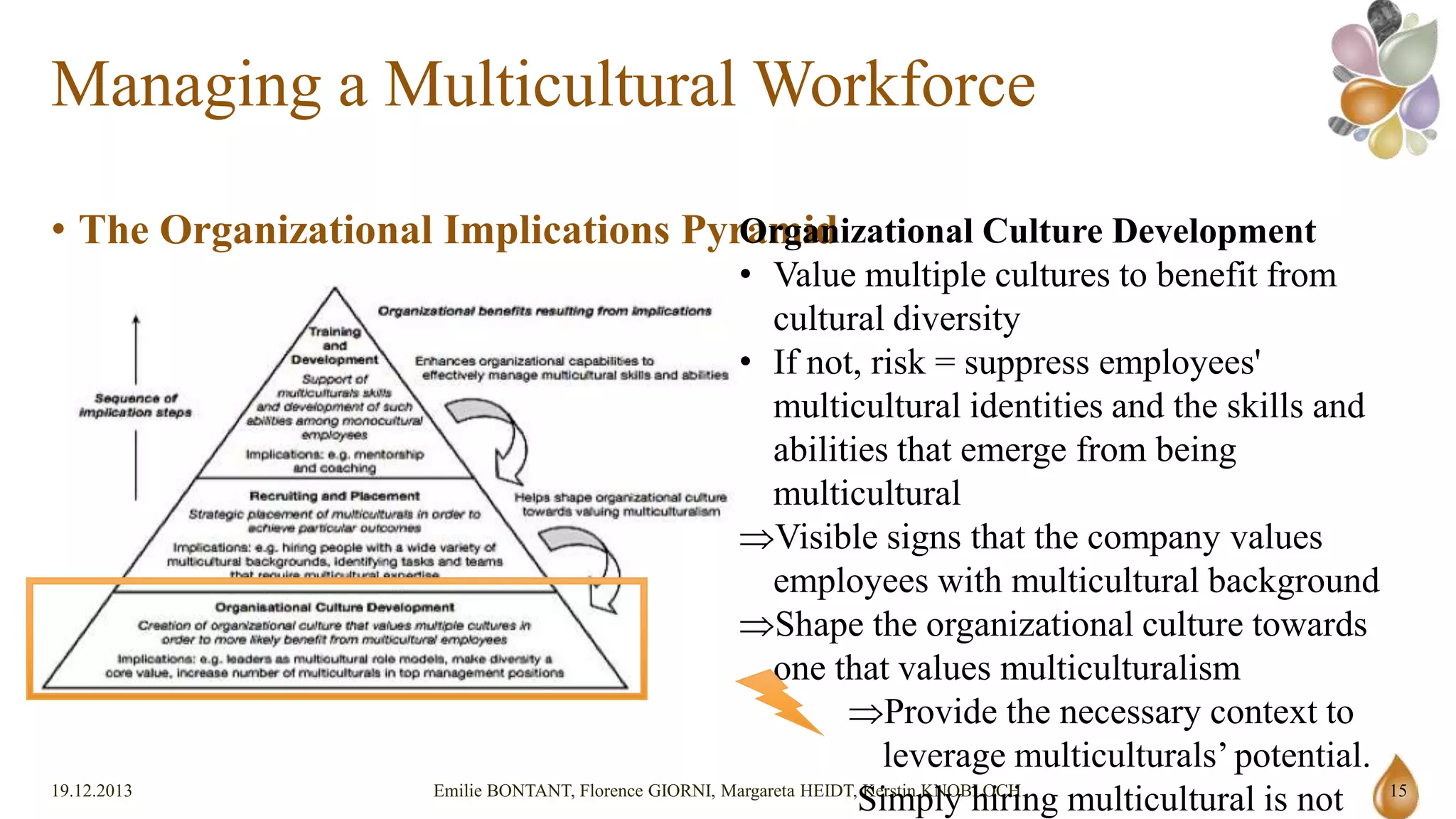
Organizational Culture Development
• Value multiple cultures to benefit from cultural diversity
• If not, risk = suppress employees' multicultural identities
and the skills and abilities that emerge from being
multicultural
Visible signs that the company values employees with
multicultural background
Shape the organizational culture towards one that values
multiculturalism
Provide the necessary context to leverage
multiculturals’ potential.
Simply hiring multicultural is not enough !

Emilie BONTANT, Florence GIORNI, Margareta HEIDT, Kerstin KNOBLOCH

15
Managing a Multicultural Workforce
• The Organizational Implications Pyramid

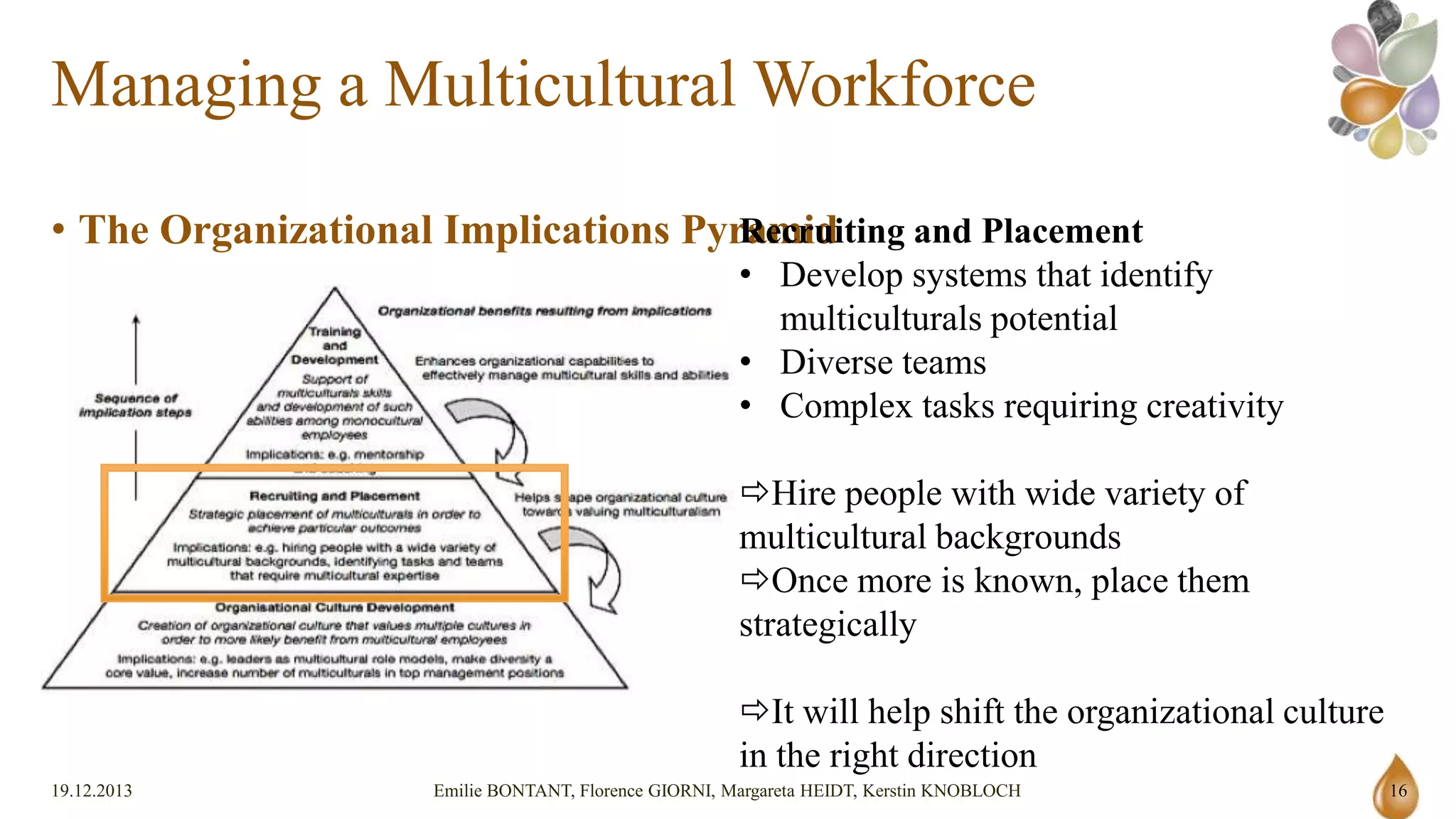
Recruiting and Placement
• Develop systems that identify multiculturals potential
• Diverse teams
• Complex tasks requiring creativity
Hire people with wide variety of multicultural backgrounds
Once more is known, place them strategically

It will help shift the organizational culture in the right
direction

19.12.2013

Emilie BONTANT, Florence GIORNI, Margareta HEIDT, Kerstin KNOBLOCH

16
Managing a Multicultural Workforce
• The Organizational Implications Pyramid

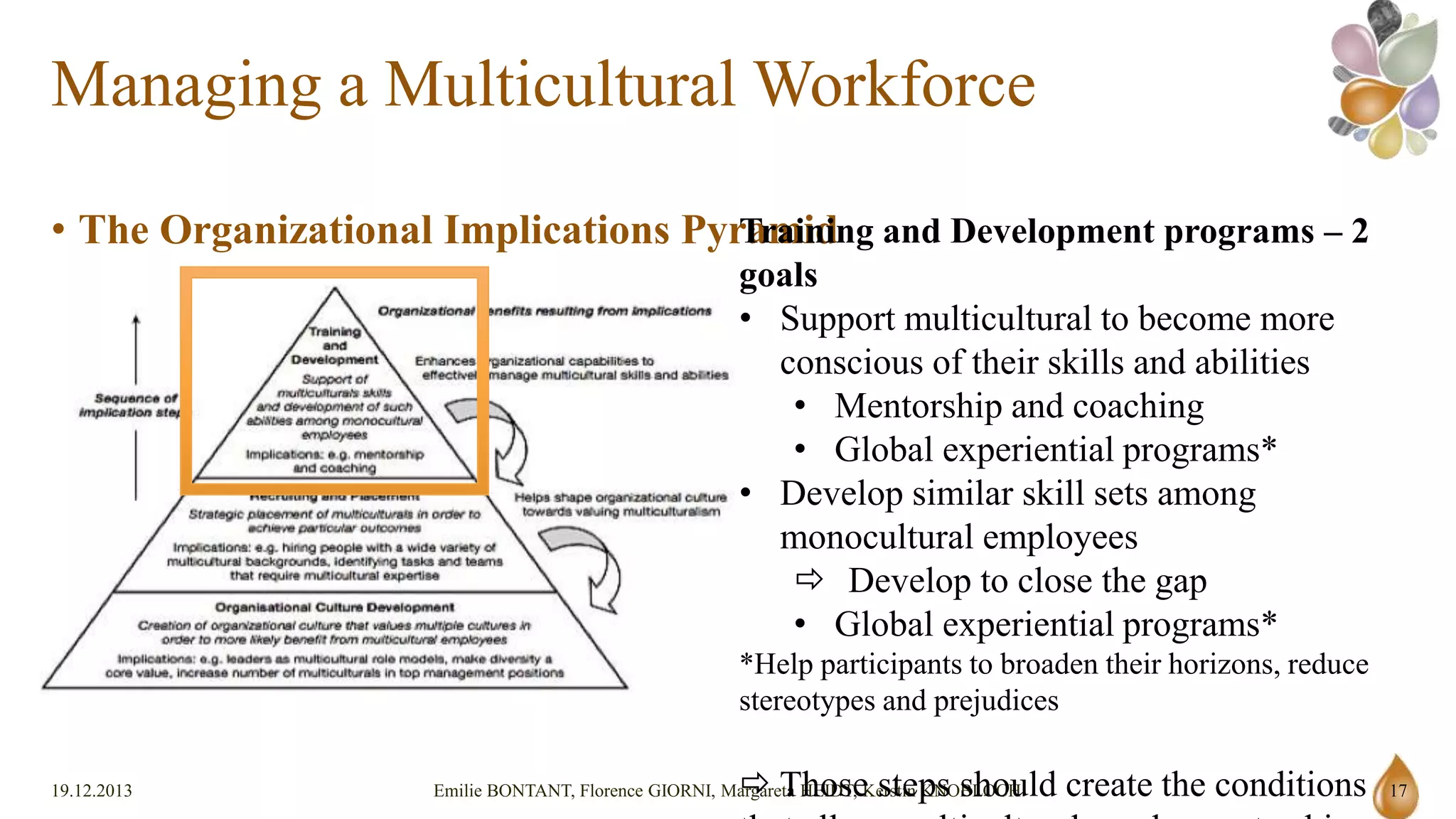
Training and Development programs – 2 goals
• Support multicultural to become more conscious of their
skills and abilities
• Mentorship and coaching
• Global experiential programs*
• Develop similar skill sets among monocultural employees
 Develop to close the gap
• Global experiential programs*
*Help participants to broaden their horizons, reduce stereotypes and
prejudices

 Those steps should create the conditions that allow
multicultural employees to shine
19.12.2013

Emilie BONTANT, Florence GIORNI, Margareta HEIDT, Kerstin KNOBLOCH

17
Conclusion
• Advantages of Multicultural Individuals:
• Contribute valuable skills to teams, negotiations, alliances, mergers and acquisitions, international assignments, ethics
and leadership

• Risk for Organizations:
• Experiences of multicultural individuals are not universal
Risk of alienating multicultural employees unless organizations consider the different ways to be multicultural

• Next Step for Companies:
Take advantage of the potential in multicultural employees by staffing, training and leading with these
benefits in mind!

19.12.2013

Emilie BONTANT, Florence GIORNI, Margareta HEIDT, Kerstin KNOBLOCH

18
THANK YOU FOR
YOUR ATTENTION
CROSS CULTURAL MANAGEMENT – 19.12.2013
Emilie BONTANT, Florence GIORNI, Margareta HEIDT, Kerstin
KNOBLOCH

Managing Multicultural Individuals

  • 1.
    Multicultural Individuals: What Can TheyBring to Global Organizations? (Fitzsimmons, Miska, Stahl) CROSS CULTURAL MANAGEMENT – 19.12.2013 Emilie BONTANT, Florence GIORNI, Margareta HEIDT, Kerstin KNOBLOCH
  • 2.
    Multicultural Individuals: What Can TheyBring to Global Organizations? Impact of Multicultural Individuals Global Organizations and Multicultural Individuals (Fitzsimmons, Miska, Stahl) AGENDA Managing a Global Workforce Conclusion Types of Multicultural Individuals
  • 3.
    Multicultural individuals: Whatcan they bring to global organizations ? • Global organizations • • • • • • an international alliance involving many different countries technology, mobility, different cultures multicultural individuals = multitalented more than one culture has been internalized cultural awarness and knowledge for corporations, it is a ressource not optimized nowadays 19.12.2013 Emilie BONTANT, Florence GIORNI, Margareta HEIDT, Kerstin KNOBLOCH 3
  • 4.
    Multicultural individuals: Whatcan they bring to global organizations ? • INDRA NOOYI • CARLOS GHOSN • CEO and Chair for Pepsico • shaped Pepsico as a global company → derive benefits from employees who have diverse cultures 19.12.2013 • President and CEO of Renault and Nissan • Brazillian – Lebanese – French – Japanese – English • Dongfeng Motor → Dongfeng Renault Automotive Co Emilie BONTANT, Florence GIORNI, Margareta HEIDT, Kerstin KNOBLOCH 4
  • 5.
    How can multiculturalemployees contribute to global businesses ? • Multiculturals' impact on teams Multicultural individuals to build cohesion • divisions within a groups or faultline : • often develop along cultural lines, promoting disharmony, dissatisfaction, poor performance • avoid factions based on nationality → multicultural individuals • to bridge fautlines through language, general knowledge, by explaining the opposing subgroups' behavior • VS intergroup hostility and stereotyping 19.12.2013 • Multicultural teams bring creativity and innovation • to speed up the process of tapping diverse perspectives • multicultural teams take longer to performe tasks : differences • multicultural individuals is a key to avoid conflicts within a global team Emilie BONTANT, Florence GIORNI, Margareta HEIDT, Kerstin KNOBLOCH 5
  • 6.
    How can multiculturalemployees contribute to global businesses ? • Multiculturals' impact on intercultural negociations • • • • • several ways to improve negociations maximizing individuals objectives – common goals to know counterparts' goals, expectations, negociation strategies monocultural individuals can see dissimilarities and obstacles creative bargaining solutions perspective-takings : the ability to consider the world from another person's viewpoint • pleasant communication experience, trust and respect multiple perspectives → creativity → joint gains • multicultural individuals : able to take both perspectives, positively influence their negociation partners' communication experience 19.12.2013 Emilie BONTANT, Florence GIORNI, Margareta HEIDT, Kerstin KNOBLOCH 6
  • 7.
    How can multiculturalemployees contribute to global businesses ? • Multicultural‘s impact on teams Multicultural individuals to build cohesion • divisions within a groups or faultline : • often develop along cultural lines, promoting disharmony, dissatisfaction, poor performance • avoid factions based on nationality → multicultural individuals • to bridge fautlines through language, general knowledge, by explaining the opposing subgroups' behavior • VS intergroup hostility and stereotyping 19.12.2013 • Multicultural teams bring creativity and innovation • to speed up the process of tapping diverse perspectives • multicultural teams take longer to performe tasks : differences • multicultural individuals is a key to avoid conflicts within a global team Emilie BONTANT, Florence GIORNI, Margareta HEIDT, Kerstin KNOBLOCH 7
  • 8.
    How can multiculturalemployees contribute to global businesses ? Multiculturals' impact on intercultural negociations • several ways to improve negociations • maximizing individuals objectives – common goals • to know counterparts' goals, expectations, negociation strategies • monocultural individuals can see dissimilarities and obstacles • creative bargaining solutions perspective-takings : the ability to consider the world from another person's viewpoint • pleasant communication experience, trust and respect multiple perspectives → creativity → joint gains • multicultural individuals : able to take both perspectives, positively influence their negociation partners' communication experience 19.12.2013 Emilie BONTANT, Florence GIORNI, Margareta HEIDT, Kerstin KNOBLOCH 8
  • 9.
    How can multiculturalemployees contribute to global businesses? • Multiculturals’ Impact on Expatriation BUT: Hearts at home • Problem: International job rotations and internationals assignments Multiculturals individuals:  More successfull in international assignments  Experience managing two or more conflicting identies  Higher cultural metacognition Cultural metacognition: Tendency to reflect on one’s cultural assumptions when preparing, monitoring, and learning from intercultural interactions  Essential für international assignments 19.12.2013 Dual citizens Dual Allegiance Dilemma Gone native Free agents DANGER ! Emilie BONTANT, Florence GIORNI, Margareta HEIDT, Kerstin KNOBLOCH 9
  • 10.
    How can multiculturalemployees contribute to global businesses ? • Multiculturals’ Impact on Ethics and Leadership Problem: Use or adopt ethical principles? Perspectives of ethical argumentation Ethical Universalism Ethical Relativsm Multiculturals individuals:  able to reconcile these conflicting perspectives  ability to see complex situations from multiple perspectives  able to balance global consistency and local sensitivity in ethical decision making 19.12.2013 Emilie BONTANT, Florence GIORNI, Margareta HEIDT, Kerstin KNOBLOCH 10
  • 11.
    How can multiculturalemployees contribute to global businesses? • Multiculturals’ Impact on Cross-Border Alliances, M&A Problem: Integrating the different cultures and workforces of different countries Cultural Due dilligence process Multiculturals individuals: • To evaluate factors influencing the organizational fit • To understand future cultural dynamics  Greater cultural empathy  Perspective-taking skills  Ability to bridge cultural gaps Conflict about the degree of interdependence and intergration 19.12.2013 = TRANSITION TEAMS to facilitate integration process Emilie BONTANT, Florence GIORNI, Margareta HEIDT, Kerstin KNOBLOCH 11
  • 12.
    Types of MulticulturalIndividuals • Marginals „It would be better to be a full-blooded Indian or fullblooded Caucasion. But being a half-breed, well, there‘s just nothing there.“ • Cosmopolitans „When you are an outsider and you cannot be categorized into one culture, it makes people feel that you are unlikely to be biased.“ • have more than one culture, but feel disassociated with both or all of them • Feel free to choose actvities that are unconventional to both cultures  in-depth knowledge, but detached from the cultures they represent  able to make unpopular decisions (layoffs, pay cuts, etc.) in a culturally appropriate manner. • identify with many cultures, are usually frequent travelers, and have lived in several different countries • Tend to do well psychologically, with evidence of highadaptability and complex thinking • Resilient to identity threats  able to switch identities momentarily At risk of becoming free agents Weakly linked to both parent and local organizations At risk of becoming free agents Identify strongly with a global identity 19.12.2013 Emilie BONTANT, Florence GIORNI, Margareta HEIDT, Kerstin KNOBLOCH 12
  • 13.
    Types of MulticulturalIndividuals • Separated „I‘ve definitely become more assertive… It really was critical to have that Western vs. Eastern aspect, and still feel like I never had to change who I am.“ • Keep their cultural identities apart and identify with one or the other depending on the context • Higher levels of cognitive complexity ( time spend switching back and forth between cultural lenses) • Most likely to take on either the hearts-at-home or gonenative positions • Integrated „I could never claim to be Chinese at the core. Yet neither would I claim, as if by default, to be merely ‚white inside‘. I do not want to be white. I only want to be integrated.“ • Merge their cultures together, resulting in a new, hybrid culture • Benefits: lower stress, better social integration across cultures, and more creativity (comp. to separated ind.) • Most likely to become dual citizens and have bigger creative potential Both identify with two cultures, although they mentally organize those cultures differently Frame-switching increases their experience seeing the world from more than one perspective 19.12.2013 Emilie BONTANT, Florence GIORNI, Margareta HEIDT, Kerstin KNOBLOCH 13
  • 14.
    Managing a MulticulturalWorkforce • The Organizational Implications Pyramid 19.12.2013 Emilie BONTANT, Florence GIORNI, Margareta HEIDT, Kerstin KNOBLOCH 14
  • 15.
    Managing a MulticulturalWorkforce • The Organizational Implications Pyramid 19.12.2013 Organizational Culture Development • Value multiple cultures to benefit from cultural diversity • If not, risk = suppress employees' multicultural identities and the skills and abilities that emerge from being multicultural Visible signs that the company values employees with multicultural background Shape the organizational culture towards one that values multiculturalism Provide the necessary context to leverage multiculturals’ potential. Simply hiring multicultural is not enough ! Emilie BONTANT, Florence GIORNI, Margareta HEIDT, Kerstin KNOBLOCH 15
  • 16.
    Managing a MulticulturalWorkforce • The Organizational Implications Pyramid Recruiting and Placement • Develop systems that identify multiculturals potential • Diverse teams • Complex tasks requiring creativity Hire people with wide variety of multicultural backgrounds Once more is known, place them strategically It will help shift the organizational culture in the right direction 19.12.2013 Emilie BONTANT, Florence GIORNI, Margareta HEIDT, Kerstin KNOBLOCH 16
  • 17.
    Managing a MulticulturalWorkforce • The Organizational Implications Pyramid Training and Development programs – 2 goals • Support multicultural to become more conscious of their skills and abilities • Mentorship and coaching • Global experiential programs* • Develop similar skill sets among monocultural employees  Develop to close the gap • Global experiential programs* *Help participants to broaden their horizons, reduce stereotypes and prejudices  Those steps should create the conditions that allow multicultural employees to shine 19.12.2013 Emilie BONTANT, Florence GIORNI, Margareta HEIDT, Kerstin KNOBLOCH 17
  • 18.
    Conclusion • Advantages ofMulticultural Individuals: • Contribute valuable skills to teams, negotiations, alliances, mergers and acquisitions, international assignments, ethics and leadership • Risk for Organizations: • Experiences of multicultural individuals are not universal Risk of alienating multicultural employees unless organizations consider the different ways to be multicultural • Next Step for Companies: Take advantage of the potential in multicultural employees by staffing, training and leading with these benefits in mind! 19.12.2013 Emilie BONTANT, Florence GIORNI, Margareta HEIDT, Kerstin KNOBLOCH 18
  • 19.
    THANK YOU FOR YOURATTENTION CROSS CULTURAL MANAGEMENT – 19.12.2013 Emilie BONTANT, Florence GIORNI, Margareta HEIDT, Kerstin KNOBLOCH