MEASUREMENT OF OUTCOMES
IN
PHARMACOEPIDEMIOLOGY
1/18/2018
1
1/18/2018
2
 Epidemiology is about identifying associations between
exposures and outcomes.
 To identify any associations, exposures and outcomes must first
be measured in a quantitative manner.
 In treatments and health care programmes, outcomes are the
results of treatment or care and includes both positive and
negative results.
1/18/2018
3
 Outcomes are consequences or results of care or lack of care.
 Outcome measures help us predict which patients will benefit
most from a particular intervention and to document whether the
patient improves after the intervention is provided.
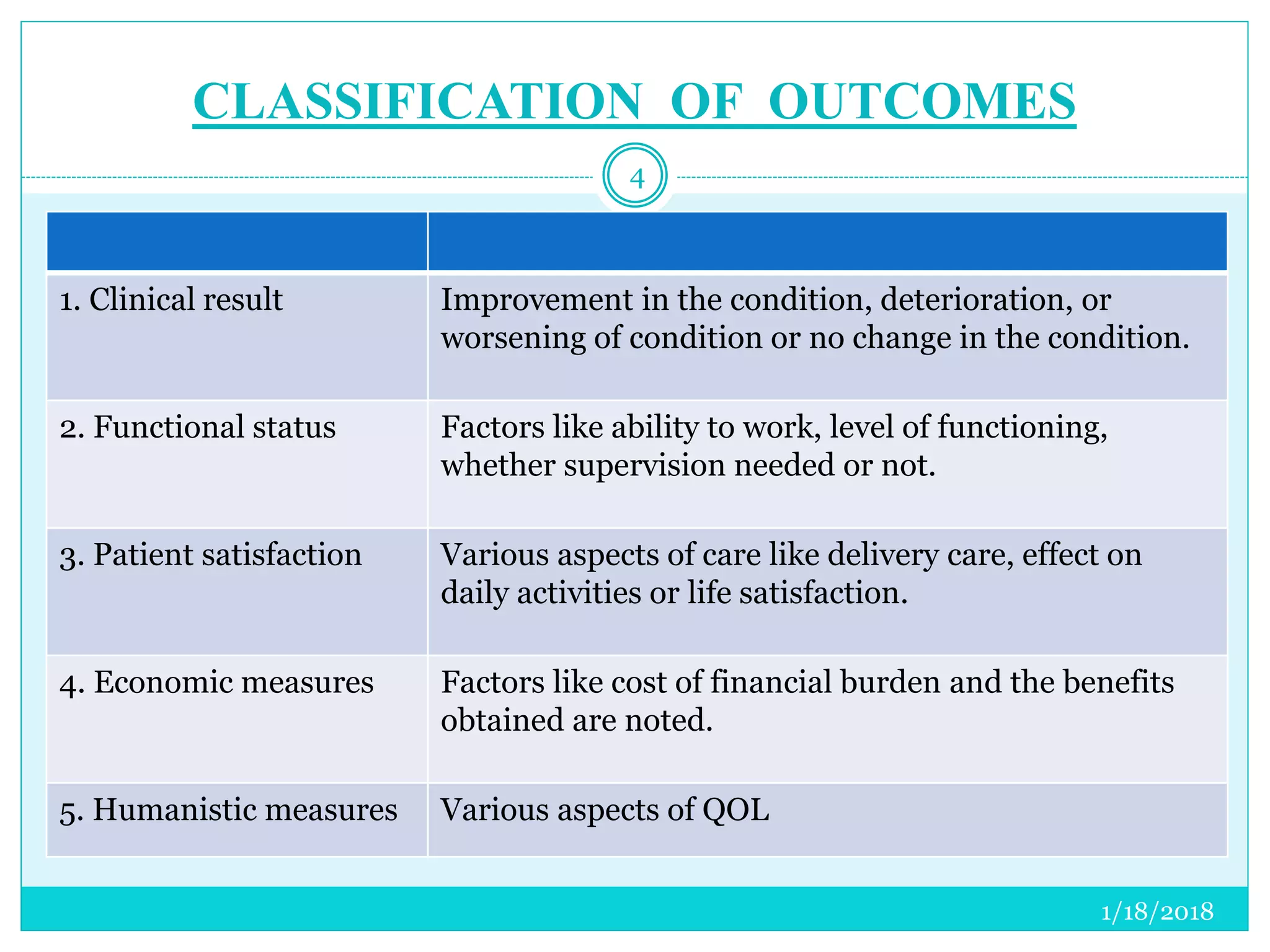
CLASSIFICATION OF OUTCOMES
1/18/2018
4
1. Clinical result Improvement in the condition, deterioration, or
worsening of condition or no change in the condition.
2. Functional status Factors like ability to work, level of functioning,
whether supervision needed or not.
3. Patient satisfaction Various aspects of care like delivery care, effect on
daily activities or life satisfaction.
4. Economic measures Factors like cost of financial burden and the benefits
obtained are noted.
5. Humanistic measures Various aspects of QOL
 Outcome measurement is defined as the systematic quantitative
analysis of the outcome indicators at a point of time .
 These measures are used to find out whether the goal of a
patient are identified and achieved .
 Outcome indicator measures performance of function process
and outcome over a period of time .
1/18/2018
5
The measurement of outcomes can be done by two
approaches:
 1. Statistical methods
 2. Drug use measures
1/18/2018
6
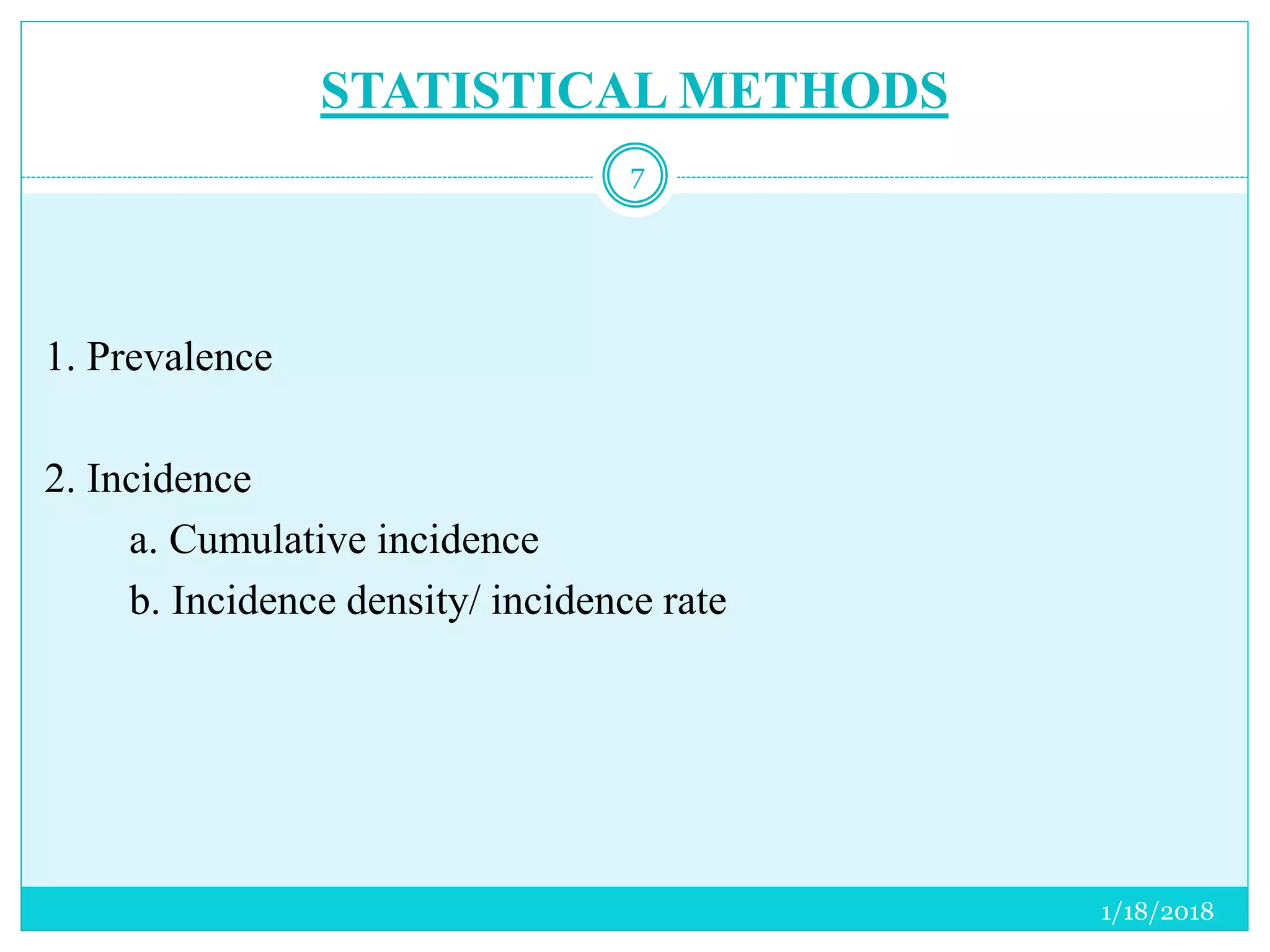
STATISTICAL METHODS
1. Prevalence
2. Incidence
a. Cumulative incidence
b. Incidence density/ incidence rate
1/18/2018
7
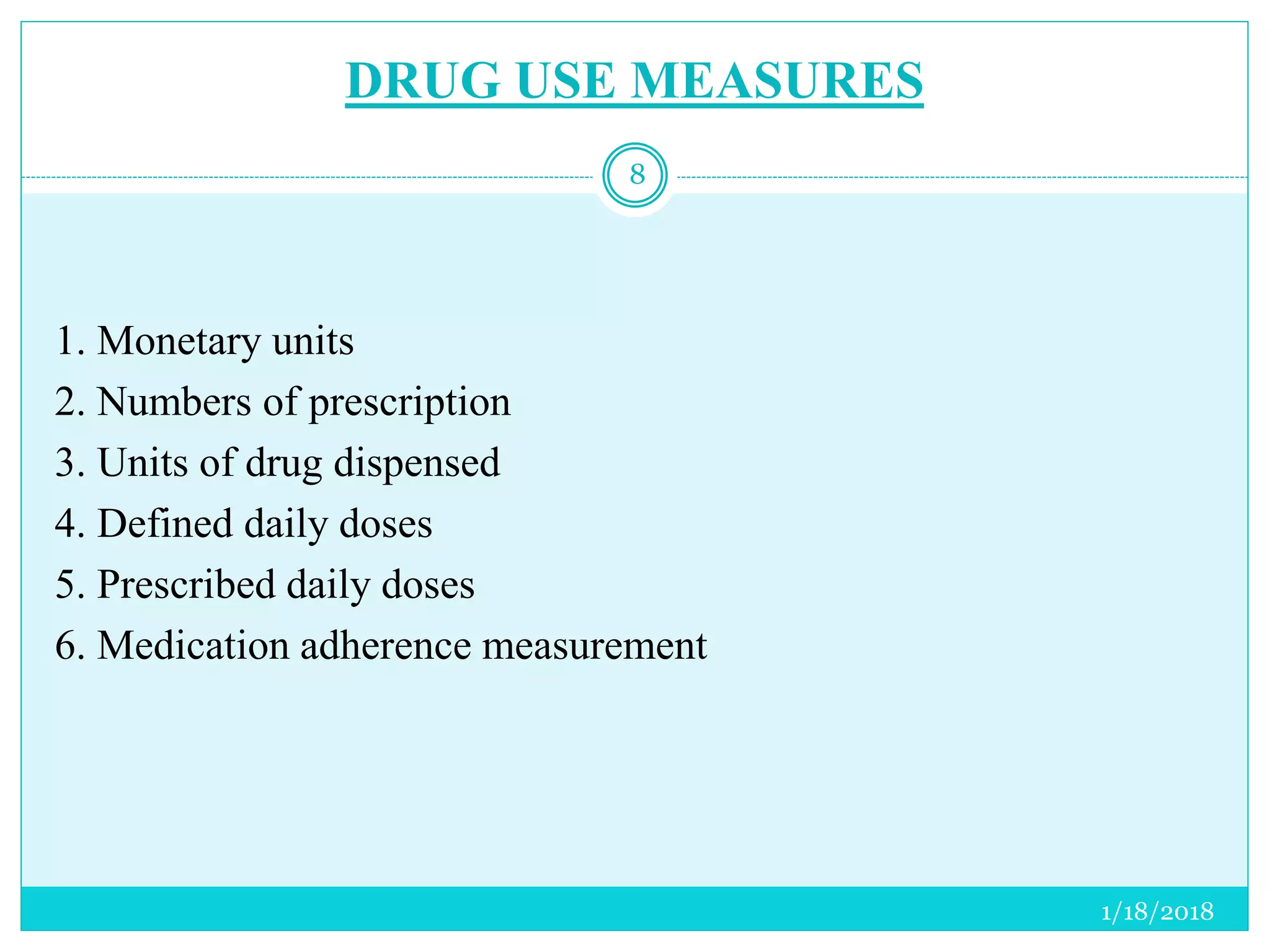
DRUG USE MEASURES
1. Monetary units
2. Numbers of prescription
3. Units of drug dispensed
4. Defined daily doses
5. Prescribed daily doses
6. Medication adherence measurement
1/18/2018
8
Prevalence
 It is concerned with the disease status.
 It is the proportion of people affected with a disease or
exposed to a particular drug in a population at a specified point
or period of time.
 It is usually determined by surveying the population of interest.
1/18/2018
9
1/18/2018
10
 Prevalence varies between 0-1, it can also be expressed as a percentage.
 Point prevalence : Prevalence at any given time
 It is a census type of measure indicating how frequent a disease is at that period of time.
 Point may be a day,several weeks, or even few events depending upon the time taken to
examine the population
 no.of all current cases of a specified disease existing at a given point of time *1000
estimated population at same point of time.
1/18/2018
11
 Period prevalence : frequency of new cases in a population over a
period of time
 It is a combination of point prevalence and incidence
 It includes cases arising before but existing into or through the
year as well as those cases arising during the year.
 Measures the frequency of current cases(old and new) existing
during defined period of time.
 No.of existing cases of a specified disease during a given period of time
interval *1000
estimated mid interval population at risk
1/18/2018
12
 Uses
 Estimate the magnitude of health or disease problem
in the community and to identify the potential high
risk population
 It is especially used for administrative and planning
purpose
Mathematically, Prevalence = A/B
 A= number of population with disease at a given time.
 B= total number of population at a given time.
EG: If there are 1000 patients with epilepsy in a district of 10,00000
population , the prevalence of epilepsy in that district will be
1000/10,00000=0.01%
 Prevalence (P) depend on previous incidence (I) and duration of
disease (D) , when both are relatively stable
P = I * D
1/18/2018
13
Incidence
 It is the measures of frequency with which new disease ,events
occurs and the rate at which people free from disease , events
occurs, and disease develop during a specified period of
obsevation.
 It is better expressed as a proportion or as a rate
 Generally a period of 1 year is used for the measurement.
1/18/2018
14
1/18/2018
15
 The important aspects of incidence are:
i. The need to define the population of interest which is often known as
‘inception cohort’.
ii. All the persons in the inception cohort should be free of disease,
iii. A period of observation should be specified,
iv. All persons should be followed for the specified period,
v. In the case of incomplete follow up the estimates of incidence should
be appropriately adjusted.
1/18/2018
16
 In the case of descriptive studies two measures of incidence are
commonly used :
1. cumulative incidence
2. incidence density/incidence rate
Cumulative incidence (incidence proportion)
1/18/2018
17
 Synonym : attack rate, risk, probability of developing disease
 It is the number of new cases within a specified time period
divided by the size of the population initially at risk.
 measure of the risk of disease or probability of developing the disease during the
specified period
 It is a longitudinal measure that time dependent.
 Normally measured with an inception cohort, ie , a large group of population is
observed over a period of time and the number of cases or outcome is measured.
 number of new cases of disease or injury during specified period
size of population at start of period
1/18/2018
18
 Eg: If a population initially contains 1,000 non-diseased persons
and 28 develop a condition over two years of observation, the
incidence proportion is 28 cases per 1,000 persons.
Incidence rate
1/18/2018
19
 Also called as person-time rate or incidence density.
 Definition: It is the number of new cases per population at risk in
a given time period, and most commonly as cases/person year
exposure
 It describes the probability of a new case occurring during a
given time interval or how quickly disease occurs in a population.
 Generally calculated from a long term cohort follow up study.
1/18/2018
20
 it is based on person time
 A measurement combining the number of person and their time
contribution (years,months or weeks)in a study.
number 0f new cases of disease or injury during
specified period
time each person was observed, totalled for all persons
 Advantage over an incidence proportion :person time is
calculated for each subject, it can accommodate persons coming
into and leaving the study.
1/18/2018
21
 Eg) investigators enrolled 2100 women in a study and followed
them annually for 4 years to determine the incidence rate of
heart disease.
 After 1 yr none had a new diagnosis of heart disease but 100 had
been lost to follow up.
 After 2 yrs 1 had a new diagnosis of heart disease and another
99 had been lost to follow up.
 After 3years another 7 had new diagnosis of heart disease and
793 had been lost to follow up.
 After 4 yrs another 8 had new diagnosis of heart disease and
392 more had been lost to follow up.
1/18/2018
22
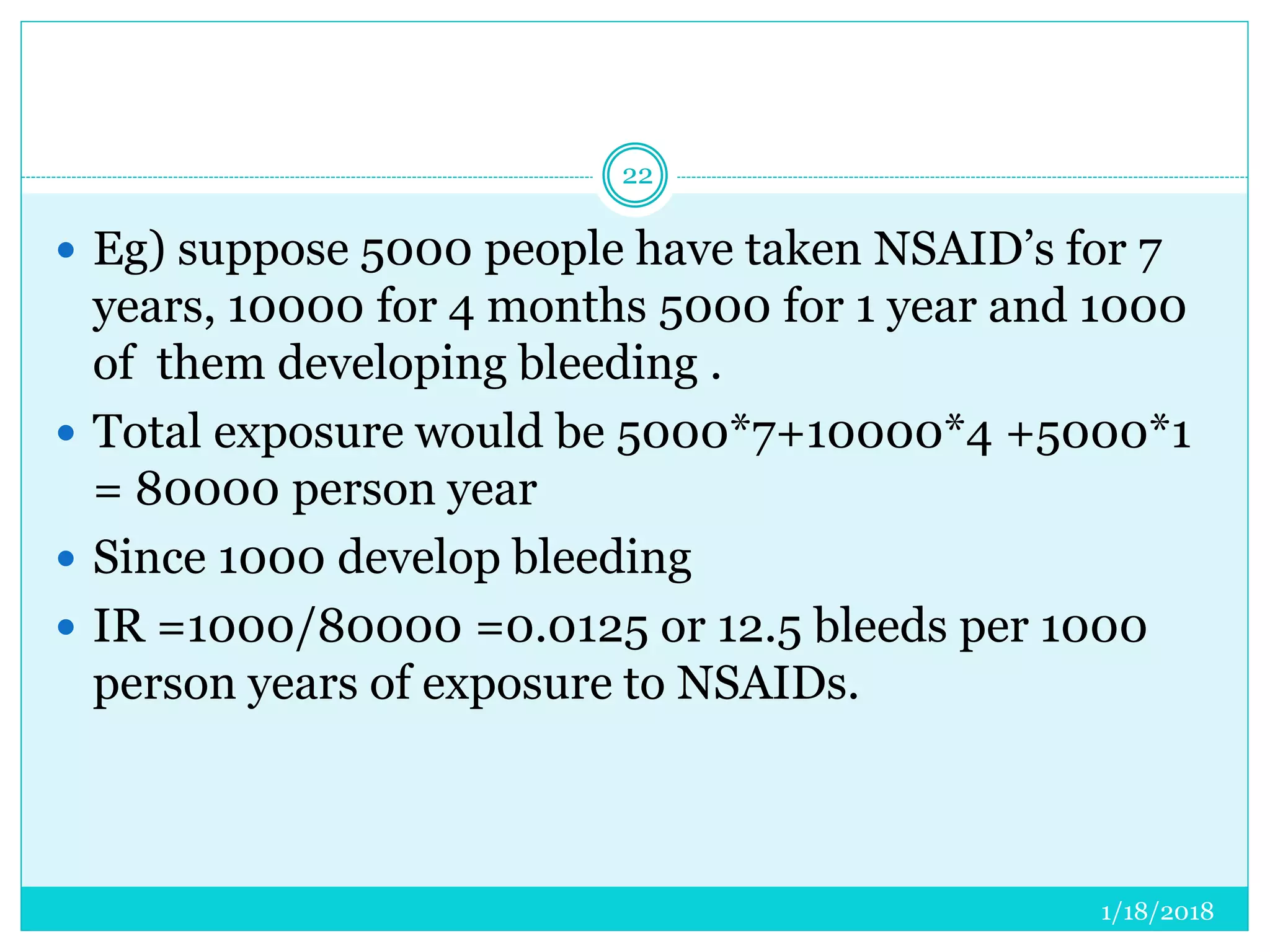
 Eg) suppose 5000 people have taken NSAID’s for 7
years, 10000 for 4 months 5000 for 1 year and 1000
of them developing bleeding .
 Total exposure would be 5000*7+10000*4 +5000*1
= 80000 person year
 Since 1000 develop bleeding
 IR =1000/80000 =0.0125 or 12.5 bleeds per 1000
person years of exposure to NSAIDs.
1/18/2018
23
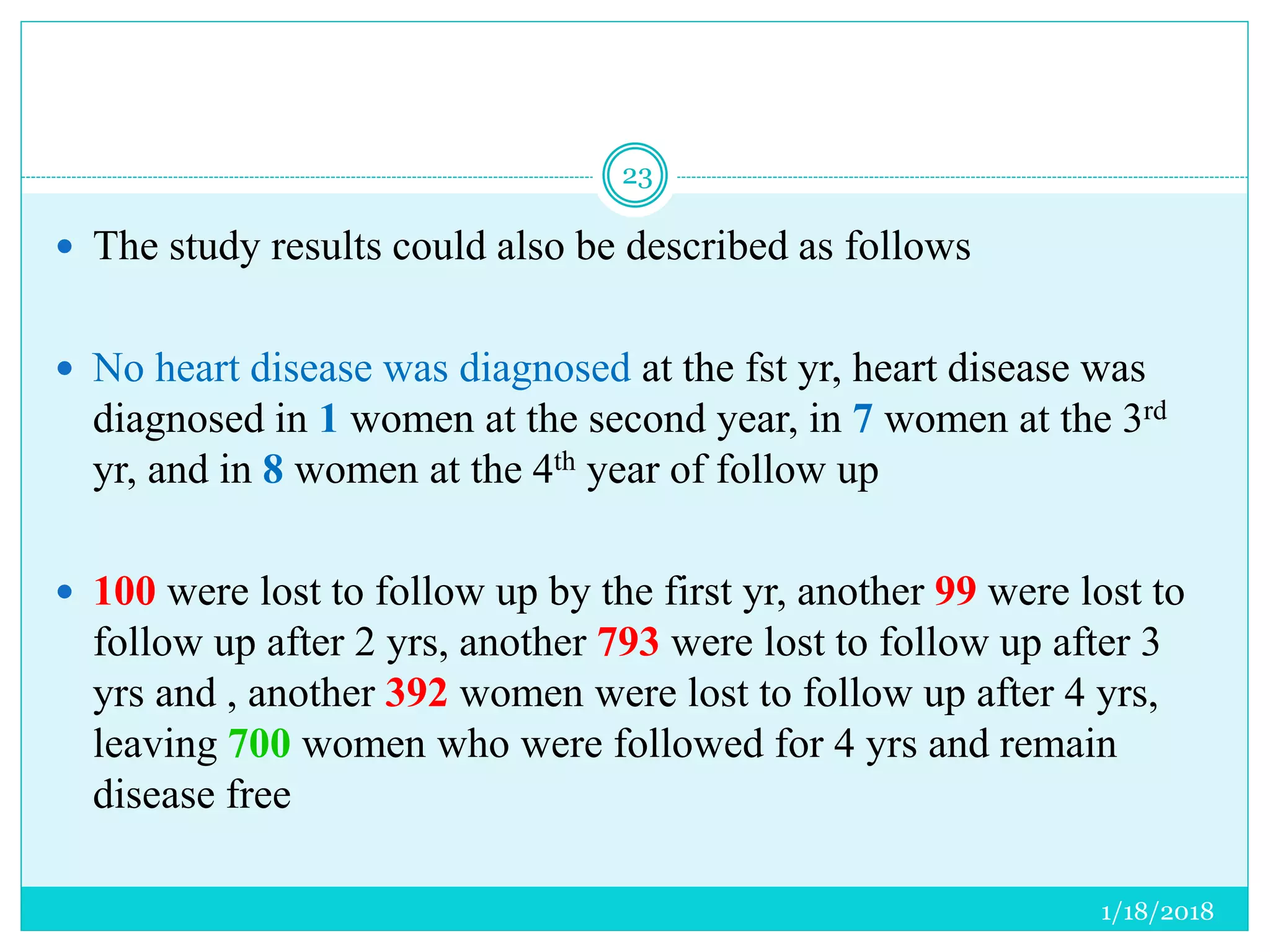
 The study results could also be described as follows
 No heart disease was diagnosed at the fst yr, heart disease was
diagnosed in 1 women at the second year, in 7 women at the 3rd
yr, and in 8 women at the 4th year of follow up
 100 were lost to follow up by the first yr, another 99 were lost to
follow up after 2 yrs, another 793 were lost to follow up after 3
yrs and , another 392 women were lost to follow up after 4 yrs,
leaving 700 women who were followed for 4 yrs and remain
disease free
1/18/2018
24
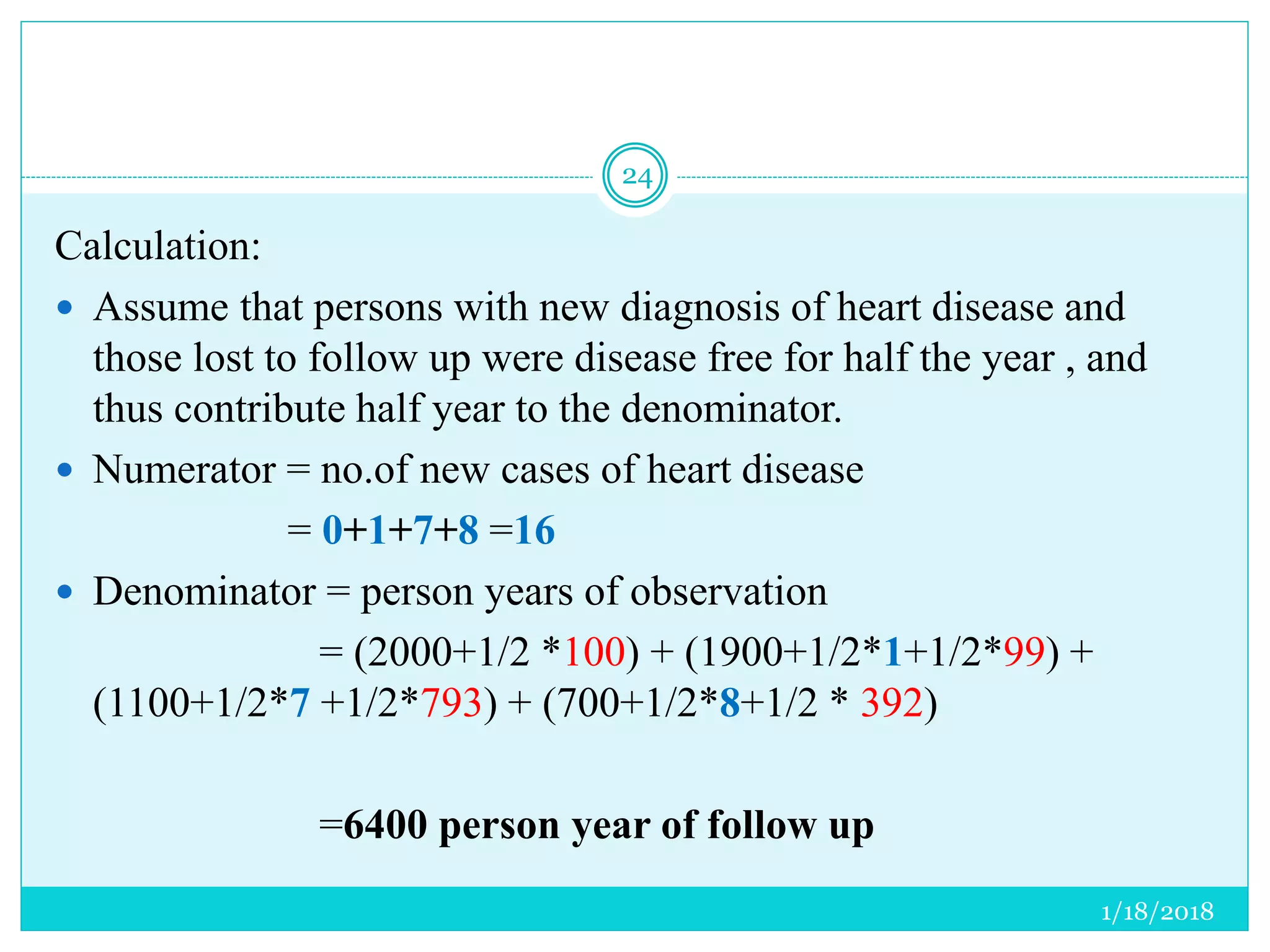
Calculation:
 Assume that persons with new diagnosis of heart disease and
those lost to follow up were disease free for half the year , and
thus contribute half year to the denominator.
 Numerator = no.of new cases of heart disease
= 0+1+7+8 =16
 Denominator = person years of observation
= (2000+1/2 *100) + (1900+1/2*1+1/2*99) +
(1100+1/2*7 +1/2*793) + (700+1/2*8+1/2 * 392)
=6400 person year of follow up
1/18/2018
25
 Person time rate (IR) = No.of new cases of disease
time each person was observed
= 16/6400
= 0.0025 cases per person year
= 2.5 cases per 1000 person year
1/18/2018
26
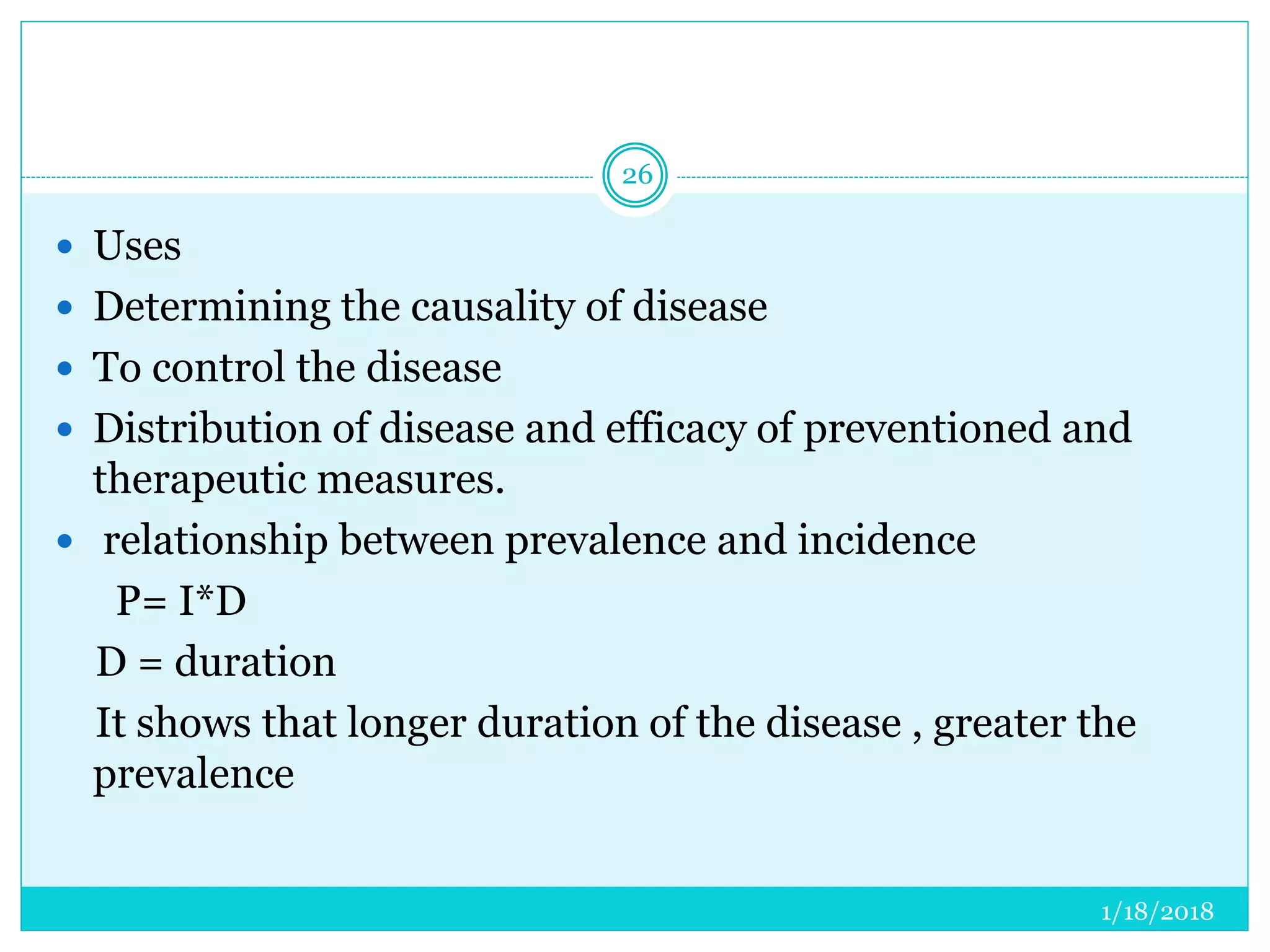
 Uses
 Determining the causality of disease
 To control the disease
 Distribution of disease and efficacy of preventioned and
therapeutic measures.
 relationship between prevalence and incidence
P= I*D
D = duration
It shows that longer duration of the disease , greater the
prevalence
1/18/2018
27
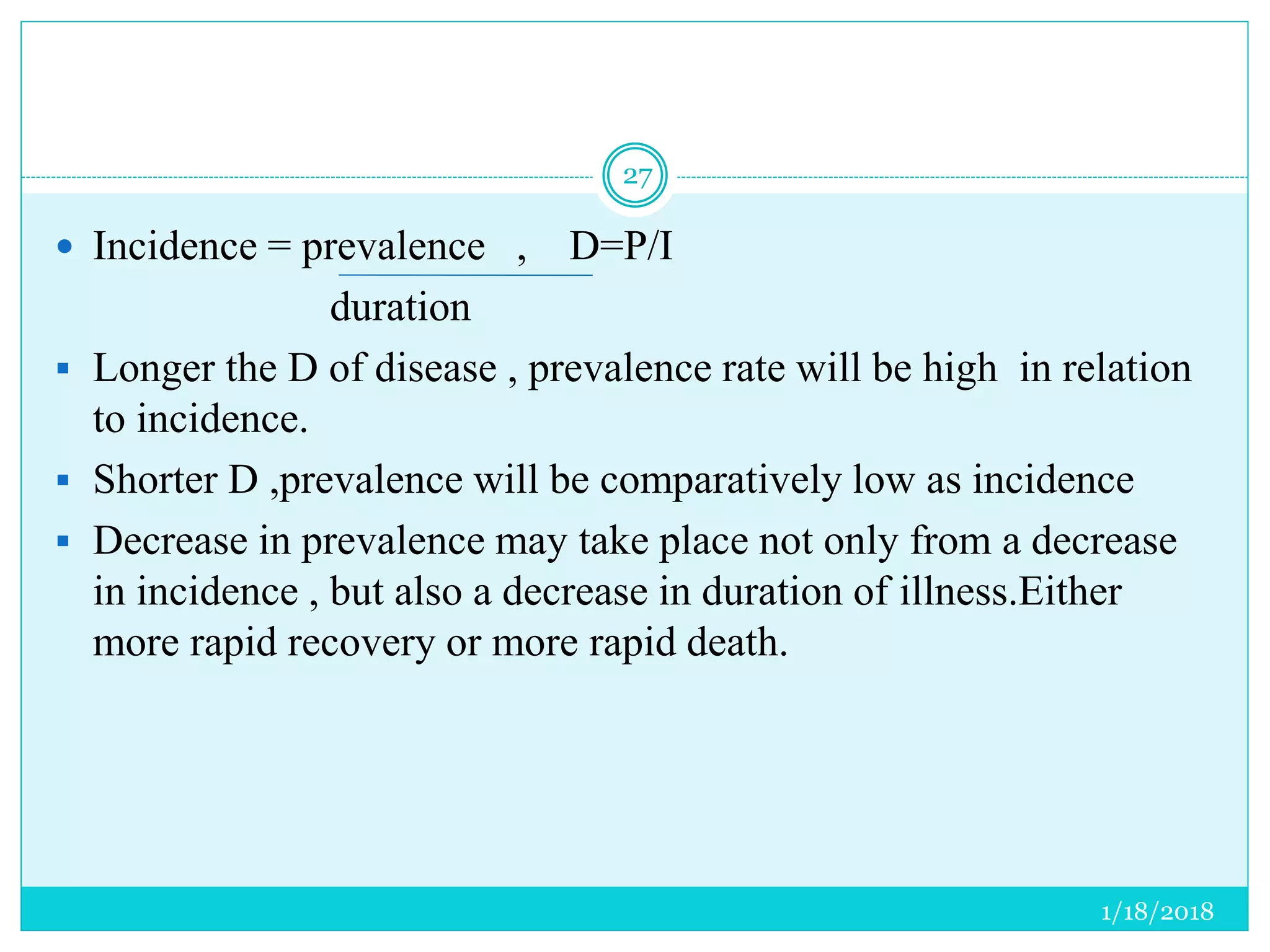
 Incidence = prevalence , D=P/I
duration
 Longer the D of disease , prevalence rate will be high in relation
to incidence.
 Shorter D ,prevalence will be comparatively low as incidence
 Decrease in prevalence may take place not only from a decrease
in incidence , but also a decrease in duration of illness.Either
more rapid recovery or more rapid death.
DRUG USE MEASURES
1/18/2018
28
1. Monetary units
2. Numbers of prescription
3. Units of drug dispensed
4. Defined daily doses
5. Prescribed daily doses
6. Medication adherence measurement
1. Monetary units
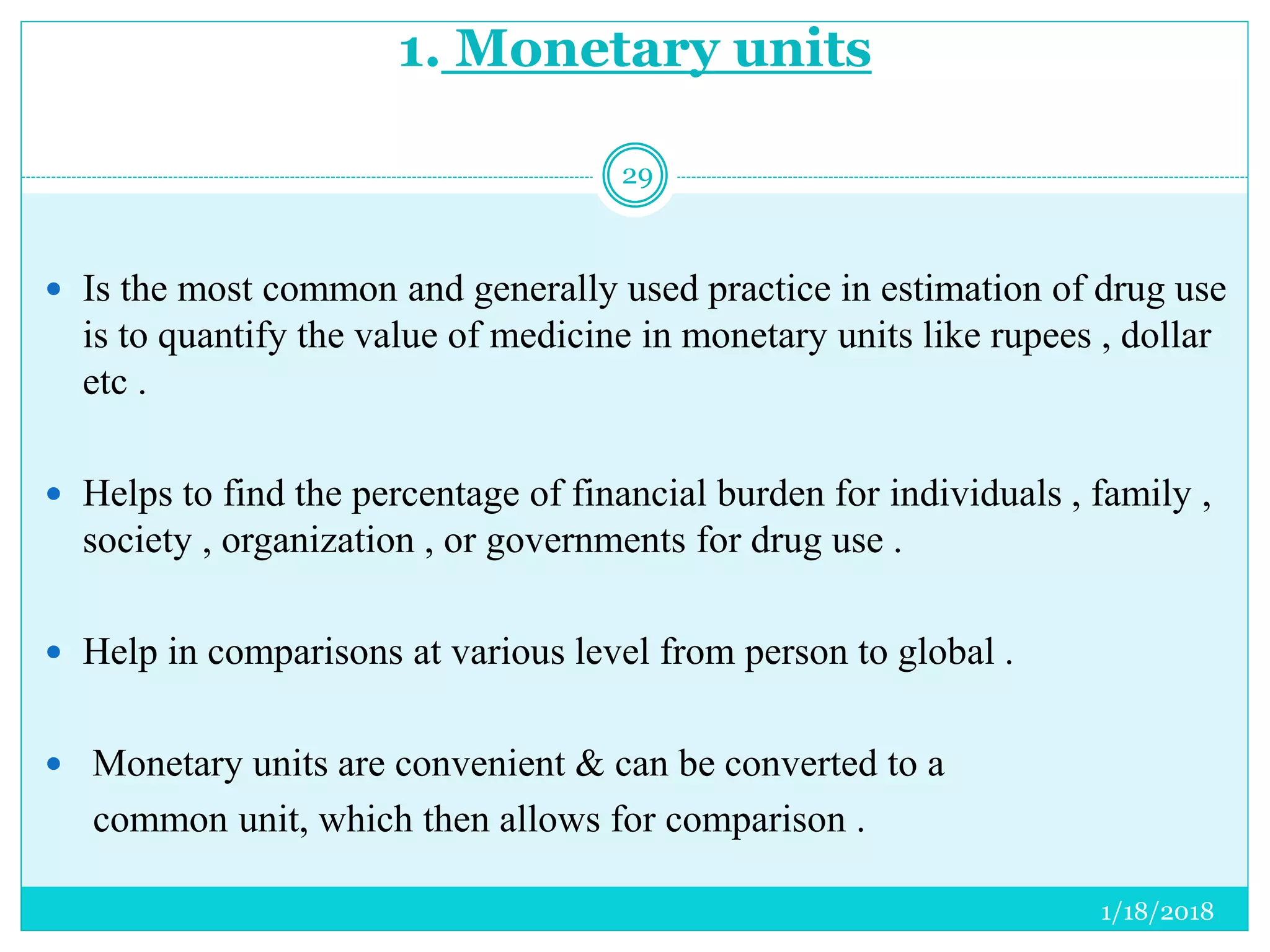
 Is the most common and generally used practice in estimation of drug use
is to quantify the value of medicine in monetary units like rupees , dollar
etc .
 Helps to find the percentage of financial burden for individuals , family ,
society , organization , or governments for drug use .
 Help in comparisons at various level from person to global .
 Monetary units are convenient & can be converted to a
common unit, which then allows for comparison .
1/18/2018
29
1/18/2018
30
 The disadvantage is quantities of drugs actually consumed
are not known & prices may vary widely .
 A Paracetamol tablet may cost 1 rupee in India can have a cost of 5
rupee in the middle east countries and 15 rupees in USA.
 In such a situation the measurement of drug use in monetary units may
not help to give a clear picture when countries are compared.
 However it is useful in comparing within a similar set up.
1/18/2018
31
 Similarly a drug may have different dosage
forms and strengths in market and price may
vary for them.
 Unless corrective measures are taken there can
be errors while estimating the monetary value of
drug use .
2. Number of prescriptions.
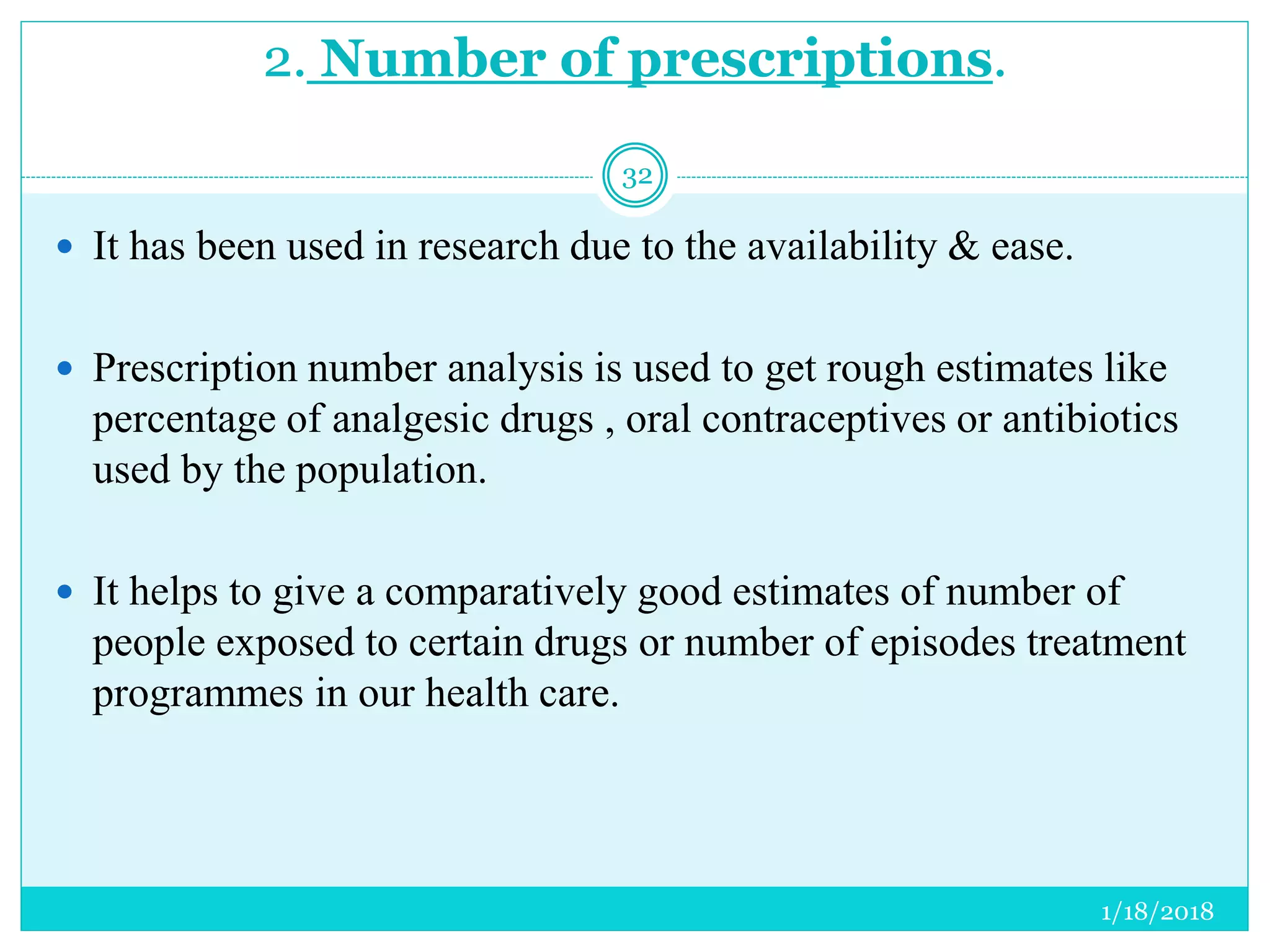
 It has been used in research due to the availability & ease.
 Prescription number analysis is used to get rough estimates like
percentage of analgesic drugs , oral contraceptives or antibiotics
used by the population.
 It helps to give a comparatively good estimates of number of
people exposed to certain drugs or number of episodes treatment
programmes in our health care.
1/18/2018
32
1/18/2018
33
 This type of studies also help to find whether there is increase in
the number of prescription during certain periods
3. Units of drug dispensed
 Units of drugs represent measures like number of capsules or
tablets or doses of vaccines
 it is easy to obtain
&can be used to compare usage trends within population
 Help to analyze drug use trend in various countries , states or
territories of country .
 Helps to compare the hypothesis generated related to drug use
like over use or under use .
1/18/2018
34
1/18/2018
35
 It has limitations like units of drugs dispensed need not always
reflect the actual number of drugs used by the population. People
may not use certain dispensed medicines for various reasons.
 Hence difficult to determine the actual no. of patients
exposed to the drug .
4. Defined daily doses
 It is a statistical measure of drug consumption defined
by the WHO.
 It is used to standardize the comparison of drug usage
between different drugs or between different health care
environments.
 It is normally expressed as DDD/1000 patients/day or
DDD/100 bed/day.
 DDD is not to be confused with the therapeutic dose or
with the dose actually prescribed by the physician for
an individual patient.
1/18/2018
36
1/18/2018
37
 It is helpful in describing & comparing patterns of DU &
provides denominator data for estimation of ADR rates.
 According to WHO “the DDD is the assumed average
maintenance dose per day for a drug used for its main
indication in adults .
 If the DDD for a certain drug is given, the number of
DDD used by an indivitual patient by a collective of
patients is as follows.
 Drug usage(DDD) = item issued * amount of drug per
item
DDD
• Eg : a patient has taken paracetamol as pain killer , it is having
DDD = 3g ie, average patient who uses paracetamol uses 3g
in a day or within a period of 24 hrs
• this is equivalent to 6 standard tab of 500mg each . If patient
consumes 24 such tablets
DDD = 24 *500 = 4
3
1/18/2018
38
1/18/2018
39
 DDD should reflect the global dosage irrespective of genetic
variations of drug metabolism .
 Drug consumption data presented in DDDs only give a rough
estimate of consumption and not an exact picture of actual use.
 DDD provide a fixed unit of measurement independent of price
and dosage form
 It help the researcher to assess trends in drug consumption and to
perform comparisons between population groups.
1/18/2018
40
• Advantage
 Its usefulness for working with readily available drug
statistics
 It allows comparisons b/w drugs in the same therapeutic
class .
1/18/2018
41
 Disadvantage
 Problems arises when doses vary widely like with
antibiotics or if the drug has more than 1 major indication.
 DDDs is a technical use of comparison and many drugs are not
yet assigned the DDDs
 Pediatric uses are often not considered in the calculations
 Problems can also arise when doses varies widely as in the case
of aspirin (high doses –inflammatory,low doses-cardio) .
Prescribed daily doses
 It is the avg daily dose of a drug that has actually been
prescribed .
 Calculated from representative sample of prescriptions.
 DDD can be determined from studies of prescriptions or medical
or pharmacy records.
 Its important to relate the DDD to the diagnosis on which the
dosage is biased.
1/18/2018
42
1/18/2018
43
 PDD is useful for validating the DDD.
 Pharmacoepidemiological information is also important in order
to interpret a PDD
 PDD can vary according to both the illness treated and national
therapeutic traditions.
 The PDDs also vary substantially between different countries and
this should always be considered while making international
comparisons.
1/18/2018
44
 Disadv is that it does not indicate no. Of population
exposed to drug.
 However, it provides estimate of no of person-days of exposure.
Medication adherence measurements
 I. Biological Assays.
 II. Pill Counts.
 lll. Weight of Topical Medications.
 IV. Electronic Monitoring.
 V. Patient interviews
1/18/2018
45
 I. Biological Assays
 Biological assays measure the concentration of a drug, its
metabolites, or tracer compounds in the blood or urine of a
patient.
 These measures are intrusive and often costly to
administer.
 Drug or food interactions, physiological differences, dosing
schedules, and the half-life of the drugs may influence the
results .
1/18/2018
46
 Biological tracers that have known half lives and do not
interfere with the medication may be used, but there are
ethical concerns .
 All of these methods have high costs for the assays that
limit the feasibility of these techniques .
1/18/2018
47
 II. Pill Counts.
 Counting the number of pills remaining in a patient's supply
and calculating the number of pills that the patient has taken
since filling the prescription is the easiest method for
calculating patient medication adherence .
 Patterns of non-adherence are often difficult to discern with a
simple count of pills on a certain date weeks to months after
the prescription was filled.
 Because pill counts are often based upon the date a prescription is
filled, patients who get prescriptions refilled prior to their first one
may present complications
1/18/2018
48
III. Weight of Topical Medications
 The weight of a topical medication remaining in a tube is
used as a measure of adherence .
 When compared with patient log books of daily medication
use, weight estimates of adherence were considerably lower
than patient log estimates.
 In a comparison of methods to measure adherence, found
that estimates calculated from medication logs and
medication weights were consistently higher than those of
electronic monitors .
1/18/2018
49
 IV. Electronic Monitoring
 The Medication Event Monitoring System (MEMS)
manufactured by Aardex corporation allows the assessment
of the number of pills missed during a period as well as
adherence to a dosing schedule .
 The system electronically monitors when the pill bottle is
opened, and the researcher can periodically download the
information to a computer .
• The availability and cost of this system could limit the
feasibility of its use .
1/18/2018
50
v. Patient interviews
1/18/2018
51
 Interviewing the patients to assess their knowledge
of the medications they have been prescribed and the
dosing schedule provide information as to whether
the patient is adherent with the actual dosing
schedule.
 THANK YOU
1/18/2018
52

Measurement of outcome v5

  • 1.
  • 2.
    1/18/2018 2  Epidemiology isabout identifying associations between exposures and outcomes.  To identify any associations, exposures and outcomes must first be measured in a quantitative manner.  In treatments and health care programmes, outcomes are the results of treatment or care and includes both positive and negative results.
  • 3.
    1/18/2018 3  Outcomes areconsequences or results of care or lack of care.  Outcome measures help us predict which patients will benefit most from a particular intervention and to document whether the patient improves after the intervention is provided.
  • 4.
    CLASSIFICATION OF OUTCOMES 1/18/2018 4 1.Clinical result Improvement in the condition, deterioration, or worsening of condition or no change in the condition. 2. Functional status Factors like ability to work, level of functioning, whether supervision needed or not. 3. Patient satisfaction Various aspects of care like delivery care, effect on daily activities or life satisfaction. 4. Economic measures Factors like cost of financial burden and the benefits obtained are noted. 5. Humanistic measures Various aspects of QOL
  • 5.
     Outcome measurementis defined as the systematic quantitative analysis of the outcome indicators at a point of time .  These measures are used to find out whether the goal of a patient are identified and achieved .  Outcome indicator measures performance of function process and outcome over a period of time . 1/18/2018 5
  • 6.
    The measurement ofoutcomes can be done by two approaches:  1. Statistical methods  2. Drug use measures 1/18/2018 6
  • 7.
    STATISTICAL METHODS 1. Prevalence 2.Incidence a. Cumulative incidence b. Incidence density/ incidence rate 1/18/2018 7
  • 8.
    DRUG USE MEASURES 1.Monetary units 2. Numbers of prescription 3. Units of drug dispensed 4. Defined daily doses 5. Prescribed daily doses 6. Medication adherence measurement 1/18/2018 8
  • 9.
    Prevalence  It isconcerned with the disease status.  It is the proportion of people affected with a disease or exposed to a particular drug in a population at a specified point or period of time.  It is usually determined by surveying the population of interest. 1/18/2018 9
  • 10.
    1/18/2018 10  Prevalence variesbetween 0-1, it can also be expressed as a percentage.  Point prevalence : Prevalence at any given time  It is a census type of measure indicating how frequent a disease is at that period of time.  Point may be a day,several weeks, or even few events depending upon the time taken to examine the population  no.of all current cases of a specified disease existing at a given point of time *1000 estimated population at same point of time.
  • 11.
    1/18/2018 11  Period prevalence: frequency of new cases in a population over a period of time  It is a combination of point prevalence and incidence  It includes cases arising before but existing into or through the year as well as those cases arising during the year.  Measures the frequency of current cases(old and new) existing during defined period of time.  No.of existing cases of a specified disease during a given period of time interval *1000 estimated mid interval population at risk
  • 12.
    1/18/2018 12  Uses  Estimatethe magnitude of health or disease problem in the community and to identify the potential high risk population  It is especially used for administrative and planning purpose
  • 13.
    Mathematically, Prevalence =A/B  A= number of population with disease at a given time.  B= total number of population at a given time. EG: If there are 1000 patients with epilepsy in a district of 10,00000 population , the prevalence of epilepsy in that district will be 1000/10,00000=0.01%  Prevalence (P) depend on previous incidence (I) and duration of disease (D) , when both are relatively stable P = I * D 1/18/2018 13
  • 14.
    Incidence  It isthe measures of frequency with which new disease ,events occurs and the rate at which people free from disease , events occurs, and disease develop during a specified period of obsevation.  It is better expressed as a proportion or as a rate  Generally a period of 1 year is used for the measurement. 1/18/2018 14
  • 15.
    1/18/2018 15  The importantaspects of incidence are: i. The need to define the population of interest which is often known as ‘inception cohort’. ii. All the persons in the inception cohort should be free of disease, iii. A period of observation should be specified, iv. All persons should be followed for the specified period, v. In the case of incomplete follow up the estimates of incidence should be appropriately adjusted.
  • 16.
    1/18/2018 16  In thecase of descriptive studies two measures of incidence are commonly used : 1. cumulative incidence 2. incidence density/incidence rate
  • 17.
    Cumulative incidence (incidenceproportion) 1/18/2018 17  Synonym : attack rate, risk, probability of developing disease  It is the number of new cases within a specified time period divided by the size of the population initially at risk.  measure of the risk of disease or probability of developing the disease during the specified period  It is a longitudinal measure that time dependent.  Normally measured with an inception cohort, ie , a large group of population is observed over a period of time and the number of cases or outcome is measured.  number of new cases of disease or injury during specified period size of population at start of period
  • 18.
    1/18/2018 18  Eg: Ifa population initially contains 1,000 non-diseased persons and 28 develop a condition over two years of observation, the incidence proportion is 28 cases per 1,000 persons.
  • 19.
    Incidence rate 1/18/2018 19  Alsocalled as person-time rate or incidence density.  Definition: It is the number of new cases per population at risk in a given time period, and most commonly as cases/person year exposure  It describes the probability of a new case occurring during a given time interval or how quickly disease occurs in a population.  Generally calculated from a long term cohort follow up study.
  • 20.
    1/18/2018 20  it isbased on person time  A measurement combining the number of person and their time contribution (years,months or weeks)in a study. number 0f new cases of disease or injury during specified period time each person was observed, totalled for all persons  Advantage over an incidence proportion :person time is calculated for each subject, it can accommodate persons coming into and leaving the study.
  • 21.
    1/18/2018 21  Eg) investigatorsenrolled 2100 women in a study and followed them annually for 4 years to determine the incidence rate of heart disease.  After 1 yr none had a new diagnosis of heart disease but 100 had been lost to follow up.  After 2 yrs 1 had a new diagnosis of heart disease and another 99 had been lost to follow up.  After 3years another 7 had new diagnosis of heart disease and 793 had been lost to follow up.  After 4 yrs another 8 had new diagnosis of heart disease and 392 more had been lost to follow up.
  • 22.
    1/18/2018 22  Eg) suppose5000 people have taken NSAID’s for 7 years, 10000 for 4 months 5000 for 1 year and 1000 of them developing bleeding .  Total exposure would be 5000*7+10000*4 +5000*1 = 80000 person year  Since 1000 develop bleeding  IR =1000/80000 =0.0125 or 12.5 bleeds per 1000 person years of exposure to NSAIDs.
  • 23.
    1/18/2018 23  The studyresults could also be described as follows  No heart disease was diagnosed at the fst yr, heart disease was diagnosed in 1 women at the second year, in 7 women at the 3rd yr, and in 8 women at the 4th year of follow up  100 were lost to follow up by the first yr, another 99 were lost to follow up after 2 yrs, another 793 were lost to follow up after 3 yrs and , another 392 women were lost to follow up after 4 yrs, leaving 700 women who were followed for 4 yrs and remain disease free
  • 24.
    1/18/2018 24 Calculation:  Assume thatpersons with new diagnosis of heart disease and those lost to follow up were disease free for half the year , and thus contribute half year to the denominator.  Numerator = no.of new cases of heart disease = 0+1+7+8 =16  Denominator = person years of observation = (2000+1/2 *100) + (1900+1/2*1+1/2*99) + (1100+1/2*7 +1/2*793) + (700+1/2*8+1/2 * 392) =6400 person year of follow up
  • 25.
    1/18/2018 25  Person timerate (IR) = No.of new cases of disease time each person was observed = 16/6400 = 0.0025 cases per person year = 2.5 cases per 1000 person year
  • 26.
    1/18/2018 26  Uses  Determiningthe causality of disease  To control the disease  Distribution of disease and efficacy of preventioned and therapeutic measures.  relationship between prevalence and incidence P= I*D D = duration It shows that longer duration of the disease , greater the prevalence
  • 27.
    1/18/2018 27  Incidence =prevalence , D=P/I duration  Longer the D of disease , prevalence rate will be high in relation to incidence.  Shorter D ,prevalence will be comparatively low as incidence  Decrease in prevalence may take place not only from a decrease in incidence , but also a decrease in duration of illness.Either more rapid recovery or more rapid death.
  • 28.
    DRUG USE MEASURES 1/18/2018 28 1.Monetary units 2. Numbers of prescription 3. Units of drug dispensed 4. Defined daily doses 5. Prescribed daily doses 6. Medication adherence measurement
  • 29.
    1. Monetary units Is the most common and generally used practice in estimation of drug use is to quantify the value of medicine in monetary units like rupees , dollar etc .  Helps to find the percentage of financial burden for individuals , family , society , organization , or governments for drug use .  Help in comparisons at various level from person to global .  Monetary units are convenient & can be converted to a common unit, which then allows for comparison . 1/18/2018 29
  • 30.
    1/18/2018 30  The disadvantageis quantities of drugs actually consumed are not known & prices may vary widely .  A Paracetamol tablet may cost 1 rupee in India can have a cost of 5 rupee in the middle east countries and 15 rupees in USA.  In such a situation the measurement of drug use in monetary units may not help to give a clear picture when countries are compared.  However it is useful in comparing within a similar set up.
  • 31.
    1/18/2018 31  Similarly adrug may have different dosage forms and strengths in market and price may vary for them.  Unless corrective measures are taken there can be errors while estimating the monetary value of drug use .
  • 32.
    2. Number ofprescriptions.  It has been used in research due to the availability & ease.  Prescription number analysis is used to get rough estimates like percentage of analgesic drugs , oral contraceptives or antibiotics used by the population.  It helps to give a comparatively good estimates of number of people exposed to certain drugs or number of episodes treatment programmes in our health care. 1/18/2018 32
  • 33.
    1/18/2018 33  This typeof studies also help to find whether there is increase in the number of prescription during certain periods
  • 34.
    3. Units ofdrug dispensed  Units of drugs represent measures like number of capsules or tablets or doses of vaccines  it is easy to obtain &can be used to compare usage trends within population  Help to analyze drug use trend in various countries , states or territories of country .  Helps to compare the hypothesis generated related to drug use like over use or under use . 1/18/2018 34
  • 35.
    1/18/2018 35  It haslimitations like units of drugs dispensed need not always reflect the actual number of drugs used by the population. People may not use certain dispensed medicines for various reasons.  Hence difficult to determine the actual no. of patients exposed to the drug .
  • 36.
    4. Defined dailydoses  It is a statistical measure of drug consumption defined by the WHO.  It is used to standardize the comparison of drug usage between different drugs or between different health care environments.  It is normally expressed as DDD/1000 patients/day or DDD/100 bed/day.  DDD is not to be confused with the therapeutic dose or with the dose actually prescribed by the physician for an individual patient. 1/18/2018 36
  • 37.
    1/18/2018 37  It ishelpful in describing & comparing patterns of DU & provides denominator data for estimation of ADR rates.  According to WHO “the DDD is the assumed average maintenance dose per day for a drug used for its main indication in adults .  If the DDD for a certain drug is given, the number of DDD used by an indivitual patient by a collective of patients is as follows.
  • 38.
     Drug usage(DDD)= item issued * amount of drug per item DDD • Eg : a patient has taken paracetamol as pain killer , it is having DDD = 3g ie, average patient who uses paracetamol uses 3g in a day or within a period of 24 hrs • this is equivalent to 6 standard tab of 500mg each . If patient consumes 24 such tablets DDD = 24 *500 = 4 3 1/18/2018 38
  • 39.
    1/18/2018 39  DDD shouldreflect the global dosage irrespective of genetic variations of drug metabolism .  Drug consumption data presented in DDDs only give a rough estimate of consumption and not an exact picture of actual use.  DDD provide a fixed unit of measurement independent of price and dosage form  It help the researcher to assess trends in drug consumption and to perform comparisons between population groups.
  • 40.
    1/18/2018 40 • Advantage  Itsusefulness for working with readily available drug statistics  It allows comparisons b/w drugs in the same therapeutic class .
  • 41.
    1/18/2018 41  Disadvantage  Problemsarises when doses vary widely like with antibiotics or if the drug has more than 1 major indication.  DDDs is a technical use of comparison and many drugs are not yet assigned the DDDs  Pediatric uses are often not considered in the calculations  Problems can also arise when doses varies widely as in the case of aspirin (high doses –inflammatory,low doses-cardio) .
  • 42.
    Prescribed daily doses It is the avg daily dose of a drug that has actually been prescribed .  Calculated from representative sample of prescriptions.  DDD can be determined from studies of prescriptions or medical or pharmacy records.  Its important to relate the DDD to the diagnosis on which the dosage is biased. 1/18/2018 42
  • 43.
    1/18/2018 43  PDD isuseful for validating the DDD.  Pharmacoepidemiological information is also important in order to interpret a PDD  PDD can vary according to both the illness treated and national therapeutic traditions.  The PDDs also vary substantially between different countries and this should always be considered while making international comparisons.
  • 44.
    1/18/2018 44  Disadv isthat it does not indicate no. Of population exposed to drug.  However, it provides estimate of no of person-days of exposure.
  • 45.
    Medication adherence measurements I. Biological Assays.  II. Pill Counts.  lll. Weight of Topical Medications.  IV. Electronic Monitoring.  V. Patient interviews 1/18/2018 45
  • 46.
     I. BiologicalAssays  Biological assays measure the concentration of a drug, its metabolites, or tracer compounds in the blood or urine of a patient.  These measures are intrusive and often costly to administer.  Drug or food interactions, physiological differences, dosing schedules, and the half-life of the drugs may influence the results . 1/18/2018 46
  • 47.
     Biological tracersthat have known half lives and do not interfere with the medication may be used, but there are ethical concerns .  All of these methods have high costs for the assays that limit the feasibility of these techniques . 1/18/2018 47
  • 48.
     II. PillCounts.  Counting the number of pills remaining in a patient's supply and calculating the number of pills that the patient has taken since filling the prescription is the easiest method for calculating patient medication adherence .  Patterns of non-adherence are often difficult to discern with a simple count of pills on a certain date weeks to months after the prescription was filled.  Because pill counts are often based upon the date a prescription is filled, patients who get prescriptions refilled prior to their first one may present complications 1/18/2018 48
  • 49.
    III. Weight ofTopical Medications  The weight of a topical medication remaining in a tube is used as a measure of adherence .  When compared with patient log books of daily medication use, weight estimates of adherence were considerably lower than patient log estimates.  In a comparison of methods to measure adherence, found that estimates calculated from medication logs and medication weights were consistently higher than those of electronic monitors . 1/18/2018 49
  • 50.
     IV. ElectronicMonitoring  The Medication Event Monitoring System (MEMS) manufactured by Aardex corporation allows the assessment of the number of pills missed during a period as well as adherence to a dosing schedule .  The system electronically monitors when the pill bottle is opened, and the researcher can periodically download the information to a computer . • The availability and cost of this system could limit the feasibility of its use . 1/18/2018 50
  • 51.
    v. Patient interviews 1/18/2018 51 Interviewing the patients to assess their knowledge of the medications they have been prescribed and the dosing schedule provide information as to whether the patient is adherent with the actual dosing schedule.
  • 52.