CONTENTS
 Introduction
 Evolution
 How PEM is initiated
 PEM process
 M-PEM
 Advantages and disadvantages of PEM
 Applications
 References
Introduction
 PEM is a non-interventional, observational cohort form
of pharmacovigilance.
 It is the method of studying the safety of new
medications used by the general practitioner.
 UK based concept
 Individualized form of Pharmacovigilance
 Collaborative effort between Doctor , Pharmacist,
Patient and Government.
Evolution
 The whole ethos of drug safety monitoring came into
existence after Thalidomide disaster 1961.
 Professor William Inam , man who developed Yellow
card system in UK –method of spontaneous
monitoring.
 Prof. Inam recognized the the limitations of
spontaneous monitoring (PRACTOLOL-
Occulomucocutaneos syndrome) and he established
DSRU(Drug Safety Research Unit) in 1980 at
University of Southampton and devised a method for
early detection of potential drug hazards know as PEM
WILLIAM HOWARD WALLACE BILL INMAN
In1990’s , a new version of PEM known as Modified
PEM was developed which offers a great flexibility in
the data requested from prescribers
How PEM is initiated
Here patient being prescribed monitored drug, which
include virtually all new chemical entities are studied
the criteria for study drug are:
NCE(New Chemical Entities)
New pharmacological Principle
Predicted wide spread use
Suspected problems
Identified for unquantified risks
Continued…..
Contd..
The information on the 1st 5000-18000
prescriptions for that drug are then obtained.
Prescribers are contacted with a questionnaire to
determine subsequent events or clinical
outcomes.
Experiences with the drugs can be examined and
the incidence of various events can be estimated.
Contd..
Collection of exposure data begins soon after the new
product is launched
For each patient in the study, DSRU prepares a
computerized longitudinal record in the date
order of drug use
After prescription to a patient, the DSRU sends the
prescriber a green form of questionnaire
Doctor receives maximum of 4 green forms in a month
The study period varies between 1 month to 12 months.
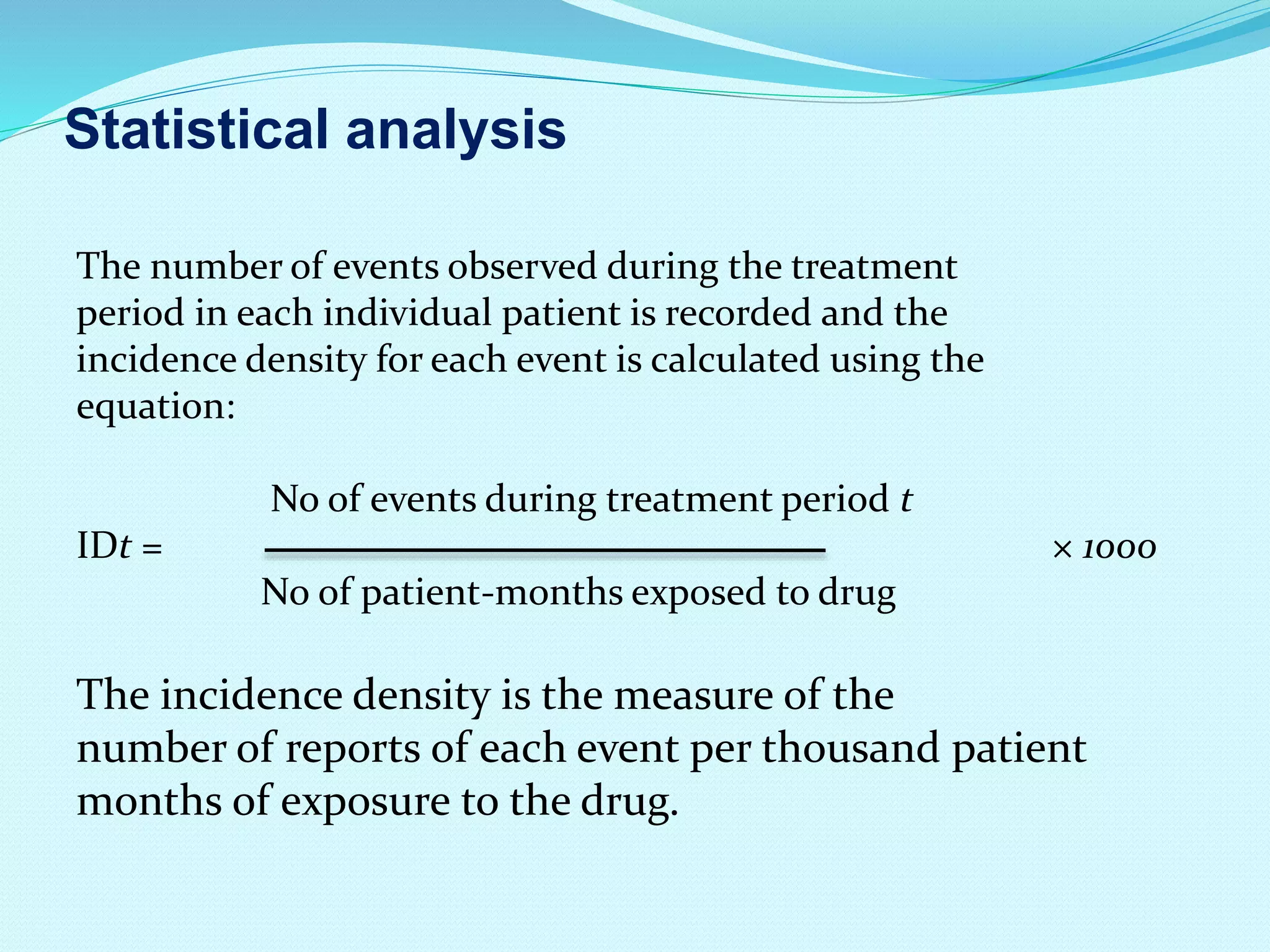
Statistical analysis
The number of events observed during the treatment
period in each individual patient is recorded and the
incidence density for each event is calculated using the
equation:
No of events during treatment period t
IDt = × 1000
No of patient-months exposed to drug
The incidence density is the measure of the
number of reports of each event per thousand patient
months of exposure to the drug.
Process of PEM
In UK, all the patients are registered with NHS-GP
which provides the primary care and act as a
gateway to specialist and hospital care.
The process of prescription event monitoringThe process of prescription event monitoring
Drug Safety
Research
Unit
Prescription
Pricing Authority
Electronic copies of prescriptions for
study drug sent to DSRU
Signal Generation,
Hypothesis
Testing,
Follow-up studies
General
Practitioner
PATIENT
DSRU sends Green
From to GP for details
of patient events
Prescription
sent to PPA
PHARMACY
Prescription for
new drug to
patient by GP
Green From
questionnaire sent back
to DSRU this is the
OUT COME DATA
Patient goes to
pharmacy
Green
form
for
PEM
study
Each green form is reviewed by a medical/
scientific officer monitoring the study, to identify
possible serious ADRs or events requiring action
Events are coded and entered in database
M-PEM
M-PEM expands the range of conventional PEM to
facilitate more targeted safety surveillance .
The questionnaires are designed to collect relevant
supplementary information in order to perform more
detailed exploration of specific safety issues.
The underlying process remains the same as in
conventional PEM
Advantages
1. PEM is non-interventional
2. The method is national in scale and thus
provides real world data
3. Method can detect adverse reactions or
syndromes that none of the reporting doctors
suspected to be due to the drug
4. Method allows close contact between the
research staff and reporting doctors
Contd…
6. ADR reporting is more complete by this
method
7. Method is found to be successful in regularly
producing data in 10,000 or more patients
given newly marketed drugs
8. Method identifies patient with ADRs who can
be studied further
9. Allows comparison of safety profile of drugs
belonging to the same therapeutic group
10.Evaluate signals generated by other systems
or databases
Disadvantages
No method to determine non-prescription
medications
Non-return of green forms
Data collection is an operational difficulty
Applications
 Searching for signal
 Assessment of important AE
 Medically important events
 Reason for stopping the drug
 Ranking of ID and reason for withdrawal
 Automated signal generation
 Long latency adverse reactions
 Comparison with external data
 Outcomes of pregnancy
A PEM study to assess the safety profile of Garenoxacin in Indian settings
Anoop Hajare et al
Department of Medical Services, Glenmark Pharmaceuticals Ltd., Mumbai, Maharashtra, India
Introduction
Garenoxacin, a newer fluoroquinolone offers an excellent
spectrum of antimicrobial coverage, which includes
Gram-positive, Gram-negative, anaerobes and atypical
microorganism. This broad spectrum of activity is
attributed to its unique structure.
Methodology
Conducted between july 2013 and september 2013 .A
total of 400 doctors participated in the study.Data
from 12,498 patients was obtained.Monitoring of
each patient was done for any adverse events.
Results
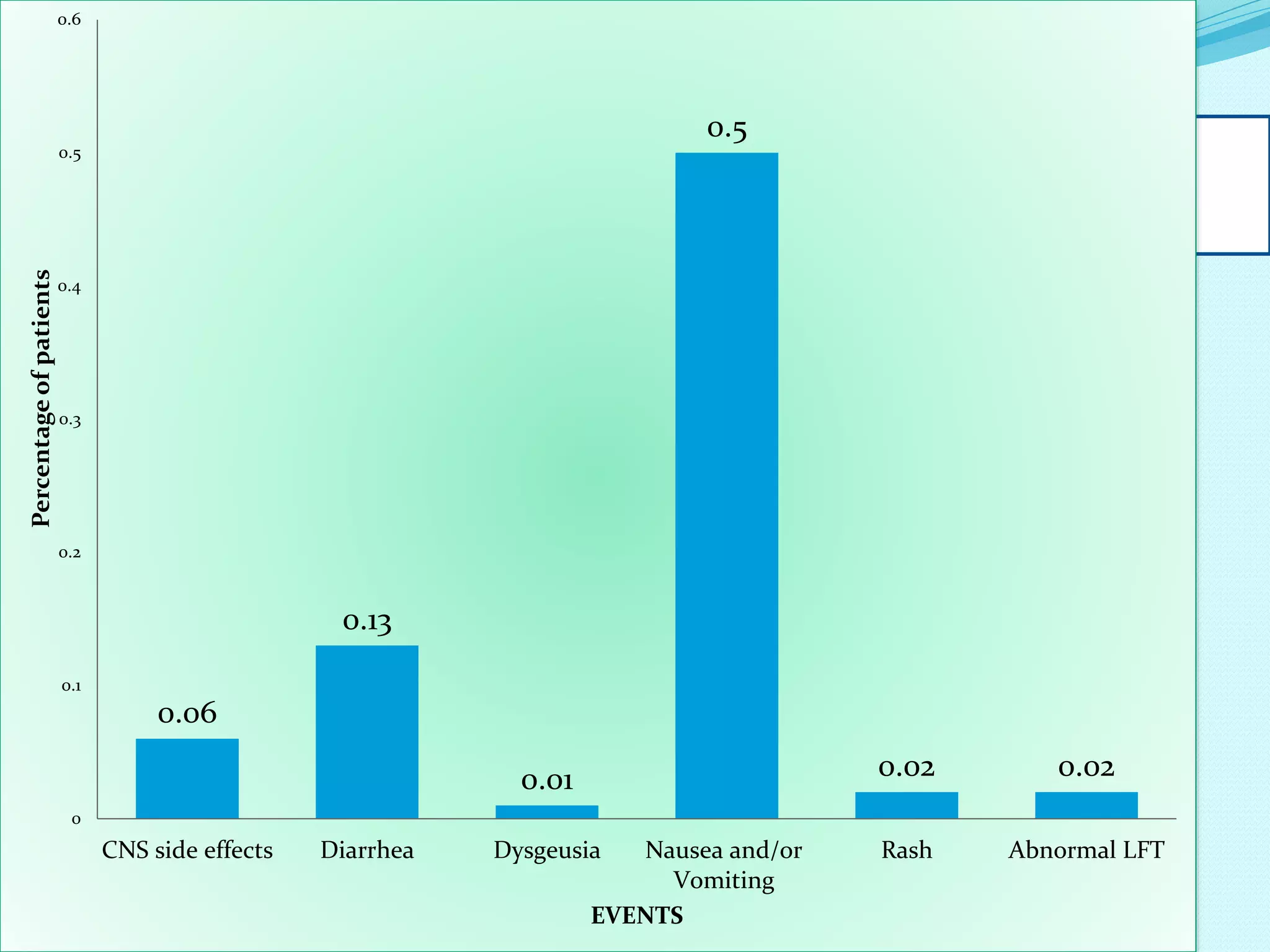
Adverse events were reported in 159 patients
which included 0.5% cases with nausea/vomiting,
0.1% cases with diarrhea. Central nervous system
side-effects like drowsiness or dizziness was
reported in 0.02% of the cases. All the adverse
events were of mild to moderate severity and did
not require hospitalization
Conclusion
Garenoxacin a novel desfluoroquinolone appears
to be an ideal antimicrobial agent for the
treatment of various respiratory tract infections
including CAP. With superior safety profile,
excellent antimicrobial coverage and a convenient
once a day dosing garenoxacin appears to
improve the patient compliance
0.06
0.13
0.01
0.5
0.02 0.02
0
0.1
0.2
0.3
0.4
0.5
0.6
CNS side effects Diarrhea Dysgeusia Nausea and/or
Vomiting
Rash Abnormal LFT
Percentageofpatients
EVENTS
References
Website: htpp//www.dsru.org
R. D. Mann, Prescription event monitoring-recent progress
and future horizons, Drug safety research unit, Bursledon
Hall, Southamton, UK
Deborah et al, Modified Prescription-Event Monitoring
studies, A tool for Pharmacovigilance and risk
management, Drug safety research unit, Bursledon Hall,
Southamton, UK
Rumana Hameed, Prescription Event Monitoring, Slideshare
Satish Veerla, Prescription Event Monitoring and Record
Linkage System, Slideshare
A PEM study to assess the safety profile of Garenoxacin in
Indian settings, Anoop Hajare et al,Department of Medical
Services, Glenmark Pharmaceuticals Ltd., Mumbai, Maharashtra, India
Thank you!
For your kind attention

Prescription event monitoring

  • 2.
    CONTENTS  Introduction  Evolution How PEM is initiated  PEM process  M-PEM  Advantages and disadvantages of PEM  Applications  References
  • 3.
    Introduction  PEM isa non-interventional, observational cohort form of pharmacovigilance.  It is the method of studying the safety of new medications used by the general practitioner.  UK based concept  Individualized form of Pharmacovigilance  Collaborative effort between Doctor , Pharmacist, Patient and Government.
  • 4.
    Evolution  The wholeethos of drug safety monitoring came into existence after Thalidomide disaster 1961.  Professor William Inam , man who developed Yellow card system in UK –method of spontaneous monitoring.  Prof. Inam recognized the the limitations of spontaneous monitoring (PRACTOLOL- Occulomucocutaneos syndrome) and he established DSRU(Drug Safety Research Unit) in 1980 at University of Southampton and devised a method for early detection of potential drug hazards know as PEM
  • 5.
    WILLIAM HOWARD WALLACEBILL INMAN In1990’s , a new version of PEM known as Modified PEM was developed which offers a great flexibility in the data requested from prescribers
  • 6.
    How PEM isinitiated Here patient being prescribed monitored drug, which include virtually all new chemical entities are studied the criteria for study drug are: NCE(New Chemical Entities) New pharmacological Principle Predicted wide spread use Suspected problems Identified for unquantified risks Continued…..
  • 7.
    Contd.. The information onthe 1st 5000-18000 prescriptions for that drug are then obtained. Prescribers are contacted with a questionnaire to determine subsequent events or clinical outcomes. Experiences with the drugs can be examined and the incidence of various events can be estimated.
  • 8.
    Contd.. Collection of exposuredata begins soon after the new product is launched For each patient in the study, DSRU prepares a computerized longitudinal record in the date order of drug use After prescription to a patient, the DSRU sends the prescriber a green form of questionnaire Doctor receives maximum of 4 green forms in a month The study period varies between 1 month to 12 months.
  • 9.
    Statistical analysis The numberof events observed during the treatment period in each individual patient is recorded and the incidence density for each event is calculated using the equation: No of events during treatment period t IDt = × 1000 No of patient-months exposed to drug The incidence density is the measure of the number of reports of each event per thousand patient months of exposure to the drug.
  • 10.
    Process of PEM InUK, all the patients are registered with NHS-GP which provides the primary care and act as a gateway to specialist and hospital care.
  • 11.
    The process ofprescription event monitoringThe process of prescription event monitoring Drug Safety Research Unit Prescription Pricing Authority Electronic copies of prescriptions for study drug sent to DSRU Signal Generation, Hypothesis Testing, Follow-up studies General Practitioner PATIENT DSRU sends Green From to GP for details of patient events Prescription sent to PPA PHARMACY Prescription for new drug to patient by GP Green From questionnaire sent back to DSRU this is the OUT COME DATA Patient goes to pharmacy
  • 12.
  • 13.
    Each green formis reviewed by a medical/ scientific officer monitoring the study, to identify possible serious ADRs or events requiring action Events are coded and entered in database
  • 14.
    M-PEM M-PEM expands therange of conventional PEM to facilitate more targeted safety surveillance . The questionnaires are designed to collect relevant supplementary information in order to perform more detailed exploration of specific safety issues. The underlying process remains the same as in conventional PEM
  • 15.
    Advantages 1. PEM isnon-interventional 2. The method is national in scale and thus provides real world data 3. Method can detect adverse reactions or syndromes that none of the reporting doctors suspected to be due to the drug 4. Method allows close contact between the research staff and reporting doctors Contd…
  • 16.
    6. ADR reportingis more complete by this method 7. Method is found to be successful in regularly producing data in 10,000 or more patients given newly marketed drugs 8. Method identifies patient with ADRs who can be studied further 9. Allows comparison of safety profile of drugs belonging to the same therapeutic group 10.Evaluate signals generated by other systems or databases
  • 17.
    Disadvantages No method todetermine non-prescription medications Non-return of green forms Data collection is an operational difficulty
  • 18.
    Applications  Searching forsignal  Assessment of important AE  Medically important events  Reason for stopping the drug  Ranking of ID and reason for withdrawal  Automated signal generation  Long latency adverse reactions  Comparison with external data  Outcomes of pregnancy
  • 19.
    A PEM studyto assess the safety profile of Garenoxacin in Indian settings Anoop Hajare et al Department of Medical Services, Glenmark Pharmaceuticals Ltd., Mumbai, Maharashtra, India Introduction Garenoxacin, a newer fluoroquinolone offers an excellent spectrum of antimicrobial coverage, which includes Gram-positive, Gram-negative, anaerobes and atypical microorganism. This broad spectrum of activity is attributed to its unique structure. Methodology Conducted between july 2013 and september 2013 .A total of 400 doctors participated in the study.Data from 12,498 patients was obtained.Monitoring of each patient was done for any adverse events. Results Adverse events were reported in 159 patients which included 0.5% cases with nausea/vomiting, 0.1% cases with diarrhea. Central nervous system side-effects like drowsiness or dizziness was reported in 0.02% of the cases. All the adverse events were of mild to moderate severity and did not require hospitalization Conclusion Garenoxacin a novel desfluoroquinolone appears to be an ideal antimicrobial agent for the treatment of various respiratory tract infections including CAP. With superior safety profile, excellent antimicrobial coverage and a convenient once a day dosing garenoxacin appears to improve the patient compliance 0.06 0.13 0.01 0.5 0.02 0.02 0 0.1 0.2 0.3 0.4 0.5 0.6 CNS side effects Diarrhea Dysgeusia Nausea and/or Vomiting Rash Abnormal LFT Percentageofpatients EVENTS
  • 20.
    References Website: htpp//www.dsru.org R. D.Mann, Prescription event monitoring-recent progress and future horizons, Drug safety research unit, Bursledon Hall, Southamton, UK Deborah et al, Modified Prescription-Event Monitoring studies, A tool for Pharmacovigilance and risk management, Drug safety research unit, Bursledon Hall, Southamton, UK Rumana Hameed, Prescription Event Monitoring, Slideshare Satish Veerla, Prescription Event Monitoring and Record Linkage System, Slideshare A PEM study to assess the safety profile of Garenoxacin in Indian settings, Anoop Hajare et al,Department of Medical Services, Glenmark Pharmaceuticals Ltd., Mumbai, Maharashtra, India
  • 21.
    Thank you! For yourkind attention