Drug Excipient Interaction
H R Patel Institute of Pharmaceutical
Education and Research
Presented By : Bagate Kuldip
Roll No. MPH-01
Mpharm (Pharmaceutics)
Guided By : Dr. Zawar Sir
Table of Content
Sr. No. Topics
1 Introduction
2 Drug Excipients
3 Drug Excipients Interaction
4 Types of Drug Excipients Interaction
5 Analytical Techniques used to detect Drug-Excipient Interaction
6 Conclusion
7 References
Introduction
 Excipients play an Important role in formulating a dosage form
 These are ingredients which along with active pharmaceutical ingredients
make up the dosage forms
 Excipients act as protective agents, bulking agents and can also be used
to improve bioavailability of drug
 Excipients as like other active pharmaceutical ingridients need to be
stabilized and standardized
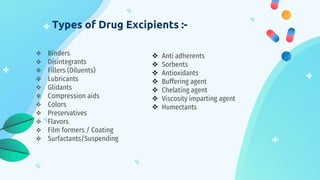
Types of Drug Excipients :-
 Binders
 Disintegrants
 Fillers (Diluents)
 Lubricants
 Glidants
 Compression aids
 Colors
 Preservatives
 Flavors
 Film formers / Coating
 Surfactants/Suspending
 Anti adherents
 Sorbents
 Antioxidants
 Buffering agent
 Chelating agent
 Viscosity imparting agent
 Humectants
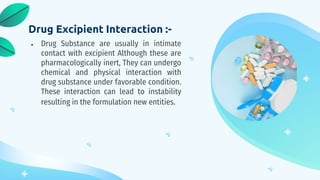
Drug Excipient Interaction :-
● Drug Substance are usually in intimate
contact with excipient Although these are
pharmacologically inert, They can undergo
chemical and physical interaction with
drug substance under favorable condition.
These interaction can lead to instability
resulting in the formulation new entities.
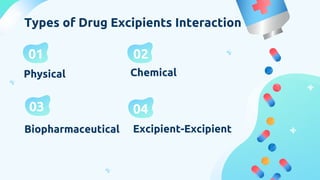
Physical
01
Chemical
02
Biopharmaceutical
03
Excipient-Excipient
04
Types of Drug Excipients Interaction
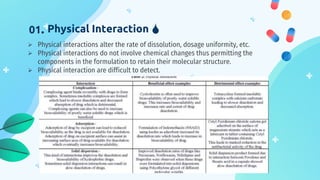
Physical Interaction
01.
 Physical interactions alter the rate of dissolution, dosage uniformity, etc.
 Physical interactions do not involve chemical changes thus permitting the
components in the formulation to retain their molecular structure.
 Physical interaction are difficult to detect.
02. Chemical Interaction :-
 Active pharmaceutical ingredients and excipients react with each other to form
unstable compounds.
 Chemical interaction involves chemical reaction between drugs and excipients or
drugs and impurities/ residues present in the excipients to from different molecules.
Chemicals interactions are almost detrimental to the product because they produce
degradation products. They are as follows-
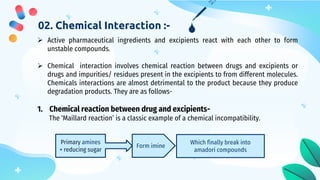
1. Chemical reaction between drug and excipients-
The ‘Maillard reaction’ is a classic example of a chemical incompatibility.
Primary amines
+ reducing sugar
Form imine
Which finally break into
amadori compounds
 Release of Diclofenac sodium from matrix table was inhibited by polymer chitosan at
low pH, due to formation of ionic complex between diclofenac sodium and ionized
cationic polymer.
 Sodium alginate dissolve in water to form large negatively charged anions co-
formulation in aqueous system with drugs such as neomycin and polymyxin
(positively charged) result precipitation.
2. Interaction of drug with excipient residues/impurities-
 Excipients are not exquisitely pure. They have some residues which affect the drug
action.
 Impurities found in common excipients-
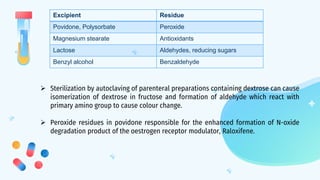
Excipient Residue
Povidone, Polysorbate Peroxide
Magnesium stearate Antioxidants
Lactose Aldehydes, reducing sugars
Benzyl alcohol Benzaldehyde
 Sterilization by autoclaving of parenteral preparations containing dextrose can cause
isomerization of dextrose in fructose and formation of aldehyde which react with
primary amino group to cause colour change.
 Peroxide residues in povidone responsible for the enhanced formation of N-oxide
degradation product of the oestrogen receptor modulator, Raloxifene.
03. Biopharmaceutical Interaction :-
 These are the interaction which are observed after administration of medicine.
These interactions occurs in the form of-
 The interaction is between the medicine (drug substance and excipients) and the
body fluids.
 The interactions have the tendency to influence the rate of absorption of the drug.
 Various examples of these interactions are as follows-
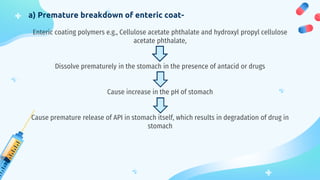
a) Premature breakdown of enteric coat-
Enteric coating polymers e.g., Cellulose acetate phthalate and hydroxyl propyl cellulose
acetate phthalate,
Dissolve prematurely in the stomach in the presence of antacid or drugs
Cause increase in the pH of stomach
Cause premature release of API in stomach itself, which results in degradation of drug in
stomach
b) Increase in Gastrointestinal motility-
 Many excipients such as sorbitol and xylitol have the tendency to increase
gastrointestinal motility, thus reducing the available time for absorption of drug like
Metoprolol.
c) Effect on P-Glycoprotein efflux transporter-
 P-glycoprotein thus interferes in the bioavailability of different anticancer and other
drug substance. Thus several excipients eg., Span 20, Tween 20, Tween 80, Pluronic ,
Poloxamer etc. are incorporated in the formulation which help in inhibition of P-
glycoprotein to enhance availability of drug into the cell , to produce the desired
action.
4) Excipient-Excipient Interaction:-
 This type of interaction occurs between two or more excipients in a drug molecule.
 Example:- In proper addition of electrolyte such as Ca++ or Mg++ ion in suspension
containing sodium carboxymethyl cellulose (Na CMC ) which will cause formation of
Calcium / Magnesium CMC.
 The suspending agent will be destroyed and cannot perform its function.
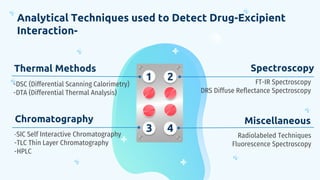
Analytical Techniques used to Detect Drug-Excipient
Interaction-
Thermal Methods
-DSC (Differential Scanning Calorimetry)
-DTA (Differential Thermal Analysis)
Spectroscopy
FT-IR Spectroscopy
DRS Diffuse Reflectance Spectroscopy
Chromatography
-SIC Self Interactive Chromatography
-TLC Thin Layer Chromatography
-HPLC
Miscellaneous
Radiolabeled Techniques
Fluorescence Spectroscopy
1 2
3 4
1) Thermal Method
Thermal method of analysis comprise a group of techniques in
which the physiochemical properties of drug substance are
measured as a function of temperature. In this method, the
test samples are subjected to a controlled temperature over a
given period of time. This method of analysis plays a vital role
in drug-excipient compatibility studies and has been
frequently used quick identification of physiochemical
interaction between drugs and excipients.
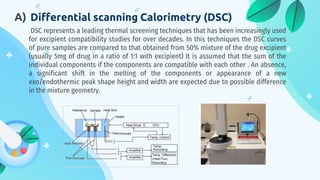
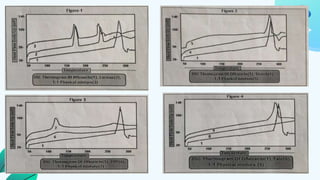
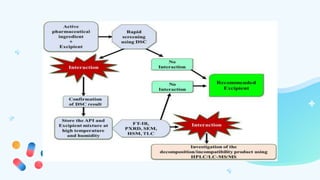
DSC represents a leading thermal screening techniques that has been increasingly used
for excipient compatibility studies for over decades. In this techniques the DSC curves
of pure samples are compared to that obtained from 50% mixture of the drug excipient
(usually 5mg of drug in a ratio of 1:1 with excipient) It is assumed that the sum of the
individual components if the components are compatible with each other . An absence,
a significant shift in the melting of the components or appearance of a new
exo/endothermic peak shape height and width are expected due to possible difference
in the mixture geometry.
A) Differential scanning Calorimetry (DSC)
DSC’s
Limitations
Conclusion based on DSC results
alone may be misleading and have to
be interpreted carefuly.
DSC cannot be used if thermal
changes are very small. Therefore, it
should always be supported by some
non thermal method like TLC or FT-
IR.
Advantages
Requires of short time of analysis.
Low sample consumption.
Provide usefule indication of any
potential incompatibility
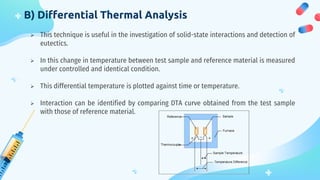
B) Differential Thermal Analysis
 This technique is useful in the investigation of solid-state interactions and detection of
eutectics.
 In this change in temperature between test sample and reference material is measured
under controlled and identical condition.
 This differential temperature is plotted against time or temperature.
 Interaction can be identified by comparing DTA curve obtained from the test sample
with those of reference material.
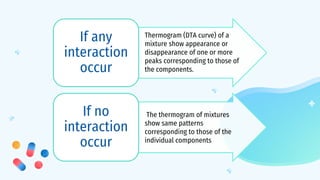
If any
interaction
occur
If no
interaction
occur
Thermogram (DTA curve) of a
mixture show appearance or
disappearance of one or more
peaks corresponding to those of
the components.
The thermogram of mixtures
show same patterns
corresponding to those of the
individual components
Chromatographic Techniques:
Compared to other available analytical techniques used in drug excipient compatibility
studies, chromatography is known for its characteristics of high resolution and detection
power, making it suitable for detecting multiple components in a complex mixture with high
accuracy, precision, specificity, and sensitivity.
a) Thin Layer Chromatography :
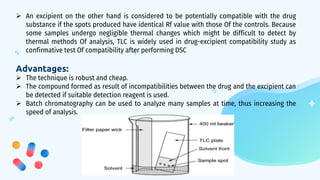
 In TLC, solution of the test sample are prepared and spotted on the same baseline at the
end of the plate. The plate is then placed upright in a closed chamber containing mixture
of organic solvents which serves as the mobile phase. The analyte moves up the plate,
under the under the influence of the mobile phase which moves through stationary
phase by capillary action.
 The distance moved by the analyte is dependent relative affinity for the stationary or the
mobile phase. Incompatibilities are indicated by formation of a spot with Rf value
(retardation factor) different from that of the controls after the plate has been
developed with solvent.
 An excipient on the other hand is considered to be potentially compatible with the drug
substance if the spots produced have identical Rf value with those Of the controls. Because
some samples undergo negligible thermal changes which might be difficult to detect by
thermal methods Of analysis, TLC is widely used in drug-excipient compatibility study as
confirmative test Of compatibility after performing DSC
Advantages:
 The technique is robust and cheap.
 The compound formed as result of incompatibilities between the drug and the excipient can
be detected if suitable detection reagent is used.
 Batch chromatography can be used to analyze many samples at time, thus increasing the
speed of analysis.
Spectroscopy:
 Spectroscopic analytical methods include all techniques which probe certain features
of given sample by measuring the amount of radiation emitted or absorbed by the
molecular or atomic species of interest.
 This method of analysis uses electromagnetic radiation to interact with matter and
thus investigate certain features of a sample as a function of wavelength.
a) Vibrational spectroscopy:
 Vibrational spectroscopy are not only used to investigate solid state properties of
drug substance and their formulations, but also used as compatibility study tool as
the vibrational changes serve as probe of potential intermolecular interaction among
the components .
 Thus drug excipient interaction that occur during processing can easily be detected
with the aid of these spectroscopic techniques.
Using this method ,information on the molecular structure and environment of organic
compounds are generated by measuring the vibrations of chemical bonds that results from
exposure to electromagnetic energy at various frequencies. These vibrations are commonly
studied by infrared.
Conclusion
Drug Excipient compatibility study is a necessary prerequisite to the
development of drug products that are safe and stable for use. Proper
selection and assessment of possible incompatibilities between the drug &
excipient during preformulation studies is of paramount importance the
target product profile and critical quality attributes.
In order to avoid stability problems encountered during drug development
and post commercialization, there is need for proper assessment of possible
incompatibilities between the drug and excipient using appropriate
analytical techniques.
These analytical techniques are needed not only to generate useful
information with regards to each excipients is compatible with a drug
substance, but also for troubleshooting unexpected problems which might
arise during formulation processes.
REFERENCES
 Lachman & Lieberman, The Theory and Practice of Industrial Pharmacy
 N. Fathima, Kajal Ahir, Vandana Patel, Lata Manani, Chirag Patel Drug excipient
interaction and its importance in dosage form development, Journal of applied
Pharmaceutical Science 2011
 Priyanka Patel, Kajal Ahir, Vandana Patel, Lata Manani, Chirag Patel Drug-
Excipient compatibility studies: First step for dosage form development, The
Pharma Innovation Journal 2015
 Bapi Gorain, Hira Choudhury, Manisha Pandey, Thiagarajan Madheswaran,
Prashant Kesharwani and Rakesh K. Tekade Drug- Excipient Interaction and
Incompatibilities 2018
Thank You

Drug Excipient Interaction.pptx

  • 1.
    Drug Excipient Interaction HR Patel Institute of Pharmaceutical Education and Research Presented By : Bagate Kuldip Roll No. MPH-01 Mpharm (Pharmaceutics) Guided By : Dr. Zawar Sir
  • 2.
    Table of Content Sr.No. Topics 1 Introduction 2 Drug Excipients 3 Drug Excipients Interaction 4 Types of Drug Excipients Interaction 5 Analytical Techniques used to detect Drug-Excipient Interaction 6 Conclusion 7 References
  • 3.
    Introduction  Excipients playan Important role in formulating a dosage form  These are ingredients which along with active pharmaceutical ingredients make up the dosage forms  Excipients act as protective agents, bulking agents and can also be used to improve bioavailability of drug  Excipients as like other active pharmaceutical ingridients need to be stabilized and standardized
  • 4.
    Types of DrugExcipients :-  Binders  Disintegrants  Fillers (Diluents)  Lubricants  Glidants  Compression aids  Colors  Preservatives  Flavors  Film formers / Coating  Surfactants/Suspending  Anti adherents  Sorbents  Antioxidants  Buffering agent  Chelating agent  Viscosity imparting agent  Humectants
  • 5.
    Drug Excipient Interaction:- ● Drug Substance are usually in intimate contact with excipient Although these are pharmacologically inert, They can undergo chemical and physical interaction with drug substance under favorable condition. These interaction can lead to instability resulting in the formulation new entities.
  • 6.
  • 7.
    Physical Interaction 01.  Physicalinteractions alter the rate of dissolution, dosage uniformity, etc.  Physical interactions do not involve chemical changes thus permitting the components in the formulation to retain their molecular structure.  Physical interaction are difficult to detect.
  • 8.
    02. Chemical Interaction:-  Active pharmaceutical ingredients and excipients react with each other to form unstable compounds.  Chemical interaction involves chemical reaction between drugs and excipients or drugs and impurities/ residues present in the excipients to from different molecules. Chemicals interactions are almost detrimental to the product because they produce degradation products. They are as follows- 1. Chemical reaction between drug and excipients- The ‘Maillard reaction’ is a classic example of a chemical incompatibility. Primary amines + reducing sugar Form imine Which finally break into amadori compounds
  • 9.
     Release ofDiclofenac sodium from matrix table was inhibited by polymer chitosan at low pH, due to formation of ionic complex between diclofenac sodium and ionized cationic polymer.  Sodium alginate dissolve in water to form large negatively charged anions co- formulation in aqueous system with drugs such as neomycin and polymyxin (positively charged) result precipitation. 2. Interaction of drug with excipient residues/impurities-  Excipients are not exquisitely pure. They have some residues which affect the drug action.  Impurities found in common excipients-
  • 10.
    Excipient Residue Povidone, PolysorbatePeroxide Magnesium stearate Antioxidants Lactose Aldehydes, reducing sugars Benzyl alcohol Benzaldehyde  Sterilization by autoclaving of parenteral preparations containing dextrose can cause isomerization of dextrose in fructose and formation of aldehyde which react with primary amino group to cause colour change.  Peroxide residues in povidone responsible for the enhanced formation of N-oxide degradation product of the oestrogen receptor modulator, Raloxifene.
  • 11.
    03. Biopharmaceutical Interaction:-  These are the interaction which are observed after administration of medicine. These interactions occurs in the form of-  The interaction is between the medicine (drug substance and excipients) and the body fluids.  The interactions have the tendency to influence the rate of absorption of the drug.  Various examples of these interactions are as follows-
  • 12.
    a) Premature breakdownof enteric coat- Enteric coating polymers e.g., Cellulose acetate phthalate and hydroxyl propyl cellulose acetate phthalate, Dissolve prematurely in the stomach in the presence of antacid or drugs Cause increase in the pH of stomach Cause premature release of API in stomach itself, which results in degradation of drug in stomach
  • 13.
    b) Increase inGastrointestinal motility-  Many excipients such as sorbitol and xylitol have the tendency to increase gastrointestinal motility, thus reducing the available time for absorption of drug like Metoprolol. c) Effect on P-Glycoprotein efflux transporter-  P-glycoprotein thus interferes in the bioavailability of different anticancer and other drug substance. Thus several excipients eg., Span 20, Tween 20, Tween 80, Pluronic , Poloxamer etc. are incorporated in the formulation which help in inhibition of P- glycoprotein to enhance availability of drug into the cell , to produce the desired action.
  • 14.
    4) Excipient-Excipient Interaction:- This type of interaction occurs between two or more excipients in a drug molecule.  Example:- In proper addition of electrolyte such as Ca++ or Mg++ ion in suspension containing sodium carboxymethyl cellulose (Na CMC ) which will cause formation of Calcium / Magnesium CMC.  The suspending agent will be destroyed and cannot perform its function.
  • 15.
    Analytical Techniques usedto Detect Drug-Excipient Interaction- Thermal Methods -DSC (Differential Scanning Calorimetry) -DTA (Differential Thermal Analysis) Spectroscopy FT-IR Spectroscopy DRS Diffuse Reflectance Spectroscopy Chromatography -SIC Self Interactive Chromatography -TLC Thin Layer Chromatography -HPLC Miscellaneous Radiolabeled Techniques Fluorescence Spectroscopy 1 2 3 4
  • 16.
    1) Thermal Method Thermalmethod of analysis comprise a group of techniques in which the physiochemical properties of drug substance are measured as a function of temperature. In this method, the test samples are subjected to a controlled temperature over a given period of time. This method of analysis plays a vital role in drug-excipient compatibility studies and has been frequently used quick identification of physiochemical interaction between drugs and excipients.
  • 17.
    DSC represents aleading thermal screening techniques that has been increasingly used for excipient compatibility studies for over decades. In this techniques the DSC curves of pure samples are compared to that obtained from 50% mixture of the drug excipient (usually 5mg of drug in a ratio of 1:1 with excipient) It is assumed that the sum of the individual components if the components are compatible with each other . An absence, a significant shift in the melting of the components or appearance of a new exo/endothermic peak shape height and width are expected due to possible difference in the mixture geometry. A) Differential scanning Calorimetry (DSC)
  • 20.
    DSC’s Limitations Conclusion based onDSC results alone may be misleading and have to be interpreted carefuly. DSC cannot be used if thermal changes are very small. Therefore, it should always be supported by some non thermal method like TLC or FT- IR. Advantages Requires of short time of analysis. Low sample consumption. Provide usefule indication of any potential incompatibility
  • 21.
    B) Differential ThermalAnalysis  This technique is useful in the investigation of solid-state interactions and detection of eutectics.  In this change in temperature between test sample and reference material is measured under controlled and identical condition.  This differential temperature is plotted against time or temperature.  Interaction can be identified by comparing DTA curve obtained from the test sample with those of reference material.
  • 22.
    If any interaction occur If no interaction occur Thermogram(DTA curve) of a mixture show appearance or disappearance of one or more peaks corresponding to those of the components. The thermogram of mixtures show same patterns corresponding to those of the individual components
  • 23.
    Chromatographic Techniques: Compared toother available analytical techniques used in drug excipient compatibility studies, chromatography is known for its characteristics of high resolution and detection power, making it suitable for detecting multiple components in a complex mixture with high accuracy, precision, specificity, and sensitivity. a) Thin Layer Chromatography :  In TLC, solution of the test sample are prepared and spotted on the same baseline at the end of the plate. The plate is then placed upright in a closed chamber containing mixture of organic solvents which serves as the mobile phase. The analyte moves up the plate, under the under the influence of the mobile phase which moves through stationary phase by capillary action.  The distance moved by the analyte is dependent relative affinity for the stationary or the mobile phase. Incompatibilities are indicated by formation of a spot with Rf value (retardation factor) different from that of the controls after the plate has been developed with solvent.
  • 24.
     An excipienton the other hand is considered to be potentially compatible with the drug substance if the spots produced have identical Rf value with those Of the controls. Because some samples undergo negligible thermal changes which might be difficult to detect by thermal methods Of analysis, TLC is widely used in drug-excipient compatibility study as confirmative test Of compatibility after performing DSC Advantages:  The technique is robust and cheap.  The compound formed as result of incompatibilities between the drug and the excipient can be detected if suitable detection reagent is used.  Batch chromatography can be used to analyze many samples at time, thus increasing the speed of analysis.
  • 25.
    Spectroscopy:  Spectroscopic analyticalmethods include all techniques which probe certain features of given sample by measuring the amount of radiation emitted or absorbed by the molecular or atomic species of interest.  This method of analysis uses electromagnetic radiation to interact with matter and thus investigate certain features of a sample as a function of wavelength. a) Vibrational spectroscopy:  Vibrational spectroscopy are not only used to investigate solid state properties of drug substance and their formulations, but also used as compatibility study tool as the vibrational changes serve as probe of potential intermolecular interaction among the components .  Thus drug excipient interaction that occur during processing can easily be detected with the aid of these spectroscopic techniques.
  • 26.
    Using this method,information on the molecular structure and environment of organic compounds are generated by measuring the vibrations of chemical bonds that results from exposure to electromagnetic energy at various frequencies. These vibrations are commonly studied by infrared.
  • 27.
    Conclusion Drug Excipient compatibilitystudy is a necessary prerequisite to the development of drug products that are safe and stable for use. Proper selection and assessment of possible incompatibilities between the drug & excipient during preformulation studies is of paramount importance the target product profile and critical quality attributes. In order to avoid stability problems encountered during drug development and post commercialization, there is need for proper assessment of possible incompatibilities between the drug and excipient using appropriate analytical techniques. These analytical techniques are needed not only to generate useful information with regards to each excipients is compatible with a drug substance, but also for troubleshooting unexpected problems which might arise during formulation processes.
  • 28.
    REFERENCES  Lachman &Lieberman, The Theory and Practice of Industrial Pharmacy  N. Fathima, Kajal Ahir, Vandana Patel, Lata Manani, Chirag Patel Drug excipient interaction and its importance in dosage form development, Journal of applied Pharmaceutical Science 2011  Priyanka Patel, Kajal Ahir, Vandana Patel, Lata Manani, Chirag Patel Drug- Excipient compatibility studies: First step for dosage form development, The Pharma Innovation Journal 2015  Bapi Gorain, Hira Choudhury, Manisha Pandey, Thiagarajan Madheswaran, Prashant Kesharwani and Rakesh K. Tekade Drug- Excipient Interaction and Incompatibilities 2018
  • 29.