MODERN PHARMACEUTICS
1. a. Preformulation Concepts –
Drug Excipient interactions - different methods, kinetics of stability,
Stability testing. Theories of dispersion and Pharmaceutical Dispersion
(Emulsion and Suspension, SMEDDS). Preparation and stability of Large and
small volume parental – physiological and formulation consideration,
Manufacturing and evaluation.
b. Optimization techniques in Pharmaceutical Formulation: Concept
and parameters of optimization, Optimization techniques in pharmaceutical
formulation and processing. Statistical design, Response surface method,
Contour designs, Factorial designs and application in formulation
2 Validation : Introduction to Pharmaceutical Validation, Scope & merits of
Validation, Validation and calibration of Master plan, ICH & WHO guidelines
for calibration and validation of equipments, Validation of specific dosage
form, Types of validation. Government regulation, Manufacturing Process
Model, URS, DQ,IQ, OQ &P.Q. of facilities.
3 cGMP & Industrial Management: Objectives and policies of current good
manufacturing practices, layout of buildings, services, equipments and
their maintenance Production management: Production organization, ,
materials management, handling and transportation, inventory
management and control, production and planning control, Sales
forecasting, budget and cost control, industrial and personal relationship.
Concept of Total Quality Management
4 Compression and compaction: Physics of tablet compression,
compression, consolidation, effect of friction, distribution of forces,
compaction profiles.Solubility.
5 Study of consolidation parameters; Diffusion parameters, Dissolution
parameters and Pharmacokinetic parameters, Heckel plots, Similarity
factors – f2 and f1, Higuchi and Peppas plot, Linearity Concept of
significance, Standard deviation , Chisquare test, students T-test , ANOVA
test. 10 Hrs 10 Hr
PREFORMULATION
• It is defined as phase of research and
development in which preformulation scientist
characterize physical & chemical properties of
new drug molecule in order to develop safe,
effective, and stable dosage form.
• Investigation of physical & chemical properties
of a drug and mixer of drug & excipient
3
DEFINITION
• It can be defined as an investigation of
physical and chemical properties of a drug
substance - alone and or when combined
with excipients.
• The overall objective of preformulation testing
is to generate information useful to the
formulator in developing stable and safe
dosage forms with good bioavailability.
• Prior to development of dosage form with new
drug candidate, it is essential that some
fundamental physicochemical properties of new
drug molecule are to be determined. This
information may dictate many of subsequent
events and possible approaches in formulation
development.
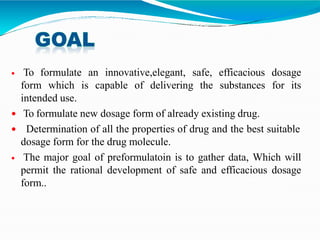
 To formulate an innovative,elegant, safe, efficacious dosage
form which is capable of delivering the substances for its
intended use.
 To formulate new dosage form of already existing drug.
 Determination of all the properties of drug and the best suitable
dosage form for the drug molecule.
 The major goal of preformulatoin is to gather data, Which will
permit the rational development of safe and efficacious dosage
form..
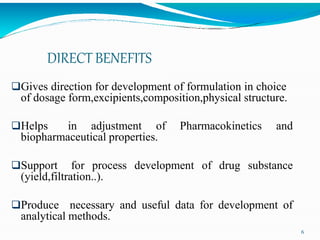
DIRECT BENEFITS
Gives direction for development of formulation in choice
of dosage form,excipients,composition,physical structure.
Helps in adjustment of Pharmacokinetics and
biopharmaceutical properties.
Support for process development of drug substance
(yield,filtration..).
Produce necessary and useful data for development of
analytical methods.
6
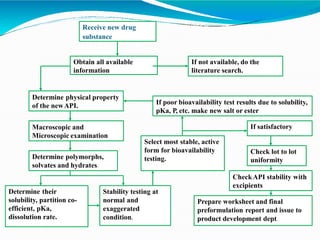
Receive new drug
substance
Obtain all available
information
If not available, do the
literature search.
Determine physical property
of the newAPI.
Macroscopic and
Microscopic examination
Determine polymorphs,
solvates and hydrates.
Stability testing at
normal and
exaggerated
condition.
Determine their
solubility, partition co-
efficient, pKa,
dissolution rate.
If poor bioavailability test results due to solubility,
pKa, P, etc. make new salt or ester
If satisfactory
Check lot to lot
uniformity
Select most stable, active
form for bioavailability
testing.
CheckAPI stability with
excipients
Prepare worksheet and final
preformulation report and issue to
product development dept.
9
I. PHYSICAL CHARACTERISTICS
A. BULK CHARACTERISTIC
1) Particle Size & SurfaceArea.
2) Polymorphism.
3) Crystallinity.
4) Hygroscopicity.
5) Flow properties & Bulk density.
6) Compressibility.
7) Drug-Excipient Compatability.
8) Electrostatic charge.
9) Osmolarity.
10) Rheology.
11) Wettability.
10
B. SOLUBILITY ANALYSIS
1) Aqueous Solubility.
a. Intrinsic solubility.
b. Ionization constant.
2) Solubilization.
3) Partition Coefficient.
4) Thermal effect.
5) Common ion effect.
6) Dissolution.
C.STABILITY ANALYSIS
1) Solid State Stability.
2) Solution State Stability.
11
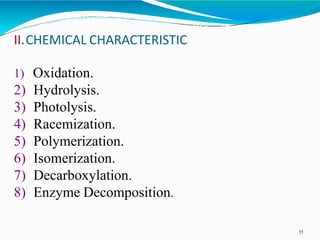
II.CHEMICAL CHARACTERISTIC
1) Oxidation.
2) Hydrolysis.
3) Photolysis.
4) Racemization.
5) Polymerization.
6) Isomerization.
7) Decarboxylation.
8) Enzyme Decomposition.
“When we mix two or moreAPI and / or
excipient with each other & if they are
antagonistic & affect adversely the safety,
therapeutic efficacy, appearance or
elegance then they are said to be
incompatible.’’
DEFINITION
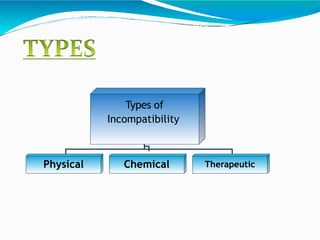
Types of
Incompatibility
Physical Chemical Therapeutic
 Why to screen excipients?
1.need to minimize no.of model formulations
2.provide rational basis for selecting excipients
3.Formulation stability studies are time consuming.
 Goal of the study( Identify the excipients that)
1.are compatible withAPI
2.do not have impact on the stability ofAPI
 Importance
1.Stabity of formulation can be maximised.
2.Helps to avoid surprise problems.
3.Essential for IND submission.
4.Bridges drug discovery and drug development
COMPATIBILITY TESTS
Aspects of compatibility tests are:
1. Identification of compatible excipients for a formulation.
2. Identification of stable storage conditions.
Types:
1. Solid state reactions:
- much slower and difficult to interpret.
2. Liquid state reactions:
- easier to detect
-According to Stability Guidelines by FDAfollowing conditions
should be evaluated for solutions or suspensions
1. Acidic or alkaline pH.
2. Presence of added substances
3. High oxygen and nitrogen atmospheres.
4. Effect of stress testing conditions.
STEPS IN COMPATIBILITY STUDY
There are four steps to consider.
1. Sample preparation
2. Statistical design
3. Storage
4. Method of analysis
SAMPLE PREPARATION
FOR SOLID STATE REACTIONS:
 SampleA: - mixture of drug and excipient
 SampleB: - SampleA+ 5% moisture
 SampleC: - Drug itself without excipients
 All the samples of drug-excipient blends are kept for 1-3
weeks at specified storage conditions.
 Then sample is physically observed .
 It is then assayed by TLC or HPLC or DSC.
 Whenever feasible, the degradation product are identified by
MASS SPECTROSCOPY, NMR or other relevant analytical
techniques.
 To determine Solid state stability profile of a new
compound….
 To test the Surface Oxidation…..
FOR LIQUID STATE REACTIONS:
o Place the drug in the solution of additives.
o Both flint and amber vials are used.
o This will provide information about
-Susceptibility to oxidation.
-Susceptibility to light exposure.
-Susceptibility to heavy metals.
o In case of oral liquids, compatibility with ethanol, glycerin
,sucrose, preservatives and buffers are usually carried out.
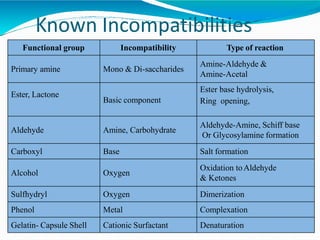
Known Incompatibilities
Functional group Incompatibility Type of reaction
Primary amine Mono & Di-saccharides
Amine-Aldehyde &
Amine-Acetal
Ester, Lactone
Basic component
Ester base hydrolysis,
Ring opening,
Aldehyde Amine, Carbohydrate
Aldehyde-Amine, Schiff base
Or Glycosylamine formation
Carboxyl Base Salt formation
Alcohol Oxygen
Oxidation toAldehyde
& Ketones
Sulfhydryl Oxygen Dimerization
Phenol Metal Complexation
Gelatin- Capsule Shell Cationic Surfactant Denaturation
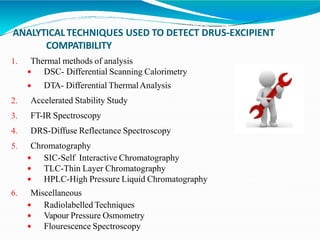
ANALYTICALTECHNIQUES USED TO DETECT DRUS-EXCIPIENT
COMPATIBILITY
1. Thermal methods of analysis


DSC- Differential Scanning Calorimetry
DTA- Differential ThermalAnalysis
2. Accelerated Stability Study
3. FT-IR Spectroscopy
4. DRS-Diffuse Reflectance Spectroscopy
5. Chromatography
 SIC-Self Interactive Chromatography
 TLC-Thin Layer Chromatography
 HPLC-High Pressure Liquid Chromatography
6. Miscellaneous
 Radiolabelled Techniques
 Vapour Pressure Osmometry
 Flourescence Spectroscopy
1) DIFFRENTIAL THERMALANALYSIS
 Thermal Analysis is useful in the investigation of solid-
state interactions.
 It is also useful in the detection of eutectics.
 Thermograms are generated for pure components and their
physical mixtures with other components.
 In the absence of any interaction, the thermograms of
mixtures show patterns corresponding to those of the
individual components.
 In the event that interaction occurs, this is indicated in the
thermogram of a mixture by the appearance of one or more
new peaks or the disappearance of one or more peaks
corresponding to those of the components.
2) DSC-DIFFERENTIAL SCANNING CALORIMETRY
o DSC is widely used to investigate and predict any physico-
chemical interaction between drug and excipients involving
thermal changes..
o METHOD
-The preformulation screening of drug-excipient interaction
requires (1 : 1)Drug:excipient ratio, to maximize the likehood
of observing an interaction.
-Mixture should be examined under N2 to eliminate oxidative
and pyrrolytic effects at heating rate ( 2, 5 or 100 c / min) on
DSC apparatus.
LIMITATIONS OF DSC
o If thermal changes are very small, DSC can’t be used.
o DSC can not detect the incompatibilities which occur
after long term storage.
Eg. MCC /ASPIRIN…
o Not applicable if test material exhibits properties that
make data interpretation difficult.
ADV
ANTAGES:
-Fast
-Reliable and very less sample required.
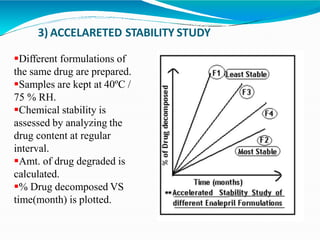
3) ACCELARETED STABILITY STUDY
Different formulations of
the same drug are prepared.
Samples are kept at 40ºC /
75 % RH.
Chemical stability is
assessed by analyzing the
drug content at regular
interval.
Amt. of drug degraded is
calculated.
% Drug decomposed VS
time(month) is plotted.
4) DIFFUSE REFLECTANCE SPECTROSCOPY
 Principle:
“Penetration of a portion of incident radiation flux into the
interior of the solid sample, return of some portion of
radiation to the surface of sample following partial
absorption and multiple scattering at boundary of individual
sample particles.”
 Detects the decomposed products, along with physical and
chemical adsorption of excipients on toA.P.I. and vice versa.
 Example:
Ethanol mediated interaction between dextroamphatamine
sulphate and spray dried lactose in solid–solid mixture.
 Diffuse reflectance spectroscopy is gaining increasing popularity
among preformulation scientists as a tool to detect and monitor
drug-excipient interactions.
 In this technique solid drugs, excipients, and their physical
mixtures are exposed to incident radiation.
 Aportion of the incident radiation is partly absorbed and partly
reflected in a diffuse manner.
 The diffuse reflectance depends on the packing density of the
solid, its particle size, and its crystal form, among other factors.
 When these factors are adequately controlled, diffuse reflectance
spectroscopy can be used to investigate physical and chemical
changes occurring on solid surfaces.
5) SELF INTERACTIVE CHROMATOGRAPHY
 SIC is useful for proteinous drug and excipients.
METHOD:-
 SIC is a modified type of affinity chromatography.
 Here,drug is made immobilized as the SP& soln. to be
tested( excipient soln.) acts as MP.
 Measure Rt (Retention time) & compare with non –retained
marker.
PRINCIPLE:-
For different mobile phases (i.e. different excipients) the injected
drug havedifferent interactions (may be repulsiveor attractive) with
the SP of drug leads toshift in retention time (Rt)
time
FIGURE-1 FIGURE-2 FIGURE-3
When interaction When no net When attractive
interactions,it
will have longer
retention time&
widerpeak
is repulsive,a interaction between
sharperpeak is the immobilized
obtained ata drug,Rt=dead
shorterretention volumeof column.
6) TLC AND HPTLC
o TLC is generally used as confirmative test of compatibility
after performing DSC.
o S.P. consist of powder (Silica,Alumina, Polyamide, Cellulose
& Ion exchange resin) adhered onto glass, plastic or metal
plate.
o Solution of Drug, Excipient & Drug: Excipient mixture are
prepared & spotted on the same baseline at the end of plate.
o The plate is then placed upright in a closed chamber containing
the solvent which constitutes the M.P.
7) RADIO LABELLED TECHNIQUES:
 It is important when theAPI is having radio–activity.
 Method is carried out by using either 3H or 13C.
 Highly sensitive method but the cost of carrying out
the method & the availability of well established
other techniques & methods, this method is
generally not preferred.
ORDER OF REACTION:
ZERO ORDER REACTION
 When the reaction rate is independent of concentration
of the reacting substance, it depends on the zero power of
the reactant and therefore is zero order reaction.
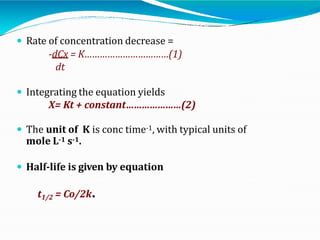
 Rate of concentration decrease =
-dCx = K……………………………(1)
dt
 Integrating the equation yields
X= Kt + constant…………………(2)
 The unit of K is conc time-1, with typical units of
mole L-1 s-1.
 Half-life is given by equation
t1/2 = Co/2k.
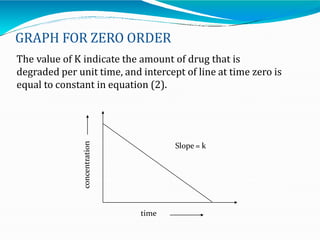
GRAPH FOR ZERO ORDER
time
concentration
Slope = k
The value of K indicate the amount of drug that is
degraded per unit time, and intercept of line at time zero is
equal to constant in equation (2).
FIRST ORDER REACTION
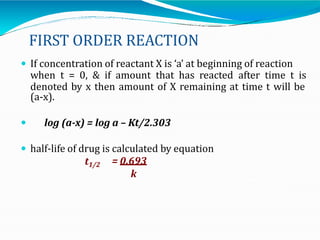
 If concentration of reactant X is ‘a’ at beginning of reaction
when t = 0, & if amount that has reacted after time t is
denoted by x then amount of X remaining at time t will be
(a-x).
 log (a-x) = log a – Kt/2.303
 half-life of drug is calculated by equation
t1/2 = 0.693
k
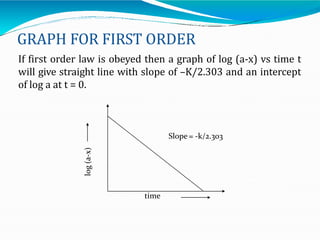
GRAPH FOR FIRST ORDER
time
log
(a-x)
Slope = -k/2.303
If first order law is obeyed then a graph of log (a-x) vs time t
will give straight line with slope of –K/2.303 and an intercept
of log a at t = 0.
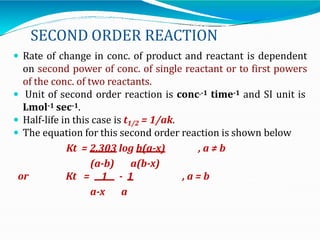
SECOND ORDER REACTION
 Rate of change in conc. of product and reactant is dependent
on second power of conc. of single reactant or to first powers
of the conc. of two reactants.
 Unit of second order reaction is conc.-1 time-1 and SI unit is
Lmol-1 sec-1.
 Half-life in this case is t1/2 = 1/ak.
 The equation for this second order reaction is shown below
Kt = 2.303 log b(a-x) , a ≠ b
or
(a-b) a(b-x)
Kt = 1 - 1 , a = b
a-x a
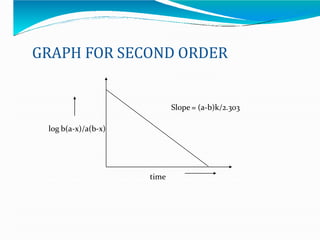
GRAPH FOR SECOND ORDER
time
log b(a-x)/a(b-x)
Slope = (a-b)k/2.303
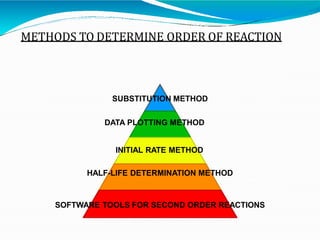
METHODS TO DETERMINE ORDER OF REACTION
SUBSTITUTION METHOD
DATA PLOTTING METHOD
INITIAL RATE METHOD
HALF-LIFE DETERMINATION METHOD
SOFTWARE TOOLS FOR SECOND ORDER REACTIONS
STABILITY TESTING
STABILITY TESTING
Stability : defined as capability of a particular formulation in a
specific container/closure system to remain within its physical,
chemical, microbiological, toxicological, protective and
informational specifications.
It is the extent to which a product retains, within the specified
limits, throughout its period of storage and use, the same
properties and characteristics possessed at the time of its
packaging.
SCOPE OF STABILITY TESTING
Provide evidence as to how the quality of drug product varies with time.
Establish shelf life of drug product.
Determines recommended storage conditions.
Determine container closure system suitability.
IMPORTANCE OF STABILITY TESTING
1.Assurance to patient that drug is safe.
2.Legal requirement to provide data.
3.to protect the reputation of the manufacturer.
4.to provide a database.
5.to determine shelf life and storage conditions.
6.to verify that no changes have been introduced
in the formulation or manufacturing process that
can adversely affect the stability of the product.
TYPE OF STABILITY
CHEMICAL• Each active ingredient retains its chemical
integrity and labeled potency within specified limits.
PHYSICAL:• Includes appearance, palatability,
uniformity, dissolution and suspend ability are retained.
MICROBIOLOGICAL:• Sterility or resistance to
microbial growth is retained according to specific
requirement.
THERAPEUTIC:• Activity remains unchanged.
TOXICOLOGIC:• No significant increase in toxicity.
STABILITY TESTING METHODS
1. REAL TIME STABILITY TESTING
2. ACCELERATED STABILITY TESTING
3.RETAINED SAMPLE STABILITY
TESTING
4. CYCLIC TEMPERATURE STRESS
TESTING
1.REAL TIME STABILITY TESTING
Performed for longer duration of the test period in order to
allow significant product degradation under recommended
storage conditions.
Depends upon the stability of the product which should be
long enough to indicate clearly that no measurable
degradation occurs.
Data collected at appropriate frequency
To distinguish instability from day to day
Stability of reference material include the stability of reagent
as well as consistency of performance 1.
2.ACCELERATED STABILITY TESTING
.
A product is stressed at several high temp. & the amount
of heat input required to cause product failure is
determined.
• This is done to subject the product to a condition that
accelerates degradation.
• This information is then projected to predict shelf life
or used to compare the relative stability of alternative
formulations.
Samples subjected to stress
Refrigerated
Assayed simultaneously
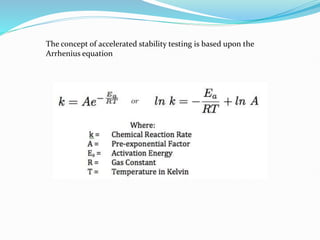
The concept of accelerated stability testing is based upon the
Arrhenius equation
3. RETAINED SAMPLE STABILITY
TESTING
Usual practice for every marketed product for which
stability data are required.
• Only one batch a year are selected.
• If the number of batches marketed exceeds 50, stability
samples from two batches are recommended to be
taken.
• Stability testing by evaluation of market samples is a
modified method which involves taking samples already
in the market place and evaluating stability attributes.
4. CYCLIC TEMPERATURE STRESS
TESTING
Is not a routine testing method for marketed products.
• In this method, cyclic temp. stress tests are designed on
knowledge of the product so as to mimic likely conditions in
market place storage.
• The period of cycle mostly considered is 24 hours.
• The min. and max. temp. for the cyclic stress testing is
recommended to be selected on a product by-product basis
and considering factors like recommended storage temp. for
the product and specific chemical and physical degradation
properties of the products.
• the test should normally have 20 cycles.
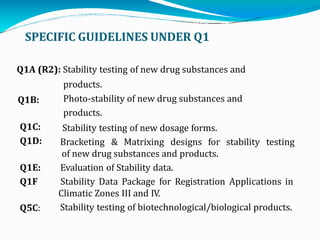
SPECIFIC GUIDELINES UNDER Q1
Q1A (R2): Stability testing of new drug substances and
products.
Q1B:
Q1C:
Q1D:
Q5C:
Photo-stability of new drug substances and
products.
Stability testing of new dosage forms.
Bracketing & Matrixing designs for stability testing
of new drug substances and products.
Q1E: Evaluation of Stability data.
Q1F Stability Data Package for Registration Applications in
Climatic Zones III and IV.
Stability testing of biotechnological/biological products.
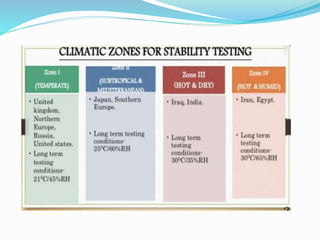
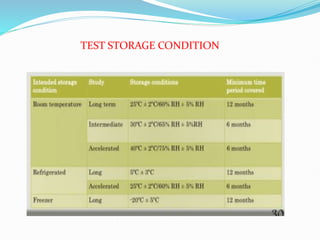
TEST STORAGE CONDITION
Estimation of shelf life
The time period during which a drug product is expected to
remain within the approved shelf life specification, provided
that it is stored under the conditions.
The time period during which the drug maintain its 90%
potency or loss not more than 10% potency.
The shelf life is determined from the data obtained from the
long term storage studies.
Expiration of date
An expiration date is defined as the time up to which
the product will remain stable when stored under
recommended storage conditions.
Thus, an expiration date is the date beyond which it is
predicted that the product may no longer retain fitness
for use.
If the product is not stored in accordance with the
manufacturer’s instructions, then the product may be
expected to degrade more rapidly.
METHOD TO DETERMINE OVERAGES
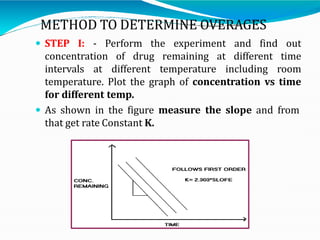
 STEP I: - Perform the experiment and find out
concentration of drug remaining at different time
intervals at different temperature including room
temperature. Plot the graph of concentration vs time
for different temp.
 As shown in the figure measure the slope and from
that get rate Constant K.
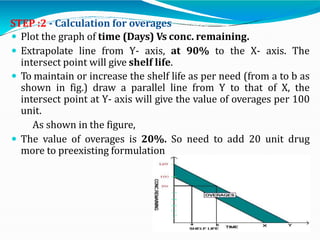
STEP :2 - Calculation for overages
 Plot the graph of time (Days) Vs conc. remaining.
 Extrapolate line from Y- axis, at 90% to the X- axis. The
intersect point will give shelf life.
 To maintain or increase the shelf life as per need (from a to b as
shown in fig.) draw a parallel line from Y to that of X, the
intersect point at Y- axis will give the value of overages per 100
unit.
As shown in the figure,
 The value of overages is 20%. So need to add 20 unit drug
more to preexisting formulation
Most important guidelines are
 Food and DrugAdministration (FDA)
 International Conference on Harmonization (ICH)
 European Union Guidelines (EU)
 Japanese Guidelines (MHW)
 Therapeutic GoodAdministration (TGA) – ForAustralia
 Gulf Central Committee (GCC) – For Gulf Countries
 Association of South EastAsian Nations (ASEAN)
 Eastern Mediterranean Region etc.
ICH GUIDLINE
What is ICH?
The International Conference on Harmonization (ICH) of
Technical Requirements for Registration of
Pharmaceuticals for Human Use is a unique project that
brings together the regulatory authorities of Europe,
Japan and the United States and experts from the
pharmaceutical industry in the three regions to discuss
scientific and technical aspects of product registration.
Objectives of ICH:
 More economical use of human, animal, and material
resources.
 Elimination of unnecessary delay in the global
development & availability of new medicines.
 Maintaining safeguards on Quality, safety & efficacy, and
regulatory obligations to protect public health.
 TOPICS OF ICH: Four Broad Categories - QSEM
 Quality (Q): Topics related to Manufacturing QA.
 Safety (S): Topics related to non-clinical pharmacology &
toxicology studies.
 Efficacy (E): Topics related to Clinical studies in humans.
 Multidisciplinary (M): Topics affecting more than one
discipline.
 Our concern is only with quality topics.
 QUALITY TOPICS: Consists of six subtopics:-
 Q1: Stability testing
 Q2: Analytical methods validation
 Q3: Impurity testing
 Q4: Pharmacopoeias
 Q5: Quality of Biotechnological products
 Q6: Specifications for new drug substances & products.
 Our concern is only Q1 (i.e. Stability testing).
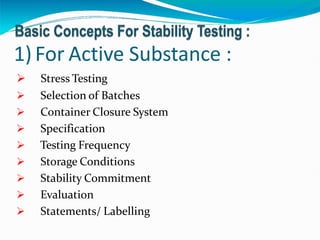
1)For Active Substance :
 Stress Testing
 Selection of Batches
 Container Closure System
 Specification
 Testing Frequency
 Storage Conditions
 Stability Commitment
 Evaluation
 Statements/ Labelling
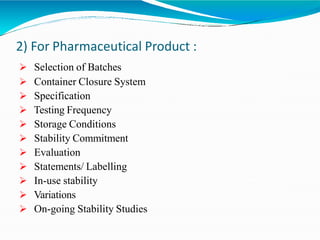
2) For Pharmaceutical Product :
 Selection of Batches
 Container Closure System
 Specification
 Testing Frequency
 Storage Conditions
 Stability Commitment
 Evaluation
 Statements/ Labelling
 In-use stability
 Variations
 On-going Stability Studies
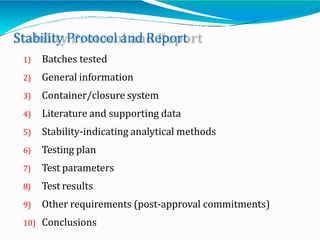
Stability Protocol and Report
1) Batches tested
2) General information
3) Container/closure system
4) Literature and supporting data
5) Stability-indicating analytical methods
6) Testing plan
7) Test parameters
8) Test results
9) Other requirements (post-approval commitments)
10) Conclusions
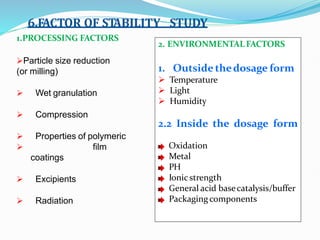
1.PROCESSING FACTORS
Particle size reduction
(or milling)
 Wet granulation
 Compression
 Properties of polymeric
 film
coatings
 Excipients
 Radiation
2. ENVIRONMENTALFACTORS
1. Outside thedosage form
 Temperature
 Light
 Humidity
2.2 Inside the dosage form
Oxidation
Metal
PH
Ionicstrength
General acid basecatalysis/buffer
Packaging components
6.FACTOR OF ST
ABILITY STUDY
 Pharmaceutics- The science of Dosage Form Design by M. E.Aulton.
(2nd edition): pg.113
 The Science & Practice of Pharmacy by Remington.(19th edition): pg.1447
 The Theory & Practice of Industrial Pharmacy by Leon Lachman, HerbetA.
Lieberman, Joseph L. Kaing.(3rd edition): pg.171
 Pharmaceutical Dosage Forms by Leon Lachman, H.A. Lieberman; Vol.1:
pg.1
 Pharmaceutical Dosage Forms & Delivery Systems by H.C.Ansel,
L.V.Allen
 P’ceutical preformulation &formulation, A practical guide by Mark
gibson

1.preformulation concept in Modern pharmaceutics.pptx

  • 1.
    MODERN PHARMACEUTICS 1. a.Preformulation Concepts – Drug Excipient interactions - different methods, kinetics of stability, Stability testing. Theories of dispersion and Pharmaceutical Dispersion (Emulsion and Suspension, SMEDDS). Preparation and stability of Large and small volume parental – physiological and formulation consideration, Manufacturing and evaluation. b. Optimization techniques in Pharmaceutical Formulation: Concept and parameters of optimization, Optimization techniques in pharmaceutical formulation and processing. Statistical design, Response surface method, Contour designs, Factorial designs and application in formulation 2 Validation : Introduction to Pharmaceutical Validation, Scope & merits of Validation, Validation and calibration of Master plan, ICH & WHO guidelines for calibration and validation of equipments, Validation of specific dosage form, Types of validation. Government regulation, Manufacturing Process Model, URS, DQ,IQ, OQ &P.Q. of facilities.
  • 2.
    3 cGMP &Industrial Management: Objectives and policies of current good manufacturing practices, layout of buildings, services, equipments and their maintenance Production management: Production organization, , materials management, handling and transportation, inventory management and control, production and planning control, Sales forecasting, budget and cost control, industrial and personal relationship. Concept of Total Quality Management 4 Compression and compaction: Physics of tablet compression, compression, consolidation, effect of friction, distribution of forces, compaction profiles.Solubility. 5 Study of consolidation parameters; Diffusion parameters, Dissolution parameters and Pharmacokinetic parameters, Heckel plots, Similarity factors – f2 and f1, Higuchi and Peppas plot, Linearity Concept of significance, Standard deviation , Chisquare test, students T-test , ANOVA test. 10 Hrs 10 Hr
  • 3.
  • 4.
    • It isdefined as phase of research and development in which preformulation scientist characterize physical & chemical properties of new drug molecule in order to develop safe, effective, and stable dosage form. • Investigation of physical & chemical properties of a drug and mixer of drug & excipient 3
  • 5.
    DEFINITION • It canbe defined as an investigation of physical and chemical properties of a drug substance - alone and or when combined with excipients. • The overall objective of preformulation testing is to generate information useful to the formulator in developing stable and safe dosage forms with good bioavailability.
  • 6.
    • Prior todevelopment of dosage form with new drug candidate, it is essential that some fundamental physicochemical properties of new drug molecule are to be determined. This information may dictate many of subsequent events and possible approaches in formulation development.
  • 7.
     To formulatean innovative,elegant, safe, efficacious dosage form which is capable of delivering the substances for its intended use.  To formulate new dosage form of already existing drug.  Determination of all the properties of drug and the best suitable dosage form for the drug molecule.  The major goal of preformulatoin is to gather data, Which will permit the rational development of safe and efficacious dosage form..
  • 8.
    DIRECT BENEFITS Gives directionfor development of formulation in choice of dosage form,excipients,composition,physical structure. Helps in adjustment of Pharmacokinetics and biopharmaceutical properties. Support for process development of drug substance (yield,filtration..). Produce necessary and useful data for development of analytical methods. 6
  • 9.
    Receive new drug substance Obtainall available information If not available, do the literature search. Determine physical property of the newAPI. Macroscopic and Microscopic examination Determine polymorphs, solvates and hydrates. Stability testing at normal and exaggerated condition. Determine their solubility, partition co- efficient, pKa, dissolution rate. If poor bioavailability test results due to solubility, pKa, P, etc. make new salt or ester If satisfactory Check lot to lot uniformity Select most stable, active form for bioavailability testing. CheckAPI stability with excipients Prepare worksheet and final preformulation report and issue to product development dept.
  • 11.
    9 I. PHYSICAL CHARACTERISTICS A.BULK CHARACTERISTIC 1) Particle Size & SurfaceArea. 2) Polymorphism. 3) Crystallinity. 4) Hygroscopicity. 5) Flow properties & Bulk density. 6) Compressibility. 7) Drug-Excipient Compatability. 8) Electrostatic charge. 9) Osmolarity. 10) Rheology. 11) Wettability.
  • 12.
    10 B. SOLUBILITY ANALYSIS 1)Aqueous Solubility. a. Intrinsic solubility. b. Ionization constant. 2) Solubilization. 3) Partition Coefficient. 4) Thermal effect. 5) Common ion effect. 6) Dissolution. C.STABILITY ANALYSIS 1) Solid State Stability. 2) Solution State Stability.
  • 13.
    11 II.CHEMICAL CHARACTERISTIC 1) Oxidation. 2)Hydrolysis. 3) Photolysis. 4) Racemization. 5) Polymerization. 6) Isomerization. 7) Decarboxylation. 8) Enzyme Decomposition.
  • 15.
    “When we mixtwo or moreAPI and / or excipient with each other & if they are antagonistic & affect adversely the safety, therapeutic efficacy, appearance or elegance then they are said to be incompatible.’’ DEFINITION
  • 16.
  • 17.
     Why toscreen excipients? 1.need to minimize no.of model formulations 2.provide rational basis for selecting excipients 3.Formulation stability studies are time consuming.  Goal of the study( Identify the excipients that) 1.are compatible withAPI 2.do not have impact on the stability ofAPI  Importance 1.Stabity of formulation can be maximised. 2.Helps to avoid surprise problems. 3.Essential for IND submission. 4.Bridges drug discovery and drug development
  • 18.
    COMPATIBILITY TESTS Aspects ofcompatibility tests are: 1. Identification of compatible excipients for a formulation. 2. Identification of stable storage conditions. Types: 1. Solid state reactions: - much slower and difficult to interpret. 2. Liquid state reactions: - easier to detect -According to Stability Guidelines by FDAfollowing conditions should be evaluated for solutions or suspensions 1. Acidic or alkaline pH. 2. Presence of added substances 3. High oxygen and nitrogen atmospheres. 4. Effect of stress testing conditions.
  • 19.
    STEPS IN COMPATIBILITYSTUDY There are four steps to consider. 1. Sample preparation 2. Statistical design 3. Storage 4. Method of analysis
  • 20.
    SAMPLE PREPARATION FOR SOLIDSTATE REACTIONS:  SampleA: - mixture of drug and excipient  SampleB: - SampleA+ 5% moisture  SampleC: - Drug itself without excipients  All the samples of drug-excipient blends are kept for 1-3 weeks at specified storage conditions.  Then sample is physically observed .  It is then assayed by TLC or HPLC or DSC.  Whenever feasible, the degradation product are identified by MASS SPECTROSCOPY, NMR or other relevant analytical techniques.  To determine Solid state stability profile of a new compound….  To test the Surface Oxidation…..
  • 21.
    FOR LIQUID STATEREACTIONS: o Place the drug in the solution of additives. o Both flint and amber vials are used. o This will provide information about -Susceptibility to oxidation. -Susceptibility to light exposure. -Susceptibility to heavy metals. o In case of oral liquids, compatibility with ethanol, glycerin ,sucrose, preservatives and buffers are usually carried out.
  • 22.
    Known Incompatibilities Functional groupIncompatibility Type of reaction Primary amine Mono & Di-saccharides Amine-Aldehyde & Amine-Acetal Ester, Lactone Basic component Ester base hydrolysis, Ring opening, Aldehyde Amine, Carbohydrate Aldehyde-Amine, Schiff base Or Glycosylamine formation Carboxyl Base Salt formation Alcohol Oxygen Oxidation toAldehyde & Ketones Sulfhydryl Oxygen Dimerization Phenol Metal Complexation Gelatin- Capsule Shell Cationic Surfactant Denaturation
  • 23.
    ANALYTICALTECHNIQUES USED TODETECT DRUS-EXCIPIENT COMPATIBILITY 1. Thermal methods of analysis   DSC- Differential Scanning Calorimetry DTA- Differential ThermalAnalysis 2. Accelerated Stability Study 3. FT-IR Spectroscopy 4. DRS-Diffuse Reflectance Spectroscopy 5. Chromatography  SIC-Self Interactive Chromatography  TLC-Thin Layer Chromatography  HPLC-High Pressure Liquid Chromatography 6. Miscellaneous  Radiolabelled Techniques  Vapour Pressure Osmometry  Flourescence Spectroscopy
  • 24.
    1) DIFFRENTIAL THERMALANALYSIS Thermal Analysis is useful in the investigation of solid- state interactions.  It is also useful in the detection of eutectics.  Thermograms are generated for pure components and their physical mixtures with other components.  In the absence of any interaction, the thermograms of mixtures show patterns corresponding to those of the individual components.  In the event that interaction occurs, this is indicated in the thermogram of a mixture by the appearance of one or more new peaks or the disappearance of one or more peaks corresponding to those of the components.
  • 25.
    2) DSC-DIFFERENTIAL SCANNINGCALORIMETRY o DSC is widely used to investigate and predict any physico- chemical interaction between drug and excipients involving thermal changes.. o METHOD -The preformulation screening of drug-excipient interaction requires (1 : 1)Drug:excipient ratio, to maximize the likehood of observing an interaction. -Mixture should be examined under N2 to eliminate oxidative and pyrrolytic effects at heating rate ( 2, 5 or 100 c / min) on DSC apparatus.
  • 27.
    LIMITATIONS OF DSC oIf thermal changes are very small, DSC can’t be used. o DSC can not detect the incompatibilities which occur after long term storage. Eg. MCC /ASPIRIN… o Not applicable if test material exhibits properties that make data interpretation difficult. ADV ANTAGES: -Fast -Reliable and very less sample required.
  • 28.
    3) ACCELARETED STABILITYSTUDY Different formulations of the same drug are prepared. Samples are kept at 40ºC / 75 % RH. Chemical stability is assessed by analyzing the drug content at regular interval. Amt. of drug degraded is calculated. % Drug decomposed VS time(month) is plotted.
  • 29.
    4) DIFFUSE REFLECTANCESPECTROSCOPY  Principle: “Penetration of a portion of incident radiation flux into the interior of the solid sample, return of some portion of radiation to the surface of sample following partial absorption and multiple scattering at boundary of individual sample particles.”  Detects the decomposed products, along with physical and chemical adsorption of excipients on toA.P.I. and vice versa.  Example: Ethanol mediated interaction between dextroamphatamine sulphate and spray dried lactose in solid–solid mixture.
  • 30.
     Diffuse reflectancespectroscopy is gaining increasing popularity among preformulation scientists as a tool to detect and monitor drug-excipient interactions.  In this technique solid drugs, excipients, and their physical mixtures are exposed to incident radiation.  Aportion of the incident radiation is partly absorbed and partly reflected in a diffuse manner.  The diffuse reflectance depends on the packing density of the solid, its particle size, and its crystal form, among other factors.  When these factors are adequately controlled, diffuse reflectance spectroscopy can be used to investigate physical and chemical changes occurring on solid surfaces.
  • 31.
    5) SELF INTERACTIVECHROMATOGRAPHY  SIC is useful for proteinous drug and excipients. METHOD:-  SIC is a modified type of affinity chromatography.  Here,drug is made immobilized as the SP& soln. to be tested( excipient soln.) acts as MP.  Measure Rt (Retention time) & compare with non –retained marker.

  • 32.
    PRINCIPLE:- For different mobilephases (i.e. different excipients) the injected drug havedifferent interactions (may be repulsiveor attractive) with the SP of drug leads toshift in retention time (Rt) time FIGURE-1 FIGURE-2 FIGURE-3 When interaction When no net When attractive interactions,it will have longer retention time& widerpeak is repulsive,a interaction between sharperpeak is the immobilized obtained ata drug,Rt=dead shorterretention volumeof column.
  • 33.
    6) TLC ANDHPTLC o TLC is generally used as confirmative test of compatibility after performing DSC. o S.P. consist of powder (Silica,Alumina, Polyamide, Cellulose & Ion exchange resin) adhered onto glass, plastic or metal plate. o Solution of Drug, Excipient & Drug: Excipient mixture are prepared & spotted on the same baseline at the end of plate. o The plate is then placed upright in a closed chamber containing the solvent which constitutes the M.P.
  • 34.
    7) RADIO LABELLEDTECHNIQUES:  It is important when theAPI is having radio–activity.  Method is carried out by using either 3H or 13C.  Highly sensitive method but the cost of carrying out the method & the availability of well established other techniques & methods, this method is generally not preferred.
  • 36.
    ORDER OF REACTION: ZEROORDER REACTION  When the reaction rate is independent of concentration of the reacting substance, it depends on the zero power of the reactant and therefore is zero order reaction.
  • 37.
     Rate ofconcentration decrease = -dCx = K……………………………(1) dt  Integrating the equation yields X= Kt + constant…………………(2)  The unit of K is conc time-1, with typical units of mole L-1 s-1.  Half-life is given by equation t1/2 = Co/2k.
  • 38.
    GRAPH FOR ZEROORDER time concentration Slope = k The value of K indicate the amount of drug that is degraded per unit time, and intercept of line at time zero is equal to constant in equation (2).
  • 39.
    FIRST ORDER REACTION If concentration of reactant X is ‘a’ at beginning of reaction when t = 0, & if amount that has reacted after time t is denoted by x then amount of X remaining at time t will be (a-x).  log (a-x) = log a – Kt/2.303  half-life of drug is calculated by equation t1/2 = 0.693 k
  • 40.
    GRAPH FOR FIRSTORDER time log (a-x) Slope = -k/2.303 If first order law is obeyed then a graph of log (a-x) vs time t will give straight line with slope of –K/2.303 and an intercept of log a at t = 0.
  • 41.
    SECOND ORDER REACTION Rate of change in conc. of product and reactant is dependent on second power of conc. of single reactant or to first powers of the conc. of two reactants.  Unit of second order reaction is conc.-1 time-1 and SI unit is Lmol-1 sec-1.  Half-life in this case is t1/2 = 1/ak.  The equation for this second order reaction is shown below Kt = 2.303 log b(a-x) , a ≠ b or (a-b) a(b-x) Kt = 1 - 1 , a = b a-x a
  • 42.
    GRAPH FOR SECONDORDER time log b(a-x)/a(b-x) Slope = (a-b)k/2.303
  • 43.
    METHODS TO DETERMINEORDER OF REACTION SUBSTITUTION METHOD DATA PLOTTING METHOD INITIAL RATE METHOD HALF-LIFE DETERMINATION METHOD SOFTWARE TOOLS FOR SECOND ORDER REACTIONS
  • 44.
  • 45.
    STABILITY TESTING Stability :defined as capability of a particular formulation in a specific container/closure system to remain within its physical, chemical, microbiological, toxicological, protective and informational specifications. It is the extent to which a product retains, within the specified limits, throughout its period of storage and use, the same properties and characteristics possessed at the time of its packaging. SCOPE OF STABILITY TESTING Provide evidence as to how the quality of drug product varies with time. Establish shelf life of drug product. Determines recommended storage conditions. Determine container closure system suitability.
  • 46.
    IMPORTANCE OF STABILITYTESTING 1.Assurance to patient that drug is safe. 2.Legal requirement to provide data. 3.to protect the reputation of the manufacturer. 4.to provide a database. 5.to determine shelf life and storage conditions. 6.to verify that no changes have been introduced in the formulation or manufacturing process that can adversely affect the stability of the product.
  • 47.
    TYPE OF STABILITY CHEMICAL•Each active ingredient retains its chemical integrity and labeled potency within specified limits. PHYSICAL:• Includes appearance, palatability, uniformity, dissolution and suspend ability are retained. MICROBIOLOGICAL:• Sterility or resistance to microbial growth is retained according to specific requirement. THERAPEUTIC:• Activity remains unchanged. TOXICOLOGIC:• No significant increase in toxicity.
  • 48.
    STABILITY TESTING METHODS 1.REAL TIME STABILITY TESTING 2. ACCELERATED STABILITY TESTING 3.RETAINED SAMPLE STABILITY TESTING 4. CYCLIC TEMPERATURE STRESS TESTING
  • 49.
    1.REAL TIME STABILITYTESTING Performed for longer duration of the test period in order to allow significant product degradation under recommended storage conditions. Depends upon the stability of the product which should be long enough to indicate clearly that no measurable degradation occurs. Data collected at appropriate frequency To distinguish instability from day to day Stability of reference material include the stability of reagent as well as consistency of performance 1.
  • 50.
    2.ACCELERATED STABILITY TESTING . Aproduct is stressed at several high temp. & the amount of heat input required to cause product failure is determined. • This is done to subject the product to a condition that accelerates degradation. • This information is then projected to predict shelf life or used to compare the relative stability of alternative formulations. Samples subjected to stress Refrigerated Assayed simultaneously
  • 51.
    The concept ofaccelerated stability testing is based upon the Arrhenius equation
  • 52.
    3. RETAINED SAMPLESTABILITY TESTING Usual practice for every marketed product for which stability data are required. • Only one batch a year are selected. • If the number of batches marketed exceeds 50, stability samples from two batches are recommended to be taken. • Stability testing by evaluation of market samples is a modified method which involves taking samples already in the market place and evaluating stability attributes.
  • 53.
    4. CYCLIC TEMPERATURESTRESS TESTING Is not a routine testing method for marketed products. • In this method, cyclic temp. stress tests are designed on knowledge of the product so as to mimic likely conditions in market place storage. • The period of cycle mostly considered is 24 hours. • The min. and max. temp. for the cyclic stress testing is recommended to be selected on a product by-product basis and considering factors like recommended storage temp. for the product and specific chemical and physical degradation properties of the products. • the test should normally have 20 cycles.
  • 54.
    SPECIFIC GUIDELINES UNDERQ1 Q1A (R2): Stability testing of new drug substances and products. Q1B: Q1C: Q1D: Q5C: Photo-stability of new drug substances and products. Stability testing of new dosage forms. Bracketing & Matrixing designs for stability testing of new drug substances and products. Q1E: Evaluation of Stability data. Q1F Stability Data Package for Registration Applications in Climatic Zones III and IV. Stability testing of biotechnological/biological products.
  • 56.
  • 57.
    Estimation of shelflife The time period during which a drug product is expected to remain within the approved shelf life specification, provided that it is stored under the conditions. The time period during which the drug maintain its 90% potency or loss not more than 10% potency. The shelf life is determined from the data obtained from the long term storage studies.
  • 58.
    Expiration of date Anexpiration date is defined as the time up to which the product will remain stable when stored under recommended storage conditions. Thus, an expiration date is the date beyond which it is predicted that the product may no longer retain fitness for use. If the product is not stored in accordance with the manufacturer’s instructions, then the product may be expected to degrade more rapidly.
  • 59.
    METHOD TO DETERMINEOVERAGES  STEP I: - Perform the experiment and find out concentration of drug remaining at different time intervals at different temperature including room temperature. Plot the graph of concentration vs time for different temp.  As shown in the figure measure the slope and from that get rate Constant K.
  • 60.
    STEP :2 -Calculation for overages  Plot the graph of time (Days) Vs conc. remaining.  Extrapolate line from Y- axis, at 90% to the X- axis. The intersect point will give shelf life.  To maintain or increase the shelf life as per need (from a to b as shown in fig.) draw a parallel line from Y to that of X, the intersect point at Y- axis will give the value of overages per 100 unit. As shown in the figure,  The value of overages is 20%. So need to add 20 unit drug more to preexisting formulation
  • 61.
    Most important guidelinesare  Food and DrugAdministration (FDA)  International Conference on Harmonization (ICH)  European Union Guidelines (EU)  Japanese Guidelines (MHW)  Therapeutic GoodAdministration (TGA) – ForAustralia  Gulf Central Committee (GCC) – For Gulf Countries  Association of South EastAsian Nations (ASEAN)  Eastern Mediterranean Region etc.
  • 62.
    ICH GUIDLINE What isICH? The International Conference on Harmonization (ICH) of Technical Requirements for Registration of Pharmaceuticals for Human Use is a unique project that brings together the regulatory authorities of Europe, Japan and the United States and experts from the pharmaceutical industry in the three regions to discuss scientific and technical aspects of product registration.
  • 63.
    Objectives of ICH: More economical use of human, animal, and material resources.  Elimination of unnecessary delay in the global development & availability of new medicines.  Maintaining safeguards on Quality, safety & efficacy, and regulatory obligations to protect public health.
  • 64.
     TOPICS OFICH: Four Broad Categories - QSEM  Quality (Q): Topics related to Manufacturing QA.  Safety (S): Topics related to non-clinical pharmacology & toxicology studies.  Efficacy (E): Topics related to Clinical studies in humans.  Multidisciplinary (M): Topics affecting more than one discipline.  Our concern is only with quality topics.  QUALITY TOPICS: Consists of six subtopics:-  Q1: Stability testing  Q2: Analytical methods validation  Q3: Impurity testing  Q4: Pharmacopoeias  Q5: Quality of Biotechnological products  Q6: Specifications for new drug substances & products.  Our concern is only Q1 (i.e. Stability testing).
  • 65.
    1)For Active Substance:  Stress Testing  Selection of Batches  Container Closure System  Specification  Testing Frequency  Storage Conditions  Stability Commitment  Evaluation  Statements/ Labelling
  • 66.
    2) For PharmaceuticalProduct :  Selection of Batches  Container Closure System  Specification  Testing Frequency  Storage Conditions  Stability Commitment  Evaluation  Statements/ Labelling  In-use stability  Variations  On-going Stability Studies
  • 67.
    Stability Protocol andReport 1) Batches tested 2) General information 3) Container/closure system 4) Literature and supporting data 5) Stability-indicating analytical methods 6) Testing plan 7) Test parameters 8) Test results 9) Other requirements (post-approval commitments) 10) Conclusions
  • 68.
    1.PROCESSING FACTORS Particle sizereduction (or milling)  Wet granulation  Compression  Properties of polymeric  film coatings  Excipients  Radiation 2. ENVIRONMENTALFACTORS 1. Outside thedosage form  Temperature  Light  Humidity 2.2 Inside the dosage form Oxidation Metal PH Ionicstrength General acid basecatalysis/buffer Packaging components 6.FACTOR OF ST ABILITY STUDY
  • 69.
     Pharmaceutics- Thescience of Dosage Form Design by M. E.Aulton. (2nd edition): pg.113  The Science & Practice of Pharmacy by Remington.(19th edition): pg.1447  The Theory & Practice of Industrial Pharmacy by Leon Lachman, HerbetA. Lieberman, Joseph L. Kaing.(3rd edition): pg.171  Pharmaceutical Dosage Forms by Leon Lachman, H.A. Lieberman; Vol.1: pg.1  Pharmaceutical Dosage Forms & Delivery Systems by H.C.Ansel, L.V.Allen  P’ceutical preformulation &formulation, A practical guide by Mark gibson