EFFECT OF FRICTION, DISTRIBUTIONOF FORCES,
COMPACTIONPROFILES, SOLUBILITY
Presented by
MISS.JYOTIDIPAKMHOPREKAR
M Pharmacy(FirstYear,SemI)
RollNo. 06
DEPARTMENTOF PHARMACEUTICS
SHREESANTKRUPACOLLEGEOF PHARMACYGHOGAON.
CONTENTS:
Effect of friction
Distribution of forces
Compaction profiles
solubility
Various forces involved in the compression :
Frictional force
Distributional force
Radial force
Ejection force
FRICTIONAL FORCE :
EFFECT OF FRICTION:
The major component to the Frictional force :
1. Interparticulate Friction:
This arises at particle/ particle contacts and can be expressed in
terms of a coefficient of interparticulate friction µ1; it is more
significant at low applied loads. Materials that reduce this effect are
referred to as glidants.
e.g. colloidal silica, corn starch, talc.
When particle rearrangement has ceased and is particularly important
in tabletting operations. Most tablets contain a small amount of an
additive designed to reduce die- wall friction; such additives are called
lubricants. Magnesium stearate is a common choice.
2. Die – wall friction :
This results from material being pressed against the die wall and moved
down it; it is expressed as µw, the coefficient of die- wall friction. This
effect becomes dominant at high applied forces.
DISTRIBUTION OF FORCES:
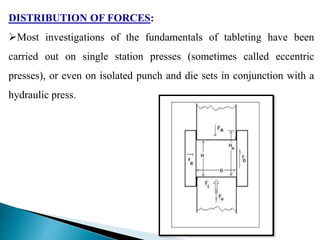
Most investigations of the fundamentals of tableting have been
carried out on single station presses (sometimes called eccentric
presses), or even on isolated punch and die sets in conjunction with a
hydraulic press.
The force being applied to the top of a cylindric powder mass. This
simple compaction system provides a convenient way to examine the
process in greater detail. More specifically, the following basic
relationships apply. Since their must be an axial (vertical) balance of
forces:
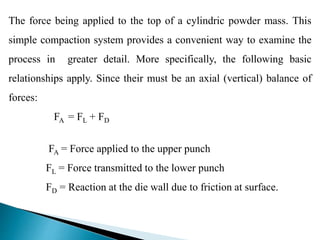
FA = FL + FD
FA = Force applied to the upper punch
FL = Force transmitted to the lower punch
FD = Reaction at the die wall due to friction at surface.
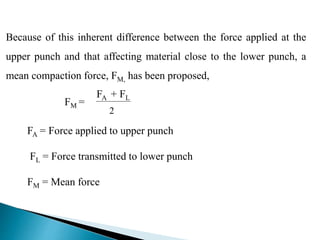
Because of this inherent difference between the force applied at the
upper punch and that affecting material close to the lower punch, a
mean compaction force, FM, has been proposed,
FA + FL
2
FM =
FA = Force applied to upper punch
FL = Force transmitted to lower punch
FM = Mean force
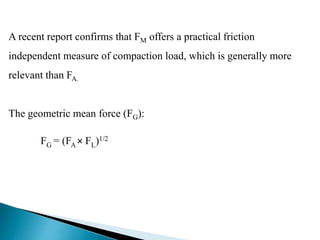
A recent report confirms that FM offers a practical friction
independent measure of compaction load, which is generally more
relevant than FA.
The geometric mean force (FG):
FG = (FA × FL)1/2
RADIAL FORCE :
As the compression force increased and any repacking of the tabletting
mass is completed, the material may be regarded to some extent as a
single solid body.
Then as with other solid, compressive force applied in one direction
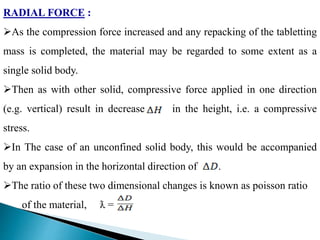
(e.g. vertical) result in decrease in the height, i.e. a compressive
stress.
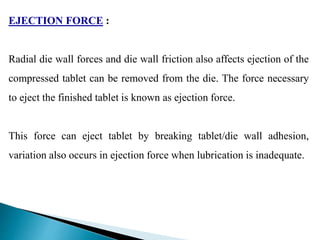
In The case of an unconfined solid body, this would be accompanied
by an expansion in the horizontal direction of .
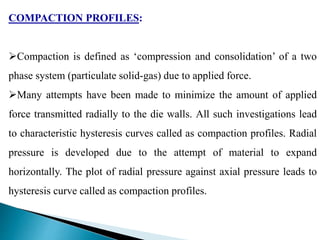
The ratio of these two dimensional changes is known as poisson ratio
of the material, ƛ =
EJECTION FORCE :
Radial die wall forces and die wall friction also affects ejection of the
compressed tablet can be removed from the die. The force necessary
to eject the finished tablet is known as ejection force.
This force can eject tablet by breaking tablet/die wall adhesion,
variation also occurs in ejection force when lubrication is inadequate.
COMPACTION PROFILES:
Compaction is defined as ‘compression and consolidation’ of a two
phase system (particulate solid-gas) due to applied force.
Many attempts have been made to minimize the amount of applied
force transmitted radially to the die walls. All such investigations lead
to characteristic hysteresis curves called as compaction profiles. Radial
pressure is developed due to the attempt of material to expand
horizontally. The plot of radial pressure against axial pressure leads to
hysteresis curve called as compaction profiles.
When the elastic limit of the material is high, elastic deformation
may make the major contribution, and on removal of the applied load,
the extent of the elastic relaxation depends on the value of the
materials modules of elasticity (young’s modulus).
Lower the modulus higher will be the elastic relaxation. Then there
will be the danger of structural failure. Higher the modulus value
results in low decompression hence lesser risk of structural failure.
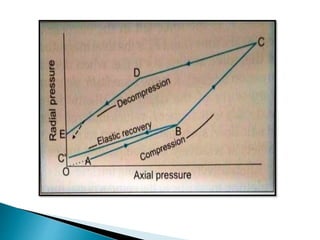
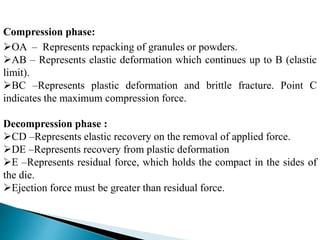
Compression phase:
OA – Represents repacking of granules or powders.
AB – Represents elastic deformation which continues up to B (elastic
limit).
BC –Represents plastic deformation and brittle fracture. Point C
indicates the maximum compression force.
Decompression phase :
CD –Represents elastic recovery on the removal of applied force.
DE –Represents recovery from plastic deformation
E –Represents residual force, which holds the compact in the sides of
the die.
Ejection force must be greater than residual force.
How they are measured?
It is analyzed by compaction simulators, these are attached to
punching machines which collect or measure the data from forces on
punches, displacement of punches, die wall friction, ejection force
and temperature change.
Types of compaction profiles :
Force –time profile
Force –displacement profile
Die wall force profile
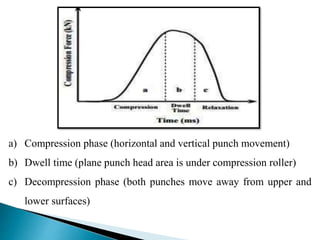
1) Force time profile:
Compression force time profiles are used to characterize the
compression behavior of the active ingredients, excipients and
formulations with respect to their plastic and elastic
deformation.
a) Compression phase
b) Dwell time
c) Decompression/relaxation phase
a) Compression phase:
Compression is the process in which maximum force is applied on
powdered bed in order to reduce its volume.
b) Dwell phase:
when compression force reaches a maximum value, this maximum
force is maintained for prolonged period before decompression.
The time period b/w the compression phase and decompression
phase is known as dwell time.
c) Decompression phase:
Removal of applied force on powder bed i.e., both punches
moving away from upper and lower surfaces.
a) Compression phase (horizontal and vertical punch movement)
b) Dwell time (plane punch head area is under compression roller)
c) Decompression phase (both punches move away from upper and
lower surfaces)
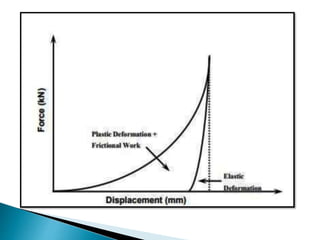
2) Force –displacement profiles:
Assessment of the compaction behavior of materials is done by force
–displacement profile .
Force –displacement profile can be used to determine the behavior of
plastic and elastic materials.
Stress relaxation is observe to be minimal in case of plastic
deformation; where as the material that undergoes elastic deformation
tend to relax to a greater extent during and/or after compression.
At a given fmax the displacement area of plastic deformation is more
when compared to the displacement area of elastic deformation.
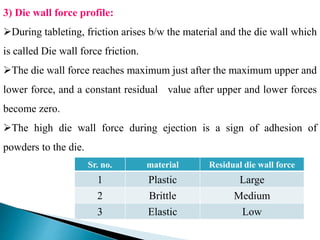
3) Die wall force profile:
During tableting, friction arises b/w the material and the die wall which
is called Die wall force friction.
The die wall force reaches maximum just after the maximum upper and
lower force, and a constant residual value after upper and lower forces
become zero.
The high die wall force during ejection is a sign of adhesion of
powders to the die.
Sr. no. material Residual die wall force
1 Plastic Large
2 Brittle Medium
3 Elastic Low
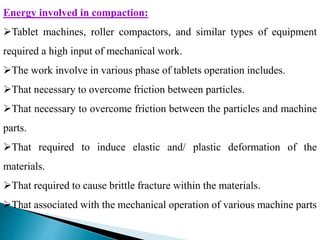
Energy involved in compaction:
Tablet machines, roller compactors, and similar types of equipment
required a high input of mechanical work.
The work involve in various phase of tablets operation includes.
That necessary to overcome friction between particles.
That necessary to overcome friction between the particles and machine
parts.
That required to induce elastic and/ plastic deformation of the
materials.
That required to cause brittle fracture within the materials.
That associated with the mechanical operation of various machine parts
Applications:
These can be used to monitor compaction cycle.
Compaction profiles give a good assessment of the elastic
component of the powder.
Provides information regarding the radial transmission of applied
force to the die wall.
Helps in calculating possible ejection force and lubricant
requirements.
SOLUBILITY :
Solubility is defined as Quantitative terms as concentration of solute
in concentration of solute in concentrated solution at a certain
temperature, and in qualitative way it can be defined as a spontaneous
interaction of two or more substance to form a homogeneous
molecular dispersion.
Importance of solubility :
Therapeutics effectiveness of a drug depends upon the bioavailability
and ultimately upon the solubility of drug molecule.
It is important parameter to achieve desired concentration of drug in
systemic circulation for pharmacological response to be shown.
Any drug to be absorbed must be soluble or present in the form of an
aqueous solution at the site of absorption.
Compression and compaction

Compression and compaction

  • 1.
    EFFECT OF FRICTION,DISTRIBUTIONOF FORCES, COMPACTIONPROFILES, SOLUBILITY Presented by MISS.JYOTIDIPAKMHOPREKAR M Pharmacy(FirstYear,SemI) RollNo. 06 DEPARTMENTOF PHARMACEUTICS SHREESANTKRUPACOLLEGEOF PHARMACYGHOGAON.
  • 2.
    CONTENTS: Effect of friction Distributionof forces Compaction profiles solubility
  • 3.
    Various forces involvedin the compression : Frictional force Distributional force Radial force Ejection force
  • 4.
    FRICTIONAL FORCE : EFFECTOF FRICTION: The major component to the Frictional force : 1. Interparticulate Friction: This arises at particle/ particle contacts and can be expressed in terms of a coefficient of interparticulate friction µ1; it is more significant at low applied loads. Materials that reduce this effect are referred to as glidants. e.g. colloidal silica, corn starch, talc.
  • 5.
    When particle rearrangementhas ceased and is particularly important in tabletting operations. Most tablets contain a small amount of an additive designed to reduce die- wall friction; such additives are called lubricants. Magnesium stearate is a common choice. 2. Die – wall friction : This results from material being pressed against the die wall and moved down it; it is expressed as µw, the coefficient of die- wall friction. This effect becomes dominant at high applied forces.
  • 6.
    DISTRIBUTION OF FORCES: Mostinvestigations of the fundamentals of tableting have been carried out on single station presses (sometimes called eccentric presses), or even on isolated punch and die sets in conjunction with a hydraulic press.
  • 7.
    The force beingapplied to the top of a cylindric powder mass. This simple compaction system provides a convenient way to examine the process in greater detail. More specifically, the following basic relationships apply. Since their must be an axial (vertical) balance of forces: FA = FL + FD FA = Force applied to the upper punch FL = Force transmitted to the lower punch FD = Reaction at the die wall due to friction at surface.
  • 8.
    Because of thisinherent difference between the force applied at the upper punch and that affecting material close to the lower punch, a mean compaction force, FM, has been proposed, FA + FL 2 FM = FA = Force applied to upper punch FL = Force transmitted to lower punch FM = Mean force
  • 9.
    A recent reportconfirms that FM offers a practical friction independent measure of compaction load, which is generally more relevant than FA. The geometric mean force (FG): FG = (FA × FL)1/2
  • 10.
    RADIAL FORCE : Asthe compression force increased and any repacking of the tabletting mass is completed, the material may be regarded to some extent as a single solid body. Then as with other solid, compressive force applied in one direction (e.g. vertical) result in decrease in the height, i.e. a compressive stress. In The case of an unconfined solid body, this would be accompanied by an expansion in the horizontal direction of . The ratio of these two dimensional changes is known as poisson ratio of the material, ƛ =
  • 11.
    EJECTION FORCE : Radialdie wall forces and die wall friction also affects ejection of the compressed tablet can be removed from the die. The force necessary to eject the finished tablet is known as ejection force. This force can eject tablet by breaking tablet/die wall adhesion, variation also occurs in ejection force when lubrication is inadequate.
  • 12.
    COMPACTION PROFILES: Compaction isdefined as ‘compression and consolidation’ of a two phase system (particulate solid-gas) due to applied force. Many attempts have been made to minimize the amount of applied force transmitted radially to the die walls. All such investigations lead to characteristic hysteresis curves called as compaction profiles. Radial pressure is developed due to the attempt of material to expand horizontally. The plot of radial pressure against axial pressure leads to hysteresis curve called as compaction profiles.
  • 13.
    When the elasticlimit of the material is high, elastic deformation may make the major contribution, and on removal of the applied load, the extent of the elastic relaxation depends on the value of the materials modules of elasticity (young’s modulus). Lower the modulus higher will be the elastic relaxation. Then there will be the danger of structural failure. Higher the modulus value results in low decompression hence lesser risk of structural failure.
  • 15.
    Compression phase: OA –Represents repacking of granules or powders. AB – Represents elastic deformation which continues up to B (elastic limit). BC –Represents plastic deformation and brittle fracture. Point C indicates the maximum compression force. Decompression phase : CD –Represents elastic recovery on the removal of applied force. DE –Represents recovery from plastic deformation E –Represents residual force, which holds the compact in the sides of the die. Ejection force must be greater than residual force.
  • 16.
    How they aremeasured? It is analyzed by compaction simulators, these are attached to punching machines which collect or measure the data from forces on punches, displacement of punches, die wall friction, ejection force and temperature change. Types of compaction profiles : Force –time profile Force –displacement profile Die wall force profile
  • 17.
    1) Force timeprofile: Compression force time profiles are used to characterize the compression behavior of the active ingredients, excipients and formulations with respect to their plastic and elastic deformation. a) Compression phase b) Dwell time c) Decompression/relaxation phase
  • 18.
    a) Compression phase: Compressionis the process in which maximum force is applied on powdered bed in order to reduce its volume. b) Dwell phase: when compression force reaches a maximum value, this maximum force is maintained for prolonged period before decompression. The time period b/w the compression phase and decompression phase is known as dwell time. c) Decompression phase: Removal of applied force on powder bed i.e., both punches moving away from upper and lower surfaces.
  • 19.
    a) Compression phase(horizontal and vertical punch movement) b) Dwell time (plane punch head area is under compression roller) c) Decompression phase (both punches move away from upper and lower surfaces)
  • 20.
    2) Force –displacementprofiles: Assessment of the compaction behavior of materials is done by force –displacement profile . Force –displacement profile can be used to determine the behavior of plastic and elastic materials. Stress relaxation is observe to be minimal in case of plastic deformation; where as the material that undergoes elastic deformation tend to relax to a greater extent during and/or after compression. At a given fmax the displacement area of plastic deformation is more when compared to the displacement area of elastic deformation.
  • 22.
    3) Die wallforce profile: During tableting, friction arises b/w the material and the die wall which is called Die wall force friction. The die wall force reaches maximum just after the maximum upper and lower force, and a constant residual value after upper and lower forces become zero. The high die wall force during ejection is a sign of adhesion of powders to the die. Sr. no. material Residual die wall force 1 Plastic Large 2 Brittle Medium 3 Elastic Low
  • 23.
    Energy involved incompaction: Tablet machines, roller compactors, and similar types of equipment required a high input of mechanical work. The work involve in various phase of tablets operation includes. That necessary to overcome friction between particles. That necessary to overcome friction between the particles and machine parts. That required to induce elastic and/ plastic deformation of the materials. That required to cause brittle fracture within the materials. That associated with the mechanical operation of various machine parts
  • 24.
    Applications: These can beused to monitor compaction cycle. Compaction profiles give a good assessment of the elastic component of the powder. Provides information regarding the radial transmission of applied force to the die wall. Helps in calculating possible ejection force and lubricant requirements.
  • 25.
    SOLUBILITY : Solubility isdefined as Quantitative terms as concentration of solute in concentration of solute in concentrated solution at a certain temperature, and in qualitative way it can be defined as a spontaneous interaction of two or more substance to form a homogeneous molecular dispersion.
  • 26.
    Importance of solubility: Therapeutics effectiveness of a drug depends upon the bioavailability and ultimately upon the solubility of drug molecule. It is important parameter to achieve desired concentration of drug in systemic circulation for pharmacological response to be shown. Any drug to be absorbed must be soluble or present in the form of an aqueous solution at the site of absorption.