DRUG 
DISTRIBUTION 
1
Introduction 
Once a drug has gained excess to the blood stream, the 
drug is subjected to a number of processes called as 
Disposition Processes that tend to lower the plasma 
concentration. 
1. Distribution which involves reversible transfer of a 
drug between compartments. 
2. Elimination which involves irreversible loss of drug 
from the body. It comprises of biotransformation and 
excretion. 
02-12-2010 KLECOP, Nipani 2
02-12-2010 KLECOP, Nipani 3
02-12-2010 KLECOP, Nipani 4
As the Pharmacological action of a drug 
depends upon its concentration at the site of 
action Distribution plays a significant role in 
the Onset, Intensity, and Duration of Action. 
Distribution of a drug is not Uniform 
throughout the body because different tissues 
receive the drug from plasma at different rates 
and to different extents. 
02-12-2010 KLECOP, Nipani 5
Volume of Distribution 
The Volume of distribution (VD), also known as Apparent volume 
of distribution, is used to quantify the distribution of a drug 
between plasma and the rest of the body after oral or 
parenteral dosing. 
It is called as Apparent Volume because all parts of the body 
equilibrated with the drug do not have equal concentration. 
It is defined as the volume in which the amount of drug would 
be uniformly distributed to produce the observed blood 
concentration. 
02-12-2010 KLECOP, Nipani 6
Redistribution 
Highly lipid soluble drugs when given by i.v. or by 
inhalation initially get distributed to organs with high blood 
flow, e.g. brain, heart, kidney etc. 
Later, less vascular but more bulky tissues (muscles,fat) 
take up the drug and plasma concentration falls and drug is 
withdrawn from these sites. 
If the site of action of the drug was in one of the highly 
perfused organs, redistribution results in termination of the 
drug action. 
Greater the lipid solubility of the drug, faster is its 
redistribution. 
02-12-2010 KLECOP, Nipani 7
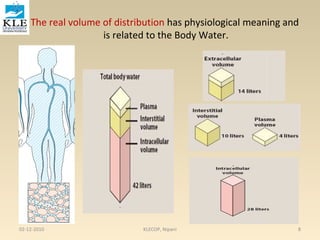
The real volume of distribution has physiological meaning and 
is related to the Body Water. 
02-12-2010 KLECOP, Nipani 8
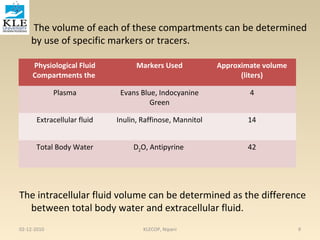
The volume of each of these compartments can be determined 
by use of specific markers or tracers. 
Physiological Fluid 
Compartments the 
Markers Used Approximate volume 
(liters) 
Plasma Evans Blue, Indocyanine 
Green 
4 
Extracellular fluid Inulin, Raffinose, Mannitol 14 
Total Body Water D2O, Antipyrine 42 
The intracellular fluid volume can be determined as the difference 
between total body water and extracellular fluid. 
02-12-2010 KLECOP, Nipani 9
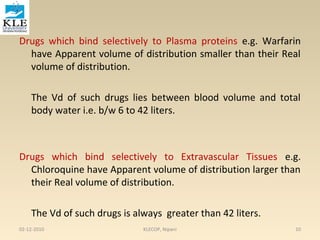
Drugs which bind selectively to Plasma proteins e.g. Warfarin 
have Apparent volume of distribution smaller than their Real 
volume of distribution. 
The Vd of such drugs lies between blood volume and total 
body water i.e. b/w 6 to 42 liters. 
Drugs which bind selectively to Extravascular Tissues e.g. 
Chloroquine have Apparent volume of distribution larger than 
their Real volume of distribution. 
The Vd of such drugs is always greater than 42 liters. 
02-12-2010 KLECOP, Nipani 10
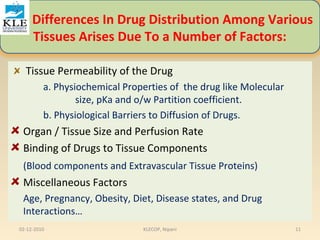
Differences In Drug Distribution Among Various 
Tissues Arises Due To a Number of Factors: 
Tissue Permeability of the Drug 
a. Physiochemical Properties of the drug like Molecular 
size, pKa and o/w Partition coefficient. 
b. Physiological Barriers to Diffusion of Drugs. 
Organ / Tissue Size and Perfusion Rate 
Binding of Drugs to Tissue Components 
(Blood components and Extravascular Tissue Proteins) 
Miscellaneous Factors 
Age, Pregnancy, Obesity, Diet, Disease states, and Drug 
Interactions… 
02-12-2010 KLECOP, Nipani 11
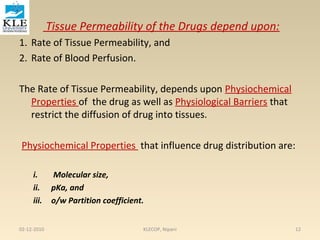
Tissue Permeability of the Drugs depend upon: 
1. Rate of Tissue Permeability, and 
2. Rate of Blood Perfusion. 
The Rate of Tissue Permeability, depends upon Physiochemical 
Properties of the drug as well as Physiological Barriers that 
restrict the diffusion of drug into tissues. 
Physiochemical Properties that influence drug distribution are: 
i. Molecular size, 
ii. pKa, and 
iii. o/w Partition coefficient. 
02-12-2010 KLECOP, Nipani 12
 Drugs having molecular wt. less than 400 daltons easily cross 
the Capillary Membrane to diffuse into the Extracellular 
Interstitial Fluids. 
 Now, the penetration of drug from the Extracellular fluid 
(ECF) is a function of :- 
 Molecular Size: 
Small ions of size < 50 daltons enter the cell through Aq. filled 
channels where as larger size ions are restricted unless a 
specialized transport system exists for them. 
 Ionisation: 
A drug that remains unionized at pH values of blood and ECF can 
permeate the cells more rapidly. 
Blood and ECF pH normally remains constant at 7.4, unless 
altered in conditions like Systemic alkalosis/acidosis. 
02-12-2010 KLECOP, Nipani 13
 Lipophilicity: 
Only unionized drugs that are lipophilic rapidly crosses the 
cell membrane. 
e.g. Thiopental, a lipophilic drug, largely unionized at Blood 
and ECF pH readily diffuses the brain where as Penicillins 
which are polar and ionized at plasma pH do not cross BBB. 
Effective Partition Coefficient for a drug is given by: 
Fraction 
Effective K o/w = unionized at pH 
X 
7.4 
K o/w of 
unionized drug 
02-12-2010 KLECOP, Nipani 14
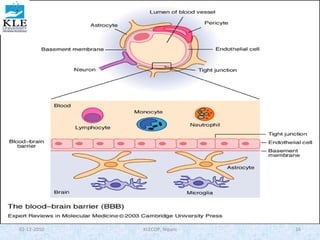
PENETRATION OF DRUGS THROUGH 
BLOOD BRAIN BARRIER 
• A stealth of endothelial cells lining the capillaries. 
• It has tight junctions and lack large intra cellular pores. 
• Further, neural tissue covers the capillaries. 
• Together , they constitute the BLOOD BRAIN BARRIER. 
• Astrocytes : Special cells / elements of supporting tissue are 
found at the base of endothelial membrane. 
• The blood-brain barrier (BBB) is a separation of circulating 
blood and cerebrospinal fluid (CSF) maintained by the choroid 
plexus in the central nervous system (CNS). 
02-12-2010 KLECOP, Nipani 15
02-12-2010 KLECOP, Nipani 16
Since BBB is a lipoidal barrier, 
It allows only the drugs having high o/w partition 
coefficient to diffuse passively where as moderately lipid 
soluble and partially ionized molecules penetrate at a slow 
rate. 
Endothelial cells restrict the diffusion of microscopic objects 
(e.g. bacteria ) and large or hydrophillic molecules into the 
CSF, while allowing the diffusion of small hydrophobic 
molecules (O2, CO2, hormones). 
Cells of the barrier actively transport metabolic products such 
as glucose across the barrier with specific proteins. 
02-12-2010 KLECOP, Nipani 17
Various approaches to promote crossing BBB: 
• Use of Permeation enhancers such as Dimethyl Sulfoxide. 
• Osmotic disruption of the BBB by infusing internal carotid 
artery with Mannitol. 
• Use of Dihydropyridine Redox system as drug carriers to the 
brain ( the lipid soluble dihydropyridine is linked as a carrier to 
the polar drug to form a prodrug that rapidly crosses the BBB ) 
02-12-2010 KLECOP, Nipani 18
PENETRATION OF DRUGS THROUGH 
PLACENTAL BARRIER 
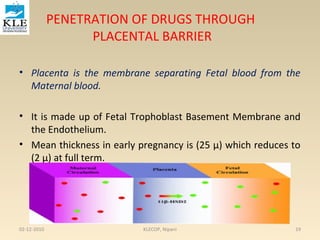
• Placenta is the membrane separating Fetal blood from the 
Maternal blood. 
• It is made up of Fetal Trophoblast Basement Membrane and 
the Endothelium. 
• Mean thickness in early pregnancy is (25 μ) which reduces to 
(2 μ) at full term. 
02-12-2010 KLECOP, Nipani 19
• Many drugs having mol. wt. < 1000 Daltons and moderate to 
high lipid solubility e.g. ethanol, sulfonamides, barbiturates, 
steroids, anticonvulsants and some antibiotics cross the 
barrier by simple diffusion quite rapidly . 
• Nutrients essential for fetal growth are transported by carrier 
mediated processes. 
02-12-2010 KLECOP, Nipani 20
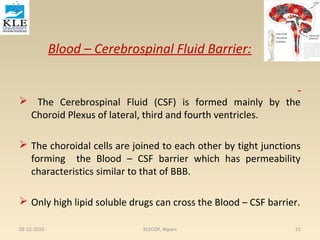
Blood – Cerebrospinal Fluid Barrier: 
 The Cerebrospinal Fluid (CSF) is formed mainly by the 
Choroid Plexus of lateral, third and fourth ventricles. 
 The choroidal cells are joined to each other by tight junctions 
forming the Blood – CSF barrier which has permeability 
characteristics similar to that of BBB. 
 Only high lipid soluble drugs can cross the Blood – CSF barrier. 
02-12-2010 KLECOP, Nipani 21
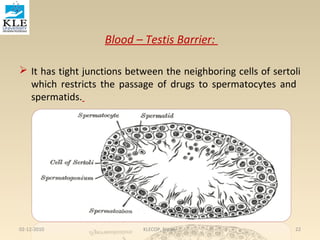
Blood – Testis Barrier: 
 It has tight junctions between the neighboring cells of sertoli 
which restricts the passage of drugs to spermatocytes and 
spermatids. 
02-12-2010 KLECOP, Nipani 22
Organ / Tissue Size and Perfusion Rate 
Perfusion Rate is defined as the volume of blood 
that flows per unit time per unit volume of the 
tissue. 
Greater the blood flow, faster the distribution. 
Highly perfused tissues such as lungs, kidneys, 
liver, heart and brain are rapidly equilibrated with 
lipid soluble drugs. 
The extent to which a drug is distributed in a 
particular tissue or organ depends upon the size of 
the tissue i.e. tissue volume. 
02-12-2010 KLECOP, Nipani 23
Miscellaneous Factors 
Diet: A Diet high in fats will increase the free fatty acid levels in 
circulation thereby affecting binding of acidic drugs such as NSAIDS to 
Albumin. 
Obesity: In Obese persons, high adipose tissue content can take up a 
large fraction of lipophilic drugs. 
Pregnancy: During pregnancy the growth of the uterus, placenta and 
fetus increases the volume available for distribution of drugs. 
Disease States: Altered albumin or drug – binding protein conc. 
Altered or Reduced perfusion to organs /tissues 
Altered Tissue pH 
02-12-2010 KLECOP, Nipani 24
Factor affecting drug-Protein 
binding , Significant , Kinetics of 
drug-protein binding 
02-12-2010 KLECOP, Nipani 25
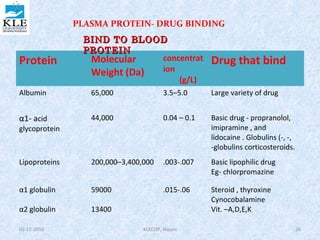
PLASMA PROTEIN- DRUG BINDING 
BBIINNDD TTOO BBLLOOOODD 
PPRROOTTEEIINN 
Protein Molecular 
Weight (Da) 
concentrat 
ion 
(g/L) 
Drug that bind 
Albumin 65,000 3.5–5.0 Large variety of drug 
α1- acid 
glycoprotein 
44,000 0.04 – 0.1 Basic drug - propranolol, 
imipramine , and 
lidocaine . Globulins (-, -, 
-globulins corticosteroids. 
Lipoproteins 200,000–3,400,000 .003-.007 Basic lipophilic drug 
Eg- chlorpromazine 
α1 globulin 
α2 globulin 
59000 
13400 
.015-.06 Steroid , thyroxine 
Cynocobalamine 
Vit. –A,D,E,K 
02-12-2010 KLECOP, Nipani 26
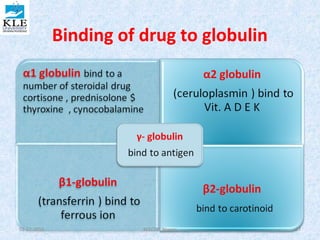
Binding of drug to globulin 
02-12-2010 KLECOP, Nipani 27
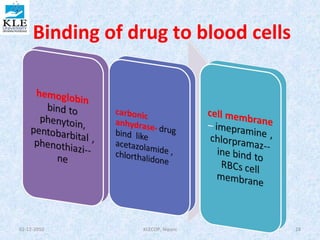
Binding of drug to blood cells 
02-12-2010 KLECOP, Nipani 28
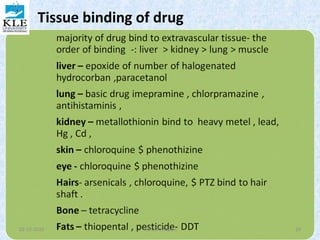
Tissue binding of drug 
02-12-2010 KLECOP, Nipani 29
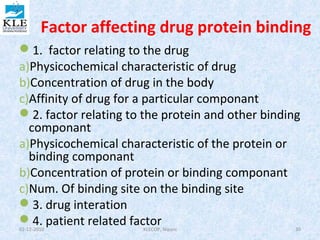
Factor affecting drug protein binding 
1. factor relating to the drug 
a)Physicochemical characteristic of drug 
b)Concentration of drug in the body 
c)Affinity of drug for a particular componant 
2. factor relating to the protein and other binding 
componant 
a)Physicochemical characteristic of the protein or 
binding componant 
b)Concentration of protein or binding componant 
c)Num. Of binding site on the binding site 
3. drug interation 
4. patient related factor 
02-12-2010 KLECOP, Nipani 30
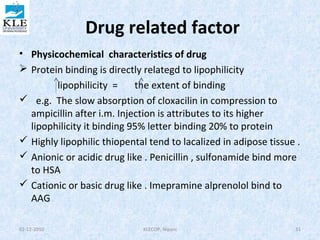
Drug related factor 
• Physicochemical characteristics of drug 
 Protein binding is directly relategd to lipophilicity 
lipophilicity = the extent of binding 
 e.g. The slow absorption of cloxacilin in compression to 
ampicillin after i.m. Injection is attributes to its higher 
lipophilicity it binding 95% letter binding 20% to protein 
 Highly lipophilic thiopental tend to lacalized in adipose tissue . 
 Anionic or acidic drug like . Penicillin , sulfonamide bind more 
to HSA 
 Cationic or basic drug like . Imepramine alprenolol bind to 
AAG 
02-12-2010 KLECOP, Nipani 31
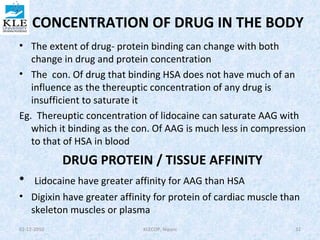
CONCENTRATION OF DRUG IN THE BODY 
• The extent of drug- protein binding can change with both 
change in drug and protein concentration 
• The con. Of drug that binding HSA does not have much of an 
influence as the thereuptic concentration of any drug is 
insufficient to saturate it 
Eg. Thereuptic concentration of lidocaine can saturate AAG with 
which it binding as the con. Of AAG is much less in compression 
to that of HSA in blood 
DRUG PROTEIN / TISSUE AFFINITY 
• Lidocaine have greater affinity for AAG than HSA 
• Digixin have greater affinity for protein of cardiac muscle than 
skeleton muscles or plasma 
02-12-2010 KLECOP, Nipani 32
Protein or tissue related factor 
Physicochemical properity of protein / binding componant – 
lipoprotein or adipose tissue tend to bind lipophilic drug by 
dissolving them to lipid core . 
• The physiological pH determine the presence of anionic or 
cationic group on the albumin molecule to bind a verity of drug 
Concentration of protein / binding componant 
• Mostly all drug bind to albumin b/c it present a higher 
concentration than other protein 
number of binding sites on the protein 
Albumin has a large number of binding site as compare to other 
protein and is a high capacity binding component 
02-12-2010 KLECOP, Nipani 33
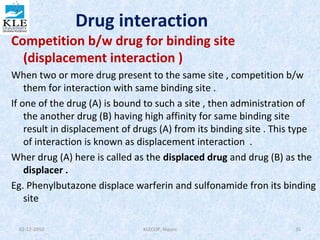
 Several drug capable to binding at 
more than one binding site 
e.g.- flucoxacillin , flurbiprofen , 
ketoprofen , tamoxifen and 
dicoumarol bind to both pri . And 
secondary site of albumin 
Indomethacin is bind to three different 
site 
AAG is a protein with limited binding 
capacity b/c of it low -conc. And moln. 
Size . The AAG has only one binding 
site for lidocaine , in presence of HAS 
two binding site have been reported 
due to direct interaction b/w them 
Site 1 
Site 2 
Site 3 
site4 
Warferin binding site 
Drug binding site on HSA 
Diazapam 
binding site 
Digitoxin 
binding site 
Tamoxifen 
binding site 
02-12-2010 KLECOP, Nipani 34
Drug interaction 
Competition b/w drug for binding site 
(displacement interaction ) 
When two or more drug present to the same site , competition b/w 
them for interaction with same binding site . 
If one of the drug (A) is bound to such a site , then administration of 
the another drug (B) having high affinity for same binding site 
result in displacement of drugs (A) from its binding site . This type 
of interaction is known as displacement interaction . 
Wher drug (A) here is called as the displaced drug and drug (B) as the 
displacer . 
Eg. Phenylbutazone displace warferin and sulfonamide fron its binding 
site 
02-12-2010 KLECOP, Nipani 35
Competition b/w drug and normal body 
constituent 
• The free fatty acids are interact to with a number of drug that 
bind primarily to HSA . When free fatty acid level is increase in 
several condition – fasting , - pathologic – diabeties , 
myocardial infraction , alcohol abstinence – the fatty acid 
which also bind to albumin influence binding of several drug 
binding – diazepam 
- propanolol 
binding - warferin 
Acidic drug like – sod. Salicilate , sod . Benzoate , 
sulfonamide displace bilirubin from its albumin binding site 
result in neonate it cross to BBB and precipitate toxicity 
(kernicterus ) 
02-12-2010 KLECOP, Nipani 36
Patient related factor 
Age 
• Neonate – albumin content is low in new born as result in 
increase conc. of unbound drug that primarily bind to albumin 
eg. Phenytoin , diazepam 
• Elderly -albumin content is lowerd result in increase conc. of 
unbound drug that primarily bind to albumin 
 In old age AAG level is increase thus decrease conc. of free drug 
that bind to AAG 
02-12-2010 KLECOP, Nipani 37
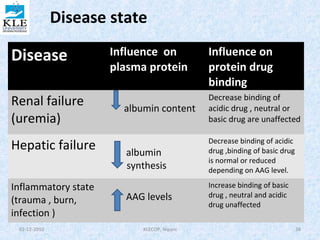
Disease state 
Disease Influence on 
plasma protein 
Influence on 
protein drug 
binding 
Renal failure 
(uremia) 
albumin content 
Decrease binding of 
acidic drug , neutral or 
basic drug are unaffected 
Hepatic failure 
albumin 
synthesis 
Decrease binding of acidic 
drug ,binding of basic drug 
is normal or reduced 
depending on AAG level. 
Inflammatory state 
(trauma , burn, 
infection ) 
AAG levels 
Increase binding of basic 
drug , neutral and acidic 
drug unaffected 
02-12-2010 KLECOP, Nipani 38
Significant of protein binding of drug 
• Absorption –the binding of absorbed drug to plasma proteins 
decrease free drug conc. And disturb equilibrium . Thus sink 
condition and conc. Gradient are established which now act as the 
driving force for further absorption 
• Systemic solubility of drug water insoluble drugs , neutral 
endogenous macromolecules , like heparin , steroids , and oil 
soluble vitamin are circulated and distributed to tissue by binding 
especially to lipoprotein act as a barrier for such drug hydrophobic 
compound . 
• Distribution -The plasma protein-drug binding thus favors 
uniform distribution of drug throughout the body by its buffer 
function . A protein bound drug in particular does not cross the 
BBB, placental barrier and the 02-12-2010 KLE CgOPl,o Nmipanei rulus 39
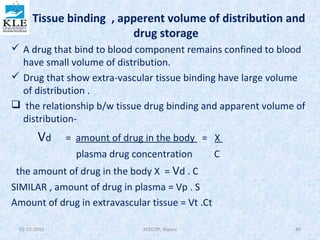
• Tissue binding , apperent volume of distribution and 
drug storage 
 A drug that bind to blood component remains confined to blood 
have small volume of distribution. 
 Drug that show extra-vascular tissue binding have large volume 
of distribution . 
 the relationship b/w tissue drug binding and apparent volume of 
distribution- 
Vd = amount of drug in the body = X 
plasma drug concentration C 
the amount of drug in the body X = Vd . C 
SIMILAR , amount of drug in plasma = Vp . S 
Amount of drug in extravascular tissue = Vt .Ct 
02-12-2010 KLECOP, Nipani 40
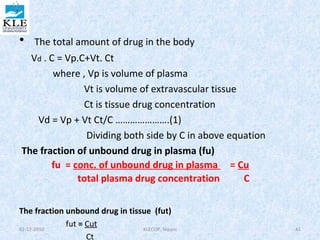
• The total amount of drug in the body 
Vd . C = Vp.C+Vt. Ct 
where , Vp is volume of plasma 
Vt is volume of extravascular tissue 
Ct is tissue drug concentration 
Vd = Vp + Vt Ct/C ………………….(1) 
Dividing both side by C in above equation 
The fraction of unbound drug in plasma (fu) 
fu = conc. of unbound drug in plasma = Cu 
total plasma drug concentration C 
The fraction unbound drug in tissue (fut) 
fut = Cut 
02-12-2010 KLECOP, Nipani 41 
Ct
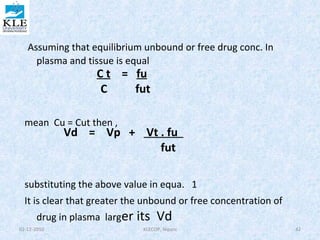
Assuming that equilibrium unbound or free drug conc. In 
plasma and tissue is equal 
C t = fu 
C fut 
mean Cu = Cut then , 
Vd = Vp + Vt . fu 
fut 
substituting the above value in equa. 1 
It is clear that greater the unbound or free concentration of 
drug in plasma larger its Vd 
02-12-2010 KLECOP, Nipani 42
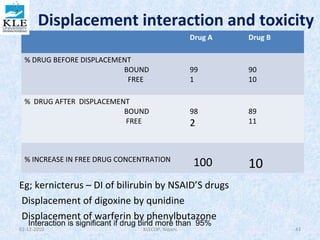
Displacement interaction and toxicity 
Drug A Drug B 
% DRUG BEFORE DISPLACEMENT 
BOUND 
FREE 
99 
1 
90 
10 
% DRUG AFTER DISPLACEMENT 
BOUND 
FREE 
98 
2 
89 
11 
% INCREASE IN FREE DRUG CONCENTRATION 100 10 
Eg; kernicterus – DI of bilirubin by NSAID’S drugs 
Displacement of digoxine by qunidine 
Displacement of warferin by phenylbutazone 
Interaction is significant if drug bind more than 95% 
02-12-2010 KLECOP, Nipani 43
Kinetics of protein drug binding 
• The kinetics of reversible drug–protein binding for a protein 
with one simple binding site can be described by the law of 
mass action, as follows: 
or ………………1 
The law of mass action, an association constant, K a, can be expressed as the 
ratio of the molar concentration of the products and the molar 
concentration of the reactants. This equation assumes only one-binding 
site per protein molecule 
……………………….…2 
Experimentally, both the free drug [D] and the protein-bound drug [PD], as 
well as the total protein concentration [P] + [PD], may be determined. To 
study the binding behavior of drugs, a determinable ratio (r )is defined, as 
follows 
02-12-2010 KLECOP, Nipani 44
moles of drug bound is [PD] and the total moles of protein is [P] + [PD], this equation 
becomes 
………………….3 
Substituting the value of PD from equa. 2 
…………4 
This equation describes the simplest situation, in which 1 mole of drug binds to 1 
mole of protein in a 1:1 complex. This case assumes only one independent binding 
site for each molecule of drug. If there are n identical independent binding sites 
per protein molecule, then the following is used: 
………………..5 
02-12-2010 KLECOP, Nipani 45
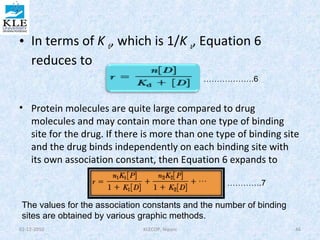
• In terms of K d, which is 1/K a, Equation 6 
reduces to 
……………….6 
• Protein molecules are quite large compared to drug 
molecules and may contain more than one type of binding 
site for the drug. If there is more than one type of binding site 
and the drug binds independently on each binding site with 
its own association constant, then Equation 6 expands to 
………….7 
The values for the association constants and the number of binding 
sites are obtained by various graphic methods. 
02-12-2010 KLECOP, Nipani 46
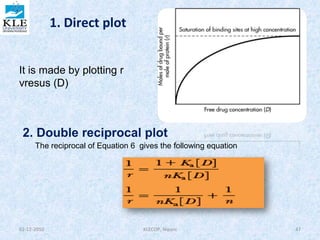
1. Direct plot 
It is made by plotting r 
vresus (D) 
2. Double reciprocal plot 
The reciprocal of Equation 6 gives the following equation 
02-12-2010 KLECOP, Nipani 47
• A graph of 1/r versus 1/[D] is called a 
double reciprocal plot. The y 
intercept is 1/n and the slope is 
1/nKa . From this graph , the number 
of binding sites may be determined 
from the y intercept, and the 
association constant may be 
determined from the slope, if the 
value for n is known. 
3. Scatchardplot 
is a rearrangement of Equation 6 The Scatchard plot 
spreads the data to give a better line for the estimation 
of the binding constants and binding sites. From 
Equation 6 , we obtain 
02-12-2010 KLECOP, Nipani 48

Drug distribution

  • 1.
  • 2.
    Introduction Once adrug has gained excess to the blood stream, the drug is subjected to a number of processes called as Disposition Processes that tend to lower the plasma concentration. 1. Distribution which involves reversible transfer of a drug between compartments. 2. Elimination which involves irreversible loss of drug from the body. It comprises of biotransformation and excretion. 02-12-2010 KLECOP, Nipani 2
  • 3.
  • 4.
  • 5.
    As the Pharmacologicalaction of a drug depends upon its concentration at the site of action Distribution plays a significant role in the Onset, Intensity, and Duration of Action. Distribution of a drug is not Uniform throughout the body because different tissues receive the drug from plasma at different rates and to different extents. 02-12-2010 KLECOP, Nipani 5
  • 6.
    Volume of Distribution The Volume of distribution (VD), also known as Apparent volume of distribution, is used to quantify the distribution of a drug between plasma and the rest of the body after oral or parenteral dosing. It is called as Apparent Volume because all parts of the body equilibrated with the drug do not have equal concentration. It is defined as the volume in which the amount of drug would be uniformly distributed to produce the observed blood concentration. 02-12-2010 KLECOP, Nipani 6
  • 7.
    Redistribution Highly lipidsoluble drugs when given by i.v. or by inhalation initially get distributed to organs with high blood flow, e.g. brain, heart, kidney etc. Later, less vascular but more bulky tissues (muscles,fat) take up the drug and plasma concentration falls and drug is withdrawn from these sites. If the site of action of the drug was in one of the highly perfused organs, redistribution results in termination of the drug action. Greater the lipid solubility of the drug, faster is its redistribution. 02-12-2010 KLECOP, Nipani 7
  • 8.
    The real volumeof distribution has physiological meaning and is related to the Body Water. 02-12-2010 KLECOP, Nipani 8
  • 9.
    The volume ofeach of these compartments can be determined by use of specific markers or tracers. Physiological Fluid Compartments the Markers Used Approximate volume (liters) Plasma Evans Blue, Indocyanine Green 4 Extracellular fluid Inulin, Raffinose, Mannitol 14 Total Body Water D2O, Antipyrine 42 The intracellular fluid volume can be determined as the difference between total body water and extracellular fluid. 02-12-2010 KLECOP, Nipani 9
  • 10.
    Drugs which bindselectively to Plasma proteins e.g. Warfarin have Apparent volume of distribution smaller than their Real volume of distribution. The Vd of such drugs lies between blood volume and total body water i.e. b/w 6 to 42 liters. Drugs which bind selectively to Extravascular Tissues e.g. Chloroquine have Apparent volume of distribution larger than their Real volume of distribution. The Vd of such drugs is always greater than 42 liters. 02-12-2010 KLECOP, Nipani 10
  • 11.
    Differences In DrugDistribution Among Various Tissues Arises Due To a Number of Factors: Tissue Permeability of the Drug a. Physiochemical Properties of the drug like Molecular size, pKa and o/w Partition coefficient. b. Physiological Barriers to Diffusion of Drugs. Organ / Tissue Size and Perfusion Rate Binding of Drugs to Tissue Components (Blood components and Extravascular Tissue Proteins) Miscellaneous Factors Age, Pregnancy, Obesity, Diet, Disease states, and Drug Interactions… 02-12-2010 KLECOP, Nipani 11
  • 12.
    Tissue Permeability ofthe Drugs depend upon: 1. Rate of Tissue Permeability, and 2. Rate of Blood Perfusion. The Rate of Tissue Permeability, depends upon Physiochemical Properties of the drug as well as Physiological Barriers that restrict the diffusion of drug into tissues. Physiochemical Properties that influence drug distribution are: i. Molecular size, ii. pKa, and iii. o/w Partition coefficient. 02-12-2010 KLECOP, Nipani 12
  • 13.
     Drugs havingmolecular wt. less than 400 daltons easily cross the Capillary Membrane to diffuse into the Extracellular Interstitial Fluids.  Now, the penetration of drug from the Extracellular fluid (ECF) is a function of :-  Molecular Size: Small ions of size < 50 daltons enter the cell through Aq. filled channels where as larger size ions are restricted unless a specialized transport system exists for them.  Ionisation: A drug that remains unionized at pH values of blood and ECF can permeate the cells more rapidly. Blood and ECF pH normally remains constant at 7.4, unless altered in conditions like Systemic alkalosis/acidosis. 02-12-2010 KLECOP, Nipani 13
  • 14.
     Lipophilicity: Onlyunionized drugs that are lipophilic rapidly crosses the cell membrane. e.g. Thiopental, a lipophilic drug, largely unionized at Blood and ECF pH readily diffuses the brain where as Penicillins which are polar and ionized at plasma pH do not cross BBB. Effective Partition Coefficient for a drug is given by: Fraction Effective K o/w = unionized at pH X 7.4 K o/w of unionized drug 02-12-2010 KLECOP, Nipani 14
  • 15.
    PENETRATION OF DRUGSTHROUGH BLOOD BRAIN BARRIER • A stealth of endothelial cells lining the capillaries. • It has tight junctions and lack large intra cellular pores. • Further, neural tissue covers the capillaries. • Together , they constitute the BLOOD BRAIN BARRIER. • Astrocytes : Special cells / elements of supporting tissue are found at the base of endothelial membrane. • The blood-brain barrier (BBB) is a separation of circulating blood and cerebrospinal fluid (CSF) maintained by the choroid plexus in the central nervous system (CNS). 02-12-2010 KLECOP, Nipani 15
  • 16.
  • 17.
    Since BBB isa lipoidal barrier, It allows only the drugs having high o/w partition coefficient to diffuse passively where as moderately lipid soluble and partially ionized molecules penetrate at a slow rate. Endothelial cells restrict the diffusion of microscopic objects (e.g. bacteria ) and large or hydrophillic molecules into the CSF, while allowing the diffusion of small hydrophobic molecules (O2, CO2, hormones). Cells of the barrier actively transport metabolic products such as glucose across the barrier with specific proteins. 02-12-2010 KLECOP, Nipani 17
  • 18.
    Various approaches topromote crossing BBB: • Use of Permeation enhancers such as Dimethyl Sulfoxide. • Osmotic disruption of the BBB by infusing internal carotid artery with Mannitol. • Use of Dihydropyridine Redox system as drug carriers to the brain ( the lipid soluble dihydropyridine is linked as a carrier to the polar drug to form a prodrug that rapidly crosses the BBB ) 02-12-2010 KLECOP, Nipani 18
  • 19.
    PENETRATION OF DRUGSTHROUGH PLACENTAL BARRIER • Placenta is the membrane separating Fetal blood from the Maternal blood. • It is made up of Fetal Trophoblast Basement Membrane and the Endothelium. • Mean thickness in early pregnancy is (25 μ) which reduces to (2 μ) at full term. 02-12-2010 KLECOP, Nipani 19
  • 20.
    • Many drugshaving mol. wt. < 1000 Daltons and moderate to high lipid solubility e.g. ethanol, sulfonamides, barbiturates, steroids, anticonvulsants and some antibiotics cross the barrier by simple diffusion quite rapidly . • Nutrients essential for fetal growth are transported by carrier mediated processes. 02-12-2010 KLECOP, Nipani 20
  • 21.
    Blood – CerebrospinalFluid Barrier:  The Cerebrospinal Fluid (CSF) is formed mainly by the Choroid Plexus of lateral, third and fourth ventricles.  The choroidal cells are joined to each other by tight junctions forming the Blood – CSF barrier which has permeability characteristics similar to that of BBB.  Only high lipid soluble drugs can cross the Blood – CSF barrier. 02-12-2010 KLECOP, Nipani 21
  • 22.
    Blood – TestisBarrier:  It has tight junctions between the neighboring cells of sertoli which restricts the passage of drugs to spermatocytes and spermatids. 02-12-2010 KLECOP, Nipani 22
  • 23.
    Organ / TissueSize and Perfusion Rate Perfusion Rate is defined as the volume of blood that flows per unit time per unit volume of the tissue. Greater the blood flow, faster the distribution. Highly perfused tissues such as lungs, kidneys, liver, heart and brain are rapidly equilibrated with lipid soluble drugs. The extent to which a drug is distributed in a particular tissue or organ depends upon the size of the tissue i.e. tissue volume. 02-12-2010 KLECOP, Nipani 23
  • 24.
    Miscellaneous Factors Diet:A Diet high in fats will increase the free fatty acid levels in circulation thereby affecting binding of acidic drugs such as NSAIDS to Albumin. Obesity: In Obese persons, high adipose tissue content can take up a large fraction of lipophilic drugs. Pregnancy: During pregnancy the growth of the uterus, placenta and fetus increases the volume available for distribution of drugs. Disease States: Altered albumin or drug – binding protein conc. Altered or Reduced perfusion to organs /tissues Altered Tissue pH 02-12-2010 KLECOP, Nipani 24
  • 25.
    Factor affecting drug-Protein binding , Significant , Kinetics of drug-protein binding 02-12-2010 KLECOP, Nipani 25
  • 26.
    PLASMA PROTEIN- DRUGBINDING BBIINNDD TTOO BBLLOOOODD PPRROOTTEEIINN Protein Molecular Weight (Da) concentrat ion (g/L) Drug that bind Albumin 65,000 3.5–5.0 Large variety of drug α1- acid glycoprotein 44,000 0.04 – 0.1 Basic drug - propranolol, imipramine , and lidocaine . Globulins (-, -, -globulins corticosteroids. Lipoproteins 200,000–3,400,000 .003-.007 Basic lipophilic drug Eg- chlorpromazine α1 globulin α2 globulin 59000 13400 .015-.06 Steroid , thyroxine Cynocobalamine Vit. –A,D,E,K 02-12-2010 KLECOP, Nipani 26
  • 27.
    Binding of drugto globulin 02-12-2010 KLECOP, Nipani 27
  • 28.
    Binding of drugto blood cells 02-12-2010 KLECOP, Nipani 28
  • 29.
    Tissue binding ofdrug 02-12-2010 KLECOP, Nipani 29
  • 30.
    Factor affecting drugprotein binding 1. factor relating to the drug a)Physicochemical characteristic of drug b)Concentration of drug in the body c)Affinity of drug for a particular componant 2. factor relating to the protein and other binding componant a)Physicochemical characteristic of the protein or binding componant b)Concentration of protein or binding componant c)Num. Of binding site on the binding site 3. drug interation 4. patient related factor 02-12-2010 KLECOP, Nipani 30
  • 31.
    Drug related factor • Physicochemical characteristics of drug  Protein binding is directly relategd to lipophilicity lipophilicity = the extent of binding  e.g. The slow absorption of cloxacilin in compression to ampicillin after i.m. Injection is attributes to its higher lipophilicity it binding 95% letter binding 20% to protein  Highly lipophilic thiopental tend to lacalized in adipose tissue .  Anionic or acidic drug like . Penicillin , sulfonamide bind more to HSA  Cationic or basic drug like . Imepramine alprenolol bind to AAG 02-12-2010 KLECOP, Nipani 31
  • 32.
    CONCENTRATION OF DRUGIN THE BODY • The extent of drug- protein binding can change with both change in drug and protein concentration • The con. Of drug that binding HSA does not have much of an influence as the thereuptic concentration of any drug is insufficient to saturate it Eg. Thereuptic concentration of lidocaine can saturate AAG with which it binding as the con. Of AAG is much less in compression to that of HSA in blood DRUG PROTEIN / TISSUE AFFINITY • Lidocaine have greater affinity for AAG than HSA • Digixin have greater affinity for protein of cardiac muscle than skeleton muscles or plasma 02-12-2010 KLECOP, Nipani 32
  • 33.
    Protein or tissuerelated factor Physicochemical properity of protein / binding componant – lipoprotein or adipose tissue tend to bind lipophilic drug by dissolving them to lipid core . • The physiological pH determine the presence of anionic or cationic group on the albumin molecule to bind a verity of drug Concentration of protein / binding componant • Mostly all drug bind to albumin b/c it present a higher concentration than other protein number of binding sites on the protein Albumin has a large number of binding site as compare to other protein and is a high capacity binding component 02-12-2010 KLECOP, Nipani 33
  • 34.
     Several drugcapable to binding at more than one binding site e.g.- flucoxacillin , flurbiprofen , ketoprofen , tamoxifen and dicoumarol bind to both pri . And secondary site of albumin Indomethacin is bind to three different site AAG is a protein with limited binding capacity b/c of it low -conc. And moln. Size . The AAG has only one binding site for lidocaine , in presence of HAS two binding site have been reported due to direct interaction b/w them Site 1 Site 2 Site 3 site4 Warferin binding site Drug binding site on HSA Diazapam binding site Digitoxin binding site Tamoxifen binding site 02-12-2010 KLECOP, Nipani 34
  • 35.
    Drug interaction Competitionb/w drug for binding site (displacement interaction ) When two or more drug present to the same site , competition b/w them for interaction with same binding site . If one of the drug (A) is bound to such a site , then administration of the another drug (B) having high affinity for same binding site result in displacement of drugs (A) from its binding site . This type of interaction is known as displacement interaction . Wher drug (A) here is called as the displaced drug and drug (B) as the displacer . Eg. Phenylbutazone displace warferin and sulfonamide fron its binding site 02-12-2010 KLECOP, Nipani 35
  • 36.
    Competition b/w drugand normal body constituent • The free fatty acids are interact to with a number of drug that bind primarily to HSA . When free fatty acid level is increase in several condition – fasting , - pathologic – diabeties , myocardial infraction , alcohol abstinence – the fatty acid which also bind to albumin influence binding of several drug binding – diazepam - propanolol binding - warferin Acidic drug like – sod. Salicilate , sod . Benzoate , sulfonamide displace bilirubin from its albumin binding site result in neonate it cross to BBB and precipitate toxicity (kernicterus ) 02-12-2010 KLECOP, Nipani 36
  • 37.
    Patient related factor Age • Neonate – albumin content is low in new born as result in increase conc. of unbound drug that primarily bind to albumin eg. Phenytoin , diazepam • Elderly -albumin content is lowerd result in increase conc. of unbound drug that primarily bind to albumin  In old age AAG level is increase thus decrease conc. of free drug that bind to AAG 02-12-2010 KLECOP, Nipani 37
  • 38.
    Disease state DiseaseInfluence on plasma protein Influence on protein drug binding Renal failure (uremia) albumin content Decrease binding of acidic drug , neutral or basic drug are unaffected Hepatic failure albumin synthesis Decrease binding of acidic drug ,binding of basic drug is normal or reduced depending on AAG level. Inflammatory state (trauma , burn, infection ) AAG levels Increase binding of basic drug , neutral and acidic drug unaffected 02-12-2010 KLECOP, Nipani 38
  • 39.
    Significant of proteinbinding of drug • Absorption –the binding of absorbed drug to plasma proteins decrease free drug conc. And disturb equilibrium . Thus sink condition and conc. Gradient are established which now act as the driving force for further absorption • Systemic solubility of drug water insoluble drugs , neutral endogenous macromolecules , like heparin , steroids , and oil soluble vitamin are circulated and distributed to tissue by binding especially to lipoprotein act as a barrier for such drug hydrophobic compound . • Distribution -The plasma protein-drug binding thus favors uniform distribution of drug throughout the body by its buffer function . A protein bound drug in particular does not cross the BBB, placental barrier and the 02-12-2010 KLE CgOPl,o Nmipanei rulus 39
  • 40.
    • Tissue binding, apperent volume of distribution and drug storage  A drug that bind to blood component remains confined to blood have small volume of distribution.  Drug that show extra-vascular tissue binding have large volume of distribution .  the relationship b/w tissue drug binding and apparent volume of distribution- Vd = amount of drug in the body = X plasma drug concentration C the amount of drug in the body X = Vd . C SIMILAR , amount of drug in plasma = Vp . S Amount of drug in extravascular tissue = Vt .Ct 02-12-2010 KLECOP, Nipani 40
  • 41.
    • The totalamount of drug in the body Vd . C = Vp.C+Vt. Ct where , Vp is volume of plasma Vt is volume of extravascular tissue Ct is tissue drug concentration Vd = Vp + Vt Ct/C ………………….(1) Dividing both side by C in above equation The fraction of unbound drug in plasma (fu) fu = conc. of unbound drug in plasma = Cu total plasma drug concentration C The fraction unbound drug in tissue (fut) fut = Cut 02-12-2010 KLECOP, Nipani 41 Ct
  • 42.
    Assuming that equilibriumunbound or free drug conc. In plasma and tissue is equal C t = fu C fut mean Cu = Cut then , Vd = Vp + Vt . fu fut substituting the above value in equa. 1 It is clear that greater the unbound or free concentration of drug in plasma larger its Vd 02-12-2010 KLECOP, Nipani 42
  • 43.
    Displacement interaction andtoxicity Drug A Drug B % DRUG BEFORE DISPLACEMENT BOUND FREE 99 1 90 10 % DRUG AFTER DISPLACEMENT BOUND FREE 98 2 89 11 % INCREASE IN FREE DRUG CONCENTRATION 100 10 Eg; kernicterus – DI of bilirubin by NSAID’S drugs Displacement of digoxine by qunidine Displacement of warferin by phenylbutazone Interaction is significant if drug bind more than 95% 02-12-2010 KLECOP, Nipani 43
  • 44.
    Kinetics of proteindrug binding • The kinetics of reversible drug–protein binding for a protein with one simple binding site can be described by the law of mass action, as follows: or ………………1 The law of mass action, an association constant, K a, can be expressed as the ratio of the molar concentration of the products and the molar concentration of the reactants. This equation assumes only one-binding site per protein molecule ……………………….…2 Experimentally, both the free drug [D] and the protein-bound drug [PD], as well as the total protein concentration [P] + [PD], may be determined. To study the binding behavior of drugs, a determinable ratio (r )is defined, as follows 02-12-2010 KLECOP, Nipani 44
  • 45.
    moles of drugbound is [PD] and the total moles of protein is [P] + [PD], this equation becomes ………………….3 Substituting the value of PD from equa. 2 …………4 This equation describes the simplest situation, in which 1 mole of drug binds to 1 mole of protein in a 1:1 complex. This case assumes only one independent binding site for each molecule of drug. If there are n identical independent binding sites per protein molecule, then the following is used: ………………..5 02-12-2010 KLECOP, Nipani 45
  • 46.
    • In termsof K d, which is 1/K a, Equation 6 reduces to ……………….6 • Protein molecules are quite large compared to drug molecules and may contain more than one type of binding site for the drug. If there is more than one type of binding site and the drug binds independently on each binding site with its own association constant, then Equation 6 expands to ………….7 The values for the association constants and the number of binding sites are obtained by various graphic methods. 02-12-2010 KLECOP, Nipani 46
  • 47.
    1. Direct plot It is made by plotting r vresus (D) 2. Double reciprocal plot The reciprocal of Equation 6 gives the following equation 02-12-2010 KLECOP, Nipani 47
  • 48.
    • A graphof 1/r versus 1/[D] is called a double reciprocal plot. The y intercept is 1/n and the slope is 1/nKa . From this graph , the number of binding sites may be determined from the y intercept, and the association constant may be determined from the slope, if the value for n is known. 3. Scatchardplot is a rearrangement of Equation 6 The Scatchard plot spreads the data to give a better line for the estimation of the binding constants and binding sites. From Equation 6 , we obtain 02-12-2010 KLECOP, Nipani 48