Drug Elimination
• Drugs are removed from the body by various elimination processes.
• Drug elimination refers to the irreversible removal of drug from the
body by all routes of elimination.
• Drug elimination is usually divided into two major components:
excretion and biotransformation.
Drug Elimination
•Drug excretion is the removal of the intact drug.
•Nonvolatile drugs are excreted mainly by renal
excretion, a process in which the drug passes through
the kidney to the bladder and ultimately into the
urine.
•Other pathways for drug excretion may include the
excretion of drug into bile, sweat, saliva, milk (via
lactation), or other body fluids.
Drug Elimination
•Volatile drugs, such as gaseous anesthetics or drugs
with high volatility, are excreted via the lungs into
expired air.
•Biotransformation or drug metabolism is the
process by which the drug is chemically converted
in the body to a metabolite.
•Biotransformation is usually an enzymatic process.
Drug Elimination
•A few drugs may also be changed chemically by a
non-enzymatic process (eg, ester hydrolysis).
•The enzymes involved in the biotransformation of
drugs are located mainly in the liver.
•Other tissues such as kidney, lung, small intestine,
and skin also contain biotransformation enzymes.
Pathways of Drug Biotransformation
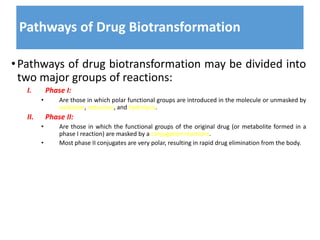
•Pathways of drug biotransformation may be divided into
two major groups of reactions:
I. Phase I:
• Are those in which polar functional groups are introduced in the molecule or unmasked by
oxidation, reduction, and hydrolysis.
II. Phase II:
• Are those in which the functional groups of the original drug (or metabolite formed in a
phase I reaction) are masked by a conjugation reactions.
• Most phase II conjugates are very polar, resulting in rapid drug elimination from the body.
Pathways of Drug Biotransformation
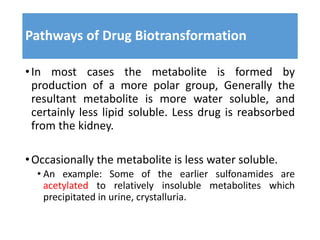
•In most cases the metabolite is formed by
production of a more polar group, Generally the
resultant metabolite is more water soluble, and
certainly less lipid soluble. Less drug is reabsorbed
from the kidney.
•Occasionally the metabolite is less water soluble.
• An example: Some of the earlier sulfonamides are
acetylated to relatively insoluble metabolites which
precipitated in urine, crystalluria.
Pathways of Drug Biotransformation
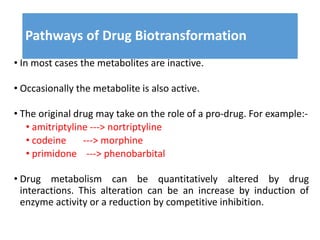
• In most cases the metabolites are inactive.
• Occasionally the metabolite is also active.
• The original drug may take on the role of a pro-drug. For example:-
• amitriptyline ---> nortriptyline
• codeine ---> morphine
• primidone ---> phenobarbital
• Drug metabolism can be quantitatively altered by drug
interactions. This alteration can be an increase by induction of
enzyme activity or a reduction by competitive inhibition.
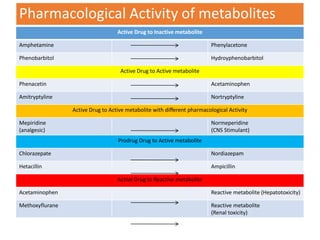
Pharmacological Activity of metabolites
Active Drug to Inactive metabolite
Amphetamine Phenylacetone
Phenobarbitol Hydroyphenobarbitol
Active Drug to Active metabolite
Phenacetin Acetaminophen
Amitryptyline Nortryptyline
Active Drug to Active metabolite with different pharmacological Activity
Mepiridine
(analgesic)
Normeperidine
(CNS Stimulant)
Prodrug Drug to Active metabolite
Chlorazepate Nordiazepam
Hetacillin Ampicillin
Active Drug to Reactive metabolite
Acetaminophen Reactive metabolite (Hepatotoxicity)
Methoxyflurane Reactive metabolite
(Renal toxicity)
First-Order Elimination
• The rate constant of elimination (k) is the sum of the first-order rate
constant for metabolism (km) and the first-order rate constant for
excretion (ke):
me kkk 
Renal Drug Excretion
• The kidneys represent about 0.5% of the total body weight and receive
approximately 20–25% of the cardiac output.
• Renal excretion is a major route of elimination for many drugs.
• Drugs that are nonvolatile, water soluble, have a low molecular weight (MW), or
are slowly biotransformed by the liver are eliminated by renal excretion.
• The processes by which a drug is excreted via the kidneys may include any
combination of the following:
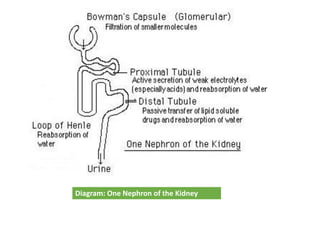
• Glomerular filtration.
• Active tubular secretion.
• Tubular reabsorption.
Diagram: One Nephron of the Kidney
Renal Drug Excretion
Glomerular Filtration:
• It is a passive process by which small molecules and drugs are
filtered through the glomerulus of the nephron.
• Drugs bound to plasma proteins are too large to be filtered at
the glomerulus.
• Drugs such inulin are not actively secreted or reabsorbed.
They are used to measure the glomerular filtration rate (GFR)
• Creatinine is used clinically to assess GFR
Renal Drug Excretion
Active Tubular Secretion
•It is carrier –mediated active transport system that
requires energy.
•Two Active tubular secretion pathways exist in the
kidney: one system for weak acids and one system
for weak bases.
Renal Drug Excretion
•Active tubular secretion shows competition effects.
• For example, probenecid (a weak acid) competes for the
same system as penicillin, decreasing the rate of penicillin
excretion.
Renal Drug Excretion
Tubular Reabsorption
•It is a passive process that follows Fick`s law of
diffusion.
•Lipid-soluble drugs are reabsorbed from the lumen
of the nephron back into the systemic circulation.
Renal Drug Excretion
•For weak electrolyte drugs, urine pH affect the ratio
of non-ionized and ionized drug:
a) If the drug exists primarily in the non-ionized or
lipid-soluble form, then it is reabsorbed more
easily from the lumen of the nephron.
b) If the drug exists primarily in the ionized or
water-soluble form, then it is excreted more
easily in urine.
Renal Drug Excretion
c) Depending on the pKa of the drug, alteration of the
urine pH alters the ratio of ionized to non-ionized drug
and affects the rate of drug excretion. For example,
alkalinization of the urine by the administration of
sodium bicarbonate increases the excretion of
salicylates (weak acid).
•An increase in urine flow caused by simultaneous
administration of a diuretic decrease the time for drug
reabsorption. Consequently more drug is excreted.
Renal Drug Excretion
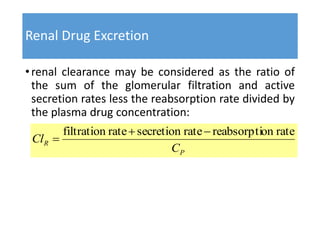
•renal clearance may be considered as the ratio of
the sum of the glomerular filtration and active
secretion rates less the reabsorption rate divided by
the plasma drug concentration:
P
R
C
Cl
rateonreabsorptiratesecretionratefiltration 

Drug Clearance
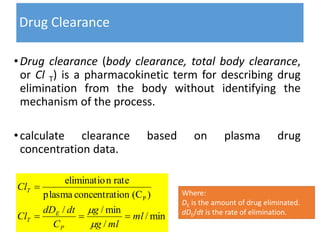
•Drug clearance (body clearance, total body clearance,
or Cl T) is a pharmacokinetic term for describing drug
elimination from the body without identifying the
mechanism of the process.
•calculate clearance based on plasma drug
concentration data.
min/
/
min//
)(Cionconcentratplasma
rateneliminatio
P
ml
mlg
g
C
dtdD
Cl
Cl
P
E
T
T




Where:
DE is the amount of drug eliminated.
dDE/dt is the rate of elimination.
Drug Clearance
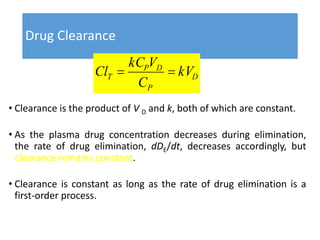
• Clearance is the product of V D and k, both of which are constant.
• As the plasma drug concentration decreases during elimination,
the rate of drug elimination, dDE/dt, decreases accordingly, but
clearance remains constant.
• Clearance is constant as long as the rate of drug elimination is a
first-order process.
D
P
DP
T kV
C
VkC
Cl 
Example
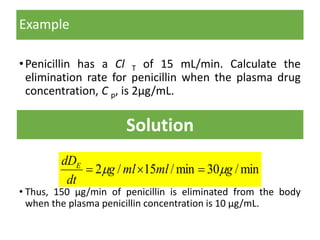
•Penicillin has a Cl T of 15 mL/min. Calculate the
elimination rate for penicillin when the plasma drug
concentration, C p, is 2μg/mL.
• Thus, 150 μg/min of penicillin is eliminated from the body
when the plasma penicillin concentration is 10 μg/mL.
Solution
min/30min/15/2 gmlmlg
dt
dDE
 
Drug Clearance
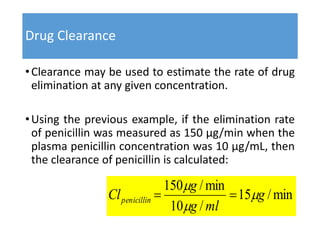
•Clearance may be used to estimate the rate of drug
elimination at any given concentration.
•Using the previous example, if the elimination rate
of penicillin was measured as 150 μg/min when the
plasma penicillin concentration was 10 μg/mL, then
the clearance of penicillin is calculated:
min/15
/10
min/150
g
mlg
g
Clpenicillin 



Drug Clearance
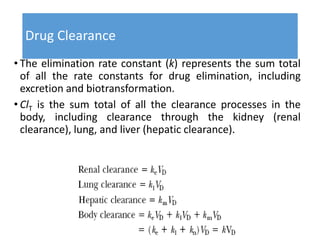
• The elimination rate constant (k) represents the sum total
of all the rate constants for drug elimination, including
excretion and biotransformation.
• ClT is the sum total of all the clearance processes in the
body, including clearance through the kidney (renal
clearance), lung, and liver (hepatic clearance).
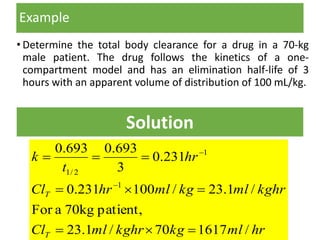
Example
• Determine the total body clearance for a drug in a 70-kg
male patient. The drug follows the kinetics of a one-
compartment model and has an elimination half-life of 3
hours with an apparent volume of distribution of 100 mL/kg.
Solution
hrmlkgkghrmlCl
kghrmlkgmlhrCl
hr
t
k
T
T
/161770/1.23
patient,70kgaFor
/1.23/100231.0
231.0
3
693.0693.0
1
1
2/1





Hepatic Clearance
•Hepatic clearance may be defined as the volume of
blood that perfuses the liver and is cleared of drug per
unit of time.
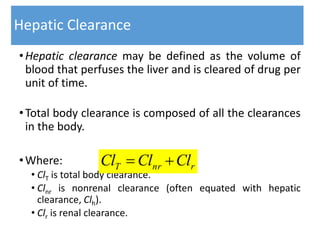
•Total body clearance is composed of all the clearances
in the body.
•Where:
• ClT is total body clearance.
• Clnr is nonrenal clearance (often equated with hepatic
clearance, Clh).
• Clr is renal clearance.
rnrT ClClCl 
Hepatic Clearance
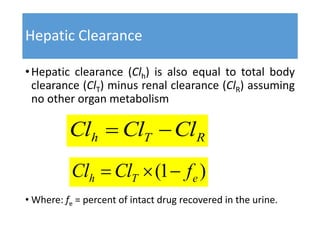
•Hepatic clearance (Clh) is also equal to total body
clearance (ClT) minus renal clearance (ClR) assuming
no other organ metabolism
• Where: fe = percent of intact drug recovered in the urine.
RTh ClClCl 
)1( eTh fClCl 
Hepatic Clearance
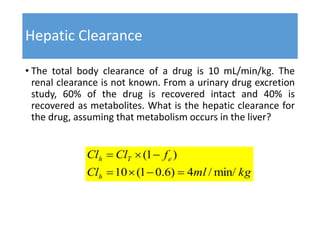
• The total body clearance of a drug is 10 mL/min/kg. The
renal clearance is not known. From a urinary drug excretion
study, 60% of the drug is recovered intact and 40% is
recovered as metabolites. What is the hepatic clearance for
the drug, assuming that metabolism occurs in the liver?
kgmlCl
fClCl
h
eTh
min//4)6.01(10
)1(


First-Pass Effects
•For some drugs, the route of administration affects
the metabolic rate of the compound.
•For example, a drug given parenterally,
transdermally, or by inhalation may distribute
within the body prior to metabolism by the liver.
•In contrast, drugs given orally are normally
absorbed in the duodenal segment of the small
intestine and transported via the mesenteric vessels
to the hepatic portal vein and then to the liver
before entering the systemic circulation.
First-Pass Effects
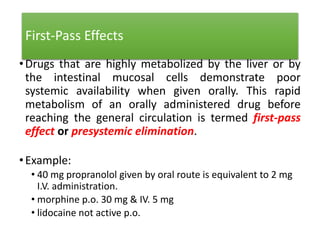
•Drugs that are highly metabolized by the liver or by
the intestinal mucosal cells demonstrate poor
systemic availability when given orally. This rapid
metabolism of an orally administered drug before
reaching the general circulation is termed first-pass
effect or presystemic elimination.
•Example:
• 40 mg propranolol given by oral route is equivalent to 2 mg
I.V. administration.
• morphine p.o. 30 mg & IV. 5 mg
• lidocaine not active p.o.
First-Pass Effects
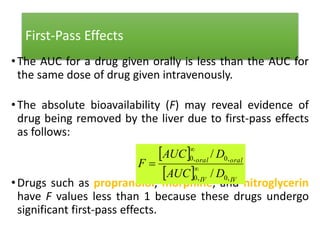
•The AUC for a drug given orally is less than the AUC for
the same dose of drug given intravenously.
•The absolute bioavailability (F) may reveal evidence of
drug being removed by the liver due to first-pass effects
as follows:
•Drugs such as propranolol, morphine, and nitroglycerin
have F values less than 1 because these drugs undergo
significant first-pass effects.
 
  IVIV
oraloral
DAUC
DAUC
F
,0,0
,0,0
/
/



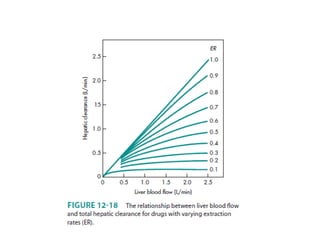
Physiologic/Organ Clearance
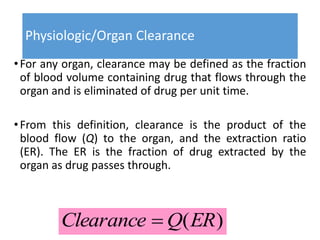
•For any organ, clearance may be defined as the fraction
of blood volume containing drug that flows through the
organ and is eliminated of drug per unit time.
•From this definition, clearance is the product of the
blood flow (Q) to the organ, and the extraction ratio
(ER). The ER is the fraction of drug extracted by the
organ as drug passes through.
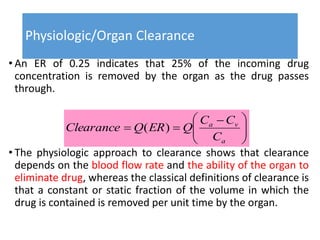
)(ERQClearance 
Physiologic/Organ Clearance
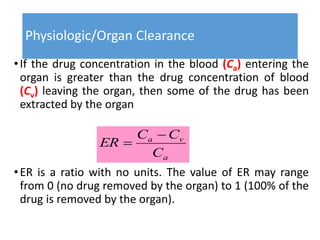
•If the drug concentration in the blood (Ca) entering the
organ is greater than the drug concentration of blood
(Cv) leaving the organ, then some of the drug has been
extracted by the organ
•ER is a ratio with no units. The value of ER may range
from 0 (no drug removed by the organ) to 1 (100% of the
drug is removed by the organ).
a
va
C
CC
ER


Physiologic/Organ Clearance
• An ER of 0.25 indicates that 25% of the incoming drug
concentration is removed by the organ as the drug passes
through.
• The physiologic approach to clearance shows that clearance
depends on the blood flow rate and the ability of the organ to
eliminate drug, whereas the classical definitions of clearance is
that a constant or static fraction of the volume in which the
drug is contained is removed per unit time by the organ.





 

a
va
C
CC
QERQClearance )(
Liver Extraction Ratio
• Because there are many other reasons for a drug to have a
reduced F value, the extent of first-pass effects is not very
precisely measured from the F value.
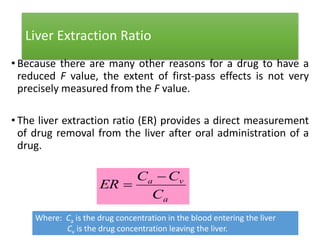
• The liver extraction ratio (ER) provides a direct measurement
of drug removal from the liver after oral administration of a
drug.
a
va
C
CC
ER


Where: Ca is the drug concentration in the blood entering the liver
Cv is the drug concentration leaving the liver.
Liver Extraction Ratio
•Because Ca is usually greater than Cv, ER is usually
less than 1.
•For example, for propranolol, ER or [E] is about
0.7—that is, about 70% of the drug is actually
removed by the liver before it is available for
general distribution to the body.
•By contrast, if the drug is injected intravenously,
most of the drug would be distributed before
reaching the liver, and less of the drug would be
metabolized.
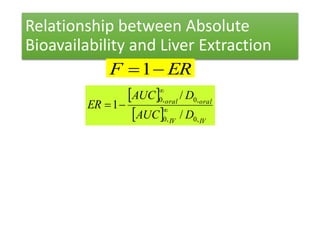
Relationship between Absolute
Bioavailability and Liver Extraction
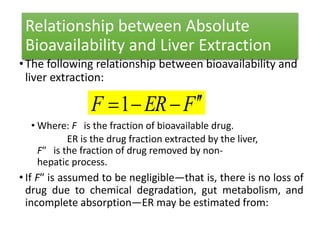
•The following relationship between bioavailability and
liver extraction:
• Where: F is the fraction of bioavailable drug.
ER is the drug fraction extracted by the liver,
F″ is the fraction of drug removed by non-
hepatic process.
• If F″ is assumed to be negligible—that is, there is no loss of
drug due to chemical degradation, gut metabolism, and
incomplete absorption—ER may be estimated from:
FERF 1
Relationship between Absolute
Bioavailability and Liver Extraction
ERF 1
 
  IVIV
oraloral
DAUC
DAUC
ER
,0,0
,0,0
/
/
1 


Estimation of Reduced Bioavailability Due to
Liver Metabolism and Variable Blood Flow
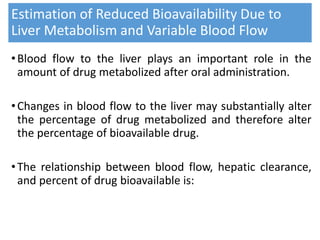
•Blood flow to the liver plays an important role in the
amount of drug metabolized after oral administration.
•Changes in blood flow to the liver may substantially alter
the percentage of drug metabolized and therefore alter
the percentage of bioavailable drug.
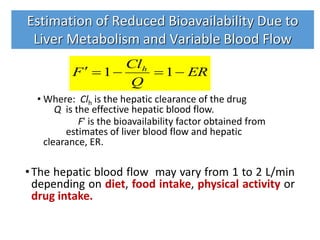
•The relationship between blood flow, hepatic clearance,
and percent of drug bioavailable is:
• Where: Clh is the hepatic clearance of the drug
Q is the effective hepatic blood flow.
F' is the bioavailability factor obtained from
estimates of liver blood flow and hepatic
clearance, ER.
•The hepatic blood flow may vary from 1 to 2 L/min
depending on diet, food intake, physical activity or
drug intake.
ER
Q
Cl
F h
 11
Estimation of Reduced Bioavailability Due to
Liver Metabolism and Variable Blood Flow
Estimation of Reduced Bioavailability Due to
Liver Metabolism and Variable Blood Flow
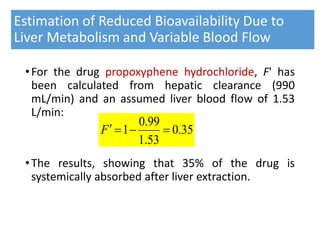
•For the drug propoxyphene hydrochloride, F' has
been calculated from hepatic clearance (990
mL/min) and an assumed liver blood flow of 1.53
L/min:
•The results, showing that 35% of the drug is
systemically absorbed after liver extraction.
35.0
53.1
99.0
1 F
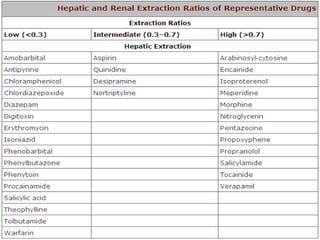
•first-pass effect is a very important consideration for
drugs that have a high extraction ratio.
•Drugs with low extraction ratios, such as theophylline,
have very little presystemic elimination, as
demonstrated by complete systemic absorption after
oral administration.
•In contrast, drugs with high extraction ratios have
poor bioavailability when given orally.
Estimation of Reduced Bioavailability Due to
Liver Metabolism and Variable Blood Flow
•Therefore, the oral dose must be higher than the
intravenous dose to achieve the same therapeutic
response.
•In some cases, oral administration of a drug with high
presystemic elimination, such as nitroglycerin, may be
impractical due to very poor oral bioavailability, and
thus a sublingual, transdermal, or nasal route of
administration may be preferred.
Estimation of Reduced Bioavailability Due to
Liver Metabolism and Variable Blood Flow
•To overcome first-pass effect, the route of
administration of the drug may be changed.
• For example, nitroglycerin may be given sublingually or
topically, and xylocaine may be given parenterally to avoid
the first-pass effects.
•Another way to overcome first-pass effects is to either
enlarge the dose or change the drug product to a
more rapidly absorbable dosage form.
Estimation of Reduced Bioavailability Due to
Liver Metabolism and Variable Blood Flow
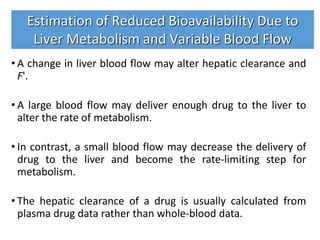
• A change in liver blood flow may alter hepatic clearance and
F'.
• A large blood flow may deliver enough drug to the liver to
alter the rate of metabolism.
• In contrast, a small blood flow may decrease the delivery of
drug to the liver and become the rate-limiting step for
metabolism.
• The hepatic clearance of a drug is usually calculated from
plasma drug data rather than whole-blood data.
Estimation of Reduced Bioavailability Due to
Liver Metabolism and Variable Blood Flow
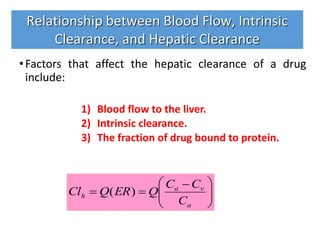
•Factors that affect the hepatic clearance of a drug
include:
1) Blood flow to the liver.
2) Intrinsic clearance.
3) The fraction of drug bound to protein.
Relationship between Blood Flow, Intrinsic
Clearance, and Hepatic Clearance





 

a
va
h
C
CC
QERQCl )(
•An increase in blood flow to the liver will increase
the rate of drug removal by the organ.
•Propranolol, a β-adrenergic blocking agent,
decreases hepatic blood flow by decreasing cardiac
output. In such a case, the drug decreases its own
clearance through the liver when given orally.
Relationship between Blood Flow, Intrinsic
Clearance, and Hepatic Clearance
• Intrinsic clearance (Clint) describes the total ability of the liver to
metabolize a drug independently of blood flow.
• Intrinsic drug clearance primarily occurs because of inherent ability
of the biotransformation enzymes (mixed-function oxidases) to
metabolized the drug as it enters the liver.
• Levels of these enzymes are increased by various drugs (e.g,
phenobarbital) and environmental agents (e.g, tobacco smoke).
• These enzymes are inhibited by other drugs and environmental
agents (e.g, cimetidine, acute lead poisoning)
Relationship between Blood Flow, Intrinsic
Clearance, and Hepatic Clearance
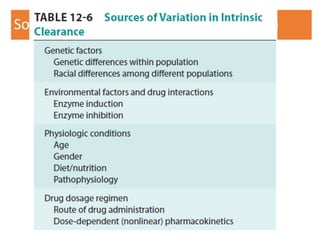
Sources of variation in intrinsic clearance
• Genetic factors.
• Genetic differences within population.
• Racial differences among different population.
• Environmental factors and drug interactions:
• Enzyme induction.
• Enzyme inhibition.
• Physiological conditions:
• Age.
• Gender.
• Diet / Nutrition.
• Pathophysiology.
• Drug dosage regimen.
• Route of drug administration.
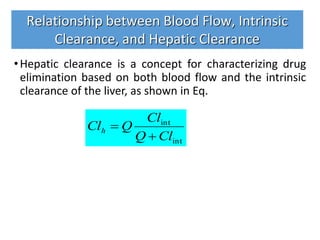
•Hepatic clearance is a concept for characterizing drug
elimination based on both blood flow and the intrinsic
clearance of the liver, as shown in Eq.
Relationship between Blood Flow, Intrinsic
Clearance, and Hepatic Clearance
int
int
ClQ
Cl
QClh


Relationship between Blood Flow, Intrinsic
Clearance, and Hepatic Clearance
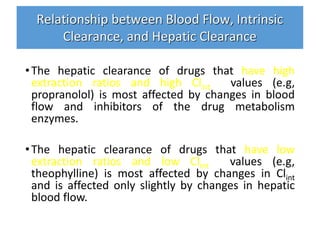
•The hepatic clearance of drugs that have high
extraction ratios and high Clint values (e.g,
propranolol) is most affected by changes in blood
flow and inhibitors of the drug metabolism
enzymes.
•The hepatic clearance of drugs that have low
extraction ratios and low Clint values (e.g,
theophylline) is most affected by changes in Clint
and is affected only slightly by changes in hepatic
blood flow.
Biliary Drug Excretion
•Biliary drug excretion, an active transport process, is
also included in hepatic clearance.
•Separate active secretion systems exist for weak acids
and weak bases.
•Drugs that are excreted in bile are usually high-
molecular- weight compounds(i.e., M. wt . More than
500) or polar drugs, such as reserpine, digoxin, and
various glucuronide conjugates.
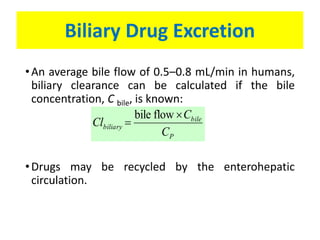
Biliary Drug Excretion
•An average bile flow of 0.5–0.8 mL/min in humans,
biliary clearance can be calculated if the bile
concentration, C bile, is known:
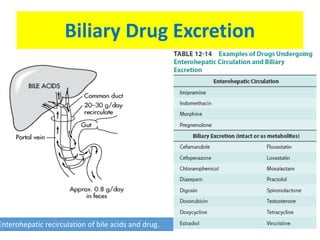
•Drugs may be recycled by the enterohepatic
circulation.
P
bile
biliary
C
C
Cl


flowbile
Biliary Drug Excretion
Enterohepatic recirculation of bile acids and drug.
Biliary Drug Excretion
• Some drugs are absorbed from GIT through the mesenteric
and hepatic portal veins, proceeding to the liver.
• The liver may secrete some of the drug (unchanged or as a
glucuronide metabolite) into the bile.
• From the bile (stored in the gallbladder), the drug may
empty into the GIT through the bile duct.
• if the drug is a glucuronide metabolite, bacteria in the GIT
may hydrolyze the glucronide moiety, allowing the released
drug to be reabsorbed.
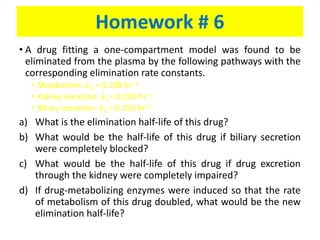
Homework # 6
• A drug fitting a one-compartment model was found to be
eliminated from the plasma by the following pathways with the
corresponding elimination rate constants.
• Metabolism: km = 0.200 hr–1
• Kidney excretion: ke = 0.250 hr–1
• Biliary excretion: kb = 0.150 hr–1
a) What is the elimination half-life of this drug?
b) What would be the half-life of this drug if biliary secretion
were completely blocked?
c) What would be the half-life of this drug if drug excretion
through the kidney were completely impaired?
d) If drug-metabolizing enzymes were induced so that the rate
of metabolism of this drug doubled, what would be the new
elimination half-life?
• A new broad-spectrum antibiotic was administered by rapid
intravenous injection to a 50-kg woman at a dose of 3
mg/kg. The apparent volume of distribution of this drug was
equivalent to 5% of body weight. The elimination half-life for
this drug is 2 hours.
• a. If 90% of the unchanged drug was recovered in the urine,
what is the renal excretion rate constant?
• b. Which is more important for the elimination of this drug,
renal excretion or biotransformation? Why?
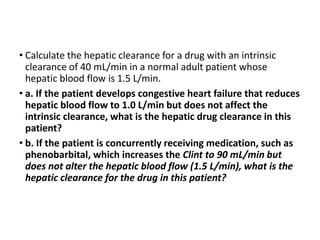
• Calculate the hepatic clearance for a drug with an intrinsic
clearance of 40 mL/min in a normal adult patient whose
hepatic blood flow is 1.5 L/min.
• a. If the patient develops congestive heart failure that reduces
hepatic blood flow to 1.0 L/min but does not affect the
intrinsic clearance, what is the hepatic drug clearance in this
patient?
• b. If the patient is concurrently receiving medication, such as
phenobarbital, which increases the Clint to 90 mL/min but
does not alter the hepatic blood flow (1.5 L/min), what is the
hepatic clearance for the drug in this patient?
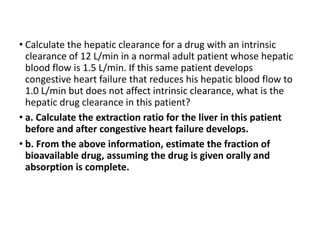
• Calculate the hepatic clearance for a drug with an intrinsic
clearance of 12 L/min in a normal adult patient whose hepatic
blood flow is 1.5 L/min. If this same patient develops
congestive heart failure that reduces his hepatic blood flow to
1.0 L/min but does not affect intrinsic clearance, what is the
hepatic drug clearance in this patient?
• a. Calculate the extraction ratio for the liver in this patient
before and after congestive heart failure develops.
• b. From the above information, estimate the fraction of
bioavailable drug, assuming the drug is given orally and
absorption is complete.
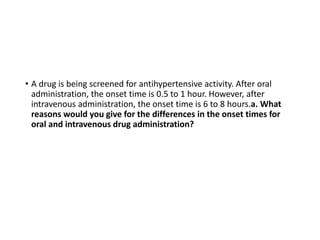
• A drug is being screened for antihypertensive activity. After oral
administration, the onset time is 0.5 to 1 hour. However, after
intravenous administration, the onset time is 6 to 8 hours.a. What
reasons would you give for the differences in the onset times for
oral and intravenous drug administration?
• The hepatic intrinsic clearance of two drugs are as follows:
• Drug A: 1300 mL/min
• Drug B: 26 mL/min
• Which drug is likely to show the greatest increase in hepatic
clearance when hepatic blood flow is increased from 1 L/min to 1.5
mL/min? Which drug will likely be blood-flow limited?