SUBSTANCE ABUSE
By
Dr.Fareed A. Minhas
Associate Professor
Rawalpindi Medical College
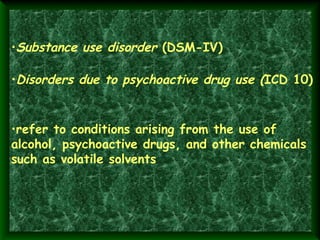
•Substance use disorder (DSM-IV)
•Disorders due to psychoactive drug use (ICD 10)

•refer to conditions arising from the use of
alcohol, psychoactive drugs, and other chemicals
such as volatile solvents
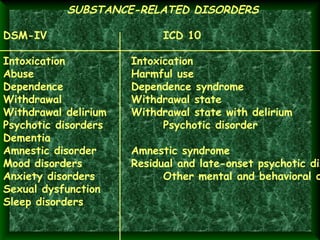
SUBSTANCE-RELATED DISORDERS
DSM-IV
Intoxication
Abuse
Dependence
Withdrawal
Withdrawal delirium
Psychotic disorders
Dementia
Amnestic disorder
Mood disorders
Anxiety disorders
Sexual dysfunction
Sleep disorders

ICD 10
Intoxication
Harmful use
Dependence syndrome
Withdrawal state
Withdrawal state with delirium
Psychotic disorder

Amnestic syndrome
Residual and late-onset psychotic dis
Other mental and behavioral d
DEFINITIONS
DRUG:
It is any substance which when taken into the living
organism, may modify one or more of its functions.
Originally  Plants, animals or minerals.
Synthetic drugs  Created artificially in lab by
combination of chemicals.
CHIEF EFFECT: of a drug is a Physical or mental change for
which it is taken.
SIDE EFFECT:
drug.

is a different or undesirable reaction to a

TOXIC DOSE:

is the dose taken in excess of the
therapeutic limit, which produces toxic
TOXIC DOSE:

is the dose taken in excess of the
therapeutic limit, which produces
toxic effects.

OVER DOSE:

is taking excess of a drug and may
cause shock, coma or death.

LETHAL DOSE: is taking enough of a drug to cause
death.
PRESCRIPTION DRUGS: are drugs taken from
the medical stores on doctors
written orders only.
OVER THE COUNTER DRUGS: can be obtained
without doctors order.
CROSS TOLERANCE: Occurs when one drug is taken and
results in tolerance not only to that drug
but also to another drug of the same or
unrelated group.
ESCALATION:

refers to a phenomenon when a person
taking so called softer drugs goes on to
harder drugs;

DETOXIFICATION: is the removal of all drugs from the
body.
REHABILITATION:

refers to the process of providing
vocational,
educational
and
social
services in conjunction with medical and
or psychological treatment with a view
of reintegrating him usefully in the
society.
ABSTINENCE OR WITHDRAWAL SYNDROME:
Signs and symptoms which develop on withdrawl of a drug or its
effects inherited by an antagonist.

SYMPTOMS:
are the subjective sensations a patient reports to the physician 


SIGNS:
are objective indicators of a disease and are perceptible to the
examining Physicians e.g. rapid pulse rate/respiratory rate etc.
LEGAL DRUGS:
are those that are considered useful and are designed to treat
various illnesses. They can be obtained as prescribed drugs or over
the counter.
ILLEGAL DRUGS:
are drugs forbidden by law, their harmful effects outweigh any useful
purpose. Their possession and sale is prohibited by law.
MEDICAL USE:
is the use of a drug with or without Medical Supervision, which is
indicated for generally accepted medical reasons.


NON-MEDICAL USE:
is the use of a drug, which is not indicated on generally accepted medical
grounds.
DRUG MISUSE:
medical or non-medical use of a drug for a disease state not considered
to be appropriate by medical science.
DRUG ABUSE:
persistent or sporadic excessive use of a drug inconsistent with, or
unrelated to acceptable medical practice. 
TOLERANCE:
is an adaptive state characterized by diminished responses to the same
quantity of a drug or by the fact that a larger dose is required to
produce same degree of pharmacodynamic effect.
DRUGS GENERALLY
ABUSED
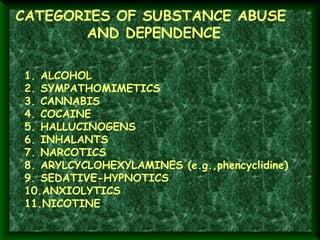
CATEGORIES OF SUBSTANCE ABUSE
AND DEPENDENCE
1. ALCOHOL
2. SYMPATHOMIMETICS
3. CANNABIS
4. COCAINE
5. HALLUCINOGENS
6. INHALANTS
7. NARCOTICS
8. ARYLCYCLOHEXYLAMINES (e.g.,phencyclidine)
9. SEDATIVE-HYPNOTICS
10.ANXIOLYTICS
11.NICOTINE
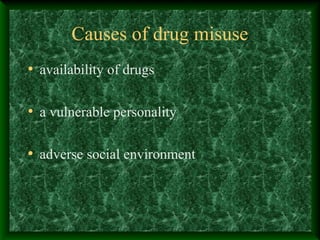
Causes of drug misuse
• availability of drugs
• a vulnerable personality
• adverse social environment
 I

OPIATES or (OPIOIDS)
Direct from opium poppy: Morphine & codeine.
Semi Synthetic:
Synthetic Subs:


Heroin or
diacetylmorphine.
methadone, meperidine
(Pethidine or Demerol)
Dipipanone, (diconal)
Dextromoramide.
Dihydrocodeine.
USES:
Pain relief, suppression of coughs, Treatment of
acute heart failure, symptomatic treatment of
diarrhea.

EFFECTS; 
Pleasant mood, euphoric detachment rather than
simply a dulled sedation.
WITHDRAWAL SYMPTOMS (MORPHINE TYPE)
 
Restlessness insomnia, Pain in muscles &
joints, running nose & eyes, Sweating,
abdominal Cramps, Vomiting & diarrhea,
Piloerection; dilated pupils, raised pulse rate
and disturbance of temperature control.
 
Begin about 6 hours after last dose; Peak 3648 hrs.
 
II

GENERAL DEPRESSANTS: 

·  Ability to suppress the activity of the brain leads to
sedation,Sleepiness and relief of anxiety.
·
  Includes: Alcohol, Barbiturates, Chloral, Paraldehyde
Chlormethiazole.
 
·Misconception: Can produce stimulation & excitement as
result of disinhibition.
Alcohol use history
• Typical days drinking. What time is the first
•
•
•
•
•

drink of the day?
When did daily drinking start?
Presence of withdrawal symptoms in
morning?
Previous attempts at treatment
Medical complications.
Patients attitude towards drinking
Approach to treatment of alcohol
misuse
•
•
•
•
•
•
•
•

Raise awareness of problem
Increase motivation to change
Withdraw alcohol( controlled drinking)
Support and advice
CBT ( social skills, relapse prevention)
Marital therapy
AA
Medication( disulfram)
Motivational interviewing
•
•
•
•
•

Express empathy
Avoid arguing
Detect and roll with resistance
Point out discrepancies in history
Raise awareness about contrast between
drug users aims and behavior
BARBITURATE TYPE:

 
Abrupt withdrawal is highly dangerous. May result in
a mental disorder, similar to alcohol withdrawal, may
lead to seizure & sometimes to death.
 
Withdrawal symptoms may not appear for several
days. Anxiety, restlessness, and disturbed sleep
anorexia, nausea.
 
May progress to vomiting hypotension, pyrexia,
tremulousness, Major Seizures, disorientation &
hallucinations.
III MINOR TRANQUILLIZERS:
(BENZODIAZIPINES)
 

Chlordiazepoxide (Librium), Diazepam (Valium),
Lorazepam (Ativan) Nitrazepam (Mogadon).
Cause:
Sedation, anxiety relief and Muscle relaxation.
IV

STIMULANTS:

Elevate mood, increase wakefulness, give an enhanced
sense of mental and physical energy.
Pleasurable stimulation & excitement potential of
misuse.
Cocaine, amphetamines, Synthetic (Phenmetrazine
diethylpropon). Khat, Caffeine. 
 
COCAINE:


Effects similar to these Amphetamines.
Strong Psychological dependence.
Excitation, dilated pupils, tremulousness.
Dizziness and sometimes convulsions.
Confusion, depression Paranoid Psychosis
Formication.
V

HALLUCINOGENS
(Psychedelics, or Psychotomimetics)

·  

Produce strange, intense, & transcendental effects,
which gives them ‘recreational’ popularity.

·        Peyote, mescaline, ‘Magic mushroom’ LSD:
acid diethyl-amide.
·        Do not give rise to dependence in true sense,
nonetheless use is intensely hazardous.

lysergic


HALLUCINOGENS:
Psychedelics  alteration in mood & perception.
Mental effects develop during 2 hours after LSD
consumption & generally last 8-14 hours.
Distortions, intensification of sensory perception.
Synaesthesia:
Confusion between sensory modalities.
Objects seem to be merged with one another.
Panic with fears of insanity.
 VI.  DRUGS NOT CONFORMING TO THE

GENERAL CLASSIFICATION

 
·       
 

CANNABIS:
Indian Hemp Plant. Active ingredient 9-delta,
tetrahydrocannabinol (TCH).
Actions of both general depressants &
hallucinogenic type.

NICOTINE:
·        Produces Complex effects. Has both stimulant
and Sedative properties.
 
·  

VOLATILE INHALANTS:
Industrial solvents, anesthetic gasses, glues,
lacquers, lighter fuels.

·        Produce rather mixed & complicated effects
including sedative, anesthetic & hallucinogenic
experiences.
 
OTHERS:
 
·        Phencyclidine angel dust:
·        Amyl nitrite.
·        “Designer drugs” North America. Synthetic
drugs mimicking properties of Known drugs,
but also display dangerous & new side effects.


SOLVENT ABUSE:
Psychological dependence.
Tolerance may develop.
Stimulation leads to depression.
Disorientation, hallucination.
Peripheral neuropathy can be fatal.
CANNABIS
• Effects vary with dose, persons expectation , mood, &
social setting.

Exaggerates Pre-existing mood: exhilaration, depression
or anxiety

• increased enjoyment of aesthetic experience & distortion
of time & space.

•  Reddening of the eyes dry mouth irritation of
respiratory treat & coughing.
CANNABIS
No definite withdrawal Syndrome.
No evidence of Tolerance. No serious side effects
amongst intermittent users.
 
No evidence of teratogenecity. Not safe in first
trimester.
 
Psychosis: disagreement.
 
Amotivational Syndrome: apathy & intolerance
objective study Beavburn & Knight: failed to demonstrate
this.
Campbell et al: reported such use may result in cerebral
atrophy.
Stages of change model
• Pre-contemplation Misuser does not believe there is a
•
•
•
•
•

problem, though others recognize it
Contemplation Individual weighs up pros and cons.
Considers that change might be necessary.
Decision Point reached where decision is made to act on
this issue.
Action User choose necessary strategy for change and
peruses this.
Maintenance Gains are maintained and consolidated.
Relapse Return to previous pattern of behavior.
PRINCIPLES OF TREATMENT
OF SUBSTANCE ABUSE
1. DETOXIFICATION
2. INSISTENCE ON ABSTINENCE
3. INVOLVEMENT OF FAMILY
4. TOXICOLOGY SCREENS (periodic urine screens are
often essential in identifying relapse and noncompliance)
5. SELF-HELP GROUPS
Some consequences of
intravenous drug misuse
• Local

- Vein thrombosis,Infection of
injection site, damage to arteries.

• Systemic - Bacterial endocarditis,
Hepatitis B & C, HIV infection
6. SANCTIONED TREATMENT
(patient forced to remain in therapy by a legal sanction
e.g. drivers/professional license)
7. CONTINGENCY CONTRACTING
(This approach provides a powerful negative contingency
for leaving treatment or relapsing or a positive
contingency for remaining drug-free. In the most widely
used contingency contracting, the patient agrees in
advance i.e. in writing that the therapist will notify an
employer or licensing body if relapse occurs. The
patient may leave a letter with the therapist outlining
the problem, which is to be mailed if a urine screen is
positive or the patient does not keep an appointment)

Drug dependence prof.fareed minhas

  • 1.
    SUBSTANCE ABUSE By Dr.Fareed A.Minhas Associate Professor Rawalpindi Medical College
  • 2.
    •Substance use disorder(DSM-IV) •Disorders due to psychoactive drug use (ICD 10) •refer to conditions arising from the use of alcohol, psychoactive drugs, and other chemicals such as volatile solvents
  • 3.
    SUBSTANCE-RELATED DISORDERS DSM-IV Intoxication Abuse Dependence Withdrawal Withdrawal delirium Psychoticdisorders Dementia Amnestic disorder Mood disorders Anxiety disorders Sexual dysfunction Sleep disorders ICD 10 Intoxication Harmful use Dependence syndrome Withdrawal state Withdrawal state with delirium Psychotic disorder Amnestic syndrome Residual and late-onset psychotic dis Other mental and behavioral d
  • 4.
  • 5.
    DRUG: It is anysubstance which when taken into the living organism, may modify one or more of its functions. Originally  Plants, animals or minerals. Synthetic drugs  Created artificially in lab by combination of chemicals. CHIEF EFFECT: of a drug is a Physical or mental change for which it is taken. SIDE EFFECT: drug. is a different or undesirable reaction to a TOXIC DOSE: is the dose taken in excess of the therapeutic limit, which produces toxic
  • 6.
    TOXIC DOSE: is thedose taken in excess of the therapeutic limit, which produces toxic effects. OVER DOSE: is taking excess of a drug and may cause shock, coma or death. LETHAL DOSE: is taking enough of a drug to cause death. PRESCRIPTION DRUGS: are drugs taken from the medical stores on doctors written orders only. OVER THE COUNTER DRUGS: can be obtained without doctors order.
  • 7.
    CROSS TOLERANCE: Occurswhen one drug is taken and results in tolerance not only to that drug but also to another drug of the same or unrelated group. ESCALATION: refers to a phenomenon when a person taking so called softer drugs goes on to harder drugs; DETOXIFICATION: is the removal of all drugs from the body. REHABILITATION: refers to the process of providing vocational, educational and social services in conjunction with medical and or psychological treatment with a view of reintegrating him usefully in the society.
  • 8.
    ABSTINENCE OR WITHDRAWALSYNDROME: Signs and symptoms which develop on withdrawl of a drug or its effects inherited by an antagonist. SYMPTOMS: are the subjective sensations a patient reports to the physician            SIGNS: are objective indicators of a disease and are perceptible to the examining Physicians e.g. rapid pulse rate/respiratory rate etc. LEGAL DRUGS: are those that are considered useful and are designed to treat various illnesses. They can be obtained as prescribed drugs or over the counter. ILLEGAL DRUGS: are drugs forbidden by law, their harmful effects outweigh any useful purpose. Their possession and sale is prohibited by law.
  • 9.
    MEDICAL USE: is theuse of a drug with or without Medical Supervision, which is indicated for generally accepted medical reasons.         NON-MEDICAL USE: is the use of a drug, which is not indicated on generally accepted medical grounds. DRUG MISUSE: medical or non-medical use of a drug for a disease state not considered to be appropriate by medical science. DRUG ABUSE: persistent or sporadic excessive use of a drug inconsistent with, or unrelated to acceptable medical practice.  TOLERANCE: is an adaptive state characterized by diminished responses to the same quantity of a drug or by the fact that a larger dose is required to produce same degree of pharmacodynamic effect.
  • 10.
  • 11.
    CATEGORIES OF SUBSTANCEABUSE AND DEPENDENCE 1. ALCOHOL 2. SYMPATHOMIMETICS 3. CANNABIS 4. COCAINE 5. HALLUCINOGENS 6. INHALANTS 7. NARCOTICS 8. ARYLCYCLOHEXYLAMINES (e.g.,phencyclidine) 9. SEDATIVE-HYPNOTICS 10.ANXIOLYTICS 11.NICOTINE
  • 12.
    Causes of drugmisuse • availability of drugs • a vulnerable personality • adverse social environment
  • 13.
     I OPIATES or (OPIOIDS) Directfrom opium poppy: Morphine & codeine. Semi Synthetic: Synthetic Subs:   Heroin or diacetylmorphine. methadone, meperidine (Pethidine or Demerol) Dipipanone, (diconal) Dextromoramide. Dihydrocodeine.
  • 14.
    USES: Pain relief, suppressionof coughs, Treatment of acute heart failure, symptomatic treatment of diarrhea. EFFECTS;  Pleasant mood, euphoric detachment rather than simply a dulled sedation.
  • 15.
    WITHDRAWAL SYMPTOMS (MORPHINETYPE)   Restlessness insomnia, Pain in muscles & joints, running nose & eyes, Sweating, abdominal Cramps, Vomiting & diarrhea, Piloerection; dilated pupils, raised pulse rate and disturbance of temperature control.   Begin about 6 hours after last dose; Peak 3648 hrs.  
  • 16.
    II GENERAL DEPRESSANTS:  ·  Ability tosuppress the activity of the brain leads to sedation,Sleepiness and relief of anxiety. ·   Includes: Alcohol, Barbiturates, Chloral, Paraldehyde Chlormethiazole.   ·Misconception: Can produce stimulation & excitement as result of disinhibition.
  • 17.
    Alcohol use history •Typical days drinking. What time is the first • • • • • drink of the day? When did daily drinking start? Presence of withdrawal symptoms in morning? Previous attempts at treatment Medical complications. Patients attitude towards drinking
  • 18.
    Approach to treatmentof alcohol misuse • • • • • • • • Raise awareness of problem Increase motivation to change Withdraw alcohol( controlled drinking) Support and advice CBT ( social skills, relapse prevention) Marital therapy AA Medication( disulfram)
  • 19.
    Motivational interviewing • • • • • Express empathy Avoidarguing Detect and roll with resistance Point out discrepancies in history Raise awareness about contrast between drug users aims and behavior
  • 20.
    BARBITURATE TYPE:   Abrupt withdrawalis highly dangerous. May result in a mental disorder, similar to alcohol withdrawal, may lead to seizure & sometimes to death.   Withdrawal symptoms may not appear for several days. Anxiety, restlessness, and disturbed sleep anorexia, nausea.   May progress to vomiting hypotension, pyrexia, tremulousness, Major Seizures, disorientation & hallucinations.
  • 21.
    III MINOR TRANQUILLIZERS: (BENZODIAZIPINES)   Chlordiazepoxide(Librium), Diazepam (Valium), Lorazepam (Ativan) Nitrazepam (Mogadon). Cause: Sedation, anxiety relief and Muscle relaxation.
  • 22.
    IV STIMULANTS: Elevate mood, increasewakefulness, give an enhanced sense of mental and physical energy. Pleasurable stimulation & excitement potential of misuse. Cocaine, amphetamines, Synthetic (Phenmetrazine diethylpropon). Khat, Caffeine.   
  • 23.
    COCAINE:       Effects similar tothese Amphetamines. Strong Psychological dependence. Excitation, dilated pupils, tremulousness. Dizziness and sometimes convulsions. Confusion, depression Paranoid Psychosis Formication.
  • 24.
    V HALLUCINOGENS (Psychedelics, or Psychotomimetics) ·   Producestrange, intense, & transcendental effects, which gives them ‘recreational’ popularity. ·        Peyote, mescaline, ‘Magic mushroom’ LSD: acid diethyl-amide. ·        Do not give rise to dependence in true sense, nonetheless use is intensely hazardous. lysergic
  • 25.
          HALLUCINOGENS: Psychedelics  alterationin mood & perception. Mental effects develop during 2 hours after LSD consumption & generally last 8-14 hours. Distortions, intensification of sensory perception. Synaesthesia: Confusion between sensory modalities. Objects seem to be merged with one another. Panic with fears of insanity.
  • 26.
     VI.  DRUGS NOT CONFORMINGTO THE GENERAL CLASSIFICATION   ·          CANNABIS: Indian Hemp Plant. Active ingredient 9-delta, tetrahydrocannabinol (TCH). Actions of both general depressants & hallucinogenic type. NICOTINE: ·        Produces Complex effects. Has both stimulant and Sedative properties.
  • 27.
      ·   VOLATILE INHALANTS: Industrial solvents,anesthetic gasses, glues, lacquers, lighter fuels. ·        Produce rather mixed & complicated effects including sedative, anesthetic & hallucinogenic experiences.   OTHERS:   ·        Phencyclidine angel dust: ·        Amyl nitrite. ·        “Designer drugs” North America. Synthetic drugs mimicking properties of Known drugs, but also display dangerous & new side effects.  
  • 28.
      SOLVENT ABUSE: Psychological dependence. Tolerancemay develop. Stimulation leads to depression. Disorientation, hallucination. Peripheral neuropathy can be fatal.
  • 29.
    CANNABIS • Effects varywith dose, persons expectation , mood, & social setting. Exaggerates Pre-existing mood: exhilaration, depression or anxiety • increased enjoyment of aesthetic experience & distortion of time & space. •  Reddening of the eyes dry mouth irritation of respiratory treat & coughing.
  • 30.
    CANNABIS No definite withdrawalSyndrome. No evidence of Tolerance. No serious side effects amongst intermittent users.   No evidence of teratogenecity. Not safe in first trimester.   Psychosis: disagreement.   Amotivational Syndrome: apathy & intolerance objective study Beavburn & Knight: failed to demonstrate this. Campbell et al: reported such use may result in cerebral atrophy.
  • 31.
    Stages of changemodel • Pre-contemplation Misuser does not believe there is a • • • • • problem, though others recognize it Contemplation Individual weighs up pros and cons. Considers that change might be necessary. Decision Point reached where decision is made to act on this issue. Action User choose necessary strategy for change and peruses this. Maintenance Gains are maintained and consolidated. Relapse Return to previous pattern of behavior.
  • 32.
    PRINCIPLES OF TREATMENT OFSUBSTANCE ABUSE 1. DETOXIFICATION 2. INSISTENCE ON ABSTINENCE 3. INVOLVEMENT OF FAMILY 4. TOXICOLOGY SCREENS (periodic urine screens are often essential in identifying relapse and noncompliance) 5. SELF-HELP GROUPS
  • 33.
    Some consequences of intravenousdrug misuse • Local - Vein thrombosis,Infection of injection site, damage to arteries. • Systemic - Bacterial endocarditis, Hepatitis B & C, HIV infection
  • 34.
    6. SANCTIONED TREATMENT (patientforced to remain in therapy by a legal sanction e.g. drivers/professional license) 7. CONTINGENCY CONTRACTING (This approach provides a powerful negative contingency for leaving treatment or relapsing or a positive contingency for remaining drug-free. In the most widely used contingency contracting, the patient agrees in advance i.e. in writing that the therapist will notify an employer or licensing body if relapse occurs. The patient may leave a letter with the therapist outlining the problem, which is to be mailed if a urine screen is positive or the patient does not keep an appointment)

Editor's Notes

  • #8 CROSS TOLEGRANCE:Occurs when one drug is taken and results in tolerance not only to that drug but also to another drug of the same or unrelated group.   ESCALATION:refers to a phenomenon when a person taking so called softer drugs goes on to harden drugs;   DETOXIFICATION:is the removal of all drugs from the body.
  • #9 CROSS TOLEGRANCE:Occurs when one drug is taken and results in tolerance not only to that drug but also to another drug of the same or unrelated group.   ESCALATION:refers to a phenomenon when a person taking so called softer drugs goes on to harden drugs;   DETOXIFICATION:is the removal of all drugs from the body.