Despite the seemingly tamed and glamorized
idea of drug use, it must be remembered that it
can still lead to ABUSE, ADDICTION, LEGAL
OFFENSES, SERIOUS HEALTHPROBLEMS, and
even DEATH.
We must understand that there is no way to
predict the effect that a drug can have on a
person, especially if it is the first time they try it,
and even regardless of dose and amount.
Given that each person’s brain and body
chemistry are different, each person would
also have a different tolerance for drugs.
Drug s
Drugs are chemicals that affect a person
in such a way as to bring about
physiological, emotional, or behavioral
change.
‘Dangerous drugs’ are those that have
high tendency for abuse and
dependency, these substances may be
organic or synthetic, and pose harm to
those who use them.
Drug Abuse
Drug abuse exists when a person
continually uses a drug other
than its intended purpose. This
continued use can lead to drug
dependence, a state of physical
and psychological dependence
or both on a dangerous drug.
Drug Addictio n
Drug addiction is a complex, and
often chronic, brain disease. It is
characterized by excessive drug
craving, seeking, and use.
Addiction is caused by brain
changes caused by constant drug
use.
De pe nde ncy
This is the state of physical and
psychological dependence, or both, on a
dangerous drug, or drugs, experienced
by a person following the use of that
substance on a periodic or continuous
basis. A person dependent on drugs will
experience withdrawal reactions (also
known as “cold turkey”, symptoms that
occur after long-term use of a drug is
reduced or stopped abruptly) after
abstaining from drugs.
Drug Abuse: By the Numbers
Estimated Drug Users
in the Philippines:
1.7 Million
Profile of Drug Users
Mean Age: 28 years old
Ratio of Male is to Female Users: 10:1
Civil Status: Single (58.21%)
Employment Status: Unemployed
Educational Attainment: High School Level
Average Monthly Household Income: Php
16,290.80
Residence: Urban Areas
Duration of Drug Use:
More than 6 years
Nature of Drug Use:
Polydrug-use
Commonly Abused Substances:
(1)Methamphetamine Hydrochloride
(Shabu)
(2) Cannabis (Marijuana)
(3) Inhalants (Contact Cement)
MOST COMMONLY
ABUSED DRUGS
AND THEIR ILL
EFFECTS
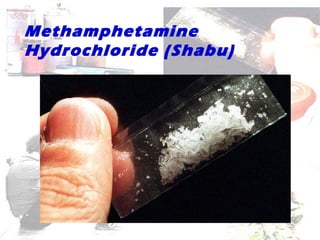
Methamphetamine
Hydrochloride (Shabu)
Methamphetamine hydrochloride is found
to have harmful effects to the brain. It
changes how the brain functions. Studies
have shown that methamphetamine
abusers have reduced motor skills and
impaired verbal learning as a result of
alterations in the activity of the dopamine,
a neurotransmitter involved in reward,
motivation, experience of pleasure and
motor function.
Street names:
shabs, ice, meth, crystal, kristal, basura,
tawas, bato
Other adverse effects of methamphetamine:
Severe dental problems (“meth
mouth”)
Anxiety
Confusion
Insomnia
Mood Disturbances
Violent behavior
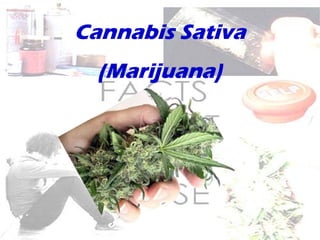
Cannabis Sativa
(Marijuana)
Marijuana use impairs a person's ability to form
new memories and to shift focus. Its active
component, tetrahydrocannabinol (THC) also
disrupts coordination and balance, posture, and
reaction time (experience commonly referred to
as “spacing out”). Thus, chronic marijuana use
significantly reduces a person’s capacity to learn,
carry-out complicated tasks, participate in sports,
driving and operating other machineries. Studies
also show that marijuana use can lead to lung
cancer and other problems in the respiratory and
immune systems.
Street names: weed, jutes, pot, grass, damo,
chongke
Health problems that come with the use of
marijuana include:
Problems with memory and learning
Distorted perception(sights, sounds,
time, touch)
Trouble with thinking and problem
solving
Loss of motor coordination
Increased heart rate and palpitations
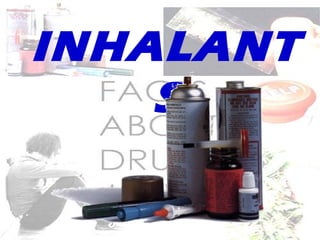
INHALANT
S
The effects of inhalants are
similar to that of alcohol,
including slurred speech, lack of
coordination, euphoria and
dizziness. Inhalant abusers may
also experience
lightheadedness, hallucinations,
and delusions.
Harmful irreversible effects of inhalants
include:
Hearing loss
Limb spasms
Central nervous system or
brain damage
Bone marrow damage
SIGNS OF DRUG ABUSE
The following are common signs of
drug revealed by individual using
drugs. While not all of these signs
mean that one person is involved in
drugs and there could be some
other physical or emotional problem
that is causing these behaviors,
there is high chance that drug use
may be a possibility:
declining interest in school or work
suddenly changes friends (hangs out with
individuals known for their drug use)
becomes pessimistic, irritable and anxious all
the time
asks to be left alone a lot
is always tired (or makes it as an excuse to
be left alone)
becomes careless and often becomes
involved in accidents
becomes implicated in a lot of fights
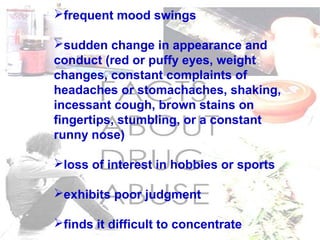
frequent mood swings
sudden change in appearance and
conduct (red or puffy eyes, weight
changes, constant complaints of
headaches or stomachaches, shaking,
incessant cough, brown stains on
fingertips, stumbling, or a constant
runny nose)
loss of interest in hobbies or sports
exhibits poor judgment
finds it difficult to concentrate
DRUG ABUSE PREVENTION PRESENTATION

DRUG ABUSE PREVENTION PRESENTATION

  • 2.
    Despite the seeminglytamed and glamorized idea of drug use, it must be remembered that it can still lead to ABUSE, ADDICTION, LEGAL OFFENSES, SERIOUS HEALTHPROBLEMS, and even DEATH. We must understand that there is no way to predict the effect that a drug can have on a person, especially if it is the first time they try it, and even regardless of dose and amount. Given that each person’s brain and body chemistry are different, each person would also have a different tolerance for drugs.
  • 3.
    Drug s Drugs arechemicals that affect a person in such a way as to bring about physiological, emotional, or behavioral change. ‘Dangerous drugs’ are those that have high tendency for abuse and dependency, these substances may be organic or synthetic, and pose harm to those who use them.
  • 4.
    Drug Abuse Drug abuseexists when a person continually uses a drug other than its intended purpose. This continued use can lead to drug dependence, a state of physical and psychological dependence or both on a dangerous drug.
  • 5.
    Drug Addictio n Drugaddiction is a complex, and often chronic, brain disease. It is characterized by excessive drug craving, seeking, and use. Addiction is caused by brain changes caused by constant drug use.
  • 6.
    De pe ndency This is the state of physical and psychological dependence, or both, on a dangerous drug, or drugs, experienced by a person following the use of that substance on a periodic or continuous basis. A person dependent on drugs will experience withdrawal reactions (also known as “cold turkey”, symptoms that occur after long-term use of a drug is reduced or stopped abruptly) after abstaining from drugs.
  • 7.
    Drug Abuse: Bythe Numbers Estimated Drug Users in the Philippines: 1.7 Million
  • 8.
    Profile of DrugUsers Mean Age: 28 years old Ratio of Male is to Female Users: 10:1 Civil Status: Single (58.21%) Employment Status: Unemployed Educational Attainment: High School Level Average Monthly Household Income: Php 16,290.80 Residence: Urban Areas
  • 9.
    Duration of DrugUse: More than 6 years
  • 10.
    Nature of DrugUse: Polydrug-use
  • 11.
    Commonly Abused Substances: (1)MethamphetamineHydrochloride (Shabu) (2) Cannabis (Marijuana) (3) Inhalants (Contact Cement)
  • 12.
  • 13.
  • 14.
    Methamphetamine hydrochloride isfound to have harmful effects to the brain. It changes how the brain functions. Studies have shown that methamphetamine abusers have reduced motor skills and impaired verbal learning as a result of alterations in the activity of the dopamine, a neurotransmitter involved in reward, motivation, experience of pleasure and motor function. Street names: shabs, ice, meth, crystal, kristal, basura, tawas, bato
  • 15.
    Other adverse effectsof methamphetamine: Severe dental problems (“meth mouth”) Anxiety Confusion Insomnia Mood Disturbances Violent behavior
  • 16.
  • 17.
    Marijuana use impairsa person's ability to form new memories and to shift focus. Its active component, tetrahydrocannabinol (THC) also disrupts coordination and balance, posture, and reaction time (experience commonly referred to as “spacing out”). Thus, chronic marijuana use significantly reduces a person’s capacity to learn, carry-out complicated tasks, participate in sports, driving and operating other machineries. Studies also show that marijuana use can lead to lung cancer and other problems in the respiratory and immune systems. Street names: weed, jutes, pot, grass, damo, chongke
  • 18.
    Health problems thatcome with the use of marijuana include: Problems with memory and learning Distorted perception(sights, sounds, time, touch) Trouble with thinking and problem solving Loss of motor coordination Increased heart rate and palpitations
  • 19.
  • 20.
    The effects ofinhalants are similar to that of alcohol, including slurred speech, lack of coordination, euphoria and dizziness. Inhalant abusers may also experience lightheadedness, hallucinations, and delusions.
  • 21.
    Harmful irreversible effectsof inhalants include: Hearing loss Limb spasms Central nervous system or brain damage Bone marrow damage
  • 26.
  • 27.
    The following arecommon signs of drug revealed by individual using drugs. While not all of these signs mean that one person is involved in drugs and there could be some other physical or emotional problem that is causing these behaviors, there is high chance that drug use may be a possibility:
  • 28.
    declining interest inschool or work suddenly changes friends (hangs out with individuals known for their drug use) becomes pessimistic, irritable and anxious all the time asks to be left alone a lot is always tired (or makes it as an excuse to be left alone) becomes careless and often becomes involved in accidents becomes implicated in a lot of fights
  • 29.
    frequent mood swings suddenchange in appearance and conduct (red or puffy eyes, weight changes, constant complaints of headaches or stomachaches, shaking, incessant cough, brown stains on fingertips, stumbling, or a constant runny nose) loss of interest in hobbies or sports exhibits poor judgment finds it difficult to concentrate