STATISTICS OF DRUG USERS:
Have you heared
the word drugs?
DRUGS
-is a substance used as medication(webster)
-a chemical substance that can change how
your body and mind work(medlineplus)
-drugs(psychoactive)
substance that can affect mental process
(who)
DRUG USE:
-Refers to the activity of taking drugs into
the body by way of inhaling, injecting,
smoking, consuming, absorbing via patch
on the skin or under the tongue.
-Some are medicines that help people when
doctors prescribed them
Drugs misuse
-Drug misuse is generally associated with
prescription medicines, meant to be taken as
directed by doctors.
Examples of drug misuse
 Taking the incorrect dose
 Taking the drug at the wrong time
 Forgetting to take a dose
 Stopping the use of a drug too soon
 Taking a drug for reasons other than why they were
prescribed
 Taking a drug that was not prescribed to you
Drug addiction
Drug addiction is a chronic brain disease. It
causes a person to take drugs repeatedly,
despite the harm they cause.
-Refers to the activity of using legal or
illegal substances in prohibited ways for the
purpose of creating pleasure effects on the
brain.
How is drug misuse different from
drug abuse?
 The key difference between a person
who misuses drugs and a person who
abuses drugs is their intent
 The former takes a drug to treat a
specific ailment, whereas the latter uses
a drug to elicit/stimulate certain
feelings.
How do you get help for drug misuse,
abuse, and addiction?
Drug misuse-
-simple reprimand may help remedy the
issue
Drug abuse-
-honest conversation about drug abuse and
its consequences can inspire a person to
change since they still have control over their
behavior
Drug addiction
-willpower is not enough to change the behavior of
a person with a drug addiction
-their bodies are already chemically dependent on
a substance, they would need pharmacotherapy
-process usually starts with a medically supervised
detoxification period to manage the symptoms of
drug withdrawal
-A mental health professional then works with the
patient to tailor a recovery plan toward sobriety
-rehabilitation
7 categories of drugs
1. Central Nervous System (CNS) Depressants
CNS depressants slow down the operations of
the brain and the body. Examples of CNS
depressants include alcohol, barbiturates,
anti-anxiety tranquilizers
7 categories of drugs
3. Hallucinogens
Hallucinogens cause
the user to perceive
things differently than
they actually are.
Examples include LSD,
(Ecstasy).
7 categories of drugs
4. Dissociative Anesthetics
Dissociative anesthetics include drugs
that inhibit pain by cutting off or
dissociating the brain's perception of
the pain. PCP, its analogs, and
dextromethoraphan are examples of
dissociative anesthetics.
7 categories of drugs
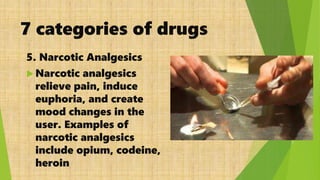
5. Narcotic Analgesics
 Narcotic analgesics
relieve pain, induce
euphoria, and create
mood changes in the
user. Examples of
narcotic analgesics
include opium, codeine,
heroin
7 categories of drugs
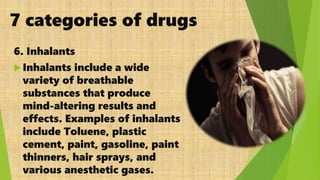
6. Inhalants
 Inhalants include a wide
variety of breathable
substances that produce
mind-altering results and
effects. Examples of inhalants
include Toluene, plastic
cement, paint, gasoline, paint
thinners, hair sprays, and
various anesthetic gases.
7 categories of drugs
7. Cannabis
 Cannabis is the scientific
name for marijuana. The
active ingredient in
cannabis is delta-9
tetrahydrocannabinol, or
THC. This category
includes cannabinoids and
synthetics like Dronabinol.
Any
questions?
DRUGS2K22 .pptx

DRUGS2K22 .pptx

  • 2.
  • 3.
  • 4.
    DRUGS -is a substanceused as medication(webster) -a chemical substance that can change how your body and mind work(medlineplus) -drugs(psychoactive) substance that can affect mental process (who)
  • 5.
    DRUG USE: -Refers tothe activity of taking drugs into the body by way of inhaling, injecting, smoking, consuming, absorbing via patch on the skin or under the tongue. -Some are medicines that help people when doctors prescribed them
  • 6.
    Drugs misuse -Drug misuseis generally associated with prescription medicines, meant to be taken as directed by doctors.
  • 7.
    Examples of drugmisuse  Taking the incorrect dose  Taking the drug at the wrong time  Forgetting to take a dose  Stopping the use of a drug too soon  Taking a drug for reasons other than why they were prescribed  Taking a drug that was not prescribed to you
  • 8.
    Drug addiction Drug addictionis a chronic brain disease. It causes a person to take drugs repeatedly, despite the harm they cause. -Refers to the activity of using legal or illegal substances in prohibited ways for the purpose of creating pleasure effects on the brain.
  • 9.
    How is drugmisuse different from drug abuse?  The key difference between a person who misuses drugs and a person who abuses drugs is their intent  The former takes a drug to treat a specific ailment, whereas the latter uses a drug to elicit/stimulate certain feelings.
  • 10.
    How do youget help for drug misuse, abuse, and addiction? Drug misuse- -simple reprimand may help remedy the issue Drug abuse- -honest conversation about drug abuse and its consequences can inspire a person to change since they still have control over their behavior
  • 11.
    Drug addiction -willpower isnot enough to change the behavior of a person with a drug addiction -their bodies are already chemically dependent on a substance, they would need pharmacotherapy -process usually starts with a medically supervised detoxification period to manage the symptoms of drug withdrawal -A mental health professional then works with the patient to tailor a recovery plan toward sobriety -rehabilitation
  • 12.
    7 categories ofdrugs 1. Central Nervous System (CNS) Depressants CNS depressants slow down the operations of the brain and the body. Examples of CNS depressants include alcohol, barbiturates, anti-anxiety tranquilizers
  • 13.
  • 14.
    7 categories ofdrugs 3. Hallucinogens Hallucinogens cause the user to perceive things differently than they actually are. Examples include LSD, (Ecstasy).
  • 15.
    7 categories ofdrugs 4. Dissociative Anesthetics Dissociative anesthetics include drugs that inhibit pain by cutting off or dissociating the brain's perception of the pain. PCP, its analogs, and dextromethoraphan are examples of dissociative anesthetics.
  • 16.
    7 categories ofdrugs 5. Narcotic Analgesics  Narcotic analgesics relieve pain, induce euphoria, and create mood changes in the user. Examples of narcotic analgesics include opium, codeine, heroin
  • 17.
    7 categories ofdrugs 6. Inhalants  Inhalants include a wide variety of breathable substances that produce mind-altering results and effects. Examples of inhalants include Toluene, plastic cement, paint, gasoline, paint thinners, hair sprays, and various anesthetic gases.
  • 18.
    7 categories ofdrugs 7. Cannabis  Cannabis is the scientific name for marijuana. The active ingredient in cannabis is delta-9 tetrahydrocannabinol, or THC. This category includes cannabinoids and synthetics like Dronabinol.
  • 19.