

OPIOID USE DISORDER
Mr.Visanth V S
Asso.Professor
IGSCON, Amethi
OPIOID USE DISORDER
• Dried exudates obtained from unripe seed capsules of
Papaver somniferum has been used and abused for
centuries.
• The natural alkaloids of opium and their synthetic
preparations are highly dependence.
• This group includes several narcotic substances like
opium, heroin, morphine, codeine, pethidine,
methadone, and pentazocine.
• Synthetic preparations are highly dependence
producing.
• These drugs are mainly used as an analgesic, but long
term use can produce dependency.
• The most important dependence producing derivatives are
morphine and heroin.
• They both like majority of dependence producing opioids
bind to μ (mu) opioid receptors.
• The other opioid receptors are k (kappa, e.g. for pentazocine),
δ (delta), σ (sigma, e.g. for phencyclidine), ε (epsilon) and λ
(lambda).
• Heroin or di-acetyl-morphine is about two times more potent
than morphine in injectable form.
• Apart from the parenteral mode of administration, heroin can
also be smoked or ‘chased’ ( chasing the dragon), often in an
impure form (called ‘ smack’ or ‘ brown sugar’ in India).
Contd…..
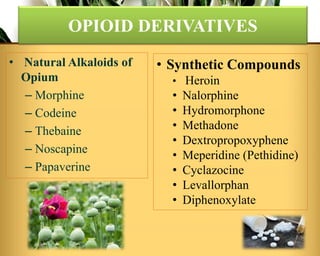
• Natural Alkaloids of
Opium
– Morphine
– Codeine
– Thebaine
– Noscapine
– Papaverine
OPIOID DERIVATIVES
• Synthetic Compounds
• Heroin
• Nalorphine
• Hydromorphone
• Methadone
• Dextropropoxyphene
• Meperidine (Pethidine)
• Cyclazocine
• Levallorphan
• Diphenoxylate
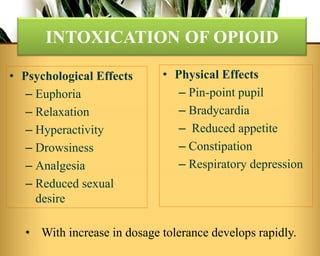
• Psychological Effects
– Euphoria
– Relaxation
– Hyperactivity
– Drowsiness
– Analgesia
– Reduced sexual
desire
INTOXICATION OF OPIOID
• Physical Effects
– Pin-point pupil
– Bradycardia
– Reduced appetite
– Constipation
– Respiratory depression
• With increase in dosage tolerance develops rapidly.
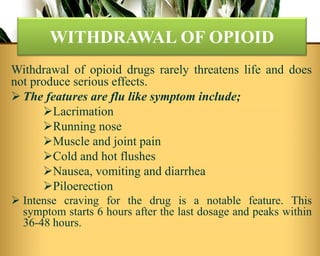
Withdrawal of opioid drugs rarely threatens life and does
not produce serious effects.
 The features are flu like symptom include;
Lacrimation
Running nose
Muscle and joint pain
Cold and hot flushes
Nausea, vomiting and diarrhea
Piloerection
 Intense craving for the drug is a notable feature. This
symptom starts 6 hours after the last dosage and peaks within
36-48 hours.
WITHDRAWAL OF OPIOID
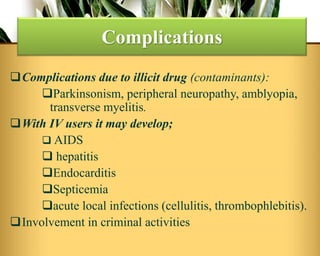
Complications due to illicit drug (contaminants):
Parkinsonism, peripheral neuropathy, amblyopia,
transverse myelitis.
With IV users it may develop;
 AIDS
 hepatitis
Endocarditis
Septicemia
acute local infections (cellulitis, thrombophlebitis).
Involvement in criminal activities
Complications
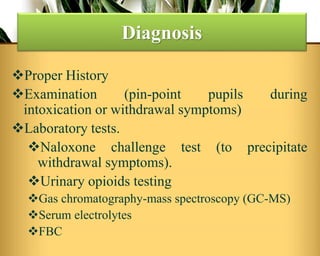
Proper History
Examination (pin-point pupils during
intoxication or withdrawal symptoms)
Laboratory tests.
Naloxone challenge test (to precipitate
withdrawal symptoms).
Urinary opioids testing
Gas chromatography-mass spectroscopy (GC-MS)
Serum electrolytes
FBC
Diagnosis
• Opioid overdose can be life threatening and needs
immediate management.
• Naloxone is the antidote used for the detoxification
of the opioid overdose.
• IV administration of 2mg Naloxone, followed by a
repeat injection in 5-10 minutes, due to its short half-
life repeated doses may be needed every 1-2 hours.
• Maintain patent airway
• Administer oxygen
• Administer IV fluids for the excretion of the drug
• Monitor vital signs
Treatment-Opioid Intoxication
• Symptomatic treatment is given
• Methadone, clonidine can be used for
maintenance
Treatment-Opioid Withdrawal
• Dietary management
• Treat complications
• Antidepressants can be used if the client
develops with depressive features
• Supportive psychotherapy
• Counseling
• Group therapy
• Family therapy
• Supportive groups
Other Treatment
This is a very important step in the post-
detoxification phase, in the absence of
which relapse rates can be very high.
Rehabilitation should be at both
occupational and social levels.
Psychosocial Rehabilitation
THANK YOU

Opioid use disorders- Psycho active substance abuse

  • 1.
    OPIOID USE DISORDER Mr.VisanthV S Asso.Professor IGSCON, Amethi
  • 2.
    OPIOID USE DISORDER •Dried exudates obtained from unripe seed capsules of Papaver somniferum has been used and abused for centuries. • The natural alkaloids of opium and their synthetic preparations are highly dependence. • This group includes several narcotic substances like opium, heroin, morphine, codeine, pethidine, methadone, and pentazocine. • Synthetic preparations are highly dependence producing. • These drugs are mainly used as an analgesic, but long term use can produce dependency.
  • 3.
    • The mostimportant dependence producing derivatives are morphine and heroin. • They both like majority of dependence producing opioids bind to μ (mu) opioid receptors. • The other opioid receptors are k (kappa, e.g. for pentazocine), δ (delta), σ (sigma, e.g. for phencyclidine), ε (epsilon) and λ (lambda). • Heroin or di-acetyl-morphine is about two times more potent than morphine in injectable form. • Apart from the parenteral mode of administration, heroin can also be smoked or ‘chased’ ( chasing the dragon), often in an impure form (called ‘ smack’ or ‘ brown sugar’ in India). Contd…..
  • 4.
    • Natural Alkaloidsof Opium – Morphine – Codeine – Thebaine – Noscapine – Papaverine OPIOID DERIVATIVES • Synthetic Compounds • Heroin • Nalorphine • Hydromorphone • Methadone • Dextropropoxyphene • Meperidine (Pethidine) • Cyclazocine • Levallorphan • Diphenoxylate
  • 5.
    • Psychological Effects –Euphoria – Relaxation – Hyperactivity – Drowsiness – Analgesia – Reduced sexual desire INTOXICATION OF OPIOID • Physical Effects – Pin-point pupil – Bradycardia – Reduced appetite – Constipation – Respiratory depression • With increase in dosage tolerance develops rapidly.
  • 6.
    Withdrawal of opioiddrugs rarely threatens life and does not produce serious effects.  The features are flu like symptom include; Lacrimation Running nose Muscle and joint pain Cold and hot flushes Nausea, vomiting and diarrhea Piloerection  Intense craving for the drug is a notable feature. This symptom starts 6 hours after the last dosage and peaks within 36-48 hours. WITHDRAWAL OF OPIOID
  • 7.
    Complications due toillicit drug (contaminants): Parkinsonism, peripheral neuropathy, amblyopia, transverse myelitis. With IV users it may develop;  AIDS  hepatitis Endocarditis Septicemia acute local infections (cellulitis, thrombophlebitis). Involvement in criminal activities Complications
  • 8.
    Proper History Examination (pin-pointpupils during intoxication or withdrawal symptoms) Laboratory tests. Naloxone challenge test (to precipitate withdrawal symptoms). Urinary opioids testing Gas chromatography-mass spectroscopy (GC-MS) Serum electrolytes FBC Diagnosis
  • 9.
    • Opioid overdosecan be life threatening and needs immediate management. • Naloxone is the antidote used for the detoxification of the opioid overdose. • IV administration of 2mg Naloxone, followed by a repeat injection in 5-10 minutes, due to its short half- life repeated doses may be needed every 1-2 hours. • Maintain patent airway • Administer oxygen • Administer IV fluids for the excretion of the drug • Monitor vital signs Treatment-Opioid Intoxication
  • 10.
    • Symptomatic treatmentis given • Methadone, clonidine can be used for maintenance Treatment-Opioid Withdrawal
  • 11.
    • Dietary management •Treat complications • Antidepressants can be used if the client develops with depressive features • Supportive psychotherapy • Counseling • Group therapy • Family therapy • Supportive groups Other Treatment
  • 12.
    This is avery important step in the post- detoxification phase, in the absence of which relapse rates can be very high. Rehabilitation should be at both occupational and social levels. Psychosocial Rehabilitation
  • 13.