Drowning and Near Drowning –
Pathophysiology & Management
Dr. Ipsita Mahapatra, PGT, Dept. of Pediatrics
Gauhati Medical College and Hospital
1. DEFINITION
• “A process resulting in primary respiratory impairment from
submersion/immersion in a liquid medium.”
- World Congress on Drowning (Amsterdam, 2002)
• Presence of a liquid/air interface at the entrance of the patient’s airway
• The term ‘drowning’ does not imply the final outcome – death or survival.
• The outcome should be denoted as fatal or non-fatal drowning.
Submersion
• Entire body to be covered in a liquid
medium
• Airway, in its entirety, is under the
liquid medium
Immersion
• A body part is covered in a liquid
medium; it does not require the entire
body to be underwater.
• Oral and nasal airways must be under
water or other liquid medium,
limiting the victim’s ability to breathe.
• The International Liaison Committee on Resuscitation (ILCOR), WHO and the
World Congress on Drowning recommends that ambiguous terms such as ‘dry
and wet drowning, active and passive drowning, near drowning, and
secondary drowning’ should no longer be used.
• Confusing and not clinically relevant.
• Simpler, more uniform “Utstein” style of terminology should be used.
• The Utstein approach to the evaluation of drowning victims standardizes
reporting and data collection and also provides guidance for the history,
physical examination, and appropriate management.
REVISED UTSTEIN
DROWNING DATA
COLLECTION FORM
TYPES OF DROWNING
These terminologies are no longer used.
 Near drowning : Survival of atleast 24 hours after an episode of suffocation
caused by submersion in a liquid medium.
 Wet vs dry drowning :
Dry-drowning is due to larynogospasm following a sudden immersion into water
which leads to asphyxia and subsequently, hypoxia. There is no collection of water
within the alveoli.
Wet-drowning is due to aspiration of more amount of liquid resulting in collection
of water within the alveoli.
 Fresh water vs salt water drowning :
There is no significant clinical difference between the two. Historically, it was felt
to affect electrolytes, cause fluid shifting and cause hemolysis.
Intravascular blood volume changes - atleast 11ml/kg of fluid
Electrolyte changes - atleast 22ml/kg of fluid
Most patients aspirate <4ml/kg of water
The distinction between salt water and fresh water drowning are no longer
considered significant.
 Secondary drowning : Any secondary condition (Heart disease, epilepsy,
alcohol use etc) leading to loss of consciousness in water, thereby, drowning.
2. STATISTICS AND GLOBAL IMPACT OF DROWNING
• Poorly studied and vastly underestimated. Deaths due to accidents are not
counted in drowning.
• Ranks as the third leading cause of unintentional injury deaths worldwide and in
South-east Asia, after road traffic injuries and falls. Majority of fatalities occur in
low- and middle- income countries.
• >50% of drowning cases occur in WHO Western Pacific and South-East Asia
regions.
• In India, majority of drowning cases are reported from
the states of Madhya Pradesh and Maharashtra.
• According to a December 2019 Lancet report on
estimates of ‘healthy life’ lost in India, the rate of years of
life lost (YLL) by drowning were highest in the central
states of Madhya Pradesh (MP), Maharashtra,
Chhattisgarh and NE state Assam.
3. EPIDEMIOLOGY
Drowning has one of the highest case
fatality rates and is in the top-10 causes of
death related to unintentional injuries for
all pediatric age groups.
 Highest rates of drowning deaths in 2
age groups : 1-4 years and 15-19 years
 Males > Females
Children < 1year
• Bathtub/household bucket
• Left alone or with an elder sibling without adult supervision.
Children 1-4 years
 Curious but unaware nature coupled with rapid progression of their physical
capabilities.
 Lack of adult supervision
 In affluent countries, drownings are reported in residential swimming pools.
 In rural areas, drownings reported in irrigation ditches, nearby ponds, rivers.
School age children
• Natural water bodies such as lakes, ponds, rivers and canals.
• Drowning cases are mostly due to swimming or boating activities in this
age group.
Adolescents
 90% of drowning cases occur in natural bodies of water
 Adolescent males >> females
 Due to greater risk-taking behaviour, alcohol use, less perception of risks
associated with drowning and greater confidence in their swimming
ability.
4. RISK FACTORS
 Males > Females
 Age < 14 years
 Low SE status and poor education
 Living in rural areas
 Epilepsy (15-19 times risk)
 Cardiac etiologies – arrythmias, myocarditis, prolonged QT syndromes (Cold water
may prolong the QT interval)
 Substance abuse/intoxication
 Attempted self harm
 Trauma
 Abuse (bath-tub related drownings)
5. PATHOPHYSIOLOGY
The primary physiologic effects of drowning are due to hypoxic-ischemic and
reperfusion injuries.
The “drowning process” is the stepwise progression of events leading to respiratory
failure, hypoxia, and death.
Initial struggle for 20-30 seconds (unable to call for help as breathing takes
priority)
Submersion (airway below the surface of water)
Panic, voluntary breath holding (60 seconds maximum).
Small amount of water aspirated triggering cough reflex and laryngospasm
Respiratory impairment leads to hypoxia, hypercarbia and acidosis
Arterial oxygen tension decreases, laryngospasm abates and more water is
aspirated
Cardiopulmonary arrest
By 3-4 minutes, myocardial hypoxia leads to abrupt circulatory failure.
Ineffective cardiac contractions with ineffective perfusion (Pulseless electrical
activity)
Progressively decreasing cardiac output and oxygen delivery to other organs
Terminal apnea due to profound hypoxia and medullary depression
Progressive decrease in SaO2, loss of consciousness from hypoxia
END ORGAN EFFECTS
• Pulmonary
Aspiration of 1-3 ml of liquid causes surfactant washout, increased capillary
endothelial permeability
Profound hypoxia, tachypnea, acid/base disturbances
Poor lung compliance, intrapulmonary shunting, V/Q mismatch and atelectasis
Acute respiratory distress syndrome (ARDS)
• Cardiovascular
systemic venous return from compressive forces on the upper and lower
extremities, peripheral vasoconstriction
Increased myocardial stretch, increased pulmonary artery pressure, and an
increase in stroke volume, leading to increased cardiac output
Lethal in pre-existing illness, such as congestive heart failure or pulmonary
hypertension
Central hypervolemia
Swimming (including diving) can precipitate fatal ventricular arrythmias in
patients with congenital long QT syndrome
Neurologic
• The primary mechanisms of injury to the central nervous system are tissue
hypoxia and ischemia which cause neuronal damage.
• Several hours after cardiopulmonary arrest, cerebral edema may develop
(mechanism not clearly understood)
• The biggest determinants of outcome and long-term neurologic sequelae are
the duration of submersion and the interval time between drowning and
ventilation efforts. Approximately, 20% of nonfatal drowning victims sustain
neurologic damage, limiting functional recovery despite successful
cardiopulmonary resuscitation.
Renal
Free water deficit and dehydration over time
Increased glomerular blood flow, decreased free water reabsorption, and
decreased vasopressin release from the hypothalamus
Stretching of myocardium, release od Atrial Natriuretic peptide (ANP)
Central hypervolemia
ARF may occur (though rarely) due to lactic acidosis, prolonged hypoperfusion and
rhabdomyolysis.
• Acid-base and electrolytes: A metabolic and/or respiratory acidosis is
often observed
• Coagulation : Hemolysis and coagulopathy are rare potential
complications of non fatal drowning.
6. PRESENTATION
Asymptomatic Patients Symptomatic Patients
• No cough or dyspnea
• Normal vital signs
• No signs of hypoxia or
tachypnea, Chest exam is
normal (without crackles
or wheezes)
• Altered sensorium
• Hypotension or shock
• Hypoventilation or absent pulse
• Cough or pulmonary rales in
auscultation
• Asystole, arrythmias
7. MANAGEMENT
Drowning chain of Survival
The steps of the chain are: (1) prevent drowning; (2) recognize distress; (3)
provide flotation; (4) remove from water; and (5) provide care
• A drowning victim is usually silent and may not make violent movements in
water.
• Management of drowning victims can be divided into 3 phases :
1. Pre-hospital care
2. Emergency department (ED) care
3. Inpatient care
Pre-hospital care
(At the scene)
Emergency
department (ED)
care
Inpatient care
PRE-HOSPITAL CARE
• Scene safety, rapid extraction, and prompt basic life support are key to improve survival.
• Rescue and extrication : Swift water rescue training programs teach the adage “Reach,
Throw, Row, Go.” These are the four steps in water rescue with “progressively more risk
to the rescuer.”
• Reach : Rescuers should start by reaching for the victim with an object, such as a paddle
or branch
• Throw: If this fails, rescuers should throw a floatation device such as a throwbag or
personal flotation device (PFD) to the victim.
• Row: If necessary, rescuers should proceed to take a boat to the victim.
• Go: As a last resort, rescuers should enter the water to rescue the victim.
• Rescue and immediate resuscitation efforts by bystanders improves the outcome of
drowning patients.
• Activate EMS if unconscious drowning victim
• CPR for drowning victims: traditional A-B-C approach with emphasis on ventilating
the patient
• Give two rescue breaths before proceeding to check the pulse and to give chest
compressions if the patient is pulseless.
• Clear the airway of secretions, look out for vomiting, place the patient in rescue
position.
• Cervical spine should be protected in anyone with potential traumatic neck injury.
• Remove wet clothing, passive external rewarming.
• Heimlich’s manoeuvre has no proven role.
• Patient should be immediately shifted to a nearby hospital.
DURING AMBULANCE TRANSPORTATION/EMERGENCY
DEPARTMENT CARE
• EMS personnel should do a primary survey on all drowning victims, including
aggressive airway management and restoration of adequate oxygenation and
ventilation.
• For a patient in cardiopulmonary arrest, an automatic external defibrillator (AED)
should be applied as soon as possible and BLS/ACLS algorithms should be
followed.
Primary survey
A: Airway : definite airway in the form of
endotracheal intubation or with a suproglottic
device if the patient has respiratory distress, is
not able to protect the airway or has traumatic
injuries.
• B : Breathing : Consider giving PPV. The goal is to
make the oxygen saturation above 92%
• C: Circulation: Vascular access must be established as
quickly as possible for the administration on IV fluids
and vasopressors.
• Epinephrine is drug of choice in victims with
bradyasystolic cardiopulmonary arrest. IV dose of
0.01mg/kg using 1:10,000 (0.1mg/ml) solution should
be given every 3-5 min, as needed.
• Epinephrine can be given intratracheally at a dose of
0.1 – 0.2 mg/kg of 1:1000 (1mg/ml) solution if no IV
access is available.
• IV bolus of lactated Ringers solution or 0.9% NaCl (10-
20 ml/kg) is to augment preload, repeated doses
maybe necessary.
• D: Disability : Neurological assessment using
Glasgow Coma Scale (GCS) has prognostic
significance.
• E: Exposure : Hypothermic patients may
require external rewarming.
Secondary Survey
• Detailed history with details of the
drowning event to guide treatment and
determine prognosis
• Physical examination
• Relevant blood investigations must be
ordered – CBC, electrolytes, RFT, glucose,
screening for toxicology if indicated.
• ECG : Osborn waves
• ABG : Acidosis
• CXR :to look for evidence of aspiration,
pneumonitis, atelectasis, pulmonary
edema, and inhaled foreign bodies
INPATIENT CARE
Treatment is guided by Szpilman classification system of drowning grades for
risk stratification and management.
Inpatient management is aimed at supportive care and treatment of organ-
specific complications.
Goal is to prevent further secondary neurologic injury and minimize end-
organ damage.
Check response to verbal and tactile
stimuli
Conscious
Unconscious
5 breaths
Lungs clear
Rales
Cough No cough
Some
All
Grade 2 Grade 1 Grade 0
Norma
l BP
Shock
Grade 3
Grade 4
Pulse
No pulse
Check submersion
time
Grade 5
>1
hour,
signs of
death
< 1
hour
Grade 6
DEATH
Conside
r
autopsy
Medications
 Prophylactic broad spectrum antibiotics (change as per C/S)
 Consider antifungal and anaerobes if drowning in dirty water
 Treat bronchospasm : Salbutamol MDI/Nebulisation
 In case of seizures, consider phenytoin or fosphenytoin (loading dose of 10-
20mg/kg/day followed by maintenance of 5-8mg/kg/day). They are less
sedative, may have some neuroprotective effects and may mitigate neurogenic
pulmonary edema.
 Head end elevation to 30 degrees after ruling out cervical spine injury
 IV fluids (Hypotonic solutions should be avoided)
 Electrolyte management
• Other strategies
 ECMO
 Prevention of raised ICP and management
 Mannitol
 Hypothermia management:
Attention to core body temperature starts in the field and continues during
transport and in the hospital.
Goal is to prevent or treat moderate or severe hypothermia.
Damp clothes to be removed from all drowning victims.
Passive, active external, active internal rewarming.
8. COMPLICATIONS
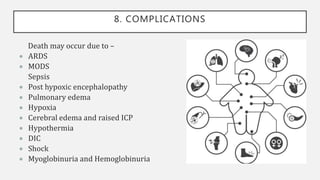
Death may occur due to –
 ARDS
 MODS
Sepsis
 Post hypoxic encephalopathy
 Pulmonary edema
 Hypoxia
 Cerebral edema and raised ICP
 Hypothermia
 DIC
 Shock
 Myoglobinuria and Hemoglobinuria
9. PROGNOSIS
Markers of poor prognosis:
 Duration of submersion > 5 min
 Time to effective basic life support >10
minutes
 Resuscitation duration > 25 min
 Water temperature > 10◦C
 Persistent apnea and requirement of
cardiopulmonary resuscitation
 GCS < 6 at presentation
 Arterial pH < 7.1 upon presentation
Markers of good prognosis :
 CPR in the field
 Resuscitation duration < 25 min
 Detectable pulse on arrival
 Core temperature < 35◦C
 GCS ≥ 6 at presentation
• 35 – 60% of individuals needing continued CPR on arrival to the ED die.
• 10 – 20% of patients presenting with coma recover completely, despite fixed
and dilated pupils with varying degrees of residual neurological deficit.
• Approximately 6% suffer a residual neurologic deficit.
• 75 % of drowning victims survive.
10. WHEN TO DISCHARGE ?
 Asymptomatic patients with normal CXR and blood investigations should
be monitored for 6-8 hours prior to successful discharge.
 Symptomatic patients, once stabilized and recovered can be discharged as
per the treating physician’s clinical assessment.
11. PREVENTIVE MEASURES
The WHO Global Report on Drowning (2016) outlines four strategies and six
interventions for drowning prevention.
4 strategies
Assam’s State Disaster Management Authority has
produced a flood safety document, while the
Government of Maharashtra’s Tourism
Department has issued a notification for drowning
prevention on beaches during bad weather.
To ensure a comprehensive response to
drowning, to identify and align efforts to
prevent drowning deaths, and assign clear
roles and responsibilities.
To understand risk factors
for drowning and assess
the effectiveness of
interventions
Implementing mass media communication
campaigns directly relevant to drowning
prevention, dangers of consuming alcohol before
or during swimming or boating activities,
implementing initiatives to enhance awareness
and highlight the vulnerability of children to
drowning
6 interventions
12. FORENSIC AUTOPSY INTERNAL FINDINGS OF DROWNING
 Emphysema aquosum - Aspirated drowning medium in lungs and ballooning
of lungs.
 Paltauf's spots – Subpleural hemorrhages due to rupture of alveolar capillaries
 Silt, weed or sand in airways, frothy fluid in conducting airway
 White or blood tinged froth at mouth, nostrils.
 Pink or red-tinged froth exuding from the lumen of the sectioned larynx,
trachea, and bronchial tubes as well as the cut surfaces of the lung parenchyma.
13. TAKE HOME MESSAGE
 Immediate resuscitative efforts is key!
 Consider associated co-morbidities (trauma/alcohol or drug
intoxication/medical conditions)
 Development of pulmonary edema may take time, the clinical findings will
always precede the radiological findings and the initial CXR maybe normal.
 No clinical difference between salt water and fresh water drowning as in
majority of cases the amount of aspirated liquid around 3-4 ml only.
 Majority of treatment is supportive.
 Asymptomatic patients should be monitored for 6-8 hours prior to successful
discharge.
14. BIBLIOGRAPHY
1. WHO Regional Status Report on Drowning in South-East Asia (2019)
2. New England Journal of Medicine (NEJM)
3. The Lancet
4. Nelson Textbook of Pediatrics
5. Idris AH, et al. Recommended guidelines for uniform reporting of data from
drowning: the “Utstein style.”
6. Global burden of drowning, Paper Presented at World Congress on Drowning;
2002
7. Drowning (BLS): Systematic review, ILCOR
THANK YOU

Drowning

  • 1.
    Drowning and NearDrowning – Pathophysiology & Management Dr. Ipsita Mahapatra, PGT, Dept. of Pediatrics Gauhati Medical College and Hospital
  • 2.
    1. DEFINITION • “Aprocess resulting in primary respiratory impairment from submersion/immersion in a liquid medium.” - World Congress on Drowning (Amsterdam, 2002) • Presence of a liquid/air interface at the entrance of the patient’s airway • The term ‘drowning’ does not imply the final outcome – death or survival. • The outcome should be denoted as fatal or non-fatal drowning.
  • 3.
    Submersion • Entire bodyto be covered in a liquid medium • Airway, in its entirety, is under the liquid medium Immersion • A body part is covered in a liquid medium; it does not require the entire body to be underwater. • Oral and nasal airways must be under water or other liquid medium, limiting the victim’s ability to breathe.
  • 4.
    • The InternationalLiaison Committee on Resuscitation (ILCOR), WHO and the World Congress on Drowning recommends that ambiguous terms such as ‘dry and wet drowning, active and passive drowning, near drowning, and secondary drowning’ should no longer be used. • Confusing and not clinically relevant. • Simpler, more uniform “Utstein” style of terminology should be used. • The Utstein approach to the evaluation of drowning victims standardizes reporting and data collection and also provides guidance for the history, physical examination, and appropriate management.
  • 5.
  • 8.
    TYPES OF DROWNING Theseterminologies are no longer used.  Near drowning : Survival of atleast 24 hours after an episode of suffocation caused by submersion in a liquid medium.  Wet vs dry drowning : Dry-drowning is due to larynogospasm following a sudden immersion into water which leads to asphyxia and subsequently, hypoxia. There is no collection of water within the alveoli. Wet-drowning is due to aspiration of more amount of liquid resulting in collection of water within the alveoli.
  • 9.
     Fresh watervs salt water drowning : There is no significant clinical difference between the two. Historically, it was felt to affect electrolytes, cause fluid shifting and cause hemolysis. Intravascular blood volume changes - atleast 11ml/kg of fluid Electrolyte changes - atleast 22ml/kg of fluid Most patients aspirate <4ml/kg of water The distinction between salt water and fresh water drowning are no longer considered significant.  Secondary drowning : Any secondary condition (Heart disease, epilepsy, alcohol use etc) leading to loss of consciousness in water, thereby, drowning.
  • 10.
    2. STATISTICS ANDGLOBAL IMPACT OF DROWNING • Poorly studied and vastly underestimated. Deaths due to accidents are not counted in drowning. • Ranks as the third leading cause of unintentional injury deaths worldwide and in South-east Asia, after road traffic injuries and falls. Majority of fatalities occur in low- and middle- income countries. • >50% of drowning cases occur in WHO Western Pacific and South-East Asia regions.
  • 13.
    • In India,majority of drowning cases are reported from the states of Madhya Pradesh and Maharashtra. • According to a December 2019 Lancet report on estimates of ‘healthy life’ lost in India, the rate of years of life lost (YLL) by drowning were highest in the central states of Madhya Pradesh (MP), Maharashtra, Chhattisgarh and NE state Assam.
  • 14.
    3. EPIDEMIOLOGY Drowning hasone of the highest case fatality rates and is in the top-10 causes of death related to unintentional injuries for all pediatric age groups.  Highest rates of drowning deaths in 2 age groups : 1-4 years and 15-19 years  Males > Females
  • 15.
    Children < 1year •Bathtub/household bucket • Left alone or with an elder sibling without adult supervision. Children 1-4 years  Curious but unaware nature coupled with rapid progression of their physical capabilities.  Lack of adult supervision  In affluent countries, drownings are reported in residential swimming pools.  In rural areas, drownings reported in irrigation ditches, nearby ponds, rivers.
  • 16.
    School age children •Natural water bodies such as lakes, ponds, rivers and canals. • Drowning cases are mostly due to swimming or boating activities in this age group. Adolescents  90% of drowning cases occur in natural bodies of water  Adolescent males >> females  Due to greater risk-taking behaviour, alcohol use, less perception of risks associated with drowning and greater confidence in their swimming ability.
  • 17.
    4. RISK FACTORS Males > Females  Age < 14 years  Low SE status and poor education  Living in rural areas  Epilepsy (15-19 times risk)  Cardiac etiologies – arrythmias, myocarditis, prolonged QT syndromes (Cold water may prolong the QT interval)  Substance abuse/intoxication  Attempted self harm  Trauma  Abuse (bath-tub related drownings)
  • 18.
    5. PATHOPHYSIOLOGY The primaryphysiologic effects of drowning are due to hypoxic-ischemic and reperfusion injuries. The “drowning process” is the stepwise progression of events leading to respiratory failure, hypoxia, and death.
  • 19.
    Initial struggle for20-30 seconds (unable to call for help as breathing takes priority) Submersion (airway below the surface of water) Panic, voluntary breath holding (60 seconds maximum). Small amount of water aspirated triggering cough reflex and laryngospasm Respiratory impairment leads to hypoxia, hypercarbia and acidosis Arterial oxygen tension decreases, laryngospasm abates and more water is aspirated
  • 20.
    Cardiopulmonary arrest By 3-4minutes, myocardial hypoxia leads to abrupt circulatory failure. Ineffective cardiac contractions with ineffective perfusion (Pulseless electrical activity) Progressively decreasing cardiac output and oxygen delivery to other organs Terminal apnea due to profound hypoxia and medullary depression Progressive decrease in SaO2, loss of consciousness from hypoxia
  • 22.
    END ORGAN EFFECTS •Pulmonary Aspiration of 1-3 ml of liquid causes surfactant washout, increased capillary endothelial permeability Profound hypoxia, tachypnea, acid/base disturbances Poor lung compliance, intrapulmonary shunting, V/Q mismatch and atelectasis Acute respiratory distress syndrome (ARDS)
  • 23.
    • Cardiovascular systemic venousreturn from compressive forces on the upper and lower extremities, peripheral vasoconstriction Increased myocardial stretch, increased pulmonary artery pressure, and an increase in stroke volume, leading to increased cardiac output Lethal in pre-existing illness, such as congestive heart failure or pulmonary hypertension Central hypervolemia Swimming (including diving) can precipitate fatal ventricular arrythmias in patients with congenital long QT syndrome
  • 24.
    Neurologic • The primarymechanisms of injury to the central nervous system are tissue hypoxia and ischemia which cause neuronal damage. • Several hours after cardiopulmonary arrest, cerebral edema may develop (mechanism not clearly understood) • The biggest determinants of outcome and long-term neurologic sequelae are the duration of submersion and the interval time between drowning and ventilation efforts. Approximately, 20% of nonfatal drowning victims sustain neurologic damage, limiting functional recovery despite successful cardiopulmonary resuscitation.
  • 25.
    Renal Free water deficitand dehydration over time Increased glomerular blood flow, decreased free water reabsorption, and decreased vasopressin release from the hypothalamus Stretching of myocardium, release od Atrial Natriuretic peptide (ANP) Central hypervolemia ARF may occur (though rarely) due to lactic acidosis, prolonged hypoperfusion and rhabdomyolysis.
  • 26.
    • Acid-base andelectrolytes: A metabolic and/or respiratory acidosis is often observed • Coagulation : Hemolysis and coagulopathy are rare potential complications of non fatal drowning.
  • 27.
    6. PRESENTATION Asymptomatic PatientsSymptomatic Patients • No cough or dyspnea • Normal vital signs • No signs of hypoxia or tachypnea, Chest exam is normal (without crackles or wheezes) • Altered sensorium • Hypotension or shock • Hypoventilation or absent pulse • Cough or pulmonary rales in auscultation • Asystole, arrythmias
  • 28.
    7. MANAGEMENT Drowning chainof Survival The steps of the chain are: (1) prevent drowning; (2) recognize distress; (3) provide flotation; (4) remove from water; and (5) provide care
  • 29.
    • A drowningvictim is usually silent and may not make violent movements in water. • Management of drowning victims can be divided into 3 phases : 1. Pre-hospital care 2. Emergency department (ED) care 3. Inpatient care Pre-hospital care (At the scene) Emergency department (ED) care Inpatient care
  • 30.
    PRE-HOSPITAL CARE • Scenesafety, rapid extraction, and prompt basic life support are key to improve survival. • Rescue and extrication : Swift water rescue training programs teach the adage “Reach, Throw, Row, Go.” These are the four steps in water rescue with “progressively more risk to the rescuer.” • Reach : Rescuers should start by reaching for the victim with an object, such as a paddle or branch • Throw: If this fails, rescuers should throw a floatation device such as a throwbag or personal flotation device (PFD) to the victim. • Row: If necessary, rescuers should proceed to take a boat to the victim. • Go: As a last resort, rescuers should enter the water to rescue the victim. • Rescue and immediate resuscitation efforts by bystanders improves the outcome of drowning patients.
  • 31.
    • Activate EMSif unconscious drowning victim • CPR for drowning victims: traditional A-B-C approach with emphasis on ventilating the patient • Give two rescue breaths before proceeding to check the pulse and to give chest compressions if the patient is pulseless. • Clear the airway of secretions, look out for vomiting, place the patient in rescue position. • Cervical spine should be protected in anyone with potential traumatic neck injury. • Remove wet clothing, passive external rewarming. • Heimlich’s manoeuvre has no proven role. • Patient should be immediately shifted to a nearby hospital.
  • 33.
    DURING AMBULANCE TRANSPORTATION/EMERGENCY DEPARTMENTCARE • EMS personnel should do a primary survey on all drowning victims, including aggressive airway management and restoration of adequate oxygenation and ventilation. • For a patient in cardiopulmonary arrest, an automatic external defibrillator (AED) should be applied as soon as possible and BLS/ACLS algorithms should be followed. Primary survey A: Airway : definite airway in the form of endotracheal intubation or with a suproglottic device if the patient has respiratory distress, is not able to protect the airway or has traumatic injuries.
  • 34.
    • B :Breathing : Consider giving PPV. The goal is to make the oxygen saturation above 92% • C: Circulation: Vascular access must be established as quickly as possible for the administration on IV fluids and vasopressors. • Epinephrine is drug of choice in victims with bradyasystolic cardiopulmonary arrest. IV dose of 0.01mg/kg using 1:10,000 (0.1mg/ml) solution should be given every 3-5 min, as needed. • Epinephrine can be given intratracheally at a dose of 0.1 – 0.2 mg/kg of 1:1000 (1mg/ml) solution if no IV access is available. • IV bolus of lactated Ringers solution or 0.9% NaCl (10- 20 ml/kg) is to augment preload, repeated doses maybe necessary.
  • 35.
    • D: Disability: Neurological assessment using Glasgow Coma Scale (GCS) has prognostic significance. • E: Exposure : Hypothermic patients may require external rewarming.
  • 36.
    Secondary Survey • Detailedhistory with details of the drowning event to guide treatment and determine prognosis • Physical examination • Relevant blood investigations must be ordered – CBC, electrolytes, RFT, glucose, screening for toxicology if indicated. • ECG : Osborn waves • ABG : Acidosis • CXR :to look for evidence of aspiration, pneumonitis, atelectasis, pulmonary edema, and inhaled foreign bodies
  • 41.
    INPATIENT CARE Treatment isguided by Szpilman classification system of drowning grades for risk stratification and management. Inpatient management is aimed at supportive care and treatment of organ- specific complications. Goal is to prevent further secondary neurologic injury and minimize end- organ damage.
  • 42.
    Check response toverbal and tactile stimuli Conscious Unconscious 5 breaths Lungs clear Rales Cough No cough Some All Grade 2 Grade 1 Grade 0 Norma l BP Shock Grade 3 Grade 4 Pulse No pulse Check submersion time Grade 5 >1 hour, signs of death < 1 hour Grade 6 DEATH Conside r autopsy
  • 45.
    Medications  Prophylactic broadspectrum antibiotics (change as per C/S)  Consider antifungal and anaerobes if drowning in dirty water  Treat bronchospasm : Salbutamol MDI/Nebulisation  In case of seizures, consider phenytoin or fosphenytoin (loading dose of 10- 20mg/kg/day followed by maintenance of 5-8mg/kg/day). They are less sedative, may have some neuroprotective effects and may mitigate neurogenic pulmonary edema.  Head end elevation to 30 degrees after ruling out cervical spine injury  IV fluids (Hypotonic solutions should be avoided)  Electrolyte management
  • 46.
    • Other strategies ECMO  Prevention of raised ICP and management  Mannitol  Hypothermia management: Attention to core body temperature starts in the field and continues during transport and in the hospital. Goal is to prevent or treat moderate or severe hypothermia. Damp clothes to be removed from all drowning victims. Passive, active external, active internal rewarming.
  • 47.
    8. COMPLICATIONS Death mayoccur due to –  ARDS  MODS Sepsis  Post hypoxic encephalopathy  Pulmonary edema  Hypoxia  Cerebral edema and raised ICP  Hypothermia  DIC  Shock  Myoglobinuria and Hemoglobinuria
  • 48.
    9. PROGNOSIS Markers ofpoor prognosis:  Duration of submersion > 5 min  Time to effective basic life support >10 minutes  Resuscitation duration > 25 min  Water temperature > 10◦C  Persistent apnea and requirement of cardiopulmonary resuscitation  GCS < 6 at presentation  Arterial pH < 7.1 upon presentation Markers of good prognosis :  CPR in the field  Resuscitation duration < 25 min  Detectable pulse on arrival  Core temperature < 35◦C  GCS ≥ 6 at presentation
  • 49.
    • 35 –60% of individuals needing continued CPR on arrival to the ED die. • 10 – 20% of patients presenting with coma recover completely, despite fixed and dilated pupils with varying degrees of residual neurological deficit. • Approximately 6% suffer a residual neurologic deficit. • 75 % of drowning victims survive.
  • 50.
    10. WHEN TODISCHARGE ?  Asymptomatic patients with normal CXR and blood investigations should be monitored for 6-8 hours prior to successful discharge.  Symptomatic patients, once stabilized and recovered can be discharged as per the treating physician’s clinical assessment.
  • 51.
    11. PREVENTIVE MEASURES TheWHO Global Report on Drowning (2016) outlines four strategies and six interventions for drowning prevention. 4 strategies Assam’s State Disaster Management Authority has produced a flood safety document, while the Government of Maharashtra’s Tourism Department has issued a notification for drowning prevention on beaches during bad weather. To ensure a comprehensive response to drowning, to identify and align efforts to prevent drowning deaths, and assign clear roles and responsibilities.
  • 52.
    To understand riskfactors for drowning and assess the effectiveness of interventions Implementing mass media communication campaigns directly relevant to drowning prevention, dangers of consuming alcohol before or during swimming or boating activities, implementing initiatives to enhance awareness and highlight the vulnerability of children to drowning
  • 53.
  • 55.
    12. FORENSIC AUTOPSYINTERNAL FINDINGS OF DROWNING  Emphysema aquosum - Aspirated drowning medium in lungs and ballooning of lungs.  Paltauf's spots – Subpleural hemorrhages due to rupture of alveolar capillaries  Silt, weed or sand in airways, frothy fluid in conducting airway  White or blood tinged froth at mouth, nostrils.  Pink or red-tinged froth exuding from the lumen of the sectioned larynx, trachea, and bronchial tubes as well as the cut surfaces of the lung parenchyma.
  • 57.
    13. TAKE HOMEMESSAGE  Immediate resuscitative efforts is key!  Consider associated co-morbidities (trauma/alcohol or drug intoxication/medical conditions)  Development of pulmonary edema may take time, the clinical findings will always precede the radiological findings and the initial CXR maybe normal.  No clinical difference between salt water and fresh water drowning as in majority of cases the amount of aspirated liquid around 3-4 ml only.  Majority of treatment is supportive.  Asymptomatic patients should be monitored for 6-8 hours prior to successful discharge.
  • 59.
    14. BIBLIOGRAPHY 1. WHORegional Status Report on Drowning in South-East Asia (2019) 2. New England Journal of Medicine (NEJM) 3. The Lancet 4. Nelson Textbook of Pediatrics 5. Idris AH, et al. Recommended guidelines for uniform reporting of data from drowning: the “Utstein style.” 6. Global burden of drowning, Paper Presented at World Congress on Drowning; 2002 7. Drowning (BLS): Systematic review, ILCOR
  • 60.