THE NERVE
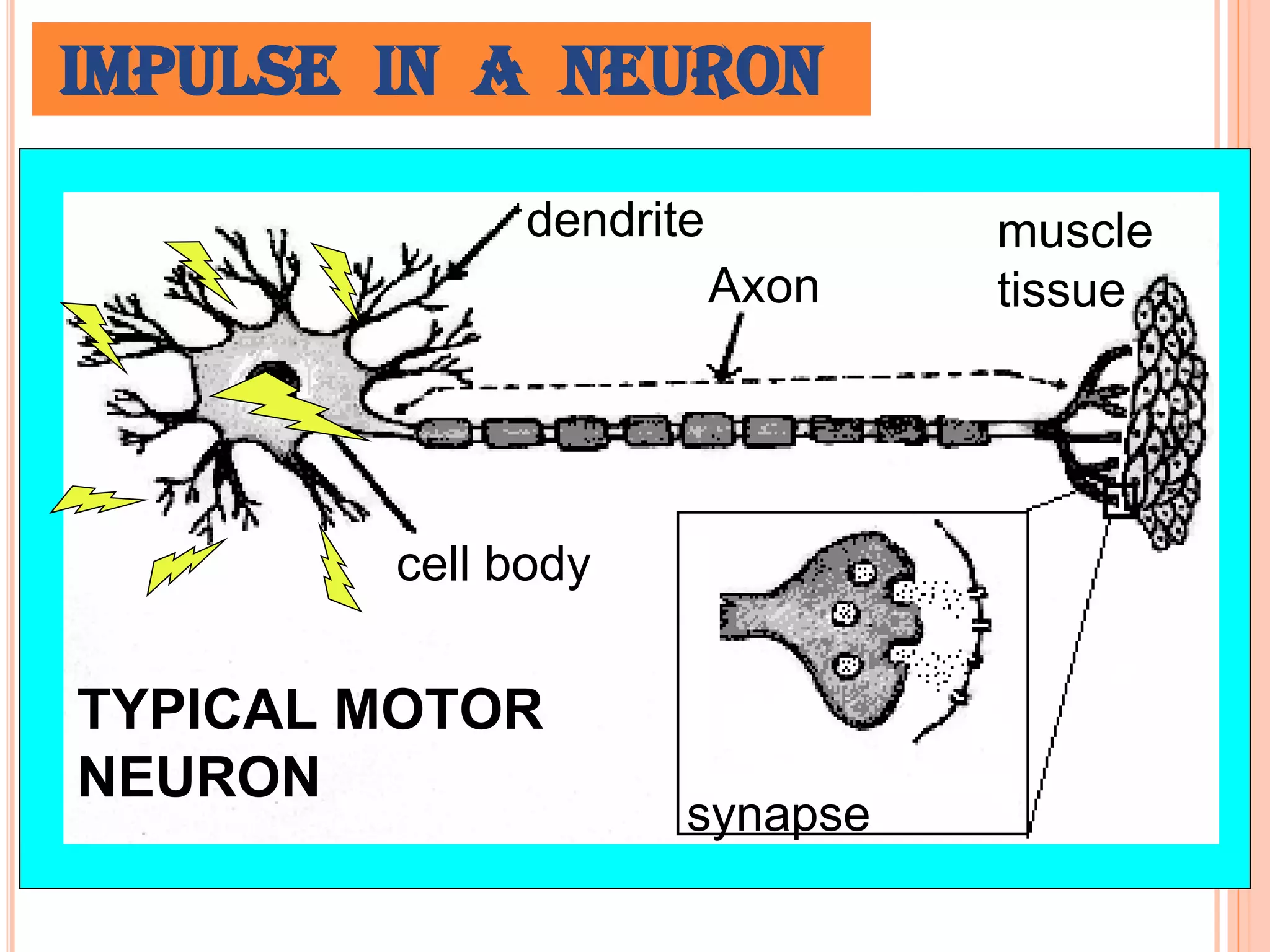
A nerve is an organ containing a bundle of nerve cells 
called neurons.  
Neurons carry electrical messages called impulses 
throughout the body. 
impulse in a neuron
muscle
tissue
TYPICAL MOTOR
NEURON
Axon
dendrite
synapse
cell body
ANESTHESIA
Presented by
Mr B kalyankumar
Msc(N) Dept of MSN
INTRODUCTION
 The word Anesthesia  is coined from Greek word. Throughout 
their lives, most people will undergo anesthesia either during the 
birth of their baby or for a surgical procedure.
 
DEFINITION
 Anesthesia is an artificially induced state of  partial or total loss 
of sensation, occurring with or without loss of  consciousness.
Selection of Anesthesia depends on many variables.
 Age and physical condition of  the patient
 Type , location and duration of the surgery
 Previous Anesthetic  history
 Personal preference and judgement  of  the Anesthesiologist. 
CLASSIFICATION OF ANETHESIA
GeneralGeneral
anesthesiaanesthesia RegionalRegional
anesthesiaanesthesia
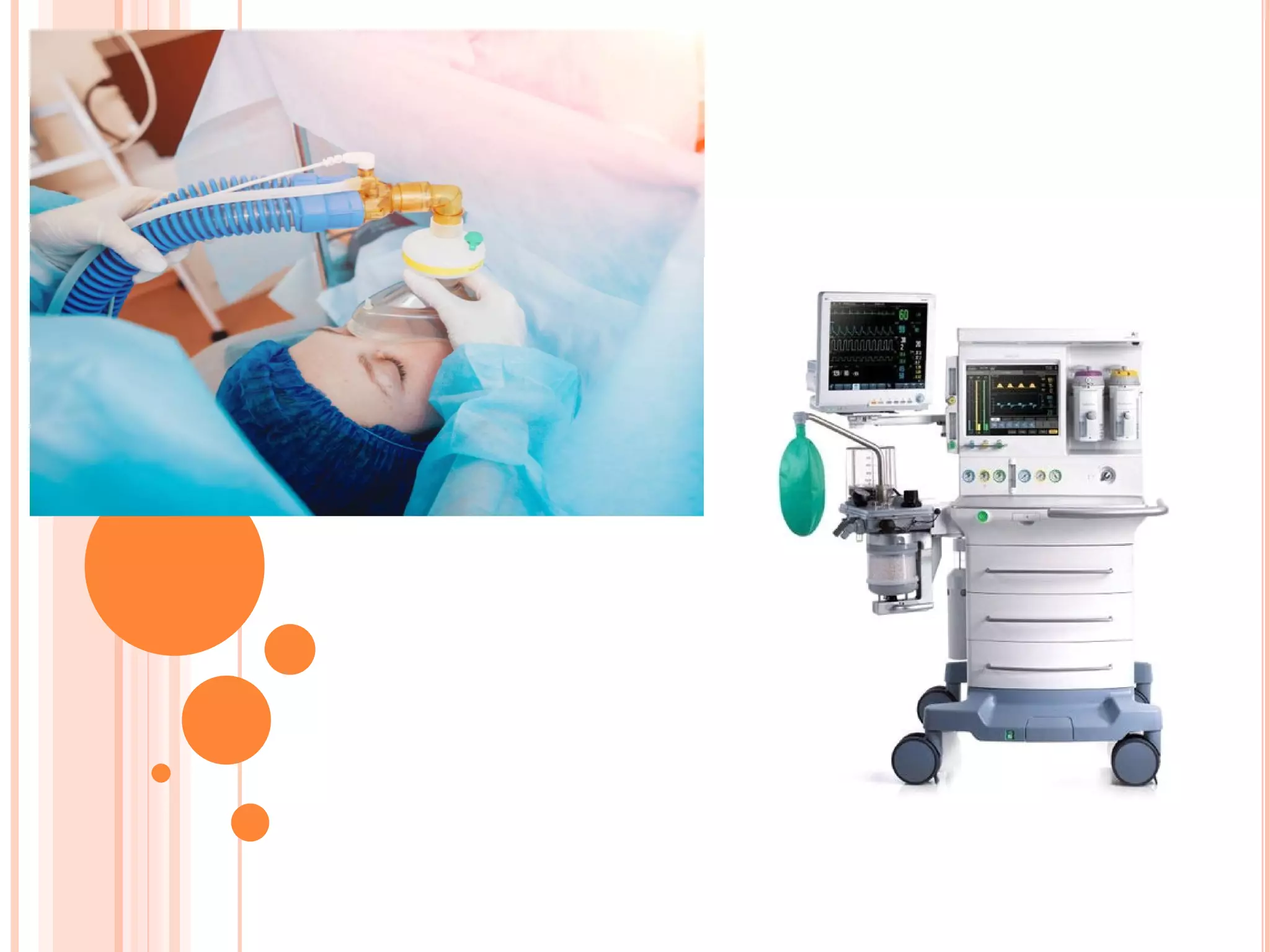
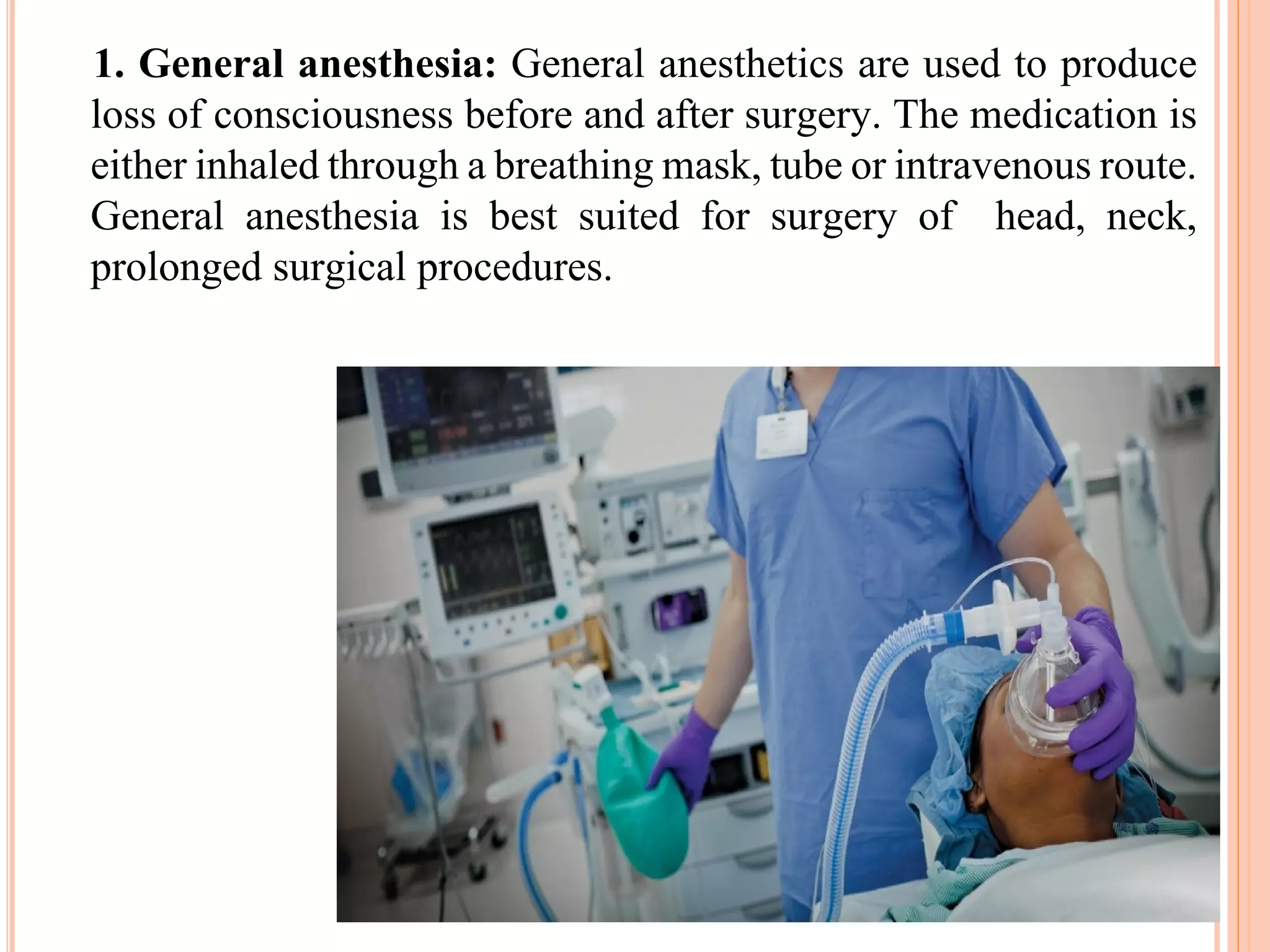
1. General anesthesia: General anesthetics are used to produce 
loss of consciousness before and after surgery. The medication is 
either inhaled through a breathing mask, tube or intravenous route. 
General  anesthesia  is  best  suited  for  surgery  of    head,  neck, 
prolonged surgical procedures.
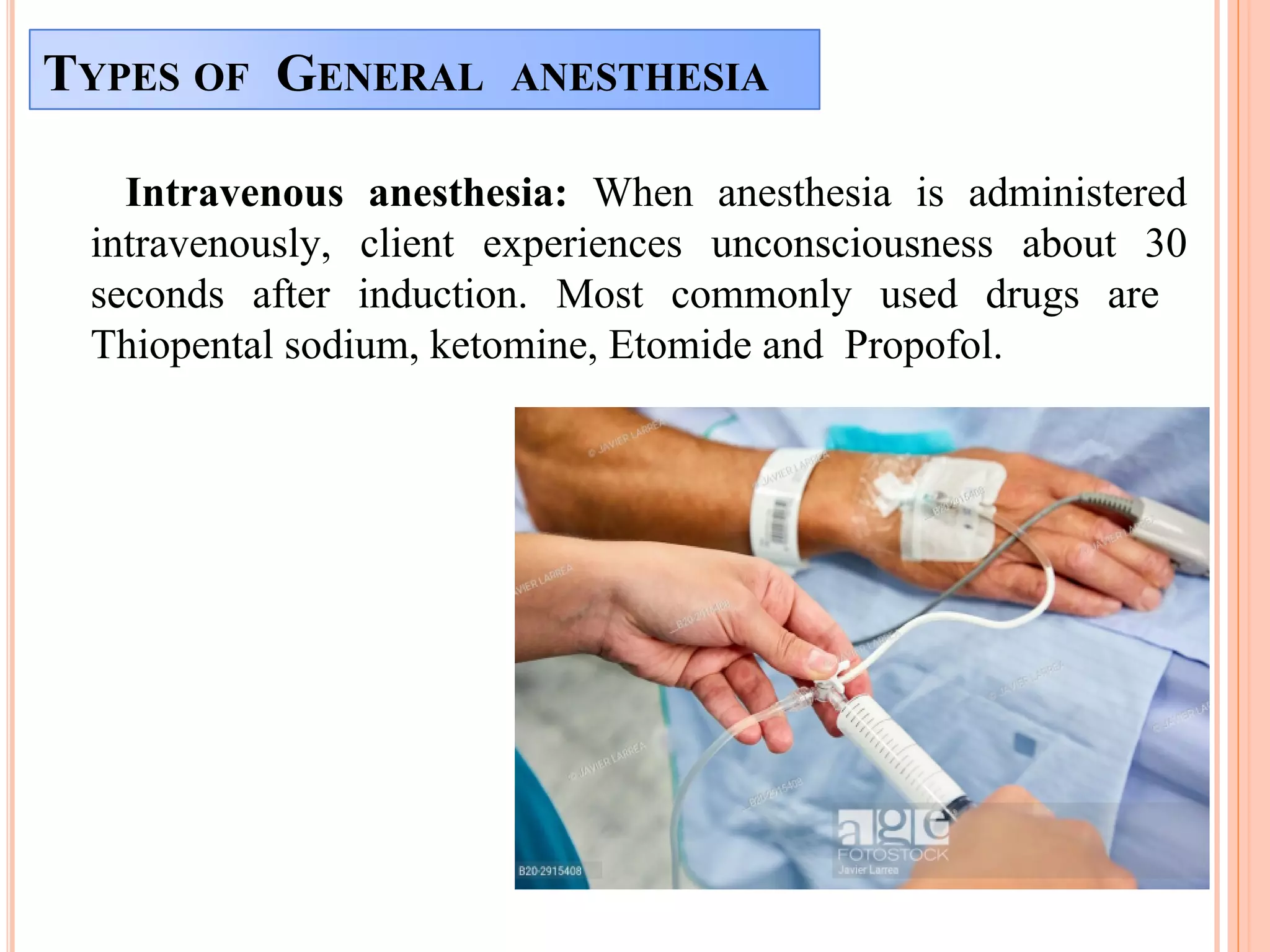
STAGES OF GENERAL ANESTHESIA
 Stage I : This  is  also  known  as  induction,  it  is  the  period 
between  the  administration  of    induction  agents  and  loss  of 
consciousness.
 Stage II:  It  is  known  as  excitement  stage,  it  is  from  loss  of 
consciousness  to  loss    of    eyelid    reflexes.  During  this  stage 
patients respiration and heart rate may become irregular.
 Stage III:  It  is  known  as  Surgical  anesthesia,  respiratory 
depression, skeletal muscle relax occurs.
 Stage IV: It also  known as Over dose, occur  when too much 
anesthetic  medication  given.  Resulting  in  cessation  of   
respiratory and potential cardiovascular collapse.
TYPES OF GENERAL ANESTHESIA
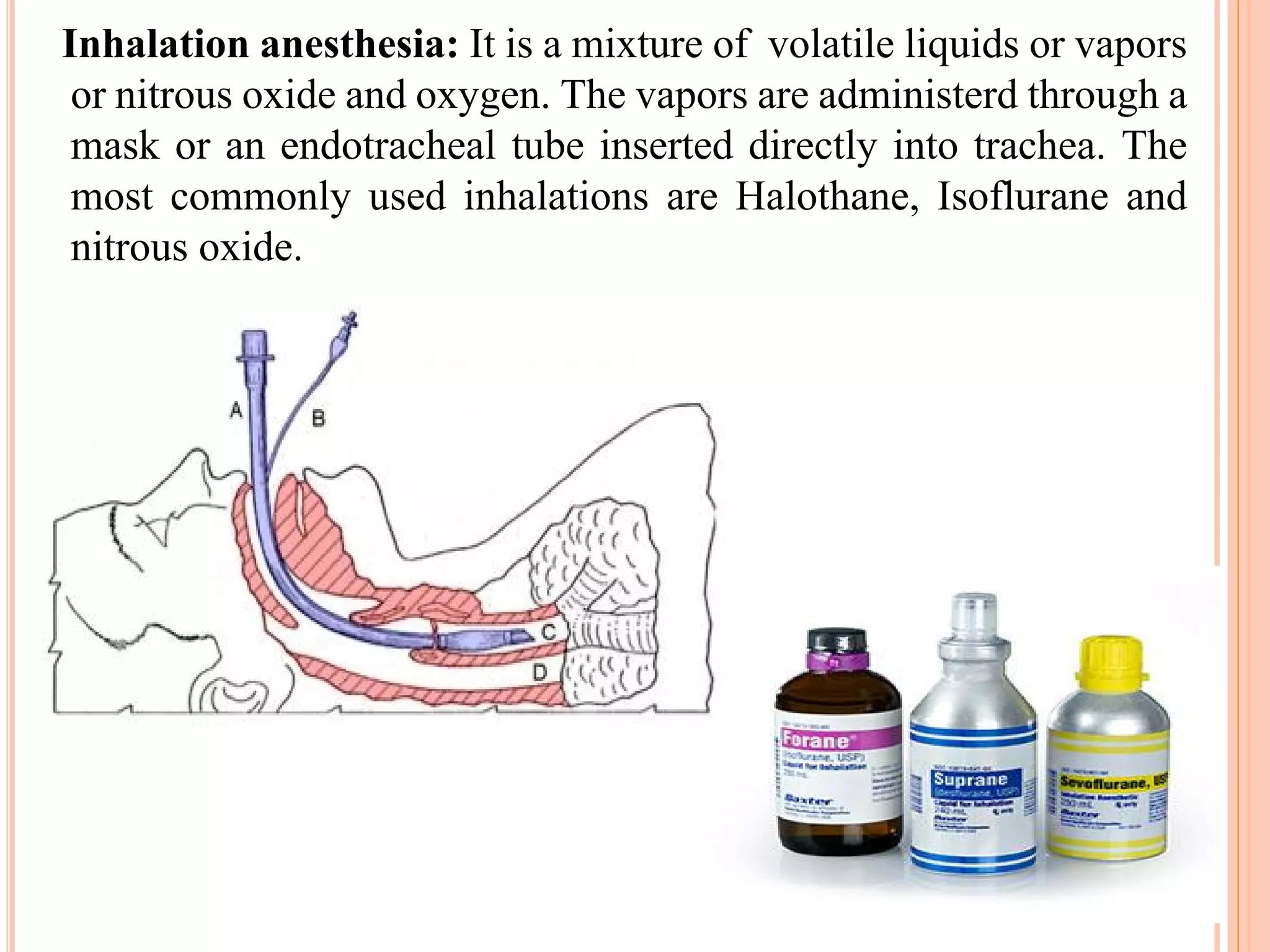
Intravenous anesthesia:  When  anesthesia  is  administered 
intravenously,  client  experiences  unconsciousness  about  30 
seconds  after  induction.  Most  commonly  used  drugs  are   
Thiopental sodium, ketomine, Etomide and  Propofol.
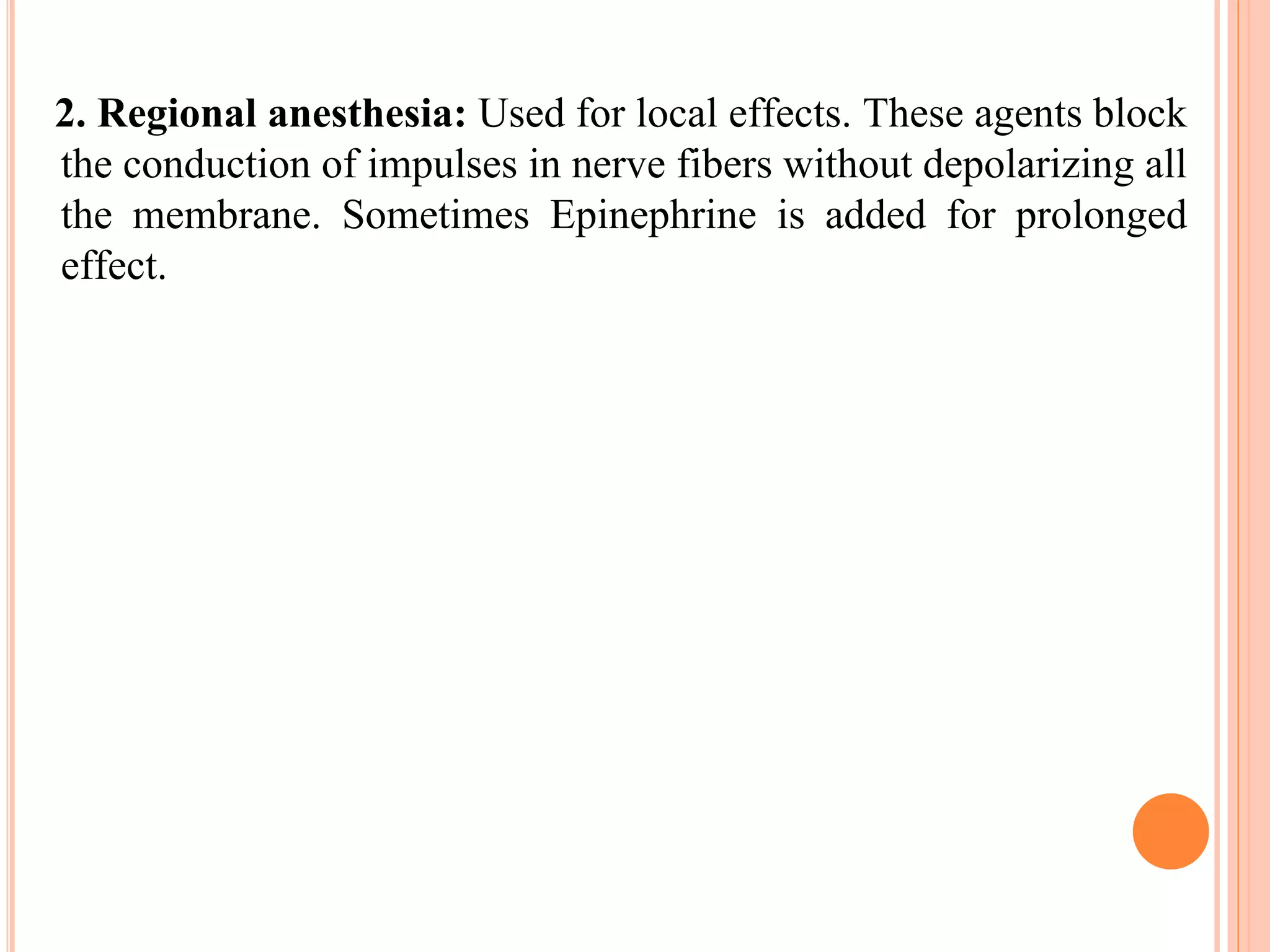
Inhalation anesthesia: It is a mixture of  volatile liquids or vapors 
or nitrous oxide and oxygen. The vapors are administerd through a 
mask or an endotracheal tube inserted directly into trachea. The 
most  commonly  used  inhalations  are  Halothane,  Isoflurane  and 
nitrous oxide.
Muscle relaxant: Muscle relaxants are administered 
intravenously and usually given to facilitate intubation. It block 
transmission of  nerve impulses to the muscles. Common drugs 
Succinylcholine, Atracurium.
2. Regional anesthesia: Used for local effects. These agents block 
the conduction of impulses in nerve fibers without depolarizing all 
the  membrane.  Sometimes  Epinephrine  is  added  for  prolonged 
effect.
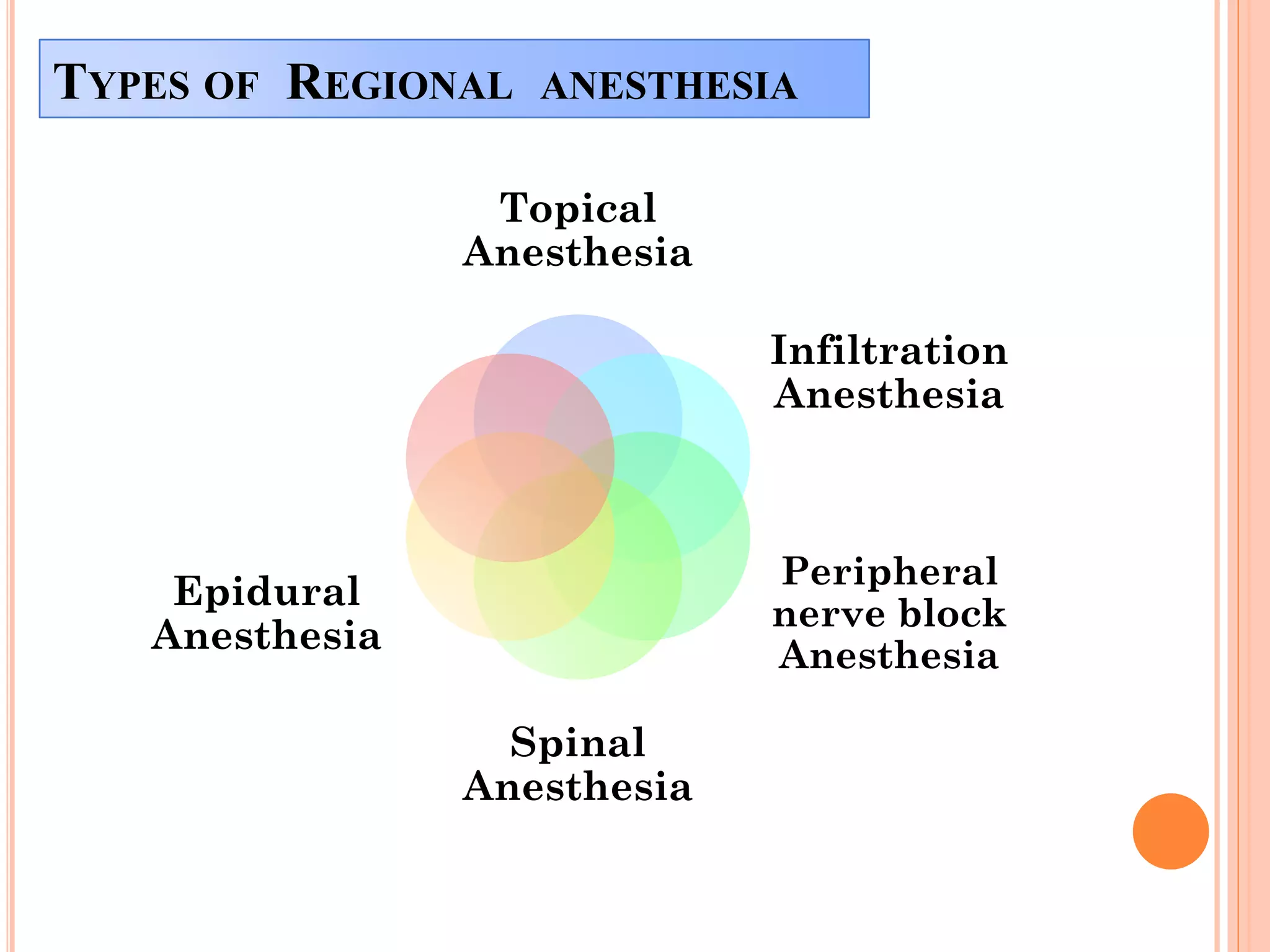
TYPES OF REGIONAL ANESTHESIA
Topical
Anesthesia
Infiltration
Anesthesia
Peripheral
nerve block
Anesthesia
Spinal
Anesthesia
Epidural
Anesthesia
TOPICAL ANESTHESIA
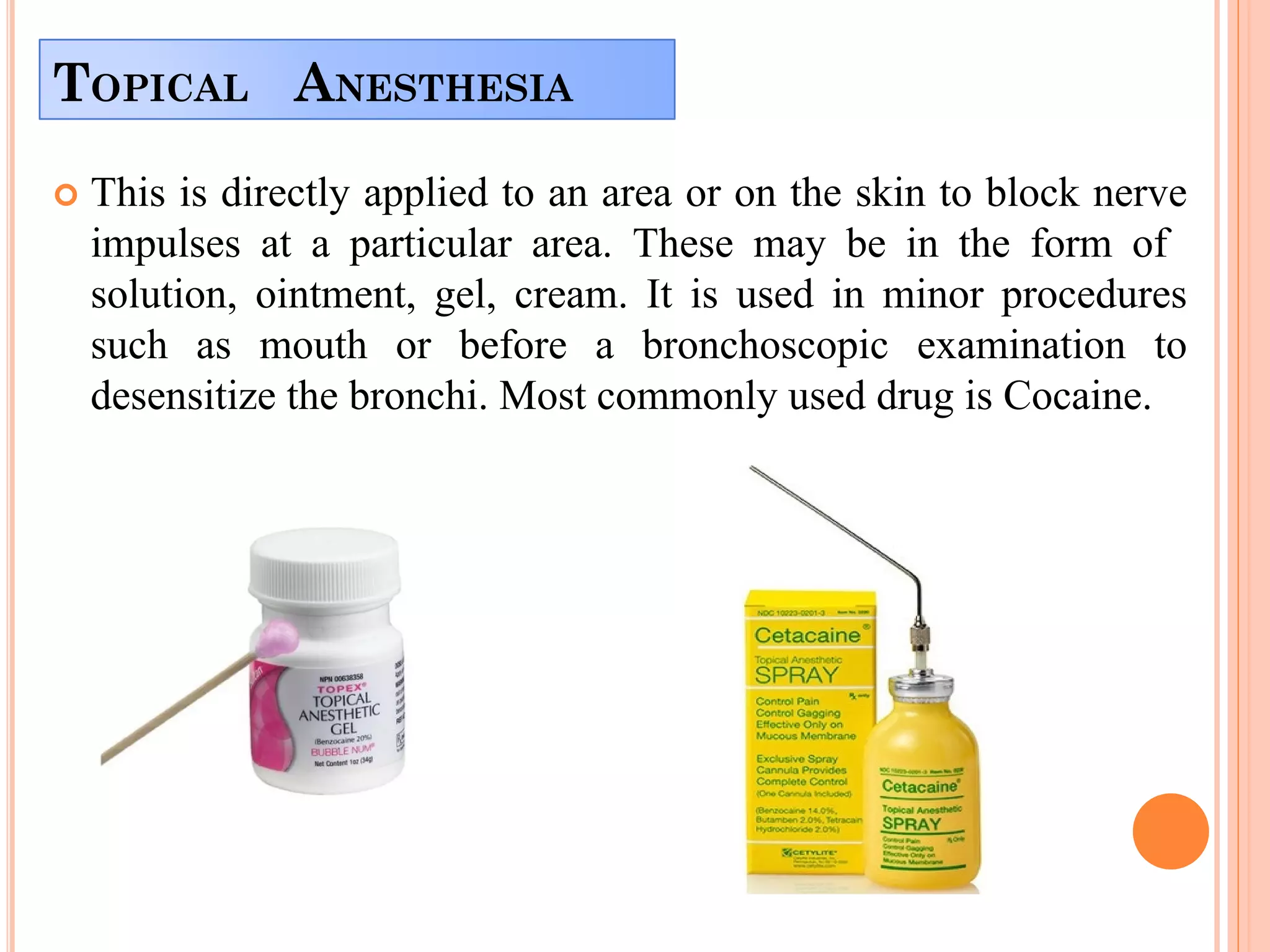
 This is directly applied to an area or on the skin to block nerve 
impulses  at  a  particular  area.  These  may  be  in  the  form  of   
solution,  ointment,  gel,  cream.  It  is  used  in  minor  procedures 
such  as  mouth  or  before  a  bronchoscopic  examination  to 
desensitize the bronchi. Most commonly used drug is Cocaine.
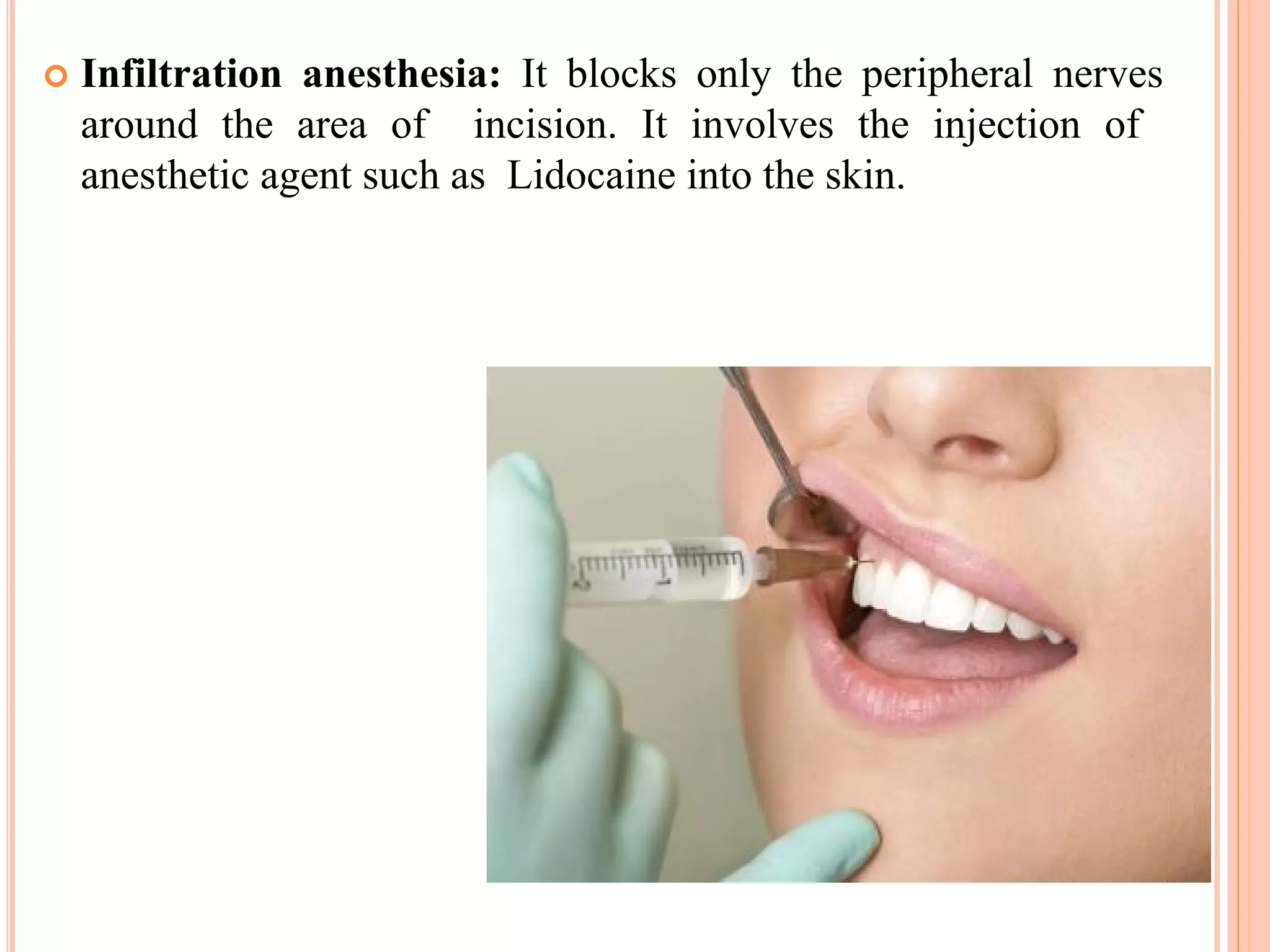
 Infiltration anesthesia:  It  blocks  only  the  peripheral  nerves 
around  the  area  of    incision.  It  involves  the  injection  of   
anesthetic agent such as  Lidocaine into the skin.
 Spinal anesthesia:Anesthesia introduced into the subarachnoid 
space at the lumbar level, usually between L4 and L5.
 Epidural anesthesia: It is achieved by injecting local anesthetic 
agent into epidural space. Needle inserted at the thoracic, lumbar, 
sacral.  It blocks  sensory and motor function.
COMPLICATIONS OF ANESTHESIA
 Nausea and vomiting
 Hypotension
 Headache
 Respiratory paralysis
 Neurological complications
 Severe numbness
GOOD TIME WITH YOU

Anesthesia types and complications