Drillships
Indian Maritime University
Visakhapatnam Campus
B.Tech Naval Architecture & Ocean Engineering
SUDRIPTO KHASNABIS
B.Tech 2ndYr. 13400052035
PRESENTED BY
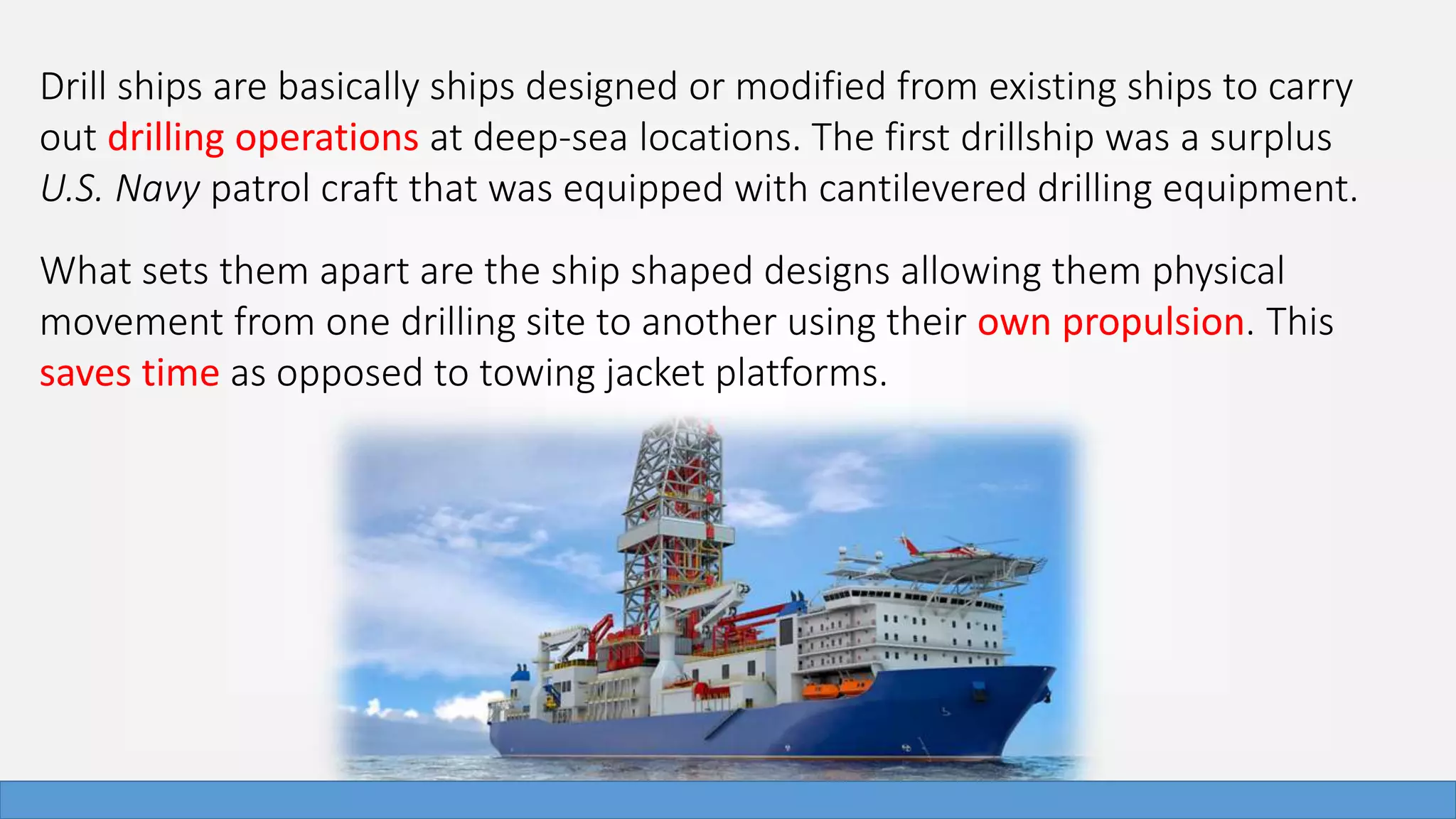
Drill ships are basically ships designed or modified from existing ships to carry
out drilling operations at deep-sea locations. The first drillship was a surplus
U.S. Navy patrol craft that was equipped with cantilevered drilling equipment.
What sets them apart are the ship shaped designs allowing them physical
movement from one drilling site to another using their own propulsion. This
saves time as opposed to towing jacket platforms.
However drill ships have to operate in deeper waters which may be turbulent,
and so they are comparatively less stable than Semi submersibles.
To gain stability, these ships make use of their anchors or the Dynamic Positioning
Systems (DPS) equipped with complex algorithms and a numerical model of the
ship coupled with the thrusters and preliminary propulsion of the ship which
allows a smoother operation.
Drill ships today are mainly used for exploratory drilling and not production
drilling.
They typically carry a maximum crew of 120 people combining engineers, mates
and scientists.
Typically Drill Ships have a drilling platform and derrick located amidships.
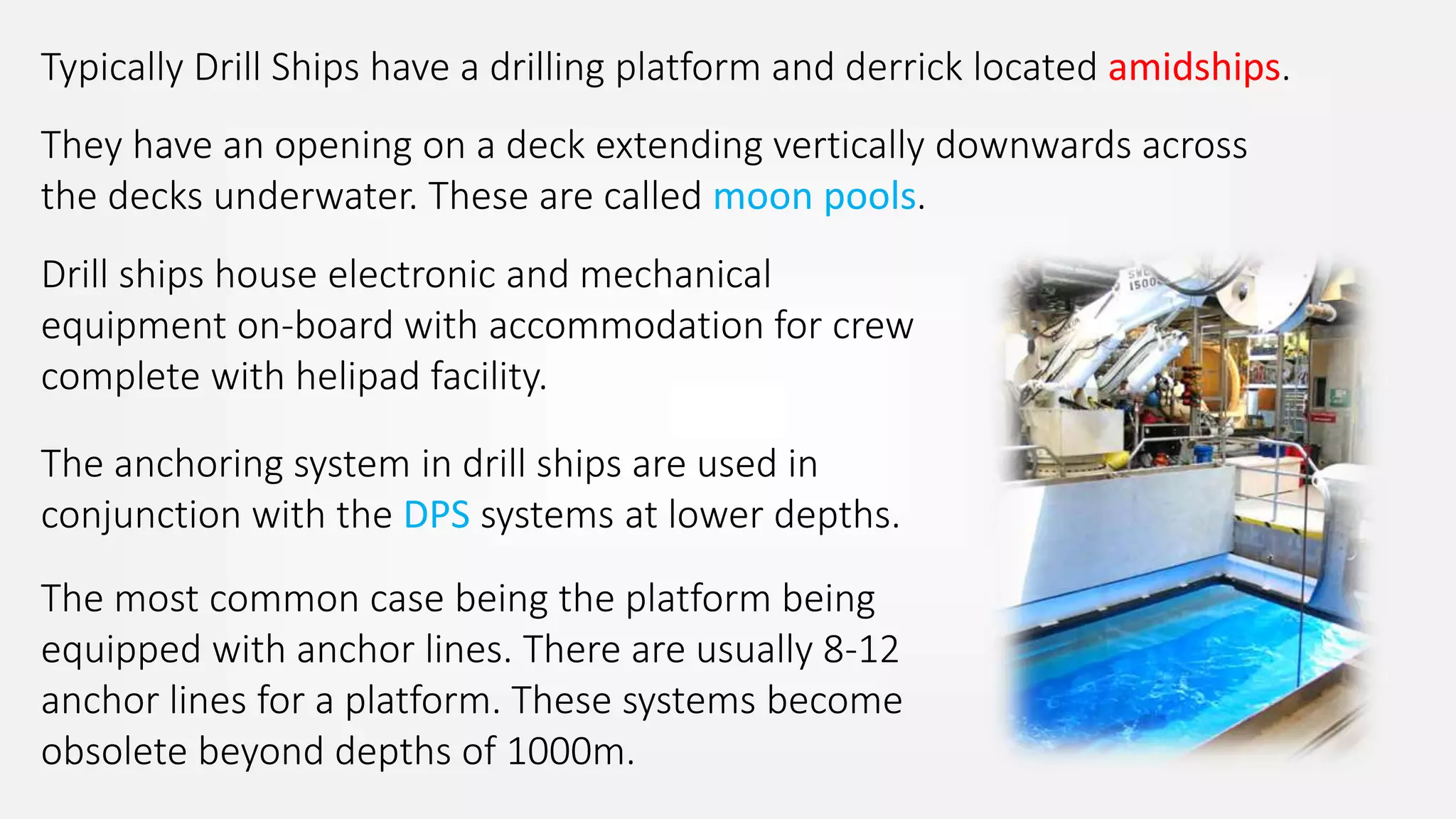
They have an opening on a deck extending vertically downwards across
the decks underwater. These are called moon pools.
Drill ships house electronic and mechanical
equipment on-board with accommodation for crew
complete with helipad facility.
The anchoring system in drill ships are used in
conjunction with the DPS systems at lower depths.
The most common case being the platform being
equipped with anchor lines. There are usually 8-12
anchor lines for a platform. These systems become
obsolete beyond depths of 1000m.
Drill ships are intended for operation in remote locations at deeper seas but
these ships have issues with stability in rougher sea states.
Normally, the stability of the ship when drilling is not taking place is
accounted for.
The issue becomes important when these ships carry out a drilling
operation and the waves, winds and currents come and directly impact the
ship. The ship should be designed to withstand design dynamic loads.
The possible risks include obstructions in the working of the drilling
platform, toppling of the ship as a whole!
Thinking of drill ships as an adaptation of any seagoing ship
• Additions to a normal seagoing ship structure include:
o Substructure containing moon pool.
o Cantilever beams from which the drilling operations will be carried out.
• Additional means of positioning unit over the drill centre.
o Contact of the bore hole with sea bed.
o Vessel connected to sea bed with riser and drill string in contact with
bottom of bore hole.
The Marine Drilling Riser
Drill ships require means of extracting the oil from the
depths of the ocean and the drilling risers provide
temporary extension of the oil well to this facility aboard
the ship.
These risers when operated beyond depths of 20 metres
require tensioning equipment. As they may be affected
by the deeper sea phenomenon.
These platforms have low pressure main tubes and
higher pressure auxiliary tubes which when combined
with a range of sub sea valve systems ensure proper
reception of the extract.
Oil and Gas Exploration
• Exploration for oil and gas is time and effort-intensive process.
• Extensive analysis required.
• Surveying, mapping and subsurface analysis is done.
• Drill ships have advantages like mobility and economic feasibility as they
are not required to be towed from destination to destination. Although
they have their own disadvantages as other platforms like semi-
submersible platforms are able to work with greater degrees of stability.
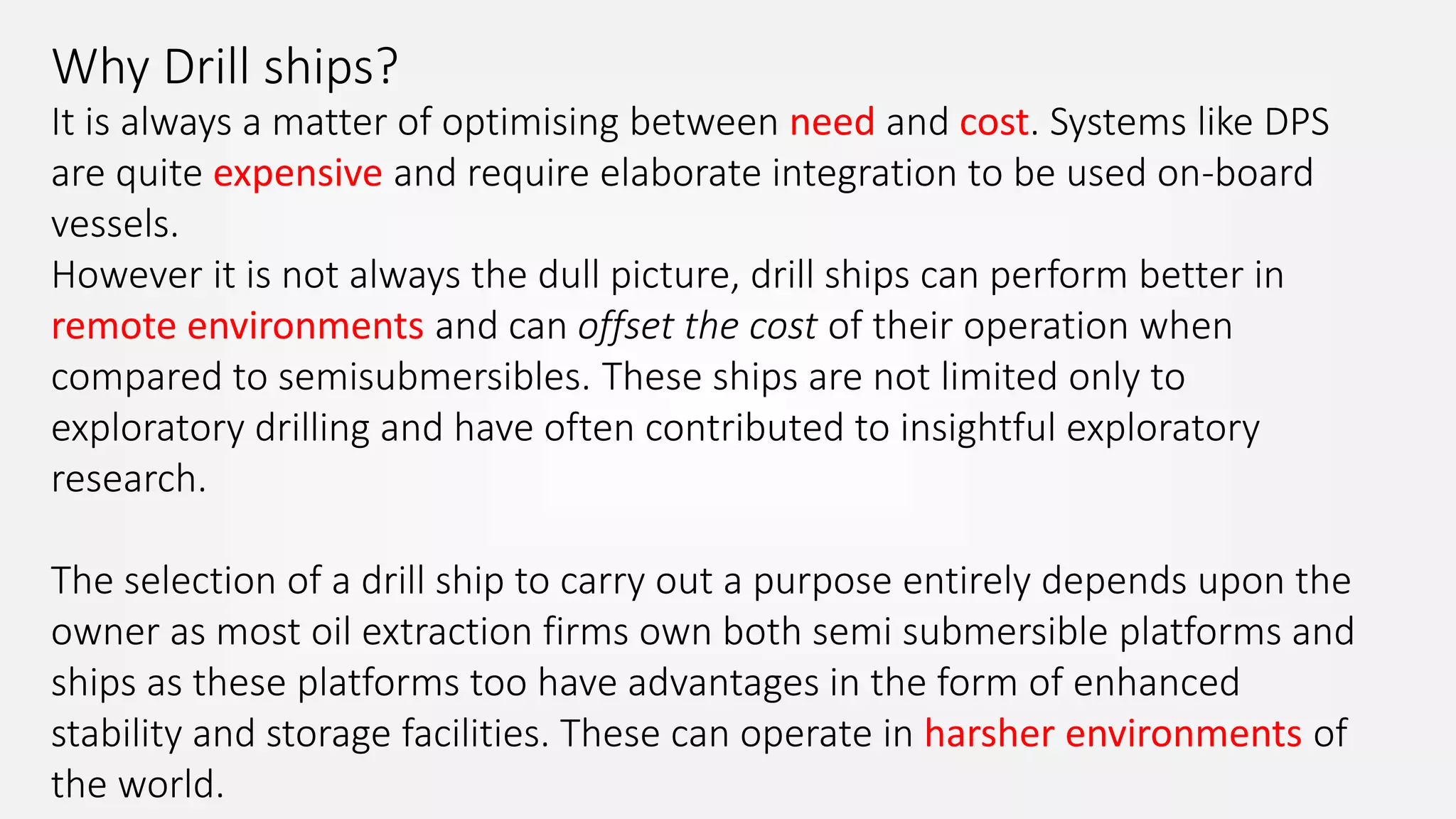
In 2013 the Transocean drillship, the Dhirubhai Deepwater KG1 set the
world water-depth record at 3,165 m while working for ONGC off the east
coast of India.
Transocean, Pride, Seadrill, Frontier Drilling and Noble are a few of the
companies that own and operate drill ships globally today.
Why Drill ships?
It is always a matter of optimising between need and cost. Systems like DPS
are quite expensive and require elaborate integration to be used on-board
vessels.
However it is not always the dull picture, drill ships can perform better in
remote environments and can offset the cost of their operation when
compared to semisubmersibles. These ships are not limited only to
exploratory drilling and have often contributed to insightful exploratory
research.
The selection of a drill ship to carry out a purpose entirely depends upon the
owner as most oil extraction firms own both semi submersible platforms and
ships as these platforms too have advantages in the form of enhanced
stability and storage facilities. These can operate in harsher environments of
the world.
THANK YOU

Drillships

  • 1.
    Drillships Indian Maritime University VisakhapatnamCampus B.Tech Naval Architecture & Ocean Engineering SUDRIPTO KHASNABIS B.Tech 2ndYr. 13400052035 PRESENTED BY
  • 2.
    Drill ships arebasically ships designed or modified from existing ships to carry out drilling operations at deep-sea locations. The first drillship was a surplus U.S. Navy patrol craft that was equipped with cantilevered drilling equipment. What sets them apart are the ship shaped designs allowing them physical movement from one drilling site to another using their own propulsion. This saves time as opposed to towing jacket platforms.
  • 3.
    However drill shipshave to operate in deeper waters which may be turbulent, and so they are comparatively less stable than Semi submersibles. To gain stability, these ships make use of their anchors or the Dynamic Positioning Systems (DPS) equipped with complex algorithms and a numerical model of the ship coupled with the thrusters and preliminary propulsion of the ship which allows a smoother operation. Drill ships today are mainly used for exploratory drilling and not production drilling. They typically carry a maximum crew of 120 people combining engineers, mates and scientists.
  • 4.
    Typically Drill Shipshave a drilling platform and derrick located amidships. They have an opening on a deck extending vertically downwards across the decks underwater. These are called moon pools. Drill ships house electronic and mechanical equipment on-board with accommodation for crew complete with helipad facility. The anchoring system in drill ships are used in conjunction with the DPS systems at lower depths. The most common case being the platform being equipped with anchor lines. There are usually 8-12 anchor lines for a platform. These systems become obsolete beyond depths of 1000m.
  • 5.
    Drill ships areintended for operation in remote locations at deeper seas but these ships have issues with stability in rougher sea states. Normally, the stability of the ship when drilling is not taking place is accounted for. The issue becomes important when these ships carry out a drilling operation and the waves, winds and currents come and directly impact the ship. The ship should be designed to withstand design dynamic loads. The possible risks include obstructions in the working of the drilling platform, toppling of the ship as a whole!
  • 6.
    Thinking of drillships as an adaptation of any seagoing ship • Additions to a normal seagoing ship structure include: o Substructure containing moon pool. o Cantilever beams from which the drilling operations will be carried out. • Additional means of positioning unit over the drill centre. o Contact of the bore hole with sea bed. o Vessel connected to sea bed with riser and drill string in contact with bottom of bore hole.
  • 8.
    The Marine DrillingRiser Drill ships require means of extracting the oil from the depths of the ocean and the drilling risers provide temporary extension of the oil well to this facility aboard the ship. These risers when operated beyond depths of 20 metres require tensioning equipment. As they may be affected by the deeper sea phenomenon. These platforms have low pressure main tubes and higher pressure auxiliary tubes which when combined with a range of sub sea valve systems ensure proper reception of the extract.
  • 9.
    Oil and GasExploration • Exploration for oil and gas is time and effort-intensive process. • Extensive analysis required. • Surveying, mapping and subsurface analysis is done. • Drill ships have advantages like mobility and economic feasibility as they are not required to be towed from destination to destination. Although they have their own disadvantages as other platforms like semi- submersible platforms are able to work with greater degrees of stability.
  • 12.
    In 2013 theTransocean drillship, the Dhirubhai Deepwater KG1 set the world water-depth record at 3,165 m while working for ONGC off the east coast of India. Transocean, Pride, Seadrill, Frontier Drilling and Noble are a few of the companies that own and operate drill ships globally today.
  • 13.
    Why Drill ships? Itis always a matter of optimising between need and cost. Systems like DPS are quite expensive and require elaborate integration to be used on-board vessels. However it is not always the dull picture, drill ships can perform better in remote environments and can offset the cost of their operation when compared to semisubmersibles. These ships are not limited only to exploratory drilling and have often contributed to insightful exploratory research. The selection of a drill ship to carry out a purpose entirely depends upon the owner as most oil extraction firms own both semi submersible platforms and ships as these platforms too have advantages in the form of enhanced stability and storage facilities. These can operate in harsher environments of the world.
  • 15.