Official Open
Offshore Production Technology
Introduction to
Offshore Production Technology
Marine & Offshore Technology
Official Open
Learning Outcomes
1. Quick overview of Oil Production (covered in
Offshore Drilling)
2. Types of Production Systems
– Fixed vs Floating Systems comparison
3. Factors favouring deployment of Floating
Production Storage Offloading (FPSO) Platform
4. Key Functions of FPSO Platform
Official Open
1. Quick overview of Oil Production
(covered in Offshore Drilling)
Official Open
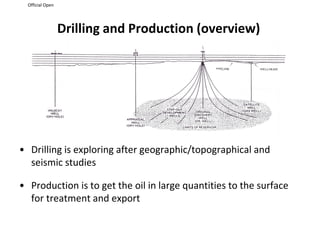
Drilling and Production (overview)
• Drilling is exploring after geographic/topographical and
seismic studies
• Production is to get the oil in large quantities to the surface
for treatment and export
Official Open
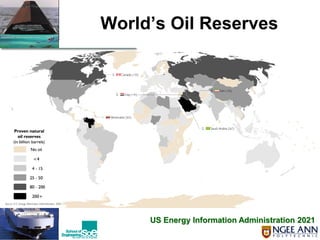
World’s Oil Reserves
US Energy Information Administration 2021
Official Open
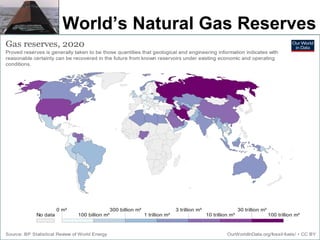
World’s Natural Gas Reserves
Official Open
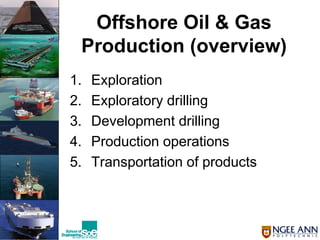
Offshore Oil & Gas
Production (overview)
1. Exploration
2. Exploratory drilling
3. Development drilling
4. Production operations
5. Transportation of products
Official Open
1. Exploration
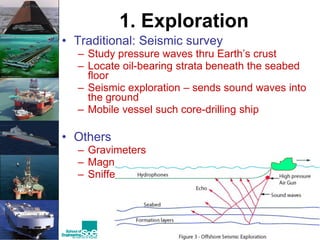
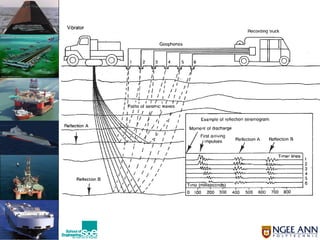
• Traditional: Seismic survey
– Study pressure waves thru Earth’s crust
– Locate oil-bearing strata beneath the seabed
floor
– Seismic exploration – sends sound waves into
the ground
– Mobile vessel such core-drilling ship
• Others
– Gravimeters
– Magnetometers
– Sniffers
Official Open
Official Open
2. Exploratory drilling
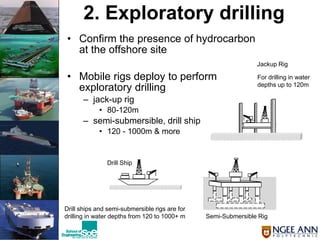
• Confirm the presence of hydrocarbon
at the offshore site
• Mobile rigs deploy to perform
exploratory drilling
– jack-up rig
• 80-120m
– semi-submersible, drill ship
• 120 - 1000m & more
Drill Ship
Drill ships and semi-submersible rigs are for
drilling in water depths from 120 to 1000+ m Semi-Submersible Rig
Jackup Rig
For drilling in water
depths up to 120m
Official Open
3. Development drilling
• Confirm the presence of hydrocarbon
at the site
• Installation of permanent and self-
containing structures
• Complete with topside facilities
(production, accommodation)
Official Open
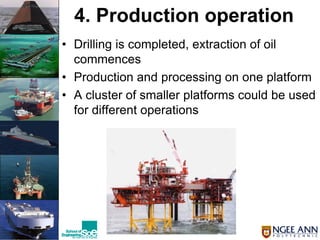
4. Production operation
• Drilling is completed, extraction of oil
commences
• Production and processing on one platform
• A cluster of smaller platforms could be used
for different operations
Official Open
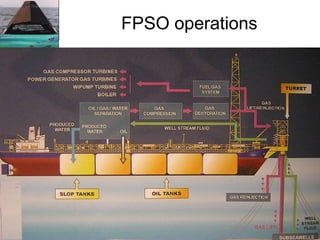
FPSO operations
Official Open
5. Transhipment of Crude
• Storage (mainly in production platforms)
– Steel jacket platform – no storage
capability
– Concrete gravity platform – temporary
storage
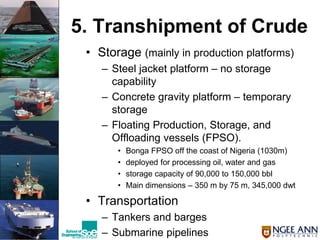
– Floating Production, Storage, and
Offloading vessels (FPSO).
• Bonga FPSO off the coast of Nigeria (1030m)
• deployed for processing oil, water and gas
• storage capacity of 90,000 to 150,000 bbl
• Main dimensions – 350 m by 75 m, 345,000 dwt
• Transportation
– Tankers and barges
– Submarine pipelines
Official Open
2. Types of Production Systems
Fixed vs Floating Systems comparison
Official Open
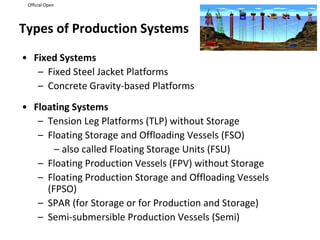
Types of Production Systems
• Fixed Systems
– Fixed Steel Jacket Platforms
– Concrete Gravity-based Platforms
• Floating Systems
– Tension Leg Platforms (TLP) without Storage
– Floating Storage and Offloading Vessels (FSO)
– also called Floating Storage Units (FSU)
– Floating Production Vessels (FPV) without Storage
– Floating Production Storage and Offloading Vessels
(FPSO)
– SPAR (for Storage or for Production and Storage)
– Semi-submersible Production Vessels (Semi)
Official Open
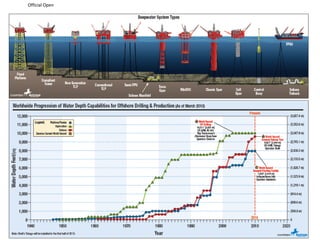
Types of Production Systems
Official Open
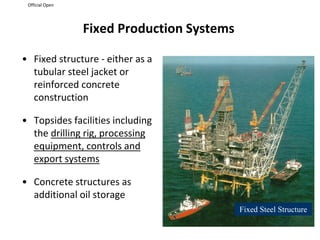
Fixed Production Systems
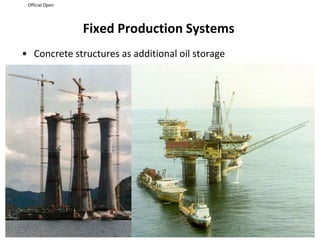
• Fixed structure - either as a
tubular steel jacket or
reinforced concrete
construction
• Topsides facilities including
the drilling rig, processing
equipment, controls and
export systems
• Concrete structures as
additional oil storage
Fixed Steel Structure
Official Open
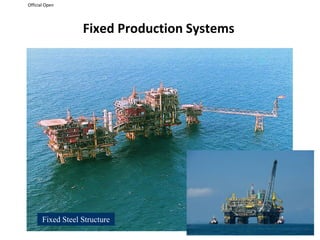
Fixed Production Systems
Fixed Steel Structure
Official Open
Fixed Production Systems
• Concrete structures as additional oil storage
Official Open
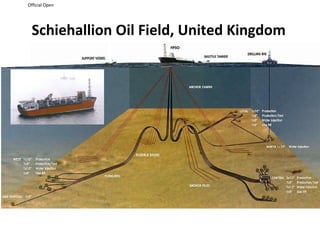
Subsea Production Systems
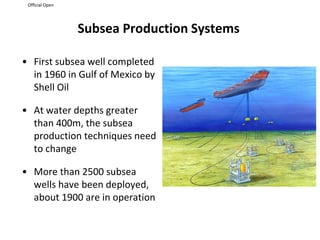
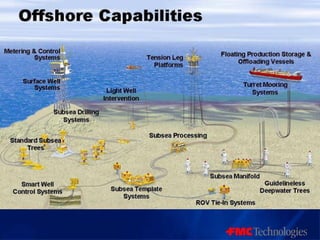
• First subsea well completed
in 1960 in Gulf of Mexico by
Shell Oil
• At water depths greater
than 400m, the subsea
production techniques need
to change
• More than 2500 subsea
wells have been deployed,
about 1900 are in operation
Official Open
Official Open
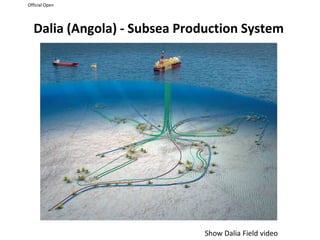
Dalia (Angola) - Subsea Production System
Show Dalia Field video
Official Open
Schiehallion Oil Field, United Kingdom
Official Open
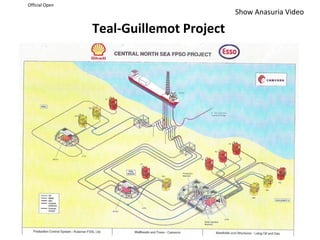
Teal-Guillemot Project
Anasuria
Show Anasuria Video
Official Open
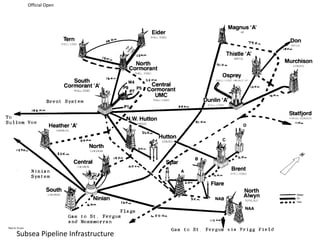
Northen North Sea - Pipeline Systems
Subsea Pipeline Infrastructure
Official Open
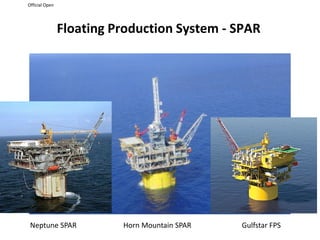
Floating Production System - SPAR
Horn Mountain SPAR Gulfstar FPS
Neptune SPAR
Official Open
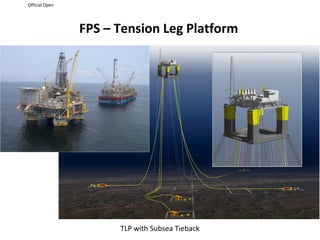
FPS – Tension Leg Platform
TLP with Subsea Tieback
Official Open
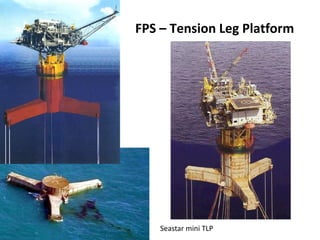
FPS – Tension Leg Platform
Seastar mini TLP
Official Open
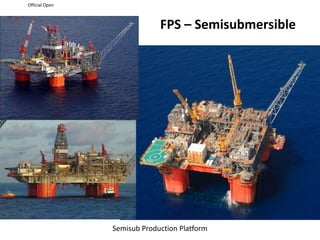
FPS – Semisubmersible
Semisub Production Platform
Official Open
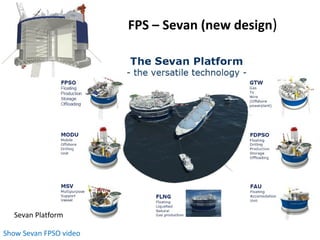
FPS – Sevan (new design)
Show Sevan FPSO video
Sevan Platform
Official Open
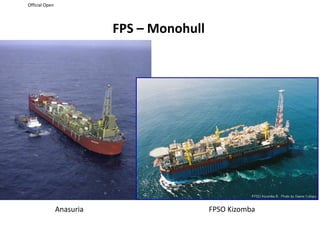
FPS – Monohull
Anasuria FPSO Kizomba
Official Open
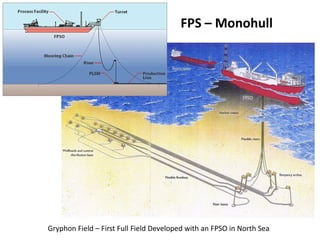
FPS – Monohull
Gryphon Field – First Full Field Developed with an FPSO in North Sea
Official Open
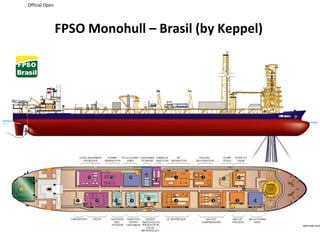
FPSO Monohull – Brasil (by Keppel)
Official Open
Official Open
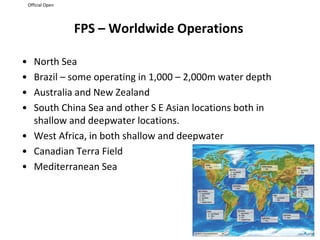
FPS – Worldwide Operations
• North Sea
• Brazil – some operating in 1,000 – 2,000m water depth
• Australia and New Zealand
• South China Sea and other S E Asian locations both in
shallow and deepwater locations.
• West Africa, in both shallow and deepwater
• Canadian Terra Field
• Mediterranean Sea
Official Open
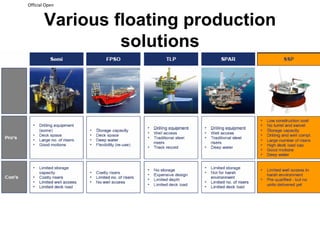
Various floating production
solutions
Official Open
3. Factors favouring deployment of Floating
Production Storage Offloading (FPSO)
Platform
Official Open
Factors Favouring
Floating Production and Subsea Systems
• Characteristics of Movement of FPS
• Location
• Field Size
• Water Depth
• Mobility
• Decommissioning and Reuse
Official Open
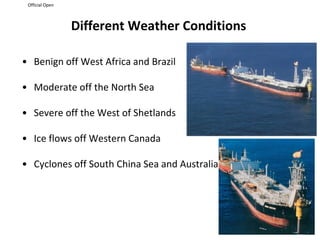
Different Weather Conditions
• Benign off West Africa and Brazil
• Moderate off the North Sea
• Severe off the West of Shetlands
• Ice flows off Western Canada
• Cyclones off South China Sea and Australia
Official Open
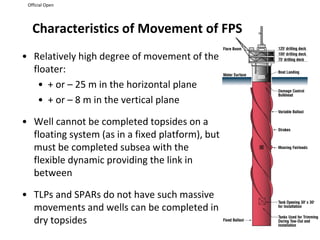
Characteristics of Movement of FPS
• Relatively high degree of movement of the
floater:
• + or – 25 m in the horizontal plane
• + or – 8 m in the vertical plane
• Well cannot be completed topsides on a
floating system (as in a fixed platform), but
must be completed subsea with the
flexible dynamic providing the link in
between
• TLPs and SPARs do not have such massive
movements and wells can be completed in
dry topsides
Official Open
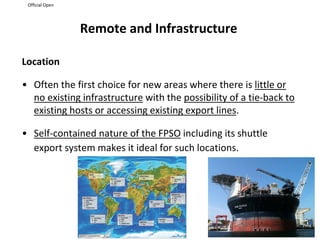
Remote and Infrastructure
Location
• Often the first choice for new areas where there is little or
no existing infrastructure with the possibility of a tie-back to
existing hosts or accessing existing export lines.
• Self-contained nature of the FPSO including its shuttle
export system makes it ideal for such locations.
Official Open
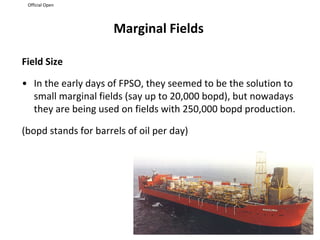
Marginal Fields
Field Size
• In the early days of FPSO, they seemed to be the solution to
small marginal fields (say up to 20,000 bopd), but nowadays
they are being used on fields with 250,000 bopd production.
(bopd stands for barrels of oil per day)
Official Open
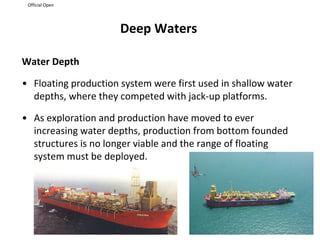
Deep Waters
Water Depth
• Floating production system were first used in shallow water
depths, where they competed with jack-up platforms.
• As exploration and production have moved to ever
increasing water depths, production from bottom founded
structures is no longer viable and the range of floating
system must be deployed.
Official Open
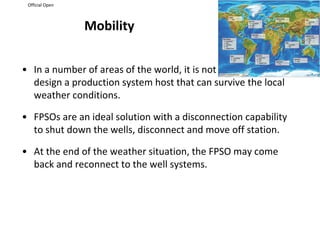
Mobility
• In a number of areas of the world, it is not possible to
design a production system host that can survive the local
weather conditions.
• FPSOs are an ideal solution with a disconnection capability
to shut down the wells, disconnect and move off station.
• At the end of the weather situation, the FPSO may come
back and reconnect to the well systems.
Official Open
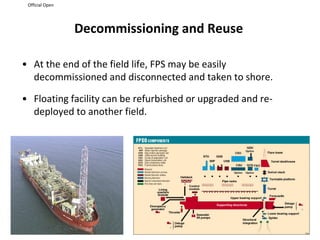
Decommissioning and Reuse
• At the end of the field life, FPS may be easily
decommissioned and disconnected and taken to shore.
• Floating facility can be refurbished or upgraded and re-
deployed to another field.
Official Open
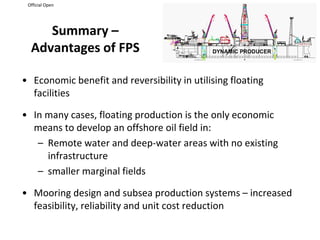
Summary –
Advantages of FPS
• Economic benefit and reversibility in utilising floating
facilities
• In many cases, floating production is the only economic
means to develop an offshore oil field in:
– Remote water and deep-water areas with no existing
infrastructure
– smaller marginal fields
• Mooring design and subsea production systems – increased
feasibility, reliability and unit cost reduction
Official Open
4. Key Functions of FPSO Platform
Official Open
FPSO - Floating Production
Storage and Offloading
By Floating - The body is in equilibrium when floating. This could include
Semi-subs, monohulls, deep draft semi-subs and spars, but does not include
TLPs. Note that the motion characteristics of the deep-draft semi-sub and the
spar permit the use of deck mounted "dry trees" whereas the first two types,
have normally to deploy subsea completed "wet trees".
By Production - the unit supports processing equipment to fully treat live well
fluids, with separation, gas compression, water injection, cooling and heating
systems, water treatment, fuel gas, chemical injection etc.
By Storage - the processed oil is held in tanks on the unit prior to export. Gas
cannot be stored and must be exported by pipeline, used for power generation,
re-injected, used for subsea gas-lifting or flared.
By Offloading - a means by which the oil product is transferred to a shuttle
tanker or other export system like pipelines.
Official Open
Key Questions
1. Provide any four (4) reasons why the floating production system is
preferred when compared to fixed production platform, especially in
offshore (deep water)
i.e. Explain the advantages of the floating over the fixed production
system in the context of:
– Location and field size
– Water depth
– Mobility
– Decommissioning and reuse
2. Describe in detail the 4 functions which make up the system
Floating, Production, Storage and Offloading (FPSO).

C1. Introduction to Offshore Production Tech

  • 1.
    Official Open Offshore ProductionTechnology Introduction to Offshore Production Technology Marine & Offshore Technology
  • 2.
    Official Open Learning Outcomes 1.Quick overview of Oil Production (covered in Offshore Drilling) 2. Types of Production Systems – Fixed vs Floating Systems comparison 3. Factors favouring deployment of Floating Production Storage Offloading (FPSO) Platform 4. Key Functions of FPSO Platform
  • 3.
    Official Open 1. Quickoverview of Oil Production (covered in Offshore Drilling)
  • 4.
    Official Open Drilling andProduction (overview) • Drilling is exploring after geographic/topographical and seismic studies • Production is to get the oil in large quantities to the surface for treatment and export
  • 5.
    Official Open World’s OilReserves US Energy Information Administration 2021
  • 6.
  • 7.
    Official Open Offshore Oil& Gas Production (overview) 1. Exploration 2. Exploratory drilling 3. Development drilling 4. Production operations 5. Transportation of products
  • 8.
    Official Open 1. Exploration •Traditional: Seismic survey – Study pressure waves thru Earth’s crust – Locate oil-bearing strata beneath the seabed floor – Seismic exploration – sends sound waves into the ground – Mobile vessel such core-drilling ship • Others – Gravimeters – Magnetometers – Sniffers
  • 9.
  • 10.
    Official Open 2. Exploratorydrilling • Confirm the presence of hydrocarbon at the offshore site • Mobile rigs deploy to perform exploratory drilling – jack-up rig • 80-120m – semi-submersible, drill ship • 120 - 1000m & more Drill Ship Drill ships and semi-submersible rigs are for drilling in water depths from 120 to 1000+ m Semi-Submersible Rig Jackup Rig For drilling in water depths up to 120m
  • 11.
    Official Open 3. Developmentdrilling • Confirm the presence of hydrocarbon at the site • Installation of permanent and self- containing structures • Complete with topside facilities (production, accommodation)
  • 12.
    Official Open 4. Productionoperation • Drilling is completed, extraction of oil commences • Production and processing on one platform • A cluster of smaller platforms could be used for different operations
  • 13.
  • 14.
    Official Open 5. Transhipmentof Crude • Storage (mainly in production platforms) – Steel jacket platform – no storage capability – Concrete gravity platform – temporary storage – Floating Production, Storage, and Offloading vessels (FPSO). • Bonga FPSO off the coast of Nigeria (1030m) • deployed for processing oil, water and gas • storage capacity of 90,000 to 150,000 bbl • Main dimensions – 350 m by 75 m, 345,000 dwt • Transportation – Tankers and barges – Submarine pipelines
  • 15.
    Official Open 2. Typesof Production Systems Fixed vs Floating Systems comparison
  • 16.
    Official Open Types ofProduction Systems • Fixed Systems – Fixed Steel Jacket Platforms – Concrete Gravity-based Platforms • Floating Systems – Tension Leg Platforms (TLP) without Storage – Floating Storage and Offloading Vessels (FSO) – also called Floating Storage Units (FSU) – Floating Production Vessels (FPV) without Storage – Floating Production Storage and Offloading Vessels (FPSO) – SPAR (for Storage or for Production and Storage) – Semi-submersible Production Vessels (Semi)
  • 17.
    Official Open Types ofProduction Systems
  • 18.
    Official Open Fixed ProductionSystems • Fixed structure - either as a tubular steel jacket or reinforced concrete construction • Topsides facilities including the drilling rig, processing equipment, controls and export systems • Concrete structures as additional oil storage Fixed Steel Structure
  • 19.
    Official Open Fixed ProductionSystems Fixed Steel Structure
  • 20.
    Official Open Fixed ProductionSystems • Concrete structures as additional oil storage
  • 21.
    Official Open Subsea ProductionSystems • First subsea well completed in 1960 in Gulf of Mexico by Shell Oil • At water depths greater than 400m, the subsea production techniques need to change • More than 2500 subsea wells have been deployed, about 1900 are in operation
  • 22.
  • 23.
    Official Open Dalia (Angola)- Subsea Production System Show Dalia Field video
  • 24.
    Official Open Schiehallion OilField, United Kingdom
  • 25.
  • 26.
    Official Open Northen NorthSea - Pipeline Systems Subsea Pipeline Infrastructure
  • 27.
    Official Open Floating ProductionSystem - SPAR Horn Mountain SPAR Gulfstar FPS Neptune SPAR
  • 28.
    Official Open FPS –Tension Leg Platform TLP with Subsea Tieback
  • 29.
    Official Open FPS –Tension Leg Platform Seastar mini TLP
  • 30.
    Official Open FPS –Semisubmersible Semisub Production Platform
  • 31.
    Official Open FPS –Sevan (new design) Show Sevan FPSO video Sevan Platform
  • 32.
    Official Open FPS –Monohull Anasuria FPSO Kizomba
  • 33.
    Official Open FPS –Monohull Gryphon Field – First Full Field Developed with an FPSO in North Sea
  • 34.
    Official Open FPSO Monohull– Brasil (by Keppel)
  • 35.
  • 36.
    Official Open FPS –Worldwide Operations • North Sea • Brazil – some operating in 1,000 – 2,000m water depth • Australia and New Zealand • South China Sea and other S E Asian locations both in shallow and deepwater locations. • West Africa, in both shallow and deepwater • Canadian Terra Field • Mediterranean Sea
  • 37.
    Official Open Various floatingproduction solutions
  • 38.
    Official Open 3. Factorsfavouring deployment of Floating Production Storage Offloading (FPSO) Platform
  • 39.
    Official Open Factors Favouring FloatingProduction and Subsea Systems • Characteristics of Movement of FPS • Location • Field Size • Water Depth • Mobility • Decommissioning and Reuse
  • 40.
    Official Open Different WeatherConditions • Benign off West Africa and Brazil • Moderate off the North Sea • Severe off the West of Shetlands • Ice flows off Western Canada • Cyclones off South China Sea and Australia
  • 41.
    Official Open Characteristics ofMovement of FPS • Relatively high degree of movement of the floater: • + or – 25 m in the horizontal plane • + or – 8 m in the vertical plane • Well cannot be completed topsides on a floating system (as in a fixed platform), but must be completed subsea with the flexible dynamic providing the link in between • TLPs and SPARs do not have such massive movements and wells can be completed in dry topsides
  • 42.
    Official Open Remote andInfrastructure Location • Often the first choice for new areas where there is little or no existing infrastructure with the possibility of a tie-back to existing hosts or accessing existing export lines. • Self-contained nature of the FPSO including its shuttle export system makes it ideal for such locations.
  • 43.
    Official Open Marginal Fields FieldSize • In the early days of FPSO, they seemed to be the solution to small marginal fields (say up to 20,000 bopd), but nowadays they are being used on fields with 250,000 bopd production. (bopd stands for barrels of oil per day)
  • 44.
    Official Open Deep Waters WaterDepth • Floating production system were first used in shallow water depths, where they competed with jack-up platforms. • As exploration and production have moved to ever increasing water depths, production from bottom founded structures is no longer viable and the range of floating system must be deployed.
  • 45.
    Official Open Mobility • Ina number of areas of the world, it is not possible to design a production system host that can survive the local weather conditions. • FPSOs are an ideal solution with a disconnection capability to shut down the wells, disconnect and move off station. • At the end of the weather situation, the FPSO may come back and reconnect to the well systems.
  • 46.
    Official Open Decommissioning andReuse • At the end of the field life, FPS may be easily decommissioned and disconnected and taken to shore. • Floating facility can be refurbished or upgraded and re- deployed to another field.
  • 47.
    Official Open Summary – Advantagesof FPS • Economic benefit and reversibility in utilising floating facilities • In many cases, floating production is the only economic means to develop an offshore oil field in: – Remote water and deep-water areas with no existing infrastructure – smaller marginal fields • Mooring design and subsea production systems – increased feasibility, reliability and unit cost reduction
  • 48.
    Official Open 4. KeyFunctions of FPSO Platform
  • 49.
    Official Open FPSO -Floating Production Storage and Offloading By Floating - The body is in equilibrium when floating. This could include Semi-subs, monohulls, deep draft semi-subs and spars, but does not include TLPs. Note that the motion characteristics of the deep-draft semi-sub and the spar permit the use of deck mounted "dry trees" whereas the first two types, have normally to deploy subsea completed "wet trees". By Production - the unit supports processing equipment to fully treat live well fluids, with separation, gas compression, water injection, cooling and heating systems, water treatment, fuel gas, chemical injection etc. By Storage - the processed oil is held in tanks on the unit prior to export. Gas cannot be stored and must be exported by pipeline, used for power generation, re-injected, used for subsea gas-lifting or flared. By Offloading - a means by which the oil product is transferred to a shuttle tanker or other export system like pipelines.
  • 50.
    Official Open Key Questions 1.Provide any four (4) reasons why the floating production system is preferred when compared to fixed production platform, especially in offshore (deep water) i.e. Explain the advantages of the floating over the fixed production system in the context of: – Location and field size – Water depth – Mobility – Decommissioning and reuse 2. Describe in detail the 4 functions which make up the system Floating, Production, Storage and Offloading (FPSO).