SHIP TYPESSHIP TYPES
1.1. General Cargo ShipsGeneral Cargo Ships
2.2. ContainerShipsContainerShips
3.3. TankersTankers
4.4. Dry Bulk CarriersDry Bulk Carriers
5.5. PassengerShipsPassengerShips
6.6. TugsTugs
7.7. Ice breakers &Ice strengthened shipsIce breakers &Ice strengthened ships
8.8. High speed craftsHigh speed crafts
9.9. Multi hulled vesselsMulti hulled vessels
10.10. Rigid Inflatable BoatsRigid Inflatable Boats
11.11. WarshipsWarships
12.12. Drilling RigsDrilling Rigs
 Packed, loaded andPacked, loaded and
stowed separatelystowed separately
 May have ‘tween deck’ forMay have ‘tween deck’ for
separation of cargo &separation of cargo &
facilitate loading &facilitate loading &
unloadingunloading
 Contains ‘Holds’, havingContains ‘Holds’, having
hatchcovershatchcovers
: Cargo carried loose in bulk: Cargo carried loose in bulk
1. General Cargo1. General Cargo
ShipsShips
1.1 Break Bulk
Cargo
1.2 Bulk Cargo
1.2.1 Hatch &Hatch1.2.1 Hatch &Hatch
CoveringCovering
FeaturesFeatures
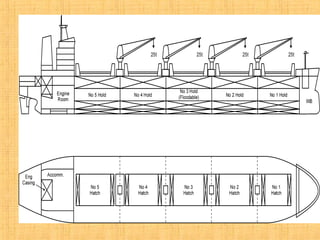
• Provided with hatch covers
• Hatch is generally 1/3 rd of beam of ship, to be as
large as
possible to facilitate loading/unloading
• Can be opened and closed using Gantry Crane
• Pontoon hatches are provided in ships upto 10,000
dwt
• Forupperdeck &tween deck, pintoon may weigh 25
tonnes
• In large bulk carriers, rolling hatchcovers are operated
by
movement in transverse direction.
1.2.2 Hatch &Hatch Covering1.2.2 Hatch &Hatch Covering
FeaturesFeatures
•Raised aboveDeck to to reducetherisk of
Flooding in heavy seas
•Can providesomecompensation for lossof
strength dueto thedeck opening
•Requirecareful planning whilerepairing to
assuredimensional accuracy.
• Design of securing arrangement isisimportant to
allow alittledistortion dueto movement of
structureduring loading / unloading operation.
 Designed forwheeled cargo (often formDesigned forwheeled cargo (often form
of trailer)of trailer)
 Cargo carrying section is large open-Cargo carrying section is large open-
deck with a loading ramp, usually at aftdeck with a loading ramp, usually at aft
end.end.
 Lo-Lo stands forLift-On Lift-Off forLo-Lo stands forLift-On Lift-Off for
cargoes moving with orwithout wheds;cargoes moving with orwithout wheds;
Cranes are used forloading /Cranes are used forloading /
discharging.discharging.
1.3.1.3. Ro-Ro ShipsRo-Ro Ships
(Roll –on, Roll-off ships)(Roll –on, Roll-off ships)
1.3.11.3.1 Structure of Ro-RoStructure of Ro-Ro
ShipsShips
 Wing Tank outboard of cargo deckWing Tank outboard of cargo deck
- provide longitudinal strength &- provide longitudinal strength &
stabilitystability
 Bulkheads up to lowest veicle deckBulkheads up to lowest veicle deck
 Machinery space and accommodationMachinery space and accommodation
aft.aft.
 Speed between 18 – 22 knotsSpeed between 18 – 22 knots
1.3.2. Double1.3.2. Double
BottomBottom
 Fitted along thelength of theship’sFitted along thelength of theship’s
length, divided into varioustankslength, divided into varioustanks
 DB Tanks– used for Fuel,DB Tanks– used for Fuel,
Lubricating Oils, Fresh Water orLubricating Oils, Fresh Water or
Ballast WaterBallast Water
FeaturesFeatures
1.3.31.3.3 Fore and Aft TanksFore and Aft Tanks
Features:-Features:-
 May Carry Ballast; may be used forMay Carry Ballast; may be used for
trimmingtrimming
Deep TanksDeep Tanks
FeaturesFeatures:-:-
 Fitted to carry liquid cargoes orwaterballastFitted to carry liquid cargoes orwaterballast
 Waterballast tanks are filled when the ship isWaterballast tanks are filled when the ship is
only partially loaded to provide sufficientonly partially loaded to provide sufficient
draught forstability, betterweight distributiondraught forstability, betterweight distribution
forlongitudinal strength &betterpropellerforlongitudinal strength &betterpropeller
immersionimmersion
1.3.41.3.4 Cranes and DericksCranes and Dericks
Features:-Features:-
 Typical Crane – 10-25 TonnesTypical Crane – 10-25 Tonnes
(reach 10-20 M)(reach 10-20 M)
 General Cargo ships can have –General Cargo ships can have –
Lifts upto 150 TonnesLifts upto 150 Tonnes
 Up to about 500 Tonnes lift – referredUp to about 500 Tonnes lift – referred
to as Heavy Lift Shipsto as Heavy Lift Ships
 Often well aft of the shipOften well aft of the ship
 There is usually one hold aft ofThere is usually one hold aft of
accommodation and machineryaccommodation and machinery
space to improve the trim ofspace to improve the trim of
the vessel when partiallythe vessel when partially
loadedloaded
1.3.51.3.5 Machinery SpaceMachinery Space
1.4 Bulk cargo Carriers1.4 Bulk cargo Carriers
 Pana maxPana max :: Beam is less than 32.25 mBeam is less than 32.25 m
 Suez maxSuez max :: To be able to transit SuezTo be able to transit Suez
Canal – Draught less thanCanal – Draught less than
19m.19m.
 Cape sizeCape size :: Without the restrictionsWithout the restrictions
stated abovestated above
 HandyHandy
sizesize
:: Less than 50,000 TonnesLess than 50,000 Tonnes
 Afra maxAfra max :: This refers to Tankers inThis refers to Tankers in
the range of 80,000 –the range of 80,000 –
 These are smallerthan the ShipsThese are smallerthan the Ships
used forcarriage of bulk cargoesused forcarriage of bulk cargoes
 Typically theirspeed range is 12Typically theirspeed range is 12
to 18 knotsto 18 knots
1.5.1.5. General Cargo ShipsGeneral Cargo Ships
 Refrigerated holds forcarrying perishableRefrigerated holds forcarrying perishable
cargoescargoes
 Holds are insulated to reduce heat transferHolds are insulated to reduce heat transfer
 Cargo can be frozen /orchilledCargo can be frozen /orchilled
 Effects of low temperature on surroundingEffects of low temperature on surrounding
structure must be considered in designstructure must be considered in design
 Refrigerated Fruits carried undermodifiedRefrigerated Fruits carried undermodified
atmosphere conditions – maintained inatmosphere conditions – maintained in
Nitrogen – rich environment, in orderto slowNitrogen – rich environment, in orderto slow
ripeningripening
1.6.1.6. Refrigerated Cargo ShipsRefrigerated Cargo Ships
Also known as ReefersAlso known as Reefers
 Ships designed forshortertrip.Ships designed forshortertrip.
 These ships are generally fasterThese ships are generally faster
than the General Cargo Ships –than the General Cargo Ships –
speed upto 22 knots.speed upto 22 knots.
 Can carry up to 12 (maximum)Can carry up to 12 (maximum)
passengers without the need topassengers without the need to
meet full passengershipmeet full passengership
regulations.regulations.
1.6.11.6.1 Refrigerated Cargo ShipsRefrigerated Cargo Ships
 Height of containeris dictated byHeight of containeris dictated by
the tunnels and bridges involvedthe tunnels and bridges involved
in land transportin land transport
 Weight of containeris dictated byWeight of containeris dictated by
wheel loading of lorries.wheel loading of lorries.
 Large containercarriers useLarge containercarriers use
dedicated Ports; therefore owndedicated Ports; therefore own
cargo-handling gantries are notcargo-handling gantries are not
required.required.
2.2. ContainerContainer
ShipsShips
2.12.1 Dimension of ContainersDimension of Containers
• Length of 20, 40 and 45 ft, width of 8 ft,
Height of 8.5 to 9 ft
• Ship isdivided into holdsto carry containers
• Holdsareseparated by deep web – framed structuresto
providetransversestrength.
• Out board of container holds, thestructureisboxlike
arrangement of wing tanksfor longitudinal & torsional
strength.
• DoubleBottom fitted to provideadditional ballast space;
also addsfor thelongitudinal strength.
• Accommodation & machinery spaceisusually located
2.22.2 TEUTEU
 No of 20 ft equivalent unit = TEUNo of 20 ft equivalent unit = TEU
 40 ft containeris 2 TEU40 ft containeris 2 TEU
 Concept work underway forship ofConcept work underway forship of
14000 TEU.14000 TEU.
 Containerships are fasterthan mostContainerships are fasterthan most
general cargo ships with speed uptogeneral cargo ships with speed upto
30 Knots30 Knots
 Can have own independent coolingCan have own independent cooling
plant; orcan be supplied withplant; orcan be supplied with
cooled airfrom ship’s refrigerationcooled airfrom ship’s refrigeration
systemsystem
 Temperature maintained at -27Temperature maintained at -27ºº c;c;
freezerunit at -60freezerunit at -60ºº cc
2.32.3 RefrigeratedRefrigerated
ContainersContainers
 These are a variant of containerThese are a variant of container
shipship
 Standard barges are carried intoStandard barges are carried into
which cargo is previously loaded.which cargo is previously loaded.
2.42.4 BarBarggee
CarriersCarriers
3. Bulk (Liquid &Gas)3. Bulk (Liquid &Gas)
Cargo CarriersCargo Carriers
These Bulk Carriers are subdivided into
(a) Tankers and (b) Dry Bulk Carriers
(a)(a) TankersTankers 1) Crude Oil Carriers1) Crude Oil Carriers
2) Product Carriers2) Product Carriers
3) Gas Carriers3) Gas Carriers
4) Chemical Carriers4) Chemical Carriers
3.1. Tankers3.1. Tankers
These are used fortransport of liquids.
They include:
3.1.13.1.1 Crude Oil CarriersCrude Oil Carriers
3.1.23.1.2 Product CarriersProduct Carriers
3.1.33.1.3 Gas CarriersGas Carriers
3.1.43.1.4 Chemical CarriersChemical Carriers
3.1.1. Crude Oil Carriers:3.1.1. Crude Oil Carriers:
Theseinclude:Theseinclude:
 ULCC (UltraLargeCrudeCarriers- ( >3,00,000ULCC (UltraLargeCrudeCarriers- ( >3,00,000
dwt)dwt)
 VLCC (Very LargeCrudeCarriers-VLCC (Very LargeCrudeCarriers-
(2,00,000 -3,00,000 dwt)(2,00,000 -3,00,000 dwt)
 Sizeand location of tanksdictated by IMOSizeand location of tanksdictated by IMO
convention (MARPOL 1973 / 78, accepted inconvention (MARPOL 1973 / 78, accepted in
1983). Theseregulationsrequiretheuseof1983). Theseregulationsrequiretheuseof
segregated ballast tanks. Segregated ballast tankssegregated ballast tanks. Segregated ballast tanks
enabletheshipsto operatewithout carrying ballastenabletheshipsto operatewithout carrying ballast
in Cargo tanks.in Cargo tanks.
 Permanent ballast tanks sufferPermanent ballast tanks suffer
corrosion once the protective coatingcorrosion once the protective coating
breaks down. High quality coating isbreaks down. High quality coating is
required, and back up anode systemrequired, and back up anode system
gives coverage of 10 mA /mgives coverage of 10 mA /m22
 Strain in the structure is measuredStrain in the structure is measuredbyby
placing strain gauges at key pointsplacing strain gauges at key points
3.1.1 Crude Oil Carriers3.1.1 Crude Oil Carriers::
 Crude oil, when refined, produce productsCrude oil, when refined, produce products
which provide gas oil, aviation fuel andwhich provide gas oil, aviation fuel and
Kerosene.Kerosene.
 In Product carriers, greatersubdivision ofIn Product carriers, greatersubdivision of
tanks are provided to carry differenttanks are provided to carry different
products.products.
 These are smallerthan crude oil carriersThese are smallerthan crude oil carriers
 Tank surfaces coated to preventTank surfaces coated to prevent
contamination.contamination.
 Sizes range from about 18,000 up toSizes range from about 18,000 up to
3.1.2. Product Carriers:3.1.2. Product Carriers:
3.1.3 Liquid Gas carriers3.1.3 Liquid Gas carriers
 Commonly carried liquefied gases are :Commonly carried liquefied gases are :
– ‘‘LNG’ ( Liquefied Natural Gas) &LNG’ ( Liquefied Natural Gas) &
– ‘‘LPG’ ( Liquefied Petroleum Gas)LPG’ ( Liquefied Petroleum Gas)
kept in liquid form by combination ofkept in liquid form by combination of
pressure &low temperature.pressure &low temperature.
 Natural gas is released as a result of Oil-Natural gas is released as a result of Oil-
drilling operation. It is a mixture ofdrilling operation. It is a mixture of
Methane, Ethane, Propane, Butane andMethane, Ethane, Propane, Butane and
Pentane.Pentane.
 The heaviergases i.e. Propane &ButaneThe heaviergases i.e. Propane &Butane
are termed as “Petroleum gases”are termed as “Petroleum gases”
 The remainder, i.e. largely MethaneThe remainder, i.e. largely Methane
is known as “Natural Gas”.is known as “Natural Gas”.
 Different types of storage duringDifferent types of storage during
transit are required as propertiestransit are required as properties
and behaviourof these two gasesand behaviourof these two gases
vary considerably.vary considerably.
3.1.3.3.1.3. Liquid Gas carriersLiquid Gas carriers
 Natural gas = 75-79% Methane,Natural gas = 75-79% Methane,
boiling point is -162boiling point is -162º C at atmosphericº C at atmospheric
pressure.pressure.
 Pressure of 47 barrequired to liquefyPressure of 47 barrequired to liquefy
Methane at -82º C (as Methane hasMethane at -82º C (as Methane has
critical temperature at -82º C.critical temperature at -82º C.
 LNG carriers – carry gas at atmosphericLNG carriers – carry gas at atmospheric
pressure and temperature of -164º C.pressure and temperature of -164º C.
 Tanks protected against the lowTanks protected against the low
temperature, to reduce loss of gas.temperature, to reduce loss of gas.
3.1.3 (a).3.1.3 (a). Natural Gas carriersNatural Gas carriers
 Tank designs are eithermembrane orTank designs are eithermembrane or
semi membrane. Membrane Tankssemi membrane. Membrane Tanks
have insulation between Tank &Hull.have insulation between Tank &Hull.
 Self supported tanks can accept anySelf supported tanks can accept any
load.load.
 Single ordouble metallic membraneSingle ordouble metallic membrane
can be used with insulation separatingcan be used with insulation separating
the membrane.the membrane.
 Semi membrane design has almostSemi membrane design has almost
rectangularcross section, with tanksrectangularcross section, with tanks
unsupported at corners.unsupported at corners.
3.1.3 (a).3.1.3 (a). Natural Gas carriersNatural Gas carriers
 The tanks and insulation structure isThe tanks and insulation structure is
surrounded by double hull, doublesurrounded by double hull, double
bottom.bottom.
 Accommodation, E/R– aft of ship withAccommodation, E/R– aft of ship with
a cofferdam.a cofferdam.
 LNG carriers – ships of about 1,40,000LNG carriers – ships of about 1,40,000
mm33
capacity, speed 16 – 19 knotscapacity, speed 16 – 19 knots
3.1.3 (a).3.1.3 (a). Natural Gas carriersNatural Gas carriers
 Petroleum GasPetroleum Gas – may bePropane, Propylene,– may bePropane, Propylene,
Butaneor amixture. All thesehavecriticalButaneor amixture. All thesehavecritical
temperatureabovenormal ambient temperaturetemperatureabovenormal ambient temperature
 Fully pressurised tank operatesat about 17 barsandFully pressurised tank operatesat about 17 barsand
isusually spherical or cylindrical for structuralisusually spherical or cylindrical for structural
efficiency.efficiency.
 LPG carriershaveflush deck with insulated,LPG carriershaveflush deck with insulated,
independent, prismatic cargo tanksindependent, prismatic cargo tanks
 Accommodation & machinery areright aft of ship.Accommodation & machinery areright aft of ship.
Cargo pumping, piping arrangement similar to LNGCargo pumping, piping arrangement similar to LNG
3.1.3 (b).3.1.3 (b). Petroleum Gas carriersPetroleum Gas carriers
 Cargo is toxic and flammableCargo is toxic and flammable
 Cargoes are segregated by cofferdamsCargoes are segregated by cofferdams
 Care taken to prevent fumesCare taken to prevent fumes
spreading to manned spacespreading to manned space
3.1.4.3.1.4. Chemical carriersChemical carriers
 Carry bulk cargoes: Grain, Coal, Iron ore,Carry bulk cargoes: Grain, Coal, Iron ore,
Bauxite, Phosphate, Nitrates.Bauxite, Phosphate, Nitrates.
 Sizes of ships increased with volume ofSizes of ships increased with volume of
demand. Ships of 2,00,000 dwt weredemand. Ships of 2,00,000 dwt were
operating by 1970, biggersizes were builtoperating by 1970, biggersizes were built
later.later.
 Losses of this type of vessels include totalLosses of this type of vessels include total
loss of 43 in 28 months, between 1990 –loss of 43 in 28 months, between 1990 –
1993 with 300 loss of lives.1993 with 300 loss of lives.
3.2.3.2. Dry Bulk CarriersDry Bulk Carriers
 Large Hatchways are a particularfeature ofLarge Hatchways are a particularfeature of
these vesselsthese vessels
 There are combination carriers – carryingThere are combination carriers – carrying
several bulk cargoes, e.g. Ore, Crude oil orseveral bulk cargoes, e.g. Ore, Crude oil or
dry bulk cargodry bulk cargo
 Stability &Wading manuals are supplied.Stability &Wading manuals are supplied.
Loading computerprogrammes are alsoLoading computerprogrammes are also
supplied to every ship.supplied to every ship.
3.2.3.2. Dry Bulk CarriersDry Bulk Carriers
3.2 (a) Ore Carriers3.2 (a) Ore Carriers
 Have two longitudinal bulkheads &a deepHave two longitudinal bulkheads &a deep
double bottom tank.double bottom tank.
 Deep double bottom raises the centre ofDeep double bottom raises the centre of
gravity of the cargo.gravity of the cargo.
 Ore /Bulk /Oil – i.e. OBO is the popularOre /Bulk /Oil – i.e. OBO is the popular
combination bulk carriercombination bulk carrier
 Cargo carrying cross section similartoCargo carrying cross section similarto
general bulk carrier, but the structure isgeneral bulk carrier, but the structure is
significantly stronger.significantly stronger.
Ore Carrier
3.2 (a) Ore Carriers3.2 (a) Ore Carriers
 Combination carriers have theirown cargoCombination carriers have theirown cargo
pumps.pumps.
 They confirm to the requirements ofThey confirm to the requirements of
MARPOL.MARPOL.
 Deadweight capacity = Range from small toDeadweight capacity = Range from small to
2,00,000 Tonnes2,00,000 Tonnes
 Typical = 1,50,000 to 1,60,000,Typical = 1,50,000 to 1,60,000,
L200m x b 45m &depth of 24mL200m x b 45m &depth of 24m
Nine holds hold some 1,80,000 mNine holds hold some 1,80,000 m33
grain.grain.
Ballast Tank of 75,000 mBallast Tank of 75,000 m33
capacitycapacity
Speed 15.5 knots on 14 MWpowerSpeed 15.5 knots on 14 MWpower
 Two Categories: (a) Cruise Ships (2) FerryTwo Categories: (a) Cruise Ships (2) Ferry
5. PassengerShips5. PassengerShips
(a):(a): Cruise Ships:Cruise Ships:
• Provided with high standard ofProvided with high standard of
accommodationaccommodation
• Leisure facilitiesLeisure facilities
• Anchorwell out in harbourand assisted byAnchorwell out in harbourand assisted by
smallerboats usuallysmallerboats usually
• Prominent features include largeProminent features include large
superstructuresuperstructure
• Many tiers of decks fitted with large openMany tiers of decks fitted with large open
lounges,lounges,
ballrooms, swimming pools and promenadeballrooms, swimming pools and promenade
5. PassengerShips5. PassengerShips
(b)(b) Large FerriesLarge Ferries
 TheseThese are combination of Ro-Ro &Passengerare combination of Ro-Ro &Passenger
vessel.vessel. Three Layers i.e.Three Layers i.e.  Lowermachinery spaceLowermachinery space
 Vehicle decksVehicle decks
 PassengeraccommodationPassengeraccommodation
 Large Stern Door, sometimes Bow DoorprovideLarge Stern Door, sometimes Bow Doorprovide
access forwheeled cargoaccess forwheeled cargo
Stabilizers and bow thrusters improve sea keepingStabilizers and bow thrusters improve sea keeping
and maneuverability.and maneuverability.
Speed usually 20 – 22 knotsSpeed usually 20 – 22 knots
When used as Ferry, vehicles enterat one end andWhen used as Ferry, vehicles enterat one end and
leave at the otherleave at the other
PassengerShip: Liner
6. Tugs6. Tugs
- Categorized as- Categorized as
::
 InlandInland
 CoastalCoastal
 OceangoingOceangoing
Tug is a means of applying externalTug is a means of applying external
force to vessel it is assisting. Thisforce to vessel it is assisting. This
force may be applied in the direct orforce may be applied in the direct or
indirect mode.indirect mode.
6.1 TUGS6.1 TUGS
 Direct mode of application of forceDirect mode of application of force
Majorcomponent of pull is providedMajorcomponent of pull is provided
by Tug’s propulsion system.by Tug’s propulsion system.
 In indirect modeIn indirect mode, pull is provided by, pull is provided by
the lift generated by the flow of waterthe lift generated by the flow of water
around tugs hullaround tugs hull
Tugs
 Efficient design forfree runningEfficient design forfree running
 High thrust at zero speedHigh thrust at zero speed
(Bollard Pull)(Bollard Pull)
 Good maneuverability to getGood maneuverability to get
close alongside the otherclose alongside the other
vessels, good stabilityvessels, good stability
6.2 Main features6.2 Main features
6.3 Classification of Tugs6.3 Classification of Tugs
(a)(a) Conventional TugsConventional Tugs: Shaft &Propeller(open: Shaft &Propeller(open
oror
nozzled, fixed orcontrollable pitch, bynozzled, fixed orcontrollable pitch, by
steerable nozzle orvertical axissteerable nozzle orvertical axis
propeller)propeller)
(b)(b) Stern Drive Tugs /orZ-drive tugsStern Drive Tugs /orZ-drive tugs
((as fitted with two right angle driveas fitted with two right angle drive
gears:)gears:)
 Stern cut awayStern cut away to accommodate twinto accommodate twin
azimuthing propellers.azimuthing propellers.
 These Propellers may be fixed /orThese Propellers may be fixed /or
c)c) TractorTugsTractorTugs::
 Unconventional Hull form withUnconventional Hull form with
Propulsors fitted underhull about 1/3Propulsors fitted underhull about 1/3rdrd
of length from bow &fitted with a skegof length from bow &fitted with a skeg
aft.aft.
 Propulsion by azumuthing units orPropulsion by azumuthing units or
vertical axis propellers.vertical axis propellers.
 They usually tow overstem orpushThey usually tow overstem orpush
with stem.with stem.
6.3 Classification of Tugs6.3 Classification of Tugs
(7) ICEBREAKERS AND(7) ICEBREAKERS AND
ICESTRENGTHENEDSHIPSICESTRENGTHENEDSHIPS
 Specially strengthened with steel to remainSpecially strengthened with steel to remain
tough at low temperaturetough at low temperature
 Extra structure at bow and along waterline.Extra structure at bow and along waterline.
 High Powerpropulsion &maneuveringHigh Powerpropulsion &maneuvering
devices.devices.
 Ride overice. Ship may ‘rock’ byRide overice. Ship may ‘rock’ by
transfering ballast waterlongitudinally.transfering ballast waterlongitudinally.
Protruding stabilisors are not acceptable.Protruding stabilisors are not acceptable.
 Good Hull sub deviationGood Hull sub deviation
 Special hull painterSpecial hull painter
(7) ICEBREAKERS AND(7) ICEBREAKERS AND
OTHEROPERATING IN VICINITY OFICEOTHEROPERATING IN VICINITY OFICE
 Usually cope with 1(One) yearold iceUsually cope with 1(One) yearold ice
ofof
50 to 100 cm thickness. Typically these50 to 100 cm thickness. Typically these
are of double hull design, thickerplatingare of double hull design, thickerplating
forward and in vicinity of waterline,forward and in vicinity of waterline,
with extra framing. Flat hull withwith extra framing. Flat hull with
rounded bow form. Rudders androunded bow form. Rudders and
propellers are protected by hull shape.propellers are protected by hull shape.
Inlets forengine must not get blockedInlets forengine must not get blocked..
(8) HIGHSPEEDCRAFT(8) HIGHSPEEDCRAFT
(Civil orMilitary Applications(Civil orMilitary Applications))
CatamaranCatamaran Avoid lossof stabilityAvoid lossof stability Provided with roundProvided with round
bilgemono hullbilgemono hull
HydrofoilHydrofoil Reduced resistanceReduced resistance Lift main hull fromLift main hull from
contact with watercontact with water
AircushionAircushion
VehiclesVehicles
Low resistanceLow resistance AmphibiousoperationAmphibiousoperation
Small water plateSmall water plate
AreaTwin HullAreaTwin Hull
(SWATH;(SWATH;
to reducewash)to reducewash)
High speed in restrictedHigh speed in restricted
waterwater
TransportTransport
Efficiency FactorEfficiency Factor
==
Payload x SpeedPayload x Speed
Installed PowerInstalled Power
Deciding factorin all above is
(a)
(8) HIGHSPEEDCRAFT(8) HIGHSPEEDCRAFT
(Civil orMilitary Applications(Civil orMilitary Applications))(b)
MONOHULLMONOHULL :- Characterised by:- Characterised by
 Hard ChimeHard Chime
 Reduced length &greaterReduced length &greater
beambeam
 Deep ‘V’ formDeep ‘V’ form
(i.e. higherdeadrise angle)(i.e. higherdeadrise angle)
 But current practice favours –But current practice favours –
round bilge forlowerpower,round bilge forlowerpower,
seakindliness, adoption ofseakindliness, adoption of
hardhard
chine forfroude Numberchine forfroude Number
(8) HIGHSPEEDCRAFT(8) HIGHSPEEDCRAFT
Civil orMilitary ApplicationsCivil orMilitary Applications))
Surface Effect Ships (SESs)
(c) HovercraftHovercraft::  Blow air under hull to lift theBlow air under hull to lift the
craft clear of water; containedcraft clear of water; contained
by skirtby skirt
 Propelled by airscrew of jetPropelled by airscrew of jet
engines.engines.
 Most SESshavealow length toMost SESshavealow length to
beam ratio.beam ratio.
(8) HIGHSPEEDCRAFT(8) HIGHSPEEDCRAFT
(Civil orMilitary Applications(Civil orMilitary Applications))
Surface Effect Ships (SESs)
(d) Hydrofoil(d) Hydrofoil
CraftCraft
 Attached with hydrofoil at bottomAttached with hydrofoil at bottom
Two typesof foilsTwo typesof foils
(i)(i) Completely submerged, incidenceCompletely submerged, incidence
controlled – reducecavitations,controlled – reducecavitations,
control angleof attack of thefoils.control angleof attack of thefoils.
ThisisactivesystemThisisactivesystem
(ii)(ii) Fixed surface– piercing foils. FoilsFixed surface– piercing foils. Foils
arranged asaladder either sideofarranged asaladder either sideof
hull.hull.
It isapassivesystemIt isapassivesystem
(9) Multihulled Vessels(9) Multihulled Vessels
Theseinclude:Theseinclude:
1)1) Catamarans2) Trimarans3) OffshorerigsCatamarans2) Trimarans3) Offshorerigs
4) Divinesupport vessels & 5) Ferries4) Divinesupport vessels & 5) Ferries
Catamarans:Catamarans: e.g. Ferries with assured stabilitye.g. Ferries with assured stability
Trimarans -Trimarans - Multichine side hull with plane bottom.Multichine side hull with plane bottom.
One vessel mv ‘Triton’ built in 2000 wasOne vessel mv ‘Triton’ built in 2000 was
successful. It was 98m, 20 knot craft,successful. It was 98m, 20 knot craft,
Diesel-Electric drive.Diesel-Electric drive.
Pentamarans:Pentamarans: These are developed version of Trimarans,These are developed version of Trimarans,
slenderhull form, have two small hullsslenderhull form, have two small hulls
each sideeach side
Multihulls are usually built of aluminiumMultihulls are usually built of aluminium
to preserve payloadto preserve payload
 First RIBwas in 1960:- having anFirst RIBwas in 1960:- having an
inflatable tube surrounding woodeninflatable tube surrounding wooden
hull.hull.
 Late hulls used reinforced plastic &Late hulls used reinforced plastic &
Aluminium hull. Length range 4-16m,Aluminium hull. Length range 4-16m,
speed 80 knots. Users includespeed 80 knots. Users include
Military, Coastguard, Custom &Military, Coastguard, Custom &
Excise,Excise,
Oil CompaniesOil Companies
(10) Rigid Inflatable boats (RIBs)(10) Rigid Inflatable boats (RIBs)
(11) WARSHIPS(11) WARSHIPS
 Interesting problems to Design ofInteresting problems to Design of
WarshipsWarships
 Need to carry sensors to detect enemyNeed to carry sensors to detect enemy
 Need weapons to defend and attackNeed weapons to defend and attack
 Least susceptibility to being hit.Least susceptibility to being hit.
 Least vulnerability to the effect of aLeast vulnerability to the effect of a
striking weapon.striking weapon.
 To have capacity forstealth.To have capacity forstealth.
 To betray presence by a variety ofTo betray presence by a variety of
signatures which include:signatures which include:
 Noise from propulsorNoise from propulsor: (fitting antinoise mountings: (fitting antinoise mountings
to noisy machines, applying special covering to hull,to noisy machines, applying special covering to hull,
smooth hull reduces turbulence.smooth hull reduces turbulence.
• Radarcross sectionRadarcross section: To scatterthe returning pulses: To scatterthe returning pulses
overwide areaoverwide area
•Infrared emissions from areas of heatInfrared emissions from areas of heat: Like, the: Like, the
funnel exhaust can be cooled &pointed in afunnel exhaust can be cooled &pointed in a
different direction.different direction.
• MagneticMagnetic: Built in magnetism can be countered by: Built in magnetism can be countered by
creating opposite field with special coils, carryingcreating opposite field with special coils, carrying
electrical current. This is called Degaussing.electrical current. This is called Degaussing.
• PressurePressure: Can change pressure field while moving: Can change pressure field while moving
through water&mines can respond to this. Thisthrough water&mines can respond to this. This
Types of WarshipsTypes of Warships
 Aircraft carriersAircraft carriers
 Guided MissileCruiserGuided MissileCruiser
Provides long range
surveillance and has
attack capability
Types of WarshipsTypes of Warships
 DestroyersDestroyers
 FrigateFrigate
Acts as an escort;
so fast and
maneuverable
Carry long &medium
range missile system.
These are fixed from
silos orspecialist
launchers, may be guided
all the way to the target
Types of WarshipsTypes of Warships
 Mine CountermeasureMine Countermeasure
vesselvessel
 SubmarineSubmarine
• Nowadyas hulls are made from Glass
Reinforced Plastics (GRP) &much of
equipments made from material with low
magnetic properties.
•These can sweep and hunt mines, or
combine two functions in one hull
Fires Torpedoes, lay mines and
land covert groups on enemy
coast. Stability becomes critical
between submerged and
surfaced condition. Fitted with
Periscopes to see outside
world.
Types of WarshipsTypes of Warships
 Support ShipSupport Ship
AmphibiousOperation ShipAmphibiousOperation Ship
An amphibious operation is a
military operation launched from
the sea by naval and landing
forces embarked in ships orcraft
involving a landing on a hostile or
potentially hostile shore
(12) Drilling Rigs T(12) Drilling Rigs Typesypes
 Included in the list are fixed-Included in the list are fixed-
piled structures which are notpiled structures which are not
mobile; and mentioned formobile; and mentioned for
complete coverage of all RIGcomplete coverage of all RIG
TYPESTYPES
(a) Fixed Piled Structures
(c) Submersible Barge
(d) Jack-up Barges
1. Individual legs
i). No leg footings
ii). With leg footings
2. Legs joined by lower
hull ormat
i) buoyant lower
hull
ii) Non-buoyant
mat
3. Constant height
problem
Jack-up Rig (Ocean MasterI)Jack-up Rig (Ocean MasterI)
 Thisunit hasthreetrust-typelegs, each 400-ft long, withThisunit hasthreetrust-typelegs, each 400-ft long, with
individual spud cansat thebottom. Thetrunnion-individual spud cansat thebottom. Thetrunnion-
mounted legsarearranged to tilt or spread at thebottommounted legsarearranged to tilt or spread at thebottom
to increasetheresistanceto overturning. Thetilt angleisto increasetheresistanceto overturning. Thetilt angleis
controlled by an electric motor-driven rack and pinioncontrolled by an electric motor-driven rack and pinion
located abovethehinges. Thelegshaveatriangularlocated abovethehinges. Thelegshaveatriangular
crosssection, and thetwo cornerscrosssection, and thetwo corners nearest thehull havenearest thehull have
frame-cut gear racks. Electric motorsdrivepinionsframe-cut gear racks. Electric motorsdrivepinions
which engagetheseracksto raiseand lower theunitsatwhich engagetheseracksto raiseand lower theunitsat
speedsup to 4.5 ft per min.speedsup to 4.5 ft per min.
 Thehull isapproximately hexagonal in shape, 211 byThehull isapproximately hexagonal in shape, 211 by
208 by 23 ft, with aslot in oneend for drilling. Quarters208 by 23 ft, with aslot in oneend for drilling. Quarters
areprovided for 45 men.areprovided for 45 men.
(e) Semi
submersibles
(f) Operational Jack-up Rigs
Footing of Rigs
Jack-up Rigs-Constant Platform Type
Floating Hulls
f) Floating Hulls
g) Special Types(Spar)
Dead weight anchorDead weight anchor

VARIOUS SHIP TYPES

  • 1.
    SHIP TYPESSHIP TYPES 1.1.General Cargo ShipsGeneral Cargo Ships 2.2. ContainerShipsContainerShips 3.3. TankersTankers 4.4. Dry Bulk CarriersDry Bulk Carriers 5.5. PassengerShipsPassengerShips 6.6. TugsTugs 7.7. Ice breakers &Ice strengthened shipsIce breakers &Ice strengthened ships 8.8. High speed craftsHigh speed crafts 9.9. Multi hulled vesselsMulti hulled vessels 10.10. Rigid Inflatable BoatsRigid Inflatable Boats 11.11. WarshipsWarships 12.12. Drilling RigsDrilling Rigs
  • 2.
     Packed, loadedandPacked, loaded and stowed separatelystowed separately  May have ‘tween deck’ forMay have ‘tween deck’ for separation of cargo &separation of cargo & facilitate loading &facilitate loading & unloadingunloading  Contains ‘Holds’, havingContains ‘Holds’, having hatchcovershatchcovers : Cargo carried loose in bulk: Cargo carried loose in bulk 1. General Cargo1. General Cargo ShipsShips 1.1 Break Bulk Cargo 1.2 Bulk Cargo
  • 3.
    1.2.1 Hatch &Hatch1.2.1Hatch &Hatch CoveringCovering FeaturesFeatures • Provided with hatch covers • Hatch is generally 1/3 rd of beam of ship, to be as large as possible to facilitate loading/unloading • Can be opened and closed using Gantry Crane • Pontoon hatches are provided in ships upto 10,000 dwt • Forupperdeck &tween deck, pintoon may weigh 25 tonnes • In large bulk carriers, rolling hatchcovers are operated by movement in transverse direction.
  • 4.
    1.2.2 Hatch &HatchCovering1.2.2 Hatch &Hatch Covering FeaturesFeatures •Raised aboveDeck to to reducetherisk of Flooding in heavy seas •Can providesomecompensation for lossof strength dueto thedeck opening •Requirecareful planning whilerepairing to assuredimensional accuracy. • Design of securing arrangement isisimportant to allow alittledistortion dueto movement of structureduring loading / unloading operation.
  • 5.
     Designed forwheeledcargo (often formDesigned forwheeled cargo (often form of trailer)of trailer)  Cargo carrying section is large open-Cargo carrying section is large open- deck with a loading ramp, usually at aftdeck with a loading ramp, usually at aft end.end.  Lo-Lo stands forLift-On Lift-Off forLo-Lo stands forLift-On Lift-Off for cargoes moving with orwithout wheds;cargoes moving with orwithout wheds; Cranes are used forloading /Cranes are used forloading / discharging.discharging. 1.3.1.3. Ro-Ro ShipsRo-Ro Ships (Roll –on, Roll-off ships)(Roll –on, Roll-off ships)
  • 6.
    1.3.11.3.1 Structure ofRo-RoStructure of Ro-Ro ShipsShips  Wing Tank outboard of cargo deckWing Tank outboard of cargo deck - provide longitudinal strength &- provide longitudinal strength & stabilitystability  Bulkheads up to lowest veicle deckBulkheads up to lowest veicle deck  Machinery space and accommodationMachinery space and accommodation aft.aft.  Speed between 18 – 22 knotsSpeed between 18 – 22 knots
  • 7.
    1.3.2. Double1.3.2. Double BottomBottom Fitted along thelength of theship’sFitted along thelength of theship’s length, divided into varioustankslength, divided into varioustanks  DB Tanks– used for Fuel,DB Tanks– used for Fuel, Lubricating Oils, Fresh Water orLubricating Oils, Fresh Water or Ballast WaterBallast Water FeaturesFeatures
  • 8.
    1.3.31.3.3 Fore andAft TanksFore and Aft Tanks Features:-Features:-  May Carry Ballast; may be used forMay Carry Ballast; may be used for trimmingtrimming Deep TanksDeep Tanks FeaturesFeatures:-:-  Fitted to carry liquid cargoes orwaterballastFitted to carry liquid cargoes orwaterballast  Waterballast tanks are filled when the ship isWaterballast tanks are filled when the ship is only partially loaded to provide sufficientonly partially loaded to provide sufficient draught forstability, betterweight distributiondraught forstability, betterweight distribution forlongitudinal strength &betterpropellerforlongitudinal strength &betterpropeller immersionimmersion
  • 9.
    1.3.41.3.4 Cranes andDericksCranes and Dericks Features:-Features:-  Typical Crane – 10-25 TonnesTypical Crane – 10-25 Tonnes (reach 10-20 M)(reach 10-20 M)  General Cargo ships can have –General Cargo ships can have – Lifts upto 150 TonnesLifts upto 150 Tonnes  Up to about 500 Tonnes lift – referredUp to about 500 Tonnes lift – referred to as Heavy Lift Shipsto as Heavy Lift Ships
  • 10.
     Often wellaft of the shipOften well aft of the ship  There is usually one hold aft ofThere is usually one hold aft of accommodation and machineryaccommodation and machinery space to improve the trim ofspace to improve the trim of the vessel when partiallythe vessel when partially loadedloaded 1.3.51.3.5 Machinery SpaceMachinery Space
  • 11.
    1.4 Bulk cargoCarriers1.4 Bulk cargo Carriers  Pana maxPana max :: Beam is less than 32.25 mBeam is less than 32.25 m  Suez maxSuez max :: To be able to transit SuezTo be able to transit Suez Canal – Draught less thanCanal – Draught less than 19m.19m.  Cape sizeCape size :: Without the restrictionsWithout the restrictions stated abovestated above  HandyHandy sizesize :: Less than 50,000 TonnesLess than 50,000 Tonnes  Afra maxAfra max :: This refers to Tankers inThis refers to Tankers in the range of 80,000 –the range of 80,000 –
  • 12.
     These aresmallerthan the ShipsThese are smallerthan the Ships used forcarriage of bulk cargoesused forcarriage of bulk cargoes  Typically theirspeed range is 12Typically theirspeed range is 12 to 18 knotsto 18 knots 1.5.1.5. General Cargo ShipsGeneral Cargo Ships
  • 14.
     Refrigerated holdsforcarrying perishableRefrigerated holds forcarrying perishable cargoescargoes  Holds are insulated to reduce heat transferHolds are insulated to reduce heat transfer  Cargo can be frozen /orchilledCargo can be frozen /orchilled  Effects of low temperature on surroundingEffects of low temperature on surrounding structure must be considered in designstructure must be considered in design  Refrigerated Fruits carried undermodifiedRefrigerated Fruits carried undermodified atmosphere conditions – maintained inatmosphere conditions – maintained in Nitrogen – rich environment, in orderto slowNitrogen – rich environment, in orderto slow ripeningripening 1.6.1.6. Refrigerated Cargo ShipsRefrigerated Cargo Ships Also known as ReefersAlso known as Reefers
  • 15.
     Ships designedforshortertrip.Ships designed forshortertrip.  These ships are generally fasterThese ships are generally faster than the General Cargo Ships –than the General Cargo Ships – speed upto 22 knots.speed upto 22 knots.  Can carry up to 12 (maximum)Can carry up to 12 (maximum) passengers without the need topassengers without the need to meet full passengershipmeet full passengership regulations.regulations. 1.6.11.6.1 Refrigerated Cargo ShipsRefrigerated Cargo Ships
  • 16.
     Height ofcontaineris dictated byHeight of containeris dictated by the tunnels and bridges involvedthe tunnels and bridges involved in land transportin land transport  Weight of containeris dictated byWeight of containeris dictated by wheel loading of lorries.wheel loading of lorries.  Large containercarriers useLarge containercarriers use dedicated Ports; therefore owndedicated Ports; therefore own cargo-handling gantries are notcargo-handling gantries are not required.required. 2.2. ContainerContainer ShipsShips
  • 17.
    2.12.1 Dimension ofContainersDimension of Containers • Length of 20, 40 and 45 ft, width of 8 ft, Height of 8.5 to 9 ft • Ship isdivided into holdsto carry containers • Holdsareseparated by deep web – framed structuresto providetransversestrength. • Out board of container holds, thestructureisboxlike arrangement of wing tanksfor longitudinal & torsional strength. • DoubleBottom fitted to provideadditional ballast space; also addsfor thelongitudinal strength. • Accommodation & machinery spaceisusually located
  • 18.
    2.22.2 TEUTEU  Noof 20 ft equivalent unit = TEUNo of 20 ft equivalent unit = TEU  40 ft containeris 2 TEU40 ft containeris 2 TEU  Concept work underway forship ofConcept work underway forship of 14000 TEU.14000 TEU.  Containerships are fasterthan mostContainerships are fasterthan most general cargo ships with speed uptogeneral cargo ships with speed upto 30 Knots30 Knots
  • 19.
     Can haveown independent coolingCan have own independent cooling plant; orcan be supplied withplant; orcan be supplied with cooled airfrom ship’s refrigerationcooled airfrom ship’s refrigeration systemsystem  Temperature maintained at -27Temperature maintained at -27ºº c;c; freezerunit at -60freezerunit at -60ºº cc 2.32.3 RefrigeratedRefrigerated ContainersContainers
  • 20.
     These area variant of containerThese are a variant of container shipship  Standard barges are carried intoStandard barges are carried into which cargo is previously loaded.which cargo is previously loaded. 2.42.4 BarBarggee CarriersCarriers
  • 21.
    3. Bulk (Liquid&Gas)3. Bulk (Liquid &Gas) Cargo CarriersCargo Carriers These Bulk Carriers are subdivided into (a) Tankers and (b) Dry Bulk Carriers (a)(a) TankersTankers 1) Crude Oil Carriers1) Crude Oil Carriers 2) Product Carriers2) Product Carriers 3) Gas Carriers3) Gas Carriers 4) Chemical Carriers4) Chemical Carriers
  • 22.
    3.1. Tankers3.1. Tankers Theseare used fortransport of liquids. They include: 3.1.13.1.1 Crude Oil CarriersCrude Oil Carriers 3.1.23.1.2 Product CarriersProduct Carriers 3.1.33.1.3 Gas CarriersGas Carriers 3.1.43.1.4 Chemical CarriersChemical Carriers
  • 23.
    3.1.1. Crude OilCarriers:3.1.1. Crude Oil Carriers: Theseinclude:Theseinclude:  ULCC (UltraLargeCrudeCarriers- ( >3,00,000ULCC (UltraLargeCrudeCarriers- ( >3,00,000 dwt)dwt)  VLCC (Very LargeCrudeCarriers-VLCC (Very LargeCrudeCarriers- (2,00,000 -3,00,000 dwt)(2,00,000 -3,00,000 dwt)  Sizeand location of tanksdictated by IMOSizeand location of tanksdictated by IMO convention (MARPOL 1973 / 78, accepted inconvention (MARPOL 1973 / 78, accepted in 1983). Theseregulationsrequiretheuseof1983). Theseregulationsrequiretheuseof segregated ballast tanks. Segregated ballast tankssegregated ballast tanks. Segregated ballast tanks enabletheshipsto operatewithout carrying ballastenabletheshipsto operatewithout carrying ballast in Cargo tanks.in Cargo tanks.
  • 24.
     Permanent ballasttanks sufferPermanent ballast tanks suffer corrosion once the protective coatingcorrosion once the protective coating breaks down. High quality coating isbreaks down. High quality coating is required, and back up anode systemrequired, and back up anode system gives coverage of 10 mA /mgives coverage of 10 mA /m22  Strain in the structure is measuredStrain in the structure is measuredbyby placing strain gauges at key pointsplacing strain gauges at key points 3.1.1 Crude Oil Carriers3.1.1 Crude Oil Carriers::
  • 25.
     Crude oil,when refined, produce productsCrude oil, when refined, produce products which provide gas oil, aviation fuel andwhich provide gas oil, aviation fuel and Kerosene.Kerosene.  In Product carriers, greatersubdivision ofIn Product carriers, greatersubdivision of tanks are provided to carry differenttanks are provided to carry different products.products.  These are smallerthan crude oil carriersThese are smallerthan crude oil carriers  Tank surfaces coated to preventTank surfaces coated to prevent contamination.contamination.  Sizes range from about 18,000 up toSizes range from about 18,000 up to 3.1.2. Product Carriers:3.1.2. Product Carriers:
  • 26.
    3.1.3 Liquid Gascarriers3.1.3 Liquid Gas carriers  Commonly carried liquefied gases are :Commonly carried liquefied gases are : – ‘‘LNG’ ( Liquefied Natural Gas) &LNG’ ( Liquefied Natural Gas) & – ‘‘LPG’ ( Liquefied Petroleum Gas)LPG’ ( Liquefied Petroleum Gas) kept in liquid form by combination ofkept in liquid form by combination of pressure &low temperature.pressure &low temperature.  Natural gas is released as a result of Oil-Natural gas is released as a result of Oil- drilling operation. It is a mixture ofdrilling operation. It is a mixture of Methane, Ethane, Propane, Butane andMethane, Ethane, Propane, Butane and Pentane.Pentane.  The heaviergases i.e. Propane &ButaneThe heaviergases i.e. Propane &Butane are termed as “Petroleum gases”are termed as “Petroleum gases”
  • 27.
     The remainder,i.e. largely MethaneThe remainder, i.e. largely Methane is known as “Natural Gas”.is known as “Natural Gas”.  Different types of storage duringDifferent types of storage during transit are required as propertiestransit are required as properties and behaviourof these two gasesand behaviourof these two gases vary considerably.vary considerably. 3.1.3.3.1.3. Liquid Gas carriersLiquid Gas carriers
  • 28.
     Natural gas= 75-79% Methane,Natural gas = 75-79% Methane, boiling point is -162boiling point is -162º C at atmosphericº C at atmospheric pressure.pressure.  Pressure of 47 barrequired to liquefyPressure of 47 barrequired to liquefy Methane at -82º C (as Methane hasMethane at -82º C (as Methane has critical temperature at -82º C.critical temperature at -82º C.  LNG carriers – carry gas at atmosphericLNG carriers – carry gas at atmospheric pressure and temperature of -164º C.pressure and temperature of -164º C.  Tanks protected against the lowTanks protected against the low temperature, to reduce loss of gas.temperature, to reduce loss of gas. 3.1.3 (a).3.1.3 (a). Natural Gas carriersNatural Gas carriers
  • 29.
     Tank designsare eithermembrane orTank designs are eithermembrane or semi membrane. Membrane Tankssemi membrane. Membrane Tanks have insulation between Tank &Hull.have insulation between Tank &Hull.  Self supported tanks can accept anySelf supported tanks can accept any load.load.  Single ordouble metallic membraneSingle ordouble metallic membrane can be used with insulation separatingcan be used with insulation separating the membrane.the membrane.  Semi membrane design has almostSemi membrane design has almost rectangularcross section, with tanksrectangularcross section, with tanks unsupported at corners.unsupported at corners. 3.1.3 (a).3.1.3 (a). Natural Gas carriersNatural Gas carriers
  • 31.
     The tanksand insulation structure isThe tanks and insulation structure is surrounded by double hull, doublesurrounded by double hull, double bottom.bottom.  Accommodation, E/R– aft of ship withAccommodation, E/R– aft of ship with a cofferdam.a cofferdam.  LNG carriers – ships of about 1,40,000LNG carriers – ships of about 1,40,000 mm33 capacity, speed 16 – 19 knotscapacity, speed 16 – 19 knots 3.1.3 (a).3.1.3 (a). Natural Gas carriersNatural Gas carriers
  • 32.
     Petroleum GasPetroleumGas – may bePropane, Propylene,– may bePropane, Propylene, Butaneor amixture. All thesehavecriticalButaneor amixture. All thesehavecritical temperatureabovenormal ambient temperaturetemperatureabovenormal ambient temperature  Fully pressurised tank operatesat about 17 barsandFully pressurised tank operatesat about 17 barsand isusually spherical or cylindrical for structuralisusually spherical or cylindrical for structural efficiency.efficiency.  LPG carriershaveflush deck with insulated,LPG carriershaveflush deck with insulated, independent, prismatic cargo tanksindependent, prismatic cargo tanks  Accommodation & machinery areright aft of ship.Accommodation & machinery areright aft of ship. Cargo pumping, piping arrangement similar to LNGCargo pumping, piping arrangement similar to LNG 3.1.3 (b).3.1.3 (b). Petroleum Gas carriersPetroleum Gas carriers
  • 33.
     Cargo istoxic and flammableCargo is toxic and flammable  Cargoes are segregated by cofferdamsCargoes are segregated by cofferdams  Care taken to prevent fumesCare taken to prevent fumes spreading to manned spacespreading to manned space 3.1.4.3.1.4. Chemical carriersChemical carriers
  • 34.
     Carry bulkcargoes: Grain, Coal, Iron ore,Carry bulk cargoes: Grain, Coal, Iron ore, Bauxite, Phosphate, Nitrates.Bauxite, Phosphate, Nitrates.  Sizes of ships increased with volume ofSizes of ships increased with volume of demand. Ships of 2,00,000 dwt weredemand. Ships of 2,00,000 dwt were operating by 1970, biggersizes were builtoperating by 1970, biggersizes were built later.later.  Losses of this type of vessels include totalLosses of this type of vessels include total loss of 43 in 28 months, between 1990 –loss of 43 in 28 months, between 1990 – 1993 with 300 loss of lives.1993 with 300 loss of lives. 3.2.3.2. Dry Bulk CarriersDry Bulk Carriers
  • 35.
     Large Hatchwaysare a particularfeature ofLarge Hatchways are a particularfeature of these vesselsthese vessels  There are combination carriers – carryingThere are combination carriers – carrying several bulk cargoes, e.g. Ore, Crude oil orseveral bulk cargoes, e.g. Ore, Crude oil or dry bulk cargodry bulk cargo  Stability &Wading manuals are supplied.Stability &Wading manuals are supplied. Loading computerprogrammes are alsoLoading computerprogrammes are also supplied to every ship.supplied to every ship. 3.2.3.2. Dry Bulk CarriersDry Bulk Carriers
  • 37.
    3.2 (a) OreCarriers3.2 (a) Ore Carriers  Have two longitudinal bulkheads &a deepHave two longitudinal bulkheads &a deep double bottom tank.double bottom tank.  Deep double bottom raises the centre ofDeep double bottom raises the centre of gravity of the cargo.gravity of the cargo.  Ore /Bulk /Oil – i.e. OBO is the popularOre /Bulk /Oil – i.e. OBO is the popular combination bulk carriercombination bulk carrier  Cargo carrying cross section similartoCargo carrying cross section similarto general bulk carrier, but the structure isgeneral bulk carrier, but the structure is significantly stronger.significantly stronger.
  • 38.
  • 39.
    3.2 (a) OreCarriers3.2 (a) Ore Carriers  Combination carriers have theirown cargoCombination carriers have theirown cargo pumps.pumps.  They confirm to the requirements ofThey confirm to the requirements of MARPOL.MARPOL.  Deadweight capacity = Range from small toDeadweight capacity = Range from small to 2,00,000 Tonnes2,00,000 Tonnes  Typical = 1,50,000 to 1,60,000,Typical = 1,50,000 to 1,60,000, L200m x b 45m &depth of 24mL200m x b 45m &depth of 24m Nine holds hold some 1,80,000 mNine holds hold some 1,80,000 m33 grain.grain. Ballast Tank of 75,000 mBallast Tank of 75,000 m33 capacitycapacity Speed 15.5 knots on 14 MWpowerSpeed 15.5 knots on 14 MWpower
  • 40.
     Two Categories:(a) Cruise Ships (2) FerryTwo Categories: (a) Cruise Ships (2) Ferry 5. PassengerShips5. PassengerShips (a):(a): Cruise Ships:Cruise Ships: • Provided with high standard ofProvided with high standard of accommodationaccommodation • Leisure facilitiesLeisure facilities • Anchorwell out in harbourand assisted byAnchorwell out in harbourand assisted by smallerboats usuallysmallerboats usually • Prominent features include largeProminent features include large superstructuresuperstructure • Many tiers of decks fitted with large openMany tiers of decks fitted with large open lounges,lounges, ballrooms, swimming pools and promenadeballrooms, swimming pools and promenade
  • 41.
    5. PassengerShips5. PassengerShips (b)(b)Large FerriesLarge Ferries  TheseThese are combination of Ro-Ro &Passengerare combination of Ro-Ro &Passenger vessel.vessel. Three Layers i.e.Three Layers i.e.  Lowermachinery spaceLowermachinery space  Vehicle decksVehicle decks  PassengeraccommodationPassengeraccommodation  Large Stern Door, sometimes Bow DoorprovideLarge Stern Door, sometimes Bow Doorprovide access forwheeled cargoaccess forwheeled cargo Stabilizers and bow thrusters improve sea keepingStabilizers and bow thrusters improve sea keeping and maneuverability.and maneuverability. Speed usually 20 – 22 knotsSpeed usually 20 – 22 knots When used as Ferry, vehicles enterat one end andWhen used as Ferry, vehicles enterat one end and leave at the otherleave at the other
  • 42.
  • 43.
    6. Tugs6. Tugs -Categorized as- Categorized as ::  InlandInland  CoastalCoastal  OceangoingOceangoing Tug is a means of applying externalTug is a means of applying external force to vessel it is assisting. Thisforce to vessel it is assisting. This force may be applied in the direct orforce may be applied in the direct or indirect mode.indirect mode.
  • 44.
    6.1 TUGS6.1 TUGS Direct mode of application of forceDirect mode of application of force Majorcomponent of pull is providedMajorcomponent of pull is provided by Tug’s propulsion system.by Tug’s propulsion system.  In indirect modeIn indirect mode, pull is provided by, pull is provided by the lift generated by the flow of waterthe lift generated by the flow of water around tugs hullaround tugs hull
  • 45.
  • 46.
     Efficient designforfree runningEfficient design forfree running  High thrust at zero speedHigh thrust at zero speed (Bollard Pull)(Bollard Pull)  Good maneuverability to getGood maneuverability to get close alongside the otherclose alongside the other vessels, good stabilityvessels, good stability 6.2 Main features6.2 Main features
  • 47.
    6.3 Classification ofTugs6.3 Classification of Tugs (a)(a) Conventional TugsConventional Tugs: Shaft &Propeller(open: Shaft &Propeller(open oror nozzled, fixed orcontrollable pitch, bynozzled, fixed orcontrollable pitch, by steerable nozzle orvertical axissteerable nozzle orvertical axis propeller)propeller) (b)(b) Stern Drive Tugs /orZ-drive tugsStern Drive Tugs /orZ-drive tugs ((as fitted with two right angle driveas fitted with two right angle drive gears:)gears:)  Stern cut awayStern cut away to accommodate twinto accommodate twin azimuthing propellers.azimuthing propellers.  These Propellers may be fixed /orThese Propellers may be fixed /or
  • 48.
    c)c) TractorTugsTractorTugs::  UnconventionalHull form withUnconventional Hull form with Propulsors fitted underhull about 1/3Propulsors fitted underhull about 1/3rdrd of length from bow &fitted with a skegof length from bow &fitted with a skeg aft.aft.  Propulsion by azumuthing units orPropulsion by azumuthing units or vertical axis propellers.vertical axis propellers.  They usually tow overstem orpushThey usually tow overstem orpush with stem.with stem. 6.3 Classification of Tugs6.3 Classification of Tugs
  • 49.
    (7) ICEBREAKERS AND(7)ICEBREAKERS AND ICESTRENGTHENEDSHIPSICESTRENGTHENEDSHIPS  Specially strengthened with steel to remainSpecially strengthened with steel to remain tough at low temperaturetough at low temperature  Extra structure at bow and along waterline.Extra structure at bow and along waterline.  High Powerpropulsion &maneuveringHigh Powerpropulsion &maneuvering devices.devices.  Ride overice. Ship may ‘rock’ byRide overice. Ship may ‘rock’ by transfering ballast waterlongitudinally.transfering ballast waterlongitudinally. Protruding stabilisors are not acceptable.Protruding stabilisors are not acceptable.  Good Hull sub deviationGood Hull sub deviation  Special hull painterSpecial hull painter
  • 50.
    (7) ICEBREAKERS AND(7)ICEBREAKERS AND OTHEROPERATING IN VICINITY OFICEOTHEROPERATING IN VICINITY OFICE  Usually cope with 1(One) yearold iceUsually cope with 1(One) yearold ice ofof 50 to 100 cm thickness. Typically these50 to 100 cm thickness. Typically these are of double hull design, thickerplatingare of double hull design, thickerplating forward and in vicinity of waterline,forward and in vicinity of waterline, with extra framing. Flat hull withwith extra framing. Flat hull with rounded bow form. Rudders androunded bow form. Rudders and propellers are protected by hull shape.propellers are protected by hull shape. Inlets forengine must not get blockedInlets forengine must not get blocked..
  • 51.
    (8) HIGHSPEEDCRAFT(8) HIGHSPEEDCRAFT (CivilorMilitary Applications(Civil orMilitary Applications)) CatamaranCatamaran Avoid lossof stabilityAvoid lossof stability Provided with roundProvided with round bilgemono hullbilgemono hull HydrofoilHydrofoil Reduced resistanceReduced resistance Lift main hull fromLift main hull from contact with watercontact with water AircushionAircushion VehiclesVehicles Low resistanceLow resistance AmphibiousoperationAmphibiousoperation Small water plateSmall water plate AreaTwin HullAreaTwin Hull (SWATH;(SWATH; to reducewash)to reducewash) High speed in restrictedHigh speed in restricted waterwater TransportTransport Efficiency FactorEfficiency Factor == Payload x SpeedPayload x Speed Installed PowerInstalled Power Deciding factorin all above is (a)
  • 52.
    (8) HIGHSPEEDCRAFT(8) HIGHSPEEDCRAFT (CivilorMilitary Applications(Civil orMilitary Applications))(b) MONOHULLMONOHULL :- Characterised by:- Characterised by  Hard ChimeHard Chime  Reduced length &greaterReduced length &greater beambeam  Deep ‘V’ formDeep ‘V’ form (i.e. higherdeadrise angle)(i.e. higherdeadrise angle)  But current practice favours –But current practice favours – round bilge forlowerpower,round bilge forlowerpower, seakindliness, adoption ofseakindliness, adoption of hardhard chine forfroude Numberchine forfroude Number
  • 53.
    (8) HIGHSPEEDCRAFT(8) HIGHSPEEDCRAFT CivilorMilitary ApplicationsCivil orMilitary Applications)) Surface Effect Ships (SESs) (c) HovercraftHovercraft::  Blow air under hull to lift theBlow air under hull to lift the craft clear of water; containedcraft clear of water; contained by skirtby skirt  Propelled by airscrew of jetPropelled by airscrew of jet engines.engines.  Most SESshavealow length toMost SESshavealow length to beam ratio.beam ratio.
  • 54.
    (8) HIGHSPEEDCRAFT(8) HIGHSPEEDCRAFT (CivilorMilitary Applications(Civil orMilitary Applications)) Surface Effect Ships (SESs) (d) Hydrofoil(d) Hydrofoil CraftCraft  Attached with hydrofoil at bottomAttached with hydrofoil at bottom Two typesof foilsTwo typesof foils (i)(i) Completely submerged, incidenceCompletely submerged, incidence controlled – reducecavitations,controlled – reducecavitations, control angleof attack of thefoils.control angleof attack of thefoils. ThisisactivesystemThisisactivesystem (ii)(ii) Fixed surface– piercing foils. FoilsFixed surface– piercing foils. Foils arranged asaladder either sideofarranged asaladder either sideof hull.hull. It isapassivesystemIt isapassivesystem
  • 55.
    (9) Multihulled Vessels(9)Multihulled Vessels Theseinclude:Theseinclude: 1)1) Catamarans2) Trimarans3) OffshorerigsCatamarans2) Trimarans3) Offshorerigs 4) Divinesupport vessels & 5) Ferries4) Divinesupport vessels & 5) Ferries Catamarans:Catamarans: e.g. Ferries with assured stabilitye.g. Ferries with assured stability Trimarans -Trimarans - Multichine side hull with plane bottom.Multichine side hull with plane bottom. One vessel mv ‘Triton’ built in 2000 wasOne vessel mv ‘Triton’ built in 2000 was successful. It was 98m, 20 knot craft,successful. It was 98m, 20 knot craft, Diesel-Electric drive.Diesel-Electric drive. Pentamarans:Pentamarans: These are developed version of Trimarans,These are developed version of Trimarans, slenderhull form, have two small hullsslenderhull form, have two small hulls each sideeach side Multihulls are usually built of aluminiumMultihulls are usually built of aluminium to preserve payloadto preserve payload
  • 56.
     First RIBwasin 1960:- having anFirst RIBwas in 1960:- having an inflatable tube surrounding woodeninflatable tube surrounding wooden hull.hull.  Late hulls used reinforced plastic &Late hulls used reinforced plastic & Aluminium hull. Length range 4-16m,Aluminium hull. Length range 4-16m, speed 80 knots. Users includespeed 80 knots. Users include Military, Coastguard, Custom &Military, Coastguard, Custom & Excise,Excise, Oil CompaniesOil Companies (10) Rigid Inflatable boats (RIBs)(10) Rigid Inflatable boats (RIBs)
  • 57.
    (11) WARSHIPS(11) WARSHIPS Interesting problems to Design ofInteresting problems to Design of WarshipsWarships  Need to carry sensors to detect enemyNeed to carry sensors to detect enemy  Need weapons to defend and attackNeed weapons to defend and attack  Least susceptibility to being hit.Least susceptibility to being hit.  Least vulnerability to the effect of aLeast vulnerability to the effect of a striking weapon.striking weapon.  To have capacity forstealth.To have capacity forstealth.  To betray presence by a variety ofTo betray presence by a variety of signatures which include:signatures which include:
  • 58.
     Noise frompropulsorNoise from propulsor: (fitting antinoise mountings: (fitting antinoise mountings to noisy machines, applying special covering to hull,to noisy machines, applying special covering to hull, smooth hull reduces turbulence.smooth hull reduces turbulence. • Radarcross sectionRadarcross section: To scatterthe returning pulses: To scatterthe returning pulses overwide areaoverwide area •Infrared emissions from areas of heatInfrared emissions from areas of heat: Like, the: Like, the funnel exhaust can be cooled &pointed in afunnel exhaust can be cooled &pointed in a different direction.different direction. • MagneticMagnetic: Built in magnetism can be countered by: Built in magnetism can be countered by creating opposite field with special coils, carryingcreating opposite field with special coils, carrying electrical current. This is called Degaussing.electrical current. This is called Degaussing. • PressurePressure: Can change pressure field while moving: Can change pressure field while moving through water&mines can respond to this. Thisthrough water&mines can respond to this. This
  • 59.
    Types of WarshipsTypesof Warships  Aircraft carriersAircraft carriers  Guided MissileCruiserGuided MissileCruiser Provides long range surveillance and has attack capability
  • 60.
    Types of WarshipsTypesof Warships  DestroyersDestroyers  FrigateFrigate Acts as an escort; so fast and maneuverable Carry long &medium range missile system. These are fixed from silos orspecialist launchers, may be guided all the way to the target
  • 61.
    Types of WarshipsTypesof Warships  Mine CountermeasureMine Countermeasure vesselvessel  SubmarineSubmarine • Nowadyas hulls are made from Glass Reinforced Plastics (GRP) &much of equipments made from material with low magnetic properties. •These can sweep and hunt mines, or combine two functions in one hull Fires Torpedoes, lay mines and land covert groups on enemy coast. Stability becomes critical between submerged and surfaced condition. Fitted with Periscopes to see outside world.
  • 62.
    Types of WarshipsTypesof Warships  Support ShipSupport Ship AmphibiousOperation ShipAmphibiousOperation Ship An amphibious operation is a military operation launched from the sea by naval and landing forces embarked in ships orcraft involving a landing on a hostile or potentially hostile shore
  • 63.
    (12) Drilling RigsT(12) Drilling Rigs Typesypes  Included in the list are fixed-Included in the list are fixed- piled structures which are notpiled structures which are not mobile; and mentioned formobile; and mentioned for complete coverage of all RIGcomplete coverage of all RIG TYPESTYPES
  • 64.
    (a) Fixed PiledStructures
  • 65.
  • 66.
    (d) Jack-up Barges 1.Individual legs i). No leg footings ii). With leg footings 2. Legs joined by lower hull ormat i) buoyant lower hull ii) Non-buoyant mat 3. Constant height problem
  • 67.
    Jack-up Rig (OceanMasterI)Jack-up Rig (Ocean MasterI)  Thisunit hasthreetrust-typelegs, each 400-ft long, withThisunit hasthreetrust-typelegs, each 400-ft long, with individual spud cansat thebottom. Thetrunnion-individual spud cansat thebottom. Thetrunnion- mounted legsarearranged to tilt or spread at thebottommounted legsarearranged to tilt or spread at thebottom to increasetheresistanceto overturning. Thetilt angleisto increasetheresistanceto overturning. Thetilt angleis controlled by an electric motor-driven rack and pinioncontrolled by an electric motor-driven rack and pinion located abovethehinges. Thelegshaveatriangularlocated abovethehinges. Thelegshaveatriangular crosssection, and thetwo cornerscrosssection, and thetwo corners nearest thehull havenearest thehull have frame-cut gear racks. Electric motorsdrivepinionsframe-cut gear racks. Electric motorsdrivepinions which engagetheseracksto raiseand lower theunitsatwhich engagetheseracksto raiseand lower theunitsat speedsup to 4.5 ft per min.speedsup to 4.5 ft per min.  Thehull isapproximately hexagonal in shape, 211 byThehull isapproximately hexagonal in shape, 211 by 208 by 23 ft, with aslot in oneend for drilling. Quarters208 by 23 ft, with aslot in oneend for drilling. Quarters areprovided for 45 men.areprovided for 45 men.
  • 68.
  • 69.
  • 70.
  • 71.
  • 72.
  • 73.
  • 74.
  • 77.