CLASSIFICATION 
OF SHIP 
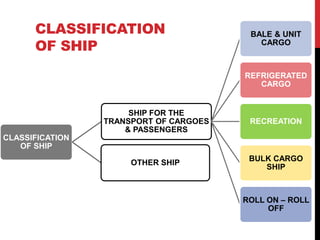
CLASSIFICATION 
OF SHIP 
SHIP FOR THE 
TRANSPORT OF CARGOES 
& PASSENGERS 
BALE & UNIT 
CARGO 
REFRIGERATED 
CARGO 
RECREATION 
BULK CARGO 
SHIP 
ROLL ON – ROLL 
OFF 
OTHER SHIP
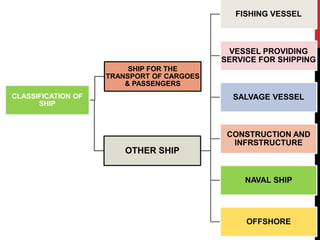
CLASSIFICATION OF 
SHIP 
SHIP FOR THE 
TRANSPORT OF CARGOES 
& PASSENGERS 
OTHER SHIP 
FISHING VESSEL 
VESSEL PROVIDING 
SERVICE FOR SHIPPING 
SALVAGE VESSEL 
CONSTRUCTION AND 
INFRSTRUCTURE 
NAVAL SHIP 
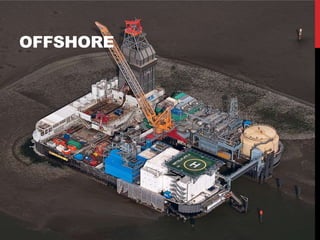
OFFSHORE
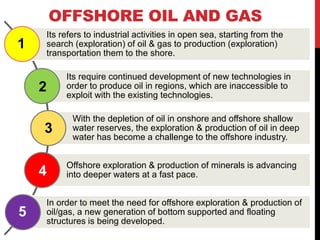
OFFSHORE OIL AND GAS 
Its refers to industrial activities in open sea, starting from the 
search (exploration) of oil & gas to production (exploration) 
transportation them to the shore. 
Its require continued development of new technologies in 
order to produce oil in regions, which are inaccessible to 
exploit with the existing technologies. 
With the depletion of oil in onshore and offshore shallow 
water reserves, the exploration & production of oil in deep 
water has become a challenge to the offshore industry. 
Offshore exploration & production of minerals is advancing 
into deeper waters at a fast pace. 
In order to meet the need for offshore exploration & production of 
oil/gas, a new generation of bottom supported and floating 
structures is being developed. 
1 
2 
3 
5 
4
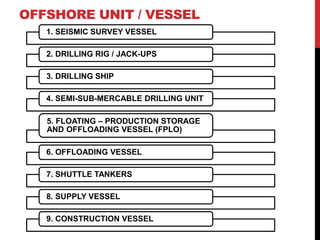
OFFSHORE UNIT / VESSEL 
1. SEISMIC SURVEY VESSEL 
2. DRILLING RIG / JACK-UPS 
3. DRILLING SHIP 
4. SEMI-SUB-MERCABLE DRILLING UNIT 
5. FLOATING – PRODUCTION STORAGE 
AND OFFLOADING VESSEL (FPLO) 
6. OFFLOADING VESSEL 
7. SHUTTLE TANKERS 
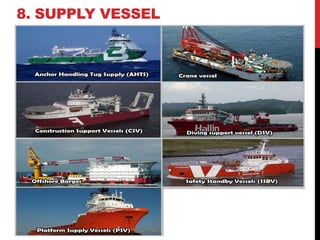
8. SUPPLY VESSEL 
9. CONSTRUCTION VESSEL
OFFSHORE
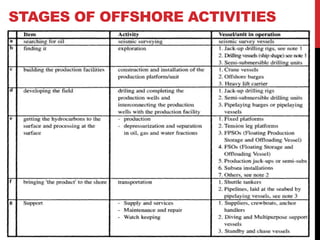
STAGES OF OFFSHORE ACTIVITIES
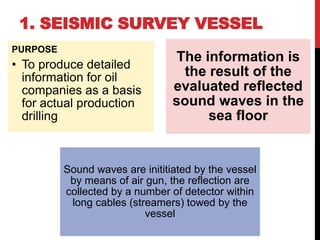
1. SEISMIC SURVEY VESSEL 
PURPOSE 
• To produce detailed 
information for oil 
companies as a basis 
for actual production 
drilling 
The information is 
the result of the 
evaluated reflected 
sound waves in the 
sea floor 
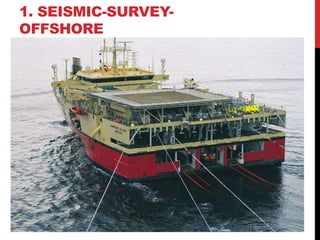
Sound waves are inititiated by the vessel 
by means of air gun, the reflection are 
collected by a number of detector within 
long cables (streamers) towed by the 
vessel
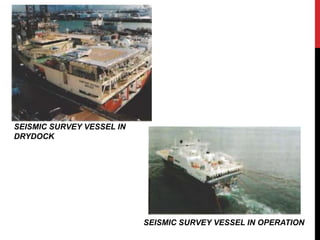
SEISMIC SURVEY VESSEL IN 
DRYDOCK 
SEISMIC SURVEY VESSEL IN OPERATION
1. SEISMIC-SURVEY-OFFSHORE
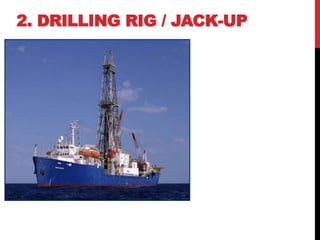
2. DRILLING RIG / JACK-UP
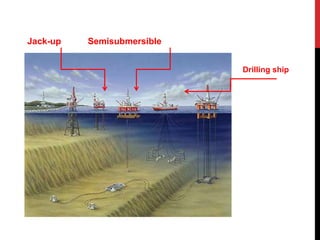
JACK-UP 
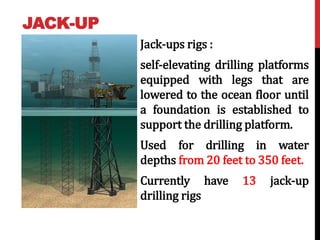
Jack-ups rigs : 
self-elevating drilling platforms 
equipped with legs that are 
lowered to the ocean floor until 
a foundation is established to 
support the drilling platform. 
Used for drilling in water 
depths from20 feet to 350 feet. 
Currently have 13 jack-up 
drilling rigs
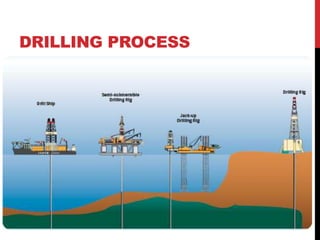
Jack-up Semisubmersible 
Drilling ship
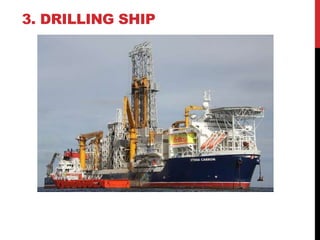
3. DRILLING SHIP
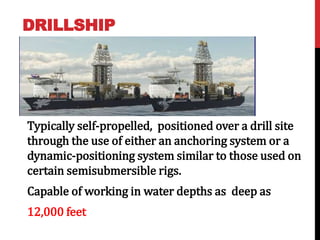
DRILLSHIP 
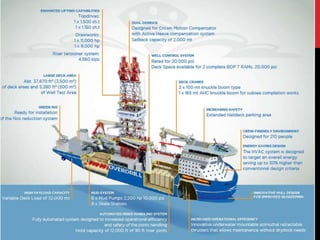
Typically self-propelled, positioned over a drill site 
through the use of either an anchoring system or a 
dynamic-positioning system similar to those used on 
certain semisubmersible rigs. 
Capable of working in water depths as deep as 
12,000 feet
DRILLING PROCESS
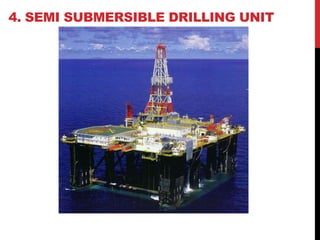
4. SEMI SUBMERSIBLE DRILLING UNIT
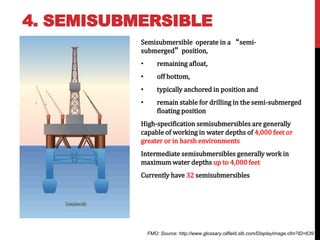
4. SEMISUBMERSIBLE 
Semisubmersible operate in a “semi-submerged” 
position, 
• remaining afloat, 
• off bottom, 
• typically anchored in position and 
• remain stable for drilling in the semi-submerged 
floating position 
High-specification semisubmersibles are generally 
capable of working in water depths of 4,000 feet or 
greater or in harsh environments 
Intermediate semisubmersibles generally work in 
maximum water depths up to 4,000 feet 
Currently have 32 semisubmersibles 
FMO: Source: http://www.glossary.oilfield.slb.com/DisplayImage.cfm?ID=639
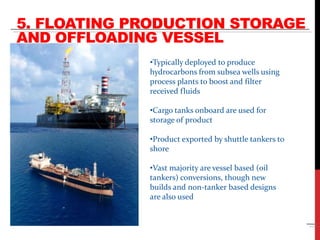
5. FLOATING PRODUCTION STORAGE 
AND OFFLOADING VESSEL 
Kikeh 
Source: PraGlobal 
•Typically deployed to produce 
hydrocarbons from subsea wells using 
process plants to boost and filter 
received fluids 
•Cargo tanks onboard are used for 
storage of product 
•Product exported by shuttle tankers to 
shore 
•Vast majority are vessel based (oil 
tankers) conversions, though new 
builds and non-tanker based designs 
are also used
6. OFFLOADING VESSEL 
A Floating Production, Storage and Offloading vessel is a 
type of floating tank system used by the 
offshore oil and gas industry and designed to take all of 
the oil or gas produced from nearby platforms or 
templates, process it, and store it until the oil or gas can 
be offloaded onto a tanker or transported through 
a pipeline.
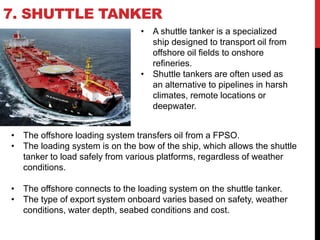
7. SHUTTLE TANKER 
• A shuttle tanker is a specialized 
ship designed to transport oil from 
offshore oil fields to onshore 
refineries. 
• Shuttle tankers are often used as 
an alternative to pipelines in harsh 
climates, remote locations or 
deepwater. 
• The offshore loading system transfers oil from a FPSO. 
• The loading system is on the bow of the ship, which allows the shuttle 
tanker to load safely from various platforms, regardless of weather 
conditions. 
• The offshore connects to the loading system on the shuttle tanker. 
• The type of export system onboard varies based on safety, weather 
conditions, water depth, seabed conditions and cost.
8. SUPPLY VESSEL
9. NAVY VESSEL 
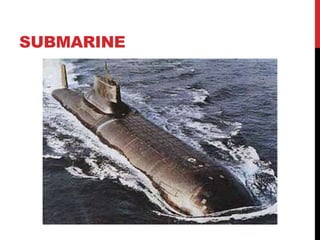
• The Navy deploys two classes of submarines: 
1. attack submarines (SSNs) and 
2. ballistic missile submarines (SSBNs). 
• The mission of nuclear attack submarines (SSNs) is to locate 
and destroy enemy ships and submarines 
• Fleet ballistic missile submarines (SSBNs) deliver ballistic 
missile attacks against assigned targets from either a 
submerged or surfaced condition. 
• The term most commonly refers to a large, crewed, autonomous 
vessel.
SUBMARINE
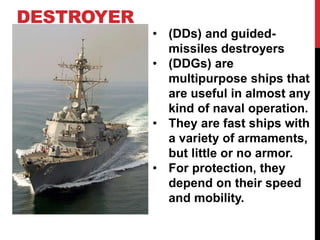
DESTROYER 
• (DDs) and guided-missiles 
destroyers 
• (DDGs) are 
multipurpose ships that 
are useful in almost any 
kind of naval operation. 
• They are fast ships with 
a variety of armaments, 
but little or no armor. 
• For protection, they 
depend on their speed 
and mobility.
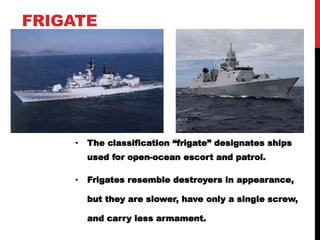
FRIGATE 
• The classification “frigate” designates ships 
used for open-ocean escort and patrol. 
• Frigates resemble destroyers in appearance, 
but they are slower, have only a single screw, 
and carry less armament.

OFFSHORE ACTIVITIES

  • 2.
    CLASSIFICATION OF SHIP CLASSIFICATION OF SHIP SHIP FOR THE TRANSPORT OF CARGOES & PASSENGERS BALE & UNIT CARGO REFRIGERATED CARGO RECREATION BULK CARGO SHIP ROLL ON – ROLL OFF OTHER SHIP
  • 3.
    CLASSIFICATION OF SHIP SHIP FOR THE TRANSPORT OF CARGOES & PASSENGERS OTHER SHIP FISHING VESSEL VESSEL PROVIDING SERVICE FOR SHIPPING SALVAGE VESSEL CONSTRUCTION AND INFRSTRUCTURE NAVAL SHIP OFFSHORE
  • 4.
    OFFSHORE OIL ANDGAS Its refers to industrial activities in open sea, starting from the search (exploration) of oil & gas to production (exploration) transportation them to the shore. Its require continued development of new technologies in order to produce oil in regions, which are inaccessible to exploit with the existing technologies. With the depletion of oil in onshore and offshore shallow water reserves, the exploration & production of oil in deep water has become a challenge to the offshore industry. Offshore exploration & production of minerals is advancing into deeper waters at a fast pace. In order to meet the need for offshore exploration & production of oil/gas, a new generation of bottom supported and floating structures is being developed. 1 2 3 5 4
  • 5.
    OFFSHORE UNIT /VESSEL 1. SEISMIC SURVEY VESSEL 2. DRILLING RIG / JACK-UPS 3. DRILLING SHIP 4. SEMI-SUB-MERCABLE DRILLING UNIT 5. FLOATING – PRODUCTION STORAGE AND OFFLOADING VESSEL (FPLO) 6. OFFLOADING VESSEL 7. SHUTTLE TANKERS 8. SUPPLY VESSEL 9. CONSTRUCTION VESSEL
  • 6.
  • 7.
  • 8.
    1. SEISMIC SURVEYVESSEL PURPOSE • To produce detailed information for oil companies as a basis for actual production drilling The information is the result of the evaluated reflected sound waves in the sea floor Sound waves are inititiated by the vessel by means of air gun, the reflection are collected by a number of detector within long cables (streamers) towed by the vessel
  • 9.
    SEISMIC SURVEY VESSELIN DRYDOCK SEISMIC SURVEY VESSEL IN OPERATION
  • 10.
  • 11.
    2. DRILLING RIG/ JACK-UP
  • 12.
    JACK-UP Jack-ups rigs: self-elevating drilling platforms equipped with legs that are lowered to the ocean floor until a foundation is established to support the drilling platform. Used for drilling in water depths from20 feet to 350 feet. Currently have 13 jack-up drilling rigs
  • 13.
  • 14.
  • 15.
    DRILLSHIP Typically self-propelled,positioned over a drill site through the use of either an anchoring system or a dynamic-positioning system similar to those used on certain semisubmersible rigs. Capable of working in water depths as deep as 12,000 feet
  • 17.
  • 18.
    4. SEMI SUBMERSIBLEDRILLING UNIT
  • 19.
    4. SEMISUBMERSIBLE Semisubmersibleoperate in a “semi-submerged” position, • remaining afloat, • off bottom, • typically anchored in position and • remain stable for drilling in the semi-submerged floating position High-specification semisubmersibles are generally capable of working in water depths of 4,000 feet or greater or in harsh environments Intermediate semisubmersibles generally work in maximum water depths up to 4,000 feet Currently have 32 semisubmersibles FMO: Source: http://www.glossary.oilfield.slb.com/DisplayImage.cfm?ID=639
  • 20.
    5. FLOATING PRODUCTIONSTORAGE AND OFFLOADING VESSEL Kikeh Source: PraGlobal •Typically deployed to produce hydrocarbons from subsea wells using process plants to boost and filter received fluids •Cargo tanks onboard are used for storage of product •Product exported by shuttle tankers to shore •Vast majority are vessel based (oil tankers) conversions, though new builds and non-tanker based designs are also used
  • 21.
    6. OFFLOADING VESSEL A Floating Production, Storage and Offloading vessel is a type of floating tank system used by the offshore oil and gas industry and designed to take all of the oil or gas produced from nearby platforms or templates, process it, and store it until the oil or gas can be offloaded onto a tanker or transported through a pipeline.
  • 22.
    7. SHUTTLE TANKER • A shuttle tanker is a specialized ship designed to transport oil from offshore oil fields to onshore refineries. • Shuttle tankers are often used as an alternative to pipelines in harsh climates, remote locations or deepwater. • The offshore loading system transfers oil from a FPSO. • The loading system is on the bow of the ship, which allows the shuttle tanker to load safely from various platforms, regardless of weather conditions. • The offshore connects to the loading system on the shuttle tanker. • The type of export system onboard varies based on safety, weather conditions, water depth, seabed conditions and cost.
  • 23.
  • 24.
    9. NAVY VESSEL • The Navy deploys two classes of submarines: 1. attack submarines (SSNs) and 2. ballistic missile submarines (SSBNs). • The mission of nuclear attack submarines (SSNs) is to locate and destroy enemy ships and submarines • Fleet ballistic missile submarines (SSBNs) deliver ballistic missile attacks against assigned targets from either a submerged or surfaced condition. • The term most commonly refers to a large, crewed, autonomous vessel.
  • 25.
  • 26.
    DESTROYER • (DDs)and guided-missiles destroyers • (DDGs) are multipurpose ships that are useful in almost any kind of naval operation. • They are fast ships with a variety of armaments, but little or no armor. • For protection, they depend on their speed and mobility.
  • 27.
    FRIGATE • Theclassification “frigate” designates ships used for open-ocean escort and patrol. • Frigates resemble destroyers in appearance, but they are slower, have only a single screw, and carry less armament.