DRILLING FLUID SYSTEMS
&
FUNCTIONS
1
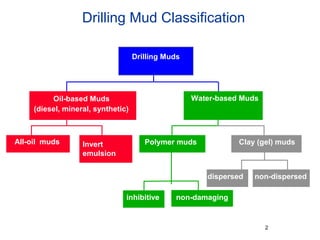
All-oil muds Invert
emulsion
Oil-based Muds
(diesel, mineral, synthetic)
non-damaging
Polymer muds
dispersed non-dispersed
Clay (gel) muds
Water-based Muds
Drilling Muds
inhibitive
Drilling Mud Classification
2
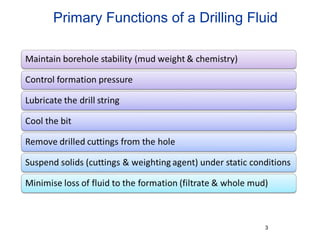
Primary Functions of a Drilling Fluid
3
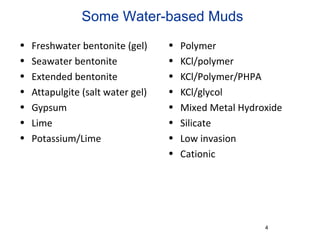
Some Water-based Muds
• Freshwater bentonite (gel)
• Seawater bentonite
• Extended bentonite
• Attapulgite (salt water gel)
• Gypsum
• Lime
• Potassium/Lime
• Polymer
• KCl/polymer
• KCl/Polymer/PHPA
• KCl/glycol
• Mixed Metal Hydroxide
• Silicate
• Low invasion
• Cationic
4
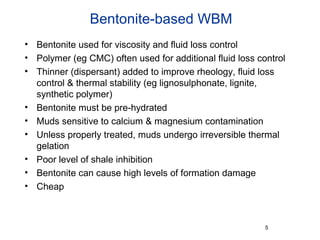
Bentonite-based WBM
• Bentonite used for viscosity and fluid loss control
• Polymer (eg CMC) often used for additional fluid loss control
• Thinner (dispersant) added to improve rheology, fluid loss
control & thermal stability (eg lignosulphonate, lignite,
synthetic polymer)
• Bentonite must be pre-hydrated
• Muds sensitive to calcium & magnesium contamination
• Unless properly treated, muds undergo irreversible thermal
gelation
• Poor level of shale inhibition
• Bentonite can cause high levels of formation damage
• Cheap
5
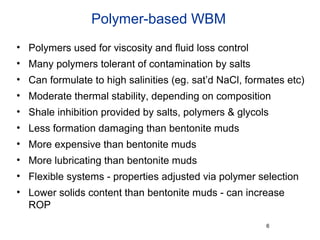
Polymer-based WBM
• Polymers used for viscosity and fluid loss control
• Many polymers tolerant of contamination by salts
• Can formulate to high salinities (eg. sat’d NaCl, formates etc)
• Moderate thermal stability, depending on composition
• Shale inhibition provided by salts, polymers & glycols
• Less formation damaging than bentonite muds
• More expensive than bentonite muds
• More lubricating than bentonite muds
• Flexible systems - properties adjusted via polymer selection
• Lower solids content than bentonite muds - can increase
ROP
6
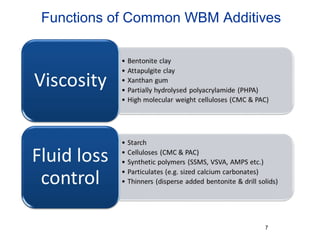
Functions of Common WBM Additives
7
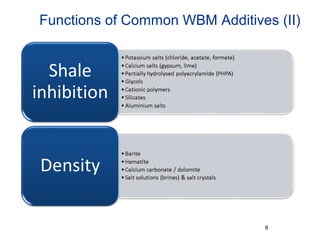
Functions of Common WBM Additives (II)
8
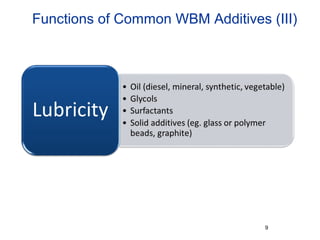
Functions of Common WBM Additives (III)
9
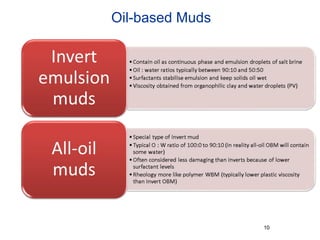
Oil-based Muds
10
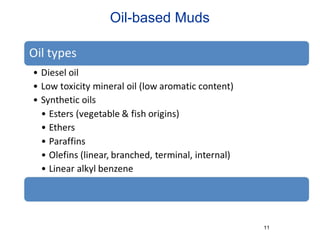
Oil-based Muds
11
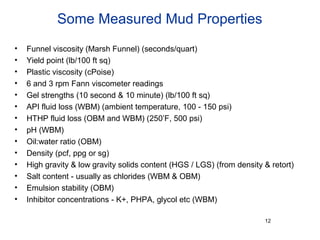
Some Measured Mud Properties
• Funnel viscosity (Marsh Funnel) (seconds/quart)
• Yield point (lb/100 ft sq)
• Plastic viscosity (cPoise)
• 6 and 3 rpm Fann viscometer readings
• Gel strengths (10 second & 10 minute) (lb/100 ft sq)
• API fluid loss (WBM) (ambient temperature, 100 - 150 psi)
• HTHP fluid loss (OBM and WBM) (250’F, 500 psi)
• pH (WBM)
• Oil:water ratio (OBM)
• Density (pcf, ppg or sg)
• High gravity & low gravity solids content (HGS / LGS) (from density & retort)
• Salt content - usually as chlorides (WBM & OBM)
• Emulsion stability (OBM)
• Inhibitor concentrations - K+, PHPA, glycol etc (WBM)
12
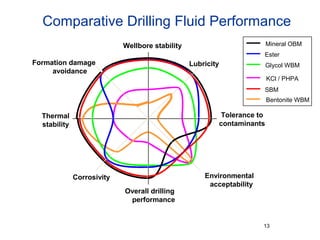
Comparative Drilling Fluid Performance
Formation damage
avoidance
Wellbore stability
Lubricity
Tolerance to
contaminants
Environmental
acceptability
Overall drilling
performance
Corrosivity
Thermal
stability
Mineral OBM
Ester
Glycol WBM
KCl / PHPA
SBM
Bentonite WBM
13

Drilling fluids

  • 1.
  • 2.
    All-oil muds Invert emulsion Oil-basedMuds (diesel, mineral, synthetic) non-damaging Polymer muds dispersed non-dispersed Clay (gel) muds Water-based Muds Drilling Muds inhibitive Drilling Mud Classification 2
  • 3.
    Primary Functions ofa Drilling Fluid 3
  • 4.
    Some Water-based Muds •Freshwater bentonite (gel) • Seawater bentonite • Extended bentonite • Attapulgite (salt water gel) • Gypsum • Lime • Potassium/Lime • Polymer • KCl/polymer • KCl/Polymer/PHPA • KCl/glycol • Mixed Metal Hydroxide • Silicate • Low invasion • Cationic 4
  • 5.
    Bentonite-based WBM • Bentoniteused for viscosity and fluid loss control • Polymer (eg CMC) often used for additional fluid loss control • Thinner (dispersant) added to improve rheology, fluid loss control & thermal stability (eg lignosulphonate, lignite, synthetic polymer) • Bentonite must be pre-hydrated • Muds sensitive to calcium & magnesium contamination • Unless properly treated, muds undergo irreversible thermal gelation • Poor level of shale inhibition • Bentonite can cause high levels of formation damage • Cheap 5
  • 6.
    Polymer-based WBM • Polymersused for viscosity and fluid loss control • Many polymers tolerant of contamination by salts • Can formulate to high salinities (eg. sat’d NaCl, formates etc) • Moderate thermal stability, depending on composition • Shale inhibition provided by salts, polymers & glycols • Less formation damaging than bentonite muds • More expensive than bentonite muds • More lubricating than bentonite muds • Flexible systems - properties adjusted via polymer selection • Lower solids content than bentonite muds - can increase ROP 6
  • 7.
    Functions of CommonWBM Additives 7
  • 8.
    Functions of CommonWBM Additives (II) 8
  • 9.
    Functions of CommonWBM Additives (III) 9
  • 10.
  • 11.
  • 12.
    Some Measured MudProperties • Funnel viscosity (Marsh Funnel) (seconds/quart) • Yield point (lb/100 ft sq) • Plastic viscosity (cPoise) • 6 and 3 rpm Fann viscometer readings • Gel strengths (10 second & 10 minute) (lb/100 ft sq) • API fluid loss (WBM) (ambient temperature, 100 - 150 psi) • HTHP fluid loss (OBM and WBM) (250’F, 500 psi) • pH (WBM) • Oil:water ratio (OBM) • Density (pcf, ppg or sg) • High gravity & low gravity solids content (HGS / LGS) (from density & retort) • Salt content - usually as chlorides (WBM & OBM) • Emulsion stability (OBM) • Inhibitor concentrations - K+, PHPA, glycol etc (WBM) 12
  • 13.
    Comparative Drilling FluidPerformance Formation damage avoidance Wellbore stability Lubricity Tolerance to contaminants Environmental acceptability Overall drilling performance Corrosivity Thermal stability Mineral OBM Ester Glycol WBM KCl / PHPA SBM Bentonite WBM 13