DRILLING FLUIDS
THE DRILLING FLUID IS AN ENGINEERED TOOL TO:
– MAXIMISE DRILLING PERFORMANCE (M/DAY)
– MAXIMISE PRODUCTION POTENTIAL OF A WELL
(M³/DAY)
– MINIMISE COST ($/M  $/M³)
– HAVE MINIMAL HSE IMPACT ($$)
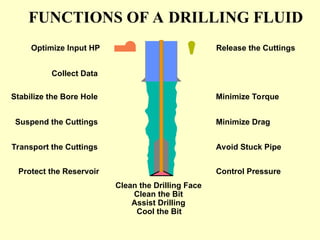
FUNCTIONS OF A DRILLING FLUID
Clean the Drilling Face
Clean the Bit
Assist Drilling
Cool the Bit
Minimize Torque
Minimize Drag
Avoid Stuck Pipe
Control Pressure
Release the Cuttings
Optimize Input HP
Stabilize the Bore Hole
Suspend the Cuttings
Transport the Cuttings
Protect the Reservoir
Collect Data
Water-based drilling fluid chemicals
• Fresh/sea water = 1) make-up fluid 2) pre-hydration bentonite
• Barite = barium sulphate – BaSO4 – weighting material (SG 4.2)
• KCl salt = 1) shale swelling inhibitor 2) density control
• NaCl salt = 1) density control 2) base fluid for drilling
salt layer 3) shale swelling inhibitor
• Bentonite = Montmorillonite clay – viscosifier – 50 to 75 kg/m3
(20 to 25 ppb)
• XC-polymer = xanthan gum – viscosifier – 2 to 6 kg/m3
(0.7 – 2 ppb)
• CMC LV/HV/EHV = carboxymethylcellulose – 1) fluidloss control
2) viscosifier - 6 to 12 kg/m3
(2 to 4 ppb)
• PAC-L/-R = poly anionic cellulose – 1) fluidloss control 2) viscosifier
6 to 12 kg/m3
(2 to 4 ppb)
• Starch = carbohydrates – fluidloss control - 6 to 12 kg/m3
(2 to 4 ppb)
Water-based drilling fluid chemicals
• PHPA = partially-hydrolyzed polyacrylamide 1) shale stabilizer
2) viscosifier -
• Lignosulphonate = deflocculant (thinner) for bentonite mud
• Caustic soda = sodium hydroxide – NaOH - pH control
• Potassium hydroxide = KOH – 1) pH control – 2) shale swelling inhibitor
• Soda ash = sodium carbonate - Na2CO3 -1) calcium removal
2) pH control
Na2CO3  2Na+
+ CO3
2-
and CO3
2-
+ Ca2+
 CaCO3
• Sodium bicarbonate = NaHCO3 – cement (lime) contamination
NaHCO3  Na+
+ H+
+ CO3
2-
and
H+
+ CO3
2-
+ Ca2+
+ 2OH-
 OH-
+ H2O + CaCO3 
• Gypsum = calcium sulphate dihydrate – CaSO4.2H2O – shale swelling
inhibitor – 15 kg/m3
(5 ppb) in combination with
bentonite & CMC
Water-based drilling fluid chemicals
• Lime = Ca(OH)2 – pH buffer in case of H2S
• Ironite Sponge = Fe3O4 – H2S scavenger
• Zinc carbonate = ZnCO3 – H2S scavenger
• [Sulphonated] asphalt = plugging agent for shale formations
• Walnut shells, mica flakes, marble chips = lost circulation material
•Calcium carbonate = CaCO3 – 1) acid-soluble weighting material –
2) Lost circulation material
H2O  H+
+ OH-
 pH = -log [H+
] where H+
is the hydrogen concentration in mol/l
 pOH = -log [OH-
] where OH-
is the hydroxide concentration in mol/l
 pH + pOH = 14
pH range
Example:
pH = 10  pOH = 4  [OH-
] concentration = 10-4
mol/l (1 mol = 17 gram)
 Caustic soda added to water: NaOH  Na+
+ OH-
 Lime added to water: Ca(OH)2  Ca2+
+ 2OH-
(largely insoluble)
<7 = Acidic
7
>7 = Alkaline
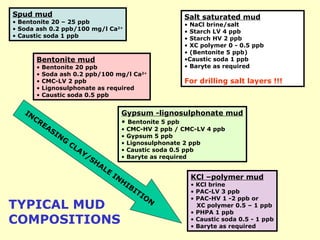
Spud mud
• Bentonite 20 – 25 ppb
• Soda ash 0.2 ppb/100 mg/l Ca2+
• Caustic soda 1 ppb
KCl –polymer mud
• KCl brine
• PAC-LV 3 ppb
• PAC-HV 1 -2 ppb or
XC polymer 0.5 – 1 ppb
• PHPA 1 ppb
• Caustic soda 0.5 - 1 ppb
• Baryte as required
TYPICAL MUD
COMPOSITIONS
IN
CREASIN
G
CLAY/SHALE
INHIBITION
Gypsum -lignosulphonate mud
• Bentonite 5 ppb
• CMC-HV 2 ppb / CMC-LV 4 ppb
• Gypsum 5 ppb
• Lignosulphonate 2 ppb
• Caustic soda 0.5 ppb
• Baryte as required
Bentonite mud
• Bentonite 20 ppb
• Soda ash 0.2 ppb/100 mg/l Ca2+
• CMC-LV 2 ppb
• Lignosulphonate as required
• Caustic soda 0.5 ppb
Salt saturated mud
• NaCl brine/salt
• Starch LV 4 ppb
• Starch HV 2 ppb
• XC polymer 0 - 0.5 ppb
• (Bentonite 5 ppb)
•Caustic soda 1 ppb
• Baryte as required
For drilling salt layers !!!
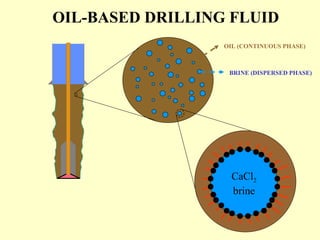
OIL-BASED DRILLING FLUID
OIL (CONTINUOUS PHASE)
BRINE (DISPERSED PHASE)
CaCl2
brine
Oil-based drilling fluid chemicals
• Base oil = diesel/low-aromatic mineral oil/synthetic oil - 1) make-up
fluid
• Primary-/secondary emulsifiers = surfactants – 1) emulsification agents
for brine phase – 2) oil-wetting agent for solids
• Oil-wetting agent = surfactant – 1) oil-wetting agent for solids –
2) emulsification agents for brine phase
• NaCl / CaCl2 brine = dispersed phase – 1) viscosity – 2) fluidloss
control – 3) clay swelling inhibition
• Lime = Ca(OH)2 – alkalinity source for proper functioning of surfactants
• Viscosifier = organophilic clay (chemically-treated bentonite)
• Fluidloss control agent = alphalitic product
• Weighting material = CaCO3 / Barite / Hematite
Specific oil-based mud parameters
• oil/water ratio (50/50 to 90/10)
• Lime content
• Emulsion stability
Dis-/advantages of oil-based mud
• high shale inhibition/hole stability – also for salt drilling
• high lubricity
• excellent fluidloss control
• high formation damage tendency- difficult to remove
• high complexity of treatment
• expensive
• HSE (health risk, environmental)
New developments:
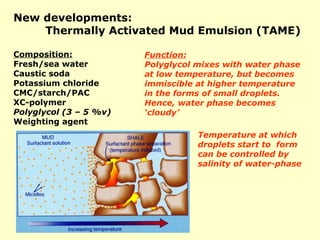
Thermally Activated Mud Emulsion (TAME)
Composition:
Fresh/sea water
Caustic soda
Potassium chloride
CMC/starch/PAC
XC-polymer
Polyglycol (3 – 5 %v)
Weighting agent
Function:
Polyglycol mixes with water phase
at low temperature, but becomes
immiscible at higher temperature
in the forms of small droplets.
Hence, water phase becomes
‘cloudy’
Temperature at which
droplets start to form
can be controlled by
salinity of water-phase
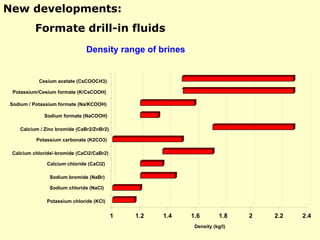
1 1.2 1.4 1.6 1.8 2 2.2 2.4
Density (kg/l)
Potassium chloride (KCl)
Sodium chloride (NaCl)
Sodium bromide (NaBr)
Calcium chloride (CaCl2)
Calcium chloride/-bromide (CaCl2/CaBr2)
Potassium carbonate (K2CO3)
Calcium / Zinc bromide (CaBr2/ZnBr2)
Sodium formate (NaCOOH)
Sodium / Potassium formate (Na/KCOOH)
Potassium/Cesium formate (K/CsCOOH)
Cesium acetate (CsCOOCH3)
Density range of brines
New developments:
Formate drill-in fluids
Composition:
•Formate brine - 10.8 to 19.2 ppg
•Xanthan Gum viscosifier – 0.5 to 1.5 ppb
•PAC fluidloss agent – 1 to 3 ppb
•Sized calcium carbonate - filter cake build-up – 25 to 50 ppb
Advantages formate-based drill-in fluid:
 No weighting material required; low ECD
 High temperature stability
 Simple systems
Very low corrosion
 Low toxicity/environmental friendly
 No scaling tendency with formation water components
However, very expensive
 saturated Na-/K-formate brine ~ $ 200/bbl
 saturated Cs-formate brine ~ $ 2 - 3000/bbl
New developments:
Formate drill-in fluids
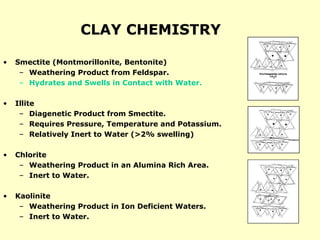
• Smectite (Montmorillonite, Bentonite)
– Weathering Product from Feldspar.
– Hydrates and Swells in Contact with Water.
• Illite
– Diagenetic Product from Smectite.
– Requires Pressure, Temperature and Potassium.
– Relatively Inert to Water (>2% swelling)
• Chlorite
– Weathering Product in an Alumina Rich Area.
– Inert to Water.
• Kaolinite
– Weathering Product in Ion Deficient Waters.
– Inert to Water.
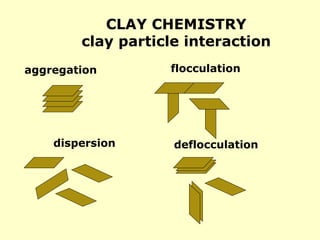
CLAY CHEMISTRY
aggregation
dispersion
flocculation
deflocculation
CLAY CHEMISTRY
clay particle interaction
CONTAMINANTS:
Dispersed bentonite-based mud:
• Divalent ions (Ca2+
, Mg2+
)  flocculation/aggregation 
increase in viscosity/gellation/fluidloss
Add soda ash (NaCO3) / lignosulphonate / change over to
calcium-based system
• Salt (NaCl)  flocculation  increase in viscosity/gellation/
fluidloss
 Add lignosulphonate/change over to salt saturated mud
• Green cement  high pH/Ca2+
 flocculation  increase in
viscosity/gellation/fluidloss
 Add soda bicarbonate (NaHCO3)
• Carbonate (CO3
2-
; over-treatment or CO2 gas  flocculation
increase in viscosity/gellation
 Add lime and/or gypsum (pH dependent)
CONTAMINANTS:
• Hydrogen sulfide (H2S) – TOXIC !!!!
• pH reduction  viscosity/fluidloss
increase
• dark colour development (FeS)
• rotten egg smell
• black scale on drill pipe
Add caustic soda to pH 11 – 12
 add lime to maintain high pH
 add scavenger
• Drilled solids – fines generated while drilling  gradual increase
in viscosity (PV/YP), gellation, fluidloss
Add water, improve solids removal equipment, deflocculant

drilling fluids at drilling rigs and cement

  • 1.
    DRILLING FLUIDS THE DRILLINGFLUID IS AN ENGINEERED TOOL TO: – MAXIMISE DRILLING PERFORMANCE (M/DAY) – MAXIMISE PRODUCTION POTENTIAL OF A WELL (M³/DAY) – MINIMISE COST ($/M  $/M³) – HAVE MINIMAL HSE IMPACT ($$)
  • 2.
    FUNCTIONS OF ADRILLING FLUID Clean the Drilling Face Clean the Bit Assist Drilling Cool the Bit Minimize Torque Minimize Drag Avoid Stuck Pipe Control Pressure Release the Cuttings Optimize Input HP Stabilize the Bore Hole Suspend the Cuttings Transport the Cuttings Protect the Reservoir Collect Data
  • 3.
    Water-based drilling fluidchemicals • Fresh/sea water = 1) make-up fluid 2) pre-hydration bentonite • Barite = barium sulphate – BaSO4 – weighting material (SG 4.2) • KCl salt = 1) shale swelling inhibitor 2) density control • NaCl salt = 1) density control 2) base fluid for drilling salt layer 3) shale swelling inhibitor • Bentonite = Montmorillonite clay – viscosifier – 50 to 75 kg/m3 (20 to 25 ppb) • XC-polymer = xanthan gum – viscosifier – 2 to 6 kg/m3 (0.7 – 2 ppb) • CMC LV/HV/EHV = carboxymethylcellulose – 1) fluidloss control 2) viscosifier - 6 to 12 kg/m3 (2 to 4 ppb) • PAC-L/-R = poly anionic cellulose – 1) fluidloss control 2) viscosifier 6 to 12 kg/m3 (2 to 4 ppb) • Starch = carbohydrates – fluidloss control - 6 to 12 kg/m3 (2 to 4 ppb)
  • 4.
    Water-based drilling fluidchemicals • PHPA = partially-hydrolyzed polyacrylamide 1) shale stabilizer 2) viscosifier - • Lignosulphonate = deflocculant (thinner) for bentonite mud • Caustic soda = sodium hydroxide – NaOH - pH control • Potassium hydroxide = KOH – 1) pH control – 2) shale swelling inhibitor • Soda ash = sodium carbonate - Na2CO3 -1) calcium removal 2) pH control Na2CO3  2Na+ + CO3 2- and CO3 2- + Ca2+  CaCO3 • Sodium bicarbonate = NaHCO3 – cement (lime) contamination NaHCO3  Na+ + H+ + CO3 2- and H+ + CO3 2- + Ca2+ + 2OH-  OH- + H2O + CaCO3  • Gypsum = calcium sulphate dihydrate – CaSO4.2H2O – shale swelling inhibitor – 15 kg/m3 (5 ppb) in combination with bentonite & CMC
  • 5.
    Water-based drilling fluidchemicals • Lime = Ca(OH)2 – pH buffer in case of H2S • Ironite Sponge = Fe3O4 – H2S scavenger • Zinc carbonate = ZnCO3 – H2S scavenger • [Sulphonated] asphalt = plugging agent for shale formations • Walnut shells, mica flakes, marble chips = lost circulation material •Calcium carbonate = CaCO3 – 1) acid-soluble weighting material – 2) Lost circulation material
  • 6.
    H2O  H+ +OH-  pH = -log [H+ ] where H+ is the hydrogen concentration in mol/l  pOH = -log [OH- ] where OH- is the hydroxide concentration in mol/l  pH + pOH = 14 pH range Example: pH = 10  pOH = 4  [OH- ] concentration = 10-4 mol/l (1 mol = 17 gram)  Caustic soda added to water: NaOH  Na+ + OH-  Lime added to water: Ca(OH)2  Ca2+ + 2OH- (largely insoluble) <7 = Acidic 7 >7 = Alkaline
  • 7.
    Spud mud • Bentonite20 – 25 ppb • Soda ash 0.2 ppb/100 mg/l Ca2+ • Caustic soda 1 ppb KCl –polymer mud • KCl brine • PAC-LV 3 ppb • PAC-HV 1 -2 ppb or XC polymer 0.5 – 1 ppb • PHPA 1 ppb • Caustic soda 0.5 - 1 ppb • Baryte as required TYPICAL MUD COMPOSITIONS IN CREASIN G CLAY/SHALE INHIBITION Gypsum -lignosulphonate mud • Bentonite 5 ppb • CMC-HV 2 ppb / CMC-LV 4 ppb • Gypsum 5 ppb • Lignosulphonate 2 ppb • Caustic soda 0.5 ppb • Baryte as required Bentonite mud • Bentonite 20 ppb • Soda ash 0.2 ppb/100 mg/l Ca2+ • CMC-LV 2 ppb • Lignosulphonate as required • Caustic soda 0.5 ppb Salt saturated mud • NaCl brine/salt • Starch LV 4 ppb • Starch HV 2 ppb • XC polymer 0 - 0.5 ppb • (Bentonite 5 ppb) •Caustic soda 1 ppb • Baryte as required For drilling salt layers !!!
  • 8.
    OIL-BASED DRILLING FLUID OIL(CONTINUOUS PHASE) BRINE (DISPERSED PHASE) CaCl2 brine
  • 9.
    Oil-based drilling fluidchemicals • Base oil = diesel/low-aromatic mineral oil/synthetic oil - 1) make-up fluid • Primary-/secondary emulsifiers = surfactants – 1) emulsification agents for brine phase – 2) oil-wetting agent for solids • Oil-wetting agent = surfactant – 1) oil-wetting agent for solids – 2) emulsification agents for brine phase • NaCl / CaCl2 brine = dispersed phase – 1) viscosity – 2) fluidloss control – 3) clay swelling inhibition • Lime = Ca(OH)2 – alkalinity source for proper functioning of surfactants • Viscosifier = organophilic clay (chemically-treated bentonite) • Fluidloss control agent = alphalitic product • Weighting material = CaCO3 / Barite / Hematite
  • 10.
    Specific oil-based mudparameters • oil/water ratio (50/50 to 90/10) • Lime content • Emulsion stability Dis-/advantages of oil-based mud • high shale inhibition/hole stability – also for salt drilling • high lubricity • excellent fluidloss control • high formation damage tendency- difficult to remove • high complexity of treatment • expensive • HSE (health risk, environmental)
  • 11.
    New developments: Thermally ActivatedMud Emulsion (TAME) Composition: Fresh/sea water Caustic soda Potassium chloride CMC/starch/PAC XC-polymer Polyglycol (3 – 5 %v) Weighting agent Function: Polyglycol mixes with water phase at low temperature, but becomes immiscible at higher temperature in the forms of small droplets. Hence, water phase becomes ‘cloudy’ Temperature at which droplets start to form can be controlled by salinity of water-phase
  • 12.
    1 1.2 1.41.6 1.8 2 2.2 2.4 Density (kg/l) Potassium chloride (KCl) Sodium chloride (NaCl) Sodium bromide (NaBr) Calcium chloride (CaCl2) Calcium chloride/-bromide (CaCl2/CaBr2) Potassium carbonate (K2CO3) Calcium / Zinc bromide (CaBr2/ZnBr2) Sodium formate (NaCOOH) Sodium / Potassium formate (Na/KCOOH) Potassium/Cesium formate (K/CsCOOH) Cesium acetate (CsCOOCH3) Density range of brines New developments: Formate drill-in fluids
  • 13.
    Composition: •Formate brine -10.8 to 19.2 ppg •Xanthan Gum viscosifier – 0.5 to 1.5 ppb •PAC fluidloss agent – 1 to 3 ppb •Sized calcium carbonate - filter cake build-up – 25 to 50 ppb Advantages formate-based drill-in fluid:  No weighting material required; low ECD  High temperature stability  Simple systems Very low corrosion  Low toxicity/environmental friendly  No scaling tendency with formation water components However, very expensive  saturated Na-/K-formate brine ~ $ 200/bbl  saturated Cs-formate brine ~ $ 2 - 3000/bbl New developments: Formate drill-in fluids
  • 14.
    • Smectite (Montmorillonite,Bentonite) – Weathering Product from Feldspar. – Hydrates and Swells in Contact with Water. • Illite – Diagenetic Product from Smectite. – Requires Pressure, Temperature and Potassium. – Relatively Inert to Water (>2% swelling) • Chlorite – Weathering Product in an Alumina Rich Area. – Inert to Water. • Kaolinite – Weathering Product in Ion Deficient Waters. – Inert to Water. CLAY CHEMISTRY
  • 15.
  • 16.
    CONTAMINANTS: Dispersed bentonite-based mud: •Divalent ions (Ca2+ , Mg2+ )  flocculation/aggregation  increase in viscosity/gellation/fluidloss Add soda ash (NaCO3) / lignosulphonate / change over to calcium-based system • Salt (NaCl)  flocculation  increase in viscosity/gellation/ fluidloss  Add lignosulphonate/change over to salt saturated mud • Green cement  high pH/Ca2+  flocculation  increase in viscosity/gellation/fluidloss  Add soda bicarbonate (NaHCO3) • Carbonate (CO3 2- ; over-treatment or CO2 gas  flocculation increase in viscosity/gellation  Add lime and/or gypsum (pH dependent)
  • 17.
    CONTAMINANTS: • Hydrogen sulfide(H2S) – TOXIC !!!! • pH reduction  viscosity/fluidloss increase • dark colour development (FeS) • rotten egg smell • black scale on drill pipe Add caustic soda to pH 11 – 12  add lime to maintain high pH  add scavenger • Drilled solids – fines generated while drilling  gradual increase in viscosity (PV/YP), gellation, fluidloss Add water, improve solids removal equipment, deflocculant