1
Content
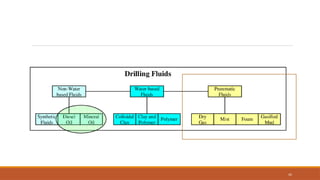
Types of Drilling fluids
Applications of Drilling fluids
Synthetic Oil Based Drilling fluid
Mud Weight Calculations
2
Classification of drilling fluids
Water Based Muds
◦ Principal component is water (Fresh water, sea water, produced water)
Oil Based Muds
◦ Principal component is Oil (Example: Paraffin, Olefins, Esters, Olephins)
Gas Based Muds
◦ Principle component is gas (Example: N2, CO2 etc)
3
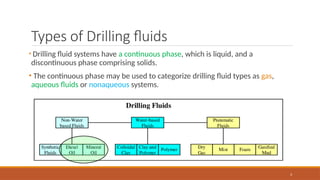
Types of Drilling fluids
• Drilling fluid systems have a continuous phase, which is liquid, and a
discontinuous phase comprising solids.
• The continuous phase may be used to categorize drilling fluid types as gas,
aqueous fluids or nonaqueous systems.
4
Water based fluids (WBFs):
• Water-based fluids (WBFs):
• Most common technique
• Less expensive than oil-based fluids (OBFs)
• Easily available
• Example: fresh water, seawater, brine
• WBMs used for pay-zone drilling different for non-pay-zone drilling
• Pay-zone drilling fluid are also called a non-damaging drilling fluid
• Design is Costly
5
Oil based fluids (OBFs):
• Oil-based systems was introduced in the 1960s to help in several drilling problems
• Increasing downhole temperatures
• Formation clays that react, swell, or slough after exposure to WBFs
• Stuck pipe and torque and drag
• Contaminants
• Examples: Oil-based fluids (OBFs) are used for formulated with diesel, mineral oil, or
low-toxicity linear olefins and paraffins.
6
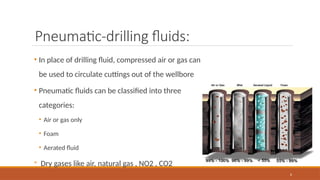
Pneumatic-drilling fluids:
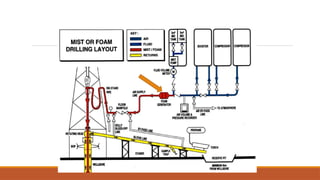
• In place of drilling fluid, compressed air or gas can
be used to circulate cuttings out of the wellbore
• Pneumatic fluids can be classified into three
categories:
• Air or gas only
• Foam
• Aerated fluid
◦ Dry gases like air, natural gas , NO2 , CO2
7
Evolution Drilling Fluids
Cuttings Removal
• Drilling fluids used for only cutting removals until 1844 when Robert Beart in
England patented drilling fluid circulation system.
• In 1866, Sweeney received US patent on stone drill that displayed many features
of todays rotary Rig.
• All patents between 1860-1880 mention the circulation of a drilling fluid to
remove cuttings
8
Evolution Drilling Fluids
Hole Stabilization
• Patent in 1887 by Chapman proposed stream of water and a quantity of plastic
material to remove core from the formation. (Ex. Clay, bran, grain, and cement)
• He suggested another function of drilling fluid i.e. to plaster wall to avoid caving
tendencies.
• 1890 drilling fluid used are mostly muds containing clay particles in it.
9
Evolution Drilling Fluids
Pressure Control by Mud Density
• In 1913-14, shown the practicality of sealing gas bearing zone by adding mud-
laden fluid.
• Advantage of mud-laden fluid were:
• Reduction in number of casing strings
• Protection of upper sands while drilling was continued
• Prevention of migration between casing
• Allowing recovery of casing
• Protection of casing from corrosion
• They keep ignoring the practical benefit of mud as a means of pressure
control.
10
Evolution Drilling Fluids
• In 1922, stroud recommends that driller should frequently weigh sample of mud.
He stated that success and failure in drilling a well depends upon control of the
gas pressure by heavy mud.
• They introduced weighing additive such as galena, iron oxides
11
Evolution Drilling Fluids
Birth of Mud Industry
• 1926 use of Barite in oil well drilling has attracted the interest of many
businessman. Mining of barite increased.
• 1929 companies started selling mixture of Barite and Bentonite (95:5) as heavy
weight mud. Later they identified problems in lifting cutting due to reduction in
the use of bentonite quantity.
• With this they identified another properties of mud i.e. gel strength.
12
Evolution Drilling Fluids
Rapid Growth of Industry
• Inventions of mud properties testing instruments
• 1924 wall building cake identification
• 1930 Viscometer to measure mud viscosity
• 1931 Marsh funnel
• 1937 Static filtration tester
13
Development of Mud types or System
• Water and Bentonite was the most practical material for improving the
viscosity and wall-building properties
Salt water Mud
• Easily Availability
• Increase in salt content decreases the effect of bentonite mud properties
• New additives introduced like starch, gums, gelatine to improve those
properties
14
Development of Mud types or System
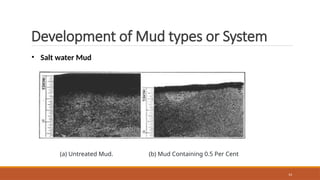
(a) Untreated Mud. (b) Mud Containing 0.5 Per Cent
• Salt water Mud
15
Development of Mud types or System
Muds for Heaving Shale
• Heaving shale: any shale that sloughed into the hole in excessive quantities and
interfered with drilling progress.
• Sensitivity to water was a characteristic of such shale
• A patent issued in 1931 proposed the use of dissolved salts to reduce the osmotic
pressure between fluid in the bore hole and that in the heaving shale.
• Sodium silicate muds were used with some success in a number of problem wells
until about 1945. Later different additive overcome this problem.
16
Development of Mud types or System
High-pH Mud
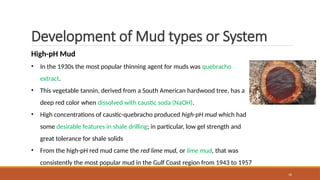
• In the 1930s the most popular thinning agent for muds was quebracho
extract.
• This vegetable tannin, derived from a South American hardwood tree, has a
deep red color when dissolved with caustic soda (NaOH).
• High concentrations of caustic-quebracho produced high-pH mud which had
some desirable features in shale drilling; in particular, low gel strength and
great tolerance for shale solids
• From the high-pH red mud came the red lime mud, or lime mud, that was
consistently the most popular mud in the Gulf Coast region from 1943 to 1957
17
Development of Mud types or System
Oil Emulsion Muds
• Process of making good mud better
• Oil used for loosen struck pipe and to slick up the hole before running casing
• 1934-1936 adding crude oil reduces pipe sticking and increases drilling rate
• 1950 numerous experience of using oil emulsion muds
• Later oil in water emulsion concluded to have improved performance of water
in muds
18
Development of Mud types or System
Muds for deep wells
• Mud treated with lime was popular as it is cheap and contains all desired properties.
• Problem arise when we start drilling deep and temperature of formation increase.
• The mud becoming thicker and harder at high temperature, difficult to circulate
• Use of less alkaline mud was introduced such as Calcium surfactant mud introduced in 1957 to
overcome the temperature limitation and minimize swelling.
• Clay treated with surfactant and gypsum, later CMC added to reduce filtrate loss.
• For high temperature, use of CMC is uneconomical. So, salts were added for make sodium surfactant
mud and polyacrylates used for filtration loss control.
19
Evolution Drilling Fluids
Low solids Muds
• Maintain the minimum practical solids content
• Increase in density of mud decreases the rate of penetration due accumulation
of drill cuttings near the drill bit and collar of the drilling string
• Milk emulsion introduced i.e. water, diesel (5%) and 0.03% emulsifiers (a non-
ionic surfactant example polyoxyethylene sorbitan tall-oil ester)
• Adequate cutting recovers while retaining drilling advantages of water
20
Evolution Drilling Fluids
Low solids Muds
• Other method used to control solid content were aerated mud,
hydrocyclone and centrifuge, flocculants and substitution of CMC
for bentonite in the control of viscosity and filtration properties.
• Guar gum, Starch provided carrying capacity for cuttings and
adequate filtration control in clay-free salt-water system
• Use of flocculant to remove small cuttings from water was also
studied in 1958
21
Evolution Drilling Fluids
Non dispersed polymer Muds
• Dispersion of shale cutting is undesirable which occurs due to addition of thinners to mud
• Polymers for bentonite are useful for fast drilling, it also provide coating at surface of cuttings
and borehole
• Considering, hole cleaning, mud properties concluded that nondispersed polymer mud
improves mud saving
• Shear thinning characteristics of certain polymers offers advantage in drilling rate and cutting
carrying qualities at the same time.
22
Evolution Drilling Fluids
• Inhibited Muds
• Addition of potassium chloride and suitable polymer formed shale inhibitive muds
• Inhibitive suppresses the swelling of bentonite.
• Addition of 10% KCL by weigth in water and 0.5% calcium lignisulfonate reduces mud swelling, further
Starch could be added for to control filtration
• Inhibitive property of potassium ion significantly reduced hole enlargement in shale section
• Potassium chloride polymers compositions also helped mechanically incompetent formations in fault zone
• In arctic region where problems like hole enlargement, stuck pipe, cementing surface casing difficulties
handle by KCL, bentonite, XC polymer.
23
Evolution Drilling Fluids
• Corrosion control Muds
• Corrosion of drilling string and casing string was less till 1930
• Extensive drilling leads to drilling string failure
• Corrosion occurs due to acidic nature of produced water, H2S and fatigue in drill pipe.
• In 1936, less corrosion were observed due to high pH of mud
• Salt solution has found advantageous for long time stability of packers
• Recent study show that use of inert gas replaces the dissolved oxygen in the drilling fluids and
reduces the chance of corrosion
24
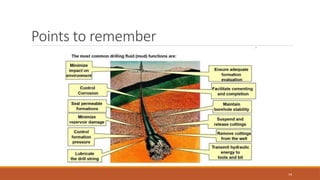
Different type of drilling fluids for different functions
• Technology has developed as a response to the increasing demands (greater
well depths and the increasing complexity of drilling problems).
• The functional requirements placed on the mud have grown from one—
cuttings removal—to many, and now include pressure control and hole
stability maintenance.
• The muds must not damage well productivity nor be injurious to personnel,
drilling equipment, or the environment.
Conclusion
25
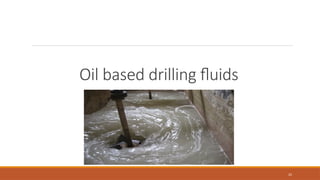
Oil based drilling fluids
26
Reasons for the development of Oil based drilling fluids
• Problem with water based drilling fluids
1. Ability to dissolve salts
2. Interfere with the flow of oil and gas through porous rocks
3. Promote disintegration and dispersion of clays
4. Effect on corrosion of iron
• Advantage of using oil based mud
1. Better lubricating quality
2. Higher boiling point
3. Low freezing point
• Cost of OBM is higher compared to WBM
27
Earlier trace of use of Oil in drilling
• Use of crude oil as drilling fluid for drilling low pressure reservoirs has no
recorded history.
• 1923 Swan proposed a nonaquous viscid liquid, such as coal tar, wood tar,
resin asphalt thinned with benzene to drill a well
• Oil based mud used for coring in salt dome and shallow oil sands during
exploration.
• Numerous well used oil as completion fluid (Beckman 1938)
28
Earlier OBM development
• Use of diesel, ground oyster shells or limestones, air-blown asphalt,
lampblack with barite were used in oil bearing zone in several fields (Hindry
1941)
• The above composition gives a specific properties:
• Density by shells, limestone and barite;
• Initial plastering by diesel and limestones;
• Lampblack provides suspending properties;
• Air-blown asphalt provides both suspending and final plastering, filter cake formation
• Emphasis for use OBM was given due to thin filter cake and the absence of
water in the filtrate.
29
Introduction of commercial oil muds
• Commercial oil muds become available since 1942, company name Oil based
Drilling fluid company in California supplies blown asphalt in the name of black
magic (powder of asphalt and oil).
• Ready mixed oil muds were supplied along with addition of naphthenic acid and
calcium oxide
• Halliburton patented and marketed brown asphalt, and tall oil soap formed by
reaction with sodium hydroxide and sodium silicate
• 1948, Ken corporation supplied oil based drilling fluid with composition alkali
and alkaline soaps of resin acid instead of air-blown asphalt
30
Categories of Oil based drilling fluids
1. Oil Base-Emulsion (Invert Emulsion) Drilling fluids
2. Pseudo Oil Based Mud
3. Invert Emulsion Oil Muds: low toxicity and controlled viscosity drilling fluids
Compositions:
• Low toxic base oil
• Water
• Emulsifier
• Wetting agent
• Organophillic Clay
• Lime
31
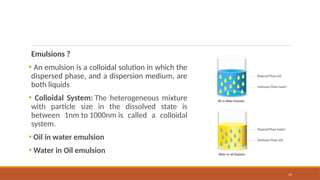
Emulsions ?
• An emulsion is a colloidal solution in which the
dispersed phase, and a dispersion medium, are
both liquids
• Colloidal System: The heterogeneous mixture
with particle size in the dissolved state is
between 1nm to 1000nm is called a colloidal
system.
• Oil in water emulsion
• Water in Oil emulsion
32
Composition of Invert emulsion
• Water: In emulsion water is used to control viscosity by controlling water (%)
• The salinity of the water phase can be controlled by the use of dissolved salts,
usually calcium chloride.
• Control of salinity in invert oil muds is necessary to "tie-up" free water molecules
and prevent any water migration between the mud and the open formation
such as shales.
• Emulsifiers: Often divided into primary and secondary emulsifiers.
• These act at the interface between the oil and the water droplets.
• Emulsifier levels are held in excess to act against possible water and solid
contamination.
33
• Wetting Agent: This is a high concentration emulsifier used especially in high
density fluids to oil wet all the solids. If solids become water wet they will not be
suspended in the fluid, and would settle out of the system.
• Organophillic Clay: These are clays treated to react and hydrate in the presence
of oil. They react with oil to give both suspension and viscosity characteristics.
• Lime: Lime is the primary ingredient necessary for reaction with the emulsifiers
to develop the oil water interface. It is also useful in combating acidic gases such
as CO2 and H2S. The concentration of lime is usually held in excess of 2 to 6 ppb,
depending on conditions.
34
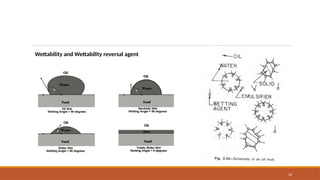
Wettability and Wettability reversal agent
35
2. Pseudo Oil based Mud:
• To help in the battle against the environmental problem of low toxicity oil
based muds and their low biodegradability, developments have been made in
producing a biodegradable synthetic base oil.
• A system which uses synthetic base oil is called a Pseudo Oil Based Mud
(SOB) and is designed to behave as close as possible to low toxic oil based mud
(LTOBM).
• SOB muds are an expensive systems and should only be considered in drilling
hole sections that cannot be drilled using water based muds without the risk of
compromising the well objectives.
36
The base oil that is being changed out can be one of the following:
• Detergent Alkalates, Synthetic Hydrocarbon, Ether and Ester. These have been listed in
increasing order of cost, biodegradability and instability.
• Synthetic base fluids include Linear Alpha Olefins (LAO), Isomerised Olefins (IO), and
normal alkanes.
• Esters are non-petroleum oils and are derived from vegetable oils. They contain no
aromatics or petroleum-derived hydrocarbons (reduced toxicity).
The primary advantage of an ester-based fluid is:
• Biodegrades readily
• Mud cuttings disposal
37
Effect of OBM on Bore hole stability
• Transfer of water from the shale to the oil mud was attributed to
osmotic forces across the semi-permeable membrane pressure of
the shale equaled the osmotic pressure of the oil mud around the
emulsified water droplets.
• Calcium chloride, when dissolved in the emulsified water, was
more effective than an equal weight of sodium chloride similarly
dissolved.
• No movement of water occurred when the surface-hydration.
38
Effect of OBM in Extreme Borehole conditions
• OBM showed great potential of using for extreme temperature, pressure,
corrosive environment and plastic salt.
• OBM is more stable then WBM in terms for heat resistance and cost of
maintenance.
• OBM found stable at 291 o
C at a depth of 23, 837 ft (7,266m)
• Gas and salt water Kicks can be controlled by only minor effects on the
properties of the oil mud.
• Drilling through salt bed makes solid in the drilling mud to become water wet,
reduces the effectiveness of water in oil emulsifying agents
39
Effect of OBM in Penetration rate with Oil Muds
• Penetration rate of OBM is slower then WBM due to high plastic viscosity
• Drilling rate in shale and sand is faster using OBM then WBM for same density
and flow properties (Reason due Salinity control)
• WBM is faster in drilling then OBM through limestone formations; Reducing
colloidal content can improve rate of penetration in OBM
• Salinity-controlled invert emulsion compositions with relaxed filtration
requirements shows
• Advantages of shale stability,
• Torque and drag reduction,
• Quick release of trip gas, and
• Corrosion mitigation are gained without loss of penetration rate.
40
Annulus Packs
• Oil based fluids are noncorrosive (Example: Salts)
• Shock proof composition of oil based fluids use to absorb earthquake
shockwaves (Ex. Oil-based composition with clay)
• Easy to maintenance during workover
• Deep well fluids to sustain at high temperature (Ex. Chromelignosulphonate
treated mud substituted lime mud)
• Drilling fluids for permafrost zone (Ex. Organophilic Clay with diesel)
41
Current based Oils:
• Paraffin (alkanes)
• Olephins (alkenes)
• Esters
• Olephins
42
Characteristics of Oils
1. Toxicity
2. Good biodegradation
3. Stability at high and low temperature
4. Cost
5. Viscosity
6. Easy to maintain
43
Gas based drilling fluids
44
Development of Gas based system
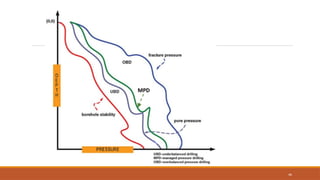
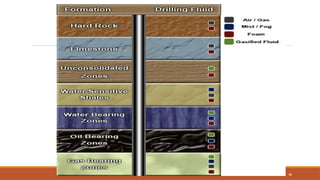
• Gas based drilling fluid used in underbalanced drilling techniques
• It is also termed as reduced-pressure drilling fluid.
• The major advantages of using reduced pressure drilling fluid are:
• Avoid loss of water, and the resulting damage to productive zones.
• High rate of penetration in drilling through hard rock formations
45
46
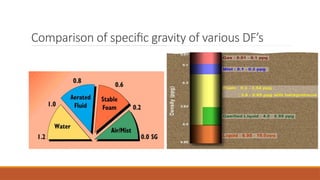
Comparison of specific gravity of various DF’s
48
49
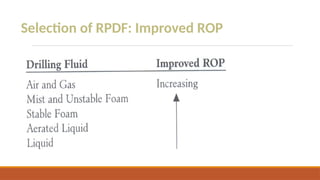
Selection of RPDF: Improved ROP
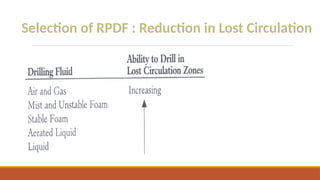
Selection of RPDF : Reduction in Lost Circulation
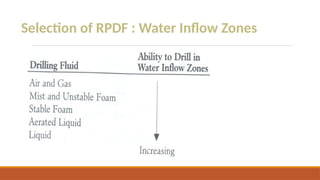
Selection of RPDF : Water Inflow Zones
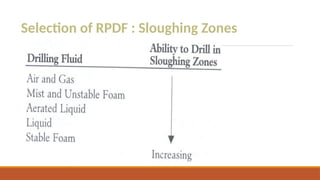
Selection of RPDF : Sloughing Zones
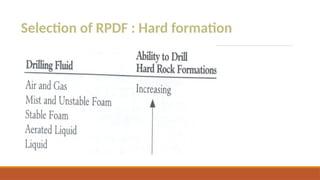
Selection of RPDF : Hard formation
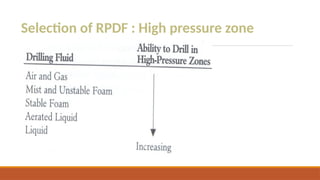
Selection of RPDF : High pressure zone
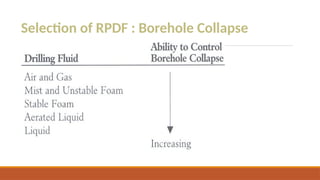
Selection of RPDF : Borehole Collapse
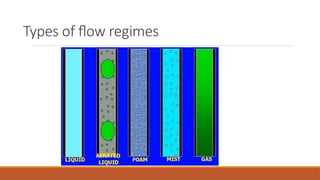
Types of flow regimes
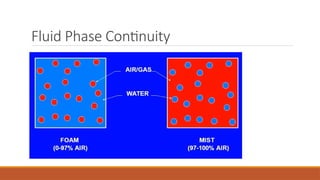
Fluid Phase Continuity
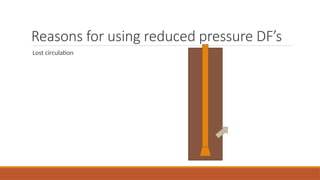
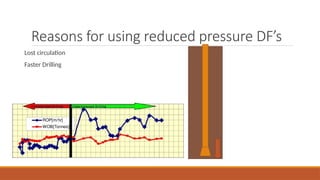
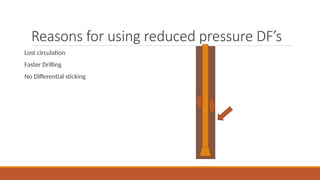
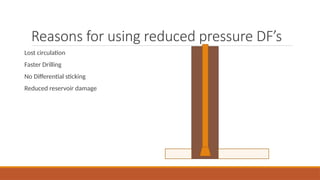
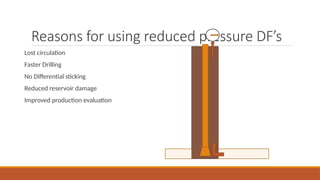
Reasons for using reduced pressure DF’s
Lost circulation
Reasons for using reduced pressure DF’s
Lost circulation
Faster Drilling
Reasons for using reduced pressure DF’s
Lost circulation
Faster Drilling
No Differential sticking
Reasons for using reduced pressure DF’s
Lost circulation
Faster Drilling
No Differential sticking
Reduced reservoir damage
Reasons for using reduced pressure DF’s
Lost circulation
Faster Drilling
No Differential sticking
Reduced reservoir damage
Improved production evaluation
Various Gas base DF
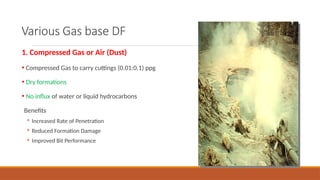
1. Compressed Gas or Air (Dust)
• Compressed Gas to carry cuttings (0.01:0.1) ppg
• Dry formations
• No influx of water or liquid hydrocarbons
Benefits
◦ Increased Rate of Penetration
◦ Reduced Formation Damage
◦ Improved Bit Performance
Various Gas base DF
2. Mist or Unstable Foam
• A mist is formed when the liquid volume fraction is below two percent at a given pressure and
temperature.
• With sufficient water inflow downhole, the liquid fraction can increase and lead to foam
formation.
• The specific gravity varies (0.1 to 0.3) ppg
• Clean and lubricates the bit
• Carries the cuttings to the surface as a mist or more normally in modified two phase flow.
• If there is a substantial water influx, foaming might occur in the cuttings pit.
• It is a good practice to have defoaming agents ready during mist drilling. Ex: Alkyl polyacrylates
Various Gas base DF
3. Stable Foam Drilling
• Mixture of gas phase and foaming solution (Gas, water and surfactant)
• Its main characteristics are a relatively low density and extremely high viscosity.
• Density of stable foam varied between 0.3 and 0.7 ppg
• The high viscosity allows efficient cuttings transport with relatively low gas injection rates.
• The low density ensures that the underbalanced conditions are established in the most practical
circumstances.
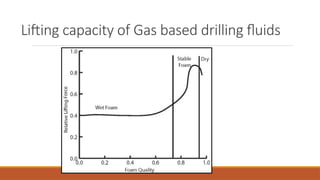
• The large liquid lifting capacity of foam drilling is one of its greatest benefits.
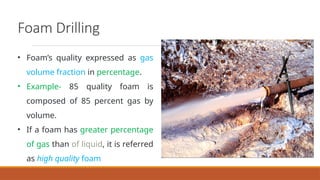
Foam Drilling
• Foam’s quality expressed as gas
volume fraction in percentage.
• Example- 85 quality foam is
composed of 85 percent gas by
volume.
• If a foam has greater percentage
of gas than of liquid, it is referred
as high quality foam
68
Flow properties of Foam
The major factor affecting foam flow behaviour are:
• Foam quality: Apparent viscosity increased rapidly as foam quality increased
from about 0.85 to 0.96, the limit of foam stability at the mist condition.
• The ratio of gas volume to total foam volume at a specified temperature and
pressure.
 Based on the behavior of foam as a Bingham plastic, charts were prepared for
common drill pipe and hole sizes to allow estimations of air-volume and water-
volume rates, and injection pressures, that minimize hydraulic horse-power.
Foam Drilling Benefits
• Faster Penetration rate
• Large liquid lifting capacity
• Low Air requirements
• Low fluid requirements
• Low Hydrostatic head
• No damage to formation
• Best for large holes
Various Gas base DF
4. Aerated (Gasified) Liquid Drilling
• Initially designed as a technique to lighten mud to reduce lost circulation
• The average densities of aerated liquids used in drilling are 4-7 ppg
• The average density of an aerated liquid depends on the gas volume fraction,
pressure, and temperature
• Equipment required for aerated liquid drilling is similar to that used in foam drilling
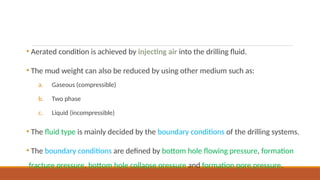
• Aerated condition is achieved by injecting air into the drilling fluid.
• The mud weight can also be reduced by using other medium such as:
a. Gaseous (compressible)
b. Two phase
c. Liquid (incompressible)
• The fluid type is mainly decided by the boundary conditions of the drilling systems.
• The boundary conditions are defined by bottom hole flowing pressure, formation
fracture pressure, bottom hole collapse pressure and formation pore pressure.
Lifting capacity of Gas based drilling fluids
74
Points to remember
75
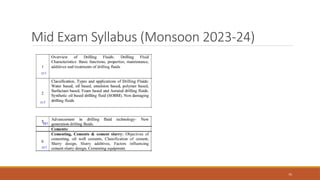
Mid Exam Syllabus (Monsoon 2023-24)
76
Calculations
of Mud Weighting
77
Mud Weighting
 The four fundamental equations used in developing mud weighting mathematical
relations are:
1) The material balance equation,
2) The volume balance equation,
3) The relationship between weight and volume equation, and
4) The volume balance in low specific gravity solids equation
78
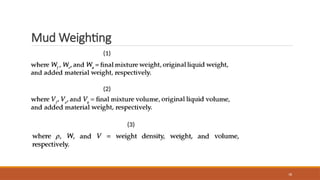
Mud Weighting
(1)
(2)
(3)
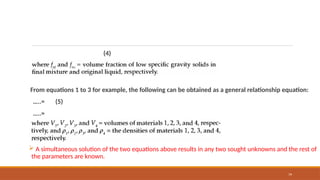
79
(4)
From equations 1 to 3 for example, the following can be obtained as a general relationship equation:
…..= (5)
…..=
 A simultaneous solution of the two equations above results in any two sought unknowns and the rest of
the parameters are known.
80
The following are example formulations for commonly encountered field
problems:
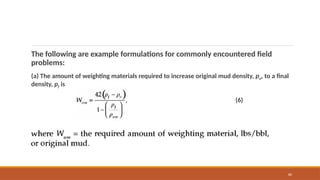
(a) The amount of weighting materials required to increase original mud density, po, to a final
density, pf is
(6)
81
(b) The average weight density, p , of two added materials i and j'
of weights pi. and pj, respectively, is
(7)
where fw, = wj /wi + wj = the weight fraction of material; with respect to added
weights of materials i and j'.
82
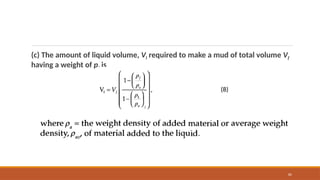
(c) The amount of liquid volume, Vl required to make a mud of total volume Vf
having a weight of pf is
(8)
83
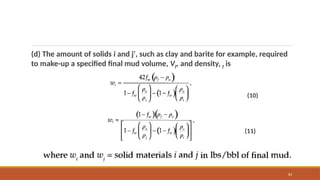
(d) The amount of solids i and j', such as clay and barite for example, required
to make-up a specified final mud volume, Vf, and density, f is
(10)
(11)
84
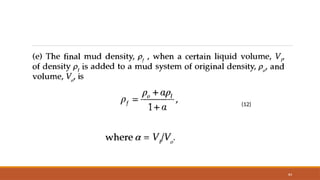
(12)
85
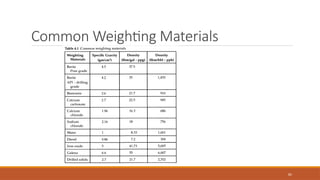
Common Weighting Materials
86
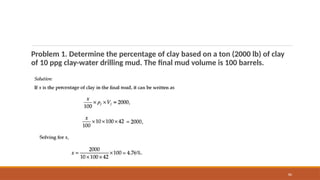
Problem 1. Determine the percentage of clay based on a ton (2000 lb) of clay
of 10 ppg clay-water drilling mud. The final mud volume is 100 barrels.
87
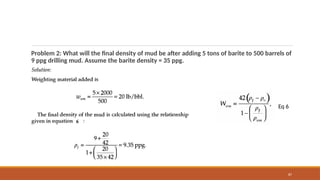
Problem 2: What will the final density of mud be after adding 5 tons of barite to 500 barrels of
9 ppg drilling mud. Assume the barite density = 35 ppg.
Eq 6
88
Problem 3. A mud engineer is planning to calculate the volume of mud that can be prepared
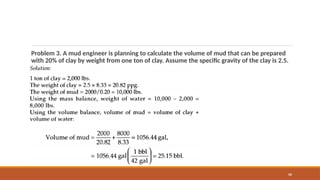
with 20% of clay by weight from one ton of clay. Assume the specific gravity of the clay is 2.5.
89
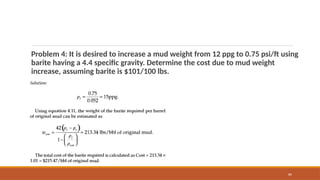
Problem 4: It is desired to increase a mud weight from 12 ppg to 0.75 psi/ft using
barite having a 4.4 specific gravity. Determine the cost due to mud weight
increase, assuming barite is $101/100 lbs.
90
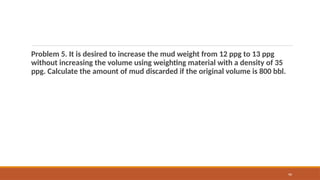
Problem 5. It is desired to increase the mud weight from 12 ppg to 13 ppg
without increasing the volume using weighting material with a density of 35
ppg. Calculate the amount of mud discarded if the original volume is 800 bbl.
91
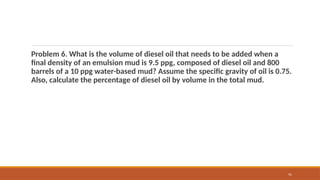
Problem 6. What is the volume of diesel oil that needs to be added when a
final density of an emulsion mud is 9.5 ppg, composed of diesel oil and 800
barrels of a 10 ppg water-based mud? Assume the specific gravity of oil is 0.75.
Also, calculate the percentage of diesel oil by volume in the total mud.
92
The End

Unit 2 Classification of Drilling Fluids.pptx

  • 1.
    1 Content Types of Drillingfluids Applications of Drilling fluids Synthetic Oil Based Drilling fluid Mud Weight Calculations
  • 2.
    2 Classification of drillingfluids Water Based Muds ◦ Principal component is water (Fresh water, sea water, produced water) Oil Based Muds ◦ Principal component is Oil (Example: Paraffin, Olefins, Esters, Olephins) Gas Based Muds ◦ Principle component is gas (Example: N2, CO2 etc)
  • 3.
    3 Types of Drillingfluids • Drilling fluid systems have a continuous phase, which is liquid, and a discontinuous phase comprising solids. • The continuous phase may be used to categorize drilling fluid types as gas, aqueous fluids or nonaqueous systems.
  • 4.
    4 Water based fluids(WBFs): • Water-based fluids (WBFs): • Most common technique • Less expensive than oil-based fluids (OBFs) • Easily available • Example: fresh water, seawater, brine • WBMs used for pay-zone drilling different for non-pay-zone drilling • Pay-zone drilling fluid are also called a non-damaging drilling fluid • Design is Costly
  • 5.
    5 Oil based fluids(OBFs): • Oil-based systems was introduced in the 1960s to help in several drilling problems • Increasing downhole temperatures • Formation clays that react, swell, or slough after exposure to WBFs • Stuck pipe and torque and drag • Contaminants • Examples: Oil-based fluids (OBFs) are used for formulated with diesel, mineral oil, or low-toxicity linear olefins and paraffins.
  • 6.
    6 Pneumatic-drilling fluids: • Inplace of drilling fluid, compressed air or gas can be used to circulate cuttings out of the wellbore • Pneumatic fluids can be classified into three categories: • Air or gas only • Foam • Aerated fluid ◦ Dry gases like air, natural gas , NO2 , CO2
  • 7.
    7 Evolution Drilling Fluids CuttingsRemoval • Drilling fluids used for only cutting removals until 1844 when Robert Beart in England patented drilling fluid circulation system. • In 1866, Sweeney received US patent on stone drill that displayed many features of todays rotary Rig. • All patents between 1860-1880 mention the circulation of a drilling fluid to remove cuttings
  • 8.
    8 Evolution Drilling Fluids HoleStabilization • Patent in 1887 by Chapman proposed stream of water and a quantity of plastic material to remove core from the formation. (Ex. Clay, bran, grain, and cement) • He suggested another function of drilling fluid i.e. to plaster wall to avoid caving tendencies. • 1890 drilling fluid used are mostly muds containing clay particles in it.
  • 9.
    9 Evolution Drilling Fluids PressureControl by Mud Density • In 1913-14, shown the practicality of sealing gas bearing zone by adding mud- laden fluid. • Advantage of mud-laden fluid were: • Reduction in number of casing strings • Protection of upper sands while drilling was continued • Prevention of migration between casing • Allowing recovery of casing • Protection of casing from corrosion • They keep ignoring the practical benefit of mud as a means of pressure control.
  • 10.
    10 Evolution Drilling Fluids •In 1922, stroud recommends that driller should frequently weigh sample of mud. He stated that success and failure in drilling a well depends upon control of the gas pressure by heavy mud. • They introduced weighing additive such as galena, iron oxides
  • 11.
    11 Evolution Drilling Fluids Birthof Mud Industry • 1926 use of Barite in oil well drilling has attracted the interest of many businessman. Mining of barite increased. • 1929 companies started selling mixture of Barite and Bentonite (95:5) as heavy weight mud. Later they identified problems in lifting cutting due to reduction in the use of bentonite quantity. • With this they identified another properties of mud i.e. gel strength.
  • 12.
    12 Evolution Drilling Fluids RapidGrowth of Industry • Inventions of mud properties testing instruments • 1924 wall building cake identification • 1930 Viscometer to measure mud viscosity • 1931 Marsh funnel • 1937 Static filtration tester
  • 13.
    13 Development of Mudtypes or System • Water and Bentonite was the most practical material for improving the viscosity and wall-building properties Salt water Mud • Easily Availability • Increase in salt content decreases the effect of bentonite mud properties • New additives introduced like starch, gums, gelatine to improve those properties
  • 14.
    14 Development of Mudtypes or System (a) Untreated Mud. (b) Mud Containing 0.5 Per Cent • Salt water Mud
  • 15.
    15 Development of Mudtypes or System Muds for Heaving Shale • Heaving shale: any shale that sloughed into the hole in excessive quantities and interfered with drilling progress. • Sensitivity to water was a characteristic of such shale • A patent issued in 1931 proposed the use of dissolved salts to reduce the osmotic pressure between fluid in the bore hole and that in the heaving shale. • Sodium silicate muds were used with some success in a number of problem wells until about 1945. Later different additive overcome this problem.
  • 16.
    16 Development of Mudtypes or System High-pH Mud • In the 1930s the most popular thinning agent for muds was quebracho extract. • This vegetable tannin, derived from a South American hardwood tree, has a deep red color when dissolved with caustic soda (NaOH). • High concentrations of caustic-quebracho produced high-pH mud which had some desirable features in shale drilling; in particular, low gel strength and great tolerance for shale solids • From the high-pH red mud came the red lime mud, or lime mud, that was consistently the most popular mud in the Gulf Coast region from 1943 to 1957
  • 17.
    17 Development of Mudtypes or System Oil Emulsion Muds • Process of making good mud better • Oil used for loosen struck pipe and to slick up the hole before running casing • 1934-1936 adding crude oil reduces pipe sticking and increases drilling rate • 1950 numerous experience of using oil emulsion muds • Later oil in water emulsion concluded to have improved performance of water in muds
  • 18.
    18 Development of Mudtypes or System Muds for deep wells • Mud treated with lime was popular as it is cheap and contains all desired properties. • Problem arise when we start drilling deep and temperature of formation increase. • The mud becoming thicker and harder at high temperature, difficult to circulate • Use of less alkaline mud was introduced such as Calcium surfactant mud introduced in 1957 to overcome the temperature limitation and minimize swelling. • Clay treated with surfactant and gypsum, later CMC added to reduce filtrate loss. • For high temperature, use of CMC is uneconomical. So, salts were added for make sodium surfactant mud and polyacrylates used for filtration loss control.
  • 19.
    19 Evolution Drilling Fluids Lowsolids Muds • Maintain the minimum practical solids content • Increase in density of mud decreases the rate of penetration due accumulation of drill cuttings near the drill bit and collar of the drilling string • Milk emulsion introduced i.e. water, diesel (5%) and 0.03% emulsifiers (a non- ionic surfactant example polyoxyethylene sorbitan tall-oil ester) • Adequate cutting recovers while retaining drilling advantages of water
  • 20.
    20 Evolution Drilling Fluids Lowsolids Muds • Other method used to control solid content were aerated mud, hydrocyclone and centrifuge, flocculants and substitution of CMC for bentonite in the control of viscosity and filtration properties. • Guar gum, Starch provided carrying capacity for cuttings and adequate filtration control in clay-free salt-water system • Use of flocculant to remove small cuttings from water was also studied in 1958
  • 21.
    21 Evolution Drilling Fluids Nondispersed polymer Muds • Dispersion of shale cutting is undesirable which occurs due to addition of thinners to mud • Polymers for bentonite are useful for fast drilling, it also provide coating at surface of cuttings and borehole • Considering, hole cleaning, mud properties concluded that nondispersed polymer mud improves mud saving • Shear thinning characteristics of certain polymers offers advantage in drilling rate and cutting carrying qualities at the same time.
  • 22.
    22 Evolution Drilling Fluids •Inhibited Muds • Addition of potassium chloride and suitable polymer formed shale inhibitive muds • Inhibitive suppresses the swelling of bentonite. • Addition of 10% KCL by weigth in water and 0.5% calcium lignisulfonate reduces mud swelling, further Starch could be added for to control filtration • Inhibitive property of potassium ion significantly reduced hole enlargement in shale section • Potassium chloride polymers compositions also helped mechanically incompetent formations in fault zone • In arctic region where problems like hole enlargement, stuck pipe, cementing surface casing difficulties handle by KCL, bentonite, XC polymer.
  • 23.
    23 Evolution Drilling Fluids •Corrosion control Muds • Corrosion of drilling string and casing string was less till 1930 • Extensive drilling leads to drilling string failure • Corrosion occurs due to acidic nature of produced water, H2S and fatigue in drill pipe. • In 1936, less corrosion were observed due to high pH of mud • Salt solution has found advantageous for long time stability of packers • Recent study show that use of inert gas replaces the dissolved oxygen in the drilling fluids and reduces the chance of corrosion
  • 24.
    24 Different type ofdrilling fluids for different functions • Technology has developed as a response to the increasing demands (greater well depths and the increasing complexity of drilling problems). • The functional requirements placed on the mud have grown from one— cuttings removal—to many, and now include pressure control and hole stability maintenance. • The muds must not damage well productivity nor be injurious to personnel, drilling equipment, or the environment. Conclusion
  • 25.
  • 26.
    26 Reasons for thedevelopment of Oil based drilling fluids • Problem with water based drilling fluids 1. Ability to dissolve salts 2. Interfere with the flow of oil and gas through porous rocks 3. Promote disintegration and dispersion of clays 4. Effect on corrosion of iron • Advantage of using oil based mud 1. Better lubricating quality 2. Higher boiling point 3. Low freezing point • Cost of OBM is higher compared to WBM
  • 27.
    27 Earlier trace ofuse of Oil in drilling • Use of crude oil as drilling fluid for drilling low pressure reservoirs has no recorded history. • 1923 Swan proposed a nonaquous viscid liquid, such as coal tar, wood tar, resin asphalt thinned with benzene to drill a well • Oil based mud used for coring in salt dome and shallow oil sands during exploration. • Numerous well used oil as completion fluid (Beckman 1938)
  • 28.
    28 Earlier OBM development •Use of diesel, ground oyster shells or limestones, air-blown asphalt, lampblack with barite were used in oil bearing zone in several fields (Hindry 1941) • The above composition gives a specific properties: • Density by shells, limestone and barite; • Initial plastering by diesel and limestones; • Lampblack provides suspending properties; • Air-blown asphalt provides both suspending and final plastering, filter cake formation • Emphasis for use OBM was given due to thin filter cake and the absence of water in the filtrate.
  • 29.
    29 Introduction of commercialoil muds • Commercial oil muds become available since 1942, company name Oil based Drilling fluid company in California supplies blown asphalt in the name of black magic (powder of asphalt and oil). • Ready mixed oil muds were supplied along with addition of naphthenic acid and calcium oxide • Halliburton patented and marketed brown asphalt, and tall oil soap formed by reaction with sodium hydroxide and sodium silicate • 1948, Ken corporation supplied oil based drilling fluid with composition alkali and alkaline soaps of resin acid instead of air-blown asphalt
  • 30.
    30 Categories of Oilbased drilling fluids 1. Oil Base-Emulsion (Invert Emulsion) Drilling fluids 2. Pseudo Oil Based Mud 3. Invert Emulsion Oil Muds: low toxicity and controlled viscosity drilling fluids Compositions: • Low toxic base oil • Water • Emulsifier • Wetting agent • Organophillic Clay • Lime
  • 31.
    31 Emulsions ? • Anemulsion is a colloidal solution in which the dispersed phase, and a dispersion medium, are both liquids • Colloidal System: The heterogeneous mixture with particle size in the dissolved state is between 1nm to 1000nm is called a colloidal system. • Oil in water emulsion • Water in Oil emulsion
  • 32.
    32 Composition of Invertemulsion • Water: In emulsion water is used to control viscosity by controlling water (%) • The salinity of the water phase can be controlled by the use of dissolved salts, usually calcium chloride. • Control of salinity in invert oil muds is necessary to "tie-up" free water molecules and prevent any water migration between the mud and the open formation such as shales. • Emulsifiers: Often divided into primary and secondary emulsifiers. • These act at the interface between the oil and the water droplets. • Emulsifier levels are held in excess to act against possible water and solid contamination.
  • 33.
    33 • Wetting Agent:This is a high concentration emulsifier used especially in high density fluids to oil wet all the solids. If solids become water wet they will not be suspended in the fluid, and would settle out of the system. • Organophillic Clay: These are clays treated to react and hydrate in the presence of oil. They react with oil to give both suspension and viscosity characteristics. • Lime: Lime is the primary ingredient necessary for reaction with the emulsifiers to develop the oil water interface. It is also useful in combating acidic gases such as CO2 and H2S. The concentration of lime is usually held in excess of 2 to 6 ppb, depending on conditions.
  • 34.
  • 35.
    35 2. Pseudo Oilbased Mud: • To help in the battle against the environmental problem of low toxicity oil based muds and their low biodegradability, developments have been made in producing a biodegradable synthetic base oil. • A system which uses synthetic base oil is called a Pseudo Oil Based Mud (SOB) and is designed to behave as close as possible to low toxic oil based mud (LTOBM). • SOB muds are an expensive systems and should only be considered in drilling hole sections that cannot be drilled using water based muds without the risk of compromising the well objectives.
  • 36.
    36 The base oilthat is being changed out can be one of the following: • Detergent Alkalates, Synthetic Hydrocarbon, Ether and Ester. These have been listed in increasing order of cost, biodegradability and instability. • Synthetic base fluids include Linear Alpha Olefins (LAO), Isomerised Olefins (IO), and normal alkanes. • Esters are non-petroleum oils and are derived from vegetable oils. They contain no aromatics or petroleum-derived hydrocarbons (reduced toxicity). The primary advantage of an ester-based fluid is: • Biodegrades readily • Mud cuttings disposal
  • 37.
    37 Effect of OBMon Bore hole stability • Transfer of water from the shale to the oil mud was attributed to osmotic forces across the semi-permeable membrane pressure of the shale equaled the osmotic pressure of the oil mud around the emulsified water droplets. • Calcium chloride, when dissolved in the emulsified water, was more effective than an equal weight of sodium chloride similarly dissolved. • No movement of water occurred when the surface-hydration.
  • 38.
    38 Effect of OBMin Extreme Borehole conditions • OBM showed great potential of using for extreme temperature, pressure, corrosive environment and plastic salt. • OBM is more stable then WBM in terms for heat resistance and cost of maintenance. • OBM found stable at 291 o C at a depth of 23, 837 ft (7,266m) • Gas and salt water Kicks can be controlled by only minor effects on the properties of the oil mud. • Drilling through salt bed makes solid in the drilling mud to become water wet, reduces the effectiveness of water in oil emulsifying agents
  • 39.
    39 Effect of OBMin Penetration rate with Oil Muds • Penetration rate of OBM is slower then WBM due to high plastic viscosity • Drilling rate in shale and sand is faster using OBM then WBM for same density and flow properties (Reason due Salinity control) • WBM is faster in drilling then OBM through limestone formations; Reducing colloidal content can improve rate of penetration in OBM • Salinity-controlled invert emulsion compositions with relaxed filtration requirements shows • Advantages of shale stability, • Torque and drag reduction, • Quick release of trip gas, and • Corrosion mitigation are gained without loss of penetration rate.
  • 40.
    40 Annulus Packs • Oilbased fluids are noncorrosive (Example: Salts) • Shock proof composition of oil based fluids use to absorb earthquake shockwaves (Ex. Oil-based composition with clay) • Easy to maintenance during workover • Deep well fluids to sustain at high temperature (Ex. Chromelignosulphonate treated mud substituted lime mud) • Drilling fluids for permafrost zone (Ex. Organophilic Clay with diesel)
  • 41.
    41 Current based Oils: •Paraffin (alkanes) • Olephins (alkenes) • Esters • Olephins
  • 42.
    42 Characteristics of Oils 1.Toxicity 2. Good biodegradation 3. Stability at high and low temperature 4. Cost 5. Viscosity 6. Easy to maintain
  • 43.
  • 44.
    44 Development of Gasbased system • Gas based drilling fluid used in underbalanced drilling techniques • It is also termed as reduced-pressure drilling fluid. • The major advantages of using reduced pressure drilling fluid are: • Avoid loss of water, and the resulting damage to productive zones. • High rate of penetration in drilling through hard rock formations
  • 45.
  • 46.
  • 47.
    Comparison of specificgravity of various DF’s
  • 48.
  • 49.
  • 50.
    Selection of RPDF:Improved ROP
  • 51.
    Selection of RPDF: Reduction in Lost Circulation
  • 52.
    Selection of RPDF: Water Inflow Zones
  • 53.
    Selection of RPDF: Sloughing Zones
  • 54.
    Selection of RPDF: Hard formation
  • 55.
    Selection of RPDF: High pressure zone
  • 56.
    Selection of RPDF: Borehole Collapse
  • 57.
  • 58.
  • 59.
    Reasons for usingreduced pressure DF’s Lost circulation
  • 60.
    Reasons for usingreduced pressure DF’s Lost circulation Faster Drilling
  • 61.
    Reasons for usingreduced pressure DF’s Lost circulation Faster Drilling No Differential sticking
  • 62.
    Reasons for usingreduced pressure DF’s Lost circulation Faster Drilling No Differential sticking Reduced reservoir damage
  • 63.
    Reasons for usingreduced pressure DF’s Lost circulation Faster Drilling No Differential sticking Reduced reservoir damage Improved production evaluation
  • 64.
    Various Gas baseDF 1. Compressed Gas or Air (Dust) • Compressed Gas to carry cuttings (0.01:0.1) ppg • Dry formations • No influx of water or liquid hydrocarbons Benefits ◦ Increased Rate of Penetration ◦ Reduced Formation Damage ◦ Improved Bit Performance
  • 65.
    Various Gas baseDF 2. Mist or Unstable Foam • A mist is formed when the liquid volume fraction is below two percent at a given pressure and temperature. • With sufficient water inflow downhole, the liquid fraction can increase and lead to foam formation. • The specific gravity varies (0.1 to 0.3) ppg • Clean and lubricates the bit • Carries the cuttings to the surface as a mist or more normally in modified two phase flow. • If there is a substantial water influx, foaming might occur in the cuttings pit. • It is a good practice to have defoaming agents ready during mist drilling. Ex: Alkyl polyacrylates
  • 66.
    Various Gas baseDF 3. Stable Foam Drilling • Mixture of gas phase and foaming solution (Gas, water and surfactant) • Its main characteristics are a relatively low density and extremely high viscosity. • Density of stable foam varied between 0.3 and 0.7 ppg • The high viscosity allows efficient cuttings transport with relatively low gas injection rates. • The low density ensures that the underbalanced conditions are established in the most practical circumstances. • The large liquid lifting capacity of foam drilling is one of its greatest benefits.
  • 67.
    Foam Drilling • Foam’squality expressed as gas volume fraction in percentage. • Example- 85 quality foam is composed of 85 percent gas by volume. • If a foam has greater percentage of gas than of liquid, it is referred as high quality foam
  • 68.
    68 Flow properties ofFoam The major factor affecting foam flow behaviour are: • Foam quality: Apparent viscosity increased rapidly as foam quality increased from about 0.85 to 0.96, the limit of foam stability at the mist condition. • The ratio of gas volume to total foam volume at a specified temperature and pressure.  Based on the behavior of foam as a Bingham plastic, charts were prepared for common drill pipe and hole sizes to allow estimations of air-volume and water- volume rates, and injection pressures, that minimize hydraulic horse-power.
  • 69.
    Foam Drilling Benefits •Faster Penetration rate • Large liquid lifting capacity • Low Air requirements • Low fluid requirements • Low Hydrostatic head • No damage to formation • Best for large holes
  • 70.
    Various Gas baseDF 4. Aerated (Gasified) Liquid Drilling • Initially designed as a technique to lighten mud to reduce lost circulation • The average densities of aerated liquids used in drilling are 4-7 ppg • The average density of an aerated liquid depends on the gas volume fraction, pressure, and temperature • Equipment required for aerated liquid drilling is similar to that used in foam drilling
  • 71.
    • Aerated conditionis achieved by injecting air into the drilling fluid. • The mud weight can also be reduced by using other medium such as: a. Gaseous (compressible) b. Two phase c. Liquid (incompressible) • The fluid type is mainly decided by the boundary conditions of the drilling systems. • The boundary conditions are defined by bottom hole flowing pressure, formation fracture pressure, bottom hole collapse pressure and formation pore pressure.
  • 73.
    Lifting capacity ofGas based drilling fluids
  • 74.
  • 75.
    75 Mid Exam Syllabus(Monsoon 2023-24)
  • 76.
  • 77.
    77 Mud Weighting  Thefour fundamental equations used in developing mud weighting mathematical relations are: 1) The material balance equation, 2) The volume balance equation, 3) The relationship between weight and volume equation, and 4) The volume balance in low specific gravity solids equation
  • 78.
  • 79.
    79 (4) From equations 1to 3 for example, the following can be obtained as a general relationship equation: …..= (5) …..=  A simultaneous solution of the two equations above results in any two sought unknowns and the rest of the parameters are known.
  • 80.
    80 The following areexample formulations for commonly encountered field problems: (a) The amount of weighting materials required to increase original mud density, po, to a final density, pf is (6)
  • 81.
    81 (b) The averageweight density, p , of two added materials i and j' of weights pi. and pj, respectively, is (7) where fw, = wj /wi + wj = the weight fraction of material; with respect to added weights of materials i and j'.
  • 82.
    82 (c) The amountof liquid volume, Vl required to make a mud of total volume Vf having a weight of pf is (8)
  • 83.
    83 (d) The amountof solids i and j', such as clay and barite for example, required to make-up a specified final mud volume, Vf, and density, f is (10) (11)
  • 84.
  • 85.
  • 86.
    86 Problem 1. Determinethe percentage of clay based on a ton (2000 lb) of clay of 10 ppg clay-water drilling mud. The final mud volume is 100 barrels.
  • 87.
    87 Problem 2: Whatwill the final density of mud be after adding 5 tons of barite to 500 barrels of 9 ppg drilling mud. Assume the barite density = 35 ppg. Eq 6
  • 88.
    88 Problem 3. Amud engineer is planning to calculate the volume of mud that can be prepared with 20% of clay by weight from one ton of clay. Assume the specific gravity of the clay is 2.5.
  • 89.
    89 Problem 4: Itis desired to increase a mud weight from 12 ppg to 0.75 psi/ft using barite having a 4.4 specific gravity. Determine the cost due to mud weight increase, assuming barite is $101/100 lbs.
  • 90.
    90 Problem 5. Itis desired to increase the mud weight from 12 ppg to 13 ppg without increasing the volume using weighting material with a density of 35 ppg. Calculate the amount of mud discarded if the original volume is 800 bbl.
  • 91.
    91 Problem 6. Whatis the volume of diesel oil that needs to be added when a final density of an emulsion mud is 9.5 ppg, composed of diesel oil and 800 barrels of a 10 ppg water-based mud? Assume the specific gravity of oil is 0.75. Also, calculate the percentage of diesel oil by volume in the total mud.
  • 92.

Editor's Notes

  • #29 Tall oil is principally a mixture of resin acids, such as abietic acid, and fatty acids, such as oleic and linoleic acids, with some sterols and other compounds