 Abstract
 Meaning of drilling fluid
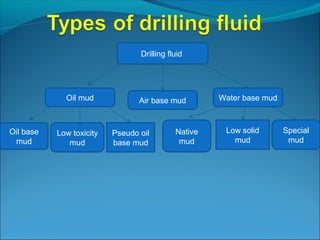
 Types of drilling fluid
 Drilling fluid additives
 Rheological properties of drilling fluid
 The doctor of an oil well.
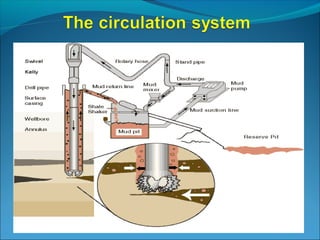
 The circulation system.
 References
 Questions
Jacob Ebere ( petroleum engineering AUST.)
Date :Friday, March 30th
, 2012. Venue: Zenith Hall, AUST Campus. Time 6.00pm
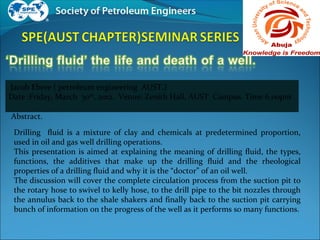
Abstract.
Drilling fluid is a mixture of clay and chemicals at predetermined proportion,
used in oil and gas well drilling operations.
This presentation is aimed at explaining the meaning of drilling fluid, the types,
functions, the additives that make up the drilling fluid and the rheological
properties of a drilling fluid and why it is the “doctor” of an oil well.
The discussion will cover the complete circulation process from the suction pit to
the rotary hose to swivel to kelly hose, to the drill pipe to the bit nozzles through
the annulus back to the shale shakers and finally back to the suction pit carrying
bunch of information on the progress of the well as it performs so many functions.
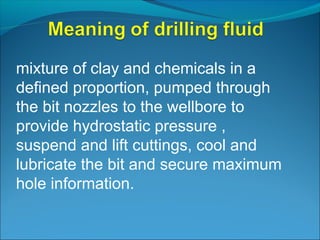
mixture of clay and chemicals in a
defined proportion, pumped through
the bit nozzles to the wellbore to
provide hydrostatic pressure ,
suspend and lift cuttings, cool and
lubricate the bit and secure maximum
hole information.
Drilling fluid
Water base mudOil mud
Low solid
mud
Oil base
mud
Low toxicity
mud
Pseudo oil
base mud
Native
mud
Special
mud
Air base mud
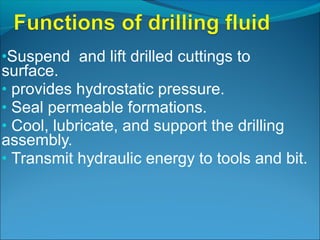
•Suspend and lift drilled cuttings to
surface.
• provides hydrostatic pressure.
• Seal permeable formations.
• Cool, lubricate, and support the drilling
assembly.
• Transmit hydraulic energy to tools and bit.
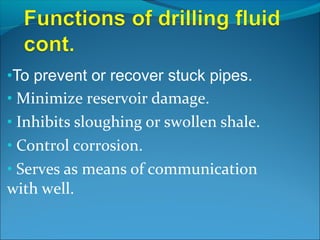
•To prevent or recover stuck pipes.
• Minimize reservoir damage.
• Inhibits sloughing or swollen shale.
• Control corrosion.
• Serves as means of communication
with well.
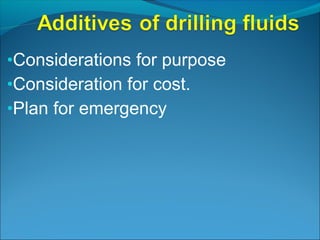
•Considerations for purpose
•Consideration for cost.
•Plan for emergency
 Base oil
 Calcium chloride(in form of brine)
 Lime
 Viscosifier
 Primary and secondary emulsifier
 Fluid loss agent (usually called FLG)
 Barite (weighting agent)
 Pre-hydrated bentonite.
 Salt (KCL, NaCl, CaCl2).
 Filtration Control Agent ( soltex).
 Guar gum.(polymer).
 sodiumcarboxymethyl cellulose
(polymer)
 XC-polymer (polymer).
 Custic soda (NaOH).
 plastic viscosity(PV)
 Yield point(YP)
 Gel strength(GS)
 Marsh funnel viscosity(MFV)
 apparent viscosity(AV)
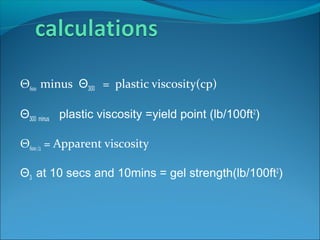
Θ600 minus Θ300 = plastic viscosity(cp)
Θ300 minus plastic viscosity =yield point (lb/100ft2
)
Θ600/2 = Apparent viscosity
Θ3 at 10 secs and 10mins = gel strength(lb/100ft2
)
 remedy to kick.
 remedy to blown well.
 gas out measurement.
 telemetry system.
?S
ANA industries Drilling fluids Manuals,
(2004).
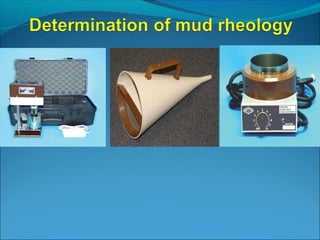
Ofite drilling fluids equipment manuals,
(2010)
http://www.ofite.com/products/110-10.asp
spe fluid

spe fluid

  • 1.
     Abstract  Meaningof drilling fluid  Types of drilling fluid  Drilling fluid additives  Rheological properties of drilling fluid  The doctor of an oil well.  The circulation system.  References  Questions
  • 2.
    Jacob Ebere (petroleum engineering AUST.) Date :Friday, March 30th , 2012. Venue: Zenith Hall, AUST Campus. Time 6.00pm Abstract. Drilling fluid is a mixture of clay and chemicals at predetermined proportion, used in oil and gas well drilling operations. This presentation is aimed at explaining the meaning of drilling fluid, the types, functions, the additives that make up the drilling fluid and the rheological properties of a drilling fluid and why it is the “doctor” of an oil well. The discussion will cover the complete circulation process from the suction pit to the rotary hose to swivel to kelly hose, to the drill pipe to the bit nozzles through the annulus back to the shale shakers and finally back to the suction pit carrying bunch of information on the progress of the well as it performs so many functions.
  • 3.
    mixture of clayand chemicals in a defined proportion, pumped through the bit nozzles to the wellbore to provide hydrostatic pressure , suspend and lift cuttings, cool and lubricate the bit and secure maximum hole information.
  • 4.
    Drilling fluid Water basemudOil mud Low solid mud Oil base mud Low toxicity mud Pseudo oil base mud Native mud Special mud Air base mud
  • 5.
    •Suspend and liftdrilled cuttings to surface. • provides hydrostatic pressure. • Seal permeable formations. • Cool, lubricate, and support the drilling assembly. • Transmit hydraulic energy to tools and bit.
  • 6.
    •To prevent orrecover stuck pipes. • Minimize reservoir damage. • Inhibits sloughing or swollen shale. • Control corrosion. • Serves as means of communication with well.
  • 7.
    •Considerations for purpose •Considerationfor cost. •Plan for emergency
  • 8.
     Base oil Calcium chloride(in form of brine)  Lime  Viscosifier  Primary and secondary emulsifier  Fluid loss agent (usually called FLG)  Barite (weighting agent)
  • 9.
     Pre-hydrated bentonite. Salt (KCL, NaCl, CaCl2).  Filtration Control Agent ( soltex).  Guar gum.(polymer).  sodiumcarboxymethyl cellulose (polymer)  XC-polymer (polymer).  Custic soda (NaOH).
  • 10.
     plastic viscosity(PV) Yield point(YP)  Gel strength(GS)  Marsh funnel viscosity(MFV)  apparent viscosity(AV)
  • 12.
    Θ600 minus Θ300= plastic viscosity(cp) Θ300 minus plastic viscosity =yield point (lb/100ft2 ) Θ600/2 = Apparent viscosity Θ3 at 10 secs and 10mins = gel strength(lb/100ft2 )
  • 13.
     remedy tokick.  remedy to blown well.  gas out measurement.  telemetry system.
  • 15.
  • 16.
    ANA industries Drillingfluids Manuals, (2004). Ofite drilling fluids equipment manuals, (2010) http://www.ofite.com/products/110-10.asp