Drilling fluid Engineering
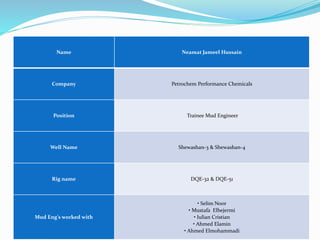
Name Neamat Jameel Hussain
Company Petrochem Performance Chemicals
Position Trainee Mud Engineer
Well Name Shewashan-3 & Shewashan-4
Rig name DQE-32 & DQE-51
Mud Eng’s worked with
• Selim Noor
• Mustafa Elbejermi
• Iulian Cristian
• Ahmed Elamin
• Ahmed Elmohammadi
Introduction
 First of all I would like to thank all the people in Petrochem
who helped me to get a good training as a mud engineer.
 I like to thank the experienced people who helped me with
their knowledge and gave me full support while I was on
my 3 months training ….
 I appreciate their good efforts.
Function of mud
 Remove cuttings from well
 Suspend and release cuttings
 Control formation pressures
 Seal permeable formations
 Maintain wellbore stability
 Minimizing formation damage
 Cool, lubricate, and support the bit and drilling
assembly
 Transmit hydraulic energy to tools and bit
 Control corrosion (in acceptable level)
Types of mud
 Water base mud (Spud mud , KCl polymer mud , Gel
Polymer , Sodium chloride mud, Truhib Mud , LSND (low
solid non dispersed mud )
 Oil base mud ( toxic oil , non toxic )
Drilling fluid testing procedures
 Rheology
 Filtration low pressure/low temperature
 Retort
 KCL
 MBT
 Chloride
 Calcium
 Total hardness
 Pf/Mf
 Estimating sand content
 Filtration High Pressure/High Temperature test
 Tracer
 Measuring PH by PH meter and Litmus Papers
Purpose & measuring of each of them
 Retort :
For measuring percentage of Water , Oil and solid inside of
mud and reported by percentage like 2% oil , 3% of solid and
95% of water
 Filtration :-
Is to measure the fluid invasion into the formation and how
it will effect the thickness of filter cake build of the wall of
the well. Filter cake should be thin , tough and smooth
 Rheology:
Plastic viscosity : indication of solid in your mud
Yield point: carrying capacity during dynamic condition
Gel strength: carrying capacity during static condition (no
circulation)
Gel strength will guide you to detect the concentration of
Bentonite build up in the mud or solid build up in the mud
Types of gel while reading by VG meter
1-flash gel: indicate bentonite build up in your mud we will
find reading 3 rpm at 10 second and 10 min both of them are
high with little different between them for example 11/13 ,
21/24
 2-Progresive gel :
which indicate solid build up in your mud and we will find
reading 3 rpm has a big deferent between them we can find
5/13 , 3/12
 MBT :
 This test indicate bentonite in your mud
MBT= (CC)mb*5/cc of sample
measured as lb/bbl of bentonite
 KCL : this test measure percentage in your mud should be
same as program and reported as %KCl
PPC package with categories
 Viscosifiers: this branch of chemicals which is responsible
of giving viscosity to mud and performing viscous shape
1. Tuzan DS & Truzan ( xanthan gum )
2. Bentonite ( master of yield point performing mud texture
)
3. Trupack RS & Trupack R (polyanionic cellulose polymer )
4. HEC ( hydroxy ethyl cellulose )
 Fluid lose Reducer :-
1. Polylose B ( Starch)
2. PAL-FLC ( Starch)
3. Trupack SL ( cellulose base and super low)
4. Trupack LV ( Cellulose base and low viscosity )
5. Trupack RS & R
6. Bentonite
 Calcium control chemicals :
1. Soda Ash ( sodium carbonate Na2CO3)
2. Sodium bicarbonate ( NaHCO3)
 PH control chemicals :
1. Caustic soda ( NaOH)
2. Lime ( Ca(OH)2)
3. KOH( Potassium Hydroxide) ( potash)
4. Soda Ash
5. Sodium Bicarbonate
6. SAPP ( Soduim acid pyrophosphate )
 Chemicals for controlling magnesium
Caustic Soda ( NaOH sodium Hydroxide )
 Weighting material :-
1. Hematite ( Ferrous Oxide ( 4.9-5.26) gm/cc)
2. Barite ( Barium Sulphate (4.2) gm/cc )
3. Calcium Carbonate fine ( CaCO3)
4. Salts:-
a) NaCl
b) CaCl2
c) CaBr2
d) KCL
 Preservative Chemicals:-
1. Biocide ( Anti Bactria degradation )
2. All kind of salts are preservatives
3. All PH controlers are preservatives
 Scavengers:-
1. NO-OX PC-100 ( Oxygen Scavengers which removes any
free Oxygen in mud and Minimize the Corrosion
2. H2S Scavengers ( Scavenge H2S and minimize corrosion
which are caused by H2S gases
 Corrosion inhibitors:-
1-NOCOR C825 (Anti corrosion )
2-Amifilm ( Amine Base used to Coat drill pipe to prevent
corrosion
3-All PH control chemicals specially most strong of them
which is caustic soda and lime and increase PH can work as
Corrosion Inhibitors
4- also Biocide can work as Corrosion inhibitor because it
kills bacteria
 Anti Foam Categories :
No Foam SB30 ( all anti Foam working on scientific base of
reducing surface tension
 Lost Circulation Material (LCM ):- damaging stuff
1-Not Plug ( fine-medium-Coarse )
2-Mica (Aluminum Silicate )
3-Super Seal (fiber material, Flake )
4-Tru Seal (fiber material, Flake)
5-Tru Plug
6-Cotton Seads
7-Magma fiber
All the products are damaging (LCM) means we can not mix this
stuff in reservoir section because they are not acid soluble
 None damaging Stuff
1-Calcium Carbonate fine medium and Coarse
2- TruPlug
Its None damaging stuff because its acid soluble
 Shale control chemicals :-
1-KCL Potassium Chloride
It make inhibition to the shale by Cation Exchange between
chloride anion and Sodium or Calcium cations on the shale
platelets , shale nature consist of several layers and connected
together by bonds of Sodium or Calcium
2-GlyPlus MC , HC ( Glycol)
3-Truguard Cationic liquid polyamine
4-Free drill ( Asphaltic material with potassium cation
5-drill text K ( potassium asphalt sulfonate )
6-Blacknite ( liquid gilsonite )
7-PHPA ( Partially hydrolyzed poly acrylamide )
8- Soltex (asphaltic material )
 Stuck free Chemicals:-
1. Deferential stuck pipe: kwickspot
2. Mechanical stuck : HCL
 Surfactant : a substance which tends to reduce the surface
tension of a liquid in which it is dissolved
1-Bitclean
2- DME :Emulsifiers to get diesel inside the water
 Thinners :- this chemical is responsible for decreasing
viscosity of mud
1-Truthin L : Decreasing polymers base mud
2-CFL
 Bridging stuff : this chemical is responsible for sealing
porous of the formation to minimize the deferential
sticking and enhance API fluid losses and improve
filter cake quality .
1-Calcium Carbonate
2-GR Seal (graphite stuff)
3-Truseal XF (micronized of fibrous ,flake )
 Lubricants :-
1-Lube 100
2-Glyplus (Polyalkylene Glycol )
 Chemicals used for decreasing of Cement
contamination :-
1-Citric Acid
2-Sodium Bicarbonate
Calculations
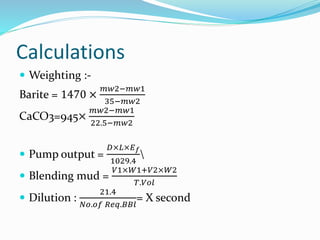
 Weighting :-
Barite = 1470 ×
𝑚𝑤2−𝑚𝑤1
35−𝑚𝑤2
CaCO3=945×
𝑚𝑤2−𝑚𝑤1
22.5−𝑚𝑤2
 Pump output =
𝐷×𝐿×𝐸 𝑓
1029.4

 Blending mud =
𝑉1×𝑊1+𝑉2×𝑊2
𝑇.𝑉𝑜𝑙
 Dilution :
21.4
𝑁𝑜.𝑜𝑓 𝑅𝑒𝑞.𝐵𝐵𝑙
= X second
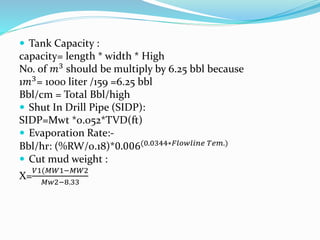
 Tank Capacity :
capacity= length * width * High
No. of 𝑚3 should be multiply by 6.25 bbl because
1𝑚3= 1000 liter /159 =6.25 bbl
Bbl/cm = Total Bbl/high
 Shut In Drill Pipe (SIDP):
SIDP=Mwt *0.052*TVD(ft)
 Evaporation Rate:-
Bbl/hr: (%RW/0.18)*0.006(0.0344∗𝐹𝑙𝑜𝑤𝑙𝑖𝑛𝑒 𝑇𝑒𝑚.)
 Cut mud weight :
X=
𝑉1(𝑀𝑊1−𝑀𝑊2
𝑀𝑤2−8.33
 Treat out required mg/l of Calcium :
Soda ash:0.00092*req. mg/l
Sodium bicarbonate: 0.00074* req. mg/l
SAPP= 0.00097* req. mg/l
Cement job
1. Be sure you have enough room in your tank
2. Remember the difference between pumping cement and
displacement (pumping no losses as cement still inside casing
) displacing could observe losses as cement in open hole
3. Before pumping of spacer we have to measure the surface of all
the tanks (active tank)
4. During pumping cement inside casing you have to be there
beside cement unit to check the cement weight
5. You have to take a few sample of lead and tail slurry to give
DSV
6. You have to float between mud tank to check the level and
shaker and be sure that the displaced mud go in the mud tank
that is planed to take it
7-Mud logger you have to keep good communication
with mud logger during cement job because both of you
have to get very close figures about gaining or losing
after cement job and displacement
8-take measurement before pumping cement and after
cement , according your going to mud logger for
checking gains and losses
 We have two scenarios for pumping cement :
1- reverse circulation
2- normal pumping inside string
Displacement of mud
1-we have to calculate hole volume
2-we have to calculate active system include sand trap to
calculate how many bbl we need (minimum )
3- build (mix) spacer to minimize contamination
between old and new mud
4- choose short system with old mud to drill cement
*short system mean we make small tank with old mud to
drill cement and returned back to same tank then we
can dump it…
5-first things to pump spacer followed by new mud
*note: we must calculate time and tell mud boy to
weight mud we appear new mud we must stop dumping
And new mud we must put it to suction tank to hole
make normal circulation
6-circulate new mud till mud become homogeneous and
add some chemicals if it need like increase mud weight
or decrease viscosity
7- take a sample and make full test and what is result if
its need chemicals apply it till become good mud
Formation problem and prevent It
 Dolomite : with this formation we get high magnesium
we must increase PH above 10
 Limestone and anhydrite : in those formation we must
have free water inside mud by water dilution free water
make dissolve limestone and anhydrite give us calcium
this make prevent drop down PH
 Shale: this formation we have bit balling , pack off
 Sandstone: possible losses increase solid content (sand
content) we can use screen above 140 API
 Limestone : always fractured and cause possible losses
We can control it by LCM this is only formation if we get
stuck pipe we can make it free by HCL and this is only
formation it will not effect PH … it can be reservoir
*Note:-
Siltstone means Shale + sand
Argillaceous limestone : means porous limestone
cemented with shale (clay)
Down hole problems
 Losing fluid while drilling :-
1. Seepage losses : <10 bbl/hr
2. Partial losses : 10-60 bbl/hr
3. Total losses : non return of mud
We can fix it by pumping LCM
 Bit balling :it means the cutting stick around the bit on
bottom and off bottom there was not torque we have to
prevent it by adding the inhibitors of shale to be not sticky
inside the mud but if it happen partially first we pump
LCM Nut Plug with free drill and other kind of LCM
 LCM Nut Plug pill to fix bit balling :-
1-bitclean pill mud from active treat with 3% of bitclean
2- 2% bitclean on active mud 20-40 ppb of nut plug fine
medium
3-2% free drill with 20-40 ppb Nut plug with mud on
active
4- three of above together
But if happen on surface we can use water with caustic
soda till PH reach 14 and pumped the bit will be clean
this is we can use with normal mud without any
weighting material to avoiding barite settling almost 3
ppb of caustic soda we can use it
 Stuck pipe:
1-deffrential stuck pipe :-
You can not rotate .. But you can circulate it happens
when hydrostatic pressure of mud exceeds the formation
pressure we can fix it by adding kwikspot and improve
the filter cake
2- mechanical stuck pipe:
You can not rotate , you can not circulate , but you can
reciprocate we can fix if it not by HCL , and other chose
breaking drill string fishing it or sidetrack ,
General information
 Calibration of VG meter, Retort , Marsh funnel , Mud
balance
 Increasing mud weight using KCl & Salt with calculating
desired amount needed by table
 High bentonite in mud with high mud weight how to fix it?
 Quantity from recipe change to field unit like ( Drums,
sacks , Pail )
 Foam inside mud where is coming and how to fix it
 What is the different between stabilizer and centralizer ?
 Flow over shaker how to fix it
 Jack or nut when we run casing
 Difference between caving cutting and pressurized
cutting on shale shaker
 Difference between sodium carbonate and sodium
bicarbonate while treating cement
 Key setting and reason that make this problem
 What is F.I.T and L.O.T
 Solid control equipment and dewatering how it work

Mud Engineering presentation

  • 1.
  • 2.
    Name Neamat JameelHussain Company Petrochem Performance Chemicals Position Trainee Mud Engineer Well Name Shewashan-3 & Shewashan-4 Rig name DQE-32 & DQE-51 Mud Eng’s worked with • Selim Noor • Mustafa Elbejermi • Iulian Cristian • Ahmed Elamin • Ahmed Elmohammadi
  • 3.
    Introduction  First ofall I would like to thank all the people in Petrochem who helped me to get a good training as a mud engineer.  I like to thank the experienced people who helped me with their knowledge and gave me full support while I was on my 3 months training ….  I appreciate their good efforts.
  • 4.
    Function of mud Remove cuttings from well  Suspend and release cuttings  Control formation pressures  Seal permeable formations  Maintain wellbore stability  Minimizing formation damage  Cool, lubricate, and support the bit and drilling assembly  Transmit hydraulic energy to tools and bit  Control corrosion (in acceptable level)
  • 5.
    Types of mud Water base mud (Spud mud , KCl polymer mud , Gel Polymer , Sodium chloride mud, Truhib Mud , LSND (low solid non dispersed mud )  Oil base mud ( toxic oil , non toxic )
  • 6.
    Drilling fluid testingprocedures  Rheology  Filtration low pressure/low temperature  Retort  KCL  MBT  Chloride  Calcium  Total hardness  Pf/Mf  Estimating sand content  Filtration High Pressure/High Temperature test  Tracer  Measuring PH by PH meter and Litmus Papers
  • 7.
    Purpose & measuringof each of them  Retort : For measuring percentage of Water , Oil and solid inside of mud and reported by percentage like 2% oil , 3% of solid and 95% of water  Filtration :- Is to measure the fluid invasion into the formation and how it will effect the thickness of filter cake build of the wall of the well. Filter cake should be thin , tough and smooth
  • 8.
     Rheology: Plastic viscosity: indication of solid in your mud Yield point: carrying capacity during dynamic condition Gel strength: carrying capacity during static condition (no circulation) Gel strength will guide you to detect the concentration of Bentonite build up in the mud or solid build up in the mud Types of gel while reading by VG meter 1-flash gel: indicate bentonite build up in your mud we will find reading 3 rpm at 10 second and 10 min both of them are high with little different between them for example 11/13 , 21/24
  • 9.
     2-Progresive gel: which indicate solid build up in your mud and we will find reading 3 rpm has a big deferent between them we can find 5/13 , 3/12  MBT :  This test indicate bentonite in your mud MBT= (CC)mb*5/cc of sample measured as lb/bbl of bentonite  KCL : this test measure percentage in your mud should be same as program and reported as %KCl
  • 10.
    PPC package withcategories  Viscosifiers: this branch of chemicals which is responsible of giving viscosity to mud and performing viscous shape 1. Tuzan DS & Truzan ( xanthan gum ) 2. Bentonite ( master of yield point performing mud texture ) 3. Trupack RS & Trupack R (polyanionic cellulose polymer ) 4. HEC ( hydroxy ethyl cellulose )
  • 11.
     Fluid loseReducer :- 1. Polylose B ( Starch) 2. PAL-FLC ( Starch) 3. Trupack SL ( cellulose base and super low) 4. Trupack LV ( Cellulose base and low viscosity ) 5. Trupack RS & R 6. Bentonite
  • 12.
     Calcium controlchemicals : 1. Soda Ash ( sodium carbonate Na2CO3) 2. Sodium bicarbonate ( NaHCO3)  PH control chemicals : 1. Caustic soda ( NaOH) 2. Lime ( Ca(OH)2) 3. KOH( Potassium Hydroxide) ( potash) 4. Soda Ash 5. Sodium Bicarbonate 6. SAPP ( Soduim acid pyrophosphate )
  • 13.
     Chemicals forcontrolling magnesium Caustic Soda ( NaOH sodium Hydroxide )  Weighting material :- 1. Hematite ( Ferrous Oxide ( 4.9-5.26) gm/cc) 2. Barite ( Barium Sulphate (4.2) gm/cc ) 3. Calcium Carbonate fine ( CaCO3) 4. Salts:- a) NaCl b) CaCl2 c) CaBr2 d) KCL
  • 14.
     Preservative Chemicals:- 1.Biocide ( Anti Bactria degradation ) 2. All kind of salts are preservatives 3. All PH controlers are preservatives  Scavengers:- 1. NO-OX PC-100 ( Oxygen Scavengers which removes any free Oxygen in mud and Minimize the Corrosion 2. H2S Scavengers ( Scavenge H2S and minimize corrosion which are caused by H2S gases
  • 15.
     Corrosion inhibitors:- 1-NOCORC825 (Anti corrosion ) 2-Amifilm ( Amine Base used to Coat drill pipe to prevent corrosion 3-All PH control chemicals specially most strong of them which is caustic soda and lime and increase PH can work as Corrosion Inhibitors 4- also Biocide can work as Corrosion inhibitor because it kills bacteria
  • 16.
     Anti FoamCategories : No Foam SB30 ( all anti Foam working on scientific base of reducing surface tension  Lost Circulation Material (LCM ):- damaging stuff 1-Not Plug ( fine-medium-Coarse ) 2-Mica (Aluminum Silicate ) 3-Super Seal (fiber material, Flake ) 4-Tru Seal (fiber material, Flake) 5-Tru Plug 6-Cotton Seads 7-Magma fiber All the products are damaging (LCM) means we can not mix this stuff in reservoir section because they are not acid soluble
  • 17.
     None damagingStuff 1-Calcium Carbonate fine medium and Coarse 2- TruPlug Its None damaging stuff because its acid soluble  Shale control chemicals :- 1-KCL Potassium Chloride It make inhibition to the shale by Cation Exchange between chloride anion and Sodium or Calcium cations on the shale platelets , shale nature consist of several layers and connected together by bonds of Sodium or Calcium 2-GlyPlus MC , HC ( Glycol) 3-Truguard Cationic liquid polyamine 4-Free drill ( Asphaltic material with potassium cation
  • 18.
    5-drill text K( potassium asphalt sulfonate ) 6-Blacknite ( liquid gilsonite ) 7-PHPA ( Partially hydrolyzed poly acrylamide ) 8- Soltex (asphaltic material )  Stuck free Chemicals:- 1. Deferential stuck pipe: kwickspot 2. Mechanical stuck : HCL
  • 19.
     Surfactant :a substance which tends to reduce the surface tension of a liquid in which it is dissolved 1-Bitclean 2- DME :Emulsifiers to get diesel inside the water  Thinners :- this chemical is responsible for decreasing viscosity of mud 1-Truthin L : Decreasing polymers base mud 2-CFL
  • 20.
     Bridging stuff: this chemical is responsible for sealing porous of the formation to minimize the deferential sticking and enhance API fluid losses and improve filter cake quality . 1-Calcium Carbonate 2-GR Seal (graphite stuff) 3-Truseal XF (micronized of fibrous ,flake )  Lubricants :- 1-Lube 100 2-Glyplus (Polyalkylene Glycol )
  • 21.
     Chemicals usedfor decreasing of Cement contamination :- 1-Citric Acid 2-Sodium Bicarbonate
  • 22.
    Calculations  Weighting :- Barite= 1470 × 𝑚𝑤2−𝑚𝑤1 35−𝑚𝑤2 CaCO3=945× 𝑚𝑤2−𝑚𝑤1 22.5−𝑚𝑤2  Pump output = 𝐷×𝐿×𝐸 𝑓 1029.4  Blending mud = 𝑉1×𝑊1+𝑉2×𝑊2 𝑇.𝑉𝑜𝑙  Dilution : 21.4 𝑁𝑜.𝑜𝑓 𝑅𝑒𝑞.𝐵𝐵𝑙 = X second
  • 23.
     Tank Capacity: capacity= length * width * High No. of 𝑚3 should be multiply by 6.25 bbl because 1𝑚3= 1000 liter /159 =6.25 bbl Bbl/cm = Total Bbl/high  Shut In Drill Pipe (SIDP): SIDP=Mwt *0.052*TVD(ft)  Evaporation Rate:- Bbl/hr: (%RW/0.18)*0.006(0.0344∗𝐹𝑙𝑜𝑤𝑙𝑖𝑛𝑒 𝑇𝑒𝑚.)  Cut mud weight : X= 𝑉1(𝑀𝑊1−𝑀𝑊2 𝑀𝑤2−8.33
  • 24.
     Treat outrequired mg/l of Calcium : Soda ash:0.00092*req. mg/l Sodium bicarbonate: 0.00074* req. mg/l SAPP= 0.00097* req. mg/l
  • 25.
    Cement job 1. Besure you have enough room in your tank 2. Remember the difference between pumping cement and displacement (pumping no losses as cement still inside casing ) displacing could observe losses as cement in open hole 3. Before pumping of spacer we have to measure the surface of all the tanks (active tank) 4. During pumping cement inside casing you have to be there beside cement unit to check the cement weight 5. You have to take a few sample of lead and tail slurry to give DSV 6. You have to float between mud tank to check the level and shaker and be sure that the displaced mud go in the mud tank that is planed to take it
  • 26.
    7-Mud logger youhave to keep good communication with mud logger during cement job because both of you have to get very close figures about gaining or losing after cement job and displacement 8-take measurement before pumping cement and after cement , according your going to mud logger for checking gains and losses  We have two scenarios for pumping cement : 1- reverse circulation 2- normal pumping inside string
  • 27.
    Displacement of mud 1-wehave to calculate hole volume 2-we have to calculate active system include sand trap to calculate how many bbl we need (minimum ) 3- build (mix) spacer to minimize contamination between old and new mud 4- choose short system with old mud to drill cement *short system mean we make small tank with old mud to drill cement and returned back to same tank then we can dump it…
  • 28.
    5-first things topump spacer followed by new mud *note: we must calculate time and tell mud boy to weight mud we appear new mud we must stop dumping And new mud we must put it to suction tank to hole make normal circulation 6-circulate new mud till mud become homogeneous and add some chemicals if it need like increase mud weight or decrease viscosity 7- take a sample and make full test and what is result if its need chemicals apply it till become good mud
  • 29.
    Formation problem andprevent It  Dolomite : with this formation we get high magnesium we must increase PH above 10  Limestone and anhydrite : in those formation we must have free water inside mud by water dilution free water make dissolve limestone and anhydrite give us calcium this make prevent drop down PH  Shale: this formation we have bit balling , pack off  Sandstone: possible losses increase solid content (sand content) we can use screen above 140 API  Limestone : always fractured and cause possible losses
  • 30.
    We can controlit by LCM this is only formation if we get stuck pipe we can make it free by HCL and this is only formation it will not effect PH … it can be reservoir *Note:- Siltstone means Shale + sand Argillaceous limestone : means porous limestone cemented with shale (clay)
  • 31.
    Down hole problems Losing fluid while drilling :- 1. Seepage losses : <10 bbl/hr 2. Partial losses : 10-60 bbl/hr 3. Total losses : non return of mud We can fix it by pumping LCM  Bit balling :it means the cutting stick around the bit on bottom and off bottom there was not torque we have to prevent it by adding the inhibitors of shale to be not sticky inside the mud but if it happen partially first we pump LCM Nut Plug with free drill and other kind of LCM
  • 32.
     LCM NutPlug pill to fix bit balling :- 1-bitclean pill mud from active treat with 3% of bitclean 2- 2% bitclean on active mud 20-40 ppb of nut plug fine medium 3-2% free drill with 20-40 ppb Nut plug with mud on active 4- three of above together But if happen on surface we can use water with caustic soda till PH reach 14 and pumped the bit will be clean this is we can use with normal mud without any weighting material to avoiding barite settling almost 3 ppb of caustic soda we can use it
  • 33.
     Stuck pipe: 1-deffrentialstuck pipe :- You can not rotate .. But you can circulate it happens when hydrostatic pressure of mud exceeds the formation pressure we can fix it by adding kwikspot and improve the filter cake 2- mechanical stuck pipe: You can not rotate , you can not circulate , but you can reciprocate we can fix if it not by HCL , and other chose breaking drill string fishing it or sidetrack ,
  • 34.
    General information  Calibrationof VG meter, Retort , Marsh funnel , Mud balance  Increasing mud weight using KCl & Salt with calculating desired amount needed by table  High bentonite in mud with high mud weight how to fix it?  Quantity from recipe change to field unit like ( Drums, sacks , Pail )  Foam inside mud where is coming and how to fix it  What is the different between stabilizer and centralizer ?  Flow over shaker how to fix it
  • 35.
     Jack ornut when we run casing  Difference between caving cutting and pressurized cutting on shale shaker  Difference between sodium carbonate and sodium bicarbonate while treating cement  Key setting and reason that make this problem  What is F.I.T and L.O.T  Solid control equipment and dewatering how it work