Mini-summary of week 1
Specific Questions/Comments 
In 1800s, fossils showed species that no longer existed: 
Some (e.g. Cuvier): ! 
Catastrophism: Fossils show extinct species (due to major, 
sudden, catastrophic events). 
Geologists (Hutton, Lyell): 
Uniformitarianism: Changes in nature are gradual.
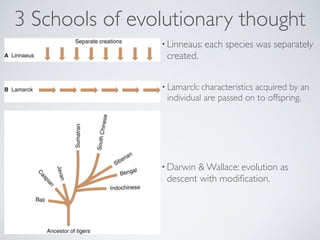
3 Schools of evolutionary thought 
• Linneaus: each species was separately 
created. 
• Lamarck: characteristics acquired by an 
individual are passed on to offspring. 
•Darwin & Wallace: evolution as 
descent with modification.
Evolution by Natural Selection 
• There is inherited variation within species.! 
• There is competition for survival within species.! 
• Genetically inherited traits affect reproduction or survival. Thus the 
frequencies of variants change. 
Evolutionary fitness: 
A measure of the ability of genetic material to perpetuate itself 
in the course of evolution. Depends on the individual’s ability to 
survive, the rate of reproduction and the viability of offspring.! 
(Not just numbers of offspring!)
Darwin’s evidence for evolution 
1. The Fossil Record 
2. Comparative Anatomy 
3. Comparative Embryology 
4. Vestigial Structures 
5. Domestication (artificial selection)
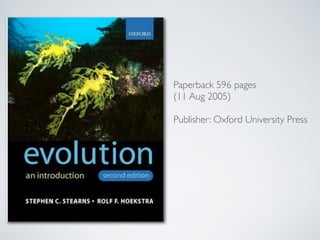
Paperback 596 pages ! 
(11 Aug 2005)! 
! 
Publisher: Oxford University Press!
Natural selection leads to adaptive 
change 
• But environmental conditions change: 
What was advantageous yesterday may be a disadvantage today. 
Evolution=change doesn’t only 
occur by natural selection!! 
! 
• Also: ! 
• genetic drift! 
• (sexual selection)! 
• artificial selection (selective breeding)! 
• mutation
“Neo-Darwinism” 
or 
“The Modern Synthesis” 
The same thing... but with better understanding of 
how things work. 
• Darwin’s Theory of Evolution by Natural Selection (1859)! 
• Mendel’s Laws of Heredity (1866, 1900; see SBS 008)! 
• Cytogenetics (1902, 1904 - )! 
• Population Genetics (1908; see Lectures 7-12) ! 
• Molecular genetics (1970s- ; see SBS 633/210 and Lecture 6) 
•More stuff since then (cultural evolution, epigenetics, etc...)
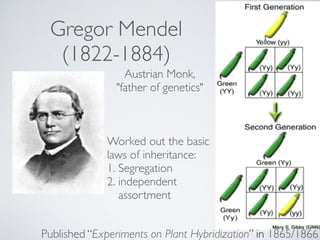
Gregor Mendel 
(1822-1884) 
Austrian Monk,! 
"father of genetics" 
Worked out the basic 
laws of inheritance:! 
1. Segregation ! 
2. independent 
assortment 
Published “Experiments on Plant Hybridization” in 1865/1866
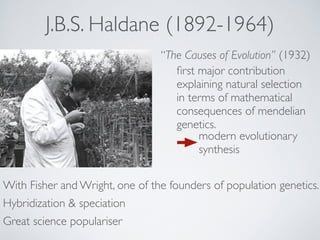
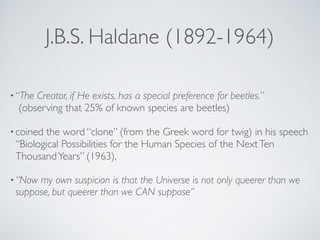
J.B.S. Haldane (1892-1964) 
“The Causes of Evolution” (1932) 
first major contribution 
explaining natural selection 
in terms of mathematical 
consequences of mendelian 
genetics. 
modern evolutionary 
synthesis 
With Fisher and Wright, one of the founders of population genetics. 
Hybridization & speciation 
Great science populariser
J.B.S. Haldane (1892-1964) 
• “The Creator, if He exists, has a special preference for beetles.” 
(observing that 25% of known species are beetles)! 
• coined the word “clone” (from the Greek word for twig) in his speech 
“Biological Possibilities for the Human Species of the Next Ten 
Thousand Years” (1963),! 
•“Now my own suspicion is that the Universe is not only queerer than we 
suppose, but queerer than we CAN suppose”
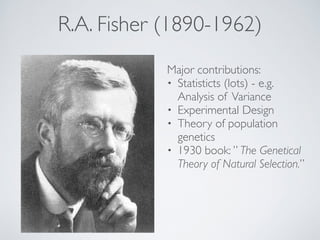
R.A. Fisher (1890-1962) 
Major contributions:! 
• Statisticts (lots) - e.g. 
Analysis of Variance! 
• Experimental Design! 
• Theory of population 
genetics! 
• 1930 book: ” The Genetical 
Theory of Natural Selection.”
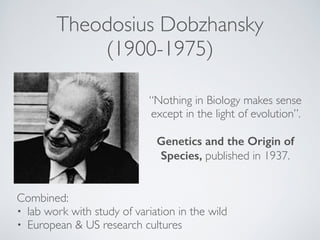
Theodosius Dobzhansky 
(1900-1975) 
“Nothing in Biology makes sense 
except in the light of evolution”. ! 
! 
Genetics and the Origin of 
Species, published in 1937. 
Combined:! 
• lab work with study of variation in the wild! 
• European & US research cultures
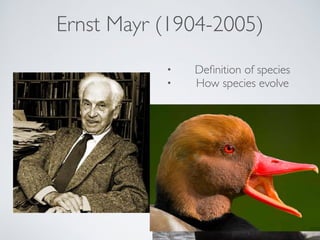
Ernst Mayr (1904-2005) 
• Definition of species! 
• How species evolve
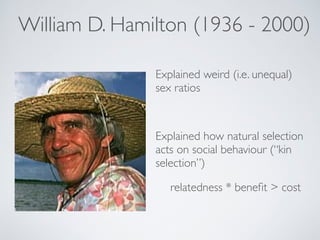
William D. Hamilton (1936 - 2000) 
Explained weird (i.e. unequal) 
sex ratios 
Explained how natural selection 
acts on social behaviour (“kin 
selection”) 
relatedness * benefit > cost
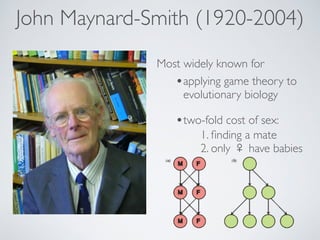
John Maynard-Smith (1920-2004) 
Most widely known for 
•applying game theory to 
evolutionary biology 
•two-fold cost of sex: 
1. finding a mate! 
2. only  have babies
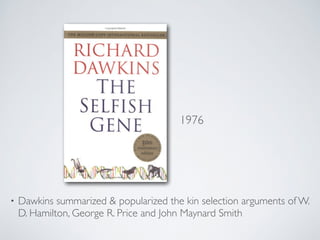
1976 
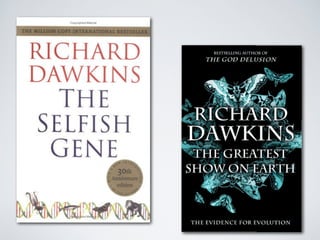
• Dawkins summarized  popularized the kin selection arguments of W. 
D. Hamilton, George R. Price and John Maynard Smith
Summary/overview
EVOLUTION! 
“descent with modification”
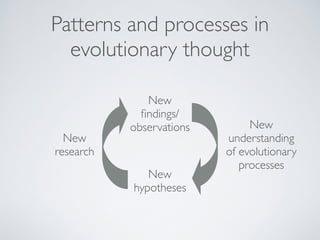
Patterns and processes in 
evolutionary thought 
New 
hypotheses 
New 
understanding 
of evolutionary! 
processes 
New 
research 
New 
findings/ 
observations
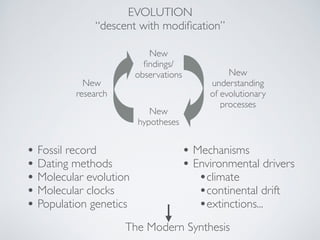
EVOLUTION! 
“descent with modification” 
• Fossil record! 
• Dating methods! 
• Molecular evolution! 
• Molecular clocks! 
• Population genetics 
New 
understanding 
of evolutionary! 
processes 
• Mechanisms! 
• Environmental drivers! 
•climate! 
•continental drift! 
•extinctions... 
New 
hypotheses 
The Modern Synthesis 
New 
research 
New 
findings/ 
observations
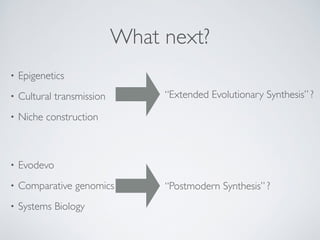
What next? 
• Epigenetics! 
• Cultural transmission! 
• Niche construction 
“Extended Evolutionary Synthesis” ? 
• Evodevo! 
• Comparative genomics! 
• Systems Biology 
“Postmodern Synthesis” ?
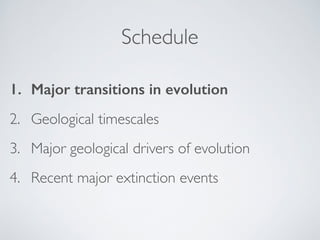
Schedule 
1. Major transitions in evolution 
2. Geological timescales! 
3. Major geological drivers of evolution ! 
4. Recent major extinction events
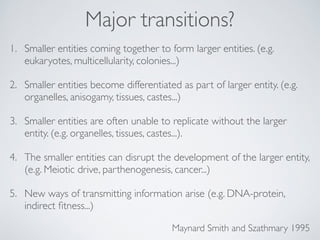
Major transitions? 
1. Smaller entities coming together to form larger entities. (e.g. 
eukaryotes, multicellularity, colonies...)! 
2. Smaller entities become differentiated as part of larger entity. (e.g. 
organelles, anisogamy, tissues, castes...)! 
3. Smaller entities are often unable to replicate without the larger 
entity. (e.g. organelles, tissues, castes...).! 
4. The smaller entities can disrupt the development of the larger entity, 
(e.g. Meiotic drive, parthenogenesis, cancer...)! 
5. New ways of transmitting information arise (e.g. DNA-protein, 
indirect fitness...) 
Maynard Smith and Szathmary 1995
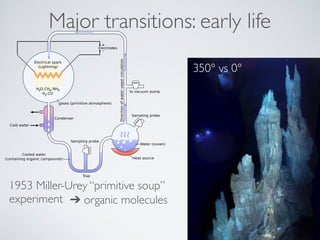
Major transitions: early life 
1953 Miller-Urey “primitive soup” 
experiment 
350° vs 0° 
âž” organic molecules
Major transitions: early life 
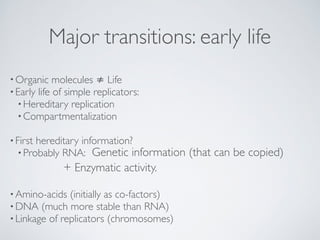
•Organic molecules ≠ Life! 
•Early life:! 
•Hereditary replication! 
•Compartmentalization! 
! 
• First hereditary information?
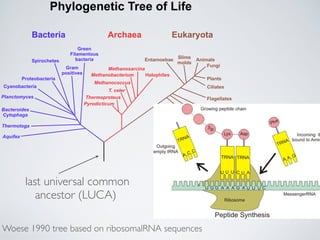
Phylogenetic Tree of Life 
Bacteria 
Green 
Filamentous 
Spirochetes bacteria 
Gram 
positives 
Proteobacteria 
Cyanobacteria 
Planctomyces 
Bacteroides 
Cytophaga 
Thermotoga 
Aquifex 
Archaea Eukaryota 
Halophiles 
Methanosarcina 
Methanobacterium 
Methanococcus 
T. celer 
Thermoproteus 
Pyrodicticum 
Entamoebae Slime 
molds Animals 
Fungi 
Plants 
Ciliates 
Flagellates 
Trichomonads 
Microsporidia 
Diplomonads 
last universal common 
ancestor (LUCA) 
Woese 1990 tree based on ribosomalRNA sequences
Major transitions: early life 
•Organic molecules ≠ Life! 
•Early life of simple replicators:! 
•Hereditary replication! 
•Compartmentalization! 
! 
• First hereditary information?! 
•Probably RNA: Genetic information (that can be copied) 
+ Enzymatic activity. 
•Amino-acids (initially as co-factors)! 
•DNA (much more stable than RNA)! 
• Linkage of replicators (chromosomes)
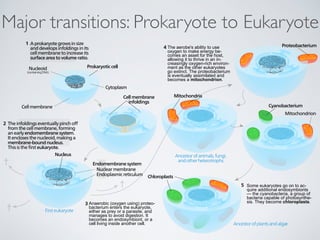
Major transitions: Prokaryote to Eukaryote 
Prokaryotic cell 
Cell membrane 
infoldings 
Cell membrane 
Cytoplasm 
Nucleoid 
(containing DNA) 
Endomembrane system 
Nuclear membrane 
Endoplasmic reticulum 
Nucleus 
Proteobacterium 
Mitochondria 
Cyanobacterium 
Chloroplasts 
Mitochondrion 
† 
† 
† 
1 A prokaryote grows in size 
and develops infoldings in its 
cell membrane to increase its 
surface area to volume ratio. 
2 The infoldings eventually pinch off 
from the cell membrane, forming 
an early endomembrane system. 
It encloses the nucleoid, making a 
membrane-bound nucleus. 
This is the first eukaryote. 
3 
5 Some eukaryotes go on to acquire additional 
endosymbionts—the cyanobacteria, a group 
of bacteria capable of photosynthesis. 
They become chloroplasts. 
Ancestor of plants and algæ 
Ancestor of animals, fungi, 
and other heterotrophs 
First eukaryote 
The aerobe's ability to use 
oxygen to make energy be-comes 
an asset for the host, 
allowing it to thrive in an in-creasingly 
oxygen-rich environ-ment 
as the other eukaryotes 
go extinct. The proteobacterium 
is eventually assimilated and 
becomes a mitochondrion. 
Some eukaryotes go on to ac-quire 
additional endosymbionts 
— the cyanobacteria, a group of 
bacteria capable of photosynthe- 
Anaerobic (oxygen using) proteo- sis. They become chloroplasts. 
bacterium enters the eukaryote, 
either as prey or a parasite, and 
manages to avoid digestion. It 
becomes an endosymbiont, or a 
cell living inside another cell.
Major transitions: sex 
• See later lectures Week .
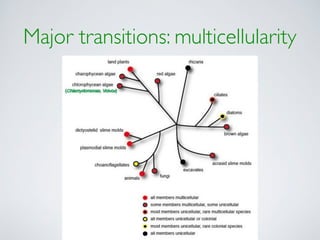
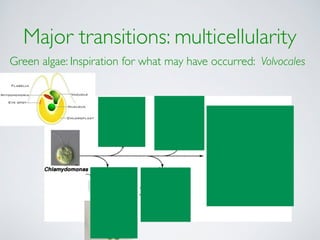
Major transitions: multicellularity
Major transitions: multicellularity 
Green algae: Inspiration for what may have occurred: Volvocales
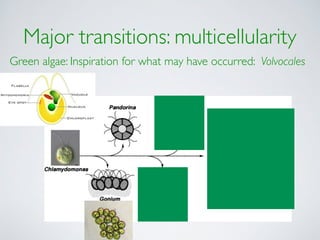
Major transitions: multicellularity 
Green algae: Inspiration for what may have occurred: Volvocales
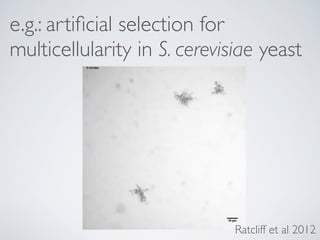
e.g.: artificial selection for 
multicellularity in S. cerevisiae yeast 
Ratcliff et al 2012
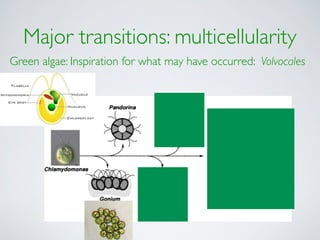
Major transitions: multicellularity 
Green algae: Inspiration for what may have occurred: Volvocales
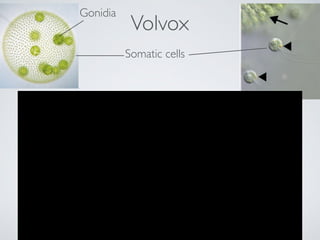
Volvox 
Somatic cells 
Gonidia
Major transitions: 
eusociality 
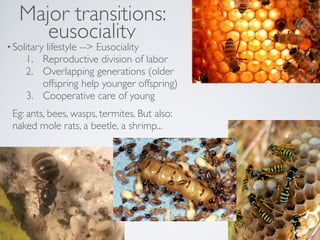
• Solitary lifestyle -- Eusociality! 
1. Reproductive division of labor ! 
2. Overlapping generations (older 
offspring help younger offspring)! 
3. Cooperative care of young! 
Eg: ants, bees, wasps, termites. But also: 
naked mole rats, a beetle, a shrimp...
Major transitions: eusociality ! 
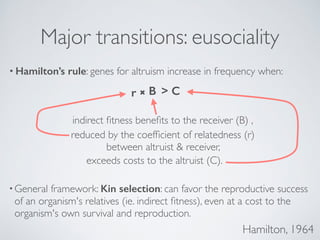
• Hamilton’s rule: genes for altruism increase in frequency when: 
r â‚’  C 
indirect fitness benefits to the receiver (B) , 
reduced by the coefficient of relatedness (r) ! 
Hamilton, 1964 
B 
between altruist  receiver, 
exceeds costs to the altruist (C). 
•General framework: Kin selection: can favor the reproductive success 
of an organism's relatives (ie. indirect fitness), even at a cost to the 
organism's own survival and reproduction.
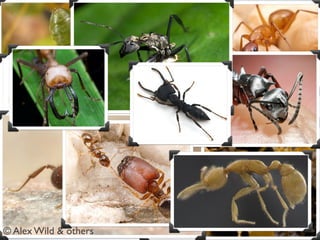
© Alex Wild  others
Similar diversity of lifestyles!
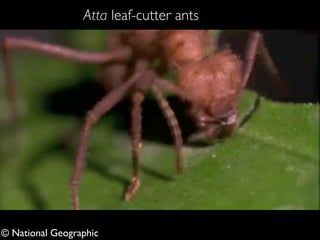
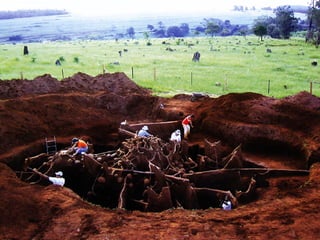
Atta leaf-cutter ants 
© National Geographic
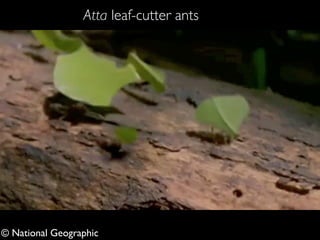
Atta leaf-cutter ants 
© National Geographic
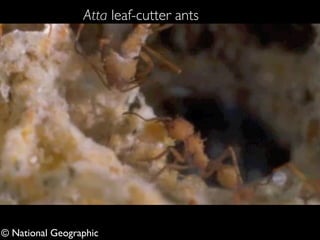
Atta leaf-cutter ants 
© National Geographic
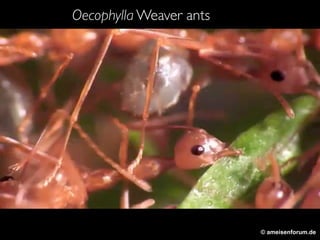
Oecophylla Weaver ants 
© ameisenforum.de
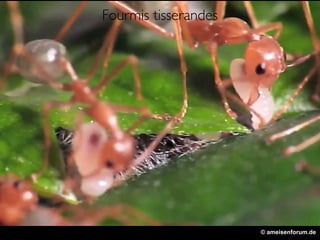
© ameisenforum.de 
Fourmis tisserandes
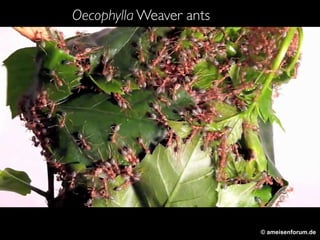
© ameisenforum.de 
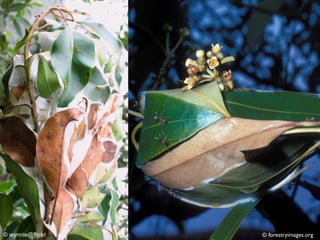
Oecophylla Weaver ants
© wynnie@flickr © forestryimages.org
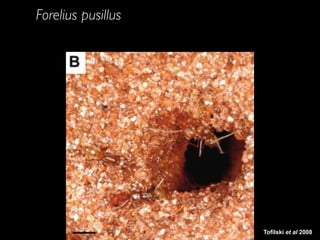
Tofilski et al 2008 
Forelius pusillus
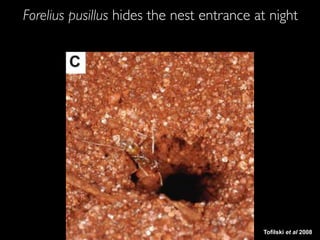
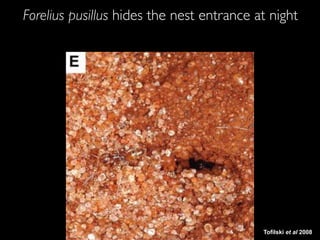
Forelius pusillus hides the nest entrance at night 
Tofilski et al 2008
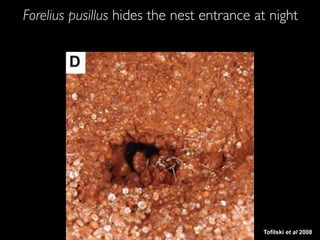
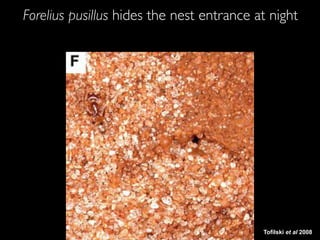
Forelius pusillus hides the nest entrance at night 
Tofilski et al 2008
Forelius pusillus hides the nest entrance at night 
Tofilski et al 2008
Forelius pusillus hides the nest entrance at night 
Tofilski et al 2008
Forelius pusillus hides the nest entrance at night 
Avant 
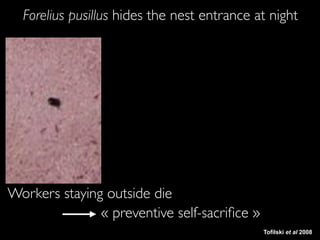
Workers staying outside die 
« preventive self-sacrifice » 
Tofilski et al 2008
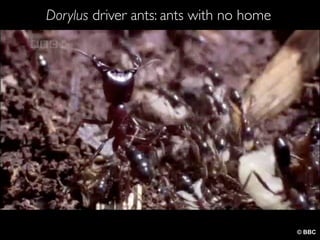
Dorylus driver ants: ants with no home 
© BBC
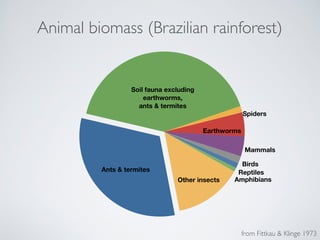
Animal biomass (Brazilian rainforest) 
Mammals 
Birds 
Reptiles 
Other insects Amphibians 
from Fittkau  Klinge 1973 
! 
Earthworms 
! 
! 
Spiders 
Soil fauna excluding 
earthworms, 
ants  termites 
Ants  termites
Schedule 
1. Major transitions in evolution! 
2. Geological timescales 
3. Major geological drivers of evolution ! 
4. Recent major extinction events
“Complexity of life” didn’t 
increase linearly. 
2. Geological time scales 
Defined by changes in flora and fauna (seen in fossil record). 
Eon  Era  Period  Epoch!
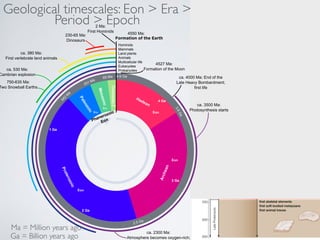
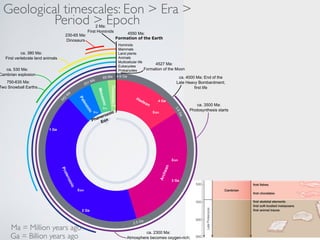
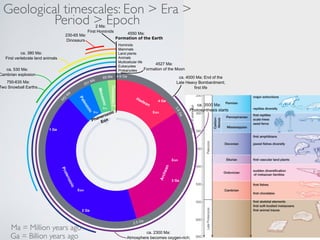
Geological timescales: Eon  Era  
Period  Epoch 
4550 Ma: 
Hominids 
Mammals 
Land plants 
Animals 
Multicellular life 
Eukaryotes 
Prokaryotes 
Hadean 
Archean 
Proterozoic 
Paleozoic 
Mesozoic 
Cenozoic 
4527 Ma: 
Formation of the Moon 
4.6 Ga 
4 Ga 
3.8 Ga 
3 Ga 
2.5 Ga 
2 Ga 
First vertebrate land animals 
1 Ga 
542 Ma 
251 Ma 65 Ma 
ca. 4000 Ma: End of the 
Late Heavy Bombardment; 
first life 
ca. 3500 Ma: 
Photosynthesis starts 
ca. 2300 Ma: 
Atmosphere becomes oxygen-rich; 
ca. 380 Ma: 
ca. 530 Ma: 
Cambrian explosion 
750-635 Ma: 
Two Snowball Earths 
230-65 Ma: 
Dinosaurs 
2 Ma: 
First Hominids 
Ma = Million years ago 
Ga = Billion years ago 
Eon 
Eon 
Eon 
Era 
Era 
Era 
Phanerozoic! 
Eon
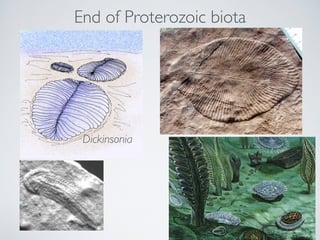
End of Proterozoic biota 
Dickinsonia
Geological timescales: Eon  Era  
Period  Epoch 
4550 Ma: 
Hominids 
Mammals 
Land plants 
Animals 
Multicellular life 
Eukaryotes 
Prokaryotes 
Hadean 
Archean 
Proterozoic 
Paleozoic 
Mesozoic 
Cenozoic 
4527 Ma: 
Formation of the Moon 
4.6 Ga 
4 Ga 
3.8 Ga 
3 Ga 
2.5 Ga 
2 Ga 
First vertebrate land animals 
1 Ga 
542 Ma 
251 Ma 65 Ma 
ca. 4000 Ma: End of the 
Late Heavy Bombardment; 
first life 
ca. 3500 Ma: 
Photosynthesis starts 
ca. 2300 Ma: 
Atmosphere becomes oxygen-rich; 
ca. 380 Ma: 
ca. 530 Ma: 
Cambrian explosion 
750-635 Ma: 
Two Snowball Earths 
230-65 Ma: 
Dinosaurs 
2 Ma: 
First Hominids 
Ma = Million years ago 
Ga = Billion years ago 
Eon 
Eon 
Eon 
Era 
Era 
Era 
Phanerozoic! 
Eon
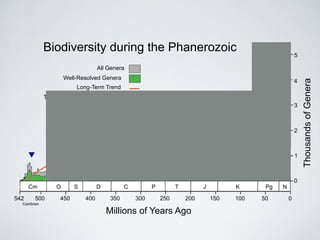
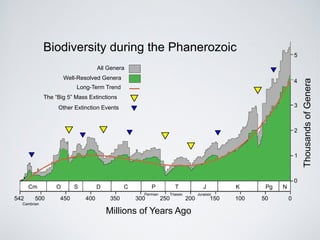
Biodiversity during the Phanerozoic 
All Genera 
Well-Resolved Genera 
Long-Term Trend 
The “Big 5” Mass Extinctions 
Other Extinction Events 
542 500 450 400 350 300 250 200 150 100 50 0 
5 
4 
3 
2 
1 
0 
Millions of Years Ago 
Thousands of Genera 
Cm O S D C P T J K Pg N 
Cambrian
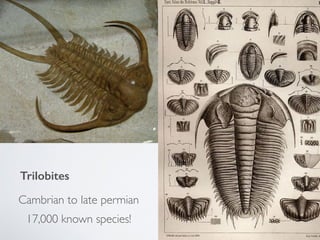
Trilobites 
Cambrian to late permian 
17,000 known species!
Biodiversity during the Phanerozoic 
All Genera 
Well-Resolved Genera 
Long-Term Trend 
The “Big 5” Mass Extinctions 
Other Extinction Events 
542 500 450 400 350 300 250 200 150 100 50 0 
5 
4 
3 
2 
1 
0 
Millions of Years Ago 
Thousands of Genera 
Cm O S D C P T J K Pg N 
Cambrian 
Permian Triassic Jurassic
Geological timescales: Eon  Era  
Period  Epoch 
4550 Ma: 
Hominids 
Mammals 
Land plants 
Animals 
Multicellular life 
Eukaryotes 
Prokaryotes 
Hadean 
Archean 
Proterozoic 
Paleozoic 
Mesozoic 
Cenozoic 
4527 Ma: 
Formation of the Moon 
4.6 Ga 
4 Ga 
3.8 Ga 
3 Ga 
2.5 Ga 
2 Ga 
First vertebrate land animals 
1 Ga 
542 Ma 
251 Ma 65 Ma 
ca. 4000 Ma: End of the 
Late Heavy Bombardment; 
first life 
ca. 3500 Ma: 
Photosynthesis starts 
ca. 2300 Ma: 
Atmosphere becomes oxygen-rich; 
ca. 380 Ma: 
ca. 530 Ma: 
Cambrian explosion 
750-635 Ma: 
Two Snowball Earths 
230-65 Ma: 
Dinosaurs 
2 Ma: 
First Hominids 
Ma = Million years ago 
Ga = Billion years ago 
Eon 
Eon 
Eon 
Era 
Era 
Era 
Phanerozoic! 
Eon
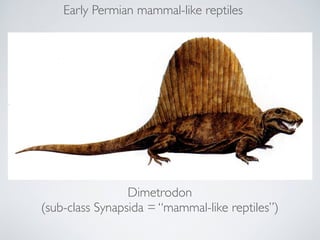
Early Permian mammal-like reptiles 
Dimetrodon! 
(sub-class Synapsida = “mammal-like reptiles”)
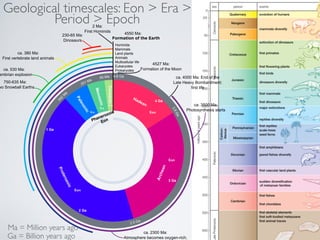
Geological timescales: Eon  Era  
Period  Epoch 
4550 Ma: 
Hominids 
Mammals 
Land plants 
Animals 
Multicellular life 
Eukaryotes 
Prokaryotes 
Hadean 
Archean 
Proterozoic 
Paleozoic 
Mesozoic 
Cenozoic 
4527 Ma: 
Formation of the Moon 
4.6 Ga 
4 Ga 
3.8 Ga 
3 Ga 
2.5 Ga 
2 Ga 
First vertebrate land animals 
1 Ga 
542 Ma 
251 Ma 65 Ma 
ca. 4000 Ma: End of the 
Late Heavy Bombardment; 
first life 
ca. 3500 Ma: 
Photosynthesis starts 
ca. 2300 Ma: 
Atmosphere becomes oxygen-rich; 
ca. 380 Ma: 
ca. 530 Ma: 
Cambrian explosion 
750-635 Ma: 
Two Snowball Earths 
230-65 Ma: 
Dinosaurs 
2 Ma: 
First Hominids 
Ma = Million years ago 
Ga = Billion years ago 
Eon 
Eon 
Eon 
Era 
Era 
Era 
Phanerozoic! 
Eon
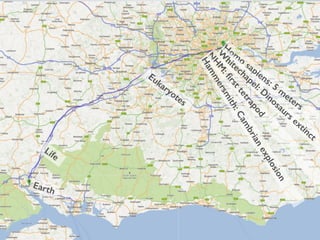
Life 
Earth 
Eukaryotes 
Homo sapiens: 5 meters 
Whitechapel: Dinosaurs extinct 
NHM: first tetrapod 
Hammersmith: Cambrian explosion
Schedule 
1. Major transitions in evolution! 
2. Geological timescales! 
3. Major geological drivers of evolution 
4. Recent major extinction events
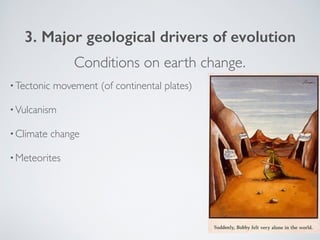
3. Major geological drivers of evolution 
Conditions on earth change. 
•Tectonic movement (of continental plates)! 
•Vulcanism! 
•Climate change! 
•Meteorites
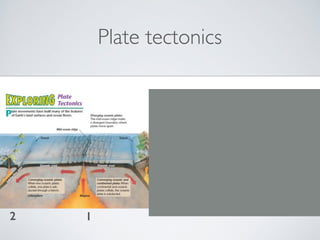
Plate tectonics 
2 1 
3 
4 5
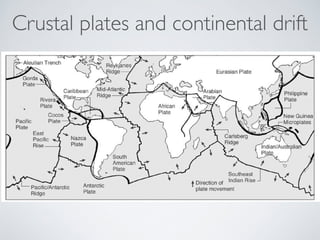
Crustal plates and continental drift
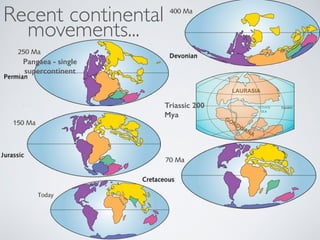
Recmeonvt ecmonetnintse..n. tal 
LAURASIA 
GONDWANA 
Triassic 200 
TETHYS 
Equator Mya 
SEA 
Pangaea - single 
supercontinent
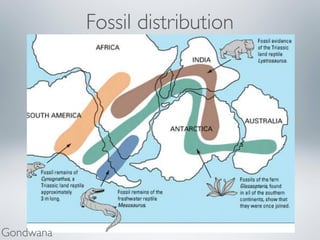
Fossil distribution 
Gondwana
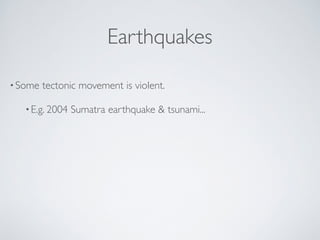
Earthquakes 
• Some tectonic movement is violent.! 
•E.g. 2004 Sumatra earthquake  tsunami...
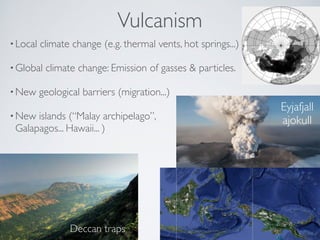
Vulcanism 
• Local climate change (e.g. thermal vents, hot springs...)! 
•Global climate change: Emission of gasses  particles.! 
•New geological barriers (migration...)! 
•New islands (“Malay archipelago”, 
Galapagos... Hawaii... ) 
Deccan traps 
Eyjafjall 
ajokull
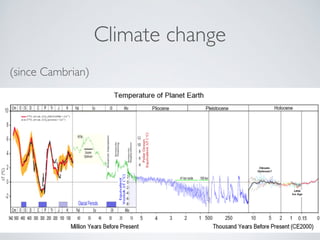
Climate change 
(since Cambrian)
Sbc174 evolution 2014 week2

Sbc174 evolution 2014 week2

  • 1.
  • 2.
    Specific Questions/Comments In1800s, fossils showed species that no longer existed: Some (e.g. Cuvier): ! Catastrophism: Fossils show extinct species (due to major, sudden, catastrophic events). Geologists (Hutton, Lyell): Uniformitarianism: Changes in nature are gradual.
  • 3.
    3 Schools ofevolutionary thought • Linneaus: each species was separately created. • Lamarck: characteristics acquired by an individual are passed on to offspring. •Darwin & Wallace: evolution as descent with modification.
  • 4.
    Evolution by NaturalSelection • There is inherited variation within species.! • There is competition for survival within species.! • Genetically inherited traits affect reproduction or survival. Thus the frequencies of variants change. Evolutionary fitness: A measure of the ability of genetic material to perpetuate itself in the course of evolution. Depends on the individual’s ability to survive, the rate of reproduction and the viability of offspring.! (Not just numbers of offspring!)
  • 5.
    Darwin’s evidence forevolution 1. The Fossil Record 2. Comparative Anatomy 3. Comparative Embryology 4. Vestigial Structures 5. Domestication (artificial selection)
  • 6.
    Paperback 596 pages! (11 Aug 2005)! ! Publisher: Oxford University Press!
  • 8.
    Natural selection leadsto adaptive change • But environmental conditions change: What was advantageous yesterday may be a disadvantage today. Evolution=change doesn’t only occur by natural selection!! ! • Also: ! • genetic drift! • (sexual selection)! • artificial selection (selective breeding)! • mutation
  • 10.
    “Neo-Darwinism” or “TheModern Synthesis” The same thing... but with better understanding of how things work. • Darwin’s Theory of Evolution by Natural Selection (1859)! • Mendel’s Laws of Heredity (1866, 1900; see SBS 008)! • Cytogenetics (1902, 1904 - )! • Population Genetics (1908; see Lectures 7-12) ! • Molecular genetics (1970s- ; see SBS 633/210 and Lecture 6) •More stuff since then (cultural evolution, epigenetics, etc...)
  • 11.
    Gregor Mendel (1822-1884) Austrian Monk,! "father of genetics" Worked out the basic laws of inheritance:! 1. Segregation ! 2. independent assortment Published “Experiments on Plant Hybridization” in 1865/1866
  • 12.
    J.B.S. Haldane (1892-1964) “The Causes of Evolution” (1932) first major contribution explaining natural selection in terms of mathematical consequences of mendelian genetics. modern evolutionary synthesis With Fisher and Wright, one of the founders of population genetics. Hybridization & speciation Great science populariser
  • 13.
    J.B.S. Haldane (1892-1964) • “The Creator, if He exists, has a special preference for beetles.” (observing that 25% of known species are beetles)! • coined the word “clone” (from the Greek word for twig) in his speech “Biological Possibilities for the Human Species of the Next Ten Thousand Years” (1963),! •“Now my own suspicion is that the Universe is not only queerer than we suppose, but queerer than we CAN suppose”
  • 14.
    R.A. Fisher (1890-1962) Major contributions:! • Statisticts (lots) - e.g. Analysis of Variance! • Experimental Design! • Theory of population genetics! • 1930 book: ” The Genetical Theory of Natural Selection.”
  • 15.
    Theodosius Dobzhansky (1900-1975) “Nothing in Biology makes sense except in the light of evolution”. ! ! Genetics and the Origin of Species, published in 1937. Combined:! • lab work with study of variation in the wild! • European & US research cultures
  • 16.
    Ernst Mayr (1904-2005) • Definition of species! • How species evolve
  • 17.
    William D. Hamilton(1936 - 2000) Explained weird (i.e. unequal) sex ratios Explained how natural selection acts on social behaviour (“kin selection”) relatedness * benefit > cost
  • 18.
    John Maynard-Smith (1920-2004) Most widely known for •applying game theory to evolutionary biology •two-fold cost of sex: 1. finding a mate! 2. only have babies
  • 19.
    1976 • Dawkinssummarized popularized the kin selection arguments of W. D. Hamilton, George R. Price and John Maynard Smith
  • 20.
  • 21.
    EVOLUTION! “descent withmodification”
  • 22.
    Patterns and processesin evolutionary thought New hypotheses New understanding of evolutionary! processes New research New findings/ observations
  • 23.
    EVOLUTION! “descent withmodification” • Fossil record! • Dating methods! • Molecular evolution! • Molecular clocks! • Population genetics New understanding of evolutionary! processes • Mechanisms! • Environmental drivers! •climate! •continental drift! •extinctions... New hypotheses The Modern Synthesis New research New findings/ observations
  • 24.
    What next? •Epigenetics! • Cultural transmission! • Niche construction “Extended Evolutionary Synthesis” ? • Evodevo! • Comparative genomics! • Systems Biology “Postmodern Synthesis” ?
  • 26.
    Schedule 1. Majortransitions in evolution 2. Geological timescales! 3. Major geological drivers of evolution ! 4. Recent major extinction events
  • 27.
    Major transitions? 1.Smaller entities coming together to form larger entities. (e.g. eukaryotes, multicellularity, colonies...)! 2. Smaller entities become differentiated as part of larger entity. (e.g. organelles, anisogamy, tissues, castes...)! 3. Smaller entities are often unable to replicate without the larger entity. (e.g. organelles, tissues, castes...).! 4. The smaller entities can disrupt the development of the larger entity, (e.g. Meiotic drive, parthenogenesis, cancer...)! 5. New ways of transmitting information arise (e.g. DNA-protein, indirect fitness...) Maynard Smith and Szathmary 1995
  • 28.
    Major transitions: earlylife 1953 Miller-Urey “primitive soup” experiment 350° vs 0° ➔ organic molecules
  • 29.
    Major transitions: earlylife •Organic molecules ≠ Life! •Early life:! •Hereditary replication! •Compartmentalization! ! • First hereditary information?
  • 30.
    Phylogenetic Tree ofLife Bacteria Green Filamentous Spirochetes bacteria Gram positives Proteobacteria Cyanobacteria Planctomyces Bacteroides Cytophaga Thermotoga Aquifex Archaea Eukaryota Halophiles Methanosarcina Methanobacterium Methanococcus T. celer Thermoproteus Pyrodicticum Entamoebae Slime molds Animals Fungi Plants Ciliates Flagellates Trichomonads Microsporidia Diplomonads last universal common ancestor (LUCA) Woese 1990 tree based on ribosomalRNA sequences
  • 31.
    Major transitions: earlylife •Organic molecules ≠ Life! •Early life of simple replicators:! •Hereditary replication! •Compartmentalization! ! • First hereditary information?! •Probably RNA: Genetic information (that can be copied) + Enzymatic activity. •Amino-acids (initially as co-factors)! •DNA (much more stable than RNA)! • Linkage of replicators (chromosomes)
  • 32.
    Major transitions: Prokaryoteto Eukaryote Prokaryotic cell Cell membrane infoldings Cell membrane Cytoplasm Nucleoid (containing DNA) Endomembrane system Nuclear membrane Endoplasmic reticulum Nucleus Proteobacterium Mitochondria Cyanobacterium Chloroplasts Mitochondrion † † † 1 A prokaryote grows in size and develops infoldings in its cell membrane to increase its surface area to volume ratio. 2 The infoldings eventually pinch off from the cell membrane, forming an early endomembrane system. It encloses the nucleoid, making a membrane-bound nucleus. This is the first eukaryote. 3 5 Some eukaryotes go on to acquire additional endosymbionts—the cyanobacteria, a group of bacteria capable of photosynthesis. They become chloroplasts. Ancestor of plants and algæ Ancestor of animals, fungi, and other heterotrophs First eukaryote The aerobe's ability to use oxygen to make energy be-comes an asset for the host, allowing it to thrive in an in-creasingly oxygen-rich environ-ment as the other eukaryotes go extinct. The proteobacterium is eventually assimilated and becomes a mitochondrion. Some eukaryotes go on to ac-quire additional endosymbionts — the cyanobacteria, a group of bacteria capable of photosynthe- Anaerobic (oxygen using) proteo- sis. They become chloroplasts. bacterium enters the eukaryote, either as prey or a parasite, and manages to avoid digestion. It becomes an endosymbiont, or a cell living inside another cell.
  • 33.
    Major transitions: sex • See later lectures Week .
  • 34.
  • 35.
    Major transitions: multicellularity Green algae: Inspiration for what may have occurred: Volvocales
  • 36.
    Major transitions: multicellularity Green algae: Inspiration for what may have occurred: Volvocales
  • 37.
    e.g.: artificial selectionfor multicellularity in S. cerevisiae yeast Ratcliff et al 2012
  • 38.
    Major transitions: multicellularity Green algae: Inspiration for what may have occurred: Volvocales
  • 39.
  • 40.
    Major transitions: eusociality • Solitary lifestyle -- Eusociality! 1. Reproductive division of labor ! 2. Overlapping generations (older offspring help younger offspring)! 3. Cooperative care of young! Eg: ants, bees, wasps, termites. But also: naked mole rats, a beetle, a shrimp...
  • 41.
    Major transitions: eusociality! • Hamilton’s rule: genes for altruism increase in frequency when: r ₒ C indirect fitness benefits to the receiver (B) , reduced by the coefficient of relatedness (r) ! Hamilton, 1964 B between altruist receiver, exceeds costs to the altruist (C). •General framework: Kin selection: can favor the reproductive success of an organism's relatives (ie. indirect fitness), even at a cost to the organism's own survival and reproduction.
  • 42.
  • 43.
  • 44.
    Atta leaf-cutter ants © National Geographic
  • 45.
    Atta leaf-cutter ants © National Geographic
  • 46.
    Atta leaf-cutter ants © National Geographic
  • 48.
    Oecophylla Weaver ants © ameisenforum.de
  • 49.
  • 50.
  • 51.
    © wynnie@flickr ©forestryimages.org
  • 52.
    Tofilski et al2008 Forelius pusillus
  • 53.
    Forelius pusillus hidesthe nest entrance at night Tofilski et al 2008
  • 54.
    Forelius pusillus hidesthe nest entrance at night Tofilski et al 2008
  • 55.
    Forelius pusillus hidesthe nest entrance at night Tofilski et al 2008
  • 56.
    Forelius pusillus hidesthe nest entrance at night Tofilski et al 2008
  • 57.
    Forelius pusillus hidesthe nest entrance at night Avant Workers staying outside die « preventive self-sacrifice » Tofilski et al 2008
  • 58.
    Dorylus driver ants:ants with no home © BBC
  • 59.
    Animal biomass (Brazilianrainforest) Mammals Birds Reptiles Other insects Amphibians from Fittkau Klinge 1973 ! Earthworms ! ! Spiders Soil fauna excluding earthworms, ants termites Ants termites
  • 60.
    Schedule 1. Majortransitions in evolution! 2. Geological timescales 3. Major geological drivers of evolution ! 4. Recent major extinction events
  • 61.
    “Complexity of life”didn’t increase linearly. 2. Geological time scales Defined by changes in flora and fauna (seen in fossil record). Eon Era Period Epoch!
  • 62.
    Geological timescales: Eon Era Period Epoch 4550 Ma: Hominids Mammals Land plants Animals Multicellular life Eukaryotes Prokaryotes Hadean Archean Proterozoic Paleozoic Mesozoic Cenozoic 4527 Ma: Formation of the Moon 4.6 Ga 4 Ga 3.8 Ga 3 Ga 2.5 Ga 2 Ga First vertebrate land animals 1 Ga 542 Ma 251 Ma 65 Ma ca. 4000 Ma: End of the Late Heavy Bombardment; first life ca. 3500 Ma: Photosynthesis starts ca. 2300 Ma: Atmosphere becomes oxygen-rich; ca. 380 Ma: ca. 530 Ma: Cambrian explosion 750-635 Ma: Two Snowball Earths 230-65 Ma: Dinosaurs 2 Ma: First Hominids Ma = Million years ago Ga = Billion years ago Eon Eon Eon Era Era Era Phanerozoic! Eon
  • 63.
    End of Proterozoicbiota Dickinsonia
  • 64.
    Geological timescales: Eon Era Period Epoch 4550 Ma: Hominids Mammals Land plants Animals Multicellular life Eukaryotes Prokaryotes Hadean Archean Proterozoic Paleozoic Mesozoic Cenozoic 4527 Ma: Formation of the Moon 4.6 Ga 4 Ga 3.8 Ga 3 Ga 2.5 Ga 2 Ga First vertebrate land animals 1 Ga 542 Ma 251 Ma 65 Ma ca. 4000 Ma: End of the Late Heavy Bombardment; first life ca. 3500 Ma: Photosynthesis starts ca. 2300 Ma: Atmosphere becomes oxygen-rich; ca. 380 Ma: ca. 530 Ma: Cambrian explosion 750-635 Ma: Two Snowball Earths 230-65 Ma: Dinosaurs 2 Ma: First Hominids Ma = Million years ago Ga = Billion years ago Eon Eon Eon Era Era Era Phanerozoic! Eon
  • 65.
    Biodiversity during thePhanerozoic All Genera Well-Resolved Genera Long-Term Trend The “Big 5” Mass Extinctions Other Extinction Events 542 500 450 400 350 300 250 200 150 100 50 0 5 4 3 2 1 0 Millions of Years Ago Thousands of Genera Cm O S D C P T J K Pg N Cambrian
  • 66.
    Trilobites Cambrian tolate permian 17,000 known species!
  • 67.
    Biodiversity during thePhanerozoic All Genera Well-Resolved Genera Long-Term Trend The “Big 5” Mass Extinctions Other Extinction Events 542 500 450 400 350 300 250 200 150 100 50 0 5 4 3 2 1 0 Millions of Years Ago Thousands of Genera Cm O S D C P T J K Pg N Cambrian Permian Triassic Jurassic
  • 68.
    Geological timescales: Eon Era Period Epoch 4550 Ma: Hominids Mammals Land plants Animals Multicellular life Eukaryotes Prokaryotes Hadean Archean Proterozoic Paleozoic Mesozoic Cenozoic 4527 Ma: Formation of the Moon 4.6 Ga 4 Ga 3.8 Ga 3 Ga 2.5 Ga 2 Ga First vertebrate land animals 1 Ga 542 Ma 251 Ma 65 Ma ca. 4000 Ma: End of the Late Heavy Bombardment; first life ca. 3500 Ma: Photosynthesis starts ca. 2300 Ma: Atmosphere becomes oxygen-rich; ca. 380 Ma: ca. 530 Ma: Cambrian explosion 750-635 Ma: Two Snowball Earths 230-65 Ma: Dinosaurs 2 Ma: First Hominids Ma = Million years ago Ga = Billion years ago Eon Eon Eon Era Era Era Phanerozoic! Eon
  • 69.
    Early Permian mammal-likereptiles Dimetrodon! (sub-class Synapsida = “mammal-like reptiles”)
  • 70.
    Geological timescales: Eon Era Period Epoch 4550 Ma: Hominids Mammals Land plants Animals Multicellular life Eukaryotes Prokaryotes Hadean Archean Proterozoic Paleozoic Mesozoic Cenozoic 4527 Ma: Formation of the Moon 4.6 Ga 4 Ga 3.8 Ga 3 Ga 2.5 Ga 2 Ga First vertebrate land animals 1 Ga 542 Ma 251 Ma 65 Ma ca. 4000 Ma: End of the Late Heavy Bombardment; first life ca. 3500 Ma: Photosynthesis starts ca. 2300 Ma: Atmosphere becomes oxygen-rich; ca. 380 Ma: ca. 530 Ma: Cambrian explosion 750-635 Ma: Two Snowball Earths 230-65 Ma: Dinosaurs 2 Ma: First Hominids Ma = Million years ago Ga = Billion years ago Eon Eon Eon Era Era Era Phanerozoic! Eon
  • 71.
    Life Earth Eukaryotes Homo sapiens: 5 meters Whitechapel: Dinosaurs extinct NHM: first tetrapod Hammersmith: Cambrian explosion
  • 72.
    Schedule 1. Majortransitions in evolution! 2. Geological timescales! 3. Major geological drivers of evolution 4. Recent major extinction events
  • 73.
    3. Major geologicaldrivers of evolution Conditions on earth change. •Tectonic movement (of continental plates)! •Vulcanism! •Climate change! •Meteorites
  • 74.
  • 75.
    Crustal plates andcontinental drift
  • 76.
    Recmeonvt ecmonetnintse..n. tal LAURASIA GONDWANA Triassic 200 TETHYS Equator Mya SEA Pangaea - single supercontinent
  • 77.
  • 78.
    Earthquakes • Sometectonic movement is violent.! •E.g. 2004 Sumatra earthquake tsunami...
  • 79.
    Vulcanism • Localclimate change (e.g. thermal vents, hot springs...)! •Global climate change: Emission of gasses particles.! •New geological barriers (migration...)! •New islands (“Malay archipelago”, Galapagos... Hawaii... ) Deccan traps Eyjafjall ajokull
  • 80.