Lesson 3.2
Evolution and Natural
Selection
Do you want to edit this presentation?
Make a copy and edit
in Google Slides.
1. On the menu bar, click File and
then Make a copy and Entire
Presentation.
2. Type a name for the file.
3. Choose where to save it on
your Google Drive.
4. Click Ok.
5. A new tab will open. Wait for
the file to be completely loaded
on a new tab.
6. Once the file has loaded, edit
this presentation using Google
Slides.
Download an offline
copy and edit in
Microsoft PowerPoint.
1. On the menu bar, click File and
then Download as.
2. Choose a file type. Select
Microsoft PowerPoint (.pptx).
3. Wait for the file to be
downloaded to your local disk.
4. Once completely downloaded,
open the file and edit it using
Microsoft PowerPoint or any
offline presentation program.
Do You Want to Edit This Presentation?
Learning Competency
Relate species extinction to the failure of populations of
organisms to adapt to abrupt changes in the environment
(S9LT-Ie-f-30).
At the end of this lesson, the given DepEd learning
competency should be met by the students.
Learning Objectives
At the end of this lesson, the learner should be able to
do the following:
● Discuss the process of evolution.
● Discuss the mechanism of natural selection.
● Explain the relationship between evolution and natural
selection.
● Recognize the importance of natural selection and
evolution to biodiversity.
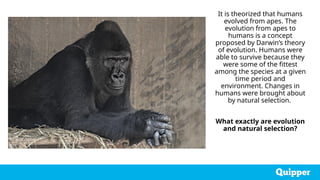
It is theorized that humans
evolved from apes. The
evolution from apes to
humans is a concept
proposed by Darwin’s theory
of evolution. Humans were
able to survive because they
were some of the fittest
among the species at a given
time period and
environment. Changes in
humans were brought about
by natural selection.
What exactly are evolution
and natural selection?
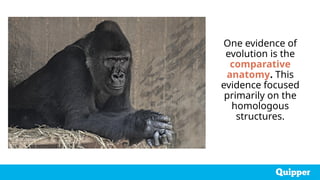
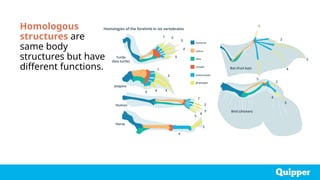
One evidence of
evolution is the
comparative
anatomy. This
evidence focused
primarily on the
homologous
structures.
Homologous
structures are
same body
structures but have
different functions.
Try it!
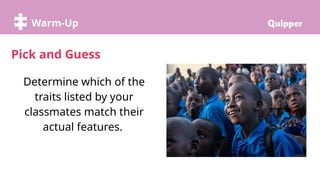
Warm-Up
Determine which of the
traits listed by your
classmates match their
actual features.
Pick and Guess
Learn about It
Charles Darwin and the
Theory of Evolution
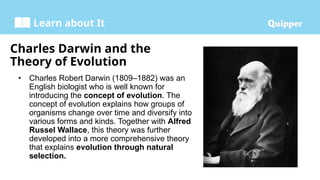
• Charles Robert Darwin (1809–1882) was an
English biologist who is well known for
introducing the concept of evolution. The
concept of evolution explains how groups of
organisms change over time and diversify into
various forms and kinds. Together with Alfred
Russel Wallace, this theory was further
developed into a more comprehensive theory
that explains evolution through natural
selection.
Learn about It
Charles Darwin and the
Theory of Evolution
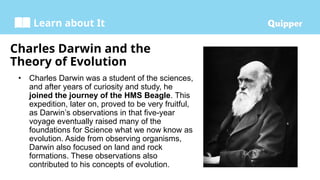
• Charles Darwin was a student of the sciences,
and after years of curiosity and study, he
joined the journey of the HMS Beagle. This
expedition, later on, proved to be very fruitful,
as Darwin’s observations in that five-year
voyage eventually raised many of the
foundations for Science what we now know as
evolution. Aside from observing organisms,
Darwin also focused on land and rock
formations. These observations also
contributed to his concepts of evolution.
Learn about It
Charles Darwin and the
Theory of Evolution
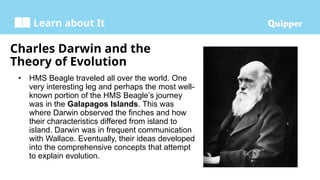
• HMS Beagle traveled all over the world. One
very interesting leg and perhaps the most well-
known portion of the HMS Beagle’s journey
was in the Galapagos Islands. This was
where Darwin observed the finches and how
their characteristics differed from island to
island. Darwin was in frequent communication
with Wallace. Eventually, their ideas developed
into the comprehensive concepts that attempt
to explain evolution.
Learn about It
Charles Darwin and the
Theory of Evolution
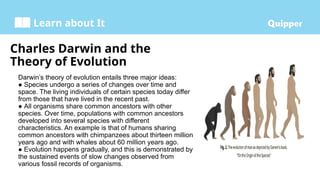
Darwin’s theory of evolution entails three major ideas:
● Species undergo a series of changes over time and
space. The living individuals of certain species today differ
from those that have lived in the recent past.
● All organisms share common ancestors with other
species. Over time, populations with common ancestors
developed into several species with different
characteristics. An example is that of humans sharing
common ancestors with chimpanzees about thirteen million
years ago and with whales about 60 million years ago.
● Evolution happens gradually, and this is demonstrated by
the sustained events of slow changes observed from
various fossil records of organisms.
Learn about It
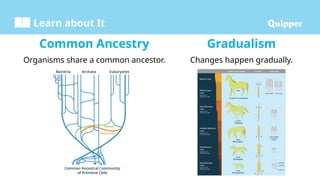
Common Ancestry
Organisms share a common ancestor.
Gradualism
Changes happen gradually.
Learn about It
Natural Selection
• Natural selection is the
principal reason for the
evolution of organisms. It is
further described as the
"survival of the fittest," that
triggers the gradual changes
in the traits of organisms
from generation to generation
until new characters or traits
are lost or created.
Learn about It
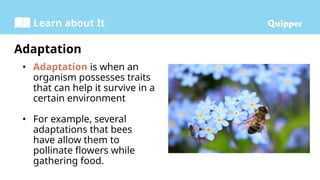
Adaptation
• Adaptation is when an
organism possesses traits
that can help it survive in a
certain environment
• For example, several
adaptations that bees
have allow them to
pollinate flowers while
gathering food.
Learn about It
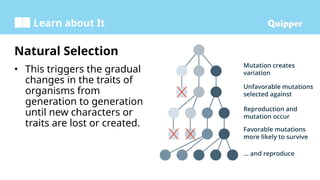
Natural Selection
• This triggers the gradual
changes in the traits of
organisms from
generation to generation
until new characters or
traits are lost or created.
Learn about It
Natural Selection
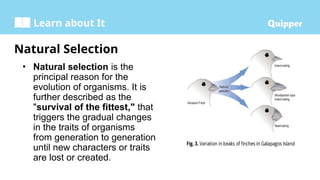
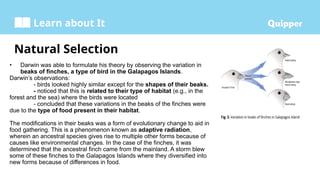
• Darwin was able to formulate his theory by observing the variation in
beaks of finches, a type of bird in the Galapagos Islands.
Darwin’s observations:
- birds looked highly similar except for the shapes of their beaks.
- noticed that this is related to their type of habitat (e.g., in the
forest and the sea) where the birds were located
- concluded that these variations in the beaks of the finches were
due to the type of food present in their habitat.
The modifications in their beaks was a form of evolutionary change to aid in
food gathering. This is a phenomenon known as adaptive radiation,
wherein an ancestral species gives rise to multiple other forms because of
causes like environmental changes. In the case of the finches, it was
determined that the ancestral finch came from the mainland. A storm blew
some of these finches to the Galapagos Islands where they diversified into
new forms because of differences in food.
Learn about It
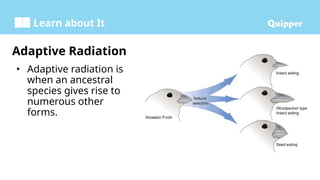
Adaptive Radiation
• Adaptive radiation is
when an ancestral
species gives rise to
numerous other
forms.
Learn about It
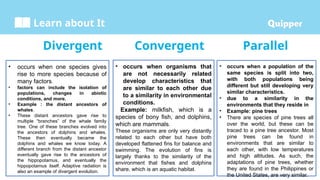
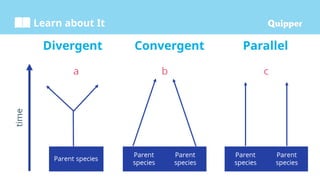
Divergent Convergent Parallel
• occurs when one species gives
rise to more species because of
many factors.
• factors can include the isolation of
populations, changes in abiotic
conditions, and more.
• Example : the distant ancestors of
whales.
• These distant ancestors gave rise to
multiple “branches” of the whale family
tree. One of these branches evolved into
the ancestors of dolphins and whales.
These then eventually became the
dolphins and whales we know today. A
different branch from the distant ancestor
eventually gave rise to the ancestors of
the hippopotamus, and eventually the
hippopotamus itself. Adaptive radiation is
also an example of divergent evolution.
• occurs when organisms that
are not necessarily related
develop characteristics that
are similar to each other due
to a similarity in environmental
conditions.
Example: milkfish, which is a
species of bony fish, and dolphins,
which are mammals.
These organisms are only very distantly
related to each other but have both
developed flattened fins for balance and
swimming. The evolution of fins is
largely thanks to the similarity of the
environment that fishes and dolphins
share, which is an aquatic habitat.
• occurs when a population of the
same species is split into two,
with both populations being
different but still developing very
similar characteristics.
• due to a similarity in the
environments that they reside in
• Example: pine trees
• There are species of pine trees all
over the world, but these can be
traced to a pine tree ancestor. Most
pine trees can be found in
environments that are similar to
each other, with low temperatures
and high altitudes. As such, the
adaptations of pine trees, whether
they are found in the Philippines or
the United States, are very similar.
Learn about It
Divergent Convergent Parallel
Learn about It
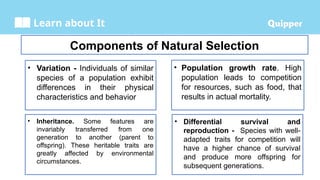
Components of Natural Selection
• Variation - Individuals of similar
species of a population exhibit
differences in their physical
characteristics and behavior
• Population growth rate. High
population leads to competition
for resources, such as food, that
results in actual mortality.
• Inheritance. Some features are
invariably transferred from one
generation to another (parent to
offspring). These heritable traits are
greatly affected by environmental
circumstances.
• Differential survival and
reproduction - Species with well-
adapted traits for competition will
have a higher chance of survival
and produce more offspring for
subsequent generations.
Learn about It
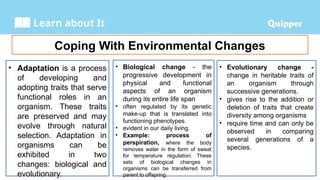
Coping With Environmental Changes
• Adaptation is a process
of developing and
adopting traits that serve
functional roles in an
organism. These traits
are preserved and may
evolve through natural
selection. Adaptation in
organisms can be
exhibited in two
changes: biological and
evolutionary.
• Biological change - the
progressive development in
physical and functional
aspects of an organism
during its entire life span
• often regulated by its genetic
make-up that is translated into
functioning phenotypes.
• evident in our daily living.
• Example: process of
perspiration, where the body
removes water in the form of sweat
for temperature regulation. These
sets of biological changes in
organisms can be transferred from
parent to offspring.
• Evolutionary change -
change in heritable traits of
an organism through
successive generations.
• gives rise to the addition or
deletion of traits that create
diversity among organisms
• require time and can only be
observed in comparing
several generations of a
species.
Learn about It
Did You Know?
Did you know that according to
YourGenome.org, the human brain is
larger than the brain of chimpanzee for
about four times and about 15 times
bigger than that of a mouse?
Key Points
● Biological change is the progressive development in physical
and functional aspects of an organism during its entire life
span.
● Evolutionary change is the change in heritable traits of an
organism through successive generations.
● Charles Darwin is the father of evolution.
● Theory of evolution explains how organisms diversified.
Check Your Understanding
1. _______________ was an English biologist who is well known
for introducing the concept of evolution.
2. _______________ helped in further explaining evolution
through natural selection.
3. It is the principal reason for the evolution of organisms.
4. Natural selection is also known as _______________.
5. Darwin observed the beaks of finches in _______________.
Fill in each blank with the term or phrase that will
complete the statements.
Bibliography
Carpenter, Kent E. and Victor G. Springer. “The Center of the Center of Marine Shore Fish Biodiversity:
the Philippine Islands.” Environmental Biology of Fishes 72 (2005): 467–80.
Dasgupta, Shreya. “Earth: Ten Shocking Animal Diseases That May Threaten Species.” BBC, March 27,
2015. www.bbc.com/earth/story/20150327-ten-scary-diseases-of-animals.
Doherty, Tim et. al. "Invasive predators are eating the world’s animals to extinction – and the worst is
close to home." The Conversation, September 19, 2016.
https://theconversation.com/invasive-predators-are-eating-the-worlds-animals-to-extinction-and-th
e-worst-is-close-to-home-64741
.
Flanders Marine Institute. n. d. "Aggregation and Marine Biological Value." Coastal Wiki.
Bibliography
Foundation for the Philippine Environment. n. d. "Why are We Losing Species?"
https://fpe.ph/biodiversity.html/view/why-are-we-losing-species.
Johnson, George B. and Peter H. Raven. Biology: Principles & Explorations. Austin: Holt, Rinehart, and
Winston, 2001.
Mader, Sylvia S. Concepts of Biology. New York: McGraw-Hill Education 2014.
Myers, Norman et al. “Biodiversity Hotspots for Conservation Priorities.” Nature, no. 403 (February 24,
2000): 853–58.
Reece, Jane and Neil Campbell. Biology. Boston: Benjamin Cummings/Pearson, 2011.
Bibliography
University of Michigan, October 10, 2010. "Evolution and Natural Selection."
https://globalchange.umich.edu/globalchange1/current/lectures/selection/selection.html.
University of Wisconsin-Eau Claire, n. d. "Causes of Extinction." UW-EAU.
https://people.uwec.edu/jolhm/EH4/Extinction/CausesLink.html.
Villanueva, Elaine Loreen C., and Inocencio E. Buot, Jr. december 7, 2015. “Threatened Plant Species of
Mindoro, Philippines.” IAMURE International Journal of Ecology and Conservation 14.1.
We Share Wisdom. February 3, 2015. “Ten Unique Endemic Species in the Philippines.” We Blog.
Wordpress.
https://wesharewisdom.wordpress.com/2015/02/03/10-unique-endemic-species-in-the-philippines/.
Your Genome. June 13, 2016. "Evolution of the Human Brain." Wellcome Genome Campus,
https://www.yourgenome.org/stories/evolution-of-the-human-brain.

fosiiiiiiiiiiiillsssssssssssssssssssssss

  • 1.
    Lesson 3.2 Evolution andNatural Selection
  • 2.
    Do you wantto edit this presentation? Make a copy and edit in Google Slides. 1. On the menu bar, click File and then Make a copy and Entire Presentation. 2. Type a name for the file. 3. Choose where to save it on your Google Drive. 4. Click Ok. 5. A new tab will open. Wait for the file to be completely loaded on a new tab. 6. Once the file has loaded, edit this presentation using Google Slides. Download an offline copy and edit in Microsoft PowerPoint. 1. On the menu bar, click File and then Download as. 2. Choose a file type. Select Microsoft PowerPoint (.pptx). 3. Wait for the file to be downloaded to your local disk. 4. Once completely downloaded, open the file and edit it using Microsoft PowerPoint or any offline presentation program. Do You Want to Edit This Presentation?
  • 3.
    Learning Competency Relate speciesextinction to the failure of populations of organisms to adapt to abrupt changes in the environment (S9LT-Ie-f-30). At the end of this lesson, the given DepEd learning competency should be met by the students.
  • 4.
    Learning Objectives At theend of this lesson, the learner should be able to do the following: ● Discuss the process of evolution. ● Discuss the mechanism of natural selection. ● Explain the relationship between evolution and natural selection. ● Recognize the importance of natural selection and evolution to biodiversity.
  • 5.
    It is theorizedthat humans evolved from apes. The evolution from apes to humans is a concept proposed by Darwin’s theory of evolution. Humans were able to survive because they were some of the fittest among the species at a given time period and environment. Changes in humans were brought about by natural selection. What exactly are evolution and natural selection?
  • 6.
    One evidence of evolutionis the comparative anatomy. This evidence focused primarily on the homologous structures.
  • 7.
  • 8.
    Try it! Warm-Up Determine whichof the traits listed by your classmates match their actual features. Pick and Guess
  • 9.
    Learn about It CharlesDarwin and the Theory of Evolution • Charles Robert Darwin (1809–1882) was an English biologist who is well known for introducing the concept of evolution. The concept of evolution explains how groups of organisms change over time and diversify into various forms and kinds. Together with Alfred Russel Wallace, this theory was further developed into a more comprehensive theory that explains evolution through natural selection.
  • 10.
    Learn about It CharlesDarwin and the Theory of Evolution • Charles Darwin was a student of the sciences, and after years of curiosity and study, he joined the journey of the HMS Beagle. This expedition, later on, proved to be very fruitful, as Darwin’s observations in that five-year voyage eventually raised many of the foundations for Science what we now know as evolution. Aside from observing organisms, Darwin also focused on land and rock formations. These observations also contributed to his concepts of evolution.
  • 11.
    Learn about It CharlesDarwin and the Theory of Evolution • HMS Beagle traveled all over the world. One very interesting leg and perhaps the most well- known portion of the HMS Beagle’s journey was in the Galapagos Islands. This was where Darwin observed the finches and how their characteristics differed from island to island. Darwin was in frequent communication with Wallace. Eventually, their ideas developed into the comprehensive concepts that attempt to explain evolution.
  • 12.
    Learn about It CharlesDarwin and the Theory of Evolution Darwin’s theory of evolution entails three major ideas: ● Species undergo a series of changes over time and space. The living individuals of certain species today differ from those that have lived in the recent past. ● All organisms share common ancestors with other species. Over time, populations with common ancestors developed into several species with different characteristics. An example is that of humans sharing common ancestors with chimpanzees about thirteen million years ago and with whales about 60 million years ago. ● Evolution happens gradually, and this is demonstrated by the sustained events of slow changes observed from various fossil records of organisms.
  • 13.
    Learn about It CommonAncestry Organisms share a common ancestor. Gradualism Changes happen gradually.
  • 14.
    Learn about It NaturalSelection • Natural selection is the principal reason for the evolution of organisms. It is further described as the "survival of the fittest," that triggers the gradual changes in the traits of organisms from generation to generation until new characters or traits are lost or created.
  • 15.
    Learn about It Adaptation •Adaptation is when an organism possesses traits that can help it survive in a certain environment • For example, several adaptations that bees have allow them to pollinate flowers while gathering food.
  • 16.
    Learn about It NaturalSelection • This triggers the gradual changes in the traits of organisms from generation to generation until new characters or traits are lost or created.
  • 17.
    Learn about It NaturalSelection • Darwin was able to formulate his theory by observing the variation in beaks of finches, a type of bird in the Galapagos Islands. Darwin’s observations: - birds looked highly similar except for the shapes of their beaks. - noticed that this is related to their type of habitat (e.g., in the forest and the sea) where the birds were located - concluded that these variations in the beaks of the finches were due to the type of food present in their habitat. The modifications in their beaks was a form of evolutionary change to aid in food gathering. This is a phenomenon known as adaptive radiation, wherein an ancestral species gives rise to multiple other forms because of causes like environmental changes. In the case of the finches, it was determined that the ancestral finch came from the mainland. A storm blew some of these finches to the Galapagos Islands where they diversified into new forms because of differences in food.
  • 18.
    Learn about It AdaptiveRadiation • Adaptive radiation is when an ancestral species gives rise to numerous other forms.
  • 19.
    Learn about It DivergentConvergent Parallel • occurs when one species gives rise to more species because of many factors. • factors can include the isolation of populations, changes in abiotic conditions, and more. • Example : the distant ancestors of whales. • These distant ancestors gave rise to multiple “branches” of the whale family tree. One of these branches evolved into the ancestors of dolphins and whales. These then eventually became the dolphins and whales we know today. A different branch from the distant ancestor eventually gave rise to the ancestors of the hippopotamus, and eventually the hippopotamus itself. Adaptive radiation is also an example of divergent evolution. • occurs when organisms that are not necessarily related develop characteristics that are similar to each other due to a similarity in environmental conditions. Example: milkfish, which is a species of bony fish, and dolphins, which are mammals. These organisms are only very distantly related to each other but have both developed flattened fins for balance and swimming. The evolution of fins is largely thanks to the similarity of the environment that fishes and dolphins share, which is an aquatic habitat. • occurs when a population of the same species is split into two, with both populations being different but still developing very similar characteristics. • due to a similarity in the environments that they reside in • Example: pine trees • There are species of pine trees all over the world, but these can be traced to a pine tree ancestor. Most pine trees can be found in environments that are similar to each other, with low temperatures and high altitudes. As such, the adaptations of pine trees, whether they are found in the Philippines or the United States, are very similar.
  • 20.
    Learn about It DivergentConvergent Parallel
  • 21.
    Learn about It Componentsof Natural Selection • Variation - Individuals of similar species of a population exhibit differences in their physical characteristics and behavior • Population growth rate. High population leads to competition for resources, such as food, that results in actual mortality. • Inheritance. Some features are invariably transferred from one generation to another (parent to offspring). These heritable traits are greatly affected by environmental circumstances. • Differential survival and reproduction - Species with well- adapted traits for competition will have a higher chance of survival and produce more offspring for subsequent generations.
  • 22.
    Learn about It CopingWith Environmental Changes • Adaptation is a process of developing and adopting traits that serve functional roles in an organism. These traits are preserved and may evolve through natural selection. Adaptation in organisms can be exhibited in two changes: biological and evolutionary. • Biological change - the progressive development in physical and functional aspects of an organism during its entire life span • often regulated by its genetic make-up that is translated into functioning phenotypes. • evident in our daily living. • Example: process of perspiration, where the body removes water in the form of sweat for temperature regulation. These sets of biological changes in organisms can be transferred from parent to offspring. • Evolutionary change - change in heritable traits of an organism through successive generations. • gives rise to the addition or deletion of traits that create diversity among organisms • require time and can only be observed in comparing several generations of a species.
  • 23.
    Learn about It DidYou Know? Did you know that according to YourGenome.org, the human brain is larger than the brain of chimpanzee for about four times and about 15 times bigger than that of a mouse?
  • 24.
    Key Points ● Biologicalchange is the progressive development in physical and functional aspects of an organism during its entire life span. ● Evolutionary change is the change in heritable traits of an organism through successive generations. ● Charles Darwin is the father of evolution. ● Theory of evolution explains how organisms diversified.
  • 25.
    Check Your Understanding 1._______________ was an English biologist who is well known for introducing the concept of evolution. 2. _______________ helped in further explaining evolution through natural selection. 3. It is the principal reason for the evolution of organisms. 4. Natural selection is also known as _______________. 5. Darwin observed the beaks of finches in _______________. Fill in each blank with the term or phrase that will complete the statements.
  • 26.
    Bibliography Carpenter, Kent E.and Victor G. Springer. “The Center of the Center of Marine Shore Fish Biodiversity: the Philippine Islands.” Environmental Biology of Fishes 72 (2005): 467–80. Dasgupta, Shreya. “Earth: Ten Shocking Animal Diseases That May Threaten Species.” BBC, March 27, 2015. www.bbc.com/earth/story/20150327-ten-scary-diseases-of-animals. Doherty, Tim et. al. "Invasive predators are eating the world’s animals to extinction – and the worst is close to home." The Conversation, September 19, 2016. https://theconversation.com/invasive-predators-are-eating-the-worlds-animals-to-extinction-and-th e-worst-is-close-to-home-64741 . Flanders Marine Institute. n. d. "Aggregation and Marine Biological Value." Coastal Wiki.
  • 27.
    Bibliography Foundation for thePhilippine Environment. n. d. "Why are We Losing Species?" https://fpe.ph/biodiversity.html/view/why-are-we-losing-species. Johnson, George B. and Peter H. Raven. Biology: Principles & Explorations. Austin: Holt, Rinehart, and Winston, 2001. Mader, Sylvia S. Concepts of Biology. New York: McGraw-Hill Education 2014. Myers, Norman et al. “Biodiversity Hotspots for Conservation Priorities.” Nature, no. 403 (February 24, 2000): 853–58. Reece, Jane and Neil Campbell. Biology. Boston: Benjamin Cummings/Pearson, 2011.
  • 28.
    Bibliography University of Michigan,October 10, 2010. "Evolution and Natural Selection." https://globalchange.umich.edu/globalchange1/current/lectures/selection/selection.html. University of Wisconsin-Eau Claire, n. d. "Causes of Extinction." UW-EAU. https://people.uwec.edu/jolhm/EH4/Extinction/CausesLink.html. Villanueva, Elaine Loreen C., and Inocencio E. Buot, Jr. december 7, 2015. “Threatened Plant Species of Mindoro, Philippines.” IAMURE International Journal of Ecology and Conservation 14.1. We Share Wisdom. February 3, 2015. “Ten Unique Endemic Species in the Philippines.” We Blog. Wordpress. https://wesharewisdom.wordpress.com/2015/02/03/10-unique-endemic-species-in-the-philippines/. Your Genome. June 13, 2016. "Evolution of the Human Brain." Wellcome Genome Campus, https://www.yourgenome.org/stories/evolution-of-the-human-brain.