Prepared by:
Funny B. Fiadcong
*
*
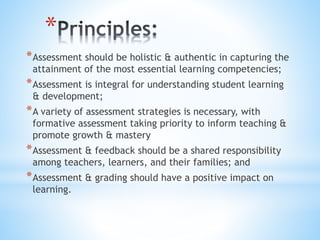
*Assessment should be holistic & authentic in capturing the
attainment of the most essential learning competencies;
*Assessment is integral for understanding student learning
& development;
*A variety of assessment strategies is necessary, with
formative assessment taking priority to inform teaching &
promote growth & mastery
*Assessment & feedback should be a shared responsibility
among teachers, learners, and their families; and
*Assessment & grading should have a positive impact on
learning.
*
*It is an ongoing process of
identifying, gathering,
organizing, and interpreting
quantitative and qualitative
information about what
learners know and can do.
*
*It is a process that involves teachers using
evidence about what learners know and
can do to inform and improve their
teaching.
*This process, through the teacher’s
immediate feedback, enables students to
take responsibility for their own learning
and identify areas where they do well and
where they need help.
*
*It is an assessment that is usually
administered toward the end of a
learning period to measure the extent to
which the learners have mastered the
essential learning competencies, the
results of which are recorded and are
used to report the learner’s
achievement.
*
*
*Designing the assessment to allow for
flexibility in multiple modalities;
*Communicating to learners and
parents/guardians the design and standards for
grading the assessment;
*Setting up mechanisms to monitor and record
progress remotely;
*Giving timely, constructive, and relevant
feedback; and
*Facilitating remediation for learners who need
further guidance.
*
*Learners are expected to be proactive in updating
their teacher of their situation, progress and
challenges encountered.
*A non-mandatory self-monitoring tool (Annex E) may
be accomplished independently or with the
assistance of their parent/guardian, if necessary.
*It is not required to accomplish the self-monitoring
tool, but its usage is highly recommended to keep
track of learners’ academic progress.
*
*Only when necessary, parents / guardians are
requested to assist in the assessment process
by:
*Communicating with the teacher to give updates
on their child’s situation, progress, and
challenges encountered; and
*Guiding their children in accomplishing the
assessment tasks and / or monitoring tools
designed by their teacher.
*
*Teachers need to be creative and flexible in assessing
the student learning.
*Assessment decisions must be made in the best
interest of all learners, ensuring that all assessment
activities:
*Align with the most essential learning competencies;
*Are reliable, valid and transparent
*Are fair, inclusive and equitable
*Are practical and manageable for both learners and
teachers
*Give learners a range of ways to demonstrate their
learning
*Provide timely and accurate information as basis for
feedback
*Formative assessment is about
getting better, so it should be
specific, frequent, repetitive,
and free from the restrictions of
grading (Christodolou, 2016).
*It should target skills that are
necessary to the attainment of
learning competencies as
measured in summative
assessments.
*To evaluate student learning
at a particular points in each
quarter, summative
assessments shall continue in
the form of written works and
performance tasks.
*Written works shall be
administered to assess essential
knowledge and understandings
through quizzes and long / unit
tests. Items should be distributed
across the Cognitive Process
Dimensions (DepEd, 2015, p. 4)
using a combination of selected-
response formats so that all are
adequately covered.
*
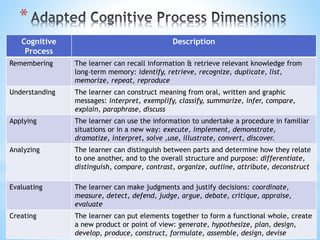
Cognitive
Process
Description
Remembering The learner can recall information & retrieve relevant knowledge from
long-term memory: identify, retrieve, recognize, duplicate, list,
memorize, repeat, reproduce
Understanding The learner can construct meaning from oral, written and graphic
messages: interpret, exemplify, classify, summarize, infer, compare,
explain, paraphrase, discuss
Applying The learner can use the information to undertake a procedure in familiar
situations or in a new way: execute, implement, demonstrate,
dramatize, interpret, solve ,use, illustrate, convert, discover.
Analyzing The learner can distinguish between parts and determine how they relate
to one another, and to the overall structure and purpose: differentiate,
distinguish, compare, contrast, organize, outline, attribute, deconstruct
Evaluating The learner can make judgments and justify decisions: coordinate,
measure, detect, defend, judge, argue, debate, critique, appraise,
evaluate
Creating The learner can put elements together to form a functional whole, create
a new product or point of view: generate, hypothesize, plan, design,
develop, produce, construct, formulate, assemble, design, devise
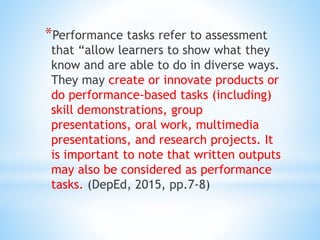
*Performance tasks refer to assessment
that “allow learners to show what they
know and are able to do in diverse ways.
They may create or innovate products or
do performance-based tasks (including)
skill demonstrations, group
presentations, oral work, multimedia
presentations, and research projects. It
is important to note that written outputs
may also be considered as performance
tasks. (DepEd, 2015, pp.7-8)
*
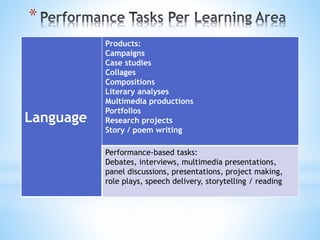
Language
Products:
Campaigns
Case studies
Collages
Compositions
Literary analyses
Multimedia productions
Portfolios
Research projects
Story / poem writing
Performance-based tasks:
Debates, interviews, multimedia presentations,
panel discussions, presentations, project making,
role plays, speech delivery, storytelling / reading
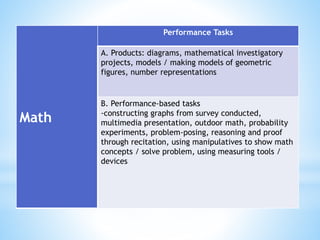
Math
Performance Tasks
A. Products: diagrams, mathematical investigatory
projects, models / making models of geometric
figures, number representations
B. Performance-based tasks
-constructing graphs from survey conducted,
multimedia presentation, outdoor math, probability
experiments, problem-posing, reasoning and proof
through recitation, using manipulatives to show math
concepts / solve problem, using measuring tools /
devices
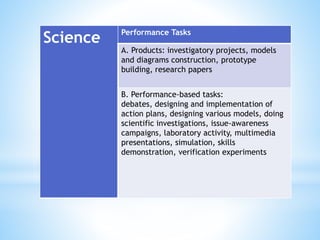
Science Performance Tasks
A. Products: investigatory projects, models
and diagrams construction, prototype
building, research papers
B. Performance-based tasks:
debates, designing and implementation of
action plans, designing various models, doing
scientific investigations, issue-awareness
campaigns, laboratory activity, multimedia
presentations, simulation, skills
demonstration, verification experiments
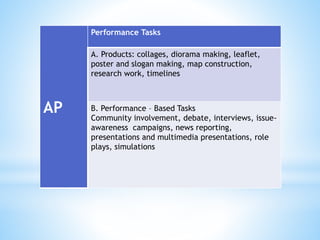
AP
Performance Tasks
A. Products: collages, diorama making, leaflet,
poster and slogan making, map construction,
research work, timelines
B. Performance – Based Tasks
Community involvement, debate, interviews, issue-
awareness campaigns, news reporting,
presentations and multimedia presentations, role
plays, simulations
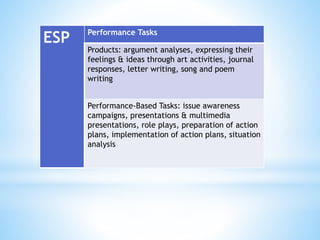
ESP Performance Tasks
Products: argument analyses, expressing their
feelings & ideas through art activities, journal
responses, letter writing, song and poem
writing
Performance-Based Tasks: issue awareness
campaigns, presentations & multimedia
presentations, role plays, preparation of action
plans, implementation of action plans, situation
analysis
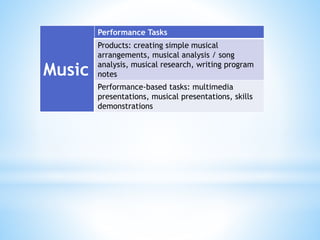
Music
Performance Tasks
Products: creating simple musical
arrangements, musical analysis / song
analysis, musical research, writing program
notes
Performance-based tasks: multimedia
presentations, musical presentations, skills
demonstrations
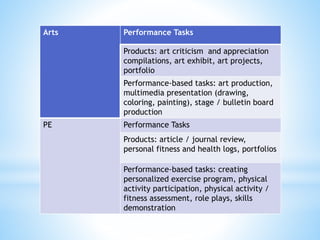
Arts Performance Tasks
Products: art criticism and appreciation
compilations, art exhibit, art projects,
portfolio
Performance-based tasks: art production,
multimedia presentation (drawing,
coloring, painting), stage / bulletin board
production
PE Performance Tasks
Products: article / journal review,
personal fitness and health logs, portfolios
Performance-based tasks: creating
personalized exercise program, physical
activity participation, physical activity /
fitness assessment, role plays, skills
demonstration
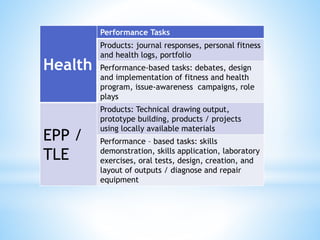
Health
Performance Tasks
Products: journal responses, personal fitness
and health logs, portfolio
Performance-based tasks: debates, design
and implementation of fitness and health
program, issue-awareness campaigns, role
plays
EPP /
TLE
Products: Technical drawing output,
prototype building, products / projects
using locally available materials
Performance – based tasks: skills
demonstration, skills application, laboratory
exercises, oral tests, design, creation, and
layout of outputs / diagnose and repair
equipment
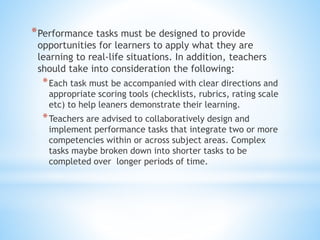
*Performance tasks must be designed to provide
opportunities for learners to apply what they are
learning to real-life situations. In addition, teachers
should take into consideration the following:
*Each task must be accompanied with clear directions and
appropriate scoring tools (checklists, rubrics, rating scale
etc) to help leaners demonstrate their learning.
*Teachers are advised to collaboratively design and
implement performance tasks that integrate two or more
competencies within or across subject areas. Complex
tasks maybe broken down into shorter tasks to be
completed over longer periods of time.
*Learners must be given flexibility in the accomplishment
of the performance tasks to consider time and resources
available to them. Nonetheless, all learners within a class
should be assessed on the same competencies using the
same scoring tool.
*Teachers should set realistic expectations and use their
professional judgment to find a good balance between
what is effective and what is feasible to accomplish
remotely.
*
*Consistent with DO No. 8 s. 2015, “teachers
should ensure that learners receive
remediation when they earn raw scores which
are consistently below expectation” in
summative assessments “by the fifth week of
any quarter. This will prevent a student from
failing in any learning area at the end of the
year.”
*Written works and performance tasks could be
designed to include the following:
*Student’s Learning Portfolio that documents all the
evidence of learning within the grading period
including self-reflections, self-evaluations of
performance tasks guided by rubrics, and self-
selected best outputs in learning modules.
*Minimum of four (4) written works and four (4)
performance tasks within the quarter, preferably one
in two weeks integrating two or more competencies.
*All competencies should be covered by the
performance tasks (e.g. A performance task can be
used to assess Science, Math, and English altogether
for certain topics).
*
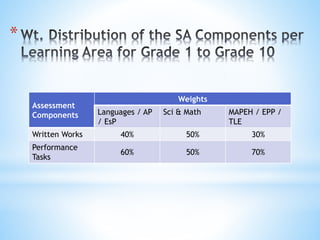
Assessment
Components
Weights
Languages / AP
/ EsP
Sci & Math MAPEH / EPP /
TLE
Written Works 40% 50% 30%
Performance
Tasks
60% 50% 70%
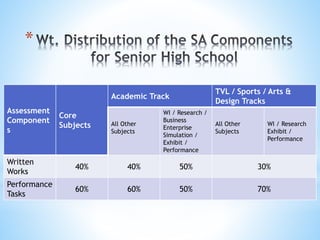
*
Assessment
Component
s
Core
Subjects
Academic Track
TVL / Sports / Arts &
Design Tracks
All Other
Subjects
WI / Research /
Business
Enterprise
Simulation /
Exhibit /
Performance
All Other
Subjects
WI / Research
Exhibit /
Performance
Written
Works
40% 40% 50% 30%
Performance
Tasks
60% 60% 50% 70%
*The transmutation table in DO No. 8 s. 2015,
shall still be used in this grading system. The
guidelines on learner’s progress report, as well
as on promotion and retention shall likewise
follow the provisions cited in the said policy.
Thank You!

Presentation on DepEd Order No. 31 s. 2020.pptx

  • 1.
  • 3.
    * *Assessment should beholistic & authentic in capturing the attainment of the most essential learning competencies; *Assessment is integral for understanding student learning & development; *A variety of assessment strategies is necessary, with formative assessment taking priority to inform teaching & promote growth & mastery *Assessment & feedback should be a shared responsibility among teachers, learners, and their families; and *Assessment & grading should have a positive impact on learning.
  • 4.
    * *It is anongoing process of identifying, gathering, organizing, and interpreting quantitative and qualitative information about what learners know and can do.
  • 5.
    * *It is aprocess that involves teachers using evidence about what learners know and can do to inform and improve their teaching. *This process, through the teacher’s immediate feedback, enables students to take responsibility for their own learning and identify areas where they do well and where they need help.
  • 6.
    * *It is anassessment that is usually administered toward the end of a learning period to measure the extent to which the learners have mastered the essential learning competencies, the results of which are recorded and are used to report the learner’s achievement.
  • 7.
  • 8.
    * *Designing the assessmentto allow for flexibility in multiple modalities; *Communicating to learners and parents/guardians the design and standards for grading the assessment; *Setting up mechanisms to monitor and record progress remotely; *Giving timely, constructive, and relevant feedback; and *Facilitating remediation for learners who need further guidance.
  • 9.
    * *Learners are expectedto be proactive in updating their teacher of their situation, progress and challenges encountered. *A non-mandatory self-monitoring tool (Annex E) may be accomplished independently or with the assistance of their parent/guardian, if necessary. *It is not required to accomplish the self-monitoring tool, but its usage is highly recommended to keep track of learners’ academic progress.
  • 10.
    * *Only when necessary,parents / guardians are requested to assist in the assessment process by: *Communicating with the teacher to give updates on their child’s situation, progress, and challenges encountered; and *Guiding their children in accomplishing the assessment tasks and / or monitoring tools designed by their teacher.
  • 11.
  • 12.
    *Teachers need tobe creative and flexible in assessing the student learning. *Assessment decisions must be made in the best interest of all learners, ensuring that all assessment activities: *Align with the most essential learning competencies; *Are reliable, valid and transparent *Are fair, inclusive and equitable *Are practical and manageable for both learners and teachers *Give learners a range of ways to demonstrate their learning *Provide timely and accurate information as basis for feedback
  • 13.
    *Formative assessment isabout getting better, so it should be specific, frequent, repetitive, and free from the restrictions of grading (Christodolou, 2016). *It should target skills that are necessary to the attainment of learning competencies as measured in summative assessments.
  • 14.
    *To evaluate studentlearning at a particular points in each quarter, summative assessments shall continue in the form of written works and performance tasks.
  • 15.
    *Written works shallbe administered to assess essential knowledge and understandings through quizzes and long / unit tests. Items should be distributed across the Cognitive Process Dimensions (DepEd, 2015, p. 4) using a combination of selected- response formats so that all are adequately covered.
  • 16.
    * Cognitive Process Description Remembering The learnercan recall information & retrieve relevant knowledge from long-term memory: identify, retrieve, recognize, duplicate, list, memorize, repeat, reproduce Understanding The learner can construct meaning from oral, written and graphic messages: interpret, exemplify, classify, summarize, infer, compare, explain, paraphrase, discuss Applying The learner can use the information to undertake a procedure in familiar situations or in a new way: execute, implement, demonstrate, dramatize, interpret, solve ,use, illustrate, convert, discover. Analyzing The learner can distinguish between parts and determine how they relate to one another, and to the overall structure and purpose: differentiate, distinguish, compare, contrast, organize, outline, attribute, deconstruct Evaluating The learner can make judgments and justify decisions: coordinate, measure, detect, defend, judge, argue, debate, critique, appraise, evaluate Creating The learner can put elements together to form a functional whole, create a new product or point of view: generate, hypothesize, plan, design, develop, produce, construct, formulate, assemble, design, devise
  • 17.
    *Performance tasks referto assessment that “allow learners to show what they know and are able to do in diverse ways. They may create or innovate products or do performance-based tasks (including) skill demonstrations, group presentations, oral work, multimedia presentations, and research projects. It is important to note that written outputs may also be considered as performance tasks. (DepEd, 2015, pp.7-8)
  • 18.
    * Language Products: Campaigns Case studies Collages Compositions Literary analyses Multimediaproductions Portfolios Research projects Story / poem writing Performance-based tasks: Debates, interviews, multimedia presentations, panel discussions, presentations, project making, role plays, speech delivery, storytelling / reading
  • 19.
    Math Performance Tasks A. Products:diagrams, mathematical investigatory projects, models / making models of geometric figures, number representations B. Performance-based tasks -constructing graphs from survey conducted, multimedia presentation, outdoor math, probability experiments, problem-posing, reasoning and proof through recitation, using manipulatives to show math concepts / solve problem, using measuring tools / devices
  • 20.
    Science Performance Tasks A.Products: investigatory projects, models and diagrams construction, prototype building, research papers B. Performance-based tasks: debates, designing and implementation of action plans, designing various models, doing scientific investigations, issue-awareness campaigns, laboratory activity, multimedia presentations, simulation, skills demonstration, verification experiments
  • 21.
    AP Performance Tasks A. Products:collages, diorama making, leaflet, poster and slogan making, map construction, research work, timelines B. Performance – Based Tasks Community involvement, debate, interviews, issue- awareness campaigns, news reporting, presentations and multimedia presentations, role plays, simulations
  • 22.
    ESP Performance Tasks Products:argument analyses, expressing their feelings & ideas through art activities, journal responses, letter writing, song and poem writing Performance-Based Tasks: issue awareness campaigns, presentations & multimedia presentations, role plays, preparation of action plans, implementation of action plans, situation analysis
  • 23.
    Music Performance Tasks Products: creatingsimple musical arrangements, musical analysis / song analysis, musical research, writing program notes Performance-based tasks: multimedia presentations, musical presentations, skills demonstrations
  • 24.
    Arts Performance Tasks Products:art criticism and appreciation compilations, art exhibit, art projects, portfolio Performance-based tasks: art production, multimedia presentation (drawing, coloring, painting), stage / bulletin board production PE Performance Tasks Products: article / journal review, personal fitness and health logs, portfolios Performance-based tasks: creating personalized exercise program, physical activity participation, physical activity / fitness assessment, role plays, skills demonstration
  • 25.
    Health Performance Tasks Products: journalresponses, personal fitness and health logs, portfolio Performance-based tasks: debates, design and implementation of fitness and health program, issue-awareness campaigns, role plays EPP / TLE Products: Technical drawing output, prototype building, products / projects using locally available materials Performance – based tasks: skills demonstration, skills application, laboratory exercises, oral tests, design, creation, and layout of outputs / diagnose and repair equipment
  • 26.
    *Performance tasks mustbe designed to provide opportunities for learners to apply what they are learning to real-life situations. In addition, teachers should take into consideration the following: *Each task must be accompanied with clear directions and appropriate scoring tools (checklists, rubrics, rating scale etc) to help leaners demonstrate their learning. *Teachers are advised to collaboratively design and implement performance tasks that integrate two or more competencies within or across subject areas. Complex tasks maybe broken down into shorter tasks to be completed over longer periods of time.
  • 27.
    *Learners must begiven flexibility in the accomplishment of the performance tasks to consider time and resources available to them. Nonetheless, all learners within a class should be assessed on the same competencies using the same scoring tool. *Teachers should set realistic expectations and use their professional judgment to find a good balance between what is effective and what is feasible to accomplish remotely.
  • 28.
    * *Consistent with DONo. 8 s. 2015, “teachers should ensure that learners receive remediation when they earn raw scores which are consistently below expectation” in summative assessments “by the fifth week of any quarter. This will prevent a student from failing in any learning area at the end of the year.”
  • 29.
    *Written works andperformance tasks could be designed to include the following: *Student’s Learning Portfolio that documents all the evidence of learning within the grading period including self-reflections, self-evaluations of performance tasks guided by rubrics, and self- selected best outputs in learning modules. *Minimum of four (4) written works and four (4) performance tasks within the quarter, preferably one in two weeks integrating two or more competencies. *All competencies should be covered by the performance tasks (e.g. A performance task can be used to assess Science, Math, and English altogether for certain topics).
  • 30.
    * Assessment Components Weights Languages / AP /EsP Sci & Math MAPEH / EPP / TLE Written Works 40% 50% 30% Performance Tasks 60% 50% 70%
  • 31.
    * Assessment Component s Core Subjects Academic Track TVL /Sports / Arts & Design Tracks All Other Subjects WI / Research / Business Enterprise Simulation / Exhibit / Performance All Other Subjects WI / Research Exhibit / Performance Written Works 40% 40% 50% 30% Performance Tasks 60% 60% 50% 70%
  • 32.
    *The transmutation tablein DO No. 8 s. 2015, shall still be used in this grading system. The guidelines on learner’s progress report, as well as on promotion and retention shall likewise follow the provisions cited in the said policy.
  • 33.