The Development of
Early Childhood
Care and Education
in India through an
eye of NCF-2022
Developed to enable implementation of the National Education Policy (NEP) 2020
Helps develop diverse Curricula in the country, while enabling consonances & harmony
across the country and providing a basis for quality and equity.
Positively transforming the school education system of India as envisioned in NEP
2020, through corresponding positive changes in the curriculum including pedagogy.
1.
Developed for
Teachers and
Practitioners in
education
Characteristics
of this NCF
2.
Lays down the
new vision for
schools
3.
Provides details
and guidelines for
quality education
at Foundational
stage
Objective
About the National Curriculum Framework
National Curriculum Framework (NCF) for the Foundational Stage
01
Five years of flexible, multilevel, play and activity-
based learning for children from Ages 3 to 8
02 Based on cutting-edge research from across
the world
03 Rooted in India’s deep traditions and
knowledge
04 Guide for Teachers and other Practitioners
05 Enables holistic development of all our children
across institutions - Schools, Anganwadis,
Balvatikas, Preschools
“First ever integrated
Curricular Framework for
children from Ages 3 to 8 in
the country
Fundamental Principles of the NCF
Families and Schools are
partners in children’s
learning
Care is central to learning
Play and activity are primary
ways of learning and
development
Children learn through
observation, imitation,
collaboration and concrete
experiences
Every child is capable of learning
Children learn best when they are
respected, valued, fully
involved in the learning
process
Continuous opportunities for
children to experience,
explore, and experiment with
the environment are
important for learning
Each child is different and
grows, learns, and
develops at their own pace
Early Childhood Care and Education (ECCE)
ECCE is defined as the care and education of children from birth to eight years & is the focus of this NCF
This National Curriculum Framework aims to address the Foundational Stage in institutional settings,
within the overall context of ECCE
ECCE
Primarily at home (Age 0-3)
Foundational stage – Mostly in
Institutional Settings (Age 3-8)
3-6 Years: Early Childhood
Education Programmes
(Anganwadis, Balvatika)
6-8 Years: Early Primary classes
in Schools (Grade 1 & 2)
Quality ECCE leads to
holistic development:
Brain
Development
School
Preparedness
Overall growth
of the country
Employability
Improved
Learning
Outcomes
Curricular Goals
This NCF comprises 13 Curricular Goals for Foundational Stage divided in 6 Domains mentioned above
Physical Development
Cognitive
Development
Language and Literacy
Development
Positive
Learning Habits
1
4
3
6
2
Social-Emotional &
Ethical Development
5
Aesthetic and
Cultural
Development
Becoming Independent Reader
and Writer
Once the concept of reading and
writing is developed in a child in
home language, use of additional
scripts can be gradually
introduced. The aim is to be an
independent reader and writer by
age 8 (Grade 3).
Medium of Instruction
in child's home
language
Since children learn concepts
most rapidly and deeply in
their home language, the
primary medium of instruction
would optimally be the child’s
home language/ mother
tongue/familiar language in
the Foundational Stage.
Exposed to multiple oral
languages
Children should be exposed to and immersed in
multiple oral languages from an early age. Schools
will aim to ensure the presence of Teachers, and
parents so that at least two or preferably three
languages present with children on a regular basis.
Reading and Writing in child’s home language
1
2
3
4
The concept of reading and
writing is initially developed
through the home language
whenever possible.
Approach to Language Education and Literacy
Approach to Numeracy
Number and
its Relations
Basic
Mathematical
Operations
Shapes and
Spatial
Understanding
Patterns Measurement Data Handling
Areas of Mathematics Learning in the Early Years
Adoption of various approaches to teach mathematics to students in a playful way:
Developing mathematical abstract ideas (concepts) through concrete experience
ENGLISH LANGUAGE PROFICIENCY STANDARD (ELPS)
Connecting mathematics learning with children’s real-life and prior knowledge
Mathematics as a problem-solving tool
Using Mathematical talk, communication, and reasoning
Developing a positive attitude towards learning mathematics
Organizing Content and Learning Material
Sensorially engaging - encourages children to examine and explore
using all their senses
All grade 1 and 2 textbooks – language and math – will have
environmental awareness integrated in them
Drawn largely from the context of the child
Print-rich environment with range of reading material -
stories, poems, picture books
Cater to different needs and levels of children
Emphasis on local material, made by Teachers and
children
Choosing and Organising Content
Content for Language, Maths and Art
TLMs and Learning Environment
Worksheets/Workbooks
Children’s literature
Audio-Visual Material
Flashcards
Project-based
Approach
Story-based
Approach
Theme-based
Approach
Eclectic
Approaches
Ways of Organising Content
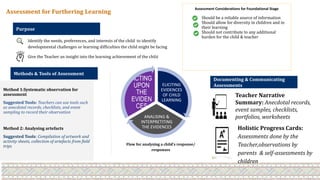
Assessment for Furthering Learning
Assessment Considerations for Foundational Stage
Should be a reliable source of information
Should allow for diversity in children and in
their learning
Should not contribute to any additional
burden for the child & teacher
Method 1:Systematic observation for
assessment
Suggested Tools: Teachers can use tools such
as anecdotal records, checklists, and event
sampling to record their observation
Method 2: Analysing artefacts
Suggested Tools: Compilation of artwork and
activity sheets, collection of artefacts from field
trips Flow for analysing a child’s response/
responses
Identify the needs, preferences, and interests of the child to identify
developmental challenges or learning difficulties the child might be facing
Give the Teacher an insight into the learning achievement of the child
Teacher Narrative
Summary: Anecdotal records,
event samples, checklists,
portfolios, worksheets
Holistic Progress Cards:
Assessments done by the
Teacher,observations by
parents & self-assessments by
children
Purpose
Methods & Tools of Assessment
Documenting & Communicating
Assessments
ELICITING
EVIDENCES
OF CHILD
LEARNING
ANALISING &
INTERPRETITING
THE EVIDENCES
ACTING
UPON
THE
EVIDEN
CES
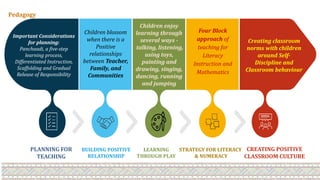
PLANNING FOR
TEACHING
Important Considerations
for planning:
Panchaadi, a five-step
learning process,
Differentiated Instruction,
Scaffolding and Gradual
Release of Responsibility
Children blossom
when there is a
Positive
relationships
between Teacher,
Family, and
Communities
Children enjoy
learning through
several ways -
talking, listening,
using toys,
painting and
drawing, singing,
dancing, running
and jumping
Four Block
approach of
teaching for
Literacy
Instruction and
Mathematics
Creating classroom
norms with children
around Self-
Discipline and
Classroom behaviour
BUILDING POSITIVE
RELATIONSHIP
LEARNING
THROUGH PLAY
STRATEGY FOR LITERACY
& NUMERACY
CREATING POSITIVE
CLASSROOM CULTURE
Pedagogy
Play
Environment
Interaction
Pedagogy
Leading to make children
Active and Engaged Learners
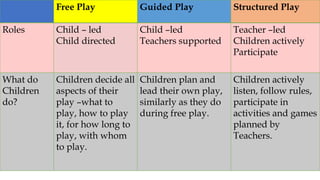
Free Play Guided Play Structured Play
Roles Child – led
Child directed
Child –led
Teachers supported
Teacher –led
Children actively
Participate
What do
Children
do?
Children decide all
aspects of their
play –what to
play, how to play
it, for how long to
play, with whom
to play.
Children plan and
lead their own play,
similarly as they do
during free play.
Children actively
listen, follow rules,
participate in
activities and games
planned by
Teachers.
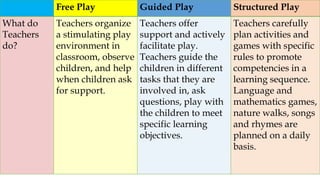
Free Play Guided Play Structured Play
What do
Teachers
do?
Teachers organize
a stimulating play
environment in
classroom, observe
children, and help
when children ask
for support.
Teachers offer
support and actively
facilitate play.
Teachers guide the
children in different
tasks that they are
involved in, ask
questions, play with
the children to meet
specific learning
objectives.
Teachers carefully
plan activities and
games with specific
rules to promote
competencies in a
learning sequence.
Language and
mathematics games,
nature walks, songs
and rhymes are
planned on a daily
basis.
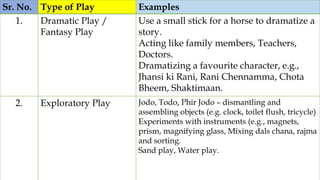
Sr. No. Type of Play Examples
1. Dramatic Play /
Fantasy Play
Use a small stick for a horse to dramatize a
story.
Acting like family members, Teachers,
Doctors.
Dramatizing a favourite character, e.g.,
Jhansi ki Rani, Rani Chennamma, Chota
Bheem, Shaktimaan.
2. Exploratory Play Jodo, Todo, Phir Jodo – dismantling and
assembling objects (e.g. clock, toilet flush, tricycle)
Experiments with instruments (e.g., magnets,
prism, magnifying glass, Mixing dals chana, rajma
and sorting.
Sand play, Water play.
Sr. No. Type of Play Examples
3. Environment / Small
world play
Using miniature animals, furniture,
kitchen set, doctor set to recreate the real
world and engage with it.
Nature walk identifying trees, plants,
insects, birds, animals, sounds, colours.
4. Physical Play Exploring the body through music,
movement, dramatization, outdoor play
balancing, games.
5. Games with Rules Hopscotch (Kith Kith, Stapu, Langdi),
Tag, Snakes and Ladders, Chaupad,
Spinning tops (Lattu, Buguri),
Marbles(Goli), Kokla Chapaki, Pitthu,
Pallanguzhi.
To prepare organised activities that are play-based but
guided and structured
.
Independent Activities for
children: Circle Time, Story
Time, Concept Time/Pre-
numeracy are Teacher-guided
and Free Play
For a small group : Learning
using materials & Allowing
children to choose their activity
Illustrative Daily Routine for Ages
3-6
Illustrative Daily/Weekly Routine
for Ages 6-8
Annual School Calendar
Informative and
accessible annual plan
calendar detailing all
important events to be
shared
Activities for ages 6-8
More structured and dedicated
time for literacy, numeracy
and arts
Supporting language development as well as socio-emotional
and ethical development
Organizing Time
Purpose
1. Learn as much as
possible about the
child.
2. Setting goals for
the child that are
realistic and
achievable.
3. Make information
as concrete as
possible.
4. Using a multi
sensory approach.
5. Sensitize other
children to the
situation
Early identification of children who are ‘at risk’ for
developmental delays and disabilities is very
crucial for timely intervention
Ensuring physical and emotional safety of
children in schools and providing a secure
environment
1. Observe the child to
understand the child’s
functioning
2. Record daily or
weekly observation
3. Share concern with
parents and family.
4. Refer the child to an
appropriate medical
professional
5. focussed work with the
child in school..
Role of Foundational
Stage Institutions
Role of Teachers Adult supervision must always be present
No physical violence or corporal punishment with
children
Adults must not bully, harass, or intimidate children
even by implication or covertly.
Teachers must intervene inappropriate behaviour
Zero tolerance of child sexual abuse.
Teachers and all other adults must be aware of child
sexual abuse, and the POCSO Act
Additional Critical Areas
1 2
Connections to the Preparatory Stage
Gradual shift
from
Development
Domains to
Curricular
Areas
(subjects) in
the
Preparatory
Stage
Gentle move
from child-
led
pedagogical
exploration
to a more
formal
learning
environment
Assessment
through
some formal
tasks in
addition to
structured
observation -
continues to
be an
integral part
of classroom
process
Begin to
move from
concrete,
sensorial
experiences
to more
abstract
ideas,
concepts
1
2
3
4
5+3+3+4 Curricular and Pedagogical design necessitates continuity and change across Stages
03
02 04
01 05
● Parents/family as co-partners
with schools to aid child
learning and development
● Community can support in
ensuring enrolment,
attendance, observations etc
● Technology can support in
accelerating capacity building,
enabling participation and
engagement, and synergies
among stakeholders
● Use cases: QR code textbooks,
translation, disability screening
etc
● Ensure joyful and adequate
learning
infrastructure/resources
● Suitable Pupil Teacher Ratio
and appropriate age of
admission
● Principals contribute to shaping
supportive and empowering culture
● Cluster/Block level functionaries
provide critical feedback for
improvement/development
● Ensure presence of adequate
teachers, TLM, access for SEDGs etc
● Requires a conducive teaching
environment, culture, and facilities
● Teachers must be equipped
through adequate training,
mentoring
● Teachers are provided career
progression and autonomy with
accountability
Creating a Supportive Ecosystem
Enabling and Empowering
Teachers
Ensuring an Appropriate
Environment for Learning
Role of Academic and
Administrative Functionaries
Role of Parents and
Community
Leveraging Technology
Recent Initiatives Taken By education
ministry
Add a Slide Title - 1
In NIPUN BHARAT guidelines for
foundational literacy and numeracy mission,
the competencies for holistic development
of the child from 3 to 9 years are codified
under three developmental goals.
Development
Goal
1
• Children maintain
good health and
well-being
• To provide
experiences for
physical and
motor
development,
socio-emotional
development,
nutrition, safety,
hygiene and
sanitation
Development
Goal
2
• Children
become
effective
communicator
s
• To build the
foundations
for language
and literacy
Development
Goal
3
• Children become
involved learners
and connect with
their immediate
environment
• To build
foundations of
numeracy, and
provide direct
experience and
interaction with
the physical, social
and natural
DG
Developmental
Goal 1
Gross Motor Skills
Fine Motor Skills
Eye hand
coordination
Socio - Emotional
development
Health & Nutrition
Hygiene
Safety
Developmental
Goal 2
Talking
&listening
Reading with
Comprehension
Writing with
purpose
Developmental
Goal 3
Sensory
Development ,
Cognitive Skills
Concepts related
to Environment,
Number Sense
• VIDYA pravesh—guidelines for three-
month play-based school preparation
module for grade-i children, has been
developed as per the recommendations
of the national education policy (NEP)
2020.
• The document suggests three months or 12
weeks preparation as an interim measure until
the universal provisioning of quality early
childhood development, care and education is
achieved with a target to ensure that all
children entering grade-i are school ready at
least by 2030 (nep 2020). VIDYA PRAVESH is an
integral part of NIPUN BHARAT—A national
mission on foundational literacy and numeracy
(FLN mission) of the government of india and
well aligned to the key competencies and the
learning outcomes of preschool 3 (balvatika)
• Provision of
stimulating safe ,
secure and joyful
learning
environment , play
based pedagogy
• Opportunities for
experimentation
,exploration ,
problem solving,
critical thinking and
interaction, Focus
on the development
of foundational
literacy and
numeracy
competencies
School
• Warm, caring,
supportive and
joyful learning
environment at
home, Appreciate
and encourage
children’s
learning
• Engage with
children, talk and
play with them,
support children’s
overall well being
Family
• Learn joyfully,
maintain good
health and well
being , become
effective
communicators
• Become involved
learners and
connect with their
immediate
environment
Children
2.-BSV-Principals-presentation.pptx

2.-BSV-Principals-presentation.pptx

  • 1.
    The Development of EarlyChildhood Care and Education in India through an eye of NCF-2022
  • 2.
    Developed to enableimplementation of the National Education Policy (NEP) 2020 Helps develop diverse Curricula in the country, while enabling consonances & harmony across the country and providing a basis for quality and equity. Positively transforming the school education system of India as envisioned in NEP 2020, through corresponding positive changes in the curriculum including pedagogy. 1. Developed for Teachers and Practitioners in education Characteristics of this NCF 2. Lays down the new vision for schools 3. Provides details and guidelines for quality education at Foundational stage Objective About the National Curriculum Framework National Curriculum Framework (NCF) for the Foundational Stage
  • 3.
    National Curriculum Framework(NCF) for the Foundational Stage 01 Five years of flexible, multilevel, play and activity- based learning for children from Ages 3 to 8 02 Based on cutting-edge research from across the world 03 Rooted in India’s deep traditions and knowledge 04 Guide for Teachers and other Practitioners 05 Enables holistic development of all our children across institutions - Schools, Anganwadis, Balvatikas, Preschools “First ever integrated Curricular Framework for children from Ages 3 to 8 in the country
  • 4.
    Fundamental Principles ofthe NCF Families and Schools are partners in children’s learning Care is central to learning Play and activity are primary ways of learning and development Children learn through observation, imitation, collaboration and concrete experiences Every child is capable of learning Children learn best when they are respected, valued, fully involved in the learning process Continuous opportunities for children to experience, explore, and experiment with the environment are important for learning Each child is different and grows, learns, and develops at their own pace
  • 5.
    Early Childhood Careand Education (ECCE) ECCE is defined as the care and education of children from birth to eight years & is the focus of this NCF This National Curriculum Framework aims to address the Foundational Stage in institutional settings, within the overall context of ECCE ECCE Primarily at home (Age 0-3) Foundational stage – Mostly in Institutional Settings (Age 3-8) 3-6 Years: Early Childhood Education Programmes (Anganwadis, Balvatika) 6-8 Years: Early Primary classes in Schools (Grade 1 & 2) Quality ECCE leads to holistic development: Brain Development School Preparedness Overall growth of the country Employability Improved Learning Outcomes
  • 7.
    Curricular Goals This NCFcomprises 13 Curricular Goals for Foundational Stage divided in 6 Domains mentioned above Physical Development Cognitive Development Language and Literacy Development Positive Learning Habits 1 4 3 6 2 Social-Emotional & Ethical Development 5 Aesthetic and Cultural Development
  • 8.
    Becoming Independent Reader andWriter Once the concept of reading and writing is developed in a child in home language, use of additional scripts can be gradually introduced. The aim is to be an independent reader and writer by age 8 (Grade 3). Medium of Instruction in child's home language Since children learn concepts most rapidly and deeply in their home language, the primary medium of instruction would optimally be the child’s home language/ mother tongue/familiar language in the Foundational Stage. Exposed to multiple oral languages Children should be exposed to and immersed in multiple oral languages from an early age. Schools will aim to ensure the presence of Teachers, and parents so that at least two or preferably three languages present with children on a regular basis. Reading and Writing in child’s home language 1 2 3 4 The concept of reading and writing is initially developed through the home language whenever possible. Approach to Language Education and Literacy
  • 9.
    Approach to Numeracy Numberand its Relations Basic Mathematical Operations Shapes and Spatial Understanding Patterns Measurement Data Handling Areas of Mathematics Learning in the Early Years Adoption of various approaches to teach mathematics to students in a playful way: Developing mathematical abstract ideas (concepts) through concrete experience ENGLISH LANGUAGE PROFICIENCY STANDARD (ELPS) Connecting mathematics learning with children’s real-life and prior knowledge Mathematics as a problem-solving tool Using Mathematical talk, communication, and reasoning Developing a positive attitude towards learning mathematics
  • 10.
    Organizing Content andLearning Material Sensorially engaging - encourages children to examine and explore using all their senses All grade 1 and 2 textbooks – language and math – will have environmental awareness integrated in them Drawn largely from the context of the child Print-rich environment with range of reading material - stories, poems, picture books Cater to different needs and levels of children Emphasis on local material, made by Teachers and children
  • 11.
    Choosing and OrganisingContent Content for Language, Maths and Art TLMs and Learning Environment Worksheets/Workbooks Children’s literature Audio-Visual Material Flashcards Project-based Approach Story-based Approach Theme-based Approach Eclectic Approaches Ways of Organising Content
  • 12.
    Assessment for FurtheringLearning Assessment Considerations for Foundational Stage Should be a reliable source of information Should allow for diversity in children and in their learning Should not contribute to any additional burden for the child & teacher Method 1:Systematic observation for assessment Suggested Tools: Teachers can use tools such as anecdotal records, checklists, and event sampling to record their observation Method 2: Analysing artefacts Suggested Tools: Compilation of artwork and activity sheets, collection of artefacts from field trips Flow for analysing a child’s response/ responses Identify the needs, preferences, and interests of the child to identify developmental challenges or learning difficulties the child might be facing Give the Teacher an insight into the learning achievement of the child Teacher Narrative Summary: Anecdotal records, event samples, checklists, portfolios, worksheets Holistic Progress Cards: Assessments done by the Teacher,observations by parents & self-assessments by children Purpose Methods & Tools of Assessment Documenting & Communicating Assessments ELICITING EVIDENCES OF CHILD LEARNING ANALISING & INTERPRETITING THE EVIDENCES ACTING UPON THE EVIDEN CES
  • 13.
    PLANNING FOR TEACHING Important Considerations forplanning: Panchaadi, a five-step learning process, Differentiated Instruction, Scaffolding and Gradual Release of Responsibility Children blossom when there is a Positive relationships between Teacher, Family, and Communities Children enjoy learning through several ways - talking, listening, using toys, painting and drawing, singing, dancing, running and jumping Four Block approach of teaching for Literacy Instruction and Mathematics Creating classroom norms with children around Self- Discipline and Classroom behaviour BUILDING POSITIVE RELATIONSHIP LEARNING THROUGH PLAY STRATEGY FOR LITERACY & NUMERACY CREATING POSITIVE CLASSROOM CULTURE Pedagogy
  • 14.
    Play Environment Interaction Pedagogy Leading to makechildren Active and Engaged Learners
  • 15.
    Free Play GuidedPlay Structured Play Roles Child – led Child directed Child –led Teachers supported Teacher –led Children actively Participate What do Children do? Children decide all aspects of their play –what to play, how to play it, for how long to play, with whom to play. Children plan and lead their own play, similarly as they do during free play. Children actively listen, follow rules, participate in activities and games planned by Teachers.
  • 16.
    Free Play GuidedPlay Structured Play What do Teachers do? Teachers organize a stimulating play environment in classroom, observe children, and help when children ask for support. Teachers offer support and actively facilitate play. Teachers guide the children in different tasks that they are involved in, ask questions, play with the children to meet specific learning objectives. Teachers carefully plan activities and games with specific rules to promote competencies in a learning sequence. Language and mathematics games, nature walks, songs and rhymes are planned on a daily basis.
  • 17.
    Sr. No. Typeof Play Examples 1. Dramatic Play / Fantasy Play Use a small stick for a horse to dramatize a story. Acting like family members, Teachers, Doctors. Dramatizing a favourite character, e.g., Jhansi ki Rani, Rani Chennamma, Chota Bheem, Shaktimaan. 2. Exploratory Play Jodo, Todo, Phir Jodo – dismantling and assembling objects (e.g. clock, toilet flush, tricycle) Experiments with instruments (e.g., magnets, prism, magnifying glass, Mixing dals chana, rajma and sorting. Sand play, Water play.
  • 18.
    Sr. No. Typeof Play Examples 3. Environment / Small world play Using miniature animals, furniture, kitchen set, doctor set to recreate the real world and engage with it. Nature walk identifying trees, plants, insects, birds, animals, sounds, colours. 4. Physical Play Exploring the body through music, movement, dramatization, outdoor play balancing, games. 5. Games with Rules Hopscotch (Kith Kith, Stapu, Langdi), Tag, Snakes and Ladders, Chaupad, Spinning tops (Lattu, Buguri), Marbles(Goli), Kokla Chapaki, Pitthu, Pallanguzhi.
  • 19.
    To prepare organisedactivities that are play-based but guided and structured . Independent Activities for children: Circle Time, Story Time, Concept Time/Pre- numeracy are Teacher-guided and Free Play For a small group : Learning using materials & Allowing children to choose their activity Illustrative Daily Routine for Ages 3-6 Illustrative Daily/Weekly Routine for Ages 6-8 Annual School Calendar Informative and accessible annual plan calendar detailing all important events to be shared Activities for ages 6-8 More structured and dedicated time for literacy, numeracy and arts Supporting language development as well as socio-emotional and ethical development Organizing Time Purpose
  • 20.
    1. Learn asmuch as possible about the child. 2. Setting goals for the child that are realistic and achievable. 3. Make information as concrete as possible. 4. Using a multi sensory approach. 5. Sensitize other children to the situation Early identification of children who are ‘at risk’ for developmental delays and disabilities is very crucial for timely intervention Ensuring physical and emotional safety of children in schools and providing a secure environment 1. Observe the child to understand the child’s functioning 2. Record daily or weekly observation 3. Share concern with parents and family. 4. Refer the child to an appropriate medical professional 5. focussed work with the child in school.. Role of Foundational Stage Institutions Role of Teachers Adult supervision must always be present No physical violence or corporal punishment with children Adults must not bully, harass, or intimidate children even by implication or covertly. Teachers must intervene inappropriate behaviour Zero tolerance of child sexual abuse. Teachers and all other adults must be aware of child sexual abuse, and the POCSO Act Additional Critical Areas 1 2
  • 21.
    Connections to thePreparatory Stage Gradual shift from Development Domains to Curricular Areas (subjects) in the Preparatory Stage Gentle move from child- led pedagogical exploration to a more formal learning environment Assessment through some formal tasks in addition to structured observation - continues to be an integral part of classroom process Begin to move from concrete, sensorial experiences to more abstract ideas, concepts 1 2 3 4 5+3+3+4 Curricular and Pedagogical design necessitates continuity and change across Stages
  • 22.
    03 02 04 01 05 ●Parents/family as co-partners with schools to aid child learning and development ● Community can support in ensuring enrolment, attendance, observations etc ● Technology can support in accelerating capacity building, enabling participation and engagement, and synergies among stakeholders ● Use cases: QR code textbooks, translation, disability screening etc ● Ensure joyful and adequate learning infrastructure/resources ● Suitable Pupil Teacher Ratio and appropriate age of admission ● Principals contribute to shaping supportive and empowering culture ● Cluster/Block level functionaries provide critical feedback for improvement/development ● Ensure presence of adequate teachers, TLM, access for SEDGs etc ● Requires a conducive teaching environment, culture, and facilities ● Teachers must be equipped through adequate training, mentoring ● Teachers are provided career progression and autonomy with accountability Creating a Supportive Ecosystem Enabling and Empowering Teachers Ensuring an Appropriate Environment for Learning Role of Academic and Administrative Functionaries Role of Parents and Community Leveraging Technology
  • 24.
    Recent Initiatives TakenBy education ministry
  • 25.
    Add a SlideTitle - 1
  • 26.
    In NIPUN BHARATguidelines for foundational literacy and numeracy mission, the competencies for holistic development of the child from 3 to 9 years are codified under three developmental goals.
  • 27.
    Development Goal 1 • Children maintain goodhealth and well-being • To provide experiences for physical and motor development, socio-emotional development, nutrition, safety, hygiene and sanitation Development Goal 2 • Children become effective communicator s • To build the foundations for language and literacy Development Goal 3 • Children become involved learners and connect with their immediate environment • To build foundations of numeracy, and provide direct experience and interaction with the physical, social and natural
  • 28.
    DG Developmental Goal 1 Gross MotorSkills Fine Motor Skills Eye hand coordination Socio - Emotional development Health & Nutrition Hygiene Safety Developmental Goal 2 Talking &listening Reading with Comprehension Writing with purpose Developmental Goal 3 Sensory Development , Cognitive Skills Concepts related to Environment, Number Sense
  • 29.
    • VIDYA pravesh—guidelinesfor three- month play-based school preparation module for grade-i children, has been developed as per the recommendations of the national education policy (NEP) 2020. • The document suggests three months or 12 weeks preparation as an interim measure until the universal provisioning of quality early childhood development, care and education is achieved with a target to ensure that all children entering grade-i are school ready at least by 2030 (nep 2020). VIDYA PRAVESH is an integral part of NIPUN BHARAT—A national mission on foundational literacy and numeracy (FLN mission) of the government of india and well aligned to the key competencies and the learning outcomes of preschool 3 (balvatika)
  • 30.
    • Provision of stimulatingsafe , secure and joyful learning environment , play based pedagogy • Opportunities for experimentation ,exploration , problem solving, critical thinking and interaction, Focus on the development of foundational literacy and numeracy competencies School • Warm, caring, supportive and joyful learning environment at home, Appreciate and encourage children’s learning • Engage with children, talk and play with them, support children’s overall well being Family • Learn joyfully, maintain good health and well being , become effective communicators • Become involved learners and connect with their immediate environment Children