PEDAGOGICAL SHIFTS IN NCF 2023
What does the NCFSE aim to achieve?
 The overarching objective of this NCF is to help in positively
transforming the school education system of India, through
positive changes in the curriculum including pedagogy.
 In particular, the NCF aims to help change practices in education
and not just ideas; indeed, since the word ‘curriculum’
encapsulates the overall experiences that a student has in school,
‘practices’ do not just refer to curricular content and pedagogy,
but also include school environment and culture.
 It is this holistic overall transformation of the curriculum that will
enable us to positively transform overall learning experiences for
students.
HOW DO CHILDREN GROW AND
LEARN?
 It’s simultaneous.
 Physical growth- learning about the body
 Mental growth- learning about mental abilities
 Intellectual growth- Learn about using the mind
to solve problems.
 Social growth- Learn about living in a society
 Emotional growth- Learn about bonds
Major shifts recommended by the NEP and NCFSE
• A more multidisciplinary and holistic education.
Holistic development of the child in all capacities – intellectual, social, physical,
ethical, and emotions. The goal is to develop good human beings, capable of
independent rational thought and action, with compassion and humaneness,
with courage and creative imagination, based on sound ethical moorings and a
rootedness in India.
• An emphasis on experiential, activity-based, and discussion-
based learning, and analytical and creative thinking, rather than
on rote learning.
• A new curricular/pedagogical structure (5+3+3+4).
Curriculum and pedagogical approaches should be in line with the
developmental stages of the child.
Other Major shifts recommended by the NEP and
NCF
Other key shifts include:
►Ensuring high-quality early childhood care and education (ECCE) for all
children;
►Emphasis on the mother tongue as the primary medium of instruction,
particularly in the early years, along with high-quality teaching-learning of all
languages;
►Emphasis on holistic education for all, including integration of vocational
education, art education, and physical education in all stages of education; no
more ‘hard separations’ or ‘streaming’;
►Reduction of content in each subject to the core essentials;
►Rootedness in India, including the integration of Indian Knowledge;
►Flexibility and choice for all students;
►Centrality of the role of the teacher, and the transformation of the teacher
education system; and
►Equity and inclusion as a cornerstone.
Structure of this NCFSE-2023
This NCF is organised into five parts.
Part A articulates the broad Aims of School Education, and the Values, Dispositions,
Capacities, Skills, and Knowledge that are required to achieve these aims. It also describes
principles and approaches for content selection, pedagogy, and assessment and gives the
rationale and design principles for the four stages of schooling.
Part B focuses on some of the important cross-cutting themes of the NCF, viz., rootedness
in India, education for values, learning and caring about the environment, inclusive
education, guidance and counselling, and use of educational technology in schools.
Part C has separate chapters for each school subject. Each of these chapters have Learning
Standards defined for all the relevant stages of schooling along with specific guidelines for
content selection, pedagogy, and assessments appropriate for that subject. This part also
has a chapter on the Foundational Stage and one on the range and design of subjects in
Grades 11 and 12
Part D handles school culture and processes that enable a positive learning environment
and inculcate desirable values and dispositions.
Part E outlines the requirements for an overall ecosystem of schooling that would enable
the achievement of the aims of the NCF. This includes aspects of Teacher capacities and
service conditions, physical infrastructure requirements, and the role of the community and
family.
Key Principles of Pedagogy
 Joyful Learning
 Holistic Development
 Inclusivity
 Inter-disciplinary Learning
 Competency based education
 Use of technology
 Effective assessment
 Experiential learning
8
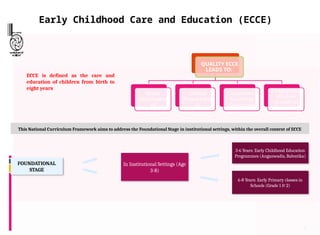
FOUNDATIONAL
STAGE
In Institutional Settings (Age
3-8)
3-6 Years: Early Childhood Education
Programmes (Anganwadis, Balvatika)
6-8 Years: Early Primary classes in
Schools (Grade 1 & 2)
QUALITY ECCE
LEADS TO:
Brain
Developme
nt
School
Preparedne
ss
Improved
Learning
Outcomes
Employabilit
yOverall
growth of
the country
ECCE is defined as the care and
education of children from birth to
eight years
This National Curriculum Framework aims to address the Foundational Stage in institutional settings, within the overall context of ECCE
Early Childhood Care and Education (ECCE)
Recommended Pedagogy
 The National Education Policy (NEP) 2020 recommends adoption of
experiential learning at all stages, including hands-on learning, arts-
integrated and sports-integrated education, story-telling-based
pedagogy, among others, as standard pedagogy within each subject,
and with explorations of relations among different subject areas.
 The NCFSE-2023 emphasis on experiential, activity-based, and
discussion-based learning, and analytical and creative thinking,
rather than on rote learning.
 Experience has an important place in the process of construction of
knowledge.
I hear and I forget, I see and I remember, I do and I understand.
Confucious, 450 BC
What is experiential Learning
• Experiential learning focuses on learning through experiences of
the learners.
• The experiences in this context include the experiences gained in
the life of the learners in the earlier events, the current/present
events in his/her lifetime and those experiences arising from the
learner’s participation in activities conducted by students and
teachers during the course of teaching learning processes.
(The activity perform in the class room)
• A key element of experiential learning is that learner analyse their
experience by reflecting, evaluating and reconstruction in order to
draw meaning from prior experience.
Implications on teaching learning
• Learning is a complex process and it occurs through various
exposures and not necessarily through a single exposure.
Teacher may craft an environment that is likely to help students
develop the idea.
•
• Therefore teachers’ understanding of learners’ experiences and
existing ideas are very important for designing teaching –
learning situations.
• Contextualisation of curriculum; learning in the context of the
learner (deep understanding of content, context and the
relationship between content and context)
Points to ponder
• Contextualisation requires that we have a deep understanding of the contexts as well
as the concepts and their interrelationships. Sometime it also require moving away
from disciplinary approach.
• The case for adopting a contextual is strong, but doing so is much more complex and
demanding on teachers’ knowledge and expertise than it may seem.
Contextualisation caged ?
• Given the backgrounds of students and teachers, as well as local factors, make the
needs of each school quite different.
• A single roadmap for implementing contextualisation is unlikely to exist.
HOW TO TEACH AND HELP LEARNING
 Foundational Stage :
 (For kids aged 3 to 8)
• Learning will focus on different areas: the body, emotions, thinking
skills, arts, words, and reading.
• Forming good habits for learning in future school years.
• Big emphasis on learning basic reading and Math skills.
• It will start with toys and fun activities, then move to books in
Grade 1.
• Stories and playing will be super important for learning.
• Children will learn through play with caring teachers.
• They will learn both by themselves and with friends, needing help
with reading and math.
• Teachers will observe and help children; sometimes, there will be
worksheets, but no big tests.
HOW TO TEACH AND HELP LEARNING
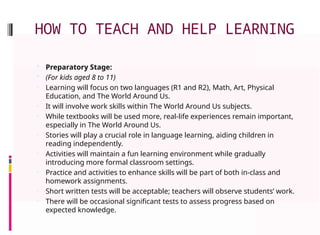
 Preparatory Stage:
 (For kids aged 8 to 11)
• Learning will focus on two languages (R1 and R2), Math, Art, Physical
Education, and The World Around Us.
• It will involve work skills within The World Around Us subjects.
• While textbooks will be used more, real-life experiences remain important,
especially in The World Around Us.
• Stories will play a crucial role in language learning, aiding children in
reading independently.
• Activities will maintain a fun learning environment while gradually
introducing more formal classroom settings.
• Practice and activities to enhance skills will be part of both in-class and
homework assignments.
• Short written tests will be acceptable; teachers will observe students’ work.
• There will be occasional significant tests to assess progress based on
expected knowledge.
HOW TO TEACH AND HELP LEARNING
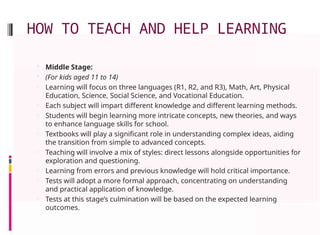
 Middle Stage:
 (For kids aged 11 to 14)
• Learning will focus on three languages (R1, R2, and R3), Math, Art, Physical
Education, Science, Social Science, and Vocational Education.
• Each subject will impart different knowledge and different learning methods.
• Students will begin learning more intricate concepts, new theories, and ways
to enhance language skills for school.
• Textbooks will play a significant role in understanding complex ideas, aiding
the transition from simple to advanced concepts.
• Teaching will involve a mix of styles: direct lessons alongside opportunities for
exploration and questioning.
• Learning from errors and previous knowledge will hold critical importance.
• Tests will adopt a more formal approach, concentrating on understanding
and practical application of knowledge.
• Tests at this stage’s culmination will be based on the expected learning
outcomes.
HOW TO TEACH AND HELP LEARNING
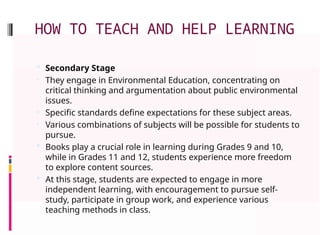
 Secondary Stage
• They engage in Environmental Education, concentrating on
critical thinking and argumentation about public environmental
issues.
• Specific standards define expectations for these subject areas.
• Various combinations of subjects will be possible for students to
pursue.
 Books play a crucial role in learning during Grades 9 and 10,
while in Grades 11 and 12, students experience more freedom
to explore content sources.
 At this stage, students are expected to engage in more
independent learning, with encouragement to pursue self-
study, participate in group work, and experience various
teaching methods in class.
Key elements that enable effective
pedagogy in the classroom
 Effective pedagogy for creating an inclusive and
holistic learning environment.
 Promote :
 active learning,
 student-centred teaching and
 collaborative learning.
 Needs Good planning and devoted
implementation of the plan.
Good planning
 Plan that keeps the students and learning at
the centre.
 Connects:
 - The students with the teacher
 The students with other students.
 The students with the concept gradually but clearly
 All the children with the activities.
 The lesson with the life.
 The class with happiness.
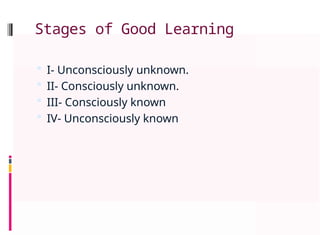
Stages of Good Learning
 I- Unconsciously unknown.
 II- Consciously unknown.
 III- Consciously known
 IV- Unconsciously known
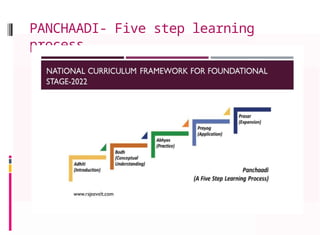
PANCHAADI- Five step learning
process
Adhiti (Introduction)
 As a first step, the Teacher introduces a new
concept/topic by establishing a connection with
the child’s prior knowledge. Children gather
relevant information regarding the new topic
with the help of the Teacher by asking
questions, exploring, and experimenting with
ideas and material.
Bodh (Conceptual Understanding)
 Children try to understand core concepts
through play, enquiry, experiments, discussion,
or reading in the second step. The Teacher
observes the process and guides the children.
The teaching plan has the list of concepts to be
learnt by the children.
Abhyas (Practice)
 The third step is about practice to strengthen
understanding and skills through a range of
interesting activities. Teachers can organize
group work or small projects to reinforce
conceptual understanding and attainment of
competencies.
 Importance of Homework
Prayog (Application)
 The fourth step is about applying the acquired
understanding in the child’s everyday life. This
can be accomplished through various activities
and small projects.
 Importance of Homework
Prasar (Expansion)
 The fifth step is about spreading the acquired
understanding through conversations with
friends, telling each other new stories, singing
new songs, reading new books together and
playing new games with each other. For each
and every new topic learnt, a neural pathway is
created in our brain. Sharing knowledge
strengthens our learning. A neural pathway is
incomplete if we don’t teach what we have
learnt. Teaching makes learning clear and long-
lasting.
Please read NCFFS/SE-2023
Thank you

NCF SE Presentation , national curriculum

  • 1.
  • 2.
    What does theNCFSE aim to achieve?  The overarching objective of this NCF is to help in positively transforming the school education system of India, through positive changes in the curriculum including pedagogy.  In particular, the NCF aims to help change practices in education and not just ideas; indeed, since the word ‘curriculum’ encapsulates the overall experiences that a student has in school, ‘practices’ do not just refer to curricular content and pedagogy, but also include school environment and culture.  It is this holistic overall transformation of the curriculum that will enable us to positively transform overall learning experiences for students.
  • 3.
    HOW DO CHILDRENGROW AND LEARN?  It’s simultaneous.  Physical growth- learning about the body  Mental growth- learning about mental abilities  Intellectual growth- Learn about using the mind to solve problems.  Social growth- Learn about living in a society  Emotional growth- Learn about bonds
  • 4.
    Major shifts recommendedby the NEP and NCFSE • A more multidisciplinary and holistic education. Holistic development of the child in all capacities – intellectual, social, physical, ethical, and emotions. The goal is to develop good human beings, capable of independent rational thought and action, with compassion and humaneness, with courage and creative imagination, based on sound ethical moorings and a rootedness in India. • An emphasis on experiential, activity-based, and discussion- based learning, and analytical and creative thinking, rather than on rote learning. • A new curricular/pedagogical structure (5+3+3+4). Curriculum and pedagogical approaches should be in line with the developmental stages of the child.
  • 5.
    Other Major shiftsrecommended by the NEP and NCF Other key shifts include: ►Ensuring high-quality early childhood care and education (ECCE) for all children; ►Emphasis on the mother tongue as the primary medium of instruction, particularly in the early years, along with high-quality teaching-learning of all languages; ►Emphasis on holistic education for all, including integration of vocational education, art education, and physical education in all stages of education; no more ‘hard separations’ or ‘streaming’; ►Reduction of content in each subject to the core essentials; ►Rootedness in India, including the integration of Indian Knowledge; ►Flexibility and choice for all students; ►Centrality of the role of the teacher, and the transformation of the teacher education system; and ►Equity and inclusion as a cornerstone.
  • 6.
    Structure of thisNCFSE-2023 This NCF is organised into five parts. Part A articulates the broad Aims of School Education, and the Values, Dispositions, Capacities, Skills, and Knowledge that are required to achieve these aims. It also describes principles and approaches for content selection, pedagogy, and assessment and gives the rationale and design principles for the four stages of schooling. Part B focuses on some of the important cross-cutting themes of the NCF, viz., rootedness in India, education for values, learning and caring about the environment, inclusive education, guidance and counselling, and use of educational technology in schools. Part C has separate chapters for each school subject. Each of these chapters have Learning Standards defined for all the relevant stages of schooling along with specific guidelines for content selection, pedagogy, and assessments appropriate for that subject. This part also has a chapter on the Foundational Stage and one on the range and design of subjects in Grades 11 and 12 Part D handles school culture and processes that enable a positive learning environment and inculcate desirable values and dispositions. Part E outlines the requirements for an overall ecosystem of schooling that would enable the achievement of the aims of the NCF. This includes aspects of Teacher capacities and service conditions, physical infrastructure requirements, and the role of the community and family.
  • 7.
    Key Principles ofPedagogy  Joyful Learning  Holistic Development  Inclusivity  Inter-disciplinary Learning  Competency based education  Use of technology  Effective assessment  Experiential learning
  • 8.
    8 FOUNDATIONAL STAGE In Institutional Settings(Age 3-8) 3-6 Years: Early Childhood Education Programmes (Anganwadis, Balvatika) 6-8 Years: Early Primary classes in Schools (Grade 1 & 2) QUALITY ECCE LEADS TO: Brain Developme nt School Preparedne ss Improved Learning Outcomes Employabilit yOverall growth of the country ECCE is defined as the care and education of children from birth to eight years This National Curriculum Framework aims to address the Foundational Stage in institutional settings, within the overall context of ECCE Early Childhood Care and Education (ECCE)
  • 12.
    Recommended Pedagogy  TheNational Education Policy (NEP) 2020 recommends adoption of experiential learning at all stages, including hands-on learning, arts- integrated and sports-integrated education, story-telling-based pedagogy, among others, as standard pedagogy within each subject, and with explorations of relations among different subject areas.  The NCFSE-2023 emphasis on experiential, activity-based, and discussion-based learning, and analytical and creative thinking, rather than on rote learning.  Experience has an important place in the process of construction of knowledge. I hear and I forget, I see and I remember, I do and I understand. Confucious, 450 BC
  • 13.
    What is experientialLearning • Experiential learning focuses on learning through experiences of the learners. • The experiences in this context include the experiences gained in the life of the learners in the earlier events, the current/present events in his/her lifetime and those experiences arising from the learner’s participation in activities conducted by students and teachers during the course of teaching learning processes. (The activity perform in the class room) • A key element of experiential learning is that learner analyse their experience by reflecting, evaluating and reconstruction in order to draw meaning from prior experience.
  • 14.
    Implications on teachinglearning • Learning is a complex process and it occurs through various exposures and not necessarily through a single exposure. Teacher may craft an environment that is likely to help students develop the idea. • • Therefore teachers’ understanding of learners’ experiences and existing ideas are very important for designing teaching – learning situations. • Contextualisation of curriculum; learning in the context of the learner (deep understanding of content, context and the relationship between content and context)
  • 15.
    Points to ponder •Contextualisation requires that we have a deep understanding of the contexts as well as the concepts and their interrelationships. Sometime it also require moving away from disciplinary approach. • The case for adopting a contextual is strong, but doing so is much more complex and demanding on teachers’ knowledge and expertise than it may seem. Contextualisation caged ? • Given the backgrounds of students and teachers, as well as local factors, make the needs of each school quite different. • A single roadmap for implementing contextualisation is unlikely to exist.
  • 16.
    HOW TO TEACHAND HELP LEARNING  Foundational Stage :  (For kids aged 3 to 8) • Learning will focus on different areas: the body, emotions, thinking skills, arts, words, and reading. • Forming good habits for learning in future school years. • Big emphasis on learning basic reading and Math skills. • It will start with toys and fun activities, then move to books in Grade 1. • Stories and playing will be super important for learning. • Children will learn through play with caring teachers. • They will learn both by themselves and with friends, needing help with reading and math. • Teachers will observe and help children; sometimes, there will be worksheets, but no big tests.
  • 17.
    HOW TO TEACHAND HELP LEARNING  Preparatory Stage:  (For kids aged 8 to 11) • Learning will focus on two languages (R1 and R2), Math, Art, Physical Education, and The World Around Us. • It will involve work skills within The World Around Us subjects. • While textbooks will be used more, real-life experiences remain important, especially in The World Around Us. • Stories will play a crucial role in language learning, aiding children in reading independently. • Activities will maintain a fun learning environment while gradually introducing more formal classroom settings. • Practice and activities to enhance skills will be part of both in-class and homework assignments. • Short written tests will be acceptable; teachers will observe students’ work. • There will be occasional significant tests to assess progress based on expected knowledge.
  • 18.
    HOW TO TEACHAND HELP LEARNING  Middle Stage:  (For kids aged 11 to 14) • Learning will focus on three languages (R1, R2, and R3), Math, Art, Physical Education, Science, Social Science, and Vocational Education. • Each subject will impart different knowledge and different learning methods. • Students will begin learning more intricate concepts, new theories, and ways to enhance language skills for school. • Textbooks will play a significant role in understanding complex ideas, aiding the transition from simple to advanced concepts. • Teaching will involve a mix of styles: direct lessons alongside opportunities for exploration and questioning. • Learning from errors and previous knowledge will hold critical importance. • Tests will adopt a more formal approach, concentrating on understanding and practical application of knowledge. • Tests at this stage’s culmination will be based on the expected learning outcomes.
  • 19.
    HOW TO TEACHAND HELP LEARNING  Secondary Stage • They engage in Environmental Education, concentrating on critical thinking and argumentation about public environmental issues. • Specific standards define expectations for these subject areas. • Various combinations of subjects will be possible for students to pursue.  Books play a crucial role in learning during Grades 9 and 10, while in Grades 11 and 12, students experience more freedom to explore content sources.  At this stage, students are expected to engage in more independent learning, with encouragement to pursue self- study, participate in group work, and experience various teaching methods in class.
  • 20.
    Key elements thatenable effective pedagogy in the classroom  Effective pedagogy for creating an inclusive and holistic learning environment.  Promote :  active learning,  student-centred teaching and  collaborative learning.  Needs Good planning and devoted implementation of the plan.
  • 21.
    Good planning  Planthat keeps the students and learning at the centre.  Connects:  - The students with the teacher  The students with other students.  The students with the concept gradually but clearly  All the children with the activities.  The lesson with the life.  The class with happiness.
  • 22.
    Stages of GoodLearning  I- Unconsciously unknown.  II- Consciously unknown.  III- Consciously known  IV- Unconsciously known
  • 23.
    PANCHAADI- Five steplearning process
  • 24.
    Adhiti (Introduction)  Asa first step, the Teacher introduces a new concept/topic by establishing a connection with the child’s prior knowledge. Children gather relevant information regarding the new topic with the help of the Teacher by asking questions, exploring, and experimenting with ideas and material.
  • 25.
    Bodh (Conceptual Understanding) Children try to understand core concepts through play, enquiry, experiments, discussion, or reading in the second step. The Teacher observes the process and guides the children. The teaching plan has the list of concepts to be learnt by the children.
  • 26.
    Abhyas (Practice)  Thethird step is about practice to strengthen understanding and skills through a range of interesting activities. Teachers can organize group work or small projects to reinforce conceptual understanding and attainment of competencies.  Importance of Homework
  • 27.
    Prayog (Application)  Thefourth step is about applying the acquired understanding in the child’s everyday life. This can be accomplished through various activities and small projects.  Importance of Homework
  • 28.
    Prasar (Expansion)  Thefifth step is about spreading the acquired understanding through conversations with friends, telling each other new stories, singing new songs, reading new books together and playing new games with each other. For each and every new topic learnt, a neural pathway is created in our brain. Sharing knowledge strengthens our learning. A neural pathway is incomplete if we don’t teach what we have learnt. Teaching makes learning clear and long- lasting.
  • 29.