Structural Approach
 Name : Parmar Krupa Jivabhai
 Roll no. : 20
 Enrolment no. : 2069108420180040
 M.A.Sem : 3
 Year : 2017-2019
 Email id : parmarkrupaj25@gmail.com
 Paper no. : 12
 Submitted to : Department of English Bhavnagar
What is Approach ?
An Approach is a set of correlative assumptions
dealing with the nature of language teaching
and learning . An approach is axiomatic .
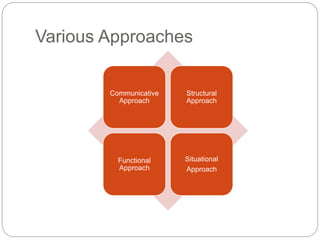
Various Approaches
Communicative
Approach
Structural
Approach
Functional
Approach
Situational
Approach
Meaning of Structural Approach...
 Teaching of English by helping the students to
learn certain structures of English as called the
structural approach.
 It is “ arrangement of words in such a way as to
form a suitable pattern”.
 That it’s main objective is to increase the students
command over the pattern of English and
enabling them to use the language more
effectively.
 It also known as ‘aural-oral approach’ as it stress
teaching language by giving opportunities to the
students to here and speak the language.
 For this structures are carefully selected and
suitably graded.
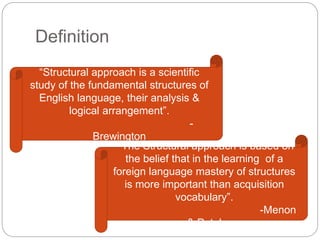
Definition
“Structural approach is a scientific
study of the fundamental structures of
English language, their analysis &
logical arrangement”.
-
Brewington
“The Structural approach is based on
the belief that in the learning of a
foreign language mastery of structures
is more important than acquisition
vocabulary”.
-Menon
& Patel
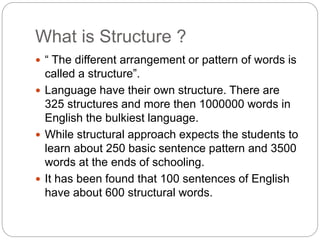
What is Structure ?
 “ The different arrangement or pattern of words is
called a structure”.
 Language have their own structure. There are
325 structures and more then 1000000 words in
English the bulkiest language.
 While structural approach expects the students to
learn about 250 basic sentence pattern and 3500
words at the ends of schooling.
 It has been found that 100 sentences of English
have about 600 structural words.
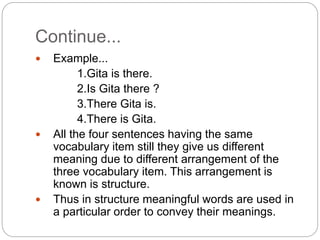
Continue...
 Example...
1.Gita is there.
2.Is Gita there ?
3.There Gita is.
4.There is Gita.
 All the four sentences having the same
vocabulary item still they give us different
meaning due to different arrangement of the
three vocabulary item. This arrangement is
known is structure.
 Thus in structure meaningful words are used in
a particular order to convey their meanings.
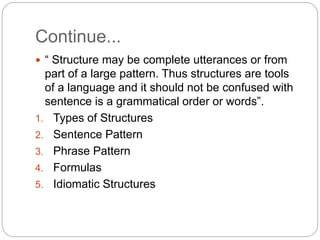
Continue...
 “ Structure may be complete utterances or from
part of a large pattern. Thus structures are tools
of a language and it should not be confused with
sentence is a grammatical order or words”.
1. Types of Structures
2. Sentence Pattern
3. Phrase Pattern
4. Formulas
5. Idiomatic Structures
Structural Approach
 “ The approach involve selection and gradation of
material to be taught”.
 Selection is there because the students are not
supposed to learn all the structure but they learn
only those structures which frequently comes.
 Thus based on usefulness & teachability.
Principles of Selection
1. Usefulness
2. Simplicity
3. Teachability
4. Productivity / Surrender Value
5. Area of difference
Gradation
 Gradation means Grading. Here Grading
structures means putting them in a suitable order.
 Here the purpose is to arrange according to their
usability & difficulty.
 Grading easier and most usable structure before
difficult & less usable ones.
Principles
 Speech is basis of acquiring other skills like
reading and writing . Thus speech is emphasized.
 Language habit formation is important : the
important of forming language habit, particularly
the habit of arranging words in English standard
sentence pattern to replace the sentences pattern
of learning of second language also becomes
natural.
 Activity base learning.
Characteristics
 It co-relate the teaching of grammar and
compositions with reading lesson. Thus grammar
is taught informally.
 The unit teaching is particular structure.
 Oral drill form a significant step of this approach.
 Meaningful situations are created by the teacher
with help of easily available teaching aids.
 It lays proper emphasis on aural – oral approach
method.
Merits
 Speech is emphasized.
 Habit formations is stressed.
 Carefully selected and graded structure /
language material.
 It creates interest and motivations in the pupils
through the use of selected and graded material .
 Language is taught in meaningful situations. This
approach is linked with the situations teaching.
Demerits
 A good plan fails without understanding of nature
of the language.
 Text books prescribed in course cannot be taught
through this approach.
 Not suitable for higher classes as they don’t like
repetition of structures.
 Knowledge of grammar cannot be obtained
through this approach as it touches only the
functional grammar.
Structural Approach

Structural Approach

  • 1.
    Structural Approach  Name: Parmar Krupa Jivabhai  Roll no. : 20  Enrolment no. : 2069108420180040  M.A.Sem : 3  Year : 2017-2019  Email id : parmarkrupaj25@gmail.com  Paper no. : 12  Submitted to : Department of English Bhavnagar
  • 2.
    What is Approach? An Approach is a set of correlative assumptions dealing with the nature of language teaching and learning . An approach is axiomatic .
  • 3.
  • 4.
    Meaning of StructuralApproach...  Teaching of English by helping the students to learn certain structures of English as called the structural approach.  It is “ arrangement of words in such a way as to form a suitable pattern”.  That it’s main objective is to increase the students command over the pattern of English and enabling them to use the language more effectively.  It also known as ‘aural-oral approach’ as it stress teaching language by giving opportunities to the students to here and speak the language.  For this structures are carefully selected and suitably graded.
  • 5.
    Definition “Structural approach isa scientific study of the fundamental structures of English language, their analysis & logical arrangement”. - Brewington “The Structural approach is based on the belief that in the learning of a foreign language mastery of structures is more important than acquisition vocabulary”. -Menon & Patel
  • 6.
    What is Structure?  “ The different arrangement or pattern of words is called a structure”.  Language have their own structure. There are 325 structures and more then 1000000 words in English the bulkiest language.  While structural approach expects the students to learn about 250 basic sentence pattern and 3500 words at the ends of schooling.  It has been found that 100 sentences of English have about 600 structural words.
  • 7.
    Continue...  Example... 1.Gita isthere. 2.Is Gita there ? 3.There Gita is. 4.There is Gita.  All the four sentences having the same vocabulary item still they give us different meaning due to different arrangement of the three vocabulary item. This arrangement is known is structure.  Thus in structure meaningful words are used in a particular order to convey their meanings.
  • 8.
    Continue...  “ Structuremay be complete utterances or from part of a large pattern. Thus structures are tools of a language and it should not be confused with sentence is a grammatical order or words”. 1. Types of Structures 2. Sentence Pattern 3. Phrase Pattern 4. Formulas 5. Idiomatic Structures
  • 9.
    Structural Approach  “The approach involve selection and gradation of material to be taught”.  Selection is there because the students are not supposed to learn all the structure but they learn only those structures which frequently comes.  Thus based on usefulness & teachability.
  • 10.
    Principles of Selection 1.Usefulness 2. Simplicity 3. Teachability 4. Productivity / Surrender Value 5. Area of difference
  • 11.
    Gradation  Gradation meansGrading. Here Grading structures means putting them in a suitable order.  Here the purpose is to arrange according to their usability & difficulty.  Grading easier and most usable structure before difficult & less usable ones.
  • 12.
    Principles  Speech isbasis of acquiring other skills like reading and writing . Thus speech is emphasized.  Language habit formation is important : the important of forming language habit, particularly the habit of arranging words in English standard sentence pattern to replace the sentences pattern of learning of second language also becomes natural.  Activity base learning.
  • 13.
    Characteristics  It co-relatethe teaching of grammar and compositions with reading lesson. Thus grammar is taught informally.  The unit teaching is particular structure.  Oral drill form a significant step of this approach.  Meaningful situations are created by the teacher with help of easily available teaching aids.  It lays proper emphasis on aural – oral approach method.
  • 14.
    Merits  Speech isemphasized.  Habit formations is stressed.  Carefully selected and graded structure / language material.  It creates interest and motivations in the pupils through the use of selected and graded material .  Language is taught in meaningful situations. This approach is linked with the situations teaching.
  • 15.
    Demerits  A goodplan fails without understanding of nature of the language.  Text books prescribed in course cannot be taught through this approach.  Not suitable for higher classes as they don’t like repetition of structures.  Knowledge of grammar cannot be obtained through this approach as it touches only the functional grammar.