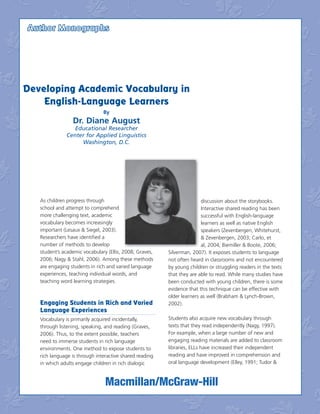
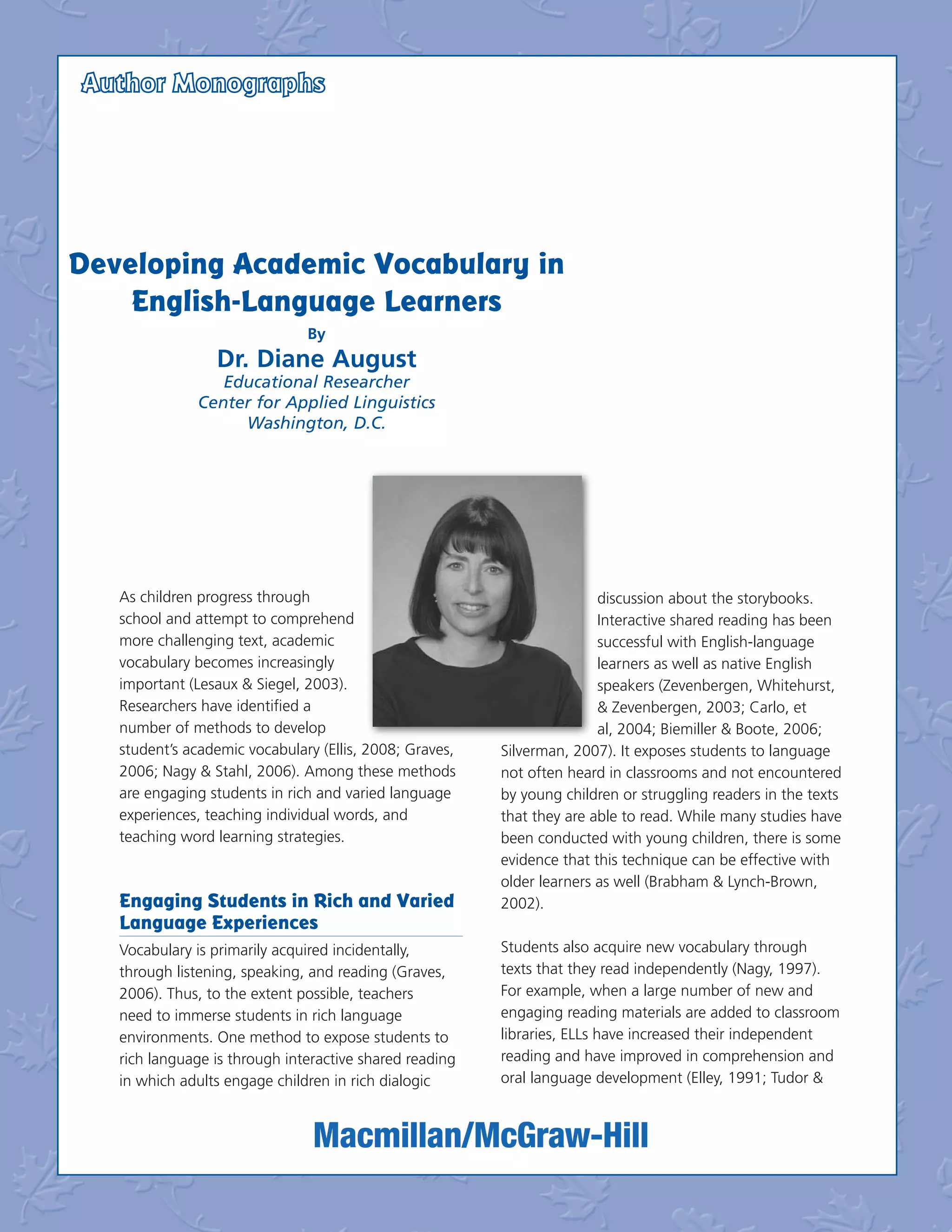
Developing Academic Vocabulary in
English-Language Learners
By
Dr. Diane August
Educational Researcher
Center for Applied Linguistics
Washington, D.C.
As children progress through
school and attempt to comprehend
more challenging text, academic
vocabulary becomes increasingly
important (Lesaux & Siegel, 2003).
Researchers have identified a
number of methods to develop
student’s academic vocabulary (Ellis, 2008; Graves,
2006; Nagy & Stahl, 2006). Among these methods
are engaging students in rich and varied language
experiences, teaching individual words, and
teaching word learning strategies.
Engaging Students in Rich and Varied
Language Experiences
Vocabulary is primarily acquired incidentally,
through listening, speaking, and reading (Graves,
2006). Thus, to the extent possible, teachers
need to immerse students in rich language
environments. One method to expose students to
rich language is through interactive shared reading
in which adults engage children in rich dialogic
discussion about the storybooks.
Interactive shared reading has been
successful with English-language
learners as well as native English
speakers (Zevenbergen, Whitehurst,
& Zevenbergen, 2003; Carlo, et
al, 2004; Biemiller & Boote, 2006;
Silverman, 2007). It exposes students to language
not often heard in classrooms and not encountered
by young children or struggling readers in the texts
that they are able to read. While many studies have
been conducted with young children, there is some
evidence that this technique can be effective with
older learners as well (Brabham & Lynch-Brown,
2002).
Students also acquire new vocabulary through
texts that they read independently (Nagy, 1997).
For example, when a large number of new and
engaging reading materials are added to classroom
libraries, ELLs have increased their independent
reading and have improved in comprehension and
oral language development (Elley, 1991; Tudor &
6648_Diane_August_4pg.indd 1 5/28/09 9:54:01 AM
Hafiz, 1989). Books for English-language learners
must be carefully selected to ensure texts are at the
highest grade-equivalent at which they can read
with high accuracy and comprehension. However,
as Laufer (2003) notes, structured support
for ELL students’ reading comprehension and
language development facilitates ELLs’ language
development to a greater degree than reading that
is not accompanied by these tasks. According to
Laufer, “ a word that is filled in a given sentence,
used in an original sentence or incorporated
into a composition has a better chance of being
remembered than a word seen in a text, even when
it is looked up in a dictionary” (Laufer, 2001, p. 10).
Teaching Individual Words
A second method of developing
academic vocabulary is through
teaching individual words. General
guidelines for teaching individuals
words call for “including both
definitional and contextual
information, involving students
in active and deep processing of
the words, providing students
with multiple exposures to the
word, reviewing, rehearsing, and
reminding students about the
word in various contexts over time,
involving students in discussions
of the word’s meaning, and spending a significant
amount of time on the word” (Graves, 2006, p 69-
70).
Several methods have been used to teach individual
words in the context of shared interactive reading.
In one method, teachers provide embedded
explanations of target words when they are
encountered during the story reading; in another
method—extended vocabulary instruction—there
is “explicit teaching that includes both contextual
and definitional information, multiple exposures to
target words in varied contexts, and experiences
that promote deep processing of word meanings”
(Coyne, McCoach, & Kapp 2007, p. 74; Silverman,
2007).
Teaching Word-Learning Strategies
A third method of building academic vocabulary is
to teach word-learning strategies. Well researched
word-learning strategies used with first language
learners include using context clues, using word
parts, and using dictionaries (Graves, 2006). There
is a substantial body of first-language research
that supports two approaches to teaching word-
learning strategies that are particularly effective
when used together (Graves, 2006, p 90-93). In
the first, direct explanation of strategies, teachers
first explain the strategy, note its importance, and
model its use and then gradually
give students responsibility for
employing it. In the second,
transactional strategies instruction,
there is some direct explanation
as part of the initial instruction;
however, this tends to be brief
and less structured than direct
explanation and carried out as part
of the ongoing reading activities of
the classroom when the occasion
arises for students to use a
particular strategy.
Modifications for English-Language
Learners
While these instructional methods build on first
language research, in some cases they have been
modified for English-language learners. With
regard to interactive shared reading and teaching
individual words, modifications include using
English-as-a-second-language techniques such
as providing additional background information;
scaffolding through the use of visuals, gestures,
and body language by both teachers and students
to demonstrate meaning; asking more literal,
“Interactive shared
reading exposes students
to language not often
heard in classrooms
and not encountered
by young children or
struggling readers in the
texts that they are able
to read.”
D E V E L O P I N G A C A D E M I C V O C A B U L A R Y I N E N G L I S H - L A N G U A G E L E A R N E R S
6648_Diane_August_4pg.indd 2 5/28/09 9:54:02 AM
inferential, and critical questions at strategically
selected intervals than are generally used with
first-language learners; providing reinforcement,
such as choral repetition of selected words and
phrases, repeated exposures to words and concepts
through re-readings and glossaries; and brief
summaries after reading challenging passages
(August & Shanahan, 2006). Other adjustments
include selecting materials relevant to ELL’s
experience or culture; strategically using students’
first languages to make the content delivered in a
second language more comprehensible (Carlo, et
al., 2004); teaching word learning strategies that
build on first language knowledge such as using
cognates; and frequently using partner talk to give
low-English-proficient students more opportunities
to talk with more English-proficient peers.
References
August, D. & Shanahan, T. (Eds.) (2006).
Developing Literacy in Second-language
Learners: Report of the National Literacy Panel
on Language Minority Children and Youth.
Mahway, NJ: Lawrence Erlbaum Associates.
Biemiller, A. & Boote, C. (2006). An effective
method for building vocabulary in primary
grades. Journal of Educational Psychology, 98
(1).
Brabham, E. G., & Lynch-Brown, C. (2002). Effects
of teachers’ reading aloud styles on vocabulary
acquisition and comprehension of students
in the early elementary grades. Journal of
Educational Psychology, 94.
Carlo, M. S., August, D., McLaughlin, B., Snow, C.
E., Dressler, C., Lippman, D., Lively, T., & White,
C. (2004). Closing the gap: Addressing the
vocabulary needs of English language learners
in bilingual and mainstream classrooms.
Reading Research Quarterly, 39(2).
Coyne, M., McCoach, B., & Knapp, S. (2007).
Vocabulary intervention for kindergarten
students: comparing extended instruction to
embedded instruction and incidental exposure.
Learbubg Disability Quarterly, 30, 74.
Elley, W. B. (1991). Acquiring literacy in a second
language: The effect of book-based programs.
Language Learning, 41(3).
Ellis, N. (2008). Phraseology: The periphery and
the heart of language. Phraseology in foreign
language learning and teaching. Philadelphia:
John Benjamins Publishing Company.
Graves, M. F. (2006). The vocabulary book. New
York, NY: Teacher’s College Press.
Graves, M. (2006). The Vocabulary Book: Learning
and Instruction. Newark, DE: International
Reading Association, 69-70, 90-93.
Laufer, B. (2001). Vocabulary acquisition in a
second language: Do learners really acquire
most vocabulary by reading? Paper presented
at an Invited Symposium on Reading at the
meeting of the American Association for
Applied Linguistics, St Louis, MO.
Laufer, B. (2003). Vocabulary acquisition in a
second language: Do learners really acquire
most vocabulary by reading? Some empirical
evidence. The Canadian Modern Language
Review, 59(4).
Lesaux, N.K, & Siegel, L.S. (2003). The development
of reading in children who speak English
as a second language (ESL). Developmental
Psychology, 39(6).
Nagy, W. E., & Stahl, S. A. (2006). Teaching word
meanings. Mahwah, NJ: Lawrence Erlbaum
Associates.
D E V E L O P I N G A C A D E M I C V O C A B U L A R Y I N E N G L I S H - L A N G U A G E L E A R N E R S
6648_Diane_August_4pg.indd 3 5/28/09 9:54:03 AM
Saunders, W. M., & Goldenberg, C. (1999). Effects
of instructional conversations and literature
logs on limited- and fluent-English proficient
students’ story comprehension and thematic
understanding. Elementary School Journal,
99(4).
Silverman, R. (2007a). Vocabulary development
of English-language and English-only learners
in kindergarten. Elementary School Journal,
107(4).
Silverman, R. (2007b). A comparison of three
methods of vocabulary instruction during read-
alouds in kindergarten. Elementary School
Journal 108(2).
Tudor, I., & Hafiz, F. (1989). Extensive reading as
a means of input to L2 learning. Journal of
Research in Reading, 12(2).
Zevenbergen, A. A., Whitehurst, G. J., &
Zevenbergen, J. A. (2003). Effects of a shared-
reading intervention on the inclusion of
evaluative devices in narratives of children
from low-income families. Journal of Applied
Developmental Psychology, 24.
RD 09 W 6648
10M 5/09
D E V E L O P I N G A C A D E M I C V O C A B U L A R Y I N E N G L I S H - L A N G U A G E L E A R N E R S
6648_Diane_August_4pg.indd 4 5/28/09 9:54:04 AM

Developing academic vocabulary in ELLs

  • 1.
    Developing Academic Vocabularyin English-Language Learners By Dr. Diane August Educational Researcher Center for Applied Linguistics Washington, D.C. As children progress through school and attempt to comprehend more challenging text, academic vocabulary becomes increasingly important (Lesaux & Siegel, 2003). Researchers have identified a number of methods to develop student’s academic vocabulary (Ellis, 2008; Graves, 2006; Nagy & Stahl, 2006). Among these methods are engaging students in rich and varied language experiences, teaching individual words, and teaching word learning strategies. Engaging Students in Rich and Varied Language Experiences Vocabulary is primarily acquired incidentally, through listening, speaking, and reading (Graves, 2006). Thus, to the extent possible, teachers need to immerse students in rich language environments. One method to expose students to rich language is through interactive shared reading in which adults engage children in rich dialogic discussion about the storybooks. Interactive shared reading has been successful with English-language learners as well as native English speakers (Zevenbergen, Whitehurst, & Zevenbergen, 2003; Carlo, et al, 2004; Biemiller & Boote, 2006; Silverman, 2007). It exposes students to language not often heard in classrooms and not encountered by young children or struggling readers in the texts that they are able to read. While many studies have been conducted with young children, there is some evidence that this technique can be effective with older learners as well (Brabham & Lynch-Brown, 2002). Students also acquire new vocabulary through texts that they read independently (Nagy, 1997). For example, when a large number of new and engaging reading materials are added to classroom libraries, ELLs have increased their independent reading and have improved in comprehension and oral language development (Elley, 1991; Tudor & 6648_Diane_August_4pg.indd 1 5/28/09 9:54:01 AM
  • 2.
    Hafiz, 1989). Booksfor English-language learners must be carefully selected to ensure texts are at the highest grade-equivalent at which they can read with high accuracy and comprehension. However, as Laufer (2003) notes, structured support for ELL students’ reading comprehension and language development facilitates ELLs’ language development to a greater degree than reading that is not accompanied by these tasks. According to Laufer, “ a word that is filled in a given sentence, used in an original sentence or incorporated into a composition has a better chance of being remembered than a word seen in a text, even when it is looked up in a dictionary” (Laufer, 2001, p. 10). Teaching Individual Words A second method of developing academic vocabulary is through teaching individual words. General guidelines for teaching individuals words call for “including both definitional and contextual information, involving students in active and deep processing of the words, providing students with multiple exposures to the word, reviewing, rehearsing, and reminding students about the word in various contexts over time, involving students in discussions of the word’s meaning, and spending a significant amount of time on the word” (Graves, 2006, p 69- 70). Several methods have been used to teach individual words in the context of shared interactive reading. In one method, teachers provide embedded explanations of target words when they are encountered during the story reading; in another method—extended vocabulary instruction—there is “explicit teaching that includes both contextual and definitional information, multiple exposures to target words in varied contexts, and experiences that promote deep processing of word meanings” (Coyne, McCoach, & Kapp 2007, p. 74; Silverman, 2007). Teaching Word-Learning Strategies A third method of building academic vocabulary is to teach word-learning strategies. Well researched word-learning strategies used with first language learners include using context clues, using word parts, and using dictionaries (Graves, 2006). There is a substantial body of first-language research that supports two approaches to teaching word- learning strategies that are particularly effective when used together (Graves, 2006, p 90-93). In the first, direct explanation of strategies, teachers first explain the strategy, note its importance, and model its use and then gradually give students responsibility for employing it. In the second, transactional strategies instruction, there is some direct explanation as part of the initial instruction; however, this tends to be brief and less structured than direct explanation and carried out as part of the ongoing reading activities of the classroom when the occasion arises for students to use a particular strategy. Modifications for English-Language Learners While these instructional methods build on first language research, in some cases they have been modified for English-language learners. With regard to interactive shared reading and teaching individual words, modifications include using English-as-a-second-language techniques such as providing additional background information; scaffolding through the use of visuals, gestures, and body language by both teachers and students to demonstrate meaning; asking more literal, “Interactive shared reading exposes students to language not often heard in classrooms and not encountered by young children or struggling readers in the texts that they are able to read.” D E V E L O P I N G A C A D E M I C V O C A B U L A R Y I N E N G L I S H - L A N G U A G E L E A R N E R S 6648_Diane_August_4pg.indd 2 5/28/09 9:54:02 AM
  • 3.
    inferential, and criticalquestions at strategically selected intervals than are generally used with first-language learners; providing reinforcement, such as choral repetition of selected words and phrases, repeated exposures to words and concepts through re-readings and glossaries; and brief summaries after reading challenging passages (August & Shanahan, 2006). Other adjustments include selecting materials relevant to ELL’s experience or culture; strategically using students’ first languages to make the content delivered in a second language more comprehensible (Carlo, et al., 2004); teaching word learning strategies that build on first language knowledge such as using cognates; and frequently using partner talk to give low-English-proficient students more opportunities to talk with more English-proficient peers. References August, D. & Shanahan, T. (Eds.) (2006). Developing Literacy in Second-language Learners: Report of the National Literacy Panel on Language Minority Children and Youth. Mahway, NJ: Lawrence Erlbaum Associates. Biemiller, A. & Boote, C. (2006). An effective method for building vocabulary in primary grades. Journal of Educational Psychology, 98 (1). Brabham, E. G., & Lynch-Brown, C. (2002). Effects of teachers’ reading aloud styles on vocabulary acquisition and comprehension of students in the early elementary grades. Journal of Educational Psychology, 94. Carlo, M. S., August, D., McLaughlin, B., Snow, C. E., Dressler, C., Lippman, D., Lively, T., & White, C. (2004). Closing the gap: Addressing the vocabulary needs of English language learners in bilingual and mainstream classrooms. Reading Research Quarterly, 39(2). Coyne, M., McCoach, B., & Knapp, S. (2007). Vocabulary intervention for kindergarten students: comparing extended instruction to embedded instruction and incidental exposure. Learbubg Disability Quarterly, 30, 74. Elley, W. B. (1991). Acquiring literacy in a second language: The effect of book-based programs. Language Learning, 41(3). Ellis, N. (2008). Phraseology: The periphery and the heart of language. Phraseology in foreign language learning and teaching. Philadelphia: John Benjamins Publishing Company. Graves, M. F. (2006). The vocabulary book. New York, NY: Teacher’s College Press. Graves, M. (2006). The Vocabulary Book: Learning and Instruction. Newark, DE: International Reading Association, 69-70, 90-93. Laufer, B. (2001). Vocabulary acquisition in a second language: Do learners really acquire most vocabulary by reading? Paper presented at an Invited Symposium on Reading at the meeting of the American Association for Applied Linguistics, St Louis, MO. Laufer, B. (2003). Vocabulary acquisition in a second language: Do learners really acquire most vocabulary by reading? Some empirical evidence. The Canadian Modern Language Review, 59(4). Lesaux, N.K, & Siegel, L.S. (2003). The development of reading in children who speak English as a second language (ESL). Developmental Psychology, 39(6). Nagy, W. E., & Stahl, S. A. (2006). Teaching word meanings. Mahwah, NJ: Lawrence Erlbaum Associates. D E V E L O P I N G A C A D E M I C V O C A B U L A R Y I N E N G L I S H - L A N G U A G E L E A R N E R S 6648_Diane_August_4pg.indd 3 5/28/09 9:54:03 AM
  • 4.
    Saunders, W. M.,& Goldenberg, C. (1999). Effects of instructional conversations and literature logs on limited- and fluent-English proficient students’ story comprehension and thematic understanding. Elementary School Journal, 99(4). Silverman, R. (2007a). Vocabulary development of English-language and English-only learners in kindergarten. Elementary School Journal, 107(4). Silverman, R. (2007b). A comparison of three methods of vocabulary instruction during read- alouds in kindergarten. Elementary School Journal 108(2). Tudor, I., & Hafiz, F. (1989). Extensive reading as a means of input to L2 learning. Journal of Research in Reading, 12(2). Zevenbergen, A. A., Whitehurst, G. J., & Zevenbergen, J. A. (2003). Effects of a shared- reading intervention on the inclusion of evaluative devices in narratives of children from low-income families. Journal of Applied Developmental Psychology, 24. RD 09 W 6648 10M 5/09 D E V E L O P I N G A C A D E M I C V O C A B U L A R Y I N E N G L I S H - L A N G U A G E L E A R N E R S 6648_Diane_August_4pg.indd 4 5/28/09 9:54:04 AM