
Language Policy: Pre and Post
Independent India
Dr.C.Thanavathi
Introduction
Diversity in the area of culture, religion, ethnic
and language is the most characteristic trait if India.
It is a home of varying cultures, ethnics and religions.
There is a saying that languages in India changes in
every 60 to 80 kilometers.
Reasons
India was ruled by Arabs, Persian, Turks
and Aftans.
British ruled India for almost 200 years.
These historical developments have added to
the diversity of India in all areas.
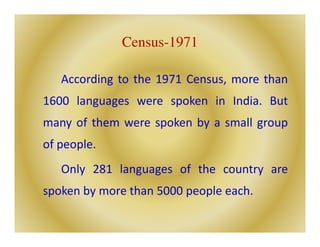
Census-1971
According to the 1971 Census, more than
1600 languages were spoken in India. But
many of them were spoken by a small group
of people.
Only 281 languages of the country are
spoken by more than 5000 people each.
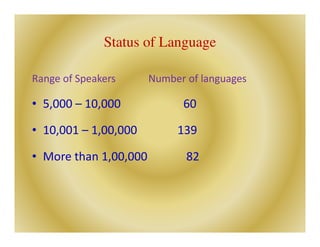
Status of Language
Range of Speakers Number of languages
• 5,000 – 10,000 60
• 10,001 – 1,00,000 139
• More than 1,00,000 82
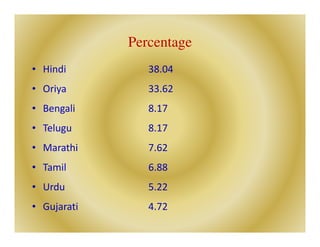
Percentage
• Hindi 38.04
• Oriya 33.62
• Bengali 8.17
• Telugu 8.17
• Marathi 7.62
• Tamil 6.88
• Urdu 5.22
• Gujarati 4.72
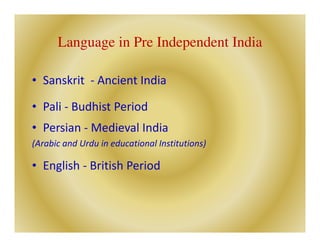
Language in Pre Independent India
• Sanskrit - Ancient India
• Pali - Budhist Period
• Persian - Medieval India
(Arabic and Urdu in educational Institutions)
• English - British Period
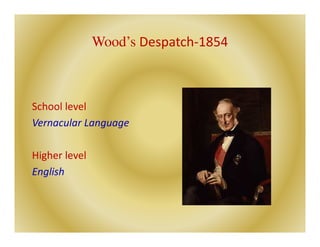
Wood’s Despatch-1854
School level
Vernacular Language
Higher level
English
Indian Education Commission
Hunter Commission-1882
Primary and School Level
Mother Tongue
Medium of Instruction
Wardha Scheme of Education
Medium of Instruction
Mother Tongue
cÉáà ÇwxÑxÇwxÇà _tÇzâtzx cÉÄ|vç
Ç Çw|t
Indian Constitution
Articles 343–351 of Part XVII and the 8th
Schedule of the Constitution of India deal with issues
of the languages of the country.
The official language of the Union shall be Hindi.
English can be used for all official purposes as a
language of vital opportunities and international
contact.
Official Language
Official communication between States
and Union should be in the Official language
of the Union i.e. Hindi.
English can be used for all legal purposes
eg. For bills, procedures of court etc.
State Responsibility
State should provide adequate facilities for
instruction in the mother-tongue at the
primary stage of education.
State should take necessary steps to
promote and spread Hindi as a national link
language.
Muthaliyar Commission-1952
Muthaliyar Commission, recommended
Three Language Formula which stated that
mother tongue should be taught at primary
stage and English and Hindi should be
introduced later.
Kothari Commission-1966
Kothari Commission put forth a revised or
modified Three Language Formula which
stated that along with Mother tongue English
and Hindi should be taught at non-Hindi states
while instead of Hindi, any other modern
South Indian language should be taught at
Hindi speaking states
Three Language Formula
The Congress Party the leader of National
Movement in India drew attention to languages of the
Indians as a sign of national identity. The leaders of
National Movement were very sensitive about using an
indigenous language.
Hindi as official language at the Union level and the
state level and the state level states own languages.
English was going to be eliminated by
replacing Hindi in fifteen year from 1950 but as
we see, as a result of opposition to Hindi, English
stayed as a de facto official language in India.
Three-language formula was suggested by the
Central Advisory Board of Education in 1956 and
approved by the Conference of Chief Ministers in
1961.
Language policy pre and post independent India

Language policy pre and post independent India

  • 1.
    Language Policy: Preand Post Independent India Dr.C.Thanavathi
  • 3.
    Introduction Diversity in thearea of culture, religion, ethnic and language is the most characteristic trait if India. It is a home of varying cultures, ethnics and religions. There is a saying that languages in India changes in every 60 to 80 kilometers.
  • 4.
    Reasons India was ruledby Arabs, Persian, Turks and Aftans. British ruled India for almost 200 years. These historical developments have added to the diversity of India in all areas.
  • 5.
    Census-1971 According to the1971 Census, more than 1600 languages were spoken in India. But many of them were spoken by a small group of people. Only 281 languages of the country are spoken by more than 5000 people each.
  • 6.
    Status of Language Rangeof Speakers Number of languages • 5,000 – 10,000 60 • 10,001 – 1,00,000 139 • More than 1,00,000 82
  • 7.
    Percentage • Hindi 38.04 •Oriya 33.62 • Bengali 8.17 • Telugu 8.17 • Marathi 7.62 • Tamil 6.88 • Urdu 5.22 • Gujarati 4.72
  • 8.
    Language in PreIndependent India • Sanskrit - Ancient India • Pali - Budhist Period • Persian - Medieval India (Arabic and Urdu in educational Institutions) • English - British Period
  • 10.
  • 11.
    Indian Education Commission HunterCommission-1882 Primary and School Level Mother Tongue Medium of Instruction
  • 12.
    Wardha Scheme ofEducation Medium of Instruction Mother Tongue
  • 13.
  • 14.
    Indian Constitution Articles 343–351of Part XVII and the 8th Schedule of the Constitution of India deal with issues of the languages of the country. The official language of the Union shall be Hindi. English can be used for all official purposes as a language of vital opportunities and international contact.
  • 15.
    Official Language Official communicationbetween States and Union should be in the Official language of the Union i.e. Hindi. English can be used for all legal purposes eg. For bills, procedures of court etc.
  • 16.
    State Responsibility State shouldprovide adequate facilities for instruction in the mother-tongue at the primary stage of education. State should take necessary steps to promote and spread Hindi as a national link language.
  • 17.
    Muthaliyar Commission-1952 Muthaliyar Commission,recommended Three Language Formula which stated that mother tongue should be taught at primary stage and English and Hindi should be introduced later.
  • 18.
    Kothari Commission-1966 Kothari Commissionput forth a revised or modified Three Language Formula which stated that along with Mother tongue English and Hindi should be taught at non-Hindi states while instead of Hindi, any other modern South Indian language should be taught at Hindi speaking states
  • 19.
    Three Language Formula TheCongress Party the leader of National Movement in India drew attention to languages of the Indians as a sign of national identity. The leaders of National Movement were very sensitive about using an indigenous language. Hindi as official language at the Union level and the state level and the state level states own languages.
  • 20.
    English was goingto be eliminated by replacing Hindi in fifteen year from 1950 but as we see, as a result of opposition to Hindi, English stayed as a de facto official language in India. Three-language formula was suggested by the Central Advisory Board of Education in 1956 and approved by the Conference of Chief Ministers in 1961.