DIFFERENTIAL PULSE-
CODE MODULATION
(DPCM)
https://sites.google.com/view/arvindk
Cont’d
Dr.Arvind Kumar 2
Differential pulse-code modulation
(DPCM)
• Exploits the use of lossy data compression to remove the redundancy inherent in a
message signal, such as voice or video, so as to reduce the bit rate of the
transmitted data without serious degradation.
• In effect, increased system complexity is traded off for reduced bit rate,
therefore reducing the bandwidth requirement of PCM.
Dr.Arvind Kumar 3
DPCM…
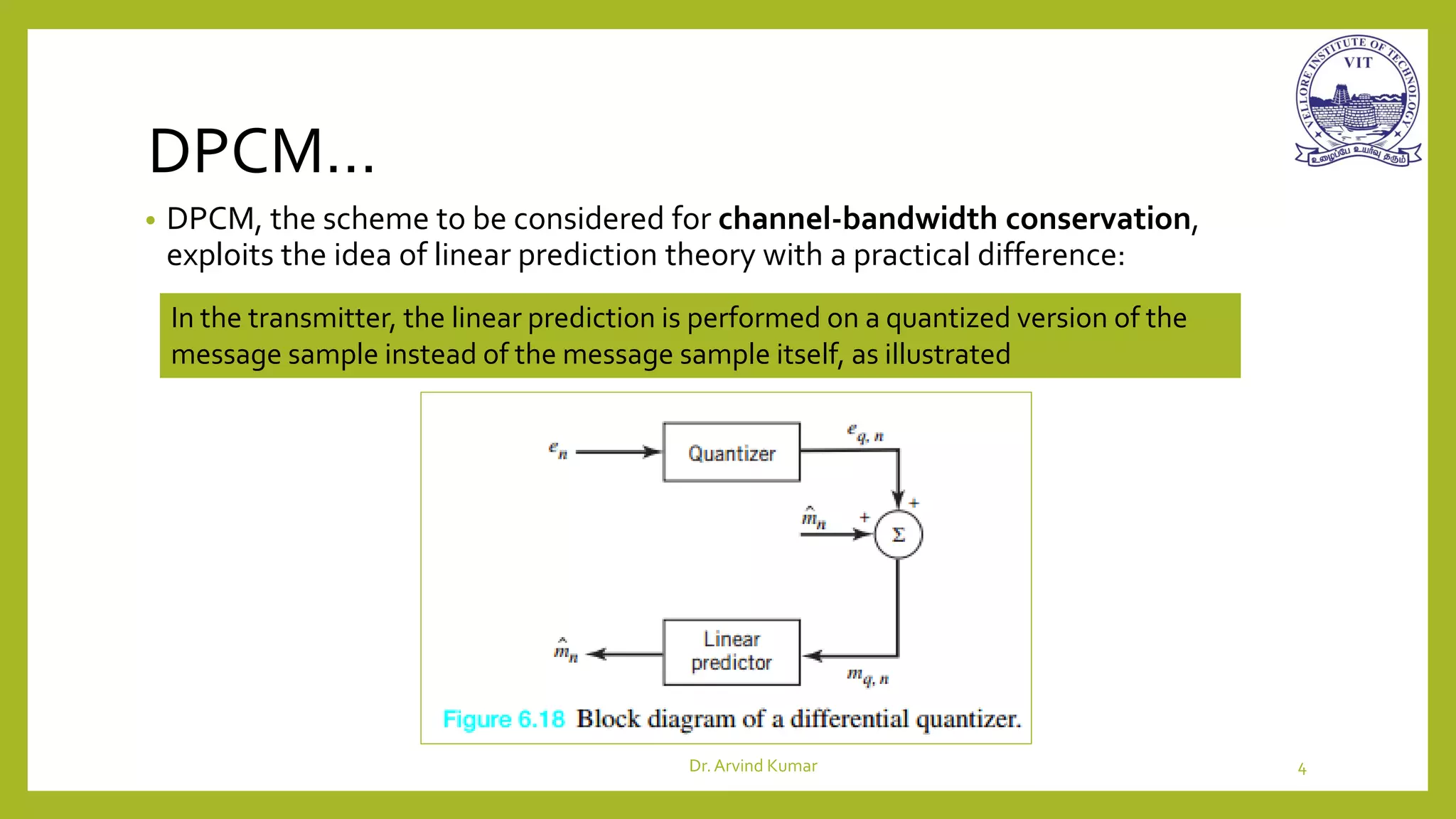
• DPCM, the scheme to be considered for channel-bandwidth conservation,
exploits the idea of linear prediction theory with a practical difference:
Dr.Arvind Kumar 4
In the transmitter, the linear prediction is performed on a quantized version of the
message sample instead of the message sample itself, as illustrated
DPCM…
• The resulting process is referred to as differential quantization.
• The motivation behind the use of differential quantization follows from two
practical considerations:
• In order to cater to both requirements in such a way that the same structure is
used for predictors in both the transmitter and the receiver.
• The transmitter has to perform prediction error filtering on the quantized version
of the message signal rather than the signal itself,
Dr.Arvind Kumar 5
1. Waveform encoding in the transmitter requires the use of quantization.
2. Waveform decoding in the receiver, therefore, has to process a quantized signal.
Dr.Arvind Kumar 6
Dr.Arvind Kumar 7
DPCMTransmitter
Dr.Arvind Kumar 8
DPCM Receiver
Dr.Arvind Kumar 9
From the foregoing analysis, we thus observe that, in a noise-free environment, the linear predictors in the
transmitter and receiver of DPCM operate on the same sequence of samples, mq,n
It is with this point in mind that a feedback path is appended to the quantizer in the transmitter
DELTA MODULATION
(NEXT)
https://sites.google.com/view/arvindk

Dpcm

  • 1.
  • 2.
  • 3.
    Differential pulse-code modulation (DPCM) •Exploits the use of lossy data compression to remove the redundancy inherent in a message signal, such as voice or video, so as to reduce the bit rate of the transmitted data without serious degradation. • In effect, increased system complexity is traded off for reduced bit rate, therefore reducing the bandwidth requirement of PCM. Dr.Arvind Kumar 3
  • 4.
    DPCM… • DPCM, thescheme to be considered for channel-bandwidth conservation, exploits the idea of linear prediction theory with a practical difference: Dr.Arvind Kumar 4 In the transmitter, the linear prediction is performed on a quantized version of the message sample instead of the message sample itself, as illustrated
  • 5.
    DPCM… • The resultingprocess is referred to as differential quantization. • The motivation behind the use of differential quantization follows from two practical considerations: • In order to cater to both requirements in such a way that the same structure is used for predictors in both the transmitter and the receiver. • The transmitter has to perform prediction error filtering on the quantized version of the message signal rather than the signal itself, Dr.Arvind Kumar 5 1. Waveform encoding in the transmitter requires the use of quantization. 2. Waveform decoding in the receiver, therefore, has to process a quantized signal.
  • 6.
  • 7.
  • 8.
  • 9.
    DPCM Receiver Dr.Arvind Kumar9 From the foregoing analysis, we thus observe that, in a noise-free environment, the linear predictors in the transmitter and receiver of DPCM operate on the same sequence of samples, mq,n It is with this point in mind that a feedback path is appended to the quantizer in the transmitter
  • 10.