Audit risk refers to the risk that an auditor may
unknowingly issue an incorrect opinion on the financial
statements. This can happen if the financial statements
are materially misstated, and the auditor either fails to
detect the misstatement or incorrectly concludes that
the financial statements are free of material errors.
Audit risk is made up of three components:
1.Inherent Risk (IR):
a. The likelihood that a material misstatement will occur in the financial statements
due to the nature of the business, the complexity of transactions, or the industry.
It assumes no related internal controls are in place.
b. For example, companies with complex financial instruments or in high-risk
industries have higher inherent risk.
2.Control Risk (CR):
a. The risk that the company's internal controls will not prevent or detect a material
misstatement. Even if good controls are in place, there’s always a chance they
could fail.
b. For example, weak internal controls increase control risk.
3.Detection Risk (DR):
a. The risk that the audit procedures will not detect a material misstatement. This is
the part of audit risk directly linked to the auditor's work.
b. Auditors can reduce detection risk by increasing the size of sample testing or
using more reliable audit procedures.
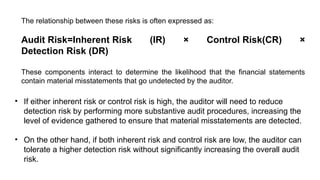
The relationship between these risks is often expressed as:
Audit Risk=Inherent Risk (IR) × Control Risk(CR) ×
Detection Risk (DR)
These components interact to determine the likelihood that the financial statements
contain material misstatements that go undetected by the auditor.
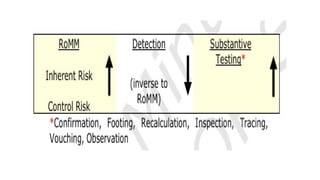
• If either inherent risk or control risk is high, the auditor will need to reduce
detection risk by performing more substantive audit procedures, increasing the
level of evidence gathered to ensure that material misstatements are detected.
• On the other hand, if both inherent risk and control risk are low, the auditor can
tolerate a higher detection risk without significantly increasing the overall audit
risk.
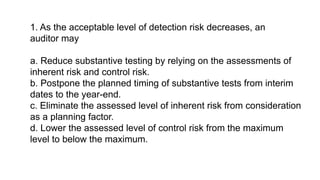
1. As the acceptable level of detection risk decreases, an
auditor may
a. Reduce substantive testing by relying on the assessments of
inherent risk and control risk.
b. Postpone the planned timing of substantive tests from interim
dates to the year-end.
c. Eliminate the assessed level of inherent risk from consideration
as a planning factor.
d. Lower the assessed level of control risk from the maximum
level to below the maximum.
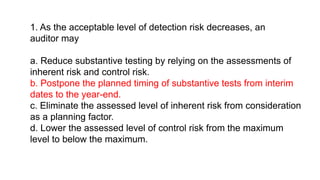
1. As the acceptable level of detection risk decreases, an
auditor may
a. Reduce substantive testing by relying on the assessments of
inherent risk and control risk.
b. Postpone the planned timing of substantive tests from interim
dates to the year-end.
c. Eliminate the assessed level of inherent risk from consideration
as a planning factor.
d. Lower the assessed level of control risk from the maximum
level to below the maximum.
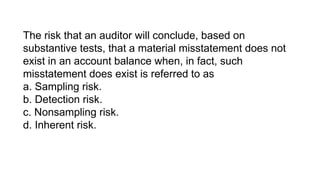
The risk that an auditor will conclude, based on
substantive tests, that a material misstatement does not
exist in an account balance when, in fact, such
misstatement does exist is referred to as
a. Sampling risk.
b. Detection risk.
c. Nonsampling risk.
d. Inherent risk.
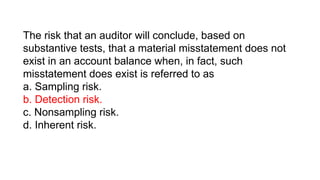
The risk that an auditor will conclude, based on
substantive tests, that a material misstatement does not
exist in an account balance when, in fact, such
misstatement does exist is referred to as
a. Sampling risk.
b. Detection risk.
c. Nonsampling risk.
d. Inherent risk.
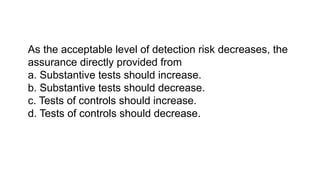
As the acceptable level of detection risk decreases, the
assurance directly provided from
a. Substantive tests should increase.
b. Substantive tests should decrease.
c. Tests of controls should increase.
d. Tests of controls should decrease.
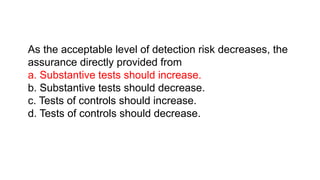
As the acceptable level of detection risk decreases, the
assurance directly provided from
a. Substantive tests should increase.
b. Substantive tests should decrease.
c. Tests of controls should increase.
d. Tests of controls should decrease.
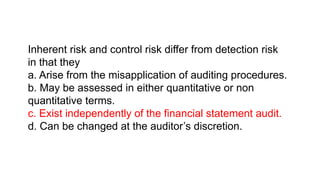
Inherent risk and control risk differ from detection risk
in that they
a. Arise from the misapplication of auditing procedures.
b. May be assessed in either quantitative or non
quantitative terms.
c. Exist independently of the financial statement audit.
d. Can be changed at the auditor’s discretion.
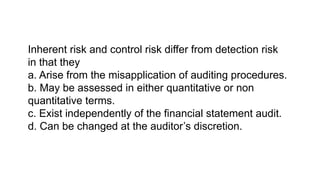
Inherent risk and control risk differ from detection risk
in that they
a. Arise from the misapplication of auditing procedures.
b. May be assessed in either quantitative or non
quantitative terms.
c. Exist independently of the financial statement audit.
d. Can be changed at the auditor’s discretion.
Inherent risk and control risk differ from detection risk
in that they
a. Arise from the misapplication of auditing procedures.
b. May be assessed in either quantitative or non
quantitative terms.
c. Exist independently of the financial statement audit.
d. Can be changed at the auditor’s discretion.

AUDIT SESSION 1.pptxAUDIT SESSION 1.pptx

  • 1.
    Audit risk refersto the risk that an auditor may unknowingly issue an incorrect opinion on the financial statements. This can happen if the financial statements are materially misstated, and the auditor either fails to detect the misstatement or incorrectly concludes that the financial statements are free of material errors.
  • 2.
    Audit risk ismade up of three components: 1.Inherent Risk (IR): a. The likelihood that a material misstatement will occur in the financial statements due to the nature of the business, the complexity of transactions, or the industry. It assumes no related internal controls are in place. b. For example, companies with complex financial instruments or in high-risk industries have higher inherent risk. 2.Control Risk (CR): a. The risk that the company's internal controls will not prevent or detect a material misstatement. Even if good controls are in place, there’s always a chance they could fail. b. For example, weak internal controls increase control risk. 3.Detection Risk (DR): a. The risk that the audit procedures will not detect a material misstatement. This is the part of audit risk directly linked to the auditor's work. b. Auditors can reduce detection risk by increasing the size of sample testing or using more reliable audit procedures.
  • 3.
    The relationship betweenthese risks is often expressed as: Audit Risk=Inherent Risk (IR) × Control Risk(CR) × Detection Risk (DR) These components interact to determine the likelihood that the financial statements contain material misstatements that go undetected by the auditor. • If either inherent risk or control risk is high, the auditor will need to reduce detection risk by performing more substantive audit procedures, increasing the level of evidence gathered to ensure that material misstatements are detected. • On the other hand, if both inherent risk and control risk are low, the auditor can tolerate a higher detection risk without significantly increasing the overall audit risk.
  • 5.
    1. As theacceptable level of detection risk decreases, an auditor may a. Reduce substantive testing by relying on the assessments of inherent risk and control risk. b. Postpone the planned timing of substantive tests from interim dates to the year-end. c. Eliminate the assessed level of inherent risk from consideration as a planning factor. d. Lower the assessed level of control risk from the maximum level to below the maximum.
  • 6.
    1. As theacceptable level of detection risk decreases, an auditor may a. Reduce substantive testing by relying on the assessments of inherent risk and control risk. b. Postpone the planned timing of substantive tests from interim dates to the year-end. c. Eliminate the assessed level of inherent risk from consideration as a planning factor. d. Lower the assessed level of control risk from the maximum level to below the maximum.
  • 7.
    The risk thatan auditor will conclude, based on substantive tests, that a material misstatement does not exist in an account balance when, in fact, such misstatement does exist is referred to as a. Sampling risk. b. Detection risk. c. Nonsampling risk. d. Inherent risk.
  • 8.
    The risk thatan auditor will conclude, based on substantive tests, that a material misstatement does not exist in an account balance when, in fact, such misstatement does exist is referred to as a. Sampling risk. b. Detection risk. c. Nonsampling risk. d. Inherent risk.
  • 9.
    As the acceptablelevel of detection risk decreases, the assurance directly provided from a. Substantive tests should increase. b. Substantive tests should decrease. c. Tests of controls should increase. d. Tests of controls should decrease.
  • 10.
    As the acceptablelevel of detection risk decreases, the assurance directly provided from a. Substantive tests should increase. b. Substantive tests should decrease. c. Tests of controls should increase. d. Tests of controls should decrease.
  • 11.
    Inherent risk andcontrol risk differ from detection risk in that they a. Arise from the misapplication of auditing procedures. b. May be assessed in either quantitative or non quantitative terms. c. Exist independently of the financial statement audit. d. Can be changed at the auditor’s discretion.
  • 12.
    Inherent risk andcontrol risk differ from detection risk in that they a. Arise from the misapplication of auditing procedures. b. May be assessed in either quantitative or non quantitative terms. c. Exist independently of the financial statement audit. d. Can be changed at the auditor’s discretion.
  • 13.
    Inherent risk andcontrol risk differ from detection risk in that they a. Arise from the misapplication of auditing procedures. b. May be assessed in either quantitative or non quantitative terms. c. Exist independently of the financial statement audit. d. Can be changed at the auditor’s discretion.

Editor's Notes