May , 2016
Literature Review
 Potdar, et al. (2012) Current Good Manufacturing Practice for
pharmaceuticals book is an honest effort to explain the true meaning
of this term and also to explain the scope and depth of its meaning.
cGMP is defined in simple words as “That part of quality assurance
which ensures that product is consistently product and controlled to
the quality standard appropriate for their intended use and legal
requirements. cGMP is thus concerned with both production and
quality control matter. ”In short cGMP is the only tool for producing
and distributing quality pharmaceutical products for consumption by
the mankind. The drug regulatory authorities all over word e.g.
WHO, M.H.R.A. (U.K.), T.G.A. (Australia), M.C.C. (South Africa)
and U.S.F.D.A. etc. provide guidelines based on their requirement of
cGMP. This project has considered a WHO and U.S.F.D.A.
guidelines.
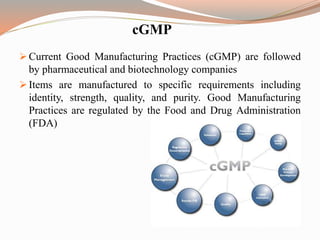
cGMP
 Current Good Manufacturing Practices (cGMP) are followed
by pharmaceutical and biotechnology companies
 Items are manufactured to specific requirements including
identity, strength, quality, and purity. Good Manufacturing
Practices are regulated by the Food and Drug Administration
(FDA)
Current
 Indicates the GMPs change with time and evolving technology
Good
 “Feasible and valuable” standard
 Not necessarily “best or state of the art”
Practice
 Relates to drug industry capabilities, and what is being done
 Dose not have to be prevailing, majority or average practice
 Relates to those processes or procedures which assure integrity
and quality, even if only done by a few
Current Good Manufacturing Practice
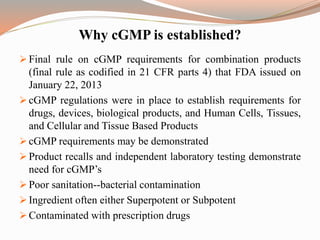
Why cGMP is established?
 Final rule on cGMP requirements for combination products
(final rule as codified in 21 CFR parts 4) that FDA issued on
January 22, 2013
 cGMP regulations were in place to establish requirements for
drugs, devices, biological products, and Human Cells, Tissues,
and Cellular and Tissue Based Products
 cGMP requirements may be demonstrated
 Product recalls and independent laboratory testing demonstrate
need for cGMP’s
 Poor sanitation--bacterial contamination
 Ingredient often either Superpotent or Subpotent
 Contaminated with prescription drugs
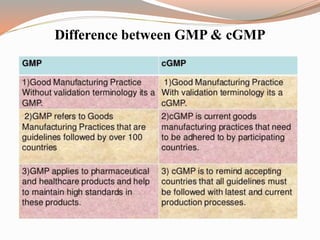
Difference between GMP & cGMP
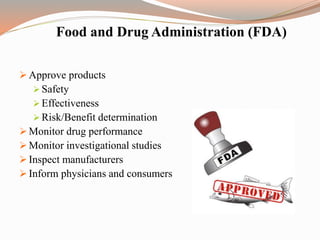
Food and Drug Administration (FDA)
 Approve products
 Safety
 Effectiveness
 Risk/Benefit determination
 Monitor drug performance
 Monitor investigational studies
 Inspect manufacturers
 Inform physicians and consumers
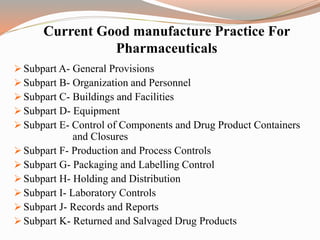
Current Good manufacture Practice For
Pharmaceuticals
 Subpart A- General Provisions
 Subpart B- Organization and Personnel
 Subpart C- Buildings and Facilities
 Subpart D- Equipment
 Subpart E- Control of Components and Drug Product Containers
and Closures
 Subpart F- Production and Process Controls
 Subpart G- Packaging and Labelling Control
 Subpart H- Holding and Distribution
 Subpart I- Laboratory Controls
 Subpart J- Records and Reports
 Subpart K- Returned and Salvaged Drug Products
General Provisions
 cGMP should apply to activities associated with
 Manufacturing
 Packaging
 Holding
 Distributing
 Manufacturer would need to comply with requirements
applicable to operations performed
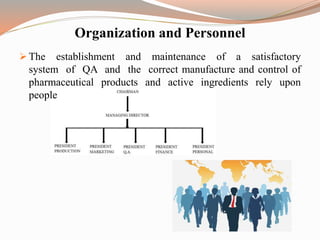
Organization and Personnel
 The establishment and maintenance of a satisfactory
system of QA and the correct manufacture and control of
pharmaceutical products and active ingredients rely upon
people
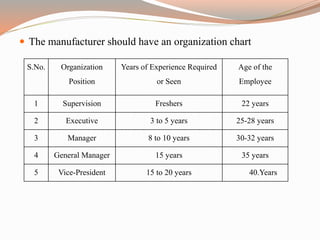
 The manufacturer should have an organization chart
S.No. Organization
Position
Years of Experience Required
or Seen
Age of the
Employee
1 Supervision Freshers 22 years
2 Executive 3 to 5 years 25-28 years
3 Manager 8 to 10 years 30-32 years
4 General Manager 15 years 35 years
5 Vice-President 15 to 20 years 40.Years
Training
A trained person generally-
 Knowledge
 Skill
 Attitude relevant to their job
 Appropriate level
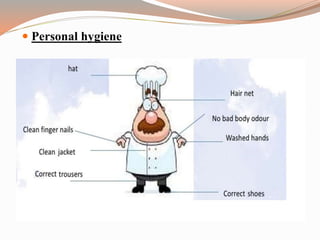
 Personal hygiene
Surrounding, Buildings and Facilities
 Design and construction
 Ceilings, floors, and walls that are easily cleaned and
maintained
 Separate areas or systems for specific operations to avoid
mix-ups
 Screening to keep out pests
 Maintenance and sanitation
 Water meets EPA drinking water requirements
 Plumbing, bathroom, lighting, ventilation, trash requirements
to prevent contamination
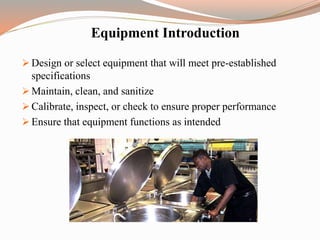
Equipment Introduction
 Design or select equipment that will meet pre-established
specifications
 Maintain, clean, and sanitize
 Calibrate, inspect, or check to ensure proper performance
 Ensure that equipment functions as intended
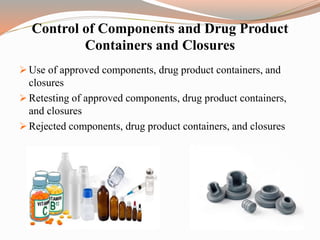
Control of Components and Drug Product
Containers and Closures
 Use of approved components, drug product containers, and
closures
 Retesting of approved components, drug product containers,
and closures
 Rejected components, drug product containers, and closures
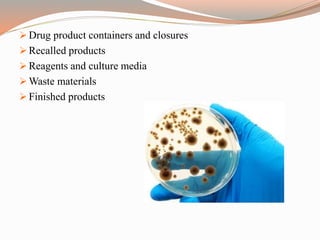
 Drug product containers and closures
 Recalled products
 Reagents and culture media
 Waste materials
 Finished products
Production and Process Controls Principle
 Quality control unit
 Master manufacturing and batch production records
 Specifications for incoming, in-process, and final product and
 Testing final product or incoming and in-process materials
 Prevention of cross-contamination and bacterial contamination
during production
 Equipment identification
 Time limitations on production
 Control of microbiological contamination
 Materials examination and usage criteria
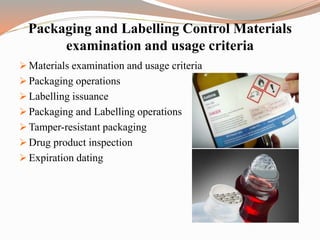
Packaging and Labelling Control Materials
examination and usage criteria
 Materials examination and usage criteria
 Packaging operations
 Labelling issuance
 Packaging and Labelling operations
 Tamper-resistant packaging
 Drug product inspection
 Expiration dating
Holding and Distribution
 To ensure that identity, purity, quality, strength, and
composition are not adversely affected
 Hold and distribute under
 Appropriate conditions of temperature, humidity, and
light
 Conditions that do not lead to mix-up, contamination,
or deterioration
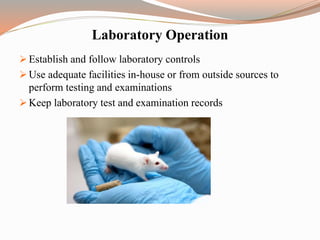
Laboratory Operation
 Establish and follow laboratory controls
 Use adequate facilities in-house or from outside sources to
perform testing and examinations
 Keep laboratory test and examination records
Records and Reports
 performance records for
 Calibration, master manufacturing and batch production,
and consumer complaints
 Keep for 3 years beyond date of manufacture of batch and
 FDA access to records when requested
 System of production and process controls
 Specifications
 Testing
 Monitoring, material review, disposition decision
 Master manufacturing record
 Batch production record
Master production and control records (MPCR)
Master production and control records shall include:
 The name and strength of the product
 Description of the dosage form
 The name and weight or measure
 Weight or measure of the drug product
 An accurate statement of the weight or measure of each
component, using the same weight system (metric, avoirdupois,
or apothecary) for each component.
 Reasonable variations may be permitted, however, in the
amount of components necessary for the preparation in the
dosage form, provided they are justified in the master
production and control records
 A statement concerning any calculated excess of component
 Complete manufacturing and control instructions
 Sampling and testing procedures, specifications, special
notations, and precautions
Batch production and control records (BPCR)
 Documentation that each significant step in the manufacture,
processing, packing, or holding of the batch was accomplished,
including:
 Dates
 Identity of individual major equipment and lines used
 Specific identification of each batch of component or in-process
material used
 Weights and measures of components used in the course of
processing
 In-process and laboratory control results
 Inspection of the packaging and Labelling area before and after use
 Complete Labelling control records, including specimens or copies
of all Labelling used
 Description of drug product containers and closures
 Any sampling performed
Returned and Salvaged Drug Products
 If the condition of the drug product, its container, carton, or
Labelling, as a result of storage or shipping, casts doubt on the
safety, identity, strength, quality or purity of the drug product,
the returned drug product shall be destroyed unless
examination, testing, or other investigations prove the drug
product meets appropriate standards of safety, identity,
strength, quality, or purity
References
 http://logistics.about.com/od/industryfocus/a/Intro_cGMP.htm
 http://www.fda.gov/Drugs/DevelopmentApprovalProcess/Man
ufacturing/ucm090016.htm
 www.fda.gov/downloads/drugs/guidancecomplianceregulatoryi
nformation/guidances/ucm403496.pdf
 http://www.fda.gov/downloads/RegulatoryInformation/Guidan
ces/UCM429304.pdf
 http://www.wipo.int/edocs/lexdocs/laws/en/ph/ph130en.pdf
 http://www.pharmaguideline.com/2012/08/current-good-
manufacturing-practice-cgmp.html
 https://en.wikipedia.org/wiki/Good_manufacturing_practice
C gmp0

C gmp0

  • 1.
  • 2.
    Literature Review  Potdar,et al. (2012) Current Good Manufacturing Practice for pharmaceuticals book is an honest effort to explain the true meaning of this term and also to explain the scope and depth of its meaning. cGMP is defined in simple words as “That part of quality assurance which ensures that product is consistently product and controlled to the quality standard appropriate for their intended use and legal requirements. cGMP is thus concerned with both production and quality control matter. ”In short cGMP is the only tool for producing and distributing quality pharmaceutical products for consumption by the mankind. The drug regulatory authorities all over word e.g. WHO, M.H.R.A. (U.K.), T.G.A. (Australia), M.C.C. (South Africa) and U.S.F.D.A. etc. provide guidelines based on their requirement of cGMP. This project has considered a WHO and U.S.F.D.A. guidelines.
  • 3.
    cGMP  Current GoodManufacturing Practices (cGMP) are followed by pharmaceutical and biotechnology companies  Items are manufactured to specific requirements including identity, strength, quality, and purity. Good Manufacturing Practices are regulated by the Food and Drug Administration (FDA)
  • 4.
    Current  Indicates theGMPs change with time and evolving technology Good  “Feasible and valuable” standard  Not necessarily “best or state of the art” Practice  Relates to drug industry capabilities, and what is being done  Dose not have to be prevailing, majority or average practice  Relates to those processes or procedures which assure integrity and quality, even if only done by a few Current Good Manufacturing Practice
  • 5.
    Why cGMP isestablished?  Final rule on cGMP requirements for combination products (final rule as codified in 21 CFR parts 4) that FDA issued on January 22, 2013  cGMP regulations were in place to establish requirements for drugs, devices, biological products, and Human Cells, Tissues, and Cellular and Tissue Based Products  cGMP requirements may be demonstrated  Product recalls and independent laboratory testing demonstrate need for cGMP’s  Poor sanitation--bacterial contamination  Ingredient often either Superpotent or Subpotent  Contaminated with prescription drugs
  • 6.
  • 7.
    Food and DrugAdministration (FDA)  Approve products  Safety  Effectiveness  Risk/Benefit determination  Monitor drug performance  Monitor investigational studies  Inspect manufacturers  Inform physicians and consumers
  • 8.
    Current Good manufacturePractice For Pharmaceuticals  Subpart A- General Provisions  Subpart B- Organization and Personnel  Subpart C- Buildings and Facilities  Subpart D- Equipment  Subpart E- Control of Components and Drug Product Containers and Closures  Subpart F- Production and Process Controls  Subpart G- Packaging and Labelling Control  Subpart H- Holding and Distribution  Subpart I- Laboratory Controls  Subpart J- Records and Reports  Subpart K- Returned and Salvaged Drug Products
  • 9.
    General Provisions  cGMPshould apply to activities associated with  Manufacturing  Packaging  Holding  Distributing  Manufacturer would need to comply with requirements applicable to operations performed
  • 10.
    Organization and Personnel The establishment and maintenance of a satisfactory system of QA and the correct manufacture and control of pharmaceutical products and active ingredients rely upon people
  • 11.
     The manufacturershould have an organization chart S.No. Organization Position Years of Experience Required or Seen Age of the Employee 1 Supervision Freshers 22 years 2 Executive 3 to 5 years 25-28 years 3 Manager 8 to 10 years 30-32 years 4 General Manager 15 years 35 years 5 Vice-President 15 to 20 years 40.Years
  • 12.
    Training A trained persongenerally-  Knowledge  Skill  Attitude relevant to their job  Appropriate level
  • 13.
  • 14.
    Surrounding, Buildings andFacilities  Design and construction  Ceilings, floors, and walls that are easily cleaned and maintained  Separate areas or systems for specific operations to avoid mix-ups  Screening to keep out pests  Maintenance and sanitation  Water meets EPA drinking water requirements  Plumbing, bathroom, lighting, ventilation, trash requirements to prevent contamination
  • 15.
    Equipment Introduction  Designor select equipment that will meet pre-established specifications  Maintain, clean, and sanitize  Calibrate, inspect, or check to ensure proper performance  Ensure that equipment functions as intended
  • 16.
    Control of Componentsand Drug Product Containers and Closures  Use of approved components, drug product containers, and closures  Retesting of approved components, drug product containers, and closures  Rejected components, drug product containers, and closures
  • 17.
     Drug productcontainers and closures  Recalled products  Reagents and culture media  Waste materials  Finished products
  • 18.
    Production and ProcessControls Principle  Quality control unit  Master manufacturing and batch production records  Specifications for incoming, in-process, and final product and  Testing final product or incoming and in-process materials  Prevention of cross-contamination and bacterial contamination during production  Equipment identification  Time limitations on production  Control of microbiological contamination  Materials examination and usage criteria
  • 19.
    Packaging and LabellingControl Materials examination and usage criteria  Materials examination and usage criteria  Packaging operations  Labelling issuance  Packaging and Labelling operations  Tamper-resistant packaging  Drug product inspection  Expiration dating
  • 20.
    Holding and Distribution To ensure that identity, purity, quality, strength, and composition are not adversely affected  Hold and distribute under  Appropriate conditions of temperature, humidity, and light  Conditions that do not lead to mix-up, contamination, or deterioration
  • 21.
    Laboratory Operation  Establishand follow laboratory controls  Use adequate facilities in-house or from outside sources to perform testing and examinations  Keep laboratory test and examination records
  • 22.
    Records and Reports performance records for  Calibration, master manufacturing and batch production, and consumer complaints  Keep for 3 years beyond date of manufacture of batch and  FDA access to records when requested  System of production and process controls  Specifications  Testing  Monitoring, material review, disposition decision  Master manufacturing record  Batch production record
  • 23.
    Master production andcontrol records (MPCR) Master production and control records shall include:  The name and strength of the product  Description of the dosage form  The name and weight or measure  Weight or measure of the drug product  An accurate statement of the weight or measure of each component, using the same weight system (metric, avoirdupois, or apothecary) for each component.
  • 24.
     Reasonable variationsmay be permitted, however, in the amount of components necessary for the preparation in the dosage form, provided they are justified in the master production and control records  A statement concerning any calculated excess of component  Complete manufacturing and control instructions  Sampling and testing procedures, specifications, special notations, and precautions
  • 25.
    Batch production andcontrol records (BPCR)  Documentation that each significant step in the manufacture, processing, packing, or holding of the batch was accomplished, including:  Dates  Identity of individual major equipment and lines used  Specific identification of each batch of component or in-process material used  Weights and measures of components used in the course of processing  In-process and laboratory control results  Inspection of the packaging and Labelling area before and after use  Complete Labelling control records, including specimens or copies of all Labelling used  Description of drug product containers and closures  Any sampling performed
  • 26.
    Returned and SalvagedDrug Products  If the condition of the drug product, its container, carton, or Labelling, as a result of storage or shipping, casts doubt on the safety, identity, strength, quality or purity of the drug product, the returned drug product shall be destroyed unless examination, testing, or other investigations prove the drug product meets appropriate standards of safety, identity, strength, quality, or purity
  • 27.
    References  http://logistics.about.com/od/industryfocus/a/Intro_cGMP.htm  http://www.fda.gov/Drugs/DevelopmentApprovalProcess/Man ufacturing/ucm090016.htm www.fda.gov/downloads/drugs/guidancecomplianceregulatoryi nformation/guidances/ucm403496.pdf  http://www.fda.gov/downloads/RegulatoryInformation/Guidan ces/UCM429304.pdf  http://www.wipo.int/edocs/lexdocs/laws/en/ph/ph130en.pdf  http://www.pharmaguideline.com/2012/08/current-good- manufacturing-practice-cgmp.html  https://en.wikipedia.org/wiki/Good_manufacturing_practice