DOCUMENTATION &
REPORTING
Presented By: Ms.
Aaditi Shirke
INTRODUCTION
 DOCUMENTATION: Documentation is the process of
communicating in written form about essential facts for the
maintenance of continuous history of events over a period of
time. Recording & reporting are the other ways of
documentation.
 RECORD: Record is a clinical, scientific, administrative legal
document relating to the nursing care given to individual, family
or community.
 Reports: Reports are oral or written exchange of information
shared between nurses or a number of persons.
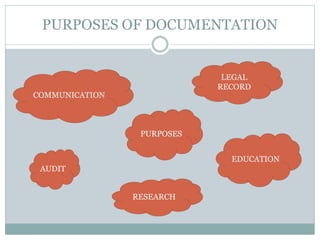
PURPOSES OF DOCUMENTATION
PURPOSES
COMMUNICATION
LEGAL
RECORD
AUDIT
RESEARCH
EDUCATION
VALUES OR PURPOSES OF RECORDING
1. Record provide accurate and detail account of
treatment and care given to patient.
2. It provide guide for follow up of the course of
disease and further care.
3. Records has great value in the diagnosis,
treatments and nursing care.
4. A record saves the duplication of work & helps
patient to get prompt treatment.
5. A written record has legal value .
6. It safe guard the patient , nurse and doctor
VALUES OR PURPOSES OF RECORDING
5. Record furnish the vital statistics.
6. Data taken from patient problem points out the
health problem of country.
7. Helps to evaluate services provided. It provides
baseline data
COMMUNICATION WITHIN HEALTH CARE TEAM
 In medical field communication with members of health team is very
important. It facilitates the process of patient care.
 IMPORTANCE OF COMMUNICATION WITHIN HEALTH TEAM
 As every member of health team gathers different information it helps in
planning comprehensive quality care of client.
 Sharing/communicating information helps to verify the cues thus reduces
ambiguity(Doubtfulness ).
 It also avoids duplication of efforts in collecting data.
 It helps the team members to benefit from the information others have
collected.
 Sharing the collected information keeps all the members in one direction
i.e. achievement of goal. It avoids deviation from achieving goal.
 Communication ensures coordination between health team members. In
order to provide quality care team efforts are required.
TYPE OF RECORDS
 WARD RECORDS
 NURSE’S RECORDS
 STUDENTS RECORDS
 STAFF RECORDS
 ACADEMIC & ADMINISTRATIVE RECORDS.
PATIENT RECORD
 Patient record in hospital is maintained as he /she comes to the
hospital for availing preventive & therapeutic services.
 OUT-PATIENT RECORD
 They provide information about out patient referral numbers, patients
biodata, medical history past & present, family history if any,
investigation records, diagnosis & treatment & frequency of visit.
 IN-PATIENT RECORD
 Admission record
 Observation record
 Investigation record
 Intake- output record
 Treatment record
 Diet record
 Progress record
 Nurse’s record
 Discharge record
all these records kept in one folder for each individual
patient in the ward under the charge of the ward sister till the patient is
discharged. Thereafter, it is transferred to the medical record section as
per rules.
OTHER PATIENT RECORDS
 Other patient records maintained & kept in the nurses duty room
include treatment book, diet book, admission, discharge & death
register, notification form, inventories & related record forms, duty
roster etc.
NURSING SERVICE RECORD
These records are maintained by nursing service department. the
nursing service records include the nurses duty register, master plan of
nursing personnel, leave register which contains annual, casual, &
medical leave, nurses attendance register confidential records,
correspondence with other hospitals, agencies.
NURSING EDUCATION RECORDS
 These records are maintained by principal’s office,school/college of
nursing, these record includes:
student admission record
attendance record
clinical master rotation plan
evaluation record
leave record
student health record
cumulative record
confidential record
PRINCIPLES OF RECORD WRITING
 Clearly written & legible
 Accurate
 Appropriate
 Error-free
 Concise
 Complete
 Chronological order
 Specified date & time
 Use standard abbreviations
 Include all services & treatment given to patient with
results
Contd……
 Leave no blank space in between
 Signed by nurse who enters the data
 Each page to have identification details, viz, name, age,
OPD No. etc.
COMMON RECORD-KEEPING FORM
 A variety of forms are used to document client’s health status,
problems, interventions, response to interventions. These are the
following:
 NURSING HISTORY: Nursing history is completed when client is
admitted to hospital. This form includes a complete assessment of
client to identify relevant nursing diagnosis. Information recorded on
this form provides a baseline data which can be compared with changes
in client’s condition.
 GRAPHIC SHEETS & FLOW SHEETS: Flow sheets have vertical &
horizontal columns for recording data, times to show assessment &
interventions. This help to identify changes in client’s condition. It is
used to document vital signs, IV therapy, routine repetitive care such as
meals, weight. It is very important to fill the flow sheets otherwise
spaces reflects no intervention carried out.
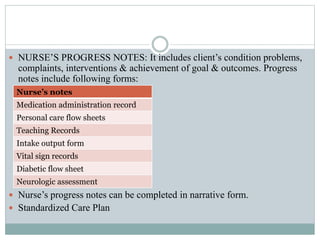
 NURSE’S PROGRESS NOTES: It includes client’s condition problems,
complaints, interventions & achievement of goal & outcomes. Progress
notes include following forms:
 Nurse’s progress notes can be completed in narrative form.
 Standardized Care Plan
Nurse’s notes
Medication administration record
Personal care flow sheets
Teaching Records
Intake output form
Vital sign records
Diabetic flow sheet
Neurologic assessment
COMPUTERIZED DOCUMENTATION
 Health care system has directed nurses leaders to develop computerized
records in response to demand for clinical, administrative & regulatory
information. Nurses are using computerized system for supplies,
equipment, stock medications & diagnostic testing for sometime.
Computers facilitates:
 Speed in communication
 Accuracy in information
 Capability of information storage
 ADVANTAGES OF COMPUTERIZED DOCUMENTATION
 It enhances systematic approach to client care through standardize
protocols, teaching documents.
 It facilitates fast communication
 It is cost effective
 Increases quality of documentation
 Save documentation time by avoiding duplication of effort.
 DISADVANTAGES
 Costly installation of computer software
 Problem in protecting client’s confidentiality. As in hospital everyone
has access to computer recording.
GUIDELINES FOR REPORTING
 Accurate: For hospital setting as well as research purposes, accuracy is
very important quality of documentation. Use medical terminology
with correct spellings in descriptive terms. Avoid using judgemental
language such as “good, poor, bad, seems". It is best to write client’s
verbatum also. Avoid using clues.e.g.INCORRECT:Client took one
glass of water.CORRECT:Client took 250 ml of water.
 Completeness: Always make complete sentences. Never leave space
inbetween lines. Even pictures can be drawn if needed at appropriate
place. Area of fractured bone. “Burn area” etc.Never forget to
document the information omitted or refused by the client. Avoid using
local abbreviations or symbols. Try to write full form of the word. For
example ‘TOF’ “Tetrology of Fallot” TOF “Tracheoesophageal
Fistula". Thus in this example abbreviation TOF have two different
diagnosis which can be detected by fully written words.
 Currentness:Keep the documents upto date. If any change occurs in
hospital policies, timings, patient care etc. It must be written
immediately.
 Organised:Start any entry with hospital name, Patient name, C.R No.,
Gender, Diagnosis, Date & Time. Write information in chronological
order such as assessment data, observation, intervention & evaluation.
Recording should be done as soon as the information is collected to
avoid missing data. It is not good practice to wait until the end of shift
to record findings of all clients.
 Confidentiality: This is very important to treat all client information in
a confidential & professional manner. It is an legal document & should
be available to the client’s health care team. It is nurse’s responsibility
to protect the privacy & confidentiality of client interactions,
assessment & care.
 Factual: A record contains descriptive & objective information about
what nurse gain through her senses. Document the findings with
supportive factual data. Avoid words such as “appears, seems,
properly". Documentation need to clearly explain the nurse’s
observations of the client’s behaviors. It is also best to document the
client’s “exact words” within quotation marks.e.g. Client state “I feel
very tensed & feeling nothing is in my control". For objective data,
nurse may check client’s vital signs.
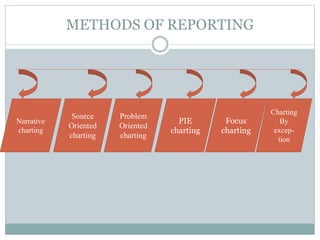
METHODS OF REPORTING
Narrative
charting
Source
Oriented
charting
Problem
Oriented
charting
PIE
charting
Focus
charting
Charting
By
excep-
tion
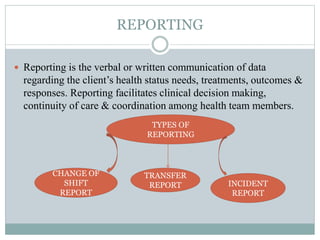
REPORTING
 Reporting is the verbal or written communication of data
regarding the client’s health status needs, treatments, outcomes &
responses. Reporting facilitates clinical decision making,
continuity of care & coordination among health team members.
TYPES OF
REPORTING
CHANGE OF
SHIFT
REPORT
TRANSFER
REPORT INCIDENT
REPORT
PURPOSES OF REPORTING
 Report is an essential tool of communication between the
patient, nurse & members of health team.
 It provides communication to the incoming nurse on duty
by giving brief & accurate information on the patient.
 It avoids duplication of work.
 Reports, when complete, helps provide better patient care.
TYPES OF REPORTS
 Reports are classified as written & oral.
 WRITTEN REPORTS
 Reports among members of the nursing team, this is done
when the nurse leaves the ward off duty & gives the report
to the incoming duty nurse.
 Reports between the head nurse & staff nurse.
 Reports between the head nurse & nursing superintendent.
 REPORT TO THE PHYICIAN
The nurse has to report to the doctor about any
unusual conditions of the patient through incharge sister
Contd……
 For instance, the patient may develop some reaction to
medicine, fall from the bed, missing from the ward. If
mistake is committed by the student nurse, report to the
doctor & matron immediately so that appropriate actions
can be taken.
 The past illness, reason for the patient transfer, his or her
condition to be noted & reported.
 Census report: it is the report of admissions, discharge,
death & transfer in 24 hrs done by he administrative office.
 ORAL REPORTS
 It is given when the information is for immediate use & not for
permanency e.g. oral report is made but the nurse while assigning the
patients care to another nurse who is planning to relieve her. These
reports may be given by the bedside of each patient during taking over
& handing over rounds. While giving oral reports great care has to be
taken by the nurses. At the bedside of the patient, family history, name
& diagnosis can be explained. All other information can be relieved in
nurses duty room.
contd…
 CHANGE OF SHIFT REPORT
At the end of each shift, nurses give information on their assigned
patients to the nurses working in the next shift. The report is a system
of communication aimed at transferring essential information
necessary for safe & complete care as per the nursing plan.
TELEPHONE REPORT
A nurse communicates information to a doctor about change in the
patients condition, to a nurse of another unit about a client transfer, or
the laboratory staff or radiologist regarding result of diagnostic test.
 TRANSFER REPORT
It involves communication of information on patients from the nurse
of the sending unit to the nurse of receiving unit. The receiving unit
must know the latest information on patients & their progress. This
report will also have the doctors transfer order.
INCIDENT REPORT
An incident is any event not consistent with the routine operation of a
health care unit. When the incident occurs, the nurse involved in it or
the nurse who witnesses it completes the incident report for the
departmental nurse Incharge & doctor.
MINIMIZE LEGAL LIABILITIES
 In hospital setting, physicians, nurses are also involved in cases
of medical malpractice, negligence, personal injury. Now days
public is very much aware of their rights. Every client expects
best quality care in hospitals. Documents are the best black &
white print which reflect the care provided. Thus while
documenting any word, nurse should consider the possibility that
client’s record may be submitted to the court as a source of
information regarding client’s condition & nursing care. So in
order to minimize legal liabilities document should have
following characteristics.
 Factual
 Accurate
 Complete
 Logically organized
 Client’s identifying information must be written on each page of
the client’s record. Nurse must ensure that she is writing notes on
right client’s record.
 While making entry on record it must be started with complete
date(month, time, year).
 Nurse should never edit or delete the documentation done by
other personnel
 At the end of nursing notes line can be drawn from end of text to
end of right margin on line so that no one else can add
documentation.
 Documents must be signed by nurse at the end of entry
 Never leave empty space between entries as someone else can
add.
 While documenting follow the hospital policy.
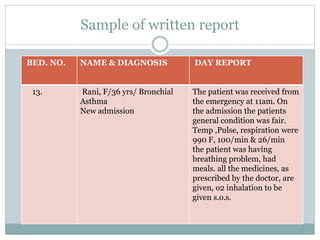
Sample of written report
BED. NO. NAME & DIAGNOSIS DAY REPORT
13. Rani, F/36 yrs/ Bronchial
Asthma
New admission
The patient was received from
the emergency at 11am. On
the admission the patients
general condition was fair.
Temp ,Pulse, respiration were
990 F, 100/min & 26/min
the patient was having
breathing problem, had
meals. all the medicines, as
prescribed by the doctor, are
given, o2 inhalation to be
given s.o.s.
CARE OF RECORD
 Records kept under custody in a place which is not accessible to the
patient & his/ her relatives but accessible to doctors & nurses
 No stranger is allowed to read the record
 Records not to be handed over even to the legal advisor without the
written permission of the administrator.
 Records to be arranged in alphabetical, numerical, geographical orders
& with an index card .this records may be maintained by the record
room.
 See that the records of the patient is well maintained, complete &
signed by the doctor before sending to the record room, take the
signature of the person receiving the record & see that the patients
name, age, ward no, bed no, OPD no, diagnosis & treatment entered.
Contd…..
 Patients record never sent out of the ward without doctors permission.
 If the patient is transferred to the another hospital, the nurse should
see that a complete summary is made in a separate paper to be sent
with the patient & not the original record.
DO'S AND DON'TS OF NURSING
DOCUMENTATION
 Nurses are well aware of the standard, which states that if a certain
matter affecting patient care is required to be charted and it is not, the
overwhelming presumption is that it may not have been done. Good
documentation will help you to defend yourself in a malpractice
lawsuit, it can also keep you out of court in the first place.
DO’S
 Check that you have the correct chart before you begin
writing.
 Make sure your documentation reflects the nursing process
and your professional capabilities.
 Write legibly.
 Chart the time you gave a medication, the administration
route, and the patient's response.
 Chart precautions or preventive measures used, such as bed
rails.
 Record each phone call to a physician, including the exact
time, message, and response.
CONTINUED……
 Chart patient care at the time you provide it.
 If you remember an important point after you've completed
your documentation, chart the information with a notation
that it's a "late entry." Include the date and time of the late
entry.
DON’T
• Don't chart a symptom, such as "c/o pain," without also
charting what you did about it.
• Don't alter a patient's record - this is a criminal offense.
• Don't use shorthand or abbreviations that aren't widely
accepted.
• Don't write imprecise descriptions, such as "bed soaked" or
"a large amount."
CONTINUED……
• Don't chart what someone else said, heard, felt, or smelled
unless the information is critical. In that case, use
quotations and attribute the remarks appropriately.
• Don't chart care ahead of time - something may happen and
you may be unable to actually give the care you've charted.
Charting care that you haven't done is considered fraud
Documentation-and-Reporting.ppt

Documentation-and-Reporting.ppt

  • 1.
  • 2.
    INTRODUCTION  DOCUMENTATION: Documentationis the process of communicating in written form about essential facts for the maintenance of continuous history of events over a period of time. Recording & reporting are the other ways of documentation.  RECORD: Record is a clinical, scientific, administrative legal document relating to the nursing care given to individual, family or community.  Reports: Reports are oral or written exchange of information shared between nurses or a number of persons.
  • 3.
  • 4.
    VALUES OR PURPOSESOF RECORDING 1. Record provide accurate and detail account of treatment and care given to patient. 2. It provide guide for follow up of the course of disease and further care. 3. Records has great value in the diagnosis, treatments and nursing care. 4. A record saves the duplication of work & helps patient to get prompt treatment. 5. A written record has legal value . 6. It safe guard the patient , nurse and doctor
  • 5.
    VALUES OR PURPOSESOF RECORDING 5. Record furnish the vital statistics. 6. Data taken from patient problem points out the health problem of country. 7. Helps to evaluate services provided. It provides baseline data
  • 6.
    COMMUNICATION WITHIN HEALTHCARE TEAM  In medical field communication with members of health team is very important. It facilitates the process of patient care.  IMPORTANCE OF COMMUNICATION WITHIN HEALTH TEAM  As every member of health team gathers different information it helps in planning comprehensive quality care of client.  Sharing/communicating information helps to verify the cues thus reduces ambiguity(Doubtfulness ).  It also avoids duplication of efforts in collecting data.  It helps the team members to benefit from the information others have collected.  Sharing the collected information keeps all the members in one direction i.e. achievement of goal. It avoids deviation from achieving goal.  Communication ensures coordination between health team members. In order to provide quality care team efforts are required.
  • 7.
    TYPE OF RECORDS WARD RECORDS  NURSE’S RECORDS  STUDENTS RECORDS  STAFF RECORDS  ACADEMIC & ADMINISTRATIVE RECORDS.
  • 8.
    PATIENT RECORD  Patientrecord in hospital is maintained as he /she comes to the hospital for availing preventive & therapeutic services.  OUT-PATIENT RECORD  They provide information about out patient referral numbers, patients biodata, medical history past & present, family history if any, investigation records, diagnosis & treatment & frequency of visit.  IN-PATIENT RECORD  Admission record  Observation record  Investigation record  Intake- output record
  • 9.
     Treatment record Diet record  Progress record  Nurse’s record  Discharge record all these records kept in one folder for each individual patient in the ward under the charge of the ward sister till the patient is discharged. Thereafter, it is transferred to the medical record section as per rules.
  • 10.
    OTHER PATIENT RECORDS Other patient records maintained & kept in the nurses duty room include treatment book, diet book, admission, discharge & death register, notification form, inventories & related record forms, duty roster etc. NURSING SERVICE RECORD These records are maintained by nursing service department. the nursing service records include the nurses duty register, master plan of nursing personnel, leave register which contains annual, casual, & medical leave, nurses attendance register confidential records, correspondence with other hospitals, agencies.
  • 11.
    NURSING EDUCATION RECORDS These records are maintained by principal’s office,school/college of nursing, these record includes: student admission record attendance record clinical master rotation plan evaluation record leave record student health record cumulative record confidential record
  • 12.
    PRINCIPLES OF RECORDWRITING  Clearly written & legible  Accurate  Appropriate  Error-free  Concise  Complete  Chronological order  Specified date & time  Use standard abbreviations  Include all services & treatment given to patient with results
  • 13.
    Contd……  Leave noblank space in between  Signed by nurse who enters the data  Each page to have identification details, viz, name, age, OPD No. etc.
  • 14.
    COMMON RECORD-KEEPING FORM A variety of forms are used to document client’s health status, problems, interventions, response to interventions. These are the following:  NURSING HISTORY: Nursing history is completed when client is admitted to hospital. This form includes a complete assessment of client to identify relevant nursing diagnosis. Information recorded on this form provides a baseline data which can be compared with changes in client’s condition.  GRAPHIC SHEETS & FLOW SHEETS: Flow sheets have vertical & horizontal columns for recording data, times to show assessment & interventions. This help to identify changes in client’s condition. It is used to document vital signs, IV therapy, routine repetitive care such as meals, weight. It is very important to fill the flow sheets otherwise spaces reflects no intervention carried out.
  • 15.
     NURSE’S PROGRESSNOTES: It includes client’s condition problems, complaints, interventions & achievement of goal & outcomes. Progress notes include following forms:  Nurse’s progress notes can be completed in narrative form.  Standardized Care Plan Nurse’s notes Medication administration record Personal care flow sheets Teaching Records Intake output form Vital sign records Diabetic flow sheet Neurologic assessment
  • 16.
    COMPUTERIZED DOCUMENTATION  Healthcare system has directed nurses leaders to develop computerized records in response to demand for clinical, administrative & regulatory information. Nurses are using computerized system for supplies, equipment, stock medications & diagnostic testing for sometime. Computers facilitates:  Speed in communication  Accuracy in information  Capability of information storage  ADVANTAGES OF COMPUTERIZED DOCUMENTATION  It enhances systematic approach to client care through standardize protocols, teaching documents.  It facilitates fast communication  It is cost effective  Increases quality of documentation
  • 17.
     Save documentationtime by avoiding duplication of effort.  DISADVANTAGES  Costly installation of computer software  Problem in protecting client’s confidentiality. As in hospital everyone has access to computer recording.
  • 18.
    GUIDELINES FOR REPORTING Accurate: For hospital setting as well as research purposes, accuracy is very important quality of documentation. Use medical terminology with correct spellings in descriptive terms. Avoid using judgemental language such as “good, poor, bad, seems". It is best to write client’s verbatum also. Avoid using clues.e.g.INCORRECT:Client took one glass of water.CORRECT:Client took 250 ml of water.  Completeness: Always make complete sentences. Never leave space inbetween lines. Even pictures can be drawn if needed at appropriate place. Area of fractured bone. “Burn area” etc.Never forget to document the information omitted or refused by the client. Avoid using local abbreviations or symbols. Try to write full form of the word. For example ‘TOF’ “Tetrology of Fallot” TOF “Tracheoesophageal Fistula". Thus in this example abbreviation TOF have two different diagnosis which can be detected by fully written words.
  • 19.
     Currentness:Keep thedocuments upto date. If any change occurs in hospital policies, timings, patient care etc. It must be written immediately.  Organised:Start any entry with hospital name, Patient name, C.R No., Gender, Diagnosis, Date & Time. Write information in chronological order such as assessment data, observation, intervention & evaluation. Recording should be done as soon as the information is collected to avoid missing data. It is not good practice to wait until the end of shift to record findings of all clients.  Confidentiality: This is very important to treat all client information in a confidential & professional manner. It is an legal document & should be available to the client’s health care team. It is nurse’s responsibility to protect the privacy & confidentiality of client interactions, assessment & care.
  • 20.
     Factual: Arecord contains descriptive & objective information about what nurse gain through her senses. Document the findings with supportive factual data. Avoid words such as “appears, seems, properly". Documentation need to clearly explain the nurse’s observations of the client’s behaviors. It is also best to document the client’s “exact words” within quotation marks.e.g. Client state “I feel very tensed & feeling nothing is in my control". For objective data, nurse may check client’s vital signs.
  • 21.
  • 22.
    REPORTING  Reporting isthe verbal or written communication of data regarding the client’s health status needs, treatments, outcomes & responses. Reporting facilitates clinical decision making, continuity of care & coordination among health team members. TYPES OF REPORTING CHANGE OF SHIFT REPORT TRANSFER REPORT INCIDENT REPORT
  • 23.
    PURPOSES OF REPORTING Report is an essential tool of communication between the patient, nurse & members of health team.  It provides communication to the incoming nurse on duty by giving brief & accurate information on the patient.  It avoids duplication of work.  Reports, when complete, helps provide better patient care.
  • 24.
    TYPES OF REPORTS Reports are classified as written & oral.  WRITTEN REPORTS  Reports among members of the nursing team, this is done when the nurse leaves the ward off duty & gives the report to the incoming duty nurse.  Reports between the head nurse & staff nurse.  Reports between the head nurse & nursing superintendent.  REPORT TO THE PHYICIAN The nurse has to report to the doctor about any unusual conditions of the patient through incharge sister
  • 25.
    Contd……  For instance,the patient may develop some reaction to medicine, fall from the bed, missing from the ward. If mistake is committed by the student nurse, report to the doctor & matron immediately so that appropriate actions can be taken.  The past illness, reason for the patient transfer, his or her condition to be noted & reported.  Census report: it is the report of admissions, discharge, death & transfer in 24 hrs done by he administrative office.
  • 26.
     ORAL REPORTS It is given when the information is for immediate use & not for permanency e.g. oral report is made but the nurse while assigning the patients care to another nurse who is planning to relieve her. These reports may be given by the bedside of each patient during taking over & handing over rounds. While giving oral reports great care has to be taken by the nurses. At the bedside of the patient, family history, name & diagnosis can be explained. All other information can be relieved in nurses duty room.
  • 27.
    contd…  CHANGE OFSHIFT REPORT At the end of each shift, nurses give information on their assigned patients to the nurses working in the next shift. The report is a system of communication aimed at transferring essential information necessary for safe & complete care as per the nursing plan. TELEPHONE REPORT A nurse communicates information to a doctor about change in the patients condition, to a nurse of another unit about a client transfer, or the laboratory staff or radiologist regarding result of diagnostic test.
  • 28.
     TRANSFER REPORT Itinvolves communication of information on patients from the nurse of the sending unit to the nurse of receiving unit. The receiving unit must know the latest information on patients & their progress. This report will also have the doctors transfer order. INCIDENT REPORT An incident is any event not consistent with the routine operation of a health care unit. When the incident occurs, the nurse involved in it or the nurse who witnesses it completes the incident report for the departmental nurse Incharge & doctor.
  • 29.
    MINIMIZE LEGAL LIABILITIES In hospital setting, physicians, nurses are also involved in cases of medical malpractice, negligence, personal injury. Now days public is very much aware of their rights. Every client expects best quality care in hospitals. Documents are the best black & white print which reflect the care provided. Thus while documenting any word, nurse should consider the possibility that client’s record may be submitted to the court as a source of information regarding client’s condition & nursing care. So in order to minimize legal liabilities document should have following characteristics.  Factual  Accurate
  • 30.
     Complete  Logicallyorganized  Client’s identifying information must be written on each page of the client’s record. Nurse must ensure that she is writing notes on right client’s record.  While making entry on record it must be started with complete date(month, time, year).  Nurse should never edit or delete the documentation done by other personnel  At the end of nursing notes line can be drawn from end of text to end of right margin on line so that no one else can add documentation.
  • 31.
     Documents mustbe signed by nurse at the end of entry  Never leave empty space between entries as someone else can add.  While documenting follow the hospital policy.
  • 32.
    Sample of writtenreport BED. NO. NAME & DIAGNOSIS DAY REPORT 13. Rani, F/36 yrs/ Bronchial Asthma New admission The patient was received from the emergency at 11am. On the admission the patients general condition was fair. Temp ,Pulse, respiration were 990 F, 100/min & 26/min the patient was having breathing problem, had meals. all the medicines, as prescribed by the doctor, are given, o2 inhalation to be given s.o.s.
  • 33.
    CARE OF RECORD Records kept under custody in a place which is not accessible to the patient & his/ her relatives but accessible to doctors & nurses  No stranger is allowed to read the record  Records not to be handed over even to the legal advisor without the written permission of the administrator.  Records to be arranged in alphabetical, numerical, geographical orders & with an index card .this records may be maintained by the record room.  See that the records of the patient is well maintained, complete & signed by the doctor before sending to the record room, take the signature of the person receiving the record & see that the patients name, age, ward no, bed no, OPD no, diagnosis & treatment entered.
  • 34.
    Contd…..  Patients recordnever sent out of the ward without doctors permission.  If the patient is transferred to the another hospital, the nurse should see that a complete summary is made in a separate paper to be sent with the patient & not the original record.
  • 35.
    DO'S AND DON'TSOF NURSING DOCUMENTATION  Nurses are well aware of the standard, which states that if a certain matter affecting patient care is required to be charted and it is not, the overwhelming presumption is that it may not have been done. Good documentation will help you to defend yourself in a malpractice lawsuit, it can also keep you out of court in the first place.
  • 36.
    DO’S  Check thatyou have the correct chart before you begin writing.  Make sure your documentation reflects the nursing process and your professional capabilities.  Write legibly.  Chart the time you gave a medication, the administration route, and the patient's response.  Chart precautions or preventive measures used, such as bed rails.  Record each phone call to a physician, including the exact time, message, and response.
  • 37.
    CONTINUED……  Chart patientcare at the time you provide it.  If you remember an important point after you've completed your documentation, chart the information with a notation that it's a "late entry." Include the date and time of the late entry.
  • 38.
    DON’T • Don't charta symptom, such as "c/o pain," without also charting what you did about it. • Don't alter a patient's record - this is a criminal offense. • Don't use shorthand or abbreviations that aren't widely accepted. • Don't write imprecise descriptions, such as "bed soaked" or "a large amount."
  • 39.
    CONTINUED…… • Don't chartwhat someone else said, heard, felt, or smelled unless the information is critical. In that case, use quotations and attribute the remarks appropriately. • Don't chart care ahead of time - something may happen and you may be unable to actually give the care you've charted. Charting care that you haven't done is considered fraud