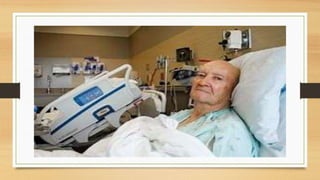
Care of terminally ill patient
Pinki
M.Sc. nursing
Community health nursing
Concept of loss, grief and grieving process
• Concept of loss -:
• Loss is a part of life cycle . All people experience loss in the form of
change, growth, and transition. The experience of loss is painful,
frightening, and lonely, and it triggers an array of emotional responses.
People may vacillate between denial, shock, disbelief, anger, loneliness
and sadness.in addition to normal losses associated with life cycle stages
there are the potential losses of health, a body part, self-image, self-
esteem, and even one’s life.
Types of losses
• 1.Necessary losses-: it is an integral part of each person’s life. Necessary
losses are something natural and positive. For example the growing up
process. We develop independence from our parents, start and leave
school, change friends, begin career and form relationship.
• 2. actual losses-: Actual losses are any loss of a person of a person or
object that can no longer be felt, heard, known or experienced by the
individual. Example include the loss of a body part.
Cont.….
• 3. Maturational loss-: Any change in the development process that is
normally expected during a life time. Event associated during a life time.
Events associated with maturational loss are part of normal life transition,
but feeling helps a cope with change.
• 4. perceived loss-: any loss that is uniquely defined by the grieving client.
It may be less obvious to others. Perceived losses are easily overlooked or
misunderstood, yet the process of grief follows the same sequencing and
progression as actual losses. Example loss of confidence or prestige.
Cont.…
• 5. Situational loss-: it includes any sudden, unpredictable external event.
Often this type of loss include multiple losses rather than a single loss
such automobile accident that leave a driver paralyzed, unable to return to
work.
Concept of grief
• Grief-: grief is an emotional response to a loss. Grief is a deep emotional
and mental anguish that is a response to the subjective experience of loss
of something significant. It is manifested in a variety of ways that are
unique to an individual and based on personal experiences, cultural
expectations and spiritual beliefs.
Cont.…
• Mourning-: Mourning is the psychology process through which the
individual passes on to successful adaptation to the loss of a valued object.
• Bereavement-: Bereavement include grief and mourning the inner feeling
and outward reactions of survivor. People grieve in different ways, and
there is no time limit for completing the grief process. The time of
grieving often depends on the significance of the loss, the length of time
the person was known and loved, the anticipation of or preparation for the
loss, the person’s emotional stability and maturity, and the person coping
ability.
Types of grief
• 1. Normal grief -: It consist of normal feeling, behaviors and reaction to a
loss. This normal grief response to a loss can prove positive, helping one
to a mature and develop as a person. It include resentment, sorrow, anger,
crying, loneliness and temporary withdrawal from activities.
• 2. Anticipatory grief-: The process of disengaging or letting go that
occurs before an actual loss or death has occurred is called anticipatory
grief. Eg: once a person or family receives a terminal diagnosis, they begin
the process of saying good bye and completing life affairs.
Cont.…
• 3.Complicated grief-: when the person has difficulty in progressing
through the normal phases or stages of grieving, bereavement appears to
go wrong and loss never resolves.
• 4. Disenfranchised grief-: person experiences grief, when a loss is
experienced and cannot be openly acknowledged, socially sanctioned, or
publically shared. Eg the loss of partner from AIDS, children experiencing
the death of steps-parent, or the mother whose child dies in-utero or at
birth.
Factors influencing loss and grief
Human development
Personal relationship
Nature of the loss
Socioeconomic status
Culture and ethnicity
Spiritual and religious belief
Human development
• Person of differing ages and stages of development will display different
and unique symptoms of grief. E.g. toddler are unable to understand loss
or death, but they feel great anxiety over loss of objects and separation
from parents.
Personal relationship
• When the loss involves a loved one, the quality and meaning of
relationship are critical in understanding a person’s grief experience. It has
been said that to lose your parents is to lose your past, to lose your spouse
is to lose your present and to lose your child is to lose your future. When a
relationship between two individuals has been very close and well
connected, it can be very difficult for the one left behind to cope. When
clients do not receive supportive understanding and compassion from
others, they become unable to handle grief and look to the future.
Nature of the loss
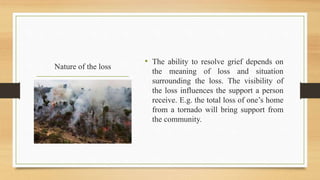
• The ability to resolve grief depends on
the meaning of loss and situation
surrounding the loss. The visibility of
the loss influences the support a person
receive. E.g. the total loss of one’s home
from a tornado will bring support from
the community.
Socioeconomic status
• It influences a person’s ability to obtain options and use support
mechanism when coping with loss. Generally an individual feels greater
burden from a loss when thee is a lack of financial, educational or
occupational resources. These clients require referral to community social
service agencies that can provide needed resources.
Culture and Ethnicity
• Interpretation of the loss and the expression of grief arise from culture
back ground and family practices. Critical components of culture are their
basic core belief system that they can and often do hold on to.
Spiritual and Religious Belief
• Individual’s spirituality influences their ability to cope with loss. Clients
who have a strong interconnectedness with a higher power are able to face
death with relatively minimal discomfort.
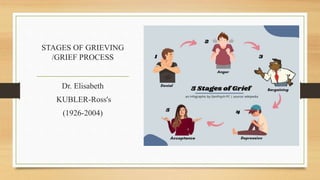
STAGES OF GRIEVING
/GRIEF PROCESS
Dr. Elisabeth
KUBLER-Ross's
(1926-2004)
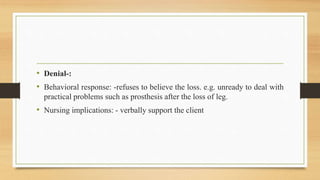
• Denial-:
• Behavioral response: -refuses to believe the loss. e.g. unready to deal with
practical problems such as prosthesis after the loss of leg.
• Nursing implications: - verbally support the client
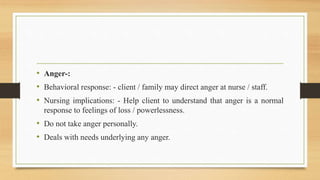
• Anger-:
• Behavioral response: - client / family may direct anger at nurse / staff.
• Nursing implications: - Help client to understand that anger is a normal
response to feelings of loss / powerlessness.
• Do not take anger personally.
• Deals with needs underlying any anger.
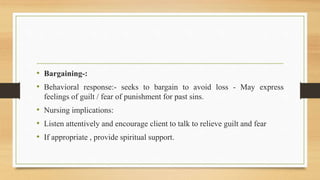
• Bargaining-:
• Behavioral response:- seeks to bargain to avoid loss - May express
feelings of guilt / fear of punishment for past sins.
• Nursing implications:
• Listen attentively and encourage client to talk to relieve guilt and fear
• If appropriate , provide spiritual support.
• Depression-:
• Behavioral response: - Grieves over what has happened and what cannot
be - May talk freely or may withdraw.
• Nursing implications:
• Allow to express sadness.
• Communicate nonverbally by sitting quietly with out conservation -
Convey caring by touch.
• Acceptance-:
• Behavioral response-:
• Comes in terms with loss.
• May have decreased interest in surroundings and support people.
• Nursing implications:
• Encourage client to participated as much as in treatment and progress.
Sign of clinical death
1. Physical Changes At End Of Life-:
A. Sensory changes:- it is mainly due to decrease oxygenation and
circulation changes.
B. Taste & smell:- decreases with disease progression, blurring of vision,
blinking reflex absent.
C. Hearing & touch:- decrease perception of pain, touch & sensation.
Cont..
• Integumentary system-: cold, clammy skin. Wax like skin due to loss of
muscles tone, cyanosis on nose, nail beds, knees due to decrease
oxygenation and circulation changes.
• Cardiovascular system:- pulse rate increase and slow down later &
become weak, blood pressure decrease, elevation in the body temperature
due to changes in hypothalamic function, and delayed absorption of drugs.
Cont..
• Respiratory system:-increase respiration rate, irregular breathing,
cheynestroke respiration.
• Urinary system:- urinary output decrease due to loss of ability to form
urine, incontinence of urine & unable to urinate.
• Gastrointestinal:- slowing of digestive tract, accumulation of gas due to
decrease gastric motility and peristalsis which lead to constipation.
Cont..
• Musculoskeletal system:- gradual loss of ability to move, difficulty in
speaking & swallowing, maintaining body posture, due to weakening of
muscular system because of metabolic changes.
2. Psychological Changes At The End Of Life-:
• Altered decision making
• Anxiety about unfinished business
• Withdrawal
• Decreased socialization
• Fear of loneliness
• Fear of meaninglessness of one’s life
• Fear of pain
• Helplessness
• Life review
• Peacefulness
• Restlessness
• Saying goodbyes
• Unusual communication
• Vision like experiences
Sign of death
• There is no breathing or pulse.
• The eyes do not move or blink, and the pupil are dilated. The eyelids may
be slightly open.
• The jaw is relaxed and the mouth is slightly open.
• The body release the bowel and bladder contents.
• The patient does not respond to being touched or spoken to.
Cont.…
• After the patient has passed away, there is no need to hurry with
arrangements. Family members and caregivers may wish to sit with the
patient, talk, or pray. When the family is ready, the following steps can be
taken.
• Place the body on its back with one pillow under the head. If necessary,
caregivers or family members may wish to put the patient’s dentures or
other artificial parts in place.
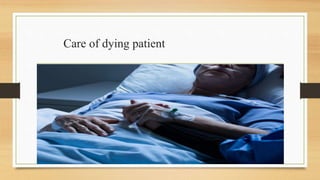
Care of dying patient
Hospice care
• Hospice is a concept of care that provides compassion, concern, and
support for he dying.
• It exists to provide support and care for the persons in last phases of
incurable diseases so that they can lead their life comfortably.
• Hospice care is given by a medically supervised interdisciplinary team of
professionals and volunteers.
Cont.…
• As a nurse it’s our responsibility to co- ordinate the team. Hospice nurse
works with hospice physicians, pharmacists, dieticians, social workers,
and volunteers to provide care and support to patient and family members.
• Hospice is a philosophy of care. The hospice philosophy or viewpoint
accepts death as the final stage of life. The goal of hospice is to enable
patients to continue an alert, pain free life and to manage other symptoms
so that their last days may be spent with dignity and quality, surrounded by
their loved ones.
Cont..
• Hospice care treats the person rather than the disease. It focuses on quality
rather than length of life. Hospice care is family centered care. It involves
the patient and the family in making decisions. Care is provided for the
patient and family 24 hrs. a day , 7 days a week.
• Hospice care can be given in the patient home, a hospital, nursing home,
or private hospice facility. Most hospice care in the united states is given
in the home, with a family member or members serving as the main hand-
on caregiver.
Palliative care
• Today, doctors are able to cure many people diagnosed with cancer. If a
cure is not possible, some people receive treatment to manage the manage
the symptoms and side effects of cancer and its treatment. This type of
treatment is called palliative care, and it helps people with cancer at all
stages at all stages of their illness live as comfortably-as-possible.
Goals of palliative care
• To prevent or treat as early as possible the symptoms of the disease, side
effects caused by treatment of the disease.
• To prevent or treat psychological, social, and spiritual problems related to
the disease or its treatment.
• To help people with life-threatening disease to live more comfortably.
• The goal of palliative care is to improve the patient’s and families.
Cont.…
• Palliative care emphasizes management of psychological, social, and
spiritual problem in addition to control of pain and other physical
symptoms. As the definition suggests, palliative care is not care that
begins when cure-focused treatment ends.
• Quality of life and many aspects of this type of comprehensive, comfort-
focused approach to care are applicable earlier in the process of life-
threatening disease in conjunction with cure focused treatment.
Management of psychological changes:-
• Withdrawal: patient near death my seem to be withdrawn from the
physical environment maintaining the ability to hear while not able to
respond. Converse as if the patient is alert, using a soft voice and gentle
touch.
• Unusual communication: patient may become restless and agitated or
perform repetitive tasks.
• Encourage the family to tell the dying person, it’s ok to go to be fine.
Cont.…
• Saying goodbyes: it is important for the patient and family members
acknowledge their sadness, mutually forgive one another and say
goodbye. Encourage the dying person and family members to verbalize
their feeling to of sadness, loss forgiveness, to touch, hug cry. Allow the
patient and family privacy to express their feeling and comfort one
another.
Advanced Directives
• Advance directive are legal documents that explain the kind of medical
treatment you would want and would not want if you become unable to
make these decision fro yourself.
• Advance directives protect your rights and preference for medical
treatment and diminish the burden of family members and other caregivers
making decisions for you. You can protect your rights and preference for
medical treatment by writing down your wishes in an advance directive
and having a witness or witnesses sign the statement.
Cont..
• It is important to talk with your family and doctor about your wishes
ahead of time, so they can be aware of your choices.
• Making and advance directive:-
• Any adult who is mentally and physically able to understand his or her
medical condition and express his or her preference can make an advance
directive.
• In most state, an advanced directive can be oral, although it is less likely
to be challenged if it is in writing.
Cont.…
• If you to another state, it is a good idea to complete a new advance
directive. It is important that you and other people involve in decisions
about your health care have accessible copies of your advance directive.
• Copies should also be given to any institution where you are treated (such
as a hospital, doctor’s office, or nursing home) and where you live. At this
time, there is no advance directive from that is valid in all 50 states.
• Check your state’s requirements and guidelines about advance directive
documents.
Types of advance directive
A. living will: this is a written set of instructions outlining your wishes
about types of medical care you may or may not want in order to sustain
life. A living will is also referred to as a directive to physician and family.
It is used in situation when you a life limiting illness and can no longer
communicate your wishes about medical care.
• Whether you want the medical team to use cardiopulmonary resuscitation
and or artificial life support, such as mechanical respirators, if your
breathing or heart stops.
Cont..
• Whether you would want to receive a feeding tube, if you cannot to be
otherwise?
• Whether you want certain procedures, such as kidney dialysis performed?
• Living wills can be as detailed as needed to make sure that your desires
and wishes for life sustaining treatment are honored. A living will can also
include directions about donating organ.
• B. Durable power of attorney for health care:- this type of advance
directive designates a person that will make medical decisions for you if
you become unable to make them yourself. The person you appoint is
often referred to as your health care proxy, agent, or attorney in face, and
has authority only over decisions, not other matters, such as finances.
• Any competent adult, age 18 or older, can be a health care agent. Your
health care agent can make decisions about your medical care after your
doctor certifies in writing that you are no longer able to make your own
decisions.
Legal documents used in end of life care:-
• Advance directives:- advance care directives are specific instructions,
prepared in advance, intended to direct a person’s medical care in the
event that he/she is unable to do so in the future.
• Durable power of attorney:- a legal document that allows an individual
to appoint someone else (proxy) to make medical or health care decision,
in the event the individual becomes unable to make and/or communicate
such decisions personally.
Cont..
• Medical power of attorney:- it is a term which describes a document
used for listing the person to make health care decisions when the patient
is unable to make decisions for self.
• Directive to physician:- A written document specifying the patients wish
to be allowed to die without heroic or extraordinary measures. Under this
acts patient can tell the physician that what treatment is or not desired.
Verbal directives are given to physician with specific instructions in the
presence of two witness in case.
Cont.…
• Euthanasia:- Refers to the practice of ending a life in painless manner.
Euthanasia may be conducted passively, non-actively, and actively.
Passive euthanasia entail the withholding of common treatments (such as
antibiotics, chemotherapy in cancer, or surgery) or the distribution of a
medication (such as morphine) to relieve pain, knowing that it may also
result in death. Passive euthanasia is the most accept form, and it is a
common practice in most hospitals. Active euthanasia entails the use of
lethal substances or forces to kill and is the most controversial means.
Cont..
• Assisted suicide-:assisted suicide is a form of euthanasia where the
patient actively takes the last step in their death. The term “assisted
suicide” is contrasted with “active euthanasia” when the difference
between providing the means and actively administering lethal medicine is
considered important. For example, Swiss law on assisted suicide allows
assisted suicide.
Care after death, equipment, procedure and care of unit:-
• Federal and state laws require institutions to develop policies and
procedures for certain events that after death, such as requesting organ or
tissue donation, performing an autopsy, certifying and documenting the
occurrence of a death, and providing safe and appropriate post-mortem
care. In accordance with federal law, a specially trained professional (e.g.
transplant coordinator or social worker) makes requests for organ and
tissue donation at the time of every death. The person requesting organ or
tissue donation provides information about who can give consent legally.
Cont.…
• In extremely stressful circumstance created by the loss of a loved one,
grieving survivors usually cannot remember all they were told. Nurses
provide support and reinforce or clarify explanation. In addition,
understanding the physiology of organ donation is often difficult for
family members. Patients who are brain dead remain on life support to
provide the vital organs with blood and oxygen before transplant, even
though they have been declared dead. The appearance of a live-looking
body confuses the family, and they need help to understand that the life
support is only preserving the vital organs.
Procedure Guideline
• Delegation and collaboration:- The skill of care of the body after death
can be delegation to assistive personnel. Nurses often find it meaningful to
help care for a patient after death and assist the assistive personnel
whenever possible. Instruct the assistive personnel to.
• Contact the nurse for all questions and procedures related to organ/tissue
donation and autopsy requests.
• Alert nurse to family members questions related to manner of death or
after death activities.
Cont..
• Equipment-: bath towel, washcloth, washbasin, scissors, clean disposable
gloves, gown (if high risk of exposure to body fluids), shroud kit with
name tags, bed linen, documentation forms.
• Steps:-
• 1. Confirm that the health care provider certified the death and
documented the time of death and action taken.
• 2. Determine whether the health care provider requested an autopsy is
required for deaths that occur under certain circumstances.
Cont.…
• 3. Validate the status of request for organ or tissue donation. Given the
complex and sensitive nature of such requests, only specially trained
personnel make the requests. Maintain sensitivity to personal, spiritual,
religious, and cultural beliefs in the process.
• 4. Identify the patient using two identifiers ( e.g. name and birthday or
name and medical record number according to agency policy.)
• 5. perform hand hygiene and apply disposable gloves. Apply gown if risk
of exposure to body fluid is high.
Cont..
• 6. Provide sensitive and dignified nursing care to the patient and family.
a. Elevate the head of the bed as soon as possible after death to prevent
discoloration of the face.
b. Collect ordered specimens.
c. Ask whether the family wishes to participate in preparation of the body.
Offer to contact someone to be there to support the family (patient/family
religious leader, spiritual care personnel, or bereavement specialist) during
body preparation.
Cont.…
d. Ask about family requests for body preparation, such as wearing special
clothing or religious artifacts. Be aware that personal, religious, or cultural
practices determine whether to shave male facial hair. Get permission
before shaving a beard.
e. Remove all equipment, tubes, and indwelling lines. Note that autopsy or
organ donation often poses exceptions to removal. Therefore consult
agency policy in these situations.
Cont..
f. Cleanse the body thoroughly, maintain safety standards for body fluids and
contamination when indicated. Remove gloves and gown (if needed) and
perform hand hygiene.
g. Comb patient’s hair or apply personal hairpieces.
h. Cover body with a clean sheet, place head on a pillow, and arms outside covers
if possible. Close eyes by gently holding them shut; leave denture in the mouth to
maintain facial shape; cover any signs of body trauma.
i. prepare and clean the environment, deodorize room if needed, and lower the
lights.
Cont..
J. Offer family members the option to view the body. Ask whether they
want you or other support people to accompany them. Honor and respect
individual choices.
k. Encourage grievers to say goodbye in their own way: word, touch,
singing, spiritual or religious rituals, or prayers.
l. Provide privacy and a quiet, peaceful atmosphere. Assess family
members need or desire for your presence. If your leave, tell them how to
reach you.
Cont..
m. Determine which personal belongings stay with the body (e.g. wedding ring
or religious symbol), and give other personal items taken, and who received
them. Save any items that are left are left behind accidentally and contact family
for further instructions.
n. apply identifying name tags and shroud according to agency policy before
transporting the body. Perform hand hygiene.
o. Complete documentation in the narrative notes section.
p. Maintain privacy and dignity when transporting the body to another location,
cover the body or stretcher with a clean sheet.
Autopsy And Embalming
• Autopsy (the surgical dissection of body after death) to determine the
exact cause and circumstances of death or to discover the pathway of a
disease. In most cases a coroner or medical examiner determines the need
to perform an autopsy. Law sometimes requires that an autopsy be
performed when death is the result of foul play; homicide; suicide; or
drugs, or deaths within 24 hrs of hospital admission. Follow state and
agency requirements regarding removal of lines (e.g. intravenous lines,
indwelling urinary catheter) in patients when an autopsy is ordered.
Cont.…
• Usually a health care provider asks for autopsy permission while the nurse
answer questions and supports the family choices. Inform family members that
an autopsy dose not deform the body and that all organs are replaced in the body.
Family members are often comforted to know that others may be helped by
either the gift of organ and tissue donation or autopsy. Respect and honour family
wishes and final decision.
• Family members deserve and expect a clear description of what happened to their
loved one, especially in cases of sudden, unusual, or unexpected circumstance.
Give only factual information in a non-judgmental, objective manner, and
sharing of the written request.
Embalming
• Embalming is the art and science of preserving human body by treating
them with chemicals to prevent decomposition. Embalming is meant to
temporarily preserve the body of a deceased person.
Purpose
• To keep the body suitable for public display at a funeral.
• For medical and scientific purposes such as their use as anatomical
SpecimensChemicals used for Embalming
• Formaldehyde
• Glutaraldehyde
• Ethanol
Steps
Arterial embalming
Cavity embalming
Hypodermic embalming
Surface embalming
Thank you