UTERINE CERVIX
Dr. Saumya, Dept of Pathology, SIMS
www.shadan.in
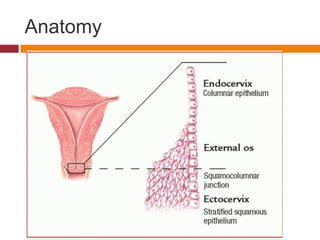
Anatomy
Squamo columnar junction
Normal cervix [gross] - nulliparous woman
Normal ectocervical epithelium - stratified squamous
 Production of estrogens by ovary stimulates
maturation of the cervical and vaginal squamous
mucosa and formation of intracellular glycogen
vacuoles in the cells
 Glycogen provides a substrate for various
endogenous vaginal aerobes and anaerobes, but
particularly lactobacilli, which are the dominant
microbial species in the normal vagina
 Lactobacilli produce lactic acid, which maintains
the vaginal pH below 4.5, suppressing the growth
of other saprophytic and pathogenic organisms
Inflammatory conditions
INFLAMMATIONS:
ACUTE & CHRONIC CERVICITIS:
 Gonococci,
 Chlamydiae,
 Mycoplasmas,
 Herpes virus [type 2],
 Tuberculosis,
[sterility]
Cervicitis
Cervicitis
 Marked cervical inflammation
produces reparative and reactive
changes of the epithelium and
shedding of atypical-appearing
squamous cells, and therefore may
cause an abnormal Pap test result
Endocervical polyps
Endocervical polyps:
 2 to 5 % of adult women
 Common benign exophytic growths that arise
within the endocervical canal
 CLINICAL FEATURES: Irregular vaginal ‘
spotting’
 GROSS: small, sessile “bumps” to large
polypoid masses
 MICRO: dense fibrous stroma covered with
endocervical epithelium
 Simple curettage OR excision.
Cervical cancerand cervical
intraepithelial neoplasia ( CIN )
 Worldwide, cervical carcinoma is the third
most common cancer in women
 remarkable benefits of effective screening,
early diagnosis, and curative therapy
Risk factors
 The risk factors for cervical cancer are related
to both host and viral characteristics such as
HPV exposure, viral oncogenicity, inefficiency
of immune response, and presence of co-
carcinogens
Major risk factors:
1. Early age at first sexual
intercourse,
2. Multiple sexual partners
3. Male partner with previous
multiple sexual partners
Sexually
transmitted
agent ---
HPV
Risk factors
Other risk factors:
 Oral contraceptives,
 Cigarette smoking,
 Parity,
 Family history,
 Genital infections,
 Lack of circumcision of male
partner - smegma
Human Papilloma Virus [HPV]
 Vulvar condyloma acuminatum,
 Vulvar & vaginal squamous cell
carcinomas,
 85% cervical cancers,
 90% condylomata & precancerous lesions;
 DNA virus
Pathogenesis
 High-risk types -- > carcinoma,
- 16, 18, 31, 33,
- Transform cells in tissue culture,
- Viral DNA integrated with host DNA,
 Low-risk types -->condyloma acuminatum
--- 6, 11, 42 & 44,
- Episomal viral DNA;
HPV
 Infect immature basal cells of the squamous
epithelium
 Mature cells are arrested in the G1 phase of
the cell cycle, but they continue to actively
progress through the cell cycle when infected
with HPV, which uses the host cell DNA
synthesis machinery to replicate its own
genome
SQUAMOUS
DIFFERENTIATION
Infection
basal cells
Early (Non-structural)
protein synthesis
LATENTLATENT
INFECTIONINFECTION
Condyloma
or CIN-1
[koilocytosis]
Integration[ISH]
+ Oncogenes
- Tumour suppressor genes
INVASIVE
CARCINOMA
Productive
DNA synthesis
Late [capsid]Late [capsid]
protein synthesisprotein synthesis
[IH][IH]
Viral
particles [EM]
DesquamationDesquamation
transmissiontransmission
HPV life cycle
Episomal DNA
replication (ISH)
Pathogenesis
E6 protein promotes
upregulates telomerase and bind to p53
promote its degradation
E7 protein binds the hypophosphorylated
(active) form of RB and promotes its
degradation via the
proteasome pathway,
Uninfected
cell
infected
cell
Deregulation of restriction point R by
HPV 16 E7
Cervical cancer and HPV
infection
Cytopathic effects of HPV
Nuclear enlargement, nuclear
pyknosis or
hyperchromaticity,
anisocytosis, multinucleation,
and
perinuclear cytoplasmic
vacuolization
(a) Histological features of a
lesion is classified as LSIL
(b) Cytological features of
LSIL
Electron microscopy
(a) intranuclear
aggregates of HPV
in a koilocytotic,
superficial cell of an
HSIL. The
marginated nuclear
chromatin is
agglutinated,
cytoplasmic
substance displays
vacuolar
degeneration (vd)-
koilocytotic
ballooning on light
microscopy
(b) Higher
magnification
Koilocytes – perinuclear halo caused by E5 that localizes to the membranes of the
endoplasmic reticulum.
Cervical Intraepithelial Neoplasia
(CIN)
Precancerous lesions
Cervical cancer 3 to 20 yrs.
( can be diagnosed by pap smear)
1. Continuum of changes
2. Not invariably progress to cancer
3. Associated with HPV
SQUAMOUS CELL
CARCINOMA
Pathogenesis
of cervical
neoplasia
Sexual activity
HPV exposure
Cervical transformation zone
Ectocervix Squamous epithelium
Low grade
Low-risk HPVs
6,11,42-44,
High grade
High-risk HPVs
16,18,31,33,35
Smoking , oral contraceptives, high parity, altered
immune status, host gene alterations, time
Endocervical columnar epithelium
Glandular intraepithelial lesion
(adenocarcinoma-in-situ)
High-risk HPVs
INVASIVE SQUAMOUS CARCINOMA ADENOCARCINOMA
rare
 The diagnosis of SIL is based on
identification of nuclear atypia
characterized by nuclear
enlargement, hyperchromasia (dark
staining), coarse chromatin granules,
and variation in nuclear size and
shape
 The grading of SIL into low or high grade is
based on expansion of the immature cell layer
from its normal, basal location
 LSIL does not progress directly to invasive
carcinoma and in fact most cases regress
spontaneously; only a small percentage
progress to HSIL
Chronic cervicitis with dysplasia
Chronic cervicitis with moderate dysplasia [ CIN - II ]
Carcinoma cervix - Morphology
 Gross: - Fungating ( Exophytic ),
- Ulcerative,
- Infiltrative;
 Micro:
.. Squamous cell carcinomas --- 75 - 90% ,
* 95% - large cell type,
* 5% - Small cell undifferentiated,
.. Adenocarcinomas
.. Adenosquamous carcinomas
.. Undifferentiated carcinomas 10 to
25%
Carcinoma, cervix - gross
Carcinoma, cervix involving the vagina
Carcinoma, cervix infiltrating the uterine corpus
LSIL H & E ISH for HPV DNA Ki67 p16INK4 IHC
Clinical course:
 Asymptomatic,
 Irregular vaginal bleeding or
bleeding on touch,
 Leukorrhea,
 Dysuria;
Diagnosis
 Pap test( Cervical cytology)
– to detect epithelial cell abnormalities
 Colposcopy
 Cervical biopsies:
• Colposcopic biopsies
• Endocervical curettage
• Cone biopsy
The pap test
 The Pap test is considered by many to be the
most cost effective cancer reduction program
ever devised
 1928- George N. Papanicolaou
 1940s- screening
programmes started
Screening methods
Approximate lifetime risks of acquiring
HPV & Death by cervical cancer:
HPV
HPV
75%
Population
50%
High-risk
HPV 10%
Persistent
High-grade
CIN
1. 3%
Invasive
Carcinoma
0. 4%
DEATH
Prognosis:
5 - year survival rate:
Stage - I = 80 to 90 %,
Stage - II = 75%,
Stage - III = 35% ,
Stage - IV = 10 to 15%.
 Gardasil (Merck & Co., Inc.)-
quadrivalent- HPV 6, 11, 16,18
 Cervarix (GlaxoSmithKline)-
bivalent - HPV 16 and 18
 They have shown extraordinary
efficacy in preventing type-specific
histologic CIN 2,3 lesions
 Administered in three doses to
females ages 9 to 26 years before
the initiation of sexual activity
Summary
HPV
VACCIN
E
PAP
SMEAR
VIA &
VILI
SURGER
Y &
RADIOTH
ERAPY
WHO comprehensive cancer
prevention and control
 Primary prevention- Education to reduce high-risk sexual
behavior to limit HPV transmission/acquisition
Delay age of first sexual intercourse
Condom use, limit number of partners, change in sexual
behavior
HPV vaccination
 Early detection (secondary prevention)
Scre e ning : Identify and treat precancerous lesions before
they progress to cervical cancer
Early diag no sis : Identify and treat early cancer while the
chance of cure is still good (reduces cervical cancer mortality)
 Tertiary prevention:
Tre atm e nt o f invasive cance r
Palliative care
 Health Systemstrengthening
Normal
cervical
epithelium
Pre-cancerous
lesions
Eliminated
lesion
Clinicalinvasive
cervicalcancer
Deathfromcvx
cancer
Cure
+Sexual promiscuity
-HPV
-(HS II)
-(Trichomonas vaginalis)
-(HIV)
-.......
+Smoking
+Hormonal contraception
+Age
+Cohortphenomena
+HPV vaccination
RISKFACTORS
PROTECTIVEFACTORS
Screening
Follow-up
Treatment
+Participation screening
+Frequency screening
+Targetpopulation
+Quality screentest
+Follow-up/treatment-strategy
+Compliance follow-up/treatment
Primaryprevention
Secondaryprevention
Cancer
treatment
+Earlyconsultation&diagnosis
+ Phase
+Therapy
+ Age
SURVIVAL
Preclinical
invasivecancer
Cervix

Cervix

  • 1.
    UTERINE CERVIX Dr. Saumya,Dept of Pathology, SIMS www.shadan.in
  • 2.
  • 3.
  • 4.
    Normal cervix [gross]- nulliparous woman
  • 5.
    Normal ectocervical epithelium- stratified squamous
  • 6.
     Production ofestrogens by ovary stimulates maturation of the cervical and vaginal squamous mucosa and formation of intracellular glycogen vacuoles in the cells  Glycogen provides a substrate for various endogenous vaginal aerobes and anaerobes, but particularly lactobacilli, which are the dominant microbial species in the normal vagina  Lactobacilli produce lactic acid, which maintains the vaginal pH below 4.5, suppressing the growth of other saprophytic and pathogenic organisms
  • 7.
  • 8.
    INFLAMMATIONS: ACUTE & CHRONICCERVICITIS:  Gonococci,  Chlamydiae,  Mycoplasmas,  Herpes virus [type 2],  Tuberculosis, [sterility]
  • 9.
  • 10.
    Cervicitis  Marked cervicalinflammation produces reparative and reactive changes of the epithelium and shedding of atypical-appearing squamous cells, and therefore may cause an abnormal Pap test result
  • 11.
  • 12.
    Endocervical polyps:  2to 5 % of adult women  Common benign exophytic growths that arise within the endocervical canal  CLINICAL FEATURES: Irregular vaginal ‘ spotting’  GROSS: small, sessile “bumps” to large polypoid masses  MICRO: dense fibrous stroma covered with endocervical epithelium  Simple curettage OR excision.
  • 13.
  • 14.
     Worldwide, cervicalcarcinoma is the third most common cancer in women  remarkable benefits of effective screening, early diagnosis, and curative therapy
  • 15.
    Risk factors  Therisk factors for cervical cancer are related to both host and viral characteristics such as HPV exposure, viral oncogenicity, inefficiency of immune response, and presence of co- carcinogens
  • 16.
    Major risk factors: 1.Early age at first sexual intercourse, 2. Multiple sexual partners 3. Male partner with previous multiple sexual partners Sexually transmitted agent --- HPV Risk factors
  • 17.
    Other risk factors: Oral contraceptives,  Cigarette smoking,  Parity,  Family history,  Genital infections,  Lack of circumcision of male partner - smegma
  • 18.
    Human Papilloma Virus[HPV]  Vulvar condyloma acuminatum,  Vulvar & vaginal squamous cell carcinomas,  85% cervical cancers,  90% condylomata & precancerous lesions;  DNA virus
  • 19.
    Pathogenesis  High-risk types-- > carcinoma, - 16, 18, 31, 33, - Transform cells in tissue culture, - Viral DNA integrated with host DNA,  Low-risk types -->condyloma acuminatum --- 6, 11, 42 & 44, - Episomal viral DNA;
  • 20.
    HPV  Infect immaturebasal cells of the squamous epithelium  Mature cells are arrested in the G1 phase of the cell cycle, but they continue to actively progress through the cell cycle when infected with HPV, which uses the host cell DNA synthesis machinery to replicate its own genome
  • 22.
    SQUAMOUS DIFFERENTIATION Infection basal cells Early (Non-structural) proteinsynthesis LATENTLATENT INFECTIONINFECTION Condyloma or CIN-1 [koilocytosis] Integration[ISH] + Oncogenes - Tumour suppressor genes INVASIVE CARCINOMA Productive DNA synthesis Late [capsid]Late [capsid] protein synthesisprotein synthesis [IH][IH] Viral particles [EM] DesquamationDesquamation transmissiontransmission HPV life cycle Episomal DNA replication (ISH)
  • 24.
    Pathogenesis E6 protein promotes upregulatestelomerase and bind to p53 promote its degradation E7 protein binds the hypophosphorylated (active) form of RB and promotes its degradation via the proteasome pathway,
  • 25.
  • 26.
    Deregulation of restrictionpoint R by HPV 16 E7
  • 27.
    Cervical cancer andHPV infection
  • 28.
    Cytopathic effects ofHPV Nuclear enlargement, nuclear pyknosis or hyperchromaticity, anisocytosis, multinucleation, and perinuclear cytoplasmic vacuolization (a) Histological features of a lesion is classified as LSIL (b) Cytological features of LSIL
  • 29.
    Electron microscopy (a) intranuclear aggregatesof HPV in a koilocytotic, superficial cell of an HSIL. The marginated nuclear chromatin is agglutinated, cytoplasmic substance displays vacuolar degeneration (vd)- koilocytotic ballooning on light microscopy (b) Higher magnification
  • 30.
    Koilocytes – perinuclearhalo caused by E5 that localizes to the membranes of the endoplasmic reticulum.
  • 31.
    Cervical Intraepithelial Neoplasia (CIN) Precancerouslesions Cervical cancer 3 to 20 yrs. ( can be diagnosed by pap smear) 1. Continuum of changes 2. Not invariably progress to cancer 3. Associated with HPV
  • 32.
  • 34.
    Pathogenesis of cervical neoplasia Sexual activity HPVexposure Cervical transformation zone Ectocervix Squamous epithelium Low grade Low-risk HPVs 6,11,42-44, High grade High-risk HPVs 16,18,31,33,35 Smoking , oral contraceptives, high parity, altered immune status, host gene alterations, time Endocervical columnar epithelium Glandular intraepithelial lesion (adenocarcinoma-in-situ) High-risk HPVs INVASIVE SQUAMOUS CARCINOMA ADENOCARCINOMA rare
  • 35.
     The diagnosisof SIL is based on identification of nuclear atypia characterized by nuclear enlargement, hyperchromasia (dark staining), coarse chromatin granules, and variation in nuclear size and shape
  • 38.
     The gradingof SIL into low or high grade is based on expansion of the immature cell layer from its normal, basal location  LSIL does not progress directly to invasive carcinoma and in fact most cases regress spontaneously; only a small percentage progress to HSIL
  • 39.
  • 40.
    Chronic cervicitis withmoderate dysplasia [ CIN - II ]
  • 41.
    Carcinoma cervix -Morphology  Gross: - Fungating ( Exophytic ), - Ulcerative, - Infiltrative;  Micro: .. Squamous cell carcinomas --- 75 - 90% , * 95% - large cell type, * 5% - Small cell undifferentiated, .. Adenocarcinomas .. Adenosquamous carcinomas .. Undifferentiated carcinomas 10 to 25%
  • 42.
  • 43.
  • 44.
  • 47.
    LSIL H &E ISH for HPV DNA Ki67 p16INK4 IHC
  • 48.
    Clinical course:  Asymptomatic, Irregular vaginal bleeding or bleeding on touch,  Leukorrhea,  Dysuria;
  • 49.
    Diagnosis  Pap test(Cervical cytology) – to detect epithelial cell abnormalities  Colposcopy  Cervical biopsies: • Colposcopic biopsies • Endocervical curettage • Cone biopsy
  • 50.
    The pap test The Pap test is considered by many to be the most cost effective cancer reduction program ever devised  1928- George N. Papanicolaou  1940s- screening programmes started
  • 53.
  • 54.
    Approximate lifetime risksof acquiring HPV & Death by cervical cancer: HPV HPV 75% Population 50% High-risk HPV 10% Persistent High-grade CIN 1. 3% Invasive Carcinoma 0. 4% DEATH
  • 55.
    Prognosis: 5 - yearsurvival rate: Stage - I = 80 to 90 %, Stage - II = 75%, Stage - III = 35% , Stage - IV = 10 to 15%.
  • 56.
     Gardasil (Merck& Co., Inc.)- quadrivalent- HPV 6, 11, 16,18  Cervarix (GlaxoSmithKline)- bivalent - HPV 16 and 18  They have shown extraordinary efficacy in preventing type-specific histologic CIN 2,3 lesions  Administered in three doses to females ages 9 to 26 years before the initiation of sexual activity
  • 57.
  • 58.
    WHO comprehensive cancer preventionand control  Primary prevention- Education to reduce high-risk sexual behavior to limit HPV transmission/acquisition Delay age of first sexual intercourse Condom use, limit number of partners, change in sexual behavior HPV vaccination  Early detection (secondary prevention) Scre e ning : Identify and treat precancerous lesions before they progress to cervical cancer Early diag no sis : Identify and treat early cancer while the chance of cure is still good (reduces cervical cancer mortality)  Tertiary prevention: Tre atm e nt o f invasive cance r Palliative care  Health Systemstrengthening
  • 59.
    Normal cervical epithelium Pre-cancerous lesions Eliminated lesion Clinicalinvasive cervicalcancer Deathfromcvx cancer Cure +Sexual promiscuity -HPV -(HS II) -(Trichomonasvaginalis) -(HIV) -....... +Smoking +Hormonal contraception +Age +Cohortphenomena +HPV vaccination RISKFACTORS PROTECTIVEFACTORS Screening Follow-up Treatment +Participation screening +Frequency screening +Targetpopulation +Quality screentest +Follow-up/treatment-strategy +Compliance follow-up/treatment Primaryprevention Secondaryprevention Cancer treatment +Earlyconsultation&diagnosis + Phase +Therapy + Age SURVIVAL Preclinical invasivecancer