MOLECULAR BIOLOGY
GENE ORGANIZATION
TODAY WE GO THOUGH THE TOPICS
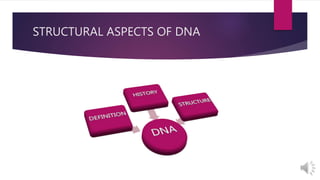
 Structural aspects of DNA
 The double helix model
 Conformations of DNA
QUESTIONS WE COVER
 What is DNA ?
 Structure of DNA ?
 History of DNA?
 Types of DNA?
 Double helix model of DNA?
 Who discovered the DNA?
 With what DNA is made up of?
STRUCTURAL ASPECTS OF DNA
DNA
 Deoxyribonucleic acid, or DNA, is a molecule that
contains the instructions an organism needs to develop,
live and reproduce.
 These instructions are found inside every cell, and are
passed down from parents to their children.
 Its one long molecule that contains our genetic ‘code’.
DEFINITION OF DNA
 Deoxyribonucleic acid is a molecule composed of two
polynucleotide chains that coil around each other to form
a double helix carrying genetic instructions for the
development, functioning, growth and reproduction of all
known organisms many viruses.
 It is a carrier of all genetic information.
 DNA and RNA are nucleic acids.
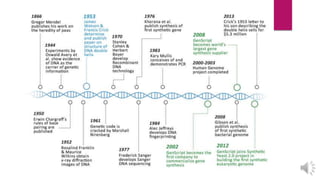
HISTORY OF DNA
 Many people believe that American biologist James Watson and
English physicist Francis Crick discovered DNA in the 1950’s. In
reality, this is not the case. Rather, DNA was first identified in the late
1860’s by Swiss chemist Friedrich Miescher.
 The discovery in 1953 of the double helix, the twisted- ladder structure
of deoxyribonucleic acid(DNA), by James Watson and Francis Crick
marked a milestone in the history of science and gave rise to modern
molecular biology, which is largely concerned with understanding how
genes control the chemical processes.
STRUCTURE OF DNA
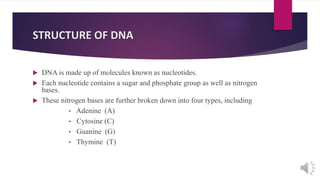
 DNA is made up of molecules known as nucleotides.
 Each nucleotide contains a sugar and phosphate group as well as nitrogen
bases.
 These nitrogen bases are further broken down into four types, including
• Adenine (A)
• Cytosine (C)
• Guanine (G)
• Thymine (T)
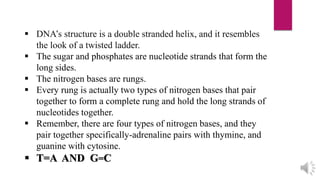
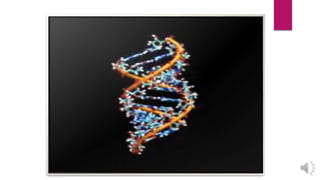
 DNA’s structure is a double stranded helix, and it resembles
the look of a twisted ladder.
 The sugar and phosphates are nucleotide strands that form the
long sides.
 The nitrogen bases are rungs.
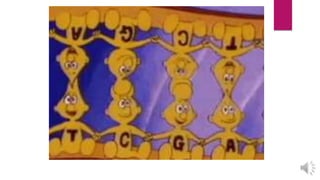
 Every rung is actually two types of nitrogen bases that pair
together to form a complete rung and hold the long strands of
nucleotides together.
 Remember, there are four types of nitrogen bases, and they
pair together specifically-adrenaline pairs with thymine, and
guanine with cytosine.
 T=A AND G=C
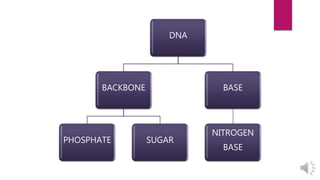
DNA
BACKBONE
PHOSPHATE SUGAR
BASE
NITROGEN
BASE
• Human DNA is unique in that it is made up of nearly 3
billion base pairs, and about 99 percent of them are the
same in every human.
• However, it’s the sequence of these bases that determines
what information is available to both build and maintain
any organism.
DOUBLE HELIX STRUCTURE
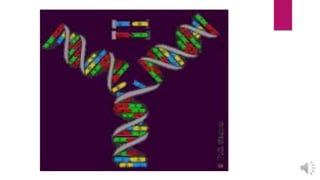
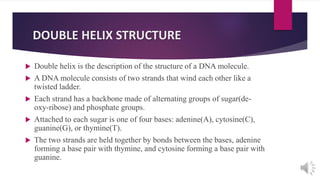
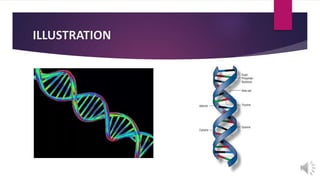
 Double helix is the description of the structure of a DNA molecule.
 A DNA molecule consists of two strands that wind each other like a
twisted ladder.
 Each strand has a backbone made of alternating groups of sugar(de-
oxy-ribose) and phosphate groups.
 Attached to each sugar is one of four bases: adenine(A), cytosine(C),
guanine(G), or thymine(T).
 The two strands are held together by bonds between the bases, adenine
forming a base pair with thymine, and cytosine forming a base pair with
guanine.
ILLUSTRATION
CONFORMATIONS OF DNA
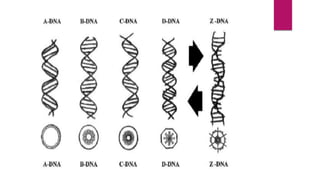
 The different types of DNA are:
• B-DNA
• A-DNA
• Z-DNA
• C-DNA
• D-DNA
• E-DNA
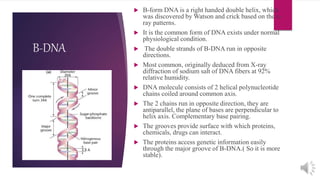
B-DNA
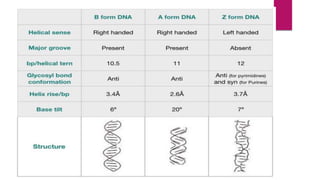
 B-form DNA is a right handed double helix, which
was discovered by Watson and crick based on the x-
ray patterns.
 It is the common form of DNA exists under normal
physiological condition.
 The double strands of B-DNA run in opposite
directions.
 Most common, originally deduced from X-ray
diffraction of sodium salt of DNA fibers at 92%
relative humidity.
 DNA molecule consists of 2 helical polynucleotide
chains coiled around common axis.
 The 2 chains run in opposite direction, they are
antiparallel, the plane of bases are perpendicular to
helix axis. Complementary base pairing.
 The grooves provide surface with which proteins,
chemicals, drugs can interact.
 The proteins access genetic information easily
through the major groove of B-DNA.( So it is more
stable).
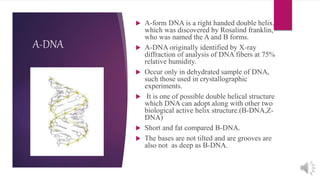
A-DNA
 A-form DNA is a right handed double helix,
which was discovered by Rosalind franklin,
who was named the A and B forms.
 A-DNA originally identified by X-ray
diffraction of analysis of DNA fibers at 75%
relative humidity.
 Occur only in dehydrated sample of DNA,
such those used in crystallographic
experiments.
 It is one of possible double helical structure
which DNA can adopt along with other two
biological active helix structure.(B-DNA,Z-
DNA)
 Short and fat compared B-DNA.
 The bases are not tilted and are grooves are
also not as deep as B-DNA.
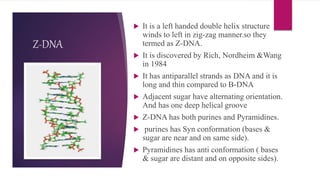
Z-DNA
 It is a left handed double helix structure
winds to left in zig-zag manner.so they
termed as Z-DNA.
 It is discovered by Rich, Nordheim &Wang
in 1984
 It has antiparallel strands as DNA and it is
long and thin compared to B-DNA
 Adjacent sugar have alternating orientation.
And has one deep helical groove
 Z-DNA has both purines and Pyramidines.
 purines has Syn conformation (bases &
sugar are near and on same side).
 Pyramidines has anti conformation ( bases
& sugar are distant and on opposite sides).
C-DNA, D-DNA, AND
E-DNA ARE THE
FORMS OF DNA.
A-DNA, B-DNA AND Z-
DNA ARE THE TYPES OF
DNA.
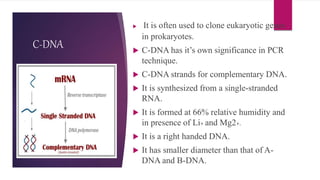
C-DNA
 It is often used to clone eukaryotic genes
in prokaryotes.
 C-DNA has it’s own significance in PCR
technique.
 C-DNA strands for complementary DNA.
 It is synthesized from a single-stranded
RNA.
 It is formed at 66% relative humidity and
in presence of Li+ and Mg2+.
 It is a right handed DNA.
 It has smaller diameter than that of A-
DNA and B-DNA.
D-DNA
 It is a rare variant with 8 base pairs per
helical turn.
 These forms of DNA found in some
DNA molecules devoid of guanine.
 The tilt of 16.7° from the axis of the
helix.
 The axis rise of 3.03A° per base pairs.
 Actually 2 different forms of D-DNA.
• D(A): takes part in D-A-B
transition.
• D(B): associated with D-B change
of conformation.
E-dna
 Extended or eccentric DNA.
 E-DNA has a long helical axis rise
and base perpendicular to the
helical axis.
 E-DNA allowed to crystallize for a
period time longer, the methylated
sequence forms standard A-DNA.
 E-DNA is the intermediate in the
crystallographic pathway from B-
DNA to A-DNA.
DNA structure, history , definition and double helix model

DNA structure, history , definition and double helix model

  • 1.
  • 2.
    TODAY WE GOTHOUGH THE TOPICS  Structural aspects of DNA  The double helix model  Conformations of DNA
  • 3.
    QUESTIONS WE COVER What is DNA ?  Structure of DNA ?  History of DNA?  Types of DNA?  Double helix model of DNA?  Who discovered the DNA?  With what DNA is made up of?
  • 4.
  • 5.
    DNA  Deoxyribonucleic acid,or DNA, is a molecule that contains the instructions an organism needs to develop, live and reproduce.  These instructions are found inside every cell, and are passed down from parents to their children.  Its one long molecule that contains our genetic ‘code’.
  • 6.
    DEFINITION OF DNA Deoxyribonucleic acid is a molecule composed of two polynucleotide chains that coil around each other to form a double helix carrying genetic instructions for the development, functioning, growth and reproduction of all known organisms many viruses.  It is a carrier of all genetic information.  DNA and RNA are nucleic acids.
  • 7.
    HISTORY OF DNA Many people believe that American biologist James Watson and English physicist Francis Crick discovered DNA in the 1950’s. In reality, this is not the case. Rather, DNA was first identified in the late 1860’s by Swiss chemist Friedrich Miescher.  The discovery in 1953 of the double helix, the twisted- ladder structure of deoxyribonucleic acid(DNA), by James Watson and Francis Crick marked a milestone in the history of science and gave rise to modern molecular biology, which is largely concerned with understanding how genes control the chemical processes.
  • 9.
    STRUCTURE OF DNA DNA is made up of molecules known as nucleotides.  Each nucleotide contains a sugar and phosphate group as well as nitrogen bases.  These nitrogen bases are further broken down into four types, including • Adenine (A) • Cytosine (C) • Guanine (G) • Thymine (T)
  • 10.
     DNA’s structureis a double stranded helix, and it resembles the look of a twisted ladder.  The sugar and phosphates are nucleotide strands that form the long sides.  The nitrogen bases are rungs.  Every rung is actually two types of nitrogen bases that pair together to form a complete rung and hold the long strands of nucleotides together.  Remember, there are four types of nitrogen bases, and they pair together specifically-adrenaline pairs with thymine, and guanine with cytosine.  T=A AND G=C
  • 11.
  • 15.
    • Human DNAis unique in that it is made up of nearly 3 billion base pairs, and about 99 percent of them are the same in every human. • However, it’s the sequence of these bases that determines what information is available to both build and maintain any organism.
  • 16.
    DOUBLE HELIX STRUCTURE Double helix is the description of the structure of a DNA molecule.  A DNA molecule consists of two strands that wind each other like a twisted ladder.  Each strand has a backbone made of alternating groups of sugar(de- oxy-ribose) and phosphate groups.  Attached to each sugar is one of four bases: adenine(A), cytosine(C), guanine(G), or thymine(T).  The two strands are held together by bonds between the bases, adenine forming a base pair with thymine, and cytosine forming a base pair with guanine.
  • 17.
  • 18.
    CONFORMATIONS OF DNA The different types of DNA are: • B-DNA • A-DNA • Z-DNA • C-DNA • D-DNA • E-DNA
  • 19.
    B-DNA  B-form DNAis a right handed double helix, which was discovered by Watson and crick based on the x- ray patterns.  It is the common form of DNA exists under normal physiological condition.  The double strands of B-DNA run in opposite directions.  Most common, originally deduced from X-ray diffraction of sodium salt of DNA fibers at 92% relative humidity.  DNA molecule consists of 2 helical polynucleotide chains coiled around common axis.  The 2 chains run in opposite direction, they are antiparallel, the plane of bases are perpendicular to helix axis. Complementary base pairing.  The grooves provide surface with which proteins, chemicals, drugs can interact.  The proteins access genetic information easily through the major groove of B-DNA.( So it is more stable).
  • 20.
    A-DNA  A-form DNAis a right handed double helix, which was discovered by Rosalind franklin, who was named the A and B forms.  A-DNA originally identified by X-ray diffraction of analysis of DNA fibers at 75% relative humidity.  Occur only in dehydrated sample of DNA, such those used in crystallographic experiments.  It is one of possible double helical structure which DNA can adopt along with other two biological active helix structure.(B-DNA,Z- DNA)  Short and fat compared B-DNA.  The bases are not tilted and are grooves are also not as deep as B-DNA.
  • 21.
    Z-DNA  It isa left handed double helix structure winds to left in zig-zag manner.so they termed as Z-DNA.  It is discovered by Rich, Nordheim &Wang in 1984  It has antiparallel strands as DNA and it is long and thin compared to B-DNA  Adjacent sugar have alternating orientation. And has one deep helical groove  Z-DNA has both purines and Pyramidines.  purines has Syn conformation (bases & sugar are near and on same side).  Pyramidines has anti conformation ( bases & sugar are distant and on opposite sides).
  • 24.
    C-DNA, D-DNA, AND E-DNAARE THE FORMS OF DNA. A-DNA, B-DNA AND Z- DNA ARE THE TYPES OF DNA.
  • 25.
    C-DNA  It isoften used to clone eukaryotic genes in prokaryotes.  C-DNA has it’s own significance in PCR technique.  C-DNA strands for complementary DNA.  It is synthesized from a single-stranded RNA.  It is formed at 66% relative humidity and in presence of Li+ and Mg2+.  It is a right handed DNA.  It has smaller diameter than that of A- DNA and B-DNA.
  • 26.
    D-DNA  It isa rare variant with 8 base pairs per helical turn.  These forms of DNA found in some DNA molecules devoid of guanine.  The tilt of 16.7° from the axis of the helix.  The axis rise of 3.03A° per base pairs.  Actually 2 different forms of D-DNA. • D(A): takes part in D-A-B transition. • D(B): associated with D-B change of conformation.
  • 27.
    E-dna  Extended oreccentric DNA.  E-DNA has a long helical axis rise and base perpendicular to the helical axis.  E-DNA allowed to crystallize for a period time longer, the methylated sequence forms standard A-DNA.  E-DNA is the intermediate in the crystallographic pathway from B- DNA to A-DNA.