RESPIRATORY PHYSIOLOGY
MODERATED BY PRESENTRD BY
DR YOGESH NARWAT DR RAJU GANDHAM
MD ANAESTHESIA
RESPIRATORY CENTRES OF CNS and CONTROL OF
BREATHING
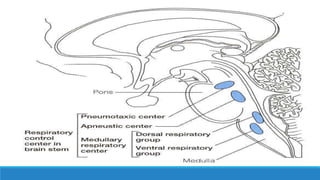
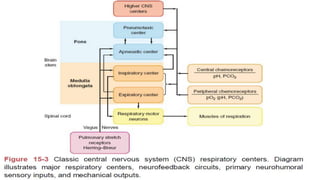
Primary portions that control ventilation -Medulla Oblongata & Pons
Respiratory centers :
Inspiratory centre (DORSAL RESPIRATORY GROUP)
Expiratory centre (VENTRAL RESPIRATORY GROUP)
Pneumotaxic centre (UPPER PONS)
• Sends continual inhibitory impulses to inspiratory center of the medulla oblongata,
• As impulse frequency rises, breathe faster and shallower
Apneustic centre (LOWER PONS)
•Stimulation causes apneusis –deep, gasping inspiration
•Integrates inspiratory cut off information
CENTRAL AND PERIPHERAL CHEMORECEPTORS
Central chemoreceptors are located in medulla oblangata of brain stem.
They detect changes in arterial pCO2 ,pH (H+) when change is detected
,the receptors send impulses to the respiratory centres in brain stem that
initiate changes in ventilation to restore normal pCO2
Detection of increased in pCO2 leads to an increased ventilation , more
CO2 is exhaled co2 returns to normal
Detection of a decrease in pCO2 leads in decrease in ventilation less CO2 is
exhaled CO2 returns to normal
The mechanism behind how central chemoreceptors detect changes in
arterial pCO2 is complex and related to changes in pH of CSF
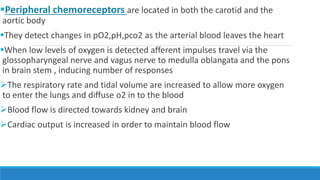
Peripheral chemoreceptors are located in both the carotid and the
aortic body
They detect changes in pO2,pH,pco2 as the arterial blood leaves the heart
When low levels of oxygen is detected afferent impulses travel via the
glossopharyngeal nerve and vagus nerve to medulla oblangata and the pons
in brain stem , inducing number of responses
The respiratory rate and tidal volume are increased to allow more oxygen
to enter the lungs and diffuse o2 in to the blood
Blood flow is directed towards kidney and brain
Cardiac output is increased in order to maintain blood flow
PULMONARY REFLEXES
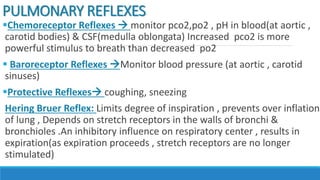
Chemoreceptor Reflexes  monitor pco2,po2 , pH in blood(at aortic ,
carotid bodies) & CSF(medulla oblongata) Increased pco2 is more
powerful stimulus to breath than decreased po2
 Baroreceptor Reflexes Monitor blood pressure (at aortic , carotid
sinuses)
Protective Reflexes coughing, sneezing
Hering Bruer Reflex: Limits degree of inspiration , prevents over inflation
of lung , Depends on stretch receptors in the walls of bronchi &
bronchioles .An inhibitory influence on respiratory center , results in
expiration(as expiration proceeds , stretch receptors are no longer
stimulated)
OXYGEN CARRIAGE IN BLOOD
Hb saturation - amount of O2 bound by each molecule of Hb
1 molecule of Hb can carry 4 molecules of O2
When O2 binds to Hb, it forms OXYHAEMOGLOBIN
Hb that is not bound to O2 referred as DEOXYHAEMOGLOBIN
Binding of O2 to Hb depends on PO2 in blood
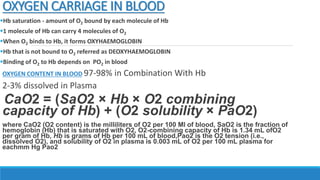
OXYGEN CONTENT IN BLOOD 97-98% in Combination With Hb
2-3% dissolved in Plasma
CaO2 = (SaO2 × Hb × O2 combining
capacity of Hb) + (O2 solubility × PaO2)
where CaO2 (O2 content) is the milliliters of O2 per 100 Ml of blood, SaO2 is the fraction of
hemoglobin (Hb) that is saturated with O2, O2-combining capacity of Hb is 1.34 mL ofO2
per gram of Hb, Hb is grams of Hb per 100 mL of blood,Pao2 is the O2 tension (i.e.,
dissolved O2), and solubility of O2 in plasma is 0.003 mL of O2 per 100 mL plasma for
eachmm Hg Pao2
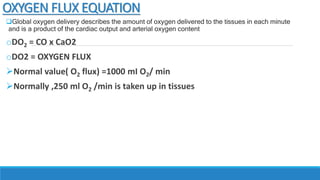
OXYGEN FLUX EQUATION
Global oxygen delivery describes the amount of oxygen delivered to the tissues in each minute
and is a product of the cardiac output and arterial oxygen content
oDO2 = CO x CaO2
oDO2 = OXYGEN FLUX
Normal value( O2 flux) =1000 mI O2/ min
Normally ,250 ml O2 /min is taken up in tissues
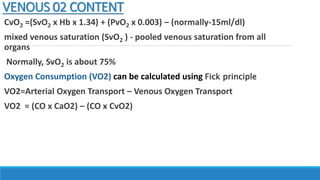
VENOUS 02 CONTENT
CvO2 =(SvO2 x Hb x 1.34) + (PvO2 x 0.003) ‒ (normally-15ml/dl)
mixed venous saturation (SvO2 ) - pooled venous saturation from all
organs
Normally, SvO2 is about 75%
Oxygen Consumption (VO2) can be calculated using Fick principle
VO2=Arterial Oxygen Transport – Venous Oxygen Transport
VO2 = (CO x CaO2) – (CO x CvO2)
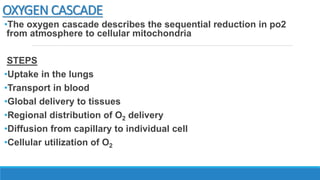
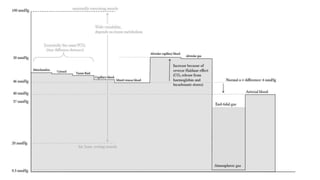
OXYGEN CASCADE
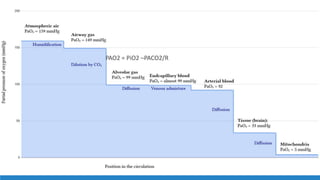
•The oxygen cascade describes the sequential reduction in po2
from atmosphere to cellular mitochondria
STEPS
•Uptake in the lungs
•Transport in blood
•Global delivery to tissues
•Regional distribution of O2 delivery
•Diffusion from capillary to individual cell
•Cellular utilization of O2
PAO2 = PiO2 –PACO2/R
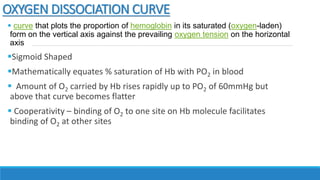
OXYGEN DISSOCIATION CURVE
 curve that plots the proportion of hemoglobin in its saturated (oxygen-laden)
form on the vertical axis against the prevailing oxygen tension on the horizontal
axis
Sigmoid Shaped
Mathematically equates % saturation of Hb with PO2 in blood
 Amount of O2 carried by Hb rises rapidly up to PO2 of 60mmHg but
above that curve becomes flatter
 Cooperativity – binding of O2 to one site on Hb molecule facilitates
binding of O2 at other sites
Plateau:
► haemoglobin highly
saturated with O2 -
>favour the loading of
O2 in lung
Steep slope:
► small drop of O2 partial pressure leads to a rapid decrease i
% saturation of haemoglobin
► favour the release of O2 in tissue cells
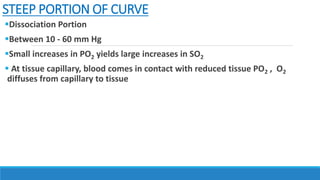
STEEP PORTION OF CURVE
Dissociation Portion
Between 10 - 60 mm Hg
Small increases in PO2 yields large increases in SO2
 At tissue capillary, blood comes in contact with reduced tissue PO2 , O2
diffuses from capillary to tissue
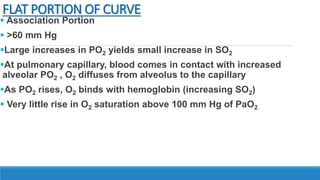
FLAT PORTION OF CURVE
 Association Portion
 >60 mm Hg
Large increases in PO2 yields small increase in SO2
At pulmonary capillary, blood comes in contact with increased
alveolar PO2 , O2 diffuses from alveolus to the capillary
As PO2 rises, O2 binds with hemoglobin (increasing SO2)
 Very little rise in O2 saturation above 100 mm Hg of PaO2
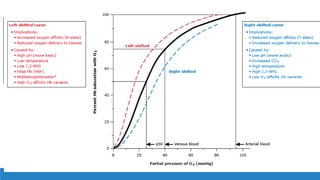
P50
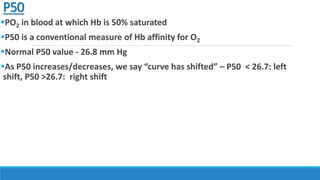
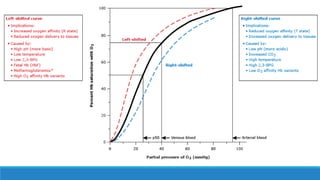
PO2 in blood at which Hb is 50% saturated
P50 is a conventional measure of Hb affinity for O2
Normal P50 value - 26.8 mm Hg
As P50 increases/decreases, we say “curve has shifted” – P50 < 26.7: left
shift, P50 >26.7: right shift
BOHR EFFECT
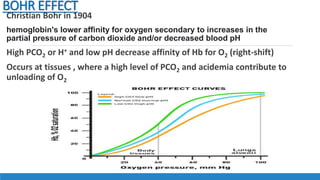
Christian Bohr in 1904
hemoglobin's lower affinity for oxygen secondary to increases in the
partial pressure of carbon dioxide and/or decreased blood pH
High PCO2 or H+ and low pH decrease affinity of Hb for O2 (right-shift)
Occurs at tissues , where a high level of PCO2 and acidemia contribute to
unloading of O2
DOUBLE BOHR EFFECT
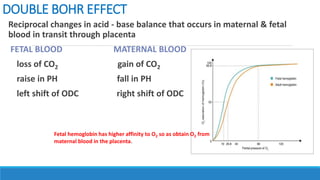
Reciprocal changes in acid - base balance that occurs in maternal & fetal
blood in transit through placenta
FETAL BLOOD MATERNAL BLOOD
loss of CO2 gain of CO2
raise in PH fall in PH
left shift of ODC right shift of ODC
Fetal hemoglobin has higher affinity to O2 so as obtain O2 from
maternal blood in the placenta.
PHSYIOLOGY OF CO2 TRANSPORT
end-product of aerobic metabolism
production averages 200 ml/min in resting adult
during exercise , amount may increase 6 times
Produced almost entirely in mitochondria
Transport of CO2:CO2 is transported in blood from tissues to the lungs in
3 ways
- dissolved form
-buffered with water as carbonic acid
- bound to proteins, particularly Hb
Approximately 75% of CO2 transport by Hb
HALDANE EFFECT
 oxygenation of blood in the lungs displaces carbon dioxide from
hemoglobin, increasing the removal of carbon dioxide
Quantitatively more important in promoting CO2 transport than Bohr
effect in promoting O2 transport
Most of H+ combine with Hb because reduced Hb is less acidic so better
proton acceptor
In lungs oxygenation causes unloading of CO2
VENTILATION
Ventilation refers to movement of inspired gas
into and exhales gas out of the lung
ALVEOLAR VENTILATION
DEAD SPACE VENTILATION
ALVEOLAR VENTILATION
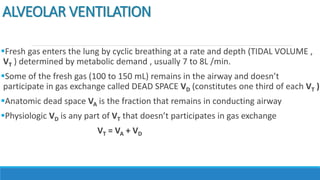
Fresh gas enters the lung by cyclic breathing at a rate and depth (TIDAL VOLUME ,
VT ) determined by metabolic demand , usually 7 to 8L /min.
Some of the fresh gas (100 to 150 mL) remains in the airway and doesn’t
participate in gas exchange called DEAD SPACE VD (constitutes one third of each VT )
Anatomic dead space VA is the fraction that remains in conducting airway
Physiologic VD is any part of VT that doesn’t participates in gas exchange
VT = VA + VD
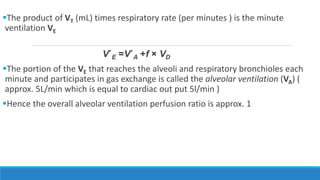
The product of VT (mL) times respiratory rate (per minutes ) is the minute
ventilation VE
V˙E =V˙A +f × VD
The portion of the VE that reaches the alveoli and respiratory bronchioles each
minute and participates in gas exchange is called the alveolar ventilation (VA) (
approx. 5L/min which is equal to cardiac out put 5l/min )
Hence the overall alveolar ventilation perfusion ratio is approx. 1
DEAD SPACE VENTILLATION
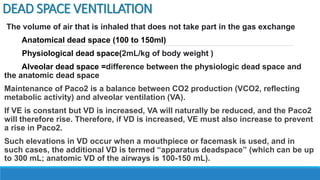
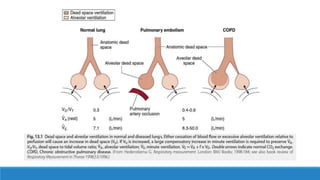
The volume of air that is inhaled that does not take part in the gas exchange
Anatomical dead space (100 to 150ml)
Physiological dead space(2mL/kg of body weight )
Alveolar dead space =difference between the physiologic dead space and
the anatomic dead space
Maintenance of Paco2 is a balance between CO2 production (VCO2, reflecting
metabolic activity) and alveolar ventilation (VA).
If VE is constant but VD is increased, VA will naturally be reduced, and the Paco2
will therefore rise. Therefore, if VD is increased, VE must also increase to prevent
a rise in Paco2.
Such elevations in VD occur when a mouthpiece or facemask is used, and in
such cases, the additional VD is termed “apparatus deadspace” (which can be up
to 300 mL; anatomic VD of the airways is 100-150 mL).
SHUNT
shunt occurs in lung that is perfused but poorly ventilated
The physiologic shunt (Q˙ SP) is that portion of the total cardiac
output (Q˙T) that returns to the left heart and systemic
circulation without receiving oxygen in the lung
When pulmonary blood is not exposed to alveoli or when those
alveoli are devoid of ventilation, the result is absolute or true
shunt, in which
V˙A/Q˙ =∞
Shunt effect, or venous admixture, is the more common clinical
phenomenon and occurs in areas where alveolar ventilation is
deficient compared with the degree of perfusion
small percentage of venous blood normally bypasses the right
ventricle and empties directly into the left atrium
This anatomic, absolute, or true shunt arises from the venous return
of the pleural, bronchiolar, and thebesian veins.
 This venous admixture accounts for 2% to 5% of total cardiac
output and represents the small shunt that normally occurs.
Anatomic shunts of greatest magnitude are usually associated with
congenital heart diseases that cause right-to-left shunt
Diseases that may cause absolute or true shunt include acute lobar
atelectasis, extensive acute lung injury, advanced pulmonary edema,
and consolidated pneumonia.
Disease entities that tend to produce venous admixture include mild
pulmonary edema, postoperative atelectasis, and COPD.
PERFUSION
The pulmonary circulation differs from the systemic circulation as
it operates at a five to tenfold lower pressure, and the vessels are
shorter and wider.
There are two important consequences of the particularly low
vascular resistance.
First, the downstream blood flow in the pulmonary capillaries is
pulsatile, in contrast to the more constant systemic capillary flow.
Second, the capillary and alveolar walls are protected from
exposure to high hydrostatic pressures
DISTRIBUTION OF LUNG BLOOD FLOW : Pulmonary blood flow
depends on driving pressure and vascular resistance; these factors
(and flow) are not homogenous throughout the lung.
DISTRIBUTION OF BLOOD FLOW IN THE LUNG AND THE EFFECT OF
GRAVITY
Blood has weight hence its been affected by gravity
The height of an adult lung is approx. 25 cm
When an adult is standing the hydrostatic pressure at the base is 25 cm of
H2O (18 mm of Hg) and 12 mm of Hg at heart level
Hence the pulmonary artery pressure at the apex approx. approaches to
zero , so less blood flow occurs at the apex
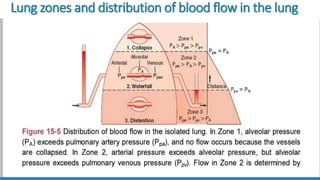
Based on gravitational distribution of pulmonary artery west and
colleagues divided the lung zones based on the principle that perfusion
depends to an alveolus depends on the pressure in pulmonary artery
,pulmonary vein and alveolus
Lung zones and distribution of blood flow in the lung
HYPOXIC PULMONARY
VASOCONSTRICTION
HPV is a compensatory mechanism that diverts blood flow away from
hypoxic lung regions toward better oxygenated regions.
The major stimulus for HPV is low alveolar oxygen tension (PAO2), whether
caused by hypoventilation or by breathing gas with a low PO2, and is more
potent when affecting a smaller lung region.
LUNG VOLUME AND CAPACITIES
TIDAL VOLUME (TV):Tidal volume is the volume of gas that moves in
and out of the lungs during quiet breathing and is about 500mL
INSPIRATORY RESERVE VOLUME (IRV): Maximum volume that can be
inspired over the inspiration of a tidal volume/normal breath. Used
during exercise/exertion.= Male 3100 ml/ Female 1900 ml
• EXPIRATRY RESERVE VOLUME (ERV): Maximal volume that can be
expired after the expiration of a tidal volume/normal breath. = Male
1200 ml/ Female 700 ml
•RESIDUAL VOLUME (RV): Following maximum expiratory effort, some
air is left in the lung and constitutes the RV (ABOUT 2L)
INSPIRATORY CAPACITY is the largest volume of gas that can
be inspired
from the resting expiratory level (4500ML)
VITAL CAPACITY The maximum volume that can be inhaled and
then exhaled is the vital capacity (4 TO 6L).
 TOTAL LUNG CAPACITY The gas volume in the lung after a
maximum inspiration is called the total lung capacity (USUALLY
6L ).
LUNG VOLUMES AND CAPACITIES
FUNCTIONAL RESIDUAL CAPACITY is the volume of gas held
in the lungs at a normal relaxed end expiratory point
Significance:
Allows continuous exchange of gases
Preoxygenation – fills FRC with O2 ,prior to intubation
Prevent early desaturation during apnoea
Load on Rt. Ventricle is reduced as collapsed lung increases PVR
Factors affecting FRC:
FRC Increased in- PEEP, CPAP, Emphysema , Asthma , Erect/propped up position
FRC Decreased in – Obesity, Supine & Trendelenburg position , Pregnancy , Sedation,
M. Gravis, Poliomyelitis ,Restrictive lung disease , Pneumothorax
CLOSING CAPACITY :
Volume of lung at which small airways in the dependent parts of the lung
begin to collapse during expiration
Mathematically – sum of closing volume & the residual volume
Normally, it is less than FRC
Unlike FRC it is unaffected by posture , It gradually raises with age
DYNAMIC TESTS FOR VENTILLATION
•MAXIMUM BREATHING CAPACITY (MBC): designed to measure the speed and
efficacy of filling and emptying the lung during increased effort and it defined as
the maximum volume of air that can be breathed per minute.(ranges from 100 to
200 L/min)
•FORCED EXPIRATORY VOLUME (FEV):the patient makes a maximal inspiration
and expires forcefully into spirometer and the total amount of air expelled out in
a given times is measured in intervals of 0.5, 1 , 2 , 3seconds.usually FEV1 is
measured expressed in percentage in young adults its about 83% of vital capacity
•PEAK EXPIRATORY FLOW RATE(PEFR) after maximal inspiration patient expires as
forcefully as he can and the maximum flow rate of air is measured .indicates
ventilation adequacy and obstructive airway
THE WORK OF BREATHING
The energy required to ventilate the lungs to overcome certain forces which tend
to prevent lungs being inflated is work of breathing
There are 3 essential components in this opposition
1.The forces needed to overcome the elastic resistance of the lung
2.the forces to move non-elastic tissues of lung (structural resistance )
3. the force to overcome resistance to the flow of air through trachea
bronchial tree
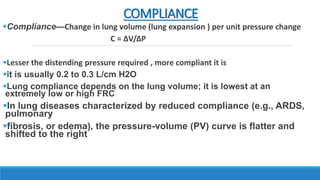
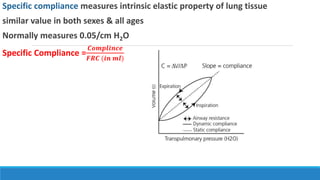
COMPLIANCE
Compliance—Change in lung volume (lung expansion ) per unit pressure change
C = ΔV/ΔP
Lesser the distending pressure required , more compliant it is
it is usually 0.2 to 0.3 L/cm H2O
Lung compliance depends on the lung volume; it is lowest at an
extremely low or high FRC
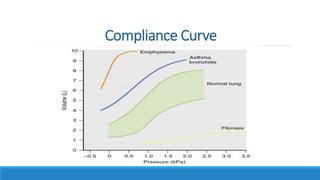
In lung diseases characterized by reduced compliance (e.g., ARDS,
pulmonary
fibrosis, or edema), the pressure-volume (PV) curve is flatter and
shifted to the right
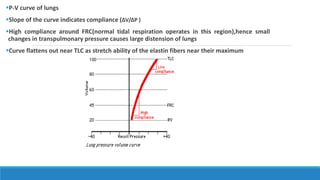
P-V curve of lungs
Slope of the curve indicates compliance (ΔV/ΔP )
High compliance around FRC(normal tidal respiration operates in this region),hence small
changes in transpulmonary pressure causes large distension of lungs
Curve flattens out near TLC as stretch ability of the elastin fibers near their maximum
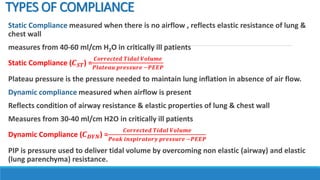
TYPES OF COMPLIANCE
Static Compliance measured when there is no airflow , reflects elastic resistance of lung &
chest wall
measures from 40-60 ml/cm H2O in critically ill patients
Static Compliance (𝑪𝑺𝑻) =
𝑪𝒐𝒓𝒓𝒆𝒄𝒕𝒆𝒅 𝑻𝒊𝒅𝒂𝒍 𝑽𝒐𝒍𝒖𝒎𝒆
𝑷𝒍𝒂𝒕𝒆𝒂𝒖 𝒑𝒓𝒆𝒔𝒔𝒖𝒓𝒆 −𝑷𝑬𝑬𝑷
Plateau pressure is the pressure needed to maintain lung inflation in absence of air flow.
Dynamic compliance measured when airflow is present
Reflects condition of airway resistance & elastic properties of lung & chest wall
Measures from 30-40 ml/cm H2O in critically ill patients
Dynamic Compliance (𝑪𝑫𝒀𝑵) =
𝑪𝒐𝒓𝒓𝒆𝒄𝒕𝒆𝒅 𝑻𝒊𝒅𝒂𝒍 𝑽𝒐𝒍𝒖𝒎𝒆
𝑷𝒆𝒂𝒌 𝒊𝒏𝒔𝒑𝒊𝒓𝒂𝒕𝒐𝒓𝒚 𝒑𝒓𝒆𝒔𝒔𝒖𝒓𝒆 −𝑷𝑬𝑬𝑷
PIP is pressure used to deliver tidal volume by overcoming non elastic (airway) and elastic
(lung parenchyma) resistance.
Specific compliance measures intrinsic elastic property of lung tissue
similar value in both sexes & all ages
Normally measures 0.05/cm H2O
Specific Compliance =
𝑪𝒐𝒎𝒑𝒍𝒊𝒏𝒄𝒆
𝑭𝑹𝑪 (𝒊𝒏 𝒎𝒍)
Factors affecting compliance
 Lung elastic recoil - surface tension
Lung volume
Gravity
Diseased states
Variations in compliance
High compliance emphysema, asthma, ageing
oExhalation is often inadequate due to lack of elastic recoil of lung
Low static compliance fibrosis , ARDS, tension pneumothorax ,
atelectasis, obesity, retained secretion Work of breathing is high
as lungs are stiff
Low dynamic compliance Bronchospasm, airway obstruction
Compliance Curve
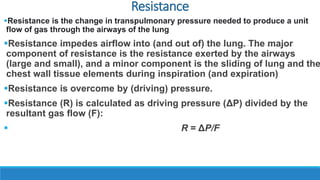
Resistance
Resistance is the change in transpulmonary pressure needed to produce a unit
flow of gas through the airways of the lung
Resistance impedes airflow into (and out of) the lung. The major
component of resistance is the resistance exerted by the airways
(large and small), and a minor component is the sliding of lung and the
chest wall tissue elements during inspiration (and expiration)
Resistance is overcome by (driving) pressure.
Resistance (R) is calculated as driving pressure (ΔP) divided by the
resultant gas flow (F):
 R = ΔP/F
Elastic resistance— the force tending to return lung to its original size after stretching
Structural resistance—composed of thoracic wall, diaphragm & abdominal contents. related
to the speed of air flow
Air resistance—dependent on length & size of lumen of bronchial tree. Extra air resistance
added on when endotracheal tube inserted
DEPENDING ON THE LAMINAR OR TURBULENT FLOW PRESSURE REQUIRED CHANGES
•Airway resistance is constant where flow is laminar
•Airway resistance increases exponentially with increasing flow where flow is
turbulent
•Under most normal conditions the airflow in human airways is mainly laminar
because the flow rates ar relatively low
•With increasing flow, flow in the airways may transition from laminar to turbulent
flow
Factors which affect airway resistance
•Effects of bronchial smooth muscle tone:
• Increased smooth muscle tone
• Bronchospasm
• Irritants, eg. histamine
• Parasympathetic nervous system agonists
• Decreased smooth muscle tone
• Bronchodilators
• Sympathetic nervous system agonists
•Decreased internal cross section
• Oedema
• Mucosal or smooth muscle hypertrophy
• Encrusted secretions
•Mechanical obstruction or compression
• Extrinsic, eg. by tumour
• Dynamic compression, eg. due to gas trapping or forceful expiratory effort
• Artificial airways and their complications, eg. endotracheal tube becoming kinked
ANAESTHESIA IMPLICATIONS ON RESPIRATORY PHYSIOLOGY
Effect on upper airway-GA causes relaxation of jaw and pharyngeal muscles and leads to
posterior displacement of tongue
Effect on volumes Anesthesia causes respiratory impairment by mismatch in alveolar
ventilation (Va) and perfusion (Q).
Effects on functional residual capacity Anesthesia leads to fall in FRC despite
maintaining spontaneous breathing and irrespective of anesthetic used
Effects of pre-oxygenation The higher oxygen concentration, used during pre-
oxygenation, leads to faster gas adsorption and consequently collapse of alveoli and
atelectasis.
Effect on dead spaceThe distribution of pulmonary blood flow is altered during
anesthesia due to increased mismatch of ventilation to perfusion ratios (Va/Q ratio)
Effect on ventilatory response Anesthesia depresses movements of intercostal muscles,
alters the shape and motion of chest wall and diminish rib cage excursion affecting lung
mechanics and consequent decrease in FRC and ventilatory response to CO
Effect on hypoxic pulmonary vasoconstriction volatile anaesthetic
agents suppress HPV in a dose-dependent manner
Effect of position In the supine position, the contribution of the chest wall is
reduced from 30% to 10% and diaphragmatic movements close to most
dependent portions of lung are significantly restricted
Effect of mechanical ventilationMechanical ventilation with high VT may
directly damage lung parenchyma by shearing stress in alveoli, which results
in interstitial oedema, decreased lung compliance and gas transfer
EFFECTS OF REGIONAL ANAESTHESIADuring high spinal anaesthesia,
owing to paralysis of abdominal muscles, there is a decrease in expiratory
reserve volume and consequently the vital capacity, which may impair forced
exhalation and ability to cough
EFFECTS OF DRUGS USED DURING ANAESTHESIA Barbiturates ,
prpophol , ketamine , Inhalational agents ,
THANK YOU

RESPIRATORY physilogy anesthesia ventillation

  • 1.
    RESPIRATORY PHYSIOLOGY MODERATED BYPRESENTRD BY DR YOGESH NARWAT DR RAJU GANDHAM MD ANAESTHESIA
  • 2.
    RESPIRATORY CENTRES OFCNS and CONTROL OF BREATHING Primary portions that control ventilation -Medulla Oblongata & Pons Respiratory centers : Inspiratory centre (DORSAL RESPIRATORY GROUP) Expiratory centre (VENTRAL RESPIRATORY GROUP) Pneumotaxic centre (UPPER PONS) • Sends continual inhibitory impulses to inspiratory center of the medulla oblongata, • As impulse frequency rises, breathe faster and shallower Apneustic centre (LOWER PONS) •Stimulation causes apneusis –deep, gasping inspiration •Integrates inspiratory cut off information
  • 4.
    CENTRAL AND PERIPHERALCHEMORECEPTORS Central chemoreceptors are located in medulla oblangata of brain stem. They detect changes in arterial pCO2 ,pH (H+) when change is detected ,the receptors send impulses to the respiratory centres in brain stem that initiate changes in ventilation to restore normal pCO2 Detection of increased in pCO2 leads to an increased ventilation , more CO2 is exhaled co2 returns to normal Detection of a decrease in pCO2 leads in decrease in ventilation less CO2 is exhaled CO2 returns to normal The mechanism behind how central chemoreceptors detect changes in arterial pCO2 is complex and related to changes in pH of CSF
  • 5.
    Peripheral chemoreceptors arelocated in both the carotid and the aortic body They detect changes in pO2,pH,pco2 as the arterial blood leaves the heart When low levels of oxygen is detected afferent impulses travel via the glossopharyngeal nerve and vagus nerve to medulla oblangata and the pons in brain stem , inducing number of responses The respiratory rate and tidal volume are increased to allow more oxygen to enter the lungs and diffuse o2 in to the blood Blood flow is directed towards kidney and brain Cardiac output is increased in order to maintain blood flow
  • 7.
    PULMONARY REFLEXES Chemoreceptor Reflexes monitor pco2,po2 , pH in blood(at aortic , carotid bodies) & CSF(medulla oblongata) Increased pco2 is more powerful stimulus to breath than decreased po2  Baroreceptor Reflexes Monitor blood pressure (at aortic , carotid sinuses) Protective Reflexes coughing, sneezing Hering Bruer Reflex: Limits degree of inspiration , prevents over inflation of lung , Depends on stretch receptors in the walls of bronchi & bronchioles .An inhibitory influence on respiratory center , results in expiration(as expiration proceeds , stretch receptors are no longer stimulated)
  • 8.
    OXYGEN CARRIAGE INBLOOD Hb saturation - amount of O2 bound by each molecule of Hb 1 molecule of Hb can carry 4 molecules of O2 When O2 binds to Hb, it forms OXYHAEMOGLOBIN Hb that is not bound to O2 referred as DEOXYHAEMOGLOBIN Binding of O2 to Hb depends on PO2 in blood OXYGEN CONTENT IN BLOOD 97-98% in Combination With Hb 2-3% dissolved in Plasma CaO2 = (SaO2 × Hb × O2 combining capacity of Hb) + (O2 solubility × PaO2) where CaO2 (O2 content) is the milliliters of O2 per 100 Ml of blood, SaO2 is the fraction of hemoglobin (Hb) that is saturated with O2, O2-combining capacity of Hb is 1.34 mL ofO2 per gram of Hb, Hb is grams of Hb per 100 mL of blood,Pao2 is the O2 tension (i.e., dissolved O2), and solubility of O2 in plasma is 0.003 mL of O2 per 100 mL plasma for eachmm Hg Pao2
  • 9.
    OXYGEN FLUX EQUATION Globaloxygen delivery describes the amount of oxygen delivered to the tissues in each minute and is a product of the cardiac output and arterial oxygen content oDO2 = CO x CaO2 oDO2 = OXYGEN FLUX Normal value( O2 flux) =1000 mI O2/ min Normally ,250 ml O2 /min is taken up in tissues
  • 10.
    VENOUS 02 CONTENT CvO2=(SvO2 x Hb x 1.34) + (PvO2 x 0.003) ‒ (normally-15ml/dl) mixed venous saturation (SvO2 ) - pooled venous saturation from all organs Normally, SvO2 is about 75% Oxygen Consumption (VO2) can be calculated using Fick principle VO2=Arterial Oxygen Transport – Venous Oxygen Transport VO2 = (CO x CaO2) – (CO x CvO2)
  • 11.
    OXYGEN CASCADE •The oxygencascade describes the sequential reduction in po2 from atmosphere to cellular mitochondria STEPS •Uptake in the lungs •Transport in blood •Global delivery to tissues •Regional distribution of O2 delivery •Diffusion from capillary to individual cell •Cellular utilization of O2
  • 12.
    PAO2 = PiO2–PACO2/R
  • 13.
    OXYGEN DISSOCIATION CURVE curve that plots the proportion of hemoglobin in its saturated (oxygen-laden) form on the vertical axis against the prevailing oxygen tension on the horizontal axis Sigmoid Shaped Mathematically equates % saturation of Hb with PO2 in blood  Amount of O2 carried by Hb rises rapidly up to PO2 of 60mmHg but above that curve becomes flatter  Cooperativity – binding of O2 to one site on Hb molecule facilitates binding of O2 at other sites
  • 14.
    Plateau: ► haemoglobin highly saturatedwith O2 - >favour the loading of O2 in lung Steep slope: ► small drop of O2 partial pressure leads to a rapid decrease i % saturation of haemoglobin ► favour the release of O2 in tissue cells
  • 15.
    STEEP PORTION OFCURVE Dissociation Portion Between 10 - 60 mm Hg Small increases in PO2 yields large increases in SO2  At tissue capillary, blood comes in contact with reduced tissue PO2 , O2 diffuses from capillary to tissue
  • 16.
    FLAT PORTION OFCURVE  Association Portion  >60 mm Hg Large increases in PO2 yields small increase in SO2 At pulmonary capillary, blood comes in contact with increased alveolar PO2 , O2 diffuses from alveolus to the capillary As PO2 rises, O2 binds with hemoglobin (increasing SO2)  Very little rise in O2 saturation above 100 mm Hg of PaO2
  • 17.
    P50 PO2 in bloodat which Hb is 50% saturated P50 is a conventional measure of Hb affinity for O2 Normal P50 value - 26.8 mm Hg As P50 increases/decreases, we say “curve has shifted” – P50 < 26.7: left shift, P50 >26.7: right shift
  • 19.
    BOHR EFFECT Christian Bohrin 1904 hemoglobin's lower affinity for oxygen secondary to increases in the partial pressure of carbon dioxide and/or decreased blood pH High PCO2 or H+ and low pH decrease affinity of Hb for O2 (right-shift) Occurs at tissues , where a high level of PCO2 and acidemia contribute to unloading of O2
  • 20.
    DOUBLE BOHR EFFECT Reciprocalchanges in acid - base balance that occurs in maternal & fetal blood in transit through placenta FETAL BLOOD MATERNAL BLOOD loss of CO2 gain of CO2 raise in PH fall in PH left shift of ODC right shift of ODC Fetal hemoglobin has higher affinity to O2 so as obtain O2 from maternal blood in the placenta.
  • 21.
    PHSYIOLOGY OF CO2TRANSPORT end-product of aerobic metabolism production averages 200 ml/min in resting adult during exercise , amount may increase 6 times Produced almost entirely in mitochondria Transport of CO2:CO2 is transported in blood from tissues to the lungs in 3 ways - dissolved form -buffered with water as carbonic acid - bound to proteins, particularly Hb Approximately 75% of CO2 transport by Hb
  • 23.
    HALDANE EFFECT  oxygenationof blood in the lungs displaces carbon dioxide from hemoglobin, increasing the removal of carbon dioxide Quantitatively more important in promoting CO2 transport than Bohr effect in promoting O2 transport Most of H+ combine with Hb because reduced Hb is less acidic so better proton acceptor In lungs oxygenation causes unloading of CO2
  • 24.
    VENTILATION Ventilation refers tomovement of inspired gas into and exhales gas out of the lung ALVEOLAR VENTILATION DEAD SPACE VENTILATION
  • 25.
    ALVEOLAR VENTILATION Fresh gasenters the lung by cyclic breathing at a rate and depth (TIDAL VOLUME , VT ) determined by metabolic demand , usually 7 to 8L /min. Some of the fresh gas (100 to 150 mL) remains in the airway and doesn’t participate in gas exchange called DEAD SPACE VD (constitutes one third of each VT ) Anatomic dead space VA is the fraction that remains in conducting airway Physiologic VD is any part of VT that doesn’t participates in gas exchange VT = VA + VD
  • 26.
    The product ofVT (mL) times respiratory rate (per minutes ) is the minute ventilation VE V˙E =V˙A +f × VD The portion of the VE that reaches the alveoli and respiratory bronchioles each minute and participates in gas exchange is called the alveolar ventilation (VA) ( approx. 5L/min which is equal to cardiac out put 5l/min ) Hence the overall alveolar ventilation perfusion ratio is approx. 1
  • 27.
    DEAD SPACE VENTILLATION Thevolume of air that is inhaled that does not take part in the gas exchange Anatomical dead space (100 to 150ml) Physiological dead space(2mL/kg of body weight ) Alveolar dead space =difference between the physiologic dead space and the anatomic dead space Maintenance of Paco2 is a balance between CO2 production (VCO2, reflecting metabolic activity) and alveolar ventilation (VA). If VE is constant but VD is increased, VA will naturally be reduced, and the Paco2 will therefore rise. Therefore, if VD is increased, VE must also increase to prevent a rise in Paco2. Such elevations in VD occur when a mouthpiece or facemask is used, and in such cases, the additional VD is termed “apparatus deadspace” (which can be up to 300 mL; anatomic VD of the airways is 100-150 mL).
  • 29.
    SHUNT shunt occurs inlung that is perfused but poorly ventilated The physiologic shunt (Q˙ SP) is that portion of the total cardiac output (Q˙T) that returns to the left heart and systemic circulation without receiving oxygen in the lung When pulmonary blood is not exposed to alveoli or when those alveoli are devoid of ventilation, the result is absolute or true shunt, in which V˙A/Q˙ =∞ Shunt effect, or venous admixture, is the more common clinical phenomenon and occurs in areas where alveolar ventilation is deficient compared with the degree of perfusion
  • 30.
    small percentage ofvenous blood normally bypasses the right ventricle and empties directly into the left atrium This anatomic, absolute, or true shunt arises from the venous return of the pleural, bronchiolar, and thebesian veins.  This venous admixture accounts for 2% to 5% of total cardiac output and represents the small shunt that normally occurs. Anatomic shunts of greatest magnitude are usually associated with congenital heart diseases that cause right-to-left shunt Diseases that may cause absolute or true shunt include acute lobar atelectasis, extensive acute lung injury, advanced pulmonary edema, and consolidated pneumonia. Disease entities that tend to produce venous admixture include mild pulmonary edema, postoperative atelectasis, and COPD.
  • 31.
    PERFUSION The pulmonary circulationdiffers from the systemic circulation as it operates at a five to tenfold lower pressure, and the vessels are shorter and wider. There are two important consequences of the particularly low vascular resistance. First, the downstream blood flow in the pulmonary capillaries is pulsatile, in contrast to the more constant systemic capillary flow. Second, the capillary and alveolar walls are protected from exposure to high hydrostatic pressures DISTRIBUTION OF LUNG BLOOD FLOW : Pulmonary blood flow depends on driving pressure and vascular resistance; these factors (and flow) are not homogenous throughout the lung.
  • 32.
    DISTRIBUTION OF BLOODFLOW IN THE LUNG AND THE EFFECT OF GRAVITY Blood has weight hence its been affected by gravity The height of an adult lung is approx. 25 cm When an adult is standing the hydrostatic pressure at the base is 25 cm of H2O (18 mm of Hg) and 12 mm of Hg at heart level Hence the pulmonary artery pressure at the apex approx. approaches to zero , so less blood flow occurs at the apex Based on gravitational distribution of pulmonary artery west and colleagues divided the lung zones based on the principle that perfusion depends to an alveolus depends on the pressure in pulmonary artery ,pulmonary vein and alveolus
  • 33.
    Lung zones anddistribution of blood flow in the lung
  • 34.
    HYPOXIC PULMONARY VASOCONSTRICTION HPV isa compensatory mechanism that diverts blood flow away from hypoxic lung regions toward better oxygenated regions. The major stimulus for HPV is low alveolar oxygen tension (PAO2), whether caused by hypoventilation or by breathing gas with a low PO2, and is more potent when affecting a smaller lung region.
  • 35.
    LUNG VOLUME ANDCAPACITIES TIDAL VOLUME (TV):Tidal volume is the volume of gas that moves in and out of the lungs during quiet breathing and is about 500mL INSPIRATORY RESERVE VOLUME (IRV): Maximum volume that can be inspired over the inspiration of a tidal volume/normal breath. Used during exercise/exertion.= Male 3100 ml/ Female 1900 ml • EXPIRATRY RESERVE VOLUME (ERV): Maximal volume that can be expired after the expiration of a tidal volume/normal breath. = Male 1200 ml/ Female 700 ml •RESIDUAL VOLUME (RV): Following maximum expiratory effort, some air is left in the lung and constitutes the RV (ABOUT 2L)
  • 36.
    INSPIRATORY CAPACITY isthe largest volume of gas that can be inspired from the resting expiratory level (4500ML) VITAL CAPACITY The maximum volume that can be inhaled and then exhaled is the vital capacity (4 TO 6L).  TOTAL LUNG CAPACITY The gas volume in the lung after a maximum inspiration is called the total lung capacity (USUALLY 6L ).
  • 37.
    LUNG VOLUMES ANDCAPACITIES
  • 38.
    FUNCTIONAL RESIDUAL CAPACITYis the volume of gas held in the lungs at a normal relaxed end expiratory point Significance: Allows continuous exchange of gases Preoxygenation – fills FRC with O2 ,prior to intubation Prevent early desaturation during apnoea Load on Rt. Ventricle is reduced as collapsed lung increases PVR Factors affecting FRC: FRC Increased in- PEEP, CPAP, Emphysema , Asthma , Erect/propped up position FRC Decreased in – Obesity, Supine & Trendelenburg position , Pregnancy , Sedation, M. Gravis, Poliomyelitis ,Restrictive lung disease , Pneumothorax
  • 39.
    CLOSING CAPACITY : Volumeof lung at which small airways in the dependent parts of the lung begin to collapse during expiration Mathematically – sum of closing volume & the residual volume Normally, it is less than FRC Unlike FRC it is unaffected by posture , It gradually raises with age
  • 40.
    DYNAMIC TESTS FORVENTILLATION •MAXIMUM BREATHING CAPACITY (MBC): designed to measure the speed and efficacy of filling and emptying the lung during increased effort and it defined as the maximum volume of air that can be breathed per minute.(ranges from 100 to 200 L/min) •FORCED EXPIRATORY VOLUME (FEV):the patient makes a maximal inspiration and expires forcefully into spirometer and the total amount of air expelled out in a given times is measured in intervals of 0.5, 1 , 2 , 3seconds.usually FEV1 is measured expressed in percentage in young adults its about 83% of vital capacity •PEAK EXPIRATORY FLOW RATE(PEFR) after maximal inspiration patient expires as forcefully as he can and the maximum flow rate of air is measured .indicates ventilation adequacy and obstructive airway
  • 41.
    THE WORK OFBREATHING The energy required to ventilate the lungs to overcome certain forces which tend to prevent lungs being inflated is work of breathing There are 3 essential components in this opposition 1.The forces needed to overcome the elastic resistance of the lung 2.the forces to move non-elastic tissues of lung (structural resistance ) 3. the force to overcome resistance to the flow of air through trachea bronchial tree
  • 42.
    COMPLIANCE Compliance—Change in lungvolume (lung expansion ) per unit pressure change C = ΔV/ΔP Lesser the distending pressure required , more compliant it is it is usually 0.2 to 0.3 L/cm H2O Lung compliance depends on the lung volume; it is lowest at an extremely low or high FRC In lung diseases characterized by reduced compliance (e.g., ARDS, pulmonary fibrosis, or edema), the pressure-volume (PV) curve is flatter and shifted to the right
  • 43.
    P-V curve oflungs Slope of the curve indicates compliance (ΔV/ΔP ) High compliance around FRC(normal tidal respiration operates in this region),hence small changes in transpulmonary pressure causes large distension of lungs Curve flattens out near TLC as stretch ability of the elastin fibers near their maximum
  • 44.
    TYPES OF COMPLIANCE StaticCompliance measured when there is no airflow , reflects elastic resistance of lung & chest wall measures from 40-60 ml/cm H2O in critically ill patients Static Compliance (𝑪𝑺𝑻) = 𝑪𝒐𝒓𝒓𝒆𝒄𝒕𝒆𝒅 𝑻𝒊𝒅𝒂𝒍 𝑽𝒐𝒍𝒖𝒎𝒆 𝑷𝒍𝒂𝒕𝒆𝒂𝒖 𝒑𝒓𝒆𝒔𝒔𝒖𝒓𝒆 −𝑷𝑬𝑬𝑷 Plateau pressure is the pressure needed to maintain lung inflation in absence of air flow. Dynamic compliance measured when airflow is present Reflects condition of airway resistance & elastic properties of lung & chest wall Measures from 30-40 ml/cm H2O in critically ill patients Dynamic Compliance (𝑪𝑫𝒀𝑵) = 𝑪𝒐𝒓𝒓𝒆𝒄𝒕𝒆𝒅 𝑻𝒊𝒅𝒂𝒍 𝑽𝒐𝒍𝒖𝒎𝒆 𝑷𝒆𝒂𝒌 𝒊𝒏𝒔𝒑𝒊𝒓𝒂𝒕𝒐𝒓𝒚 𝒑𝒓𝒆𝒔𝒔𝒖𝒓𝒆 −𝑷𝑬𝑬𝑷 PIP is pressure used to deliver tidal volume by overcoming non elastic (airway) and elastic (lung parenchyma) resistance.
  • 45.
    Specific compliance measuresintrinsic elastic property of lung tissue similar value in both sexes & all ages Normally measures 0.05/cm H2O Specific Compliance = 𝑪𝒐𝒎𝒑𝒍𝒊𝒏𝒄𝒆 𝑭𝑹𝑪 (𝒊𝒏 𝒎𝒍)
  • 46.
    Factors affecting compliance Lung elastic recoil - surface tension Lung volume Gravity Diseased states Variations in compliance High compliance emphysema, asthma, ageing oExhalation is often inadequate due to lack of elastic recoil of lung Low static compliance fibrosis , ARDS, tension pneumothorax , atelectasis, obesity, retained secretion Work of breathing is high as lungs are stiff Low dynamic compliance Bronchospasm, airway obstruction
  • 47.
  • 48.
    Resistance Resistance is thechange in transpulmonary pressure needed to produce a unit flow of gas through the airways of the lung Resistance impedes airflow into (and out of) the lung. The major component of resistance is the resistance exerted by the airways (large and small), and a minor component is the sliding of lung and the chest wall tissue elements during inspiration (and expiration) Resistance is overcome by (driving) pressure. Resistance (R) is calculated as driving pressure (ΔP) divided by the resultant gas flow (F):  R = ΔP/F
  • 49.
    Elastic resistance— theforce tending to return lung to its original size after stretching Structural resistance—composed of thoracic wall, diaphragm & abdominal contents. related to the speed of air flow Air resistance—dependent on length & size of lumen of bronchial tree. Extra air resistance added on when endotracheal tube inserted DEPENDING ON THE LAMINAR OR TURBULENT FLOW PRESSURE REQUIRED CHANGES •Airway resistance is constant where flow is laminar •Airway resistance increases exponentially with increasing flow where flow is turbulent •Under most normal conditions the airflow in human airways is mainly laminar because the flow rates ar relatively low •With increasing flow, flow in the airways may transition from laminar to turbulent flow
  • 50.
    Factors which affectairway resistance •Effects of bronchial smooth muscle tone: • Increased smooth muscle tone • Bronchospasm • Irritants, eg. histamine • Parasympathetic nervous system agonists • Decreased smooth muscle tone • Bronchodilators • Sympathetic nervous system agonists •Decreased internal cross section • Oedema • Mucosal or smooth muscle hypertrophy • Encrusted secretions •Mechanical obstruction or compression • Extrinsic, eg. by tumour • Dynamic compression, eg. due to gas trapping or forceful expiratory effort • Artificial airways and their complications, eg. endotracheal tube becoming kinked
  • 51.
    ANAESTHESIA IMPLICATIONS ONRESPIRATORY PHYSIOLOGY Effect on upper airway-GA causes relaxation of jaw and pharyngeal muscles and leads to posterior displacement of tongue Effect on volumes Anesthesia causes respiratory impairment by mismatch in alveolar ventilation (Va) and perfusion (Q). Effects on functional residual capacity Anesthesia leads to fall in FRC despite maintaining spontaneous breathing and irrespective of anesthetic used Effects of pre-oxygenation The higher oxygen concentration, used during pre- oxygenation, leads to faster gas adsorption and consequently collapse of alveoli and atelectasis. Effect on dead spaceThe distribution of pulmonary blood flow is altered during anesthesia due to increased mismatch of ventilation to perfusion ratios (Va/Q ratio) Effect on ventilatory response Anesthesia depresses movements of intercostal muscles, alters the shape and motion of chest wall and diminish rib cage excursion affecting lung mechanics and consequent decrease in FRC and ventilatory response to CO
  • 52.
    Effect on hypoxicpulmonary vasoconstriction volatile anaesthetic agents suppress HPV in a dose-dependent manner Effect of position In the supine position, the contribution of the chest wall is reduced from 30% to 10% and diaphragmatic movements close to most dependent portions of lung are significantly restricted Effect of mechanical ventilationMechanical ventilation with high VT may directly damage lung parenchyma by shearing stress in alveoli, which results in interstitial oedema, decreased lung compliance and gas transfer EFFECTS OF REGIONAL ANAESTHESIADuring high spinal anaesthesia, owing to paralysis of abdominal muscles, there is a decrease in expiratory reserve volume and consequently the vital capacity, which may impair forced exhalation and ability to cough EFFECTS OF DRUGS USED DURING ANAESTHESIA Barbiturates , prpophol , ketamine , Inhalational agents ,
  • 53.

Editor's Notes

  • #3 VENTRAL RHYTHM OF BREATHING DORSAL FOR INSPIRATION
  • #9 Methemoglobin (MetHb), formed by the oxidation to Fe3+ (ferric) instead of the usual Fe2+ (ferrous) iron, is less able to bind O2, resulting in diminished O2 content and less O2 delivery. Here, the Pao2 (in the absence of lung disease) will be normal: if the O2 content is calculated from the Pao2, it will appear normal, but if directly measured, it will be low. In contrast, MetHb level will be elevated
  • #15 2,3 DPG - an organic phosphate , normally found in RBC, Produced during Anaerobic glycolysis in RBCS It has tendency to bind to β chains of Hb & thereby decreases affinity of Hb for O2
  • #34 Distribution of blood flow in the isolated lung. In Zone 1, alveolar pressure (PA) exceeds pulmonary artery pressure (Ppa), and no flow occurs because the vessels are collapsed. In Zone 2, arterial pressure exceeds alveolar pressure, but alveolar pressure exceeds pulmonary venous pressure (Ppv). Flow in Zone 2 is determined by 967 the arterial–alveolar pressure difference (Ppa − PA), which steadily increases down the zone. In Zone 3, pulmonary venous pressure exceeds alveolar pressure, and flow is determined by the arterial–venous pressure difference (Ppa − Ppv), which is constant down this pulmonary zone. However, the pressure across the vessel walls increases down the zone so their caliber increases, as does flow