An Overview on Excise Duty,
1944
Applied Tax
Submitted To:
CA MANOJ KUMAR
YADAV
Astt. Proff. – School of
Commerce & MGMT
Submitted By:
Ashim Roy
(K13226)
MBA – 2nd Sem
 1.Central Excise Act 1994
 2.Central Excise tariff Act 1985
 3.Central Excise Rules ,1944
The law of Central Excise duties is
governed by the following :
 This is the basic law related to the levy and collection of
duties of central excise .However this Act does not contain
the rate at which duties are imposed
Central Excise Act ,1994
 This Act classifies various goods on which central excise
duties are levied and prescribes the rates a which the duty is
payable.
Central Excise Tariff Act ,1985
Background of Tariff
 Harmonized Commodity Description and Coding System
developed by World Customs Organization (WCO).
 Based on International convention of Harmonised System of
Nomenclature (HSN).
 Indian Customs adopted this nomenclature w.e.f. 28-2-1986.
Central Excise Tariff also adopted HSN based classification w.e.f.
1-3-1986.
 All manufacturers of excisable goods are required to
register under these rules. The registration is valid as long as
production activity continues and no renewals are necessary
Central Excise Rules ,1944
Central Excise Duty
It is a duty levied on the production or manufacture of excisable goods in
India. It is a tax levied upon manufacture and not upon sale of goods. In order to
attract levy of excise duty, three condition must be fulfill:-
• There should be goods.
• The goods should be excisable goods.
• Goods must have been produced/manufactured in India.
Central excise duties contribute approximately one-third share to the Union
Exchequer.
These duties from the single largest source of revenue for central govt. central
excise duty is levied and collected through the machinery of Central Excise Act,1994.
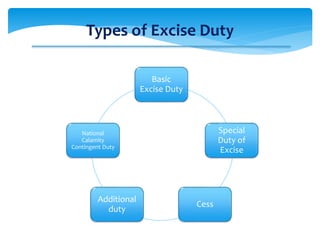
Types of Excise Duty
Basic
Excise Duty
Special
Duty of
Excise
Cess
Additional
duty
National
Calamity
Contingent Duty
• Basic excise duty (BED) or CENVAT:
This is levied u/s 3(1) of the central excise Act 1944. this duty is levied on all
excisable goods produced /manufactured within India at the rates specified in the first
schedule to central excise Traffic Act 1985.presently the rate is 10%. The basic duty
proceeds are shared by upon and states these rates do not apply in the case of petroleum and
tobacco products, pan masala and items attracting specific duty.
• Special duty of excise:
It is levied u/s 3 (i)(b) of the CE Act 1944. SED also known as auxiliary duty is
levied as surcharge on basic excise duty. The objecting of imposing SED is to generate
additional resources for some specified object. SED is livable at the rates specified schedule
second to Central Excise Tariff Act 1985.
• Additional duty on goods of special importance:
ADD is levied under either additional of excise Act 1957 or under additional duty
of excise act 1978. former provides for additional excise duties in lieu of sales tax on
specifically items like Textile, Sugar, Tobacco and later provides for specified of Textile and
articles of textile. The Central Sale Tax Act has restricted the powers of state govt. to levy
sales tax on declared goods and hence , additional duty has been clamped.
• National Calamity Contingent Duty (NCCD):
It kind of surcharge levied under Finance Act, 2001 on items like cigarettes, bidi,
pan masala and other tobacco products.
• Cess:
It is levied on certain commodities like tea, rubber etc. for the purpose utilizing the
proceeds fir the development of the industries and welfare of workers. In some cases, it's
 Taxable event for charge of duty of central excise is the manufacturer
or production of goods in India
 In this context ,the Supreme Court has observed :
Excise duty is not directly on the goods, but manufactured
thereof. Though both excise duty and sales duty levied with reference to
goods ,the two are very different imposts. In one case ,the imposition is on
the act of manufactured or production ,while in the other it is on the act of
sale.
Taxable event for central excise duty
For condition must be present for the charge of central
excise duty:
1.The duty is on goods
2.The goods must be excisable
3 .The goods must be manufactured or produced
4.Such manufacture or production must be take place in
India.
Liability for central excise
The scheme of the Act is as under :-
No. Chapter Sections
1 Titles and Definitions ( 1 to 2 A )
2 Levy and Collection of Duty ( 3 to 12 )
2 (a) Amount of Duty ( 12A to 12D )
3 Powers and Duties of Excise Officers ( 12 E to 23 )
3 (a) Advance Rulings ( 23 A to 23 H )
4 Transport by Sea ( 24 to 30 )
5 Settlement of Cases ( 31 to 32 A )
6 Adjudication of Confiscations and Penalties ( 33 to 34 A )
6 (a) Appeals ( 35 to 36 )
6 (b) Presumption as to Documents ( 36 A & 36 B )
7 Supplementary Provisions ( 37 to 40 )
MEANING OF LEVY
 Levy means imposition of tax . Once a tax or duty is imposed b,
it is quantified and then collected . The term levy includes both
imposition of tax as well as assessment , however , it does not
include collection.
DIFFERENCE BETWEEN LEVY
and collection
BASIS LEVY COLLECTION
MEANING Levy means imposition
of duty
When excise duty is
actually realized , it is
called collection
APPLICABLE
PROVISION
Section 3 is the charging
section
Rule 8 prescribes that
excise duty shall be
collected at the time of
removal
POINT OF LEVY The levy is on
production or
manufacture of
excisable goods
C collection at the time
of removal
For an item to be considered goods for the purpose of the levy of
central excise duty ,it must satisfy two requirements:
1.Movability:
Goods must be movable. Duty cannot be levied on immovable
property.
2.Marketability:
Goods must be marketable .The goods must be known in the
market and must be capable of being bought or sold.
 For the liability of duty of central excise to arise ,the
item in question should not only be goods it should
also be excisable goods. A goods become excisable if
and only if it is mentioned in the Central Excise Tariff
Act 1985. Nil Duty and Exempt from Duty – Both are
‘excisable goods’.
Excisable goods
Manufactured or Produced
 ‘Production’ is broader than ‘manufacture’.
‘Production’ included ‘manufacture’
 In both production and manufacture, new and
identifiable product should emerge
 Usually, ‘production’ term is used for new product by
natural process. ‘Manufacture’ derived from ‘manu’
i.e. by hands.
Production
 Items like ore, asbestos, coffee, tea, tobacco, dairy
products etc.
 live products like horse, fish, flowers etc.
 By-products, scrap etc. which are not really 'manufactured'
but they do get 'produced'
 It also covers ‘manufactured goods’ as term ‘produced’ is
broader than ‘manufacture’.
Meaning of ‘Manufacture’
 Manufacture as specified in various Court decisions
i.e. new and identifiable product having a distinctive
name, character or use must emerge or
 Deemed Manufacture – (a) Process amounting to
manufacture (b) Products covered under MRP
provisions.
Manufacturer
 Section 2(f) - “the word manufacturer shall be
understood accordingly and shall include not only a
person who employs hired labour in the production or
manufacture of excisable goods, but also any person
who engages in their production or manufacture on
his own account.”
Who is ‘Manufacturer’
 Person who actually brings new and identifiable
product into existence.
 Raw material supplier is not ‘manufacturer’. Job
worker is the manufacturer.
 Brand name owner is not ‘manufacturer’.
 Loan licensee is not ‘manufacturer’.
List of Documents Required for Central
Excise Registration
 PAN card copy of the company/firm.
 Address Proof of Business Premises of the company/firm (Electricity Bill /
Phone Bill / Gas Bill).
 Ground plan of factory (which should also provide description of boundaries
of premises to be registered).
 Details of Property Holding Rights of the registrant (if not self-owned then
Rent Agreement).
 If Business Premises and Head Office of the company is different than
Address Proof of Head Office also.
 PAN card copy of authorized signatory.
 Details of all banks with Bank Statement of last 2 months.
 Certificates of
 Customs Registration No.(BIN)
 Import Export Code
 State Sales Tax No.
 CST No.
 Company Index No.
 The provisions related to Central Excise are stabilized
in the past few
 years. No major changes were observed in Central
Excise Duty
 procedures, Statutory Returns, The Excise Duty Rate
also remained in
 the range of 10%to 12% adv. Provisions related to
Valuation under
 Central Excise remained unaltered.
Conclusion
Applied Taxation

Applied Taxation

  • 1.
    An Overview onExcise Duty, 1944 Applied Tax Submitted To: CA MANOJ KUMAR YADAV Astt. Proff. – School of Commerce & MGMT Submitted By: Ashim Roy (K13226) MBA – 2nd Sem
  • 2.
     1.Central ExciseAct 1994  2.Central Excise tariff Act 1985  3.Central Excise Rules ,1944 The law of Central Excise duties is governed by the following :
  • 3.
     This isthe basic law related to the levy and collection of duties of central excise .However this Act does not contain the rate at which duties are imposed Central Excise Act ,1994
  • 4.
     This Actclassifies various goods on which central excise duties are levied and prescribes the rates a which the duty is payable. Central Excise Tariff Act ,1985
  • 5.
    Background of Tariff Harmonized Commodity Description and Coding System developed by World Customs Organization (WCO).  Based on International convention of Harmonised System of Nomenclature (HSN).  Indian Customs adopted this nomenclature w.e.f. 28-2-1986. Central Excise Tariff also adopted HSN based classification w.e.f. 1-3-1986.
  • 6.
     All manufacturersof excisable goods are required to register under these rules. The registration is valid as long as production activity continues and no renewals are necessary Central Excise Rules ,1944
  • 7.
    Central Excise Duty Itis a duty levied on the production or manufacture of excisable goods in India. It is a tax levied upon manufacture and not upon sale of goods. In order to attract levy of excise duty, three condition must be fulfill:- • There should be goods. • The goods should be excisable goods. • Goods must have been produced/manufactured in India. Central excise duties contribute approximately one-third share to the Union Exchequer. These duties from the single largest source of revenue for central govt. central excise duty is levied and collected through the machinery of Central Excise Act,1994.
  • 8.
    Types of ExciseDuty Basic Excise Duty Special Duty of Excise Cess Additional duty National Calamity Contingent Duty
  • 9.
    • Basic exciseduty (BED) or CENVAT: This is levied u/s 3(1) of the central excise Act 1944. this duty is levied on all excisable goods produced /manufactured within India at the rates specified in the first schedule to central excise Traffic Act 1985.presently the rate is 10%. The basic duty proceeds are shared by upon and states these rates do not apply in the case of petroleum and tobacco products, pan masala and items attracting specific duty. • Special duty of excise: It is levied u/s 3 (i)(b) of the CE Act 1944. SED also known as auxiliary duty is levied as surcharge on basic excise duty. The objecting of imposing SED is to generate additional resources for some specified object. SED is livable at the rates specified schedule second to Central Excise Tariff Act 1985.
  • 10.
    • Additional dutyon goods of special importance: ADD is levied under either additional of excise Act 1957 or under additional duty of excise act 1978. former provides for additional excise duties in lieu of sales tax on specifically items like Textile, Sugar, Tobacco and later provides for specified of Textile and articles of textile. The Central Sale Tax Act has restricted the powers of state govt. to levy sales tax on declared goods and hence , additional duty has been clamped. • National Calamity Contingent Duty (NCCD): It kind of surcharge levied under Finance Act, 2001 on items like cigarettes, bidi, pan masala and other tobacco products. • Cess: It is levied on certain commodities like tea, rubber etc. for the purpose utilizing the proceeds fir the development of the industries and welfare of workers. In some cases, it's
  • 11.
     Taxable eventfor charge of duty of central excise is the manufacturer or production of goods in India  In this context ,the Supreme Court has observed : Excise duty is not directly on the goods, but manufactured thereof. Though both excise duty and sales duty levied with reference to goods ,the two are very different imposts. In one case ,the imposition is on the act of manufactured or production ,while in the other it is on the act of sale. Taxable event for central excise duty
  • 12.
    For condition mustbe present for the charge of central excise duty: 1.The duty is on goods 2.The goods must be excisable 3 .The goods must be manufactured or produced 4.Such manufacture or production must be take place in India. Liability for central excise
  • 13.
    The scheme ofthe Act is as under :- No. Chapter Sections 1 Titles and Definitions ( 1 to 2 A ) 2 Levy and Collection of Duty ( 3 to 12 ) 2 (a) Amount of Duty ( 12A to 12D ) 3 Powers and Duties of Excise Officers ( 12 E to 23 ) 3 (a) Advance Rulings ( 23 A to 23 H ) 4 Transport by Sea ( 24 to 30 ) 5 Settlement of Cases ( 31 to 32 A ) 6 Adjudication of Confiscations and Penalties ( 33 to 34 A ) 6 (a) Appeals ( 35 to 36 ) 6 (b) Presumption as to Documents ( 36 A & 36 B ) 7 Supplementary Provisions ( 37 to 40 )
  • 14.
    MEANING OF LEVY Levy means imposition of tax . Once a tax or duty is imposed b, it is quantified and then collected . The term levy includes both imposition of tax as well as assessment , however , it does not include collection.
  • 15.
    DIFFERENCE BETWEEN LEVY andcollection BASIS LEVY COLLECTION MEANING Levy means imposition of duty When excise duty is actually realized , it is called collection APPLICABLE PROVISION Section 3 is the charging section Rule 8 prescribes that excise duty shall be collected at the time of removal POINT OF LEVY The levy is on production or manufacture of excisable goods C collection at the time of removal
  • 16.
    For an itemto be considered goods for the purpose of the levy of central excise duty ,it must satisfy two requirements: 1.Movability: Goods must be movable. Duty cannot be levied on immovable property. 2.Marketability: Goods must be marketable .The goods must be known in the market and must be capable of being bought or sold.
  • 17.
     For theliability of duty of central excise to arise ,the item in question should not only be goods it should also be excisable goods. A goods become excisable if and only if it is mentioned in the Central Excise Tariff Act 1985. Nil Duty and Exempt from Duty – Both are ‘excisable goods’. Excisable goods
  • 18.
    Manufactured or Produced ‘Production’ is broader than ‘manufacture’. ‘Production’ included ‘manufacture’  In both production and manufacture, new and identifiable product should emerge  Usually, ‘production’ term is used for new product by natural process. ‘Manufacture’ derived from ‘manu’ i.e. by hands.
  • 19.
    Production  Items likeore, asbestos, coffee, tea, tobacco, dairy products etc.  live products like horse, fish, flowers etc.  By-products, scrap etc. which are not really 'manufactured' but they do get 'produced'  It also covers ‘manufactured goods’ as term ‘produced’ is broader than ‘manufacture’.
  • 20.
    Meaning of ‘Manufacture’ Manufacture as specified in various Court decisions i.e. new and identifiable product having a distinctive name, character or use must emerge or  Deemed Manufacture – (a) Process amounting to manufacture (b) Products covered under MRP provisions.
  • 21.
    Manufacturer  Section 2(f)- “the word manufacturer shall be understood accordingly and shall include not only a person who employs hired labour in the production or manufacture of excisable goods, but also any person who engages in their production or manufacture on his own account.”
  • 22.
    Who is ‘Manufacturer’ Person who actually brings new and identifiable product into existence.  Raw material supplier is not ‘manufacturer’. Job worker is the manufacturer.  Brand name owner is not ‘manufacturer’.  Loan licensee is not ‘manufacturer’.
  • 23.
    List of DocumentsRequired for Central Excise Registration  PAN card copy of the company/firm.  Address Proof of Business Premises of the company/firm (Electricity Bill / Phone Bill / Gas Bill).  Ground plan of factory (which should also provide description of boundaries of premises to be registered).  Details of Property Holding Rights of the registrant (if not self-owned then Rent Agreement).  If Business Premises and Head Office of the company is different than Address Proof of Head Office also.  PAN card copy of authorized signatory.  Details of all banks with Bank Statement of last 2 months.  Certificates of  Customs Registration No.(BIN)  Import Export Code  State Sales Tax No.  CST No.  Company Index No.
  • 24.
     The provisionsrelated to Central Excise are stabilized in the past few  years. No major changes were observed in Central Excise Duty  procedures, Statutory Returns, The Excise Duty Rate also remained in  the range of 10%to 12% adv. Provisions related to Valuation under  Central Excise remained unaltered. Conclusion