

BY
DR. RATNA SINHA
ASSOCIATE PROFESSOR
ISBR BUSINESS SCHOOL
BANGALORE
VENTURECAPITAL
FINANCING
LEARNING OBJECTIVES
• Private Equity andVenture Capital:
Introduction, Rudiments of valuing and financing a
venture, Stages of venture development and
financing, Financial analysis ofVenture capital firms
(VCCs), Structuring the deal/ Financial Instrument,
Investment nurturing, valuation ofVC portfolio,
Initial Public offerings of stock –Managing internal
and seasoned equity offerings.
2
VENTURE CAPITAL
• Venture: - Course or proceedings outcome is
uncertain.This is attended by the risk or danger
of loss.
• Capital: Resources to start the enterprise.
• In short lending capital to growing company
3
EVOLUTION
• Traced to USA in 19th
and 20th
century.
• 1946 – American Research and development
Organization was established as VC
organization.
• Real development -1958 in USA when
Business development act was passed.
• 1960 Japan followed the concept.
4
NOTION OF VENTURE CAPITAL
• Venture capital (VC) is a significant financial innovation of the
twentieth century.
• Venture capital is the investment of long-term equity finance
where the venture capitalist earns his return primarily in the form
of capital gains.
• The underlying assumption is that the entrepreneur and the
venture capitalist would act together in the interest of the
enterprise as ‘partners’.
• Venture capital company is defined as “ a financing company
which joins an entrepreneur, as a co-promoter in a project and
shares the risks and rewards of the enterprise”
5
DEFINITIONS
• James Koloski Morries- VC is defined as providing
seed , start up and first stage capital, funding
expansion to companies that has demonstrated their
business potential, but do not have access to public
securities or credit oriented institutional funding
sources. Also provide management in leveraged buy
out financing.
• 1995 finance bill- long term equity investment in novel
technology, based projects with potential for growth
and financial return.
6
FEATURES OF VENTURE CAPITAL
• Equity Participation.
• Long-term Investments.
• Participation in Management.
Venture capitalist combines the qualities of
bankers, stock market investors and
entrepreneur in one.
7
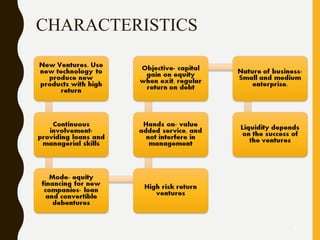
CHARACTERISTICS
8
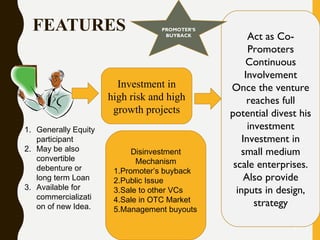
FEATURES
9
1. Generally Equity
participant
2. May be also
convertible
debenture or
long term Loan
3. Available for
commercializati
on of new Idea.
Investment in
high risk and high
growth projects
Act as Co-
Promoters
Continuous
Involvement
Once the venture
reaches full
potential divest his
investment
Investment in
small medium
scale enterprises.
Also provide
inputs in design,
strategy
Disinvestment
Mechanism
1.Promoter’s buyback
2.Public Issue
3.Sale to other VCs
4.Sale in OTC Market
5.Management buyouts
PROMOTER’S
BUYBACK
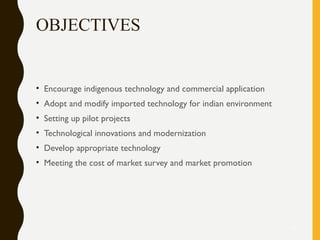
OBJECTIVES
• Encourage indigenous technology and commercial application
• Adopt and modify imported technology for indian environment
• Setting up pilot projects
• Technological innovations and modernization
• Develop appropriate technology
• Meeting the cost of market survey and market promotion
10
11
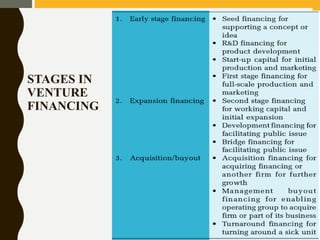
STAGES IN
VENTURE
FINANCING
THE BUSINESS PLAN
• The first step for a company (or an entrepreneur)
proposing a new venture in obtaining venture capital is to
prepare a business plan for the consideration of a venture
capitalist.
• The business plan should explain the nature of the
proposed venture’s business, what it wants to achieve and
how it is going to do it.
• The length of the business plan depends on the particular
circumstances.
• It should use simple language and all technical details
should be explained without jargons.
12
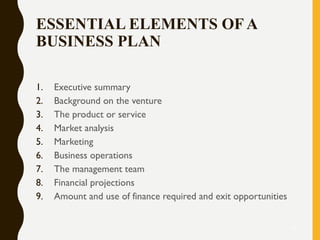
ESSENTIAL ELEMENTS OF A
BUSINESS PLAN
1. Executive summary
2. Background on the venture
3. The product or service
4. Market analysis
5. Marketing
6. Business operations
7. The management team
8. Financial projections
9. Amount and use of finance required and exit opportunities
13
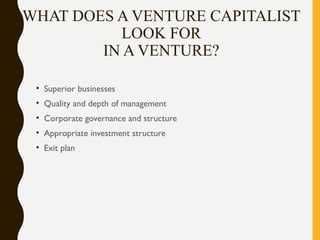
WHAT DOES A VENTURE CAPITALIST
LOOK FOR
IN A VENTURE?
• Superior businesses
• Quality and depth of management
• Corporate governance and structure
• Appropriate investment structure
• Exit plan
14
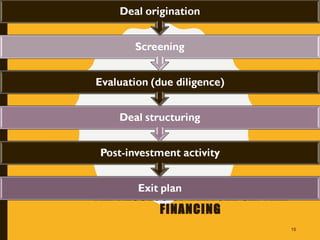
THE PROCESS OF VENTURE CAPITAL
FINANCING
15
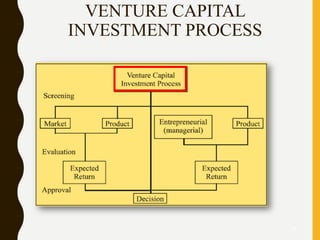
VENTURE CAPITAL
INVESTMENT PROCESS
16
METHODS OF VENTURE
FINANCING
• Equity- generally not exceed 49%.
Retained till the projects make profit
• Conditional Loan: lower interest till the
unit makes profit. Paid back as per
predetermined schedule
• Income Note: both interest and royalty
17
OTHER FINANCING METHODS
1. Participating Debentures: Three stages- till the venture
operates to minimum level- no interest. Then low interest
up to particular level. Once on attaining recommended
level – high interest
2. Partially Convertible Debentures:
3. Cumulative Convertible Preference Shares
4. Deferred Shares- ordinary shares right deferred for
certain number of years.
5. Convertible Loan Stock: Unsecured long term loan
converted to shares
6. Special Ordinary Shares: Voting rights but no
commitment to dividends:
7. Preferred Ordinary Shares: voting rights + modest
dividend+ right share in profit
18
DISINVESTMENT MECHANISMS
• Buyback by Promoters
• Initial Public Offerings
• Secondary Stock Market
• Management Buyouts
19
METHOD
OF
VALUATIONS
CONVENTIONAL METHOD
• Take into account time at which the investee company start the
venture and time at which exit.
• Look into
– Annual revenue
– Expected future earnings
– Future market valuations
– PresentValue
– Minimum percentage of ownership-
21
FIRST CHICOGO
• Gives allowance to starting point and exit point.
• Considers entire earning stream
• Steps
– Alternative scenario and probability-success, sideways survival, failure
– PresentValue ofVC
– ExpectedValue ofVC
– Maximum Percentage of ownership
22
REVENUE MULTIPLIER
• Revenue multiplier is used
• Annual revenue x estimated revenue multiplier
23
DEVELOPMENT OF VENTURE
CAPITAL IN INDIA
• The concept of venture capital was formally introduced in India in 1987,
when the government announced the creation of a venture fund, to be
operated by the Industrial Development Bank of India (IDBI).
• VCFs in India can be categorized into the following four groups:
1. VCFs promoted by the central (federal) government-controlled development
finance institutions
2. VCFs promoted by the central (federal) government-controlled development
finance institutions
3. VCFs promoted by the public sector banks
4. VCFs promoted by the foreign banks and private sector
companies and financial institutions
24
FUTURE PROSPECTS OF VENTURE
FINANCING
• Rehabilitation of sick units.
• Assist small ancillary units to upgrade their
technologies.
• Provide financial assistance to people coming out
of universities etc.
• VCFs can play a significant role in the service
sector including tourism, publishing, health care,
etc.
25
SUCCESS OF VENTURE CAPITAL
• Entrepreneurial Tradition
• Unregulated Economic Environment
• Disinvestment Avenues
• Fiscal Incentives
• Broad Based Education
• Venture Capital Managers
• Promotion Efforts
• Institute Industry Linkage
• R&D Activities
26
SEBI AND VENTURE
CAPITAL FUNDS
• Domestic VC
– Registered with SEBI- SEBI (Venture Capital
Fund ) Regulations1996.
– Not registered
• Foreign VC
– Registered with SEBI- SEBI (Foreign Venture
Capital Fund ) Regulations2000.
– Not registered
27
REGULATIONS- DOMESTIC
• Definition
– Fund established by trust, company, body corporate and
registered with SEBI
• Dedicated pool of fund
• Raised as specified by the regulations
• To invest in VC as specified by regulation
• Venture capital undertaking:
– Not listed
– Not in the line of negative list- real estate, NBFC, Gold
financing, activities not permitted under industrial policy
28
REGULATIONS- DOMESTIC
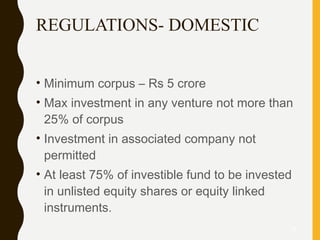
• Minimum corpus – Rs 5 crore
• Max investment in any venture not more than
25% of corpus
• Investment in associated company not
permitted
• At least 75% of investible fund to be invested
in unlisted equity shares or equity linked
instruments.
29
REGULATIONS- DOMESTIC
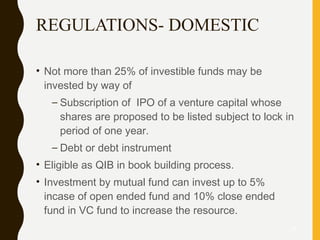
• Not more than 25% of investible funds may be
invested by way of
– Subscription of IPO of a venture capital whose
shares are proposed to be listed subject to lock in
period of one year.
– Debt or debt instrument
• Eligible as QIB in book building process.
• Investment by mutual fund can invest up to 5%
incase of open ended fund and 10% close ended
fund in VC fund to increase the resource.
30
REGULATIONS- FOREIGN
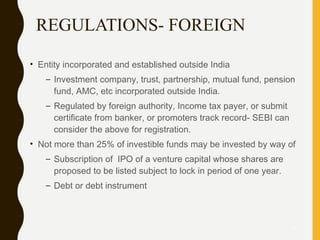
• Entity incorporated and established outside India
– Investment company, trust, partnership, mutual fund, pension
fund, AMC, etc incorporated outside India.
– Regulated by foreign authority, Income tax payer, or submit
certificate from banker, or promoters track record- SEBI can
consider the above for registration.
• Not more than 25% of investible funds may be invested by way of
– Subscription of IPO of a venture capital whose shares are
proposed to be listed subject to lock in period of one year.
– Debt or debt instrument
31
ANGEL FINANCE
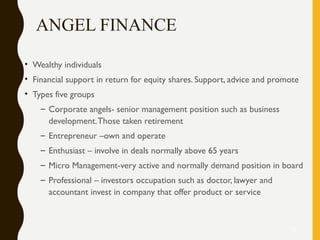
• Wealthy individuals
• Financial support in return for equity shares. Support, advice and promote
• Types five groups
– Corporate angels- senior management position such as business
development.Those taken retirement
– Entrepreneur –own and operate
– Enthusiast – involve in deals normally above 65 years
– Micro Management-very active and normally demand position in board
– Professional – investors occupation such as doctor, lawyer and
accountant invest in company that offer product or service
32
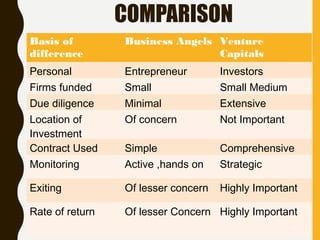
COMPARISON
Basis of
difference
Business Angels Venture
Capitals
Personal Entrepreneur Investors
Firms funded Small Small Medium
Due diligence Minimal Extensive
Location of
Investment
Of concern Not Important
Contract Used Simple Comprehensive
Monitoring Active ,hands on Strategic
Exiting Of lesser concern Highly Important
Rate of return Of lesser Concern Highly Important
33
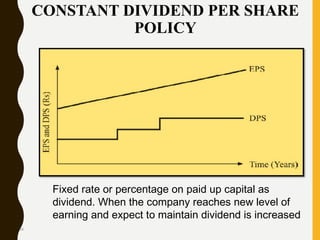
CONSTANT DIVIDEND PER SHARE
POLICY
34
Fixed rate or percentage on paid up capital as
dividend. When the company reaches new level of
earning and expect to maintain dividend is increased
THANKS

VENTURECAPITAL FINANCING

  • 1.
    BY DR. RATNA SINHA ASSOCIATEPROFESSOR ISBR BUSINESS SCHOOL BANGALORE VENTURECAPITAL FINANCING
  • 2.
    LEARNING OBJECTIVES • PrivateEquity andVenture Capital: Introduction, Rudiments of valuing and financing a venture, Stages of venture development and financing, Financial analysis ofVenture capital firms (VCCs), Structuring the deal/ Financial Instrument, Investment nurturing, valuation ofVC portfolio, Initial Public offerings of stock –Managing internal and seasoned equity offerings. 2
  • 3.
    VENTURE CAPITAL • Venture:- Course or proceedings outcome is uncertain.This is attended by the risk or danger of loss. • Capital: Resources to start the enterprise. • In short lending capital to growing company 3
  • 4.
    EVOLUTION • Traced toUSA in 19th and 20th century. • 1946 – American Research and development Organization was established as VC organization. • Real development -1958 in USA when Business development act was passed. • 1960 Japan followed the concept. 4
  • 5.
    NOTION OF VENTURECAPITAL • Venture capital (VC) is a significant financial innovation of the twentieth century. • Venture capital is the investment of long-term equity finance where the venture capitalist earns his return primarily in the form of capital gains. • The underlying assumption is that the entrepreneur and the venture capitalist would act together in the interest of the enterprise as ‘partners’. • Venture capital company is defined as “ a financing company which joins an entrepreneur, as a co-promoter in a project and shares the risks and rewards of the enterprise” 5
  • 6.
    DEFINITIONS • James KoloskiMorries- VC is defined as providing seed , start up and first stage capital, funding expansion to companies that has demonstrated their business potential, but do not have access to public securities or credit oriented institutional funding sources. Also provide management in leveraged buy out financing. • 1995 finance bill- long term equity investment in novel technology, based projects with potential for growth and financial return. 6
  • 7.
    FEATURES OF VENTURECAPITAL • Equity Participation. • Long-term Investments. • Participation in Management. Venture capitalist combines the qualities of bankers, stock market investors and entrepreneur in one. 7
  • 8.
  • 9.
    FEATURES 9 1. Generally Equity participant 2.May be also convertible debenture or long term Loan 3. Available for commercializati on of new Idea. Investment in high risk and high growth projects Act as Co- Promoters Continuous Involvement Once the venture reaches full potential divest his investment Investment in small medium scale enterprises. Also provide inputs in design, strategy Disinvestment Mechanism 1.Promoter’s buyback 2.Public Issue 3.Sale to other VCs 4.Sale in OTC Market 5.Management buyouts PROMOTER’S BUYBACK
  • 10.
    OBJECTIVES • Encourage indigenoustechnology and commercial application • Adopt and modify imported technology for indian environment • Setting up pilot projects • Technological innovations and modernization • Develop appropriate technology • Meeting the cost of market survey and market promotion 10
  • 11.
  • 12.
    THE BUSINESS PLAN •The first step for a company (or an entrepreneur) proposing a new venture in obtaining venture capital is to prepare a business plan for the consideration of a venture capitalist. • The business plan should explain the nature of the proposed venture’s business, what it wants to achieve and how it is going to do it. • The length of the business plan depends on the particular circumstances. • It should use simple language and all technical details should be explained without jargons. 12
  • 13.
    ESSENTIAL ELEMENTS OFA BUSINESS PLAN 1. Executive summary 2. Background on the venture 3. The product or service 4. Market analysis 5. Marketing 6. Business operations 7. The management team 8. Financial projections 9. Amount and use of finance required and exit opportunities 13
  • 14.
    WHAT DOES AVENTURE CAPITALIST LOOK FOR IN A VENTURE? • Superior businesses • Quality and depth of management • Corporate governance and structure • Appropriate investment structure • Exit plan 14
  • 15.
    THE PROCESS OFVENTURE CAPITAL FINANCING 15
  • 16.
  • 17.
    METHODS OF VENTURE FINANCING •Equity- generally not exceed 49%. Retained till the projects make profit • Conditional Loan: lower interest till the unit makes profit. Paid back as per predetermined schedule • Income Note: both interest and royalty 17
  • 18.
    OTHER FINANCING METHODS 1.Participating Debentures: Three stages- till the venture operates to minimum level- no interest. Then low interest up to particular level. Once on attaining recommended level – high interest 2. Partially Convertible Debentures: 3. Cumulative Convertible Preference Shares 4. Deferred Shares- ordinary shares right deferred for certain number of years. 5. Convertible Loan Stock: Unsecured long term loan converted to shares 6. Special Ordinary Shares: Voting rights but no commitment to dividends: 7. Preferred Ordinary Shares: voting rights + modest dividend+ right share in profit 18
  • 19.
    DISINVESTMENT MECHANISMS • Buybackby Promoters • Initial Public Offerings • Secondary Stock Market • Management Buyouts 19
  • 20.
  • 21.
    CONVENTIONAL METHOD • Takeinto account time at which the investee company start the venture and time at which exit. • Look into – Annual revenue – Expected future earnings – Future market valuations – PresentValue – Minimum percentage of ownership- 21
  • 22.
    FIRST CHICOGO • Givesallowance to starting point and exit point. • Considers entire earning stream • Steps – Alternative scenario and probability-success, sideways survival, failure – PresentValue ofVC – ExpectedValue ofVC – Maximum Percentage of ownership 22
  • 23.
    REVENUE MULTIPLIER • Revenuemultiplier is used • Annual revenue x estimated revenue multiplier 23
  • 24.
    DEVELOPMENT OF VENTURE CAPITALIN INDIA • The concept of venture capital was formally introduced in India in 1987, when the government announced the creation of a venture fund, to be operated by the Industrial Development Bank of India (IDBI). • VCFs in India can be categorized into the following four groups: 1. VCFs promoted by the central (federal) government-controlled development finance institutions 2. VCFs promoted by the central (federal) government-controlled development finance institutions 3. VCFs promoted by the public sector banks 4. VCFs promoted by the foreign banks and private sector companies and financial institutions 24
  • 25.
    FUTURE PROSPECTS OFVENTURE FINANCING • Rehabilitation of sick units. • Assist small ancillary units to upgrade their technologies. • Provide financial assistance to people coming out of universities etc. • VCFs can play a significant role in the service sector including tourism, publishing, health care, etc. 25
  • 26.
    SUCCESS OF VENTURECAPITAL • Entrepreneurial Tradition • Unregulated Economic Environment • Disinvestment Avenues • Fiscal Incentives • Broad Based Education • Venture Capital Managers • Promotion Efforts • Institute Industry Linkage • R&D Activities 26
  • 27.
    SEBI AND VENTURE CAPITALFUNDS • Domestic VC – Registered with SEBI- SEBI (Venture Capital Fund ) Regulations1996. – Not registered • Foreign VC – Registered with SEBI- SEBI (Foreign Venture Capital Fund ) Regulations2000. – Not registered 27
  • 28.
    REGULATIONS- DOMESTIC • Definition –Fund established by trust, company, body corporate and registered with SEBI • Dedicated pool of fund • Raised as specified by the regulations • To invest in VC as specified by regulation • Venture capital undertaking: – Not listed – Not in the line of negative list- real estate, NBFC, Gold financing, activities not permitted under industrial policy 28
  • 29.
    REGULATIONS- DOMESTIC • Minimumcorpus – Rs 5 crore • Max investment in any venture not more than 25% of corpus • Investment in associated company not permitted • At least 75% of investible fund to be invested in unlisted equity shares or equity linked instruments. 29
  • 30.
    REGULATIONS- DOMESTIC • Notmore than 25% of investible funds may be invested by way of – Subscription of IPO of a venture capital whose shares are proposed to be listed subject to lock in period of one year. – Debt or debt instrument • Eligible as QIB in book building process. • Investment by mutual fund can invest up to 5% incase of open ended fund and 10% close ended fund in VC fund to increase the resource. 30
  • 31.
    REGULATIONS- FOREIGN • Entityincorporated and established outside India – Investment company, trust, partnership, mutual fund, pension fund, AMC, etc incorporated outside India. – Regulated by foreign authority, Income tax payer, or submit certificate from banker, or promoters track record- SEBI can consider the above for registration. • Not more than 25% of investible funds may be invested by way of – Subscription of IPO of a venture capital whose shares are proposed to be listed subject to lock in period of one year. – Debt or debt instrument 31
  • 32.
    ANGEL FINANCE • Wealthyindividuals • Financial support in return for equity shares. Support, advice and promote • Types five groups – Corporate angels- senior management position such as business development.Those taken retirement – Entrepreneur –own and operate – Enthusiast – involve in deals normally above 65 years – Micro Management-very active and normally demand position in board – Professional – investors occupation such as doctor, lawyer and accountant invest in company that offer product or service 32
  • 33.
    COMPARISON Basis of difference Business AngelsVenture Capitals Personal Entrepreneur Investors Firms funded Small Small Medium Due diligence Minimal Extensive Location of Investment Of concern Not Important Contract Used Simple Comprehensive Monitoring Active ,hands on Strategic Exiting Of lesser concern Highly Important Rate of return Of lesser Concern Highly Important 33
  • 34.
    CONSTANT DIVIDEND PERSHARE POLICY 34 Fixed rate or percentage on paid up capital as dividend. When the company reaches new level of earning and expect to maintain dividend is increased
  • 35.