TRANSDISCIPLINARY
APPROACH TO
LEARNING
SUBMITTED BY:- SUBMITTED TO:-
KUMAR SHIVAM DR. MEENAKSHI RAWAT
221866
TYPES OF LEARNING APPROACHES:-
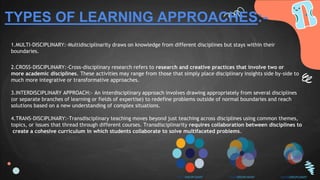
1.MULTI-DISCIPLINARY:-Multidisciplinarity draws on knowledge from different disciplines but stays within their
boundaries.
2.CROSS-DISCIPLINARY:-Cross-disciplinary research refers to research and creative practices that involve two or
more academic disciplines. These activities may range from those that simply place disciplinary insights side by-side to
much more integrative or transformative approaches.
3.INTERDISCIPLINARY APPROACH:- An interdisciplinary approach involves drawing appropriately from several disciplines
(or separate branches of learning or fields of expertise) to redefine problems outside of normal boundaries and reach
solutions based on a new understanding of complex situations.
4.TRANS-DISCIPLINARY:-Transdisciplinary teaching moves beyond just teaching across disciplines using common themes,
topics, or issues that thread through different courses. Transdisciplinarity requires collaboration between disciplines to
create a cohesive curriculum in which students collaborate to solve multifaceted problems.
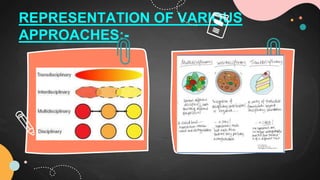
REPRESENTATION OF VARIOUS
APPROACHES:-
NEED OF LEARNING APPROACHES:-
1.What is learnt in one discipline is linked to other.
2.Different discipline helps to develop a detailed
understanding of topic being studied.
3.Interdependent relation emphasized.
4.Make education experience authentic.
1.”Trans” prefix indicates research which is carried out among different
subjects,which moves through different disciplines and goes beyond them.
2.Suffix “disciplinary” means relating to a particular field of study.
3.Transdisciplinary approach is a collaboration between the disciplines with
sharing and application of tools,skills,approaches and philosophy of different
disciplines.
4.Research or project is organized and coordinated under a real world
theme/programme that benefits from being tackled by different
perspectives.
TRANSDISCIPLINARY APPROACH
CHARACTERISTICS
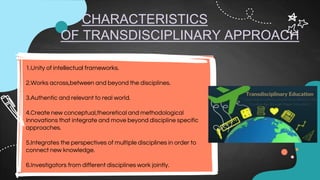
OF TRANSDISCIPLINARY APPROACH
1.Unity of intellectual frameworks.
2.Works across,between and beyond the disciplines.
3.Authentic and relevant to real world.
4.Create new conceptual,theoretical and methodological
innovations that integrate and move beyond discipline specific
approaches.
5.Integrates the perspectives of multiple disciplines in order to
connect new knowledge.
6.Investigators from different disciplines work jointly.
1.Two or more disciplinary approaches transcend(go beyond field of
range of activity)
2.Approach to curriculum integration-dissolve the boundaries and
organize teaching-learning around construction of mening in
context of real world problems.
3.New structure of intelligibility,new realm of knowledge,new
techniques of intervention and new forms of subjectivity.
4.Generation of new knowledge.
OBJECTIVES OF TRANSDISCIPLINARY
APPROACH
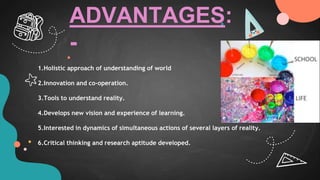
1.Holistic approach of understanding of world
2.Innovation and co-operation.
3.Tools to understand reality.
4.Develops new vision and experience of learning.
5.Interested in dynamics of simultaneous actions of several layers of reality.
6.Critical thinking and research aptitude developed.
ADVANTAGES:
-
DISADVANTAGES:-
1.Conflict of opinions
2.Time pressure
3.Integration confusion
4.Different personalities
and point of views.
THANK YOU!!

Transdisciplinary approach to learning .pptx

  • 1.
    TRANSDISCIPLINARY APPROACH TO LEARNING SUBMITTED BY:-SUBMITTED TO:- KUMAR SHIVAM DR. MEENAKSHI RAWAT 221866
  • 2.
    TYPES OF LEARNINGAPPROACHES:- 1.MULTI-DISCIPLINARY:-Multidisciplinarity draws on knowledge from different disciplines but stays within their boundaries. 2.CROSS-DISCIPLINARY:-Cross-disciplinary research refers to research and creative practices that involve two or more academic disciplines. These activities may range from those that simply place disciplinary insights side by-side to much more integrative or transformative approaches. 3.INTERDISCIPLINARY APPROACH:- An interdisciplinary approach involves drawing appropriately from several disciplines (or separate branches of learning or fields of expertise) to redefine problems outside of normal boundaries and reach solutions based on a new understanding of complex situations. 4.TRANS-DISCIPLINARY:-Transdisciplinary teaching moves beyond just teaching across disciplines using common themes, topics, or issues that thread through different courses. Transdisciplinarity requires collaboration between disciplines to create a cohesive curriculum in which students collaborate to solve multifaceted problems.
  • 3.
  • 4.
    NEED OF LEARNINGAPPROACHES:- 1.What is learnt in one discipline is linked to other. 2.Different discipline helps to develop a detailed understanding of topic being studied. 3.Interdependent relation emphasized. 4.Make education experience authentic.
  • 5.
    1.”Trans” prefix indicatesresearch which is carried out among different subjects,which moves through different disciplines and goes beyond them. 2.Suffix “disciplinary” means relating to a particular field of study. 3.Transdisciplinary approach is a collaboration between the disciplines with sharing and application of tools,skills,approaches and philosophy of different disciplines. 4.Research or project is organized and coordinated under a real world theme/programme that benefits from being tackled by different perspectives. TRANSDISCIPLINARY APPROACH
  • 6.
    CHARACTERISTICS OF TRANSDISCIPLINARY APPROACH 1.Unityof intellectual frameworks. 2.Works across,between and beyond the disciplines. 3.Authentic and relevant to real world. 4.Create new conceptual,theoretical and methodological innovations that integrate and move beyond discipline specific approaches. 5.Integrates the perspectives of multiple disciplines in order to connect new knowledge. 6.Investigators from different disciplines work jointly.
  • 7.
    1.Two or moredisciplinary approaches transcend(go beyond field of range of activity) 2.Approach to curriculum integration-dissolve the boundaries and organize teaching-learning around construction of mening in context of real world problems. 3.New structure of intelligibility,new realm of knowledge,new techniques of intervention and new forms of subjectivity. 4.Generation of new knowledge. OBJECTIVES OF TRANSDISCIPLINARY APPROACH
  • 8.
    1.Holistic approach ofunderstanding of world 2.Innovation and co-operation. 3.Tools to understand reality. 4.Develops new vision and experience of learning. 5.Interested in dynamics of simultaneous actions of several layers of reality. 6.Critical thinking and research aptitude developed. ADVANTAGES: -
  • 9.
    DISADVANTAGES:- 1.Conflict of opinions 2.Timepressure 3.Integration confusion 4.Different personalities and point of views.
  • 10.