
4/23/2013SOCIALIZATION OF STUDENTS, DEVKOTA S.P.1
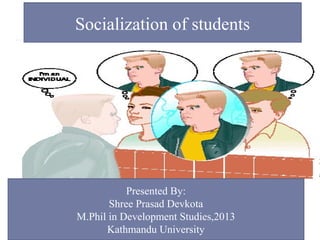
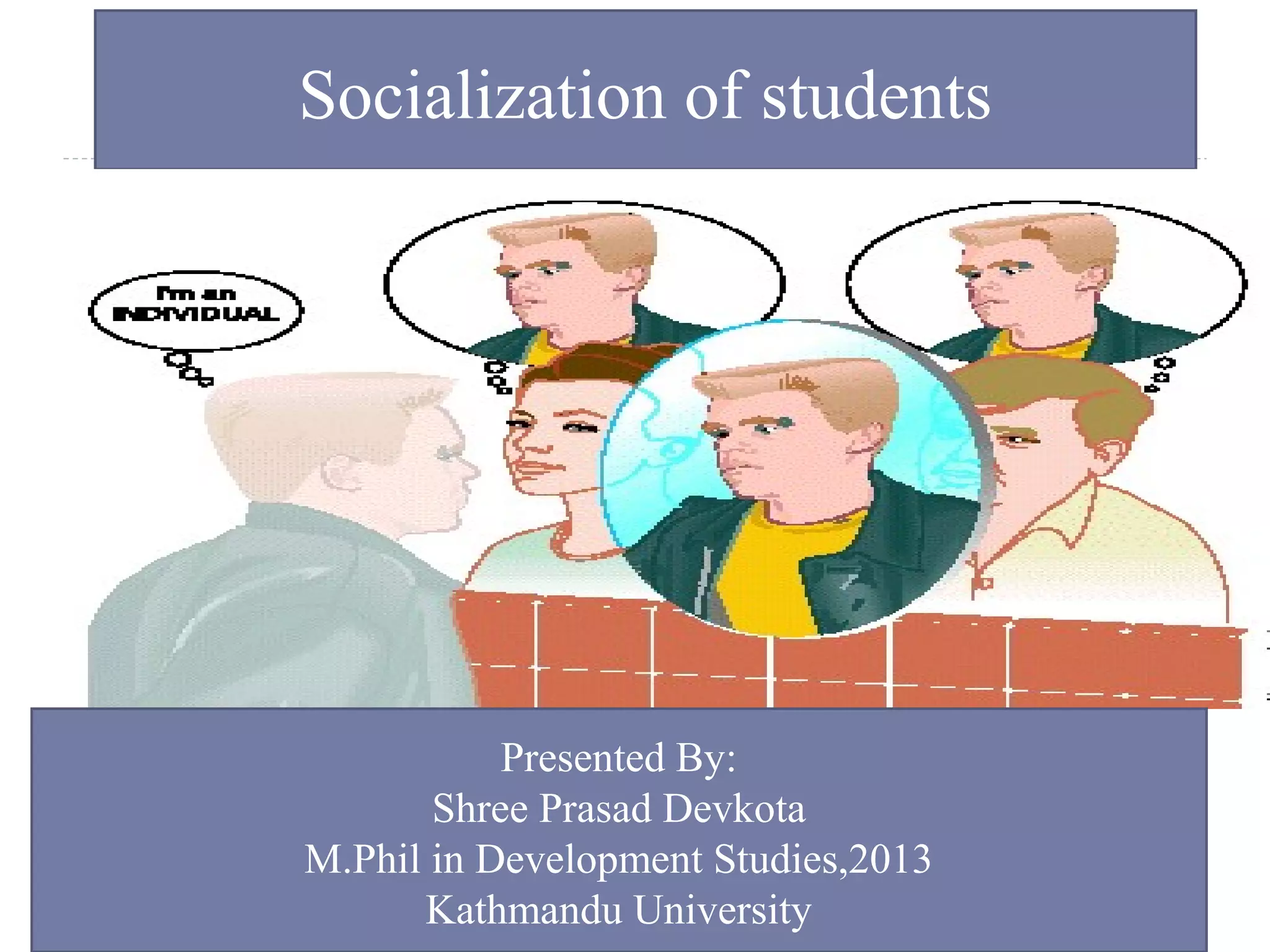
Socialization of students
Presented By:
Shree Prasad Devkota
M.Phil in Development Studies,2013
Kathmandu University
Outline of the Presentation
Definition of socialization
Agents of Socialization
Analysis from different theory
Conclusion
References
4/23/2013SOCIALIZATION OF STUDENTS, DEVKOTA S.P.2
Socialization is ……
 Socialization’ refers to the adjustment of individual
acceptance of organizational rules and culture.
Chou(2011)
 The cultural process of learning to participate in group
life.
 The lifelong process of social interaction though which
people acquire a self-identity and the physical, mental,
and social skills needed for survival in society.
 The content of socialization of student be different
from society to society.
4/23/20133 SOCIALIZATION OF STUDENTS, DEVKOTA S.P.
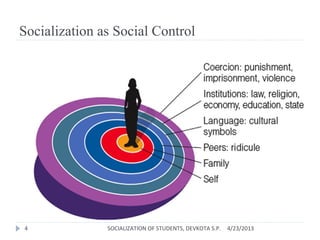
Socialization as Social Control
4/23/20134 SOCIALIZATION OF STUDENTS, DEVKOTA S.P.
Agents of Socialization
The persons, groups, or institutions that teach us what
we need to know in order to participate in society:
 family,
 school,
 peers, and
 media.
4/23/20135 SOCIALIZATION OF STUDENTS, DEVKOTA S.P.
Family
 Families introduce children to the expectations of
society.
 How parents define and treat a child is crucial to the
development of the child’s sense of self.
 Some families emphasize educational achievement;
some may be more liberal, but others emphasize strict
respect and discipline.
4/23/2013SOCIALIZATION OF STUDENTS, DEVKOTA S.P.6
Cont.
 Functionalists emphasize that families are the
primary locus of procreation and socialization of
children, as well as the primary source of emotional
support.
 To a large extent the family is where we acquire our
specific social positions in society.
 Conflict theorist stress that socialization reproduces
class structure in the next generation
4/23/2013SOCIALIZATION OF STUDENTS, DEVKOTA S.P.7
School
 From a functionalist perspective schools are responsible for:
 Socialization—teaching students to be productive
members of society
 Transmission of culture
 Social control and personal development
 According to Conflict Theorists much of what happens at
schools is a hidden curriculum
 Working class and low income children learn to be neat,
on time, wait their turn, and remain attentive to work
 These are characteristic that make them more easily
manipulated in the workforce
4/23/2013SOCIALIZATION OF STUDENTS, DEVKOTA S.P.8
Peer Group
 For children, peer culture is an important source of
identity.
 Through interaction with peers, children learn
concepts of self, gain social skills, and form values
and attitudes.
 Girls’ peer groups tend to be closely join and
democratic.
 Boys’ peer groups tend to be more hierarchical, with
evident status distinctions between members.
4/23/20139 SOCIALIZATION OF STUDENTS, DEVKOTA S.P.
Mass Media
 The mass media function as socialization agents for
children and adults in several ways:
 They inform students about events
 They introduce wide variety of people
 They provide an array of viewpoints on current
issues
 They make aware of products and services that if
we purchase them, supposedly will help us to be
accepted by others
 They entertain , by providing the opportunity to live
vicariously
4/23/201310 SOCIALIZATION OF STUDENTS, DEVKOTA S.P.
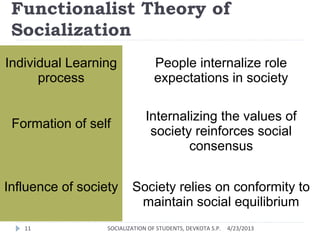
Functionalist Theory of
Socialization
Individual Learning
process
People internalize role
expectations in society
Formation of self
Internalizing the values of
society reinforces social
consensus
Influence of society Society relies on conformity to
maintain social equilibrium
4/23/201311 SOCIALIZATION OF STUDENTS, DEVKOTA S.P.
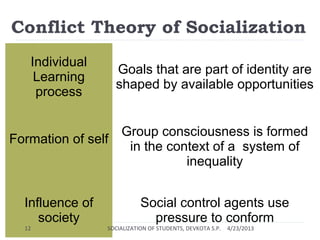
Conflict Theory of Socialization
Individual
Learning
process
Goals that are part of identity are
shaped by available opportunities
Formation of self
Group consciousness is formed
in the context of a system of
inequality
Influence of
society
Social control agents use
pressure to conform
4/23/201312 SOCIALIZATION OF STUDENTS, DEVKOTA S.P.
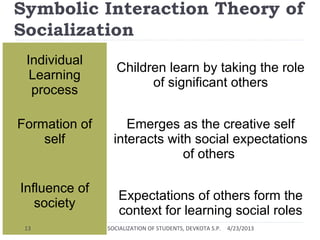
Symbolic Interaction Theory of
Socialization
Individual
Learning
process
Children learn by taking the role
of significant others
Formation of
self
Emerges as the creative self
interacts with social expectations
of others
Influence of
society
Expectations of others form the
context for learning social roles
4/23/201313 SOCIALIZATION OF STUDENTS, DEVKOTA S.P.
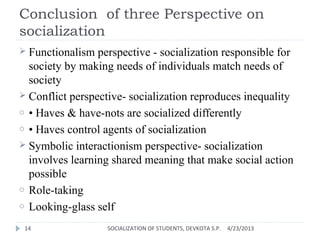
Conclusion of three Perspective on
socialization
 Functionalism perspective - socialization responsible for
society by making needs of individuals match needs of
society
 Conflict perspective- socialization reproduces inequality
o • Haves & have-nots are socialized differently
o • Haves control agents of socialization
 Symbolic interactionism perspective- socialization
involves learning shared meaning that make social action
possible
o Role-taking
o Looking-glass self
4/23/2013SOCIALIZATION OF STUDENTS, DEVKOTA S.P.14
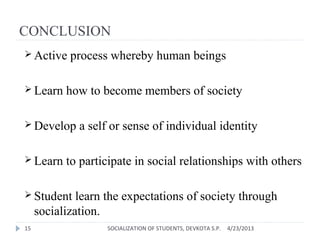
CONCLUSION
 Active process whereby human beings
 Learn how to become members of society
 Develop a self or sense of individual identity
 Learn to participate in social relationships with others
 Student learn the expectations of society through
socialization.
4/23/201315 SOCIALIZATION OF STUDENTS, DEVKOTA S.P.
References
Perrino, R. G. (n.d.). The Socialization Process and Its Impact on
Children and Learning retrieved from
httpwww.nvtutoring.compdfsSocialization.pdf3e3ea140 on 18th
April 2013.
Page, G. (n.d.). Professional Socialization of valuation students: what
the literature says. retrieved from
httpwww.prres.netPapersPage_Professional_socialization_of_valuat
ion_students.pdf on 18th
April,2013.
CHOU, C.M. (2011). Student teachers socialization development by
teaching blog: reflections and socialization strategies. The Turkish
Online Journal of Educational Technology retrieved from
httpwww.tojet.netarticlesv10i210219.pdf on 18th April,2013.
4/23/201316 SOCIALIZATION OF STUDENTS, DEVKOTA S.P.
4/23/2013SOCIALIZATION OF STUDENTS, DEVKOTA S.P.17

Socialization shree p. devkota

  • 1.
    4/23/2013SOCIALIZATION OF STUDENTS,DEVKOTA S.P.1 Socialization of students Presented By: Shree Prasad Devkota M.Phil in Development Studies,2013 Kathmandu University
  • 2.
    Outline of thePresentation Definition of socialization Agents of Socialization Analysis from different theory Conclusion References 4/23/2013SOCIALIZATION OF STUDENTS, DEVKOTA S.P.2
  • 3.
    Socialization is …… Socialization’ refers to the adjustment of individual acceptance of organizational rules and culture. Chou(2011)  The cultural process of learning to participate in group life.  The lifelong process of social interaction though which people acquire a self-identity and the physical, mental, and social skills needed for survival in society.  The content of socialization of student be different from society to society. 4/23/20133 SOCIALIZATION OF STUDENTS, DEVKOTA S.P.
  • 4.
    Socialization as SocialControl 4/23/20134 SOCIALIZATION OF STUDENTS, DEVKOTA S.P.
  • 5.
    Agents of Socialization Thepersons, groups, or institutions that teach us what we need to know in order to participate in society:  family,  school,  peers, and  media. 4/23/20135 SOCIALIZATION OF STUDENTS, DEVKOTA S.P.
  • 6.
    Family  Families introducechildren to the expectations of society.  How parents define and treat a child is crucial to the development of the child’s sense of self.  Some families emphasize educational achievement; some may be more liberal, but others emphasize strict respect and discipline. 4/23/2013SOCIALIZATION OF STUDENTS, DEVKOTA S.P.6
  • 7.
    Cont.  Functionalists emphasizethat families are the primary locus of procreation and socialization of children, as well as the primary source of emotional support.  To a large extent the family is where we acquire our specific social positions in society.  Conflict theorist stress that socialization reproduces class structure in the next generation 4/23/2013SOCIALIZATION OF STUDENTS, DEVKOTA S.P.7
  • 8.
    School  From afunctionalist perspective schools are responsible for:  Socialization—teaching students to be productive members of society  Transmission of culture  Social control and personal development  According to Conflict Theorists much of what happens at schools is a hidden curriculum  Working class and low income children learn to be neat, on time, wait their turn, and remain attentive to work  These are characteristic that make them more easily manipulated in the workforce 4/23/2013SOCIALIZATION OF STUDENTS, DEVKOTA S.P.8
  • 9.
    Peer Group  Forchildren, peer culture is an important source of identity.  Through interaction with peers, children learn concepts of self, gain social skills, and form values and attitudes.  Girls’ peer groups tend to be closely join and democratic.  Boys’ peer groups tend to be more hierarchical, with evident status distinctions between members. 4/23/20139 SOCIALIZATION OF STUDENTS, DEVKOTA S.P.
  • 10.
    Mass Media  Themass media function as socialization agents for children and adults in several ways:  They inform students about events  They introduce wide variety of people  They provide an array of viewpoints on current issues  They make aware of products and services that if we purchase them, supposedly will help us to be accepted by others  They entertain , by providing the opportunity to live vicariously 4/23/201310 SOCIALIZATION OF STUDENTS, DEVKOTA S.P.
  • 11.
    Functionalist Theory of Socialization IndividualLearning process People internalize role expectations in society Formation of self Internalizing the values of society reinforces social consensus Influence of society Society relies on conformity to maintain social equilibrium 4/23/201311 SOCIALIZATION OF STUDENTS, DEVKOTA S.P.
  • 12.
    Conflict Theory ofSocialization Individual Learning process Goals that are part of identity are shaped by available opportunities Formation of self Group consciousness is formed in the context of a system of inequality Influence of society Social control agents use pressure to conform 4/23/201312 SOCIALIZATION OF STUDENTS, DEVKOTA S.P.
  • 13.
    Symbolic Interaction Theoryof Socialization Individual Learning process Children learn by taking the role of significant others Formation of self Emerges as the creative self interacts with social expectations of others Influence of society Expectations of others form the context for learning social roles 4/23/201313 SOCIALIZATION OF STUDENTS, DEVKOTA S.P.
  • 14.
    Conclusion of threePerspective on socialization  Functionalism perspective - socialization responsible for society by making needs of individuals match needs of society  Conflict perspective- socialization reproduces inequality o • Haves & have-nots are socialized differently o • Haves control agents of socialization  Symbolic interactionism perspective- socialization involves learning shared meaning that make social action possible o Role-taking o Looking-glass self 4/23/2013SOCIALIZATION OF STUDENTS, DEVKOTA S.P.14
  • 15.
    CONCLUSION  Active processwhereby human beings  Learn how to become members of society  Develop a self or sense of individual identity  Learn to participate in social relationships with others  Student learn the expectations of society through socialization. 4/23/201315 SOCIALIZATION OF STUDENTS, DEVKOTA S.P.
  • 16.
    References Perrino, R. G.(n.d.). The Socialization Process and Its Impact on Children and Learning retrieved from httpwww.nvtutoring.compdfsSocialization.pdf3e3ea140 on 18th April 2013. Page, G. (n.d.). Professional Socialization of valuation students: what the literature says. retrieved from httpwww.prres.netPapersPage_Professional_socialization_of_valuat ion_students.pdf on 18th April,2013. CHOU, C.M. (2011). Student teachers socialization development by teaching blog: reflections and socialization strategies. The Turkish Online Journal of Educational Technology retrieved from httpwww.tojet.netarticlesv10i210219.pdf on 18th April,2013. 4/23/201316 SOCIALIZATION OF STUDENTS, DEVKOTA S.P.
  • 17.

Editor's Notes